
-
Emergence
I am not a dualist in any shape or form.You're sounding like one of the dualists that asserts that only some subset of living things has access to a special sort of magic. — noAxioms
So, how important do you think it is to convince as many theists as possible to reject theism?The mythology behind the theism seems to serve the purpose of personal comfort. That's a real purpose to the beliefs. The churches recognize this and leverage it. They sell it. — noAxioms
Do you think that a global majority rejection of theism would benefit our species and this planet?
Until we started writing stuff down, yea, this knowledge is pretty much lost. That also sort of defines when we started accumulating knowledge as a species, far more recently than the 300000 year figure you give. — noAxioms
Well, the oldest cave paintings are around 35,000 years. Bone flutes from approx 45,000 years ago, stone tools go back millions of years. I agree that these are very limited mediums of 'information' compared to your use of the term 'writing.' I am happy to go with your timeframe for when we started to 'accumulate' or memorialise information in any significant way. The closer it is to now, the more it highlights the importance of human intent and purpose and its unique ability to impact the 'universe'.
Small scale at the moment, but we are only starting. We will become an extraterrestrial species soon enough.
I would say no to this. The universe isn't something that is purposeful, through life forms or anything else. It is not a thing that has a goal, a critical ingredient for something with a purpose. — noAxioms
Then why do we ask questions? -
Emergence
All life is based on a single cell fundamental is a good one. I like it. I think all lifeforms will be quantisable and be made of fundamentals but I think it's the same as the baryonic label. It does not separate life from nonlife in any significant way. Perhaps number 1 of my 4 categories is not the path to take.Another life form in some other galaxy may use carbon in its chemistry, but it will likely bear little resemblance to Earth life. Maybe not. It's a stretch to suggest it invents something as Earth-like as a cell. — noAxioms
My goal is to find more powerful, convincing, high credence arguments against pessimists, doomsters, theists, antinatalists etc, who in my opinion, currently devalue the human experience, in very unfair and imbalanced ways.
Perhaps category 4 remains my best path.
:lol: Are you a doomster noAxioms?So where do you think this human ability to organise, store and efficiently retrieve information will ultimately take us?
To our doom or to the next level. What is going on now isn't stable. — noAxioms
That's just too pessimistic for me. It is unbalanced and untrue, as I could give you many, many examples of human actions that benefit our species as a whole, such as memorialising information, exploring the unknown. I think you should try harder to see more purpose in humanity than in sharks, as sharks don't write books or gain new knowledge at an ever increasing pace from generation to generation.I don't see any purpose to humanity any more than I see a purpose to a shark species. Each of them plays the fitness game, but neither seems to have any sense of action that benefits the species as a whole. For a smart species, we're not actually all that smart. — noAxioms
Perhaps that's another thread. A computer processor at its base level is a series of logic gates, which open and close. Computers produce output on screens, printout paper etc. The humans process that into information. Computers are currently data processors only. They don't have 'understanding,' therefore they don't know what information is. No hardware/software combination has convincingly passed the turing test yet. No current AI system has demonstrated the I part yet.You make it sound like computers are not information processors. They are. They manipulate data that is only meaningful to the computer. — noAxioms -
EmergenceWell I hope the craic was mighty then. I awaited the second half of the reply. — noAxioms
The craic was indeed mighty! and at one point, even had some relevance to this thread. Thanks for your patience noAxioms, as regards my full response to your post.
My exemplification of the importance of the carbon process to our existence, was just that, exemplification. I am attempting to trace a path towards an 'objective truth' about lifeforms, that I know currently has no extraterrestrial evidence for. I am just trying to consider what we do currently know, to see if there is anything in there that might convince others, to give a high or very high credence level to the proposal that the human condition is not being valued appropriately by too many humans. The pessimists, the theists, the theosophists, the doomsters and worst of all, the antinatalists.There's over 20 elements without which we cannot be. — noAxioms
That's interesting to me from the standpoint of my search for 'something' that's common to all life in the universe. That's the 'credence' path I am trying to trace. For life on Earth, we have a few 'commonalities' to work with.Given the abundance of carbon in the universe, I doubt any of them will be carbon free, — noAxioms
1. The physical, chemical constituents we have been discussing.
2. The definition we have for the term 'alive.'
3. The 'I think therefore I am,' proposal.
4. The proposal that only life, can demonstrate intent and purpose.
Is there anything within or related to the 4 categories above that you would give a high credence to, if it was posited as 'likely true' (if you think the 'objective truth' label is too far) of all sentient lifeforms in the universe, regardless of the fact we haven't met them all yet.We have a sample size of one. That's scant evidence that all life in this universe must be similar given abiogenesis elsewhere. — noAxioms
I am not sure I fully get what you are asking me here but does a statement like:Please give an example of a truth (in the form of 'all X is Y') that is not an objective truth. Else I don't know how to answer this. — noAxioms
'All humans have two arms is true, but it is not objectively true, as some people don't have two arms but are still considered to be fully human,' answer you? or 'A person can have a pacemaker and is still human and not cyborg.' Such is true but perhaps not objectively true for all humans, perhaps there is a cut off point where a person would become more cyborg than human.
As for my suggestion that all lifeforms in the universe contain protons, neutrons, electrons etc. I expected you to reject the 'all life in the universe is baryonic' label as useless, as everything with mass is baryonic, so, such a distinction is useless in identifying something about all life in the universe, that is objectively true. I used the 'baryonic' label as a way of establishing something that possibly could qualify as applying to all life in the universe, but even if it did, it doesn't separate life from nonlife, in a significant enough way, to help me in my purpose for this thread.
Your response was big and detailed and I want to do it justice, so I will split up my response as it will probably get too big and cumbersome, if I dont. -
EmergenceNo. Given we only have one data point – ourselves – that's an extremely premature, or hasty generalization at best ... It's like collecting specimens from the beach at low tide and never finding an octopus in the sand, then concluding "Well, I guess it's reasonable to assume there aren't any octopi in the ocean." — 180 Proof
I need a better example to follow your strong 'No' conclusion here. I agree, that given the vastness of the universe, it would be unwise to assume there are no other lifeforms in the universe, with the same (or a greater or even slightly lesser) ability to affect this planet or beyond it, to the extent that we can.
Just like your octopus example, absence of evidence is not evidence of absence of such a creature. But a creature like an octopus or even a unicorn (if such a creature exists somewhere in this universe) does not demonstrate intent or purpose to the level that we do. I don't know what abilities an actual unicorn would have but if it's just a horse with a horn then I wouldn't expect it to be able to write a book.
If there are other lifeforms in the universe that can demonstrate the same intent and purpose that we can and they are not even carbon based, would they not have the same emergent properties that we seem to be displaying? A kind of asymptotic movement towards the omnis?
We're not a 'hive mind' species, so no. Even at our most conformist we're not metacognitively "collective". — 180 Proof
Not in the sense that we see it in insect species, I agree. It's not a case of a central productive system and drone maintenance of a community or 'termite mound' or 'bees nest.'
But at our most conformist, we can act as a collective in common cause but we don't yet have the tech to increase the current level of 'networking' towards that which is closer to a 'merging' of our individual brain power. But that may change in the future. This is why I am 'hanging on' to this 'emergent' word, as firmly as I can.
Consider just two people. If you muse about future tech. How close do you think we could get to acting like a merged collective? I mean a collective that would be indistinguishable from a single mind. I assume that you think we could get closer to it than we are now and our attempts to reach it may well be forever asymptotic but how close do you think we could get? and then I would ask, why does the human imagination compel me and many others towards such thoughts?
I reject that the omnis are only available to the supernatural, to the god posits.
I remember a long chat with Jehovah witnesses, years ago when one eventually admitted that he hoped that when he got to heaven that his ultimate fate was to become like a god himself.
Is that what theism truly is, it's a projection of what humans aspire to as a means of finally defeating everything that can harm us or affect us without our permission.
Brain-machine-brain "networking" would no doubt facilitate instant-messaging-as-sharing-cognitive-functions but our brains would still be individuated. — 180 Proof
Yes, I think we would still be capable of being fully autonomous but how close to a merging of minds do you think we could get in say the next 10,000 years of science?
as Nietzsche proposes: "Man is rope tied between beast and übermensch over an abyss", that is to say, we're not "special" in the cosmos" or an "evolutionary end in nature", only a means (maybe) to a higher means (... to 'ends' inconceivably far over the horizon of human reason); Nietzsche's übermensch is a prescient dream / nightmare of our 'technological singularity'. In fact, 'God isn't dead', universeness, because AGI—>ASI ["god"] hasn't even emerged yet (as far as we know). — 180 Proof
So, how much credence do you personally assign to this 'overview?' Are the omnis an undeniable emergent of the human condition or more accurately, a natural emergent of the phenomena we label 'life' or 'alive?' I think that the evidence for the idea that in is an asymptotic emergent is very strong. We cannot make a 100% accurate measurement. There will always be another decimal place of accuracy on offer. So god isn't dead because it never was alive. The concept of the omnis comes from lifeforms like us and it only exists within us. That's the mistake theism makes. It's a well known error. God did not create us we create it as a human aspiration!
I don't think anything I've speculated about on this topic is "dystopian" in any way, — 180 Proof
I have suggested that of you in the past but I am not suggesting that here. I was merely pointing towards the large amount of dystopian literature that does exist on the topic form Huxley to the terminator films etc.
so I can only conclude you're so fixated on a 'teleological' (i.e. Hegelian, de Chardinian, Kurzweilian) 'ideal' that you cannot appreciate – imagine – any prospect of a beneficial human future that is also not controlled at all by human beings. — 180 Proof"Dystopian"? I suppose, but only from a certain point of view. The future, my friend, seems to me Posthuman, not human – extraterrestrial, not terrestrial – or our extinction. You're spinning self-flattering, cotton candy, cartoon daydreams, universeness, and you're welcome to them. — 180 Proof
Well, I certainly do hope that the benevolent future you suggest is of, for and by humans/transhumans but I would be very happy to unite with and other sentient species we encounter.
I hope you prediction of 'posthuman' is more transhuman. Perhaps in the distant future, we will live fully human lives at the start and then become transhuman when we need to. When death is the alternative. -
EmergenceThe OP wasn't about teen existential questions... rather something incomprehensible about science, a singularity, information... . :wink: Carry on. — Tom Storm
Does it matter how early in your life you ask such questions? Do the 'big' existential questions not just get more relevant and deeper as you get older?
I think my OP here is a poor attempt at trying to move towards a 'theory' about life and objects like us in the universe, which are alive.
Let me try another aspect. Animals scent mark as a means of marking territory. I don't think hominin species every did? Perhaps because we never had a good sense of smell. But we did want to leave something of ourselves to indicate we had existed. Making artistic marks in caves or leaving some carved item etc. We always seemed to do this and no other lifeform ever did. No dino carvings or marks in caves. We did this with intent and purpose. Why Tom?
It's almost like 'legacy' was always a strong driver with us.
This eventually became a need to memorialise our lives in a myriad of ways.
Would you not agree that this is common in every human that has ever lived?
If this aspect of humanity has an emergent purpose? What is it? Do you think it is a pursuit of omniscience, as many think it is, including me? -
EmergenceSentient beings are the means by which meaning manifests in the universe. Rational sentient beings are able to understand that. — Wayfarer
So, if you project that into the distance future, what do you think is emerging from the activity you describe. If we can assign meaning to the contents of the universe then then do we inherit the right to develop those contents in the way we choose to? If we gain the tech to be able to?
How much credence do you give to the idea that we are heading towards an 'information/technological singularity?
— universeness
It’s a science fiction fantasy arising out of the sublimated longing for omniscience in the same way that the fantasy of interstellar travel is the sublimated longing for the heaven we no longer believe in. — Wayfarer
So are you saying that omniscience is one of the emerging goals that is a 'natural consequence' of being an entity which can demonstrate intent and purpose?
Is such omniscience, an emergent 'collective' goal and does that explain theism?
Does theism only exist due to us projecting this 'ultimate goal,' this natural consequence of being the only object type (lifeform) in the universe, able to demonstrate intent and purpose?
Is this an objective truth of all such lifeforms in the universe, if taken as a totality, and is the proposal that we aspire to the omnis, evidence that no omnigod can possibly exist, as there would be no point at all, to an already existent god, creating something with the irrefutable goal of becoming that which already exists. 'There can be only one!' -
EmergenceNo offence, but I can honestly say I have never given those kinds of posits or questions a single moment of thought. — Tom Storm
None taken Tom but are you sure? You must have asked yourself the 'who am I,' and 'what do I want' questions at least and you must though about your 'purpose.' If you insist that you have not then fair enough. I would still ask you this. Why do humans seek new information and then memorialise it for future generations? What is emerging from that?
If theism is true and god is already omniscient then why do theists show any interest in information which was not given by god? -
Emergence
:grin: You have obviously been involved in many discussions here on TPF regarding a tech singularity and the often dystopian projections of a future where humans come into existential conflict with its own technologies.
Let's leave that alone then as you have already commented on it many times.
So what about your opinions on intent and purpose.
Do you agree, that until humans, there was no significant examples of the concepts of intent and purpose anywhere in the universe?
Obviously, we have no evidence of or against other life in the universe, but let's also set that aside for now.
Do you think the 'intent,' the 'purpose,' as demonstrated and manifest by individual humans will become more and more collective in the future? There are myriad examples of humans working in common cause but I mean a physical 'networking' of human minds.
We have been memorialising information for a few thousand years now.
This 'collectivisation' of information has not happened in the entire history of the universe since the big bang (as far as we know.) What is the purpose of this? What is the intent?
We are trying to understand a system from inside that system. In fact we are trying to understand a system that we are a physical part of. Like a microchip trying to understand what a computer is.
I think that's why it seems to be so much simpler just to appeal to an existent 'outside' of the system that created the system. It's natural, lazy thinking to suggest god posits when our ability to use intent and purpose is so technically limited at present.
BUT, what do you think of the simple fact that we know so much more now than we did then?
WE have the ability to affect the contents of the universe in ways that seem quite unique.
Our ability to affect the contents of the universe may increase more and more as our technology increases so what do you think is 'emerging' here?
That's the direction I am trying to take this thread in.
You, and a few others on TPF are able to type stuff such as, well, Kant wrote or Heidegger or Plato wrote etc, much more than I can, so, I am very interested in your viewpoint on this idea of what is 'emergent' due to all human activity, which has occurred since we left the wilds.
If theism is true then we are just 'in training' for some ineffable purpose.
If we are products OF the universe then we must be the harbingers of intent and purpose as it seems not to exist in any other object type in the universe.
If that's true then surely our inter-communications should be about that and not still be so much about trying to dispel theism. There must be some 'objective truths' that we can point to to rid ourselves of primal fear based posits. -
EmergenceTo continue my previous response to you.
So, again this puts me back on the path of trying to find high credence towards that which could be labelled an objective truth. I don't assign much credence to any panpsychism but if as you suggest, 'some contents do' or more specifically lifeforms do and lifeforms such as humans, strongly demonstrate intent and purpose then WE seem to demonstrate that which the universe since the big bang has NEVER demonstrated before, 'purpose and intent!' Is this not one of the main reasons theism exists?Do you think the universe has a purpose? You didn't say that, only that the contents do, which I suppose is true for a trivial percentage of those contents. — noAxioms
Humans are so fundamentally connected to purpose and intent that if we have gaps in our knowledge, especially the gaps we had when we first came out of the wilds, then fear based appeals to the supernatural would seem almost 'de rigueur,' for those times. Is it an objective truth that lifeforms such as humans 'BRING' intent and purpose to a universe. As we are OF the universe, does it follow that WE and any lifeform like us ARE the intent and purpose of the universe and through us, the intent and purpose of the universe IS emergent. Theism is wrong, as any actual material, empirical measure of the omnis, can only be done based on 'a notion' of our intent or purpose, measured as a 'totality.'
What credence level would you assign to this?
Probably not as beings evolved for only one habitat. Something has to change to go to this next level. If it were probable, something else probably would already have done it, so per Fermi paradox, it isn't likely to take place. — noAxioms
Do you think humas will colonise the moon and Mars?
No, I don't think that humans fundamentally seek to increase the knowledge of the species. But there are exceptions, a minority with such a drive. — noAxioms
I agree that all humans are not engaged in leading edge science research, but all humans ask questions and seek answers. That seems to be objectively true for humans but do you think it MUST BE objectively true for all sentient lifeforms at or beyond and perhaps even less than our average level of intellect? I agree that for something to be objectively true, it must apply to the entire universe.
It seems to me that an objective truth about all humans is that we seek new information. Do you think that's true? and if you do, do you think its objectively true?
You're asking if a true statement about an objective truth is objectively true? What??? — noAxioms
I hope I have cleaned this up a little by asking you about the 'objective truth' label I am trying to stick on all sentient/intelligent life in the universe by suggesting they all must be compelled to ask questions and seek answers.
Google Neuralink, where Elon Musk is (was?) attempting to do just this.
A decent article on it: https://waitbutwhy.com/2017/04/neuralink.html — noAxioms
I agree that 'brain chips' or something like it will be part of our transhuman/cybernetic future.
I am more excited by the work of Demis Hassabis and the deepmind project that I am with the toymaker mentality of freaks like Elon Musk but that's just down to my own personal bias/preference/taste etc. -
EmergenceI don't see objectiveness in just about anything, but that's just me. Yes, we're a result of, among other things, that carbon production. We'd not have occurred without it. — noAxioms
I also find an 'objective truth,' hard to 'qualify,' but in considering what we are physically made of, and how those constituents formed in the early universe, is your statement of 'we'd not have occurred, without it,' a path to an objective truth? I know that our origins are relative to us but all life on Earth is carbon based and we have no evidence of any lifeform which is not carbon based, except in science fiction or from science that clearly states that non-carbon based lifeforms are possible, which I fully accept. But for me, 'carbon based' is a start point towards a more objective truth about life.
I am not claiming that all lifeforms in the universe ARE carbon based but that maybe true. How about a claim that all lifeforms in the universe are baryonic? How much credence would you give to that if it were presented as an objective truth?
Incredibly so, mostly due to our species' unique ability to save and share information on a greater-than-personal scale. There's a danger to this since most information stored today is in a form not particularly accessible without significant fragile infrastructure. Little recent knowledge is in say books which depend on that infrastructure somewhat less. — noAxioms
So where do you think this human ability to organise, store and efficiently retrieve information will ultimately take us? and do you think this human ability speaks to a human purpose which is, in a very true sense, 'emergent?'
To what extent do you think that human beings are 'information processors?'
A jellyfish is an information processor. Where do you want to draw the line? — noAxioms
Good question, that I would like to return to you. I will offer my answer as well. A jellyfish has an information processing ability that is way below a humans and a human has a data processing speed which is way below a computers. Information has meaning, data has not.
We are currently better than computers at interpreting meaning and we can demonstrate instinct, intuition, emotion, skepticism, etc, etc better than computers currently can.
Is that not what gives us the ability to alter the Earth in the ways we have? We act based on the outputs we get from our information processing in ways that no other species does. What are we emerging into, due to this, in your opinon?
Sorry noAxioms, I am being called to a session of alcohol and good craic with friends.
I will finish this response tomorrow! Cheers! -
Papal infallibility and ex cathedra.All popes are given the title pontiff maximus. The exact same title given to Roman emperors!
Popes are the remnants of what it meant to be an emperor of Rome. -
Defining "Real"You rang? — fdrake
Perhaps someone dialled a wrong number! Some quirky opinions, that's all, no big guns needed, imo. -
Defining "Real"that those who are no longer living become reanimated through video and audio playback. — Bret Bernhoft
What do you mean by 'reanimated?'
Are you advocating some sort of philosophical romanticism? Based on a description such as from wiki:
Romanticism (also known as the Romantic movement or Romantic era) was an artistic, literary, musical, and intellectual movement that originated in Europe towards the end of the 18th century, and in most areas was at its peak in the approximate period from 1800 to 1850. Romanticism was characterized by its emphasis on emotion and individualism, clandestine literature, paganism, idealization of nature, suspicion of science and industrialization, and glorification of the past with a strong preference for the medieval rather than the classical. It was partly a reaction to the Industrial Revolution, the social and political norms of the Age of Enlightenment, and the scientific rationalization of nature. It was embodied most strongly in the visual arts, music, and literature, but had a major impact on historiography, education, chess, social sciences, and the natural sciences. It had a significant and complex effect on politics, with romantic thinkers influencing conservatism, liberalism, radicalism, and nationalism.
The movement emphasized intense emotion as an authentic source of aesthetic experience, placing new emphasis on such emotions as fear, horror, terror and awe — especially that experienced in confronting the new aesthetic categories of the sublime and beauty of nature. It elevated folk art and ancient custom to something noble, but also spontaneity as a desirable characteristic (as in the musical impromptu). In contrast to the rationalism and classicism of the Enlightenment, Romanticism revived medievalism and elements of art and narrative perceived as authentically medieval in an attempt to escape population growth, early urban sprawl, and industrialism. -
Defining "Real"You should believe time isn't linear. — neonspectraltoast
:smile: Nae bother mate! Each to their own! -
Defining "Real"
Is that a serious question or are you just being childish?How does saying "we" have no proof time isn't linear aid in obtaining proof that time isn't linear.
"We" in quotes, because I have witnessed the proof. — neonspectraltoast
Your second sentence makes no sense. -
Defining "Real"
Based on what evidence? Time may not be linear but we don't know for sure.Time isn't linear. — neonspectraltoast
The time tenses would suggest that past tense means 'was real but is real no longer.' We can only look back in time at a large universal scale. The Sun as it was 8 minutes ago, the furthers galaxies as they were billions of light years ago. What we see in the sky is past tense and may or may not still exist.The knowledge that one is real can't be altered by anything, even death. — neonspectraltoast
You are correct that the sub-atomic parts that made up dead people are still around but they are disassembled and dissipated. We have no evidence that their consciousness is still intact either so they are past tense combinatorials. They are no longer real as the combinatorial they were.I would think it common sense that the past doesn't exist apart from the essence of reality. — neonspectraltoast
So now you are saying people who are dead are real in essence only?
This seems to me to clash with:
The knowledge that one is real can't be altered by anything, even death. — neonspectraltoast -
What is a person?
A 'person' is in flux until you take a measurement and interpret your results and make your judgement.
The 'person' themselves does the same thing when they ask themselves 'who am I?'
Through a purely objective lens, a person according to wiki is:
Personhood is the status of being a person. Defining personhood is a controversial topic in philosophy and law, and is closely tied to legal and political concepts of citizenship, equality, and liberty. According to common worldwide general legal practice, only a natural person or legal personality has rights, protections, privileges, responsibilities, and legal liability. Personhood continues to be a topic of international debate, and has been questioned during the abolition of slavery and the fight for women's rights, in debates about abortion, fetal rights, and in animal rights advocacy.
Various debates have focused on questions about the personhood of different classes of entities. Historically, the personhood of women, and slaves has been a catalyst of social upheaval. In most societies today, postnatal humans are defined as persons. Likewise, certain legal entities such as corporations, sovereign states and other polities, or estates in probate are legally defined as persons. However, some people believe that other groups should be included; depending on the theory, the category of "person" may be taken to include or not pre-natal humans or such non-human entities as animals, artificial intelligences, or extraterrestrial life. -
Defining "Real"
Is the future real?
Is time linear? past-present-future? or could time be multidimensional?
How do you account for time dilation in your description of 'real'?
Is 'real' a measure of what you personally experience? If it is, then you can experience the exact same event differently than I do, so what was real for you was not identical to what was real for me.
I think the term 'real' is not as 'objectively real' or universally real as you suggest. 'Real' is more nuanced than that. -
The possibility of fields other than electromagnetic'I'll wave, and you vibrate! — Wayfarer
I would have answered you with NO! You vibrate and I'll wave! -
The possibility of fields other than electromagnetic
I think this is one of the fundamental aspects of string theory, that any 4 co-ordinate point (x,y,z,t), t=time, in spacetime can manifest any standard particle/field excitation, and the fundamental involved is some kind of (possibly inter-dimensional) vibration(string?)(excitation?)(waveform?) and there may be conditions where two points (coordinates), can be connected (entangled), in such a way that the (excitation/string etc) propagates/travels via undulation etc but its 'connected state' does not travel it just displays in accordance with the 'entangled system' when measured, regardless of the distance between them. -
The possibility of fields other than electromagneticYou are giving this as an example of a VF, right? — jgill
Yes, just based on a definition such as, from Wiki:
In vector calculus and physics, a vector field is an assignment of a vector to each point in a subset of space. For instance, a vector field in the plane can be visualised as a collection of arrows with a given magnitude and direction, each attached to a point in the plane. Vector fields are often used to model, for example, the speed and direction of a moving fluid throughout space, or the strength and direction of some force, such as the magnetic or gravitational force, as it changes from one point to another point.
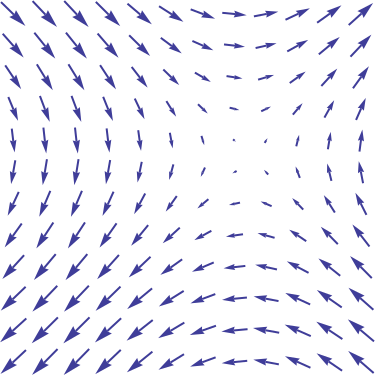
Photons have magnitude and direction in the sense that they have an extent (vector length) and move in the direction of their momentum. Is this not correct? -
Why do Christians believe that God created the world?:lol: So god could have created this world or/and this universe, if it wanted to, but it didn't.
It's existence or nonexistence has no importance to us then, we should focus on trying to find out how this world and this universe was created, and ignore questions about who or what did not create it. -
Is Chance a Cause?There is no evidence of intent from any source other than lifeforms.
There is no evidence that the origins of life, had a source with intent.
There is no evidence from big bang theory, that any event in this universe was intended, before life started, or when life started. Intent only began after creatures who could be labelled 'alive,' started.
The characteristics of living things are: Movement, respiration, sense, growth, reproduction, energy and nutrition. You need to have all of them to be considered alive.
Only living things demonstrate intent.
There is no evidence of intent in any origin of the universe story proposed by science.
Only theism proposes a source of intent in the form of god proposals and there is no evidence that any god posit has an actual existent. Theism simply fails to convince anyone who employs rational faculty, in my opinion.
Chance/happenstance exists within this universe. But we just don't know if there is any point in asking a 'why' question about the origin of the universe. We may get closer to answering the 'how' and 'when' questions but 'why' and 'where' may never be known, but, the likelihood that we will probably always try to answer such a 'why' question, may have a deeper meaning than we currently understand. -
Is Chance a Cause?if you ask "how did the universe came to be?", atheists reply "it's just a fluke". — Agent Smith
As an atheist, my answer would be 'I don't know' and then I would give my credence level for each currently popular posit such as:
god - 0.00000001% credence
Big bang singularity - very high credence but I don't understand what a singularity is.
Cyclical singularity states - high credence but I don't understand what a singularity is.
Interacting inter-dimensional branes which create singularities when they collide - respectable credence but I don't understand what a brane or a singularity is. -
Should humanity be unified under a single government?I agree that it's probable, that technical advancement will compel eventual global unity before human morality does.
-
Is the blue pill the rational choice?Although I don't agree that 'truth at the expense of (illusory) happiness' is evil. — TheMadMan
Evil is a personal judgement and a personal manifestation, as well as an interpretation based on the notions of morality held by individuals or based on legislated morality (law). I agree that 'truth at the expense of happiness' ALWAYS being an evil, is subjective. It's always has been an evil for me. The fact that I have often been able to turn such experiences to my personal eventual benefit does not mean the initial pain caused, ever goes away completely.
The evil is still there, but it is unable to defeat me, anytime it is remembered. -
Is the blue pill the rational choice?Because there are certain moments in one's life when they are exclusive. — TheMadMan
I am glad you confirm that these are 'moments' and not permanent immutable states.
I disagree that your hypothetical is pragmatic, as a pragmatist would emphasize the fact that your hypothetical is not suggesting a choice between truth and happiness which is forever mutually exclusive.
If you are now saying that your hypothetical is only referencing those times in a persons life when you have a choice between two evils, 'happiness at the expense of truth' or 'truth at the expense of happiness' then fine.
Hypothetical: You have learned that your partner who you love has cheated you multiple times.
I give the chance to press a button and completely forget that he/she has cheated on you. So you continue your relationship blissfully unaware and you are happy.
Would you push the button? — TheMadManI wouldn't push the button — T Clark
Neither would I. Although I suffered, I also experience happiness in the truth of the situation because I found out about her before we became too economically entwined and had kids etc, etc.
Yep, that did actually happen to me. Another part of that story is, she came back years later with a child in tow and suggested we got back together as 'I was the one she should have chosen.'
I did not take her up on her offer. In my opinion, I ..... eventually gained happiness from the bitter truth of her earlier actions. For me, truth before happiness but I don't assume such for everyone else.
Would I tell someone they were going to die within months, if I thought it would mean they would live their last months in terror but at least they could prepare themselves? Very tough choice indeed! -
Is the blue pill the rational choice?
So, why do you choose a hypothetical that excludes the possibility of achieving truth AND happiness?
To me, that's a mad mans hypothetical and belongs firmly to the mind of the pessimist. -
Is the blue pill the rational choice?I am only creating a hypothetical where one has the dilemma of either truth or happiness. — TheMadMan
But is your main driver for choosing one against the other based on suffering?
You are presenting the cost of gaining truth as increased suffering and that the only road to 'real' happiness is to embrace delusion and accept you will never know the truth of the world. -
Is the blue pill the rational choice?Mr. Anderson is mad of course, but shhh, don't tell anyone! — Agent Smith
He is just Alice who sometimes visits wonderland and meets a wicked queen called agent Smith.
The switcheroo was just that Alice starts off in wonderland and wakes up in dystopia.
For me, Alice was always a bit of a mad character. She has such strange dreams! -
Is the blue pill the rational choice?
So your main complaint is about 'excessive' individual suffering that is present in our 'real' world.
This is 'uninvited' and 'unwelcome' suffering. I assume you would prefer to have more control over how, when and why you experience suffering. So would I, to an extent, but I also celebrate, uninvited and unwelcome happenstance suffering, due to the 'learning' opportunity such can offer.
I don't include sufferings such as hunger, poverty, homelessness, disenfranchisement, natural disaster, mental illness, etc, etc.
The solutions to these problems lie in the will of humans to unite and work together, pool all available resources, etc to solve these problems. That's why I am a secular humanist/socialist who believes the scientific method is our best hope for creating tech that can reduce or eliminate the current extreme forms of unjustified human suffering as well as correct our ecological mistakes and offer humans more options (more lifespan, more robustness (via transhumanism)). -
Is the blue pill the rational choice?If the matrix will give you all that you want and could ever want, without ever being aware that it is fabricated, would you chose the red pill?
All you are striving for in life is achieved in the matrix in the appropriate way and you'll die thinking that it was all real.
Would you still chose to escape it? — TheMadMan
The plot of the first movie does not suggest that life in the matrix 'gives you everything you want and ever could want.' In fact, I think that's what caused the first attempts at the simulation to fail.
I think matrix world is something similar to our current world. So I think that the movies are suggesting a situation where the real world is much tougher than matrix world.
The plot doesn't make much sense, as a creature such as an electric eel produces much more electricity than humans do, so if the machines want a good organic battery, they could do much better than using humans. Electric eels would give them much fewer problems and much more power.
So, we are left with the modern dilemma, in the future, will we prefer to live in a star trek style holodeck or the 'real' world? For me, I return to the question of what is pleasure without pain?
To quote Captain Kirk in 'The undiscovered country,'"I need my pain."
We need to escape to the holodeck sometimes, so we need to experience 'unreal' and 'real' to feel human. We need both pills, and we need to be able to switch between them. We don't want either to be a permanent immutable state of being. -
The possibility of fields other than electromagnetic
I find this categorisation of field types helpful:
1. Scalar fields, these describe spin-0 particles such as the Higgs boson.
2. Spinor fields, these describe spin-1/2 particles, these describe for example the elementary fermions, like the leptons and quarks.
3. Vector fields, these describe spin-1 particles like for example the photon-field.
But I think QFT and 'strings' will eventually be 'component' parts of a t.o.e. -
The Limits of Personal IdentitiesSome of you might find this interesting. There is a online call in show which is youtube based, called the trans-atlantic call in show. You can call in and talk to trans-folks. I have watched a few of their recorded shows on youtube, such as the sample below:
I think (but I have not confirmed for sure) that Arden Hart (on the left) is a trans-man and Doctor student Ben (on the right) is a trans-woman. I don't know, to what extent they have made surgical or 'pill based' hormonal physical changes to themselves but I find the conversations they have with each other, and with online callers, to be very informative indeed, for a person such as me, who they would label a 'cis' male. If you want to watch the example below, note that it is 2.5 hours long and it takes about 3 or 4 minutes to get (load up/stream) to the actual presenters but I think its worth the time spent.
Edit: I just watched a new year podcast of 'The Line' with Jimmy Snow, and Matt Dillahunty was on along with Doctor student Ben and Arden Hart (as described and shown above).
It turns out, Arden Hart is Matt Dillahunty's current partner. So a 'cis male' (Matt) whose partner is a trans-male (Arden). -
The Limits of Personal Identities
'What's in a name?' Is always an interesting question. I would suggest a 'name' is just a label but it's a label based on human intellect. You make clothes so I name you Tailor. You work with steel (or your ancestor did) so you family label is 'steel' or maybe even stalin(Russian 'steel' also associated with 'man of steel'/superman). A native tribesman might label you 'dances with wolves,' or 'make much wind,' etc.
So, I don't think
is valid.The symbol that has served us the greatest as an identity is the personal name. — NOS4A2
I think we need to consider any aspect of a human being that is present from the moment we come into cognitive existence, that could be applied to questions such as 'who am I?' and 'what do I want.'
How a person reacts to any given sensory input, instinctively/intuitively/logically/emotionally is part of their 'identity.'
The next aspect which directly affects personal identity in my opinion is 'experiential.'
Every experience you have has some impact on the pliable aspects of personal identity.
A person might identify as a 'pessimist', but their 'experiences,' can totally change this.
A child can be moulded into an adult emotionless killing machine, but it's still possible to counter such 'intense lifelong training.'
Ask yourself, 'what would/could change 'who I am or what I want?' If you can come up with a scenario that could change who you are or what you want, at a fundamental level. Then your 'personal identity' is mainly pliable.
But there may be 'aspects' of personal identity that may be immutable from birth but I don't know of an irrefutable example of such. I don't think sex qualifies as an immutable aspect of personal identity and gender certainly, does not qualify. -
The Limits of Personal Identities
Ouch again! You continue your onslaught like a mad shadow all wacked out on scooby snacks!
I will task the technomages to come out of their hiding places and deal with you if you don't stop!
I did like some of them replicant cylons in nylons that appeared in the remake of BSG however. -
The Limits of Personal IdentitiesI get those two series confused all the time. — fdrake
:scream: You have no idea how painful that was for me to read!
You are a little bit sadistic sir! -
The Limits of Personal Identities1. Who are you?
2. What do you want?
— universeness
Have you been watching Battlestar Galactica? — fdrake
No, Babylon 5, since it first came out!
The Vorlon main question 'Who are you?'
The Shadows main question 'What do you want?'
universeness
Start FollowingSend a Message
- Other sites we like
- Social media
- Terms of Service
- Sign In
- Created with PlushForums
- © 2026 The Philosophy Forum