
-
The unavoidable dangers of belief and believers responsibility of the dangersIf there is no such thing as personal belief, then there is no such thing as projecting it. — creativesoul
There is no such thing as personal belief because everything you hold personal gets projected externally and therefore it isn't personal belief anymore. I see no flaw in that logic? -
The unavoidable dangers of belief and believers responsibility of the dangersYou haven't demonstrated that religious beliefs always lead to hateful. and & etc. — tim wood
If there’s a possibility that hateful and dangerous belief-systems will be created, it has a high probability of happening over a long enough timeline.
There is no such thing as personal belief since you do not exist in a vacuum, detached from the rest of society and other people. As long as you interact with other people and the world, you will project your personal belief into other people’s world-view and influence their choices. — Christoffer
Would you say that it's a logical induction that the probability of harmful belief and harmful consequences of belief is very high over a long enough timeline? Meaning, if we don't care about epistemic responsibility, we will always have the rise of some belief that leads to harmful consequences since there is no responsibility of explaining or testing that belief against any form of rationality.
You haven't established that people who believe something are responsible for the hateful & etc. — tim wood
That is not the conclusion. The conclusion is that belief without rationality behind it eventually leads to negative outcomes. If someone believes something that at the time is harmful, but influence people around them and them, in turn, evolve this belief into harmful forms, the irrational belief by the first person is what caused the harmful form it took. Also mentioned in premise 6, personal belief is an illusion because we cannot hold personal belief at the same time as living with others without projecting the result of that belief onto others. So the causality is there, however "personal" someone's belief may be.
You seem confused about what belief is: if you have sufficient evidence, then you know it. — tim wood
In what way am I confused in my argument? A belief in God is unsupported and susceptible to corruption. The same goes for Anti-Vaxxer belief that vaccines cause autism. None of them have any rationality behind them and they don't care for any evidence or rational argument in support of the belief.
If you have evidence, then it's not really belief anymore, right? Then you are following epistemic responsibility. You don't have evidence for belief in God or gods and you don't have evidence that vaccines cause autism, so why hold on to those beliefs when they can be corrupted and lead to negative outcomes. This is my argument.
You seem to fault people for rejecting evidence, without making clear what evidence is being rejected, or what the evidence is evidence of. — tim wood
I fault people for rejecting evidence and not caring for trying to falsify their belief. If any evidence is there, it opens up the belief for scrutiny and if that review of the belief is ignored, it breaks epistemic responsibility. It doesn't matter what the evidence is, it matters that you test your beliefs, otherwise you open the door to spreading misinformation, manipulation and the dangers of corrupted beliefs that might lead to dangerous outcomes.
The point is that unsupported belief that you ignore testing is, per my argument, not only irresponsible but also potentially dangerous.
"Because of this": the "this" has not been established. The rest is incoherent. Why is religious belief wrong for individuals who "agree that harm, harmful behavior, murder and hate to be negative and dangerous attributes of mankind." Even granting your first conclusion, it does not follow that all the bad you've listed comes from religious belief. — tim wood
Is the formulation grammatically flawed here? (I'm not a native English speaker)
The point is that if you agree that harm, harmful behavior, murder and hate are ethically wrong, then you would agree that belief without rational support or proof for that belief is also wrong since the probability of such unsupported belief leading to negative, harmful and dangerous outcomes is very high over a long enough time period. Therefore it is ethically wrong to hold a belief without support for that belief.
If that summery doesn't work help me out with formulating it. -
The unavoidable dangers of belief and believers responsibility of the dangersBecause his argument only works if science is correct but this is a part of what he was saying. — hachit
But I would argue that it did not need the science to be 100% correct.
- If you believe whatever you want and that ends up killing someone, you had the responsibility of testing that belief in order to avoid the consequence.
- You test your belief and you have doubts, but arrive at a conclusion that was not your initial belief, the man lives. You took responsibility for testing your belief with facts and rational reasoning.
You don't need to reach 100% truth, it's the method of testing belief and not just believe that is the conclusion really. The responsibility is in trying to disprove yourself until you are as certain as you can of the right choice or idea. If you are wrong, at least you can then change. Unsupported belief doesn't work like that, it's simply about believing something and accepting it.
This is where my argument comes in. If belief is so easily corrupted since you are never testing it (falsify). There is a probability that it will eventually and close to always end up in negative outcomes for you, others or people later in history.
Because of this, the conclusion is that belief, because it's so prone to be corrupted in some form or another, is unethical in comparison with living by epistemic responsibility. Belief is like pulling the ring out of a grenade, believing its a dud. Being responsible is evaluating the most possible outcome and not pull the ring. One keeps the grenade safe, the other might explode or it may be a dud until later someone else gets blast to pieces. -
The unavoidable dangers of belief and believers responsibility of the dangersSo how do you get sufficient evidence without a postules. If there are postules there is room for doubt. ( postules are an assumption). So if you can provide that science is correct without need for a postule I will agree with you. — hachit
Is your counter-argument that if there are any doubts to the conclusion of trying to falsify a belief you hold, then you don't need to falsify or try and find evidence for what you believe?
Because the entire counter argument you have is built upon proving that if you can't 100% prove something you don't need to do the scientific methods at all.
This is a very binary way of looking at this argument and flawed in actually countering my conclusion, since the conclusion isn't dependent on the deduced conclusion being perfect.
You essentially ditch rational thinking if that rational thinking isn't 100% accurate in its conclusion. It's essentially also like saying that because science doesn't know the entire solution to the universe with its unification theory, then we should just throw all science out the window. You are writing on a computer which is probably filled with technology that came out of science that had a lot of doubts during research, however, they did not ditch that and "believed together the computer"
But we have science and this science has doubts and works with those doubts, but the methods of reaching conclusions with the least amount of errors do exist and those methods should be used to uphold Epistemic Responsibility.
Epistemic responsibility is something you can read about more if you want and the validity of my argument for ethics philosophy still stands since your counter-argument here really doesn't counter it's conclusion at all. -
Grandfather Paradox and time travel
Sorry, reversal of entropy so that the arrow of thermodynamics is turned around, making the energy go backwards, into the water from the high entropy state it had before. The energy leaves the water as it distributes into a lesser form of energy, if entropy is going backwards, that distributed energy is going back into the water. -
The unavoidable dangers of belief and believers responsibility of the dangersYour entire argument is dependent on the question can anything be known. Because if the answer is no (as I believe it is) it makes all believes dangerous. — hachit
No it doesn't, it depends on the common methods of deciphering if the belief you have has any truth value. If you disagree that there are ways to find out if what you think is true or not, then you are essentially disagreeing with any common science that has produced any results up until this point. You know that you can fly on a plane? That you can write on a device while traveling and communicate on forums like this, you know, science, that made that possible. These scientific methods didn't need everything to be known because that isn't the factor for the ethical claim of this argument.
Like you believe there to be one cookie left in a jar in the kitchen, but you can't check so you lay out the evidence you have, when you bought the cookies and when you last ate, how many you took. You cross-check and falsify with as much data as you have about if you might have taken more cookies at a later time. Then you inductively reason on how many are left; one cookie. The thing to remember is that the method itself is the key, not if you were right. You took every possible way of figuring out if your belief was wrong (falsify) in order to come o a conclusion, then if possible (look in the jar) you prove it definitely.
This is light years away from the belief in, typically, religion, where belief doesn't require any rational reasoning, proof, deduction, induction, falsifiability and so on. It's totally corruptable.
If you want to corrupt your belief in the one cookie left scenario; You skip all the deduction and you believe that there are ten cookies left because you want there to be ten cookies left and you ditch any attempt to figure out how many there are left and you never check. Then your spouse goes into the kitchen and complains that there are no cookies and you continue with saying that you can't see what she is seeing so you still believe there are ten cookies. This is as flawed as a point of view could ever be by a human about the surrounding world. Essentially, this is what unsupported belief is and it's much more dangerous than getting in a fight over the number of cookies left. Because unsupported claims/beliefs about the world can influence others. Like if your belief has you wanting to restrain gay rights; that will have an effect on the community and it could eventually lead to some dark outcomes.
In order to understand the argument on a deeper, you may want to skip straw manning it. -
The unavoidable dangers of belief and believers responsibility of the dangersThat doesn't make me not strongly disagree with your last three premises. — Terrapin Station
Alright, let's break them down. I mean, I may need to revise them to clarify them better.
If there’s a possibility that hateful and dangerous belief-systems will be created, it has a high probability of happening over a long enough timeline. — Christoffer
This is simple logical probability. If X has a probability of happening, then over a long period of time X will most likely occur at some point.
If someone has an unsupported belief that gays should not have certain rights. And there's a probability of this person influencing someone else who is later on becoming violent against gays and kills a person. There's causality in this that breaks epistemic responsibility.
Essentially, my argument is a form of version of epistemic responsibility, within the context of belief-systems.
There is no such thing as personal belief since you do not exist in a vacuum, detached from the rest of society and other people. As long as you interact with other people and the world, you will project your personal belief into other people’s world-view and influence their choices — Christoffer
Please elaborate why this is illogical? The beliefs you have influence the values, opinions and actions you take externally. You will project yourself into the society you are in, influencing other people. This means that the concept of personal belief, the common argument that "you are entitled to believe whatever you want" is flawed in its reasoning about how people interact and how your thoughts and beliefs affect others around you, even if you don't intentionally project them.
How do you think the epidemic of anti-vaxxers came about. It's because of how someone's belief spread to others. It's a great example of this argument.
Epistemic responsibility put a responsibility on the ones who make choices without sufficient evidence. To choose to believe is to accept a belief without evidence and risk spreading this belief-system. — Christoffer
Epistemic responsibility is a known idea in philosophy. If you haven't, check it out.
Hope that clears things up a little. But please elaborate if you still don't think they hold up. -
The unavoidable dangers of belief and believers responsibility of the dangersI'm not some person off the street. I what it is . We are responsible for what we believe. There you happy with that. — hachit
Then why ask something about something that is known to you? Almost all my premises are based on previously established arguments in philosophy.
Science, the way we found works but it still can be false. — hachit
Yes, but there's a difference between knowing the thing you research might be wrong and ignoring it to be wrong accepting it to be true, which is what belief without rational explanation or proof is about.
That difference is the foundation of the ethics conclusion for this argument. (I may need to revise the premises and include this specifically).
This was again unclear on my part. I'm saying that it is just as logically as anything else — hachit
It is the conclusion to the premises in my argument. Premise 1 is true, there's no real denying that. This means that there is no proven or supported truth in the God the belief is about. Just because you believe in God, doesn't mean it is true. It is an unsupported belief. My argument points to the ethical problems with unsupported belief as it will over a long enough timeline always lead to harm against others or the self in some way or another, not necessarily to you directly but generations after etc.
The causality of this is as far as I can conclude, statistically very probable.
Also I have a stance were what we see is your best way of making sense of the universe but it is not actually there. This explains why science works even if the concussion is false — hachit
Even though this is metaphysics, it doesn't really counter the ethical argument. The result of science is all around us. Theories, hypotheses, research and falsifiability have all developed the world and the knowledge that we have. Even though you argue that we make sense of the universe through our eyes but it isn't there, it doesn't really counter the reality of science that is fundamental for this argument.
And if you are doing metaphysics on that idea, post the argument for it under metaphysics. I'd like to see the actual argument for your perception without true reality-hypothesis. :up: -
Grandfather Paradox and time travel
Because adding energy require you to add energy with something, converting energy into new less form of energy along the line of thermodynamics and entropy. Going backward, the less form of energy reverse entropy and there is nothing applied to the water, it heats up by the reversal of energy which left it.
Just like a glass has many more sides after it breaks and going backwards with that entropy, the increased information decrease into a higher, larger form as a single glass.
I'm not sure why you confuse this with adding energy? You know about thermodynamics and entropy? -
The unavoidable dangers of belief and believers responsibility of the dangersIt is this part of the argument that makes my argument — hachit
You might want to look up Epistemic Responsibility first.
You standing against religion — hachit
Not really, I'm making an argument against belief that is corruptable due to the lack of will to prove or rationally explain it. If you act upon your belief as being true, without proving or rationally explaining why it is true you are susceptible to a corrupted belief, be it your own, or a version of it, or someone corrupts it down the line when you influence the world around you according to that belief.
So even if religion comes to mind and probably is inevitable to be included in this, it's about the unethical ramifications of a truth claim to a belief that is not supported by anything but whatever you invent for it.
This can also apply to stuff like anti-vaxxers believe that vaccines cause autism.
I'm saying that if your correct, science is a based on observations then logical concussions. Observations come from what you see, but what evidence do you have. — hachit
How do you prove that vaccines work and don't cause autism? Some parents don't believe otherwise
How do you prove to your child that drinking gasoline kills you? Some (hopefully not) kid believes it.
How do you prove that honor killings within Islam is wrong? Some fathers and brothers believe it to be honorable.
If this is not solved it counters your frist argument — hachit
Are you writing on a device right now that is the result of scientific research, theories, theoretical physics, engineering ideas etc? Things put together through deduction, induction, trial and error, research, falsifiability methods, cross-checking and so on?
Do you mean to say, that we cannot prove, research and rationally explain things and because of that form and change our world according to it? How then are you writing on a device that is the direct result of science and research?
What do you call that knowledge, research and science?
The extreme demand for defining evidence in simplistic terms or explanations exclude the entire scale of how rational reasoning, scientific methods and falsifiability work. It's ignoring the direct results of theories and ideas for which your quality of life is resting upon. This way, the everyday methods of rational individuals and scientists to explain something to the best of their ability as detached from their own subjectivity as possible, is the kind of "proving" I'm talking about. Because if you mean that there still is no way of proving anything, you wouldn't be able to write on the device you are writing on, since no one can't seem to prove anything.
In other cases, situations where its harder to get pure solid proof, it's the mere moral obligation to at least try and explain and falsify a conviction that you have that is the ethical route. My conclusion is that it's unethical to believe something and ignoring its validity or truth because that inevitably at some time will lead to harm, as per my premises describe.
How do you draw up ethical guidelines for society to work under? How do you prove that murder is wrong? If you believe that murder is right, is it ok to spread that belief, influence and get followers under it? Why is that wrong? It's a philosophical question in its own right, but in the context of my argument. If you can rationally conclude why murder is wrong, why do a belief like anti-vaxxers have, not need to rationally explain why vaccines are bad? Why do believers who won't care for proving or rationally explain their belief be considered ethical in any way?
Because it would make it that the reason there's no evidence be that we can't see the truth. Therefore the evidence may be there but impossible to find. This makes the rest of the agreement mean any believe may be dangerous or not, but we have no way to tell. If we have no way to tell we might as well hold whatever believe we think is valid. — hachit
The premise is still true, no evidence or proof exists of any God or Gods, which means that belief in God or Gods have no truth value whatsoever and should not ethically be an influence on society and other people.
It seems that you take the premises out of context or argue them as an argument in of themselves. Like the first premise, you cannot say it is wrong, because it isn't. The same goes for premise two about Kirkegaard and Pascal, it only says what they presented as reasons for belief.
If you are going to argue against a premise you need to argue against if it's true or not. The fact is, there is no evidence for God or Gods. If there were we wouldn't even have this discussion. So premise 1 is true. Fact is that Kirkegaard presented his reason for belief and Pascal presented his wager, there's nothing to counter here, they did it so premise 2 is true.
So I recommend taking another look at the entire argument. If a premise isn't true, point that out, but so far I've only heard opinions from people and attempts to discredit through fallacies, no real breakdown of the actual argument in a rational counter-argument.
Are you absolutely sure that your counter-arguments are rational and outside of your subjective convictions? That's what I'm after.
The premises are, as I see, still true. I may need to formulate them further in order to clarify better, but I fail to see anything really disputing them so far. -
The unavoidable dangers of belief and believers responsibility of the dangersThey're both ideas without proof, thus beliefs. That one supposedly is acted upon while the other is not is an arbitrary distinction. — Tzeentch
The difference is the foundation of the ethics in this. To act like a belief is true versus understanding something is only belief and shouldn't be taken as truth is fundamental logic for this. How is this not important for the ethics of belief? And this is also why scientific belief is never called belief, but hypotheses.
You are essentially doing a fallacy by deciding preference of what is important and what is not in order to support your point. You haven't explained why this difference isn't important, you just say that it is.
You've limited your argument to religious beliefs. I suggested we add scientific beliefs as well. — Tzeentch
No, you suggest this because you seem to drive an apologist agenda. You want to add scientific belief disregarding the fundamental difference between the two. It's crystal clear that you intentionally disregard the nuances of the argument in order to shoehorn in something that is critical against science, but you don't understand the fundamental difference between belief claimed to be truth and a hypothesis that is never claimed to be true.
Believing the man in the white coat on the television that calls himself a scientist is the same as believing the man in the church that calls himself a man of god. — Tzeentch
This is a stupid fallacy of an argument with seemingly no knowledge of what science is or how it works. Irrelevant argument and you are talking complete nonsense with that kind of reasoning. It's close to populistic, anti-climate change crap from uneducated people.
Stop doing fallacies, its a waste of time. -
The unavoidable dangers of belief and believers responsibility of the dangersThere's such a thing as proof in logic and mathematics. ...and questionably in matters of physics. But not as regards ultimate reality or Reality as a whole. So it's silly to want proof of God, for example. — Michael Ossipoff
So if I believe that killing my neighbor is a good thing. Because I cannot prove this to be true its silly not to kill my neighbor?
If you get caught up in a murder, it is silly to try and rationally explain your innocence?
The judge say you cannot use math and logic in order to prove why you are the wrong man?
Do you mean that we cannot prove or rationally explain anything in this world, that science haven't proven anything at all, that the technology that enables your quality of life came out of a fluke luck of the developers of the tech?
This is the kind of rationality and proof I'm talking about.
Evidence needn't be proof. Evidence consists of some reason to believe something. There can be evidence on both sides of a y/n question. You may have your reason to believe that someone else's belief is correct. Without knowing all Theists, and all of their beliefs, and all of their evidence for their beliefs, you can't validly evaluate their evidence. — Michael Ossipoff
The premise you are answering on is about Kierkegaard and Pascal's arguments for reasons to have faith without any care for evidence that it is true or rational. So I'm not sure what your answer is referring to here?
Then Russel was all confused. Religious faith is about the larger matter of what-is, Reality as a whole, ultimate reality. The matter of what there is in space is an entirely different sort of matter, a physical matter subject to such considerations of logic, mathematics, and the standards of science. — Michael Ossipoff
This has nothing to do with the nature of belief and the ethics of it. So I don't see what this is a counter-argument to? I take it you are unfamiliar with Russel? He's being falsifiability, you know, the most important tool for doing science without bias.
7 W (South-Solstice WeekDate Calendar)
...Wednesday of the 7th week of the calendar year that started with the Monday that started closest to the South-Solstice of Gregorian 2017. — Michael Ossipoff
What does this have to do with anything? -
The unavoidable dangers of belief and believers responsibility of the dangersI don't see how the fact that they are never acted upon as truths before proven somehow makes those hypotheses special. A belief is a belief. — Tzeentch
You are making a straw man out of this.
Hypothesis = an idea about how something might be, never acted out as truth.
Belief (religious, spiritual or convinced of a specific thing) = An idea without proof, acted out as truth.
If you cannot see the difference between those two, you are intentionally ignoring the differences to support your narrative. That's a fallacy.
Another way of saying "If you don't agree with me, I think you're stupid."
*yawn* — Tzeentch
No, you aren't making any proper philosophical counter-argument to what I wrote. You are making a biased fallacy-driven case that isn't even close to proving what I said was wrong. You are just saying opinion, philosophical dialectic is not about opinion. So stop yawning.
I'm not. I'm pointing out that pictures prove nothing. I could show you a picture of God. Would that be proof that God exists? I think not. — Tzeentch
What does this have to do with the ethics-argument I presented? You are just babbling about other stuff now, focus on the argument.
How is that a nonsense argument? — Tzeentch
Because it has no place in the ethics section, it belongs in metaphysics. You grasp basic philosophy? If you mix everything together and just claim that you can't know anything, then there's no point in philosophy of anything. So what is the point of even talking about ethics? That's why your argument in here is nonsense.
If we were to discuss Descartes and his demon-argument under metaphysics we could have such a discussion, but this is about the ethics of belief. So do the dialectic properly please. -
The unavoidable dangers of belief and believers responsibility of the dangersone flaw in see. How do you know that what you see is true — hachit
I fail to see how this relates? My conclusion is that belief without rational explanation or evidence that support that belief, is dangerous.
Someone believes that vacines causes autism. It's based on someone telling them this based on a belief (which was the study that got refuted back in the 90's.). This someone, believe in this idea and ignores any evidence against that belief. This someone does not care to try and prove or rationally explain this belief and in doing all this, this someone's belief leads to their child dying in measles and spreading this further to other children.
The act of believing without caring for proving that belief killed the child and maybe more.
Someone has a belief in God. Someone else tells him that its Gods will to kill another person. The someone does not question god, because of his belief and kills the man.
These two are direct examples of my argument. But it also relates to dsitribution of belief that might become harmful. Like Nils Loc, earlier in this thread mentioned about cultures based on religious belief. There can be acts within these cultures that are downright brutal and murderous, but the belief wasn't invented by them, it was past down through generations. Therefore, belief has ramifications over time and I return to my conclusion, that belief without proof or rational reasons are unethical.
If you are talking about the purely metaphysical aspect of perception, you should go to the metaphysical section of the forum. This is an ethical argument I presented. Otherwise I can murder someone and just try and defend my actions in society with "how do the witnesses know that what they saw was the truth". A counter-argument like this for the argument I presented is nonsensical. -
The unavoidable dangers of belief and believers responsibility of the dangersEven if you have reasons for finding an explanation plausible, it is still a belief. Until one has seen the things take place or done the experiments, one is trusting words and pictures. — Tzeentch
Religious faith and belief, or other beliefs that are held without caring to rationally explain or have evidence for them are not the same things as scientific hypotheses, which are beliefs which are never acted upon as truths before proven into theories.
It is fundamental to science that a hypothesis remains as a thought experiment and not truth.
If you can't see or understand this difference I can't help you understand the argument and your misunderstanding of the argument cannot lead to a proper counter-argument to the argument I presented, sorry.
The picture you linked could be a picture of anything. I could believe that it indeed shows atoms. How could I ever be sure without looking through microscopes? I might read some books, come to find it plausible, but it remains a belief. — Tzeentch
You are making a metaphysical claim about the nature of perception itself. It has nothing to do with the ethical argument I presented. It is irrelevant. Please stick to the ethical argument and what it's about. If your way of arguing specific sections of philosophy with "how can anyone know that what they don't see is true", you are essentially making a nonsense argument.
If you want to talk metaphysics, present your argument in the metaphysics section of the forum, this is ethics. -
The unavoidable dangers of belief and believers responsibility of the dangersOne can be told by scientists that matter consists of atoms, but one cannot be sure until it is seen by one's own eyes. Until then, it is a belief. — Tzeentch
How is this an example of belief? It seems you don't know what a hypothesis is? Or how it is used in science? A scientist does not act upon a hypothesis like it is the truth, believers of religion/faith/other does. That is the critical difference here. A scientist proposes a hypothesis with relevant supporting logic to why it might be, but never say "it is true", ever.
If you are going down the Descartes-road about not trusting anything but your own mind, then you can't even trust your own senses viewing those atoms so your example falls flat with that as well.
If you mean that nothing is true until you, yourself has seen it, that's just ignorance and ignorance of logic and evidence. Are you unable to write on a device that was invented because science proved things that enabled developing parts of that device? You didn't see scientists develop the internals of the device you have, you don't even know how it works or has seen inside your own device, so are you saying that you are writing on a device that is existing even though it's based on just a bunch of science-beliefs? Just because you didn't see any of it?
Are you talking about modern scientific methods with falsifiability and cross-checking? Or are you referring to outdated methods?
Also, for the example you put forth:
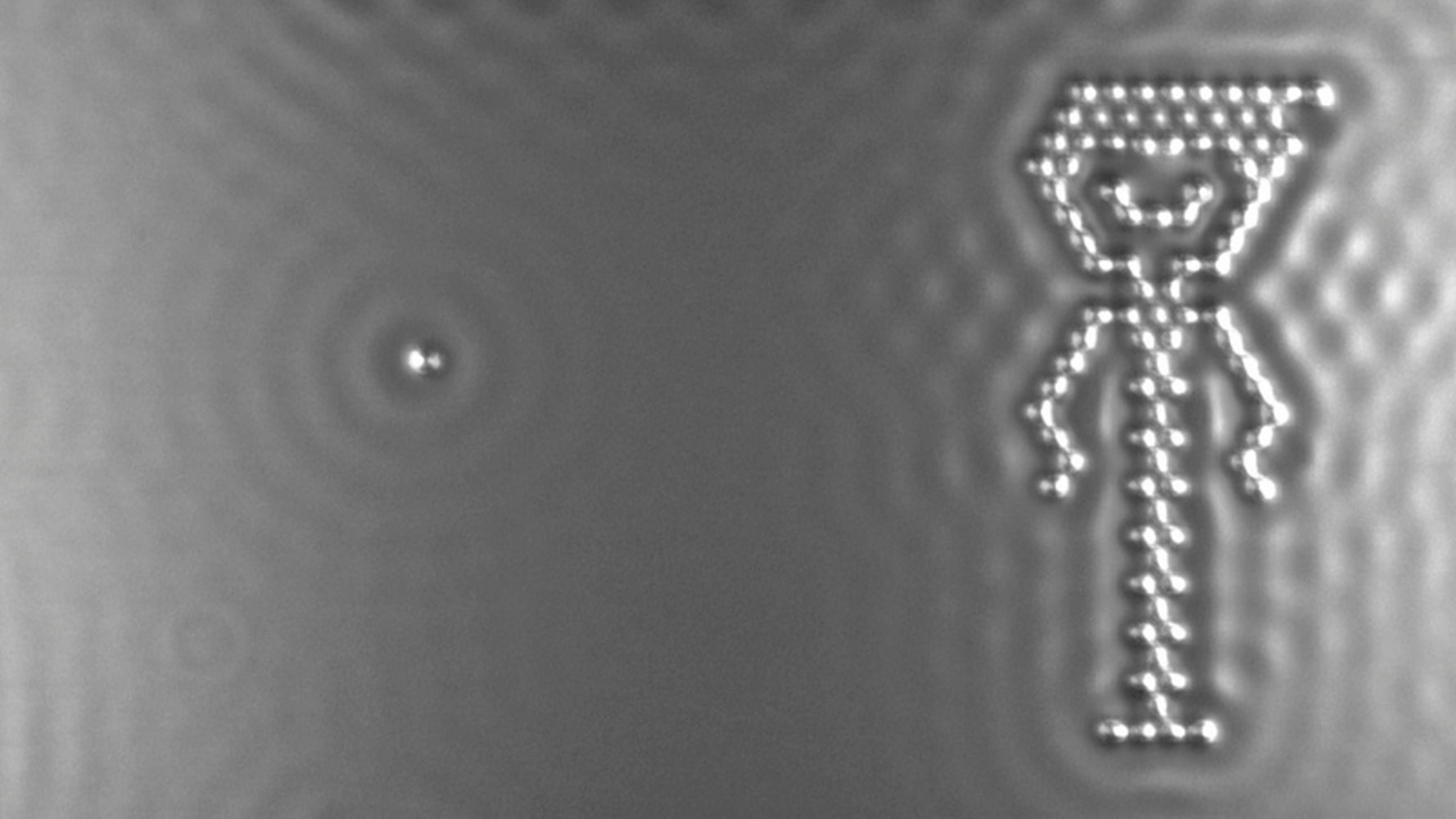
I'd like to hear a proper counter-argument to the ethical argument I made. If your point is that belief outside of just religion should be viewed in the same way, I'm totally with you on that, but that requires you to understand the difference between how science views a belief/hypothesis and how believers that won't care for the burden of proof, does. -
The unavoidable dangers of belief and believers responsibility of the dangersnot sure what this adds - will withhold judgement — Rank Amateur
That belief as a justified existence has been made by Pascal's wager and Kierkegaard's idea that faith/belief should exist because it isn't proved.
Challenge - Russels argument has nothing at all to do with rejecting evidence in favor of faith. Its sole purpose was to place the burden of proof on the person making the claim. If one is holding a view by faith that is in conflict with evidence that is just a fool. And fools do all kinds of things. In the argument, what Russel is saying is, if I make a claim that there is a teapot between the earth and the sun, the burden is on me to prove that, not on you to disprove that. — Rank Amateur
Essentially, it's in the same realm as my premise. Point being that if you do not follow the burden of proof for your belief, then anything could possibly be believed without demand for evidence.
If someone starts believing and following a belief of harm against humanity being good, if it's ok to reject evidence or the process (burden of proof), you can't argue for why this is wrong except when its too late.
Challenge - I don't see how Russels argument has anything meaningful to say about what people say they believe - based on anything. The only thing it would say is the burden of proof for any truth claims they make is on them. People are capable of all kinds of evil, and can find all kinds of basis to justify it. Not seeing the direct or unique link between religious beliefs per se and the evil. — Rank Amateur
The direct link is that without the burden of proof or demand for rationally explain the belief you have you are free to form whatever belief you want without anyone having the right to criticize it because of the freedom of belief we have.
not sure what you are saying here - there is a surety that hateful and dangerous belief systems will be created, and they will be justified by all kinds of things, including religion — Rank Amateur
I'm saying that if there's a possibility of hateful belief-systems being created because we have no demand on such created beliefs like, burden of proof, to justify that belief, it will over the course of a long enough timespan, happen, and people will get harmed.
We are free to believe and think all kinds of things - why is the simple act of belief without proof something to be avoided? — Rank Amateur
Because it eventually leads to harm by distortion of truths. I think you take the premise out of the argument instead of looking at the premises as supporting the conclusion that summarizes why.
I understand that religion, has and might well again cause real evil. But the causal relationship is, religion is a act of man, it is a human organisation, and evil is part of the human condition. I don't see you made any kind of case that says faith leads to religion that leads to evil. — Rank Amateur
My conclusion is that faith/belief eventually leads to suffering and harm because of its ignorance of truth and evidence for its claims. You can't take good sounding parts of religious writing out of context as an example of something that disputes this.
Belief is neither connected to any current religions or religion at all really. The conclusion is about all belief. The point is that if someone has a belief and ignores the demand to justify that belief, it can lead to harmful behavior since it ignores the possibility that it might be harmful. It might not even be the person creating this belief that does the harm. The belief, as I mentioned about personal belief impossible to be kept personal, can influence and spread into harmful forms later in time.
If a belief is created and it does not care for truth or rational explanation, it has a great potential for creating harm. Therefore, it is unethical to hold on to a belief that isn't explained rationally or proven. That is the point of my argument. -
Grandfather Paradox and time travel
Do you add energy to the water and heat it up again? No, you travel back along the line of energy, backward thermodynamics. The water starts to heat itself up when the energy is coming back into the water. That is what happens if you turn the arrow of entropy.
My point is essentially to think of time in terms of energy distribution and entropy instead of time as the concept of events. It might help thinking about the topic of time and time travel. -
The unavoidable dangers of belief and believers responsibility of the dangersScience, to the extent that one hasn't carried out the experiments themselves, is a belief. One may consider it a "rational" or "logical" belief, but that's an oxymoron. — Tzeentch
Need an example of what you mean. -
The unavoidable dangers of belief and believers responsibility of the dangersFar as I know, no real thinker has ever claimed direct evidence for the existence of God, such claims being the domain of the ill-informed, manipulated, fond, ignorant, stupid, pointy-headed, and so forth. — tim wood
I'm talking about Pascal's wager and Kierkegaard argument that belief is supposed to be without any evidence. This is the road most religious people take when arguing for their belief.
Nah. This conclusion doesn't hold. Further, belief in something without sufficient evidence is required to get out of bed in the morning, and into it at night. — tim wood
Please form a better argument than "Nah". It's not enough. What is not working with the conclusion? Have you actually gone into depth with all the presented premises? -
The unavoidable dangers of belief and believers responsibility of the dangersReligion as passively accepted faith (inherited lifestyle) is not something one might necessarily choose. It happens to you as a consequence of cultural pressure or personal revelation.
If you are born in some Mormon family, love or respect could be conditional upon accepting certain ways of doing things. You don't really need believe at all. You just need to act as if you believe, follow rules, otherwise you get exiled (let go).
Some Muslim households will even kill their children if they have transgressed an interpretation of religious law. — Nils Loc
These are examples of why my conclusion seems to holds up. And it supports the idea of epistemic responsibility.
It is only because of different competing values, by which society is ordered, that religious beliefs are registered as dangerous, or harmful. — Nils Loc
Which is why belief in anything that you cannot rationally back up can lead to dangers down the road. Personal belief does not exist unless you are in total isolation from the rest of humanity. As soon as you start to interact with others you will influence them and affect them in certain ways. Your spiritual/religious/other personal belief might seem harmless to you, but the causality of it down the line might build up something that harms people.
The competing values have their roots, sometimes harmless roots, which become harmful. It's not always competing though, like with honor killings.
It might be universally desirable to do no harm if we have the choice but a sense of "having the choice" might itself be a belief that is gifted to us and that we think we ought to gift to others. — Nils Loc
Can you back up the choice with rational ideas about what might be the best for other people? Because if you can argue, prove or rationalize something as true or logical outside of your conviction, it's not a belief that follows premise 2.
The gift of free thought surely permits us to advocate for the devil in the same way God would advocate for his believers, by appeal to choice or fate. — Nils Loc
But can you back up your thought rationally? If its only a belief and you start acting on it, projecting it onto the world, you are acting upon unsupported belief like in the argument presented. -
The unavoidable dangers of belief and believers responsibility of the dangersWhy only religious beliefs? Lets throw in all beliefs, including scientific ones. — Tzeentch
It's about the belief that does not have evidence or logical rational arguments behind them. If you have a scientific hypothesis, its never promoted as any kind of truth or doctrine and requires evidence or rational logic in order to become a theory.
If your assertion is that there are scientific "beliefs" that exist in any similar way to religious or other spiritual ones and do not have the demand on them to be proven, falsified, tested etc. then I'd like to hear such examples. Because the critical difference here is that if you say that a hypothesis is a "belief" according to the argument above, you are essentially saying that religious or other kinds of belief that don't care for evidence or rational explanation is the same as how scientists treat hypotheses. However, scientists never act on a hypothesis, they know its unproven, they know they need to be careful with hypotheses. Religion or other spiritual belief do not, as pointed out in premise 2.
If you are going to equal scientific hypotheses and religious/spiritual/other beliefs that don't care for evidence at all, you would need to write out that counter-argument a bit more. It's not enough to just write "scientific belief" since that feels awfully like an argument fallacy. -
Grandfather Paradox and time travelWhat does that amount to in practical terms, exactly? "Different points of energy distribution"? — Terrapin Station
Essentially I mean that we think we travel in time, but we are generally traveling between different levels of energy distribution under entropy. If I heat up water, let it cool down and then travel back to when it was hot, my initial concept is that of traveling to another time, but essentially I traveled to when the energy was high in that water. If energy and mass create time as it's "byproduct" then we are generally traveling along the causality of energy distribution.
I'm no physicist so how this relates to other aspects like quantum particles, fields (like the Higgs field) etc. I don't know at this time, but if the concept of time is that its the byproduct of mass, energy and gravity we don't really have time as a concept by its own, but as the resulted effects of the causality of all those things. If we view time instead as how mass, energy and gravity works, there might be clues to what that means for the idea of time travel. -
Grandfather Paradox and time travelAt the moment we can only look at the facts that exist in general relativity, special relativity and quantum mechanics. Though, incompatible with each other, these are all we have as a foundation for thinking about time travel.
Causality has to do with energy and motion and time seem to be the result of this distribution of energy. Time travel is essentially traveling between different points of energy distribution which represents itself as different times.
The thing is that A and B-theory, most of the philosophy of time does not take into account theoretical physics as much as it should. Causality is too solid a concept for there to be any solution to the grandfather paradox. X causes Y because of the distribution of energy, not time itself. If you change the distribution of energy, changing the trajectory of particles, mass etc. because you kill your own grandfather before your parent was conceived, you have changed the possibility of energy to be distributed into your existence.
But the thing is that all of this is so hard to conceptualize without a unification theory. The most logical conclusions out of the actual physics about time makes for the moment a hard case for causality and relativity for observers.
One interesting thought experiment is the one about communication through large distances of space. In the game series Mass Effect, humanity has expanded throughout the galaxy through ancient found devices which enables FTL travel to fixed points around the galaxy. But this would mean that if you travel to the other side of the galaxy, you essentially travel back in time relative to the position you came from. If looking back at the location you came from, it would probably be millions of light years ago. Essentially you would be able to find a spot in the galaxy in which, when traveled to, you will arrive at the exact moment when light from the position you came from shows you starting your travel to where you are. - But the interesting thing happens when we take their means of communication into consideration. They use quantum entanglement communication, meaning that they entangle a particle at both ends of the communication and communicate through interacting with that particle. This means that they can exist in vastly relative positions in spacetime, but they have a fixed point for their communication.
This means that everyone in the galaxy experience a specific position in spacetime as their "present", but no one can observe that time from the position they are in. Communication is instant, FTL travel is instant, so the arrow of time for all the inhabitants of the galaxy is specific, not relative. It is only relative when trying to observe from a specific position.
How do all the inhabitants of the galaxy then relate to general relativity and time travel? They should all be relative to each other but their experience is not. What happens when they experience time dilation through gravitational variations at their specific location? Can you quantum entangle communicate between two points in vast distance from each other, while still be able to exist within gravitational pull that dilate time?
Essentially, can you entangle a particle at a place that is vastly slower in time relative to our own? What happens if you do? -
Can artificial intelligence be creative, can it create art?
Art needs to be a creation with intended communication of something.
It then needs to be combined with a receiver (viewer) of that communication.
The communicated message goes through interpretation by the receiver and the combined event between the communicator and receiver through that art is how I define what art is in its most fundamental form.
Therefore, a thing cannot create art since it lacks the intention of saying something with it. People often say that beauty in nature is art, but that is not art, beauty is not art, nature is not art. Art is intentional.
So when we talk about an A.I that creates something, first we must define if this A.I truly has the intelligence or is just an algorithm simulating intelligence.
Does it understand that it creates something intentionally for interpretations by receivers? In the case of current A.I:s no, not even close. These AI systems are algorithmic synthetic intelligences. I often say that people lump together too much under "AI", which leads to confusion as to what AI truly is. I define any current AI as SI, synthetic intelligence or ALi, Algorithmic Intelligences. They have no self-awareness but can be programmed (in the future) to act so close to the illusion of human intellect that we will be fooled by it. For day to day life, these SI and ALi:s will function as companion "apps" and smart-things as they act in science fiction films. But they will never be able to think freely for themselves in the way we think about true intelligence.
True AI happens when the intelligence is self-aware, capable of independent actions and act out its own will based on desires. A true AI that evolves without human-like parameters will never be able to communicate with us since it acts within its own realm. It would be like trying to communicate with super-advanced aliens. But if an AI is programmed to develop a human intellect and capable of acting out emotion-like responses and have human-like desires and fears, it will be able to communicate with us.
At that stage, it will be able to create in the sense we view art. It will be able to create with an intention of something beyond just telling us straight up about something. They will understand the importance of interpretation by the receiver, in this case, us other humans.
But that leads to the question, or rather a conclusion; if the created art demands an AI to have an intellect and intelligence that resembles us, humans, it would essentially just be another "human being" who creates art. A new individual, not by flesh but by silicon, but with the same kind of desires and emotions as we have.
This is essentially the argument I have worked out about why human art can never be replaced by any machine or another being that do not function in the same way as we humans do. Art as we define it, exists within our realm of not only understanding facts and knowledge, but emotion, desires and fears. We cannot apply that to something that lacks those human elements without the resulting creation being as empty as when someone says "everything is art". Essentially my opinion on this conclusion is that people who look at these produced images and say it is art, essentially are the same who say that everything is art, which in my opinion makes the word "art" meaningless. The specific computers making this imagery presented at TED are just algorithms, they know nothing of what they themselves are doing. It would be like me throwing a hand grenade into a room filled with paint cans and say that the hand grenade painted the art on the walls, not my act of throwing the hand grenade in there. The logic fails completely. -
What could we replace capitalism withWhat would you think would make the system work better. — hachit
Resource-based economy has some merits, but mostly it's a very utopian idea that has big flaws in a society larger than a large tribe.
I think that basic income is a good way to create a baseline in order to help society and economy from becoming too segregated to a point of collapse. I also think that the basic functions in society should be totally free (tax-based); like infrastructure, electric charging for electric cars, electricity in general, internet, health-care, dental care, care for the sick and old, mental health care, construction of new homes aligned with population growth, research and science, school and high education (including the ability for older people to educate themselves for free in order to change occupation). And culture funding. All these are tax-based with a tax rate that is increasing for higher incomes. The rest of the market is a free market.
Problems arise with things like military funding and the global economy. The biggest problem we have are problematic political nations in the world which makes it hard to even develop past the current forms of economic and political systems. If all were to the standard of democracy, without corruption it would be easy to develop a better, advanced and improved system. So most of the improved ideas are utopian until we reach a better balance globally. Essentially, there's to much bullshit in the world today for a new system to actually work. Until there's a political and economic balance globally, we would probably need the capitalistic engine to run, since it still works great at pushing developed countries out of poverty. Capitalism is a great "pusher" for nations with problems to prosper, but it's generally a problem for stability without creating high-level corruption. -
What could we replace capitalism with
Most people handle different systems like a final system that won't change over time. This is a radical naive view of how systems exist in society. Systems change according to the culture in which they exist. Capitalism change through trials and errors. In Sweden, there's arguably a "socialist capitalism", in which basic functions of society acts within a socialist method, while the market is still free outside of it or even in collaboration with it. It's an evolution of pure capitalism and pure socialism.
The biggest problem we face is that the automation of industries will render most of the population unemployed, while those with higher intellectual skills, jobs and education will continue within their fields. The economic crash due to this evolution/revolution will probably be bigger than both the 30's crash, the 90's and 08's crash and it will feed into the demand of a new system that is better for all.
The closest we have to a solution is the basic income system. Research has pointed out that things like general intelligence decreases within poverty, making segregation worsen by the consequences of itself. So those that are poor have less ability to pull themselves out of that situation. If we face mass-unemployment because of automation, we will face massive poverty in which we can see a downfall of society. Basic income reduces the effects of this process and gives time for the unemployed and poor to catch up, educate and get jobs of higher complexity, which cannot easily be replaced by automation.
The conclusion is that a political and economic system needs to be a synthesis of previous ideas, none of the current ones works together with the probable development of society we face in the future.
In essence, we need to stop judging down on some political systems, stop promoting other political systems and we need to evolve the systems that exist. -
Teleological NonsenseThis is the well-known generate and test strategy of AI, which I discuss in my paper. — Dfpolis
Yes, I worked out methods for A.I researchers on this as well, so I'm familiar with the process in A.I research.
The problem is that physics tells us that there are no random processes except possibly quantum measurement. That means that before the advent of intelligent life, the evolution of the cosmos and its biological species was completely deterministic (as is the design program you cite). The generate and test strategy only works because the range of acceptable designs is implicit in the preprogrammed test criteria. So, there is no question of having ends, there is only a question of how those ends are encoded.
As for the simulation argument, it has many logical flaws. One of the most glaring is that whether or not the universe will evolve life depends on the precise values of its physical constants. The chance of a simulation having the right combination is minuscule (cf. the physics behind the fine-tuning argument.) — Dfpolis
I'm aware of the flaws because I'm not anyone who accepts either simulation or ontological arguments as logical reasoning for their conclusions, only that there is a conclusion we don't know the specifics about. What I was referring to is that if I were to play devil's advocate with the idea of a god, it would in that case, most probably, be one who has no idea of our existence.
The generate and test strategy is an example of one process being more efficient and the other inferior. However, a set of mass which are flying through the cosmos will at the end of its journey have the form that is most optimal for a journey through cosmos, if not coming across any obstacles. The problem is however if you view things to have an end with a purpose. In the case of the drone design, that design is for the purpose of flying through the air that has the density, humidity, and temperature of a basic range for habitable conditions on earth. As soon as things change, the design needs to be changed.
In the "devils-advocate" scenario I had, if there was a god with the specific intention of our design, then that would mean evolutionary changes work better to create the optimal human design, not creating us from a pre-set of design, only out of what our function would be. However, because I do not believe in god since there is no evidence for there to be, the problem even with this optimal way of creating humans is that we are still evolving. The argument is then that we might not even be the final form that a god set out to do, but a form still in change. Maybe millions of years from now, our biology has evolved into what the final form is. Either way, we, as we are now, are not the final form and not intended because we are still evolving. This means that even if there was a god aware of us, we would essentially just be the seed this god is waiting to be what that god intended.
But, the optimal function of a system or object can still reach its optimal form within the system it exists within at the moment. That, however, doesn't mean it has reached its final form. The final form is heat death, meaning, the function and identity of everything is nothing. The final form as a final goal is irrelevant when taking universal entropy into consideration since that would mean that the final form has the purpose of being nothing. The evolving state of an object or system is happening within the system it is existing in, outside of that, it does not exist within the parameters of our universal laws of physics.
This is a faith claim, the truth of which is, at best, unclear. — Dfpolis
It's a devils-advocate claim, I have no reason to claim it true. It's for the point of my argument. I recommend that you try and understand the conclusion drawn from my entire text instead of deconstructing singular sentences, that is not how the text should be read.
On what assumptions? Please note that I see evolution as an excellent and well-founded scientific theory. My question if why it would be illogical for God to choose other means to effect His ends? This seems like the kind of a priori reasoning that is antithetical to empirical science. — Dfpolis
I refer to the most logical conclusion of it. If a god has the all-power knowledge to create at an instant, knowing what is the optimal form of anything, that god would have created that form directly and not allow for evolutionary processes both in biology, energy and through other matter in the universe. So the logic is that evolution is what was intended. Then, if our research in engineering come to the conclusion that iteration-based evolutionary processes are superior in order to design a form for a specific purpose than it is to try and figure out an optimal design with our intellect, then how would that not apply to a higher intelligence? If combining the logic between these two, then if the god didn't choose to design everything to its final form directly and iteration-based evolutionary creation is better for creating a final form, then on the scale which a god could have the power to create, we are reasonably more likely to be in such a process, but have not reached our final form. It's the more logical conclusion, if we were to accept there to be a god at all.
Sound arguments demonstrating the existence of God do so on the basis of His concurrent, ongoing operation within the universe --on His immanence rather than on His transcendence. — Dfpolis
There are no sound arguments for god in the first place. If there were, we would have proven God to exist. What I refer to in my argument is that if there was a god, it would most likely be something else than what people want that god to be. And that god would probably be outside of our universe and have no knowledge of our existence, or is still waiting for our final form. If someone could present a sound argument for the existence of God and that god's "ongoing operation" within our universe, that doesn't fall flat with fallacies and lack of logic in its reasoning, then I welcome it. But people seem to be too biased in their own faith and will only argue within their realm of comfort.
So far, there are a lot of teapots floating around the sun. A new one every time someone makes a flawed argument about the existence of god.
find this attitude troubling, for it is unscientific. A scientific mindset requires openness to the data of experience -- to what is given -- not being closed to possibilities a priori. — Dfpolis
Openness is not the same as being skeptical of the answers given or the observations made. To be skeptical is more scientific than any other way of thinking. Just being "open" means you are never critical and if not, you never try and test your own ideas. Most people are open, but just don't care to test their own knowledge. I think you misunderstand what I meant about being skeptical. In relation to the existence of God, I will never accept the existence of a god if we can't prove it. If there's one thing that is unscientific, its to allow things to exist according to fantasies of what we want to exist, just because there aren't clear answers telling us otherwise. This is exactly why there are so many teapots in space.
So, the fact that a bulk of a pyramid's substance is not in its capstone is an argument that the capstone is not intentionally placed? — Dfpolis
I see no relation with this example since I was talking about the massive scale of the universe compared to our existence. If we were the point of the universe, by a creator, there's a big lack of logic in creating that scale of the universe just to have us in it. Had we existed a few billion years later, then we would not even see stars and galaxies since the expansion would make light sources too far away from each other. Which means that we wouldn't even be able to measure the scale and be isolated in a dark corner of the universe. You compare that scale to the foundation of a pyramid. If you add nearly an infinite scale to that foundation, then it would show just how irrational that shape would be. Intentionally placing a near infinite foundation of the pyramid would make the shape of the pyramid no longer visible as a pyramid and the whole idea of a pyramid with a tip, high point would become absurd. So the example of the intention becomes mathematically absurd. It would more likely be the almost infinite shape of the foundation that was the purpose and the tip an evolutionary result. If the shape was allowed for it. However, the example of the pyramid becomes absurd in relation to what I said.
I do not think that seeing God as relevant to human existence requires a grandiose self image. First, data-based arguments show that God continually maintains our existence. Thus, it is merely acknowledging truth to see ourselves as utterly dependent on God. Second, as human self-realization can only occur under laws of nature maintained by God, any successful human ethics must be based on an adequate understanding of that reality. It is not that God makes up arbitrary laws for us to follow, but that God has authored our entire ontology — Dfpolis
Historians, anthropologists, psychologists and sociologists all point to how gods, God, religion and so on, formed based upon an inability to explain the world around us at the time we couldn't explain through facts and science. It took us to the 20th century to truly be able to explain the world through the methods we came up with. The concept of a God is a descendant from times when we couldn't explain things in any other way. Because religion created institutions that have been in power in some form or another throughout human history, up until now, it's easy to see how people still try and argue for the existence of God. But it's irrational, illogical, unsupported by evidence and in psychology, it's easy to see how the concept of no purpose or external meaning to our lives frightens us into holding on to a belief that gives us purpose and meaning. But that doesn't mean it's the truth.
No data-based arguments show anything that prove God in any way. Sloppy logic in all these arguments that does not work when deconstructed. There have never been a working argument in favor of a god, ever. Try and find one that is rock solid in its logic and reasoning. Even the closest to such a logical argument does not conclude with anything related to God at all which just becomes an assumption and conclusion made before the argument, not after it.
Your view would seem to require a God Who cannot but attend to a single species -- so that attending to us would occupy God's entire attention and make us the center of reality. Mine sees God as capable of more than such tunnel vision and concern. In short, you have constructed and rejected a straw man. — Dfpolis
I argue around God within the concept and ideas that humanity invented about this God. I have argued about what would be the most logical conclusion with that concept, playing a devils-advocate to the idea that a God exists. But you cannot call it strawman when you use your own belief of a God within your argument. Your belief is irrelevant, unfounded, unsupported by evidence, have no rational argument attached to it. To call my breakdown of the concept of God within the realm of science to be a strawman because it doesn't include your personal perception of the concept of God is seriously flawed as an argument.
Again, this only applies to your straw man god, not to the infinite and omniscient God of classical theism. — Dfpolis
It applies to the most logical conclusion based on what we know in science. The theistic concept of the classical God has changed over and over every time science proved something to be something else than what that religious belief thought at the time. The classical kind of God as a concept fails, over and over, the more we know about humanity, nature and the universe. So my thought experiment here was about the most logical form of a god within our knowledge about the universe, not religious fantasies.
You method seems to be to replace the God whose existence has been proven by Aristotle, Ibn Sina, the Buddhist Logicians and Aquinas with one that virtually no one believes in, but which you can easily reject. — Dfpolis
What proof? There are no proof of any God or Gods. All those arguments fail in their conclusion or assume the conclusion to be true before the argument is done, or they draw unfounded assumptions out of a conclusion that has no relation to the concept of a god.
Philosophers before we established scientific methods, worked within the belief of those times and within the history of science, there was a lot of progress shut down by the church if they couldn't apply the science onto the religious concepts at that time.
I can easily reject any concepts of god through a proper philosophical deconstruction of those arguments. Which has been done by many philosophers throughout history. But it's convenient to ignore them in order to support your already established beliefs, right? Isn't that a biased point of view?
Only religious apologists with a cognitive bias to their beliefs, accept illogical and irrational arguments filled with fallacies. I can accept that old philosophers had trouble with their biased conclusions, but that's because we didn't have the methods to falsify and cross-check our findings or proper dialectic methods with logic and rationality. No philosopher today would accept flaws in logic when reasoning, so no philosopher today can accept arguments for god which features flawed conclusions or assumptions that lack links to that conclusion.
If you have a rock solid argument for the existence of God, go ahead and present it. -
Teleological NonsenseIf "God" then he wouldn't be omniscient. Is it that he's just tinkering around with toys? — TheMadFool
Can you explain the motivations of a higher being? It's like explaining how dimensions we cannot perceive looks, feels and behaves like, on a perceptive level. I'm a constant skeptic so I would never accept the idea that there is a god even outside our universe, but as we don't know anything of what's outside our universal bubble we cannot know and perhaps its irrelevant to us since everything that is us and this universe probably breaks down and "existence" as a concept might even be wildly inferior to whatever is outside of everything.
In general, logic still points to there being a physical reaction or change that made the big bang since the mathematical statistics points to dead matter being the majority of our universe and organic matter or thinking creatures/beings to be in so low quantity that it's illogical that its likely there to be an intentional creation and more of a reaction.
Even then, if we view the outside as a "lab" and "god" as a scientist who conducts an experiment, our universe might be one particle in a test tube that "blink" in and out of existence within a fraction of that god's framework of time. Our existence being of such low relevance that he doesn't even know about there being a chance of us existing at all. This concept is why I reject any notion that God has any link or guidance towards us humans because it's a self-indulgent, narcissistic delusion of grandeur about ourselves and our meaning to the universe. Any logical reasoning about our existence points to the universe being dead cold in caring for us. If the sun explodes we're gone and the universe doesn't care, just like there might have been another planet in the universe which featured life and prospering beauty (per our sense) that was swallowed up by its own sun. If we, humans, believe there to be any god who knows about us and guides us, the most logical conclusion to that, based on all that we know about the universe and also about psychology, is that we are delusional, narcissistic and self-indulgent in our sense of meaning. If there was a god, he logically and statistically wouldn't know about us, at all and he wouldn't care. We are on our own and that is the most optimistic view about the existence of a god that I can rationally give outside of the more logical conclusion of it being a physics-based event without an intentional cause.
Also, to an evolutionary paradigm, teleology is redundant isn't it? I don't know how to say this but imagine a world with certain rules and we're in it. It's to be expected that our form and function would be shaped by the rules in that world. It would ''appear" as though we were designed for that particular world. Yet, there is no purpose or teleology as such. Just an inevitable result of constraints (laws/rules) shaping matter and energy. I guess I'm saying evolution would be indistinguishable from teleology. If so, Ockham's razor would have us accept simple mechanistic evolution over teleology. — TheMadFool
What final static form does a liquid have that never becomes solid or gas?
Nothing around us, within us, outside of us have a static form, we are like liquid, always changing and with that physical change, we also have a change in function. Energy moves into new energy until depleted and therefore it has no final form but so dispersed into heat-death that time essentially stops. If that is the final form, it has no function and is nothing.
Therefore teleology essentially ends up in arguing against itself, the final form has no existential reason or function, it has lost any essential existential meaning by the time it reaches its final form. So the function, existence and meaning only exists in processes of change so there is no finality and when finality happens, there is nothing. -
Teleological NonsenseImagine two worlds of fish and water, A and B. World B has a God but world A doesn't. World A corresponds to only mechanism and world B corresponds to teleology.
In world A, random mutations in genes colliding with the environment would be able to produce streamlined bodies for fish.
In world B, God would purposefully make fish bodies streamlined.
To an observer from outside the two worlds would appear indistinguishable but, in the absence of knowledge about God's existence or non existence, the observer would choose the simpler theory and say mechanism, not teleology. — TheMadFool
Except you ignore biological evidence for evolutionary changes within cells, DNA and genes. If you only look at the physical form, you would assume mechanism due to Ockham's razor, but the evidence is far deeper than just an observation of form.
I also have the argument that evolutionary changes are the optimal form to create complex perfection in my counter-argument to intelligent design. Modern engineering is moving over to iteration-based development in which we abandon trying to figure out the optimal design for something in favor of evolutionary processes.
Have you seen the design for common drones?

Its form wasn't designed by a human or by a computer, it was designed by evolutionary methods. They couldn't create the optimal form for weight balance, wind turbulence etc. so they programmed the physics of its function and let a computer test them on a form over and over, just like evolution. The end result was the above design, something no one can claim to be a designer of. Because the design was evolutionary, based on the physics of our world.
If applied to the idea that a God designed things, it actually makes no sense for something to be designed directly for its function. If a God was to design the world, it would be like ourselves trying to design something with an advanced optimal function. Specific design fails, but evolutionary design optimizes itself without a designer. If there was a God, that god would most likely just have "started the universe", the simulation argument. We haven't been specifically created, we would be the result of the evolution of the universe. In that case, our known universe, in which our laws of physics etc. exist, would be its own and the existence of a God is irrelevant to us because we are most likely irrelevant to that god. We are the unintentional bacteria that evolved on the lab sample, oblivious to our existence but also our existence invisible to the scientist.
The logic here is that the most optimal way of creating something is through the process of evolution, rather than specific design and because of this, it's illogical that a God would specifically design something over letting it evolve itself. If a god is a higher intelligence, it would then not choose the less intelligent choice of creation. If there was a god, it would exist outside of this universe and wouldn't care for the internals of this universe. Therefore the internals of our universe, everything within our realm of physics is its own thing; with its own rules, detached from any type of other realms, dimensions, and gods. We have no reason to view our existence as deliberate or in connection with anything else, we are on our own. -
Kant and Modern PhysicsBut science was already very sophisticated by the time of Kant, and proved to be a reliable way of obtaining useful knowledge about the world. — darthbarracuda
I'm not saying he was wrong or that the methodology wasn't advanced enough for serious science. I'm saying that science is a field which builds on top of itself in order to progress. Previous findings get adjusted or changed depending on new evidence and proven theories get mixed together with new ones into a synthesis. Hypotheses clash until they are proven into theories and strange observations lay the foundation for tomorrows struggle for evidence.
All of this leads up to the best possible answers about the world there is and that time is usually the current present time. So, my point was that in order to view his ideas with rational eyes we need to view them in the context of all the knowledge we have today.
Before our modern methods of science, before Popper and alike, science lacked in its methodology.Although the original Kantian metaphysics does indeed suffer from certain anachronisms in light of newer developments in science and mathematics, the general idea behind Kantian philosophy remains viable to this day. — darthbarracuda
Agreed. The problem though is that many thinkers/philosophers take a lot of previous philosophy and scientific methodology as truths instead of parts of a general overview of the history of science. We use what works, but need to apply it to our modern understandings. One thing that I find lacking with the people who try to create hypotheses and arguments based on ideas before the 20th century is the lack of things like falsifiability and understanding of logical reasoning. Not saying Kant's ideas aren't working, just that the logic and falsifiability methods came long after him and could help improve upon his ideas. The solution to combine older ideas with new ones is using them through the methods of modern times. -
CreamMy opinion is that desired properties of cream as presented (fixing anything that easily) would have destroyed human life long before a business cabal would've put a quash on it. That destruction might have taken the form of everyone evaporating into light (which could as well be a metaphor for death: a radical change from state A as a known state to state Z an unknown state). — Nils Loc
I think this part brings up the question of: if you had the chance to evolve beyond the existence of being human in an instant, would you do so? Some people choose to do it, but some indulge in the pleasures of being human. If you had the option between becoming evolved past humanity, or have all the pleasures of life infinitely, which path would you choose? I think the metaphor is more about infinite knowledge, the infinite perfection of yourself, in which you become so perfected in everything that there's no reason to have any values left as a human; you "leave humanity".
There is a lot in that video that is hard to parse (to go from metaphor to whatever the manifold formal arguments and well worn questions might entail). Pick an aspect, write an essay, then argue points. You have to do it in the standardized way or else no one is interested. — Nils Loc
I've rarely seen standardized arguments in first posts on this forum. In this case, however, I was more interested in a dissection of the philosophical themes presented in this piece. So it's less about an argument and more an invitation to discussion.
However, if I had to pick one thing, it's mainly the "cream" aspect of it.
If there was something that could "fix everything", what would the consequences for humanity be?
The parameters of this "cream" are:
1. It isn't anything in itself, it cannot be anything without anything else.
2. It improves everything, wherever it's applied. The improvements seem contextual to the will of the one being improved.
3. If you descent and cover yourself fully, you will improve yourself to the point where a human is evolved to its maximum form.
4. It can replicate food and resources infinitely, even itself.
Your conclusion is that it's the end of humanity because everyone would choose to evolve past humanity. I argue that there are far too many who love life as it is, who are too scared or find the pleasures you can have in this life more important.
I would say that the conclusion would be that we lose humanity, even if we are still human. If we didn't have any differences between us, if we didn't have age, ugliness etc. we would essentially lose anything that makes life worth living. We need the pain and suffering in order to be human, without it, we have no struggle, no development, no ambition and so on. We essentially just become "nothing", an existence beyond not having universal meaning, we have no meaning in our own minds, but would still value life because "cream" would make us feel it has value. But is this "cream"-induced sense of value true?
Is our sense of meaning and value in a meaningless world/universe as much of an illusion as something induced by this "cream? Like if you have a pill that would give you a sense of meaning in your life, how is that different from if you invent a meaning to your life when there isn't any external meaning at all? Where is the illusion of meaning and where is the actual meaning?
Edit: Cream could likely be a metaphor for any technological application that radically alters the total system and the necessary politics required to conserve or progress a desirable type of life (family, community, nation, world) using some kind of cost and benefit analysis. — Nils Loc
In the realm of my thoughts too. If we had the technology to almost divinely improve our lives, how would our world change?
"If you are going to allow technologies into the market place that destroy people's jobs, it is your responsibility to find a way of replacing those jobs, or compensating those people." This is a line from Brian Cox on Joe Rogan's podcast talking about the social and economic costs of replacing middle class jobs with AI technologies. Worth thinking about. — Nils Loc
This is actually one of the biggest things we are facing... which has little to no discussion within politics, unfortunately. We will have a massive unemployment-wave around the globe because of advanced automation and it could even lead to war-like scenarios. More likely than not we will see an exponential development when the cocktail-effect of many technological fields kicks in and develops tech together.
It will no longer be a question of class by the economy, but by competence and intellect. If you have a job which automation cannot easily replace you will be able to rise above others. But how would the rest of society act, the unemployed?
I'm thinking about the master/slave argument, but this time, it's the opposite. The master is the competent and the slaves are incompetent. It might create a super-class difference that would be much harder to integrate into a society for both that it may as well be what the film Elysium shows, in which the highest classes in society even leave earth entirely. -
The problem with scienceDoes our relationship with science smell a lot like a religion? Yes, it certainly does. The one true way leading us to the promised land, typically believed without questioning based on reference to authority etc. — Jake
If this is how you think scientists think about science, you don't have much insight into scientific research. Do you think that scientists don't tread carefully forward? That they don't have ethics? And do you think that all scientists in the world blindly follow science in the religious way you describe? People and scientists trust science because of the facts it provides, because of the technology it develops and invents, because of the improvements for people's lives.
There's no promised land, it's the process of science that proves it's own worth. Religion does nothing, science has done everything for the quality of life that we have and the knowledge about the world and universe we now know. To put trust in science is to put trust in a method that produces facts humanity can live by, not fairy tales and delusions that corrupt mankind. To say that science "smell lot like religion" is pure nonsense in my opinion and totally ignorant of what science actually is.
There's a lot of distrust against science, scientists and the scientific community on this forum. I don't know if it's because of religious apologists who try to push their agenda or if a lot of people have a problem with scientific facts and intentionally try to discredit it in order to try and validate their own incoherent arguments, but most of the time when I read criticism of science it just comes across as heavily uninformed and misinformed. -
Feeling something is wrongyour basis and the basis of every moral system starts with an axiom, a definition of what the purpose of morality is. — DingoJones
In this sense, absolutely, there needs to be a definition of what morality is about. But how can you even use or discuss a concept that isn't defined? I'm using the definitions of the concept "morality" to be the common definition of the word and concept. That is the baseline, textbook explanation on what morality is. Above that is how we use morality, how it is applied to humanity, to ourselves and as a concept for society as guidelines to good/bad behavior.
This is where I put all other axioms into perspective. Terrapin's point, as I understood it, is as you say, based on how you feel. But the problem I have with this is that feelings and emotions are corruptible, which means you can only create subjective morals. If morality as a concept should have any value whatsoever it has to be outside of the subjective, something applicable to everyone, without demanding corrupted ideas.
Isn't then the only way, to find the common denominators within humanity and have a concept of morality that is applicable to everyone regardless of if our society change? Earlier we had religious doctrines that set out direct moral rules to follow, but it doesn't take much time to put those strict rules into situations where they break down. So what is common between all people? Our biology, psychology and sociology predict there are common denominators between us all. Boiling these down to shorter concepts, we end up with well-being and harm as positive and negative denominators.
Therefore, I fail to see how this idea is subjective? It's a deduction of the common denominators around humans and a method to calculate good and bad choices out of the value these gives. At least I see it as the most objective method we can have, all others are corruptible or breaks down as soon as we externalize them from ourselves as subjective entities.
Strict defined moral rules, emotion-based morality, Kant's categorical imperatives, utilitarianism or even total nihilism, all have problems since they are too strict in their definitions. They are not able to fit the situations you're facing when making moral choices. In order to make room for variables, but still never turn negatives into positives (as a nihilist), we use the common denominators we have between all people and that should be the foundation for calculating a moral choice.
In essence, I can't see how emotional-based morality, that is breaking apart as soon as you have someone with corrupted emotions, is even on the same level to a rational calculation of a moral choice based on common denominators for all humans. The former is so subjective that it's irrelevant to even use it within the concept of morality, the second is applicable to all humans.
The former is like: "would you do A or B?" -"B, because I feel like it".
That's not morality, that's just behavior.
Second is like: "would you do this thing?" -"What is the end result and consequences for my choice? Will I gain a form of well-being or be harmed? Which choice between A and B create well-being for me and the ones affected by my choice? B is only my own gain, A is a small gain for me and other people. But B might give me means to help those who gain from A. Does B equal a consequence that makes them gain more well-being in the long run? Yes, my choice is B."
Of course, it requires much more thought, but it's also much more balanced, there's a rational reason that isn't based on strict rules about the choice, but about how to think about the choice. It's vastly superior since other forms focus on strict rules for the morality itself, not a method of figuring out. It's not corruptible as a system compared to the others, since there's nothing to corrupt. -
Feeling something is wrongI suppose it depends on what you define as emotion based, but any number of ethical systems that operate from a rational or logical basis are just as legitimate as yours is. Anything you must consistently reference in order to determine what is right and wrong. Any moral system with a system of measuement, like the 12” ruler in my analogy. — DingoJones
Emotionally based is to base your morality on "feeling something is wrong", as the title describes. It's a very corruptible morality definition.
Kant had his categorical imperatives, but they can become so strict that they aren't able to form according to each situation. I still haven't seen anyone stress test my method, so I cannot say it's more or less valid than any other rational method. The difference though, is that the moral choices can change according to the situation. Killing can be good or bad but never corrupted because the parameters of common understanding of well-being and harm steer it in the direction of the common good for both the choice-maker and others.
This is what he endeavors to do in “The Moral Landscape”. His argument is very similar, you may find it a good read. — DingoJones
I might read it then :smile:
It forms the basis of your method, if you removed them, what basis would you have left? — DingoJones
Yes, and assessing what is well-being is part of the initial "advanced" version of the calculation. But removing aspects of the method in order to invalidate it is like removing anything to define it as not what it is. Remove the trunk and the branches of a tree, what do you have left? If you remove anything at all from morality, what is then, morality? If morality is supposed to be actions of good or bad, then calculating good morals and good actions need to be connected to what we humans perceive as good or bad. Anything else would mean to ignore the very foundation of what morality is supposed to be about and in doing so, it becomes nothing. We can argue what well-being and harm really means, we could deconstruct the words and their meaning to pieces, but their definitions are pretty much straight forward in our language. If you do something to gain well-being in someone else, while you at the same time gain some well-being, that is a foundation for good moral choices. It's fundamental. If you take away the aspect of "good" from morality you don't have any morality left as a concept since there isn't anything "good" that balance against something. It just becomes nothing.
What then is morality? How do you define morality outside of these concepts? -
Feeling something is wrongNo, rather I would argue that harm and well being are their own ends and not the basis of morality at all. — DingoJones
That isn't what I proposed though. I said they are parameters within the method that is used to define moral choices.
You’ve read Sam Harris I take it? You are trying to paint a moral landscape? — DingoJones
I know of Sam Harris and some of his thoughts, but this method is myself trying to deduce a working method out of a moral base that isn't emotional and free from religious doctrine.
There are other perfectly legit things morality can mean. — DingoJones
Such as? Outside of religious ones and emotional ones I really want to know what people define it as further. I argue that religious morality and emotional-based morality are flawed and cannot be used to define morality since they become such an undefined mess.
In what more ways do you define morality without it becoming "whatever you want it to be"? -
The problem with scienceI'm not saying all science is bad, just that people treat it more like a religion. — bogdan9310
Only those who do not know what science is or what the scientific process and its methods are would treat it like a religion. On both sides, those who criticize it and those who believe too strongly in it. It is what it is and it's the best way for us to arrive at new knowledge detached from human corruption. It's the closest we have to arrive at "truths". -
The problem with science
Science also features discovery and exploration that can end up creating new fields. Philosophy is not the only thing that "creates" new fields, it can happen organically. -
Feeling something is wrong
Yes, but earlier I divided the method into one which carefully defines well-being before you calculate how that well-being is being applied to the situation in order to calculate the choice.
The more simple and practical method is one which acts upon the standard definition of well-being and harm that we have. But it doesn't make the final moral choice calculated by the method, simple, it just uses these as parameters so that it's impossible to make moral choices into whatever feels right or whatever you want it to be. Assessing the well-being of someone is done through the other points in the method, by using psychology and sociology as rational and by the facts as possible or within the current knowledge at the moment. That means that the definition of well-being is being calculated by such means, not by an emotional value of what well-being is.
Would you argue that the definition of harm and well-being as they are defined as concepts in our society is wrong? In what other ways can you define these concepts? Do they ever become so differently defined that they cannot be used in my method? -
Feeling something is wrong
Yeah, wasn't really arguing against, just wanted to try and clarify my point of view on the subject of morality. I don't say my method is tested, done and finished, but I do think there is a way to create a method to calculate good and bad morals in order to guard morality against human corruption.
Christoffer
Start FollowingSend a Message
- Other sites we like
- Social media
- Terms of Service
- Sign In
- Created with PlushForums
- © 2026 The Philosophy Forum