
-
People are starving, dying, and we eat, drink and are making merryYour objection was that there was no obligation to help others because I couldn't quantify the extent of that obligation. — Hanover
I simply asked you to quantify the obligation, which you couldn't. Your defense was, 'just because I cannot quantify it, doesn't mean it's not a moral obligation'. Well, if you cannot quantify what you consider to be moral obligations, then I cannot take them seriously.
You now claim there will be no difficulty in quantifying one's obligations to one's own children because, well, that's just easily done. — Hanover
I never said it was easily done, but in the case of parenthood I think it's quite realistic.
My response is that it is no harder or easier to quantify one's obligations to one's own children as it is to others. — Hanover
I disagree. Since one's children are born of one's own actions, one is responsible for them. Responsibility, in my view, is a critical component for moral obligations, I'd say almost obviously so.
Since you've now said I do have an obligation to my own children, I suppose I'm immoral because right this second, I'm doing nothing for them. — Hanover
I wouldn't suppose that. It's quite possible for one to do their moral duties in regards to their children without being occupied 100% of the time.
I highly doubt it would be possible for one to fulfill their moral duties to all children without being occupied 100% of the time. In fact, it's clearly impossible to fulfill such a supposed moral duty.
I simply come up with what I think is reasonable for the respective children. — Hanover
Yes, as does everyone. But what you think is reasonable is not a basis for a moral obligation, assuming you mean with moral obligation something along the lines of 'something everybody should always adhere to'.
You may wish to say that the person who passes by the drowning child without simply bending down to lift him up is ethically neutral, but I don't. I think that person sucks as a human being and is unethical. I recall a case where a man heard a child being raped in the bathroom stall next to him and insisted he was under no duty to do anything at all. Maybe you would see a horrible wreck on an otherwise deserted road and feel no obligation to make an emergency call and then drive home and snuggle up in your bed without any worry about your ethical decision. If that is you, and I really doubt it is, then you are an unethical person. — Hanover
What this seems to imply is that awareness of some perceived harm produces a moral duty to alleviate said harm. This produces once again a supposed moral duty that's impossible to fulfill.
You are aware of a lot of harm being done right now, so why aren't you doing your moral duty? Every moment that goes by, you are the person who is passing the drowning child and refusing to undertake the actions required to stop them from drowning.
All you're doing is pointing at a specific instance of refusing to get involved and calling it unethical, when in fact one is doing the exact same thing in less obvious ways.
Perhaps a fair question one could ask the person who refuses to do good when it seems 'easy' is why one would pass up on such a great opportunity to do a good deed.
The best I can discern from what you've written is that you want to limit communal concern to the greatest extent possible and insist that each family unit is entirely responsible for their existence without any expectation from anyone not within their direct blood line. It has this hyper-tribal Randian feel to it, but it's too unworkable to be taken seriously. — Hanover
I guess you'll have to try harder then, because I see nothing in this paragraph that remotely connects to my views.
Lastly, I'd like to mention a comment made earlier, which I believe gets at a crucial difference between charity and moral obligation:
Arguing about charitable giving loses sight of the fact that by definition it is voluntary, that is free of moral obligation. If it was obligatory it wouldn't be a charity, it would be a tax. — LuckyR
When I undertake an act of charity, I do so out of a desire to do good. Not out of fear of being unethical. -
Israel killing civilians in Gaza and the West BankThey started to use their propaganda to brainwash the people. — javi2541997
This propaganda is age-old. The problem for Israel is that no one is believing their bullshit anymore, and the world is now rallying against it and the United States.
I've heard several analysts claim that unless a cease-fire is put into action, multiple actors are gearing up to join the war on Friday (a prayer day for Muslims). Among them Iran. -
Israel killing civilians in Gaza and the West Bank
/cloudfront-eu-central-1.images.arcpublishing.com/prisa/4ZSRZJMA3RZU7VRVGZGHAX46Q4.jpg)
Wearing the symbol of victims of the holocaust while engaging in genocidal crimes against civilians in Gaza. Shameless and vomit-inducing. -
Israel killing civilians in Gaza and the West BankI'm willing to entertain the idea that Hamas is directly funded and operated by a secret branch of the Israeli government for obvious reasons. — Merkwurdichliebe
It's pretty much an accepted fact that the Netanyahu government at various points in time supported Hamas in order to disenfranchise the more moderate elements within Palestine.
The Israeli newspaper Haaretz even calls it the 'Netanyahu-Hamas Alliance'.
But I think this is a classic example of 'feeding the beast', only for it to turn on you. US and Israeli Middle-East policy is rampacked with examples like this.
Islamic Jihad, the Taliban, Al-Qaeda - I could go on. There's scarcely an extremist group in the Middle-East that doesn't have Uncle Sam's greasy fingerprints all over it. Even modern-day Iran is a direct result of continuous divide & conquer strategy to keep the Persian Gulf weak (and thus easily influenced by the US for oil).
The problem for Israel now is that much of the Middle-East seems to have caught on to this pattern. In fact, one could argue the whole world is catching on to this. -
People are starving, dying, and we eat, drink and are making merryYou seem to believe you have a moral obligation to save children. Well, there is no shortage of children in need. Why aren't you saving them right now? It seems to me you're neglecting your moral obligation/duty.
Unless you're able to detail said obligations and duties, it follows that every moment you spend doing something else, you're neglecting them. I'm open to hearing why charity should be a moral obligation. By asking for details I'm trying to coax this thread into producing something worthy of discussion.
Personally, I don't believe a moral obligation for charity exists. Pursuing charity as an obligation simply encourages behavior that I would call 'naive do-goodery' - actions with the right intention but lacking wisdom.
That is, I have a moral obligation to care for the children I bring into this world, but because that obligation lacks a specific checklist doesn't allow me to walk away without effort. — Hanover
I'd agree with that, but the key word here is responsibility. One is responsible for bringing a child into this world, therefore moral obligations may follow from that, and I do believe we could come up with a pretty exhaustive checklist of what that obligation (parenthood) entails.
To loop it back to my first point, we have limited the moral obligation of 'saving children' to 'saving one's own children' - already a lot more reasonable.
None of this is to say that it cannot be moral to save children. If one is successful, then one has obviously done a good deed. It's the obligatory part that I take issue with.
And I also believe people have a right to remain uninvolved, which ultimately means that there is no obligation to save a stranger from drowning, but why one would do that is another question. -
People are starving, dying, and we eat, drink and are making merryThat you can't pinpoint the precise amount you might be required to love your neighbor as yourself doesn't mean you are fine to avoid it. — Hanover
If one cannot pinpoint it (or at least give an exhaustive explanation), they have no business calling it a moral obligation. That was my point.
A common idea running throughout this thread is that charity doesn't work, so why give it at all if all you're doing is temporarily postponing the inevitable. I'd just say that because we can't cure the problem is not a reason not to reduce the problem. If we can reduce a person's suffering on Monday only for him to die on Tuesday, I'd think we would be obligated to do that, especially considering how precious and sacred that Monday was, it being his last day. — Hanover
I would fundamentally disagree with calling that an obligation.
A person has a right to remain uninvolved.
If not, how come you are here writing posts on a philosophy forum rather than fulfilling your moral obligation of helping people who are suffering? There's no shortage of the latter. -
Israel killing civilians in Gaza and the West BankIsrael is now bombing refugee camps several days in a row, and not even throwing up nonsense propaganda anymore to try and cover its tracks.
Israeli airstrikes hit refugee camp for a second day
Where Israel is going, there will be no coming back from. -
Israel killing civilians in Gaza and the West BankIn what world is that irrelevant? :lol:
Amidst all this hand-waving of genocide, I feel like I'm getting a real good look at some of TPF's denizens. -
Israel killing civilians in Gaza and the West BankLook at this shit:
South into the Sinai: Will Israel Force Palestinians Out of Gaza? (Carnegie, 2023)
Since the October 7 Hamas attacks, Israel has sustained an unprecedentedly brutal assault on the Gaza Strip. The Israeli government has stated that its aim is to eliminate Hamas and seems to be preparing for a full ground invasion. But it is becoming increasingly clear that the war is in pursuit of a second goal: the mass expulsion of Palestinians from the Gaza Strip. Israeli politicians and officials from the Israeli defense establishment have called for a second nakba and urged the military to flatten Gaza. Some suggest that Palestinians should flee Gaza through the Rafah border crossing with Egypt and seek refuge in the Sinai Peninsula, including former Brigadier General Amir Avivi and the former Israeli ambassador to the United States Danny Ayalon.
Avivi and Ayalon insist that evacuating Palestinians out of Gaza is simply a humanitarian measure, protecting civilians while Israel conducts its military operations. But other reports suggest that Palestinians would be permanently resettled outside of Gaza, in an act of ethnic cleansing. On October 17, the Misgav Institute for National Security and Zionist Strategy—an Israeli think tank founded and led by former defense and security officials—published a paper urging the Israeli government to take advantage of the “unique and rare opportunity to evacuate the whole Gaza Strip,” and resettle Palestinians in Cairo with the assistance of the Egyptian government. Separately, a leaked document from the Israeli Intelligence Ministry recommended forcibly resettling 2.2 million Palestinians from Gaza in the Northern Sinai and constructing a buffer zone along the Israeli border to prevent their return.
Israel is actually considering ethnically cleansing Gaza at the top level, with US support.
At this point it's hardly a surprise, I suppose. But it does show how deep the West has sunk, and that it's still looking to explore ever deeper depths.
I'm reminded of a popular Mitchell and Webb sketch: "Hans, are we the baddies?" -
Israel killing civilians in Gaza and the West BankThere are dozens if not hundreds of similar reports I could pick from and they will all say the same thing: Israel belligerently occupies the Palestinian territories.
But since you asked for it, here is UN Security Council Resolution 2334 from 2016.
9. Urges in this regard the intensification and acceleration of international
and regional diplomatic efforts and support aimed at achieving, without delay a
comprehensive, just and lasting peace in the Middle East on the basis of the relevant
United Nations resolutions, the Madrid terms of reference, including the principle of
land for peace, the Arab Peace Initiative and the Quartet Roadmap and an end to the
Israeli occupation that began in 1967; — UN Security Council Resolution 2334
Oh, and why don't we throw another one in for good measure?
Condemning all measures aimed at altering the demographic composition, character and status of the Palestinian Territory occupied since 1967, including East Jerusalem, including, inter alia, the construction and expansion of settlements, transfer of Israeli settlers, confiscation of land, demolition of homes and displacement of Palestinian civilians, in violation of international humanitarian law and relevant resolutions, — UN Security Council Resolution 2334
That's ethnic cleansing, by the way.
Note also that 'Occupied Palestinian Territories' is used so often they turned it into an acronym.
Stop spinning apologetics. Stop coping. Accept the facts. So should Shapiro.
I have just tried reading it. Maybe you should try reading it. — tim wood
You clown. -
Israel killing civilians in Gaza and the West BankNot a year has gone by in which the UN hasn't made a report about Israel's belligerent occupation of the occupied Palestinian territories.
Here's one of the more recent ones: Study of the legality of the Israeli occupation of the OPT including East Jerusalem
But I guess
:nerd:The UN is an Israel-hating joke. — RogueAI -
Israel killing civilians in Gaza and the West BankI don't know where you pulled that quote from, but it isn't mine so I'm not sure what your point is.
-
Israel killing civilians in Gaza and the West BankGoing "not my problem," to a ground invasion they provoked seems like something that could fatally hurt their reputation. — Count Timothy von Icarus
It will be easy for Hamas to frame it in a way that suits their purposes, especially when the harassment of Israeli occupation forces begins - if they even occupy Gaza, which I suspect they won't. That can then easily be spun into a victory for Hamas.
The Hamas playbook basically writes itself here, enabled largely by Israel itself. The hatred among Palestinians for Hamas will never exceed the hatred they feel for the Israelis. The arguments you put forward are theoretical minutiae - Hamas has basically already won and all it needs to do is survive.
And Israel is never going to be more vulnerable to ambushes than when they first enter the Strip. — Count Timothy von Icarus
It sounds like you're grossly underestimating the amount of firepower Israel has at its disposal.
The Israelis don't really care about the civilian casualties they cause. Anything that looks like the barrel of a gun will be flattened immediately.
Engaging in conventional battle with the IDF, even from ambush, would be suicide, and pointless. -
Israel killing civilians in Gaza and the West BankIt's Israel that has to care about optics. Hamas doesn't care about optics.
The optics right now are that Israel is acting like a bull in a china shop with the people of Gaza as its victims.
That suits Hamas perfectly well. No need to stick their neck out to engage in a fight that they cannot win militarily.
When some of the smoke has settled and Israel has to scale back its military presence and force disposition, that's likely when the 'death-by-a-thousand-cuts' will happen. -
Israel killing civilians in Gaza and the West BankI am sort of at a loss to explain this. The IDF appears to have already moved more than halfway to the sea and now has an orthogonal spearhead moving down the coast. I assumed Hamas' whole plan was to provoke an attack so that they could attack the IDF in Gaza, but they don't seem to be defending particularly vigorously. The original attack also would have made more sense if they had developed some sort of air defenses, but it doesn't seem that they have. — Count Timothy von Icarus
Why would they meet Israel's offensive head-on?
Hamas doesn't need to fight, since Israel doesn't have an endgame here. What are they going to do? Occupy Gaza?
Israel wants to 'defeat Hamas', but has no way to cope with the fact that Hamas fighters can go back to looking like civilians at any point they wish.
Meanwhile, Israel is damaging itself through its disproportionate reaction in ways that Hamas could only dream of. -
Israel killing civilians in Gaza and the West BankYep, and that's why you don't get what actually happens in the World. — ssu
What's actually happening in the world? Enlighten us please. :roll:
The topic wasn't anymore about Ukraine, fyi. — ssu
That's why I didn't understand why you mentioned March/April 2022 in relation to the Israel-Palestine issue. -
Israel killing civilians in Gaza and the West BankI think popular opinion within Europe is generally more critical of Israel, if that is what you're asking. The term 'anti-Israel' would be a misrepresentation, though.
-
Israel killing civilians in Gaza and the West BankJust curious, do you think the inverse is true? As you imply the US has a (insert common trope Israeli lobby), European countries might have an Anti-Israeli bias/lobby? — schopenhauer1
I view the European countries as little more than US vassals. What they do or think is generally irrelevant, because on important issues they fall in lockstep with the US.
But in its actions Europe has largely been as supportive of Israel as the US has, and all my criticisms apply to Europe as well.
What happened in March/April 2022 with Israel and the Palestinians? — ssu
I'm not sure if I follow the link to the Israel-Palestine conflict, but what I'm referring to are the failed negotiations that took place.
I think in March/April the Russians still believed NATO did not really want a war with Russia, and therefore could be negotiated with if Russia showed it wasn't bluffing with their red lines.
Only after the blocked negotiations did the Russians realize that the Biden administration was serious about pursuing regime change in Russia and trying to destroy Russia economically, etc.
In my view that was the definitive point of no return. -
Israel killing civilians in Gaza and the West BankIt's one of the groups that make up the lobby, but they don't go into much detail.
It's more about how the lobby functions, and what historical impact it has had. -
Israel killing civilians in Gaza and the West BankThe tone of your reply doesn't really invite an elaborate response, so I'll keep it short:
Putin has virtually for his entire time in power attempted to foster close ties with Europe. He probably felt Europe and the US were potentially more reliable allies than China (also given historical animosity).
I don't think that train left the station until March/April 2022, but now it certainly has and the Russia-China alliance is a fact of life. I share Mearsheimer's view that this is largely due to the conscious, but ultimately misguided, effort of the United States.
Just why is the US so close to Israel isn't explained. — ssu
Mearsheimer wrote a book together with Stephen Walt, and gave many lectures about the US Israel lobby.
A must-read/watch, in my opinion. -
Israel killing civilians in Gaza and the West BankAlso: how nice it is a pansy leftist like me can finally agree on something with your conservative ass... :razz: — Benkei
In terms of politics I fancy myself more of a classic liberal, but I'll take it. :pray: -
Israel killing civilians in Gaza and the West BankMearsheimer actually makes a good point about why the possibility for Jews and Muslims to live together in a single state is basically never considered.
There are roughly as many Jews living in 'Greater Israel' as there are Muslims, which means that as soon as Muslims get equal rights, Israel ceases to be a Jewish state. In addition, due to demographic factors Muslims will start to outnumber Jews in the span of several decades, further compounding the issue.
So there you have it.
Under the paradigm that Israel must be a Jewish state, your flavors are apartheid or ethnic cleansing and genocide. -
Israel killing civilians in Gaza and the West BankJohn Mearsheimer recently gave this talk at the Centre for Independent Studies in Brisbane, Australia.
As usual he delivers a straightforward, realist analysis of the situation in Ukraine and Israel, and provides some wider context. This is part 1 of that talk. Part 2 is yet to come out.
Timestamps:
0:00 - 21:05 Russia-Ukraine War
21:05 - 37:18 Israel-Gaza War -
People are starving, dying, and we eat, drink and are making merryThe RCC, when it had a monopoly on charitable collecting, had that covered. Tithes were set according the parishioner's income and the current cause was named by the priest.
Not everyone feels obligated to share his good fortune with those whom fate or humankind have treated unfairly. Those who do are able to decide how much they can afford to donate and choose the causes they considers most worthwhile, as well as most likely to make good use of it. Some people, consider it a kind of moral duty - something akin to a debt of honour - to give back when society has been generous to them. Some are aware enough of the larger world to realize that their material comfort came about at the expense of many other people's - perhaps not directly, but through accidents of birth, history and nationality. — Vera Mont
No. Just make up a bundle of clothes for the local thrift store or a bag of groceries for the food bank or drive a disabled person to their physiotherapy session. — Vera Mont
No, but many poor people do anyway. If you want people to donate to you directly, ask them - some might feel obligated. — Vera Mont
I get that these are practical guidelines, but not quite the clear delineations one might expect when something is claimed to be a moral obligation.
A moral obligation means one ought to fulfill it always.
That becomes rather difficult without said delineations.
Society's problems are everyone's problems. — Vera Mont
I disagree. Societies don't have problems; people, individuals, have problems. Some problems are within one's power to solve, others not.
To take it upon oneself to solve everyone's problems, or the problems of abstract concepts like 'society', is foolish and an act of hubris. That's why much do-gooding ends up not helping anyone.
That isn't to say that charity cannot be good and moral. I believe it is a moral virtue. But sometimes (often?) it seems to turn into a crusade to solve 'the world's' problems while neglecting problems at home.
One doesn't need to travel to the third world to find misery. But many find it much easier to donate some cash to anonymous charities than to pay their lonely grandma a visit.
Most, if not all, problems are human problems, and require human solutions. -
People are starving, dying, and we eat, drink and are making merryWhile charity is generally regarded as a moral virtue, I think calling donating a moral obligation goes too far.
There are several gripes I would have with that:
- How much should one donate? How often? To what causes?
- What if money can't solve the problem? Am I morally obligated to fly over there and start digging wells?
- What if I am a poor person living in a rich country? Am I obligated to donate? Or are people morally obligated to donate to me?
This idea of donating as a moral obligation raises way too much questions and makes little sense to me.
People aren't put on this Earth to make other people's problems their own, and it is generally a good thing that they don't, especially when it comes to problems they know little about.
I strongly believe in the idea that people should first 'get their own house in order', before moving on to other people's problems. The latter often becomes an excuse not to do the former, and as such few problems actually end up getting solved, the result being nothing but a misplaced sense of moral superiority.
If problems were easy to solve, people would have probably been able to solve them on their own. Hubris in this regard has a way of creating more problems, not less. So even when one is being charitable, one should be humble.
Lastly, I dislike the idea of donating money. Simply because sending money rarely solves problems, from both a practical and an economic point of view - it may even cause them. It feels more like an easy way to feel good about oneself, without actually doing much.
It becomes an excuse not to take on problems that are closer to home - problems which one might actually have a good understanding of and be able to solve.
All in all, I believe charity is a moral virtue, but it must be done wisely and humbly, and as such cannot simply be considered a 'moral obligation' - as something to be done without second thought.
Sometimes charity is paying one's lonely grandma a visit. Sometimes charity is telling someone a harsh truth. I don't think money has much to do with it. -
Heading into darknessTo be honest, I think much of the worrying authoritarian trends we have seen in the last decade are a product of a lack of conflict. Voters are lulled to sleep, and elites have no pressure to perform, allowing them to pursue selfish gain or ideological fantasies of moulding the world in their image.
With large-scale conflict on the horizon, it's becoming painfully obvious how utterly incompetent the western elites have become. After the first round of failures is over, they will likely all be ousted. We'll have to see what comes in their place, and whether it's any better.
When everything goes to hell in a handbasket, the hope is that voters will once again wake up and become engaged, and cause democracy to function better. Politicians will once again have to deal with reality, rather than fantasy. -
Israel killing civilians in Gaza and the West BankNeither the US nor Israel is in the position to lecture anyone on human rights.
In addition, modern-day Iran is a problem Israel and the US themselves created.
So you hit the double whammy for hypocrisy. :lol: -
Israel killing civilians in Gaza and the West BankSo whenever Israel has a spat with a country, they should be disallowed from participating in UN bodies?
-
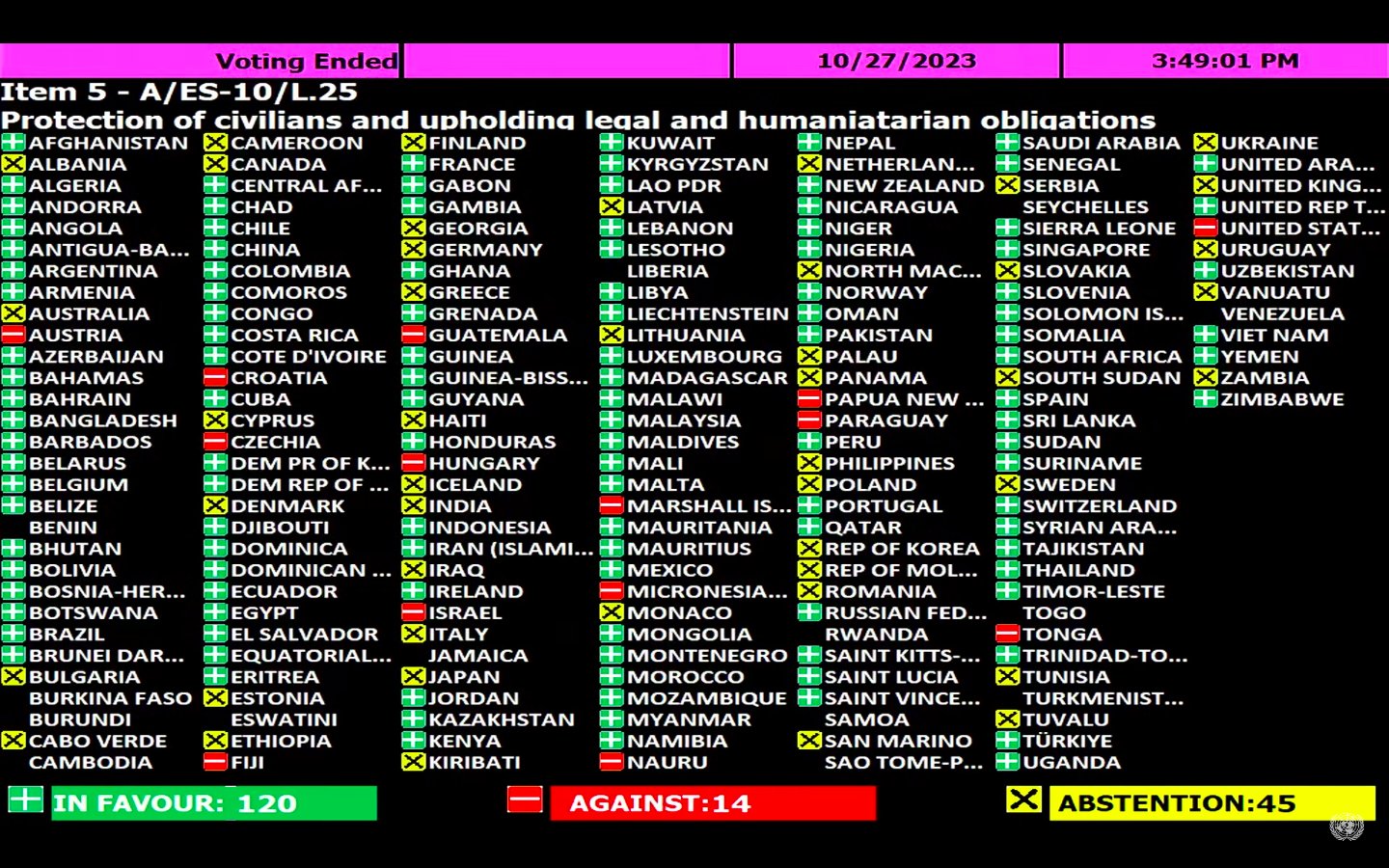
Israel killing civilians in Gaza and the West BankAlso, yesterday a resolution was adopted by the UN General Assembly calling for an “immediate, durable and sustained humanitarian truce leading to a cessation of hostilities.”
UN General Assembly resolutions aren't legally binding, so in all likelihood will be promptly ignored by Israel and the United States, but it does show how isolated they have become in terms of global opinion. -
Israel killing civilians in Gaza and the West BankDoesn't look good. Hopefully both Iran and the US can keep their cool. And minimize it to slaps on the wrist. — ssu
We can only hope.
Reports are that four US carrier groups are headed to the eastern Mediterranean and Red Sea. That's a massive deployment, likely not meant to scare small fish like Hamas or Hezbollah, and probably offensive in nature.
But time will tell. -
War & MurderPurposeful murder and accidental manslaughter are not morally equivalent.
But what group B is doing is not accidental. It is calculated, just like group A.
Both groups willfully accept that the deaths of innocents is expected and warranted in pursuit of their goals. -
Israel killing civilians in Gaza and the West BankEspecially when these it's these people that then the IDF has to safeguard in the occupied territories. — ssu
As far as I am aware, the majority of settlers are regular Orthodox Jews. The ultra-orthodox Haredi have largely (but not always) opposed settling on the West Bank due to their anti-Zionist stances. -
Israel killing civilians in Gaza and the West BankAnd it's now a bit ironic that the ultra-orthodox protested against their military service. — ssu
The ultra-orthodox even protest against the existence of the state of Israel, because they believe it is claiming the land that belongs to God.
You can find images of them burning Israeli flags during protests and things like that.
I thought that was very interesting. -
Israel killing civilians in Gaza and the West BankSo various US bases around the Middle-East have been bombed and taken under fire in the past weeks. Now the US is actively bombing those who it deems responsible - Iran and its allies/proxies.
US fighter jets strike Syria after attacks by Iran-backed militia (Reuters)
The US is going to war with Syria, it seems. And probably it won't end there. The massive build up of forces and firepower suggests they might be going to war with Iran.
Many speculate that the reason Israel hasn't gone ahead with its invasion thus far, is because the US needs to complete the deployment of its carrier groups, two of which are already in the area and reportedly two more might be on the way.
That firepower is obviously way beyond what you'd expect against an actor like Hamas, hence the speculation about a widening of the conflict.
This is following a familiar pattern of US interventions - it's going to try and pummel the enemy into submission with mass airstrikes.
The real questions is whether its adversaries are prepared for it this time around, and have something up their sleeve. -
Israel killing civilians in Gaza and the West BankAnd which is why I said they should have voted Netanyahu's fascist ass out a long time ago. — schopenhauer1
:up:
Perhaps, perhaps. But I do believe sane minds can resolve things peacefully. It's possible, just not easy. It's not easy to "bury the hatchet" on past wrongs. I think that was the point of the thread on vengeance, horror, and terror cycle. But you do need doves on both sides. I don't think everything works like Sadat and Begin, two "warriors" that came together. Rather, I think it calls for the doves coming together and agreeing that this has got to stop, Gandhi style. Economically they should freely migrate from one side to the other, but respect the laws of the other side. — schopenhauer1
Agreed with this also.
That would be just as bad if the UN was pro-Israel and condemning Palestinian actions and enforcing that. Because of problem 2, problem 1 cannot be achieved. — schopenhauer1
Imperfect though it may be. if we agree that we can't expect the two battling sides to come to a rational solution, we will have to accept the intervention of a third party at some point.
Please let it be sooner rather than later, for everyone's sake.
Ideally, that also means that Palestine would be an Arab/Muslim-oriented government that respects its minority citizens (both Christian and Jewish), similar to what Israel has, or even on the style of something like Turkey (pre-Erdogan). — schopenhauer1
Certainly. -
Israel killing civilians in Gaza and the West BankAt some point you put your big boy pants on and negotiate like an adult who cares about the physical and financial well-being of your people. You don't let grievances fester into acts of terrorism and either support or indifference to it. — schopenhauer1
Much of this starts out psycholgoically. It is the psychology of vengeance, past wrongs, religion, nationalism, and all the rest that can cause never-ending hatred. The same reason Arafat and Abbas did not take deals in the early 2000s. — schopenhauer1
I think this could just as easily apply to Israel.
But honestly, I have no problem envisioning myself being in the shoes of a Palestinian or Israeli and making the exact same mistakes.
This is kind of my point.
1) It can't act as a referee unless there is an enforcement arm. In a game, the referee is final, not ignored. If it is ignored, the game is forfeited. For the game to be a game, both parties agree to give authority to to the ref. — schopenhauer1
Do you, for example, believe the US / the West during the unipolar moment should have acted as the enforcement arm of the UN and forced a two-state solution as was accepted by, among others, UN Security Council Resolution 2334?
2) The referee has to be unbiased. No way does the UN represent an unbiased body. That will be said on both "sides" North and South (the Security Council and the General Assembly). — schopenhauer1
If anything I would assume the nations currently holding permanent seats in the UNSC would be biased towards Israel, and not against it. Or am I missing your point? -
Israel killing civilians in Gaza and the West BankI don't know what a rational manner would be. Hamas killed 1400 Israelis in the worst massacre of Jews since WWII. Any state's primary purpose is security and that is what Israel is exercising right now in its effort to destroy Hamas. There must surely be some response. Is a ground invasion justified or better to stick to air strikes? I have no idea. What is the proportionate response to 1400 massacred? Not entirely sure outside of decimating Hamas and trying to minimize collateral damage. To call for no military response is absurd and a standard that we would hold no other nation to. — BitconnectCarlos
Rationally speaking, had the Israeli government practiced restraint there would have been no doubt at all within the international community who the villains were. It would have clearly been Hamas.
I think even after initial retaliatory strikes by Israel this view would have prevailed.
It is after the intensified siege, prolonged bombing, and questionable rhetoric by prominent Israeli leaders that opinion started to shift. (Provoking the occupying force into overreacting is a typical insurgent tactic, by the way.)
But what about practical results?
Does this type of operation actually hurt Hamas? I think it does the exact opposite.
Hamas lives in tunnel networks dug up to 80 meters underground, likely with stockpiles of food and ammunition. I think they're among the people who suffer the least from these Israeli reprisals.
The people who are hurt by these bombings are the people of Gaza.
Wishful thinking may have one believe that the people of Gaza would eventually turn on Hamas and blame them for the bombing, but this is, as stated, wishful thinking and has no real precedent in history.
Pretty much ubiquitously we find collective punishment strengthens the insurgency and doesn't undermine it.
Admittedly, I am on the sideline. It is easy for me to say these things when I don't have family members to mourn. Regardless, irrational behavior will further deteriorate the crisis.
Haven't we long been at a point where both parties need to be protected from themselves? That's why I am saying, can we really expect rational behavior from either of the actors involved in this conflict? And if not, what is the way forward? -
Israel killing civilians in Gaza and the West BankI get a sense that maybe you'll agree with my view that neither side can be expected to act in a completely rational manner here, after all the damage that has been done. Would you agree with that?
If so, what approach would you suggest going forward?
Tzeentch

Start FollowingSend a Message
- Other sites we like
- Social media
- Terms of Service
- Sign In
- Created with PlushForums
- © 2026 The Philosophy Forum