
-
Assangehttps://indienewsnetwork.substack.com/p/how-blue-anon-manufactured-consent
After 2016 the intelligence agencies realized they could get liberals and democratic partisans to spread their propaganda through the one issue that could get liberals to repeat anything - Russiagate. ... The claim that Assange’s source for the DNC emails was Russia was originally drummed up by a company called crowd strike that was forced to admit under oath they had no evidence the DNC emails were hacked at all let alone hacked by Russia.... This company was what the F.B.I relied on to make their claims that Russia was Jullian Assange’s source in 2016.... So to recap, the C.I.A. could not find connections between Assange and Russia, Jullian Assange and Wikileaks published documents that exposed and embarassed the Russian government, the firm behind the claims of Russia being wikileaks source in 2016 admitted they have no eviednece in court and four former intellegence officals belive the documents were leaked over hacked based on thier expertiese. ... This propaganda despite being entirely false has caused many liberals to now to hate Assange and see him as a far-right, Trump-supporting Russian agent. ... Anyone who repeated these claims has either wittingly on unwittingly taken part in a smear campaign against a journalist who has been tortured for his exposing of war crimes.
Although no doubt the relays of manufactured consent will still think they are doing anything other than regurgitating prepared scripts from those in power. -
AssangeImagine blaming Assange for the fact that Hillary Clinton is a bloodsucking ghoul and the American political system is so fucked up that, with her as it's only alternative 'choice', some pot-shots taken advantage of by a third-rate power and amplified by domestic fanatics - i.e. half your country - got someone like Donald Trump over the line. Nah, Assange ain't at fault for the flailing of a terrorist empire who persecutes journalists for exposing their terrorism.
If your system is so fucked-up that leaks of documents that practically no one outside of a small circle of interests have ever read apart from the cliff notes - by some Australian nobody with exactly zero institutional power - than that system perhaps ought to be sunk to begin with. -
Assange"Russia" exists for Americans to absolve themselves and offshore their own entirely self-generated shitness, and if some third-rate country like Russia can take avantage of American inability to not commit war crimes on a world scale, then so much the worse for that shitty 'superpower'. Assange is a king.
-
AssangeAssange is a hero. Americans only have themselves to blame for a shitty president they deserve.
-
Standardized education opposition questionI forgot the main man - Ivan Illich. — unenlightened
Came here to say this. -
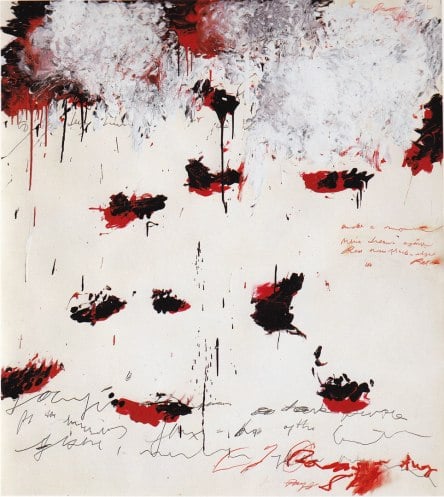
Which member on here has the best thumbnail in your opinion?Yay! It's a Cy Twombly painting, Petals of Fire.
-
Banningsthey are being compassionate to the female philosophers on the site. — unenlightened
Exactly. The moral vacuity of those who would like to see "compassion" extended to bigots while having nothing to say about a full one half of the population for whom their being lesser-than is 'just another opinion' could not be a less compassionate stance. Compassion is excizing cancer not sympthizing with it. -
BanningsAlso the main objection was that he didn't have a chance to explain himself. — dimosthenis9
Good. Proud misogynists forfeit that chance. And if anyone is offended by the way misogynists and their apologists are spoken about, good. That we are not a safe space for delicate snowflakes who want to hate women who compose our community is lovely. -
BanningsWhat's shameful is spinelessness posing as principle. Misogynists discriminate against every second person of our community. Those who cry over them are ethical voids, and their 'principled stances' are simply cowardice. A bunch of condensed cowards whining is shameful.
-
What is Being?The hypocrisy charge is so vacuous and irrelevant that it is a literal meme.

That we are complicit in capitalism - and of course we are - is yet another mark against it, yet another reason to see the back of it. Not some kind of childish gotchya moment. -
Currently ReadingJohn Smith - Imperialism in the Twenty-First Century: Globalization, Super-Exploitation, and Capitalism’s Final Crisis
Intan Suwandi - Value Chains: The New Economic Imperialism -
The Reason for Expressing OpinionsThis is odd. Surely we express opinions for all sorts of reasons. For fun. For sociality. For getting others' opinions. For challenging oneself. For challenging others. For annoyance. For agreement and elaboration. Etc.
-
Currently ReadingStevenson's Ethics and Language — Snakes Alive
I've not read this, but one of my favorite texts on ethics of all time is the 3rd(?) section of Stanley Cavell's The Claim of Reason, where he brutalizes this book.
And maybe Barthes' book on semiotics. — Snakes Alive
Am currently reading this one atm - schematic and functional, but good.
Family Values: Between Neoliberalism and the New Social Conservatism by Melinda Cooper — Maw
:cheer:
Also, about to start:
Michael Roberts - The Long Depression: How it Happened, Why it Happened, and What Happens Next. A defense of Marx's thesis on the 'tendency of the rate of profit to fall', in light of the post-2008 world economy. -
This is the title of a discussion about self-referenceTrue - but I take this to be a commentary on relative aridity of most epistemological approaches rather than anything.
-
This is the title of a discussion about self-referenceThe perplexity about self-reference among philosophers has always stuck me as hilarious. As if language ought to be up to the artificial standards of philosophers, rather than philosophers themselves dealing with artificialities. It's like that joke about the guy who only ever looks under the lamplight to find his keys, and then complains that because they aren't there, his keys must have winked out of existence. Self-reference is everywhere and perfectly ordinary. If philosophers would like to make them into anomalies, that says more about the failings of the philosophical imagination than language.
As for the relevance of self-reference: it draws attention to the event of language, it's taking place. It's the institution, at the level of the proposition, of the what is extra-propositional in language. When language takes itself as an object, the separation of language 'here' and object 'there' evaporates: language becomes enthinged, enworlded. Or rather, the always-already enworldedness of language shows itself and stops being obscured, for the briefest of moments. Self-reference is puzzling only to those who want to treat language as a pure, self-enclosed system, sterilized from any imbrication in the world. -
What is Being?There's niche band of philosophers - John Haugeland, Joseph Ruse, Rebecca Kukla - who take exactly this track of blending Heidegger and Sellars and it's probably one of the more exciting contemporary developments out there.
-
Gosar and AOCMaking shitty memes is the politics of the proletariat. Maybe instead of sticking up for bloodsucking politicians consider putting away your high-nosed class pretentions?
-
Gosar and AOCCivically educated people effectively spend their time producing and publishing threatening anime memes directed at politicians? — praxis
It just takes one dude in a basement yo. And 'civic' doesn't mean 'doing everything according to the law' - its why disobedience can be 'civic'. And yes, thrashing politicians for being shit - or for being politicians at all - is absolutely civic. Politicians should feel threatened by their constituencies, always. A vote means: 'you are worthy of my contempt', not 'I support you'. -
Gosar and AOCImagine dying from lack of healthcare only to have to watch people spend time talking about off-color anime memes. It's true that politicians should live in a state of constant fear; the trade off for power should always be misery or the constant threat of it. The problem in this situation is that it came from another politician, and not a civically educated and empowered populace.
-
COP26 in GlasgowMLK was a real suck up to power, too. — Xtrix
Ah yes, MLK, famous democratic party activist, known best for his electioneering and campaign contributions. -
COP26 in GlasgowI love that it is inconceivable to you that anyone can do anything that isn't sucking up to power.
-
COP26 in Glasgow
-
COP26 in GlasgowI'm a big fan. Probably because they don't reduce activism to 'petitioning those in power to act on their behalf' - and in fact actively disavow that sense of activism. Although activism is still a silly word mostly used by the media and liberals to enact a tidy little cordon sanitaire around political action.
-
COP26 in GlasgowYes the Australians probably voted against Trump. Very good.
The same Australians who highlighted "not choosing the give away political agency to a symbolic demonstration every four years". -
COP26 in GlasgowI love how that you're so triggered that when I post news of Biden being shit or people actually doing good in the world all you can think to do is shitpost. Go post some flyers for Biden, "socialist". Then cry more about how people aren't voting for your favourite capitalist scum.
-
COP26 in GlasgowDoing more for the climate in a day than COP26 could achieve in eons.
"Zianna and Hannah abseiled off coal handling machinery this morning at Newcastle coal port. This is the tenth consecutive day in a row Blockade Australia has shut down the worlds largest coal port!
“We are here to challenge the ruling order of domination and exploitation that is buckling our life support systems. Australia has been deliberately designed, and it needs to be deliberately confronted. We must create true decision-making power over our lives through scaling up offensive direct action and resist injustice where power operates on the ground.”
“Another system is possible and we know that because one existed on this continent for tens of thousands of years. It is now our duty to defend the biosphere that gives us life and to every person that Australia has forgotten and ignored”. -
Joe Biden (+General Biden/Harris Administration)Yep. Australia's servility to the US is pathetic and shameful. On the other hand, my freedom from getting mowed down in the street by random libertarian psychopaths is quite nice.
-
Joe Biden (+General Biden/Harris Administration)But it’s true; the sooner the world learns to defend itself and stops sucking at America’s tit the better. — NOS4A2
America relies on its tits getting sucked without which its rural economies - and by extension its entire economy - would collapse. So much so that it actively fights against efforts at international self-governance. Death overseas is the constitutive condition for American life at home. It's a nation that holds itself hostage, all the better to hold the rest of the world hostage in turn. All the better still to serve its arms dealing capitalist masters. Trump, Biden, and other subservient lackies of the American warfare state are quite happy to let this state of affairs - for which they are rewarded handsomely - metastasize indefinitely. -
Joe Biden (+General Biden/Harris Administration)No doubt you had no such reservations about Trump's $110 billion dollar arms deal with the Saudis back in '17. Nor his more recent $23 billion dollar one to the UAE. Not that it's a competition. Arms sales are a happily bipartisan phenomenon, because the US economy relies on the rest of the world killing and brutalizing each other on its behalf. The American standard of living is underwritten by the blood of the rest of the world, whose shedding it enthusiastically and materially enables and encourages. Par the the course for a terrorist state of which Biden just so happens to be the current figurehead of.
But yes, Biden, like his predecessor, is a direct material supporter of Yemini genocide, which makes support for Biden among those who cosplay as leftists all the more pathetic. Apart from "not killing the Earth", "not directly supporting genocide" is, apparently, also not one of the conditions by which Biden fanboys take into account when lending their *wink wink* totally not unconditional support to him. -
COP26 in GlasgowWho knows. Probably the future Australian population when he's done with them.
-
COP26 in Glasgow
-
Joe Biden (+General Biden/Harris Administration)The roasting must take place on democratic party approved bounds only. Just enough for a semblance of dissent, but under no circumstances must his hold on power be threatened by any means. Only inconsequential roasting allowed. Talk, but no action please (not a request, dissenters will be flamed). 3... 2... 1... aannnnd -
-
What are odds that in the near future there will be a conflict with China?Which country, America or China has the greatest history of imperial expansion. Which country has the other surrounded with military installations and nuclear weapons? Which of the two countries, has more than nine hundred military installations around the world? — boagie
These are the right questions. -
Joe Biden (+General Biden/Harris Administration)Somehow it always devolves into faces. I get it I guess, I'd do the same if I had nothing to say. Maybe throw in a hilarious Zizek quip to really give it that Xtrix stamp of predictably.
Streetlight
Start FollowingSend a Message
- Other sites we like
- Social media
- Terms of Service
- Sign In
- Created with PlushForums
- © 2026 The Philosophy Forum