
-
Systemic racism in the US: Why is it happening and what can be done?No ernest, I responded to your rise in crime rate point quite adequately, which you ignored, much like you ignored my post in your bleeding-heart thread and pretty much every other time I've actually tried to take you seriously. I'm rather coming round to the consensus that you're a bullshit artist. And no, treating non-existent crime as the absence of 'would-be-criminals' is not a 'fact', it's a bloody insult to faculty of inference.
-
Systemic racism in the US: Why is it happening and what can be done?Ah, but you clearly don't know about the most important correlation of all: pirates and climate change:

-
Systemic racism in the US: Why is it happening and what can be done?That means, over the last decade, there are well over 10 million frustrated would-be criminals — ernestm
Wow, this is so bad. Do you know how many knights there were in Europe around 1100? About 600k or so. Do you know how many knighted individuals exist today? Probably a couple of hundred. Do you think there are now 599k frustrated would-be knights?
You went to Oxford? Fucking bullshit. Like, on a day trip? -
Systemic racism in the US: Why is it happening and what can be done?Some fanicating stats about the effectiveness of US law enforcement. Long story shorts - cops are really bad at their jobs, and defunding will likely help them focus on what they are supposed to be doing. Highlighted takeaways re: crime clearance rates from 2017:
Homicide - 61.6% (probably closer to 50% due to under-reporting)
Rape - 34.5% (probably way way less)
Robbery - 29.7%
Aggravated Assault - 53.3%
Burglary - 13.5%
Larceny Theft - 19.2%
Motor Vehicle Theft - 13.7%
(source or more specifically)
Most of those rates barely scrape a passing mark - if they pass at all. Coupled with the financial oxygen that police departments are soaking up at the expense of the rest of social policy? Those are criminal numbers. -
Systemic racism in the US: Why is it happening and what can be done?A nice explainer on defunding and abolishing the police from a relatively non-partisan source.
-
Martin HeideggerI'm not sure what you mean by "idealized" here. Until that's explained, there's no way to tell if whatever conception you're referring to is narrow or not. — Xtrix
Yeah that's fair enough. Basically that Heidi offers a narrow slice of human experience passed off as a generalized phenomenology in which lots of interesting features are obscured and dropped out. I could substantiate it but I don't care enough about Heidi to spend that energy. If I had to point you in a direction, I'd say check out Alphonso Lingis's reading of Heidi in his Sensation: Intelligibility in Sensibility.
As for Heidi's philology, there's an interesting phD thesis by Rui de Sosa that meticulously tracks the responses by different philologists to Heidegger's reading of alethia, and concludes that the majority of them - although not all - more or less reject Heidi's reading. And, that even Heidi offered a half-hearted retraction of his earlier reading on the topic which barely anyone has noticed:
"The late period in the discussion of aletheia by Heidegger and the philologists is marked by Heidegger's retraction of his earlier views on early Greek truth. This cornes as a direct result of Friedlander's criticism of Heidegger and no doubt is also due to a widespread agreement with Friedlander among philologists. Heidegger's retraction remained equivocal and stated only in a cursory fashion; in his very latest work he continued to affirm that there was a fundamental difference between Greek and modem thought.
...Despite Heidegger's equivocations on the question of aletheia in his very latest work, he never again attempted to put into question the communis opinio of the philologists on the meaning of this word. He refrained from doing so, despite the fact that he continued to make pronouncements on the general character of Greek thought that seemingly set him at odds with mainstream philological opinion. There seems to be a great divide between the communis opinio growing around Friedlander's thesis that in the end andent Greek alethea was fundamentally akin to the modem concept of truth and Heidegger's daims that the fundamental premisses of the Greeks are very different from our own". (de Sosa, "Martin Heidegger's Interpretation of Ancient Greek Aletheia and the Philological Response to It")
He goes on to conclude that while there are good reasons to suspect that Friedlander's position is also not universally supported, most modern philologists have mostly just stopped any sort of dialog with Heidegger altogether. So it's still a somewhat open question, although I think it's pretty fair to remain quite suspicious of Heidi's readings as being faithful - albeit productive and philosophically entrancing. -
Does systemic racism exist in the US?I'm not saying the current waves of protest are fake, I'm saying they've been 'let through' the filters in place to control public discourse and we shouldn't take that as a means of deciding which injustice to work with. — Isaac
I think this is much too cynical and much too naive. The media powers and their unwitting lackeys - sprinkled all over this thread - have gone into overdrive in trying to reframe these protests as 'looting', and 'going too far'; police brutality is on display on every street corner, and Trump has even tried to stomp all over posse comitatus and the 3rd amendment just to try and "dominate" these uprisings. These are not filters that have been 'let though': this is the total failure of filters at work, with the State going nuts to try and reinstate them. And that's to say nothing of the evidence of small wins - still too small by far - achieved by what's been going on.
Yes we can do so by legal action, but consumer action is quicker and, if it can be culturally integrated, more sustainable. — Isaac
Again, I'm a big tent person - let's get children out of mines and defund the police and refund public goods. -
Does systemic racism exist in the US?We cannot maintain outrage at every injustice. — Isaac
Isn't that what you're trying to do? What about this injustice? And that injustice? It's precisely because we 'cannot maintain outrage at every injustice' that one needs to work with momentum where one finds it.
And frankly, now that you mention it, I'm not convinced that I want - or anyone should want - 'changes in consumer choices'. Capitalism is driven by the need to offer ever more shades of alternatives, each of which does nothing but entrench the power of capital. Every capitalist wants a 'change in consumer choices' - towards their brand. You need changes at the level of political economy, not just choosing this or that ethical phone or whatever - although all power to you if you do that. And one of the ways you do that is by showing just how interconnected all these issues are. -
Does systemic racism exist in the US?If we use what we can get, when is it going to be the turn of the 35,000 children working for less than 50 cents a day down mines to make mobile phones. — Isaac
I'm not sure you read what I wrote, or are even in fact replying to me at all. I didn't try to shut you down talking about phone brands - I don't think I even participated in that conversation at all. On the other hand, I'm encouraging you to use this momentum to talk about the links between police violence and the kind of thing that gives rise to child labour. That's what 'articulate the two together' means. I don't understand why you feel to need to turn violence into a competition. I don't see why leftist whataboutism is any better than conservative whataboutisms. -
Does systemic racism exist in the US?Let me get this straight: removing agents of state violence - i.e. the police - is somehow supposed to make the US into more of a ... police state? Like, are you even trying at this point?
-
Does systemic racism exist in the US?If you think funding public libraries, education, transport and mental health interventions will turn a country into the USSR, then Gosh, the USSR sounds pretty awesome.
-
Does systemic racism exist in the US?Right, which is why the call to defund is nothing without the call to refund public services and public infrastructure, just as I said. Pulling out police cold turkey from an environment in which their presence has only encouraged and entenched community terror and dereliction is probably going to see just that kind of backlash and, to continue the drug metaphor, symptoms of withdrawls. Again, these issues are systemic - they don't begin and end with the police. Without wider change, tinker-toy incrementalism is very likely to make things worse, not better.
-
Does systemic racism exist in the US?I think it's discraceful that the newspapers and socialist discussion groups are dominted by outcry over the deaths of a thousand blacks at the hands of their police when nearly a thousand times that amount of children (virtually all of whom are black) die from poverty in the same period due directly to our consumer choices — Isaac
Then why not articulate the two together? If these issues are as systemic as I think you would concede, then police violence functions as a metonym for wider issues which are not just supernumerary but integral to understanding both police violence and systemic cruelty. Police violence is a lever, a crowbar by which to open the door to issues which 'really matter'. You're right that this isn't being done in the main. Then do it and stop complaining about it. It's no good playing the agonized more-progressive-than-thou when frankly, many people simply don't care - not their fault; they're inured and politically incapacitated. You use what you get, and be smart about it. -
Martin HeideggerThat's a good question. Maybe no one. My favourite philosophers have always been ones who encourage an exploration beyond themselves, who offer new frames of thinking to be implicated elsewhere. Deleuze - who is my fav - offered his philosophy as a 'set of weapons' to be picked up as needed as discarded when not. I guess it's more a question of - who encourages this, and who does not? Who attempts to open philosophy to an outside, who attempts to cloister it within more philosophy? Heidi hews closer to the latter imo - which accounts for the cultic atmosphere that surrounds his followers. Nietzsche, another philosopher being discussed, seems to do the former.
Zizek writes somewhere that the only way to stay true to the spirit of a philosopher is to betray them in a direction they would not have considered. I think there's alot to that. -
Does systemic racism exist in the US?I won't speak for Jamal but I do understand that the point isn't simply to multiply racial categories as if to 'welcome white people to the club' of racially marked social groups. That's not progress. And there is lots to be said about not speaking for others and attributing issues to race where one would much prefer to be racially unmarked - one's blackness or whiteness or whatever does not have to always come into play. It's slippery, and it's hard to negotiate, but I think it's much more healthy to have something to negotiate at all then deny it a priori.
-
Does systemic racism exist in the US?Social workers and mental health intervenors should attend to most domestic disputes -- along with a police officer (in support, not in charge). Restorative justice programs should be established in neighborhoods where there are numerous misdemeanor property crimes (shoplifting, petty theft, etc.). Homelessness must be addressed with Housing First, then social services. Drug/alcohol addiction needs to be addressed with treatment, not jail time.
There are plenty of activities which the police can and should attend to: speeding, running red lights, murders, robbery, fighting, and so forth. — Bitter Crank
Yes. In many ways the call to defund the police doesn't go far enough. It needs to be coupled with the equally important call to re-fund the public, least it simply play into the neoliberal imperative to privatize everything. Comparisons like the following have been making their way around for various cities (here's another one for Columbus, Ohio), and I just pulled the most recent one I could find:
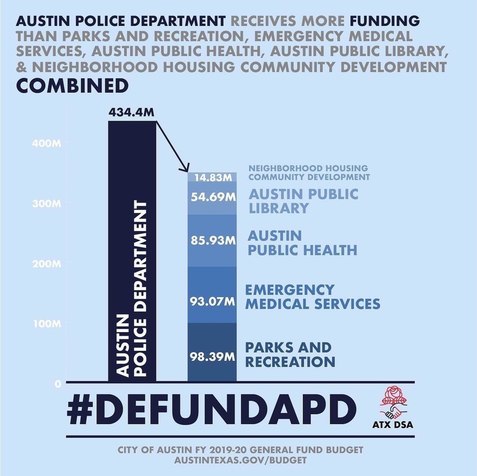
All the other programs you refer to can be paid for precisely by redistributing or reorienting what a progressive society wants or ought to value.
Maybe. But you can only try. And if you fail, the point is to fail better each time. -
Does systemic racism exist in the US?And the way it has played out so far, it seems to be predominately about race, which I don't disagree is a part of it, but it does risk missing the other aspect, especially in the measures that will be taken ultimately. — ChatteringMonkey
But then the point would be to encourage a more expansive and robust notion of race than to rail against its very mention. Now's the time to do it, if any. -
Martin HeideggerTo chime in a bit, I find Heidegger to be overly… simplistic. Not an accusation he’s usually charged with, I’m sure, but as with @fdrake, but I feel like Heidegger takes a very specific, over idealised conception of human experience and extrapolates it to very creative but ultimately narrow ends. I find I learn far more in reading a chapter of Levinas or Merleau-Ponty than I do in all of B&T sometimes. The best way I think I’ve heard it put is that Heidegger offers a ‘serene phenomenology’ in which:
“life and foreknowledge of death, individuality and connectedness, choice and foreclosure, individual and collective life in the present and projections of future prospects for both, presume, first, a close alignment between the identity the self seeks to realize and socially available possibilities of self-formation and, second, a shared sense of confidence in the world we are building, a confidence that links the present to the future through effort and anticipation at one time and memory and appreciation at another.” (William Connolly, Identity/Difference).
The lack of political and social analysis in Heidegger is no accident, but a constitutive element of his Daseinanalysis. There’s lots to learn from in Heidegger, and I always feel edified after having read him, but his whole approach has always been overly narrow to me. His peasant romanticism, his haughty disparagement of das man, his luddism are all awful aspects of his philosophy. His most interesting concept to me has always been the clearing - the Lichtung - along with his more topological considerations of Being (documented brilliantly in Jeff Malpas’ Heidegger’s Topology). But in general, he’s a thinker that’s more fun to forage around in and plunder than to take wholesale. -
Does systemic racism exist in the US?. And more importantly that we think that dealing with it as purely a race issue won't really solve it long-term. — ChatteringMonkey
No one is arguing - or at least I'm not arguing - that these issues are 'purely' race issues. If anything my line of argument has been the exact opposite: that race issues cannot be understood without implicating them into economic, social, and historical ones. But this recognition must be a two-way street. To understand racial issues as, say, economic, is equally to understand economic issues as irreducibly racial. You can’t have one without the other. As I said to someone else here - maybe you already - economics and race are not in competition with one another. They must be thought through together, and each can only ever be conceived more poorly without the other.
@Brett got confused earlier when I said that something can be specifically racial without only being about race. Another way to put this is that not even racial issues are themselves purely racial. “Race”, isolated from its social links, is purely imaginary (how could it not be? Race is a circumstance). But again, this means that the social is directly racially implicated. You can’t have it both ways. You can’t say that race issues are ultimately economic issues, while aiming to minimise any discussion of race in economics. If anything, the exact opposite holds. -
Does systemic racism exist in the US?This is a fairytale that conservatives like to tell themselves. Right wing media couldn't be more on the nose with their derangement over questions of identity if they tried.
-
Does systemic racism exist in the US?I agree, and I've made similar points many times. Nonetheless, while the momentum is here, I say use it - I haven't seen so much interesting and fruitful discussion about the role of police (in general)... maybe ever. If they have to bear the weight of all injustices so be it. All the better even, until actual change happens.
-
Martin HeideggerDon't worry about Cic. He does this every time Heidi is mentioned. It's pathological. He can't help it. Let him be.
-
Does systemic racism exist in the US?The oppression faced by blacks, even characterized at its must hyperbolic, is dramatically less than the systematic gassing of Jews. — Hanover
Sure, but that's not the salient point of comparison that I'm trying to bring out. What I do think is exactly the same is this clearly absurd idea of trying to 'smooth over' the distinctions and claim that 'bringing race into it' is a distraction or, as with the post a couple above this one, 'fanning the flames of hate'. The holocaust was not just 'people hurting people', and it would be absurd to suggest it was - or that it was only that. So too the systemic injustices visited upon the black community. The scale, intent, and rate of violence is immaterial to that.
As far as I'm concerned, resistance to understanding things in terms of race comes out of nothing but a deep anxiety over it. Black people - and basically anyone who is not white - always get pinned down to their race: being black means you are a 'black writer', a 'black lawyer', a 'black actor' or whathaveyou. Being white just means you're a writer, lawyer, or actor. The resistance to race is nothing but the terrifying idea that one might have to be a 'white writer', etc etc. It's self-anxiety reflected outwards. "Pragmatisim" means: I don't want to have to deal with race - only they need to.
There has been some discussion here about the 'uncomfortableness' of using terms like white supremacy. Gosh I hope it makes people uncomfortable. I hope it makes people squirm. Because that's what minorities have to deal with every bloody day. -
Martin HeideggerNah it was legit good. I actually laughed out loud. That phrase is just so trademark Heidi and I wasn't expecting it.
-
Weird site opening in chromeSounds like you may have your browser hijacked. I'd run a scan with Malwarebytes or something similar and see if it picks up something.
-
Does systemic racism exist in the US?Man I wish there was a thread here discussing systemic racism and how that comes about or something. :chin: That would be so rad.
-
Does systemic racism exist in the US?We could still have a problem here - it's hard to get clean statistics - but we're leagues away from the holocaust unless you believe that there is a universal covert plan in police departments to just murder black people. Is this what you believe? Do police departments have secret plans to kill black men? — BitconnectCarlos
There's no plan! It's all been a happy accident. -
Does systemic racism exist in the US?Oh no no it's OK, the wildly disproportionate murder of black people is just an accident, these things just kinda happen like magic. Nothing to see here.
-
Does systemic racism exist in the US?No I think you are just being divisive. Why are you trying to bring race into this?
-
Does systemic racism exist in the US?Yes! Just like Hitler hated lots of people! Equal opportunity murder! Nothing to do with Jews!
-
Does systemic racism exist in the US?The way Jews were treated in 1930s Germany is not remotely comparable to the way blacks are treated in the US currently. — BitconnectCarlos
Yeah, no, absolutely, why in the world would I make that comparison? Not like they get lynched by state apparatuses on the street on a regular basis. That would be insane. -
Does systemic racism exist in the US?Yeah all lives matter I dunno why you gotta bring the Jews into this specifically. WWII had nothing to do with the Jews. I mean yeah, sure, six million of them perished and there were gassing chambers and concentration camps and legislation enacted to separate them from the rest of society and murder them, but y'know, alot of other people got killed too so really we should just say that Hitler was very bad to everyone. Non-Jews also died in WWII. Don't know why anyone would single out Jews. It's so divisive! Just causes problems. It would be better if we stopped referring to Jews in WWII at all, that language just divides us.
I'm willing to accept the disproportionate murder or Jews but certainly not the systemic murder of Jews. Don't make everything about race. -
Systemic racism in the US: Why is it happening and what can be done?The past is rubbish. The future is nothing but the attempt to get over it by the present.
-
Does systemic racism exist in the US?I merely know my limits, that I am an over privieleged white animal with a useless education from oxford who is too shallow to understand anything, thats all — ernestm
Funny how the only one playing the victim card in this discussion is - would you look at that - a 'white animal'. -
Does systemic racism exist in the US?I understand, sir, whatever happened to me, I deserved it for being too shallow to understand it and a over privieleged white fuck with a useless degree from a shithole called oxford, so a series of assaults, 4 robberies, shooting my cat, and vandalizing my car is obviously what I deserved for that. — ernestm
Get over yourself. I tired to give you a fair shake in your thread, which you all but ignored. At this point you're just a bitter bloviator who is, by your admission, uninterested in discussion. -
Does systemic racism exist in the US?It's extremist quotes like this that just don't reflect reality and ignore the fact that more whites have been killed by cops,(which means that if one black is murdered everyday, then two whites are murdered everyday), — Harry Hindu
I've addressed this point multiple times in this thread. If you lack the literacy or the ability to understand those points, then I've nothing more to add.
Streetlight
Start FollowingSend a Message
- Other sites we like
- Social media
- Terms of Service
- Sign In
- Created with PlushForums
- © 2026 The Philosophy Forum