
-
Donald Trump (All General Trump Conversations Here)Ah, the 'ol secure free speech by suppressing platforms of speech trick. A classic among fucktards.
Forgetting, of course, that free speech is a principle that protects private entities from government interference... -
Donald Trump (All General Trump Conversations Here)https://nymag.com/intelligencer/2020/05/andrew-sullivan-with-trump-the-pathology-is-the-point.html
This article is a mostly useless rehashing of Trump's catastrophic uselessness - Trump's shitfuckerry is not a point open to debate - but it does end on a point well worth making:
"The key thing, however, is that none of this seems to matter to the supporters of the president. For them, the pathology seems to be the point. It is precisely Trump’s refusal to acknowledge reality that they thrill to — because it offends and upsets the people they hate (i.e., city dwellers, the educated, and the media). The more Trump brazenly lies, the more Republicans support him. The more incoherent he is, the more insistent they are. Bit by bit, they have been co-opted by Trump into a series of cascading and contradicting lies, and they are not going to give up now — even when they are being treated for COVID-19 in hospital".
One of the points of takeaway being that it's a waste of energy to to think that pointing out Trump numerous lies, failings, and reality-warping is of much strategic use. If for almost 3 years it has not worked, it's not going to magically start working anytime soon. This shit about Ukraine is an energy sink. John McCain was a war criminal and fuckbag and the world was made a better place the moment he stopped breathing. Time is better spent than trying to defend a ratfuck like him. -
The ABCs of SocialismWorth reading all the way through:
"Cutting through the culture war was Sanders’s gift. Unfortunately, since his exit from the race it has come roaring back with even greater stupidity: liberal lockdowners versus freedom fighters in open-up USA; faux outrage at Nancy Pelosi calling Trump obese; China-virus versus COVID-19. The only thing all of these fights have in common is that none of them deal with socialist politics, none of them advocate for a particular policy or social reform that would help regulate our economy in working people’s interests, none of them help organize the have-nots together by virtue of their shared economic interest against the haves. In fact, all of them succeed in burying any analysis of political economy beneath an avalanche of cultural commentary."
https://jacobinmag.com/2020/05/we-need-a-class-war-not-a-cultural-war -
Joe Biden (+General Biden/Harris Administration)Biden, normalize relations? The guy who accused Trump of being too soft on China, trying to outflank Trump on the right? Good luck with that.
Once again with feeling: fuck this racist cumsock of a human being. -
Joe Biden (+General Biden/Harris Administration)What's wrong? Did I insult your favourite racist rapist one too many times?
-
Joe Biden (+General Biden/Harris Administration)my policy would be to help them, til a future date - where they would be sent back. Is this supremacy or proudness? — remoku
No this is fair enough. Time to ship the immigrants out and leave the US to the native Americans. 300 years is time enough. Off you go. -
CoronavirusThe medical analogy is sadly common today: government as a case of maintaining the mere homeostasis of society, a bureaucracy of bare life where political questions - ones that address structural inequality, of accountability, of flourishing - are miserably absent. There's a whole very rich literature on 'biopolitics' as the overarching paradigm of political thought today. People want to be spoon-fed their politics like a doctor's patient.
-
Coronavirus:up: It's hard to imagine a more terrible analogy for democratic governance than a doctor's visit. The former being a question of self-governance, the latter being a pliant - usually sick - subject looking to an authority to tell them how to achieve a sense of normalcy again.
-
Joe Biden (+General Biden/Harris Administration)
Fuck fuckity fuck fuck 'em both. Pair of cunt white supremacists that deserve each other. -
CoronavirusI would very much like politicians to pander to their base; typically we call this democracy.
-
Coronavirushttps://jacobinmag.com/2020/05/podemos-covid-tax-spain-psoe?
"At a moment of deep national crisis, Díaz’s party insists that “those who have the most must contribute the most.” The so-called COVID tax is targeted at the superrich, particularly the one thousand largest fortunes in Spain. Under the proposal, net assets over €1 million would be taxed at 2 percent, increasing progressively to 2.5 percent above €10 million, 3 percent above €50 million, and 3.5 percent for wealth over €100 million. The tax would also apply to assets held by Spanish residents outside of the country."
:heart:
Now to expand and accelerate this all over the world - as a minimum. -
Contradictions in the universe.With the caveat that grammars are neither good nor bad as they stand; only that they are better and worse for some purposes, and not others. But yes - paradoxes are grammar - techniques - pushed to where they ought not go.
-
Joe Biden (+General Biden/Harris Administration)It's like people think Biden just popped into existence a couple of years ago and hasn't been fucking the people he's supposed to represent for four decades. Trump can only aspire to accumulate the same magnitude of blood on his hands as Biden has been lathering on all his life. Not that the former isn't trying, mind you. Still, he's an amateur compared to the decades-long professional people-fucking of Biden. Literally: Biden has been objectively responsible for a larger sum-total of human misery by orders of magnitude more than the current fuckstick in office, which I suppose makes Biden a fuckstick raised by a couple of powers. Arithmetic.
McConnell is probably one of the few people who might actually give Joe a run for his money, human misery to human misery. -
Joe Biden (+General Biden/Harris Administration)I wouldn't worry about it Tim, I don't want you to exceed your allocated mental capacity over this.
-
Joe Biden (+General Biden/Harris Administration)Presumably you're not across Biden's latest bit of verbal scatology. Par for the course given that you're manifestly exactly as you come across.
-
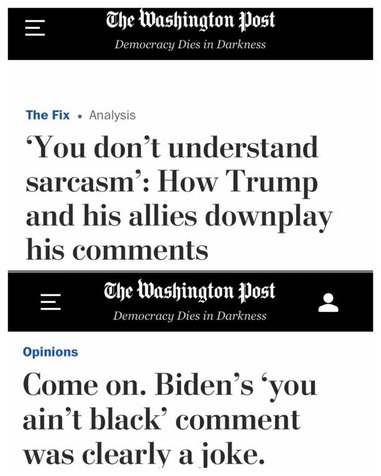
Joe Biden (+General Biden/Harris Administration)Current news: old white segregationist declares right to decide who is and is not black, depending on how much they support him. Incidentally, this is identity politics at it's finest: thinking that people owe you their vote by virtue of the color of their skin; worse and more absurdly: that the color of one's skin is determined by that vote. This coming from the same guy who once said that poor kids are just as bright as 'white kids'. This is not a gaffe. This is just Biden being the same racist fuckwad he's always been. A loathesome, rapacious cunt of a human being.
-
Which comes first the individual or the state?A couple of historical points: the state form emerged very, very late in human history, and, in official terms, only properly emerged in the wake of the treaty of Westphalia in 1648. On the other hand, 'the individual' as a political entity also emerged very late in human history, an intellectual development fermented by early liberal thinkers like Hobbes, Locke, Rousseau, and so on. Third, even the very vocabulary of 'rights' developed super, super late too, and was commensurate with the intellectual development of the 'individual'. In fact this entire cluster of political concepts - rights, state, and individual - all owe to the decline of feudal society, and the beginnings of capitalism. In a very real sense, all these concepts emerge together, defined by and with one another.
So these are not transhistorical terms, and it is very much an anachronism to ask which came first. Someone posing a similar question in feudal society might have asked: who came first? Priests, farmers, or soldiers? So my sugguestion would be to abstract from the question of 'who' came first, and ask instead which modes of social organisation came first, and how it is that these modes of social organization distributed social and political forms in their wake. The state-form and the individual-form being two political forms that developed in proto-capitalist and capitalist forms of social organization, which also gave rise to the political institution of rights. If you're going to be super abstract, what comes first is simply an ecology of society, organised in different ways. -
Currently ReadingI finished A Thousand Plateaus! Two and a bit months! What an absolutely wild, infuriating and edifying book. The longest I've taken to read something since maybe the Phenomenology of Perception. One more bit of secondary reading, then a palate cleanser after...
Eugene Holland - Deleuze and Guattari's A Thousand Plateaus
Ann Pettifor - The Production of Money: How to Break the Power of Bankers -
Deleuze Difference and the VirtualThe book is dedicated to Deleuze. There was some sort of friendship. Continuing: Klossowski's mom was the last lover of Rilke. Rilke had many lovers. One of them is Lou Salome. Lou Salome, of course, is most famous for her role as a non-lover to someone who would have preferred that things were different. — csalisbury
This is really cool. Salome was, herself, an incredible thinker and a first-rate psychoanalyst. I know of her work only second-hand - Kaja Silverman wrote an absolutely gorgeous book (Flesh of my Flesh) that deals with the notion of 'analogy', and she spends alot of time detailing the intellectual relationship between Rilke, Salome and Freud, and devotes quite a few pages to examining Salome's work on it's own terms. It made me sad and a bit ashamed that I only ever knew her as Nietzsche's and Rilke's love interest.
I read that Klossowski book a really long time ago. I remember finding it a bit hard to digest, and it's one I've been meaning to come back to. I think what I got out of it was an appreciation for just how heavily Nietzsche's psychological state left it's mark on his philosophy. What is it that keeps drawing you back?
How would you relate Deleuze's co-opting of the Nietzschean 'throw-of-the-dice' (with the sky/earth-table distinction) to this? It seems to map broadly to it, but the 'throw of the dice' itself could potentially add a few new elements, I say tentatively. Curious to hear your take — csalisbury
I'll try and relate this to Deleuze's third stipulation about the virtual: that it is not to be confused with the possible (the first two stipulations, to recall, were: (1) The virtual is an ontological problem; and (2) The virtual does not resemble the actual). This third stipulation, that the virtual is not the possible, follows from these first two. The actual (this actual horse, say) is not the realization of a 'possible horse' (note the terminological distinction: actualization =/= realization). There is no possible horse that exists somewhere and is then subsequently given the stamp of reality. So if that's the case, what is possibility? What kind of ontological standing, if any, does possibility have? How does one explain the very idea of possibility, and the idea that it comes 'before' the reality of some thing?
For Deleuze - following Bergson again - the very category of possibility is an illusion that is retroactively posited as accounting for the genesis of the actual. Possibility comes after, and not before the actual. The idea of possibility as a genuine ontological category arises when one 'forgets' that virtual problematics (grasslands, movement, light, etc) are what in fact gives rise to actual things, and when instead of difference, identity is given primacy. The possible, after all, exactly resembles the actual. It is the actual 'minus' the property or attribute of existence, but which resembles it in every other respect. This is actually alot more straightforward than it sounds - if you calculate the odds of something happening, you're almost certainly extrapolating from past events: you're using the actual to define the possible. This is how any normal betting shop will probably calculate the odds of your wager. There's nothing wrong with this per se. It just doesn't make for good grounds for ontology.
Now if this all makes sense, then it follows that there are two ways in which 'chance' can be grasped. The first way - the usual way - is that chance is the realization of one or another possibility. You have a set of possibilities, and it is by chance (a roll of the die, say) that this possibility rather than that possibility is realized. On this account, chance is subordinate to the reproduction of a situation that is identical across all throws of the die. Deleuze in the Logic of Sense puts it best: "these games... retain chance only at certain points, leaving the remainder to the mechanical development of consequences or to skill". This is just another way of saying that chance, when grasped under the aspect of possibility (and hence identity), simply 'realizes' this or that possibility, as given in advance.
However, if possibility is in fact a derivative formation that is parasitic upon an actualization that moves from virtual to actual, then there ought to be a second way to understand chance, this time as grasped under the aspect of the virtual. Rather than chance as subordinate to a given set of possibilities, this is chance as that which reorganizes or introduces new possibilities into the equation to begin with. This is why Deleuze relates the dice throw to the temporality of the future, and the introduction of genuine novelty into the world. A throw of the dice that "affirms the whole of chance each time", is one in which chance is not distributed according to a prior structure of possibility, which would instead "fragment it according to the laws of probability over several throws". Hence why the 'ideal game' is one in which "each move invents its own rules".
The stuff about the sky and earth relate to Deleuze's whole tripartite theory of time, which is a bit much to go into, but I think the above should hopefully articulate virtuality and the dice throw in a decent way. I'll say, in closing, that I reckon the discussion of the dice throw in The Logic of Sense is somewhat easier than the one in D&R. The chapter which discusses it ("The Tenth Series of the Ideal Game") is only 8 pages long, if you can read it. -
Deleuze Difference and the VirtualYeah that's a very good way of thinking about it. Deleuze characterizes his approach as an attempt to lay out Being as understood in the mode of question, what he literally calls '?-being' (as distinct from non-Being qua Parmenides):
"Being (what Plato calls the Idea) 'corresponds' to the essence of the problem or the question as such. It is as though there were an 'opening', a 'gap', an ontological 'fold' which relates being and the question to one another. In this relation, being is difference itself. Being is also non-being, but non-being is not the being of the negative; rather, it is the being of the problematic, the being of problem and question. Difference is not the negative; on the contrary, non-being is Difference: heteron, not enantion [different, not contrary -SX]. For this reason non-being should rather be written (non)-being or, better still, ?-being" (Difference and Repetition).
The danger to avoid is construing this in terms of attributes of subjects (like Aristotle). The 'question' or riddle needs to be understood as open-ended, dynamic, and temporally insisted - not closed. It's not a list. The later Deleuze (with Guattari) conceives of the relation in musical terms: point, counterpoint; call and response.
@Csalisbury, need to percolate a bit before I get back to you on that. -
Deleuze Difference and the VirtualThank you. Spent alot of time - too much - trying to figure out this stuff.
-
The ABCs of SocialismAn interesting take - not without it's problems - from a comrade:
All the discourse about small-time landlords reminds me of something I think a lot about small businesses, which is that most of the time when you hear "oh but if you did [good leftist thing] what about small businesses?" it's a good argument for why the left shouldn't particularly want many small businesses. Like, if a business is too small to pay minimum wage / endure burdensome regulation / offer family leave then maybe we want it to be replaced by a bigger business that can offer those things. Likewise, when people are like "oh well some landlords are so small-scale they'll go bankrupt if they miss one month's rent"--okay well, is there some kind of social interest in having rental units be owned by a business that's probably too undercapitalized to replace a boiler in an emergency? Should we avoid attempting policies we otherwise think would be socially desirable to keep that landlord afloat? Maybe they should sell their buildings to someone who can operate at scale.
Leftists spend a lot more time railing against big business than small business because big business runs the world, but from the perspective of a worker or tenant big business is easier to regulate, easier to organize, better able to concede to demands, etc. and all else equal it's often preferable from a worker or tenant perspective. -
The ABCs of SocialismThat all said, I'm all in favour of superfluity and excess - only one that is not propped up by socio-economic domination and the entrenchment of structural inequality:
"We hereby reject any form of self-imposed austerity. We posit that we want nice shit for everybody and that is not only feasible but desirable. We will not put forth graphs announcing how much work (or not) will require such a project but will state that such a project is part of our desire for communism. We hereby reject all forms of feigned punk slobbiness, neo-hippie shabby chic, or pajamas in the outdoors. We see the stores of the bourgeois parts of town (& the newly-gentrified ones too) and say that we want that shit and even more. Capitalism is that which stands in the way of us having the shit we want with its hoarding of commodities only to sell them to highest bidder.
We’ve been told to live with less and less by not only Green Capital, but by the Church, by our liberal “friends,” and even by fellow comrades. Fuck that shit. Nah; if we’re going to be putting our shit out on the line it’s definitely not going to be so that I can live simply.
...“I want to shed myself of my first world privilege and not live confined by how capitalism wants me to.” If only it were so simple. We’ve actually read this sentence (though its intent we’ve seen many, many times). This is pure reactionary thought. To run and do the opposite just because capitalism displays certain social features does not make one an anticapitalist. It makes you a petit-bourgeois bohemian. We all want to not pay rent, or pay for food, or have to work so many hours of our lives but there is no outside of capitalism. Asceticism is not revolutionary. Even those nodes of autonomy scattered around the globe, like among the Zapatistas, or Marinaleda, Spain still have to contend with the fact that Capital has them surrounded."
https://theanarchistlibrary.org/library/l-a-onda-hostis-nice-shit-for-everybody -
Deleuze Difference and the VirtualI missed this earlier! Will have a crack at the virtual before moving on to difference:
The virtual is best understood as a "problem" that has ontological standing. It is distinguished from the actual, which, by contrast, can be understood to be the corresponding 'solution' to the problem. A simple example that Deleuze gives - following Bergson - is the eye, which he refers to as the 'solution to the problem of light'. In other words, the eye - as an actual entity - solves a problem for a living creature: how to coordinate bodily movement in an environment, hunger, the need to live, the presence of light in the atmosphere, and a hereditary mechanism of biological evolution (among other things). The eye is a kind of 'condensation point' for all these factors, and it is a response to the conjunction of all of them. These factors or elements can be understood in turn as the virtual out of which the actual owes its genesis.
Importantly, the virtual is not 'less real' than the actual. Just as the elements that preside over the genesis of the eye are entirely real, so too is the eye. Hence Deleuze's well known stipulation: "The virtual is opposed not to the real but to the actual. The virtual is fully real in so far as it is virtual". One way to understand this is as an attempt to replace Platonic Ideas with what Deleuze instead dubs 'Virtual Ideas'. The biggest difference being that the actual does not copy or resemble the virtual. Unlike Platonic Ideas, in which say, actual horses all simply emulate the Form of the 'Ideal Horse', Virtual ideas are not mere templates for actual horses. The horse - as an actuality - is the solution to a conjunction of problems that do not 'resemble' the horse: quadrupedal movement, grasslands, human domestication, hunger, etc etc. The virtualities that give rise to the horse are nothing 'like' the horse. None of this is limited to living things either: the earthquake and the tsunami are solutions to the problem of tectonic forces and geomorphic constraints.
From this, you can get a sense of why Deleuze considers difference to be primary over identity. The identity of the horse, or the eye - or anything actual - is not a matter of an Ideal Essence which is then somehow instantiated on the worldly plane. There is no identity between the two. Rather, it is a whole play of differences that gives rise to the identity of any one (actual) thing. To be able to 'see' is to be able to evaluate differences in the environment; to be hungry to recognise a fall in energy that needs to be replenished so as to be able to engage in bodily work; to be able to move is to be able to articulate one's body among a changing environment; etc etc. These differences, and the relation of 'difference to difference' in particular 'complexes' that compose an individual, give rise to identities, which are derivative or secondary in relation to those primary differences.
The last point to make is that the 'solutions' in question - the actual - are never of a finished form. They are provisional, usually sub-optimal (nature is a hack, a bunch of jerry-rigging and kludging, inefficient and excessive) and last for only as long as the problems to which they respond insist (no grasslands, no horses). In the most general terms, this is a dynamic, worldly, and temporally infused metaphysics: things - or the actual - don't exist by virtue of some Eternal, superlunary realm which lends form to matter, but by virtue of being temporary involutions of worldly problematics and differential forces. Knots of being, as it were, less ex-istant than con-sistant, everything a matter of temporary coalescence, sustained only as long as singular fields of difference in-sist or per-sist. -
The ABCs of SocialismBut who decides and how do they decide what fair compensation is? — prothero
Ideally, anyone with a stake in how things are run. This means workers, employers, and even the surrounding society and community for whom the work impacts upon - and ideally enriches (and not just in a monetary way). I don't have any easy answers as to the mechanisms by which such principles might be incarnated. It's even possible and likely that the market will still play a role in some manner (markets, after all, are not capitalist: they existed long before capitalism, and will probably exist long after it. The problem with capitalism is the political elevation of a very specific configuration of the market as being the sole arbiter of value). -
The ABCs of Socialismou can say all you want that they shouldn't get paid more than a school teacher or janitor, but people are still going to go sell out concerts and watch movies — Marchesk
These two things are not the same.
I wonder how some of those wage slaves feel about not being able to go to work. — Marchesk
Pretty bloody good, by all accounts. And to drill it into you again: the point is not to get rid of work. It is to ensure fairly compensated work. -
The ABCs of SocialismAll wrangling aside, it's really simple: workers are the primary producers of value; they ought to be compensated as such.
Again, COVID has demonstrated this beyond a shadow of a doubt. -
The ABCs of SocialismYou seem to miss the part where the skill of an NBA player or top engineer is rare, and people are willing to pay more for that. If everyone gets the same cut, then you've distorted the value of the market, and that's where shortages and starvation enter the picture. — Marchesk
Considering that the NBA was among the first industries shut down as being entirely superfluous in the wake of COVID, I'd say the market is plenty distored as is. And of course, that we as a society decide to 'value' the rarity of some guy who can juggle his balls well is an entirely political deicison - it's not written in the stars, and to the degree that what and how we value is open to reassesment and reevaluation, we can well afford not to waste gargantuan sums of money on, effectively, an entirely useless activity - one that operates at the expense of others. -
The ABCs of SocialismExcept, this entire analysis is bullshit, as without janitors and warehouse employees and so on, the entire economy collapses, as has been the case with COVID. No accident that those who are 'essential workers' are precisely those who pick up your garbage and serve you in supermarkets. You may be at the game to watch Lebron James, but the possibility of seeing that game, at that scale, with those seats, is enabled by an entire underclass that undergrids your 'enjoyment'.
And the fact that your example defends just about the biggest fucking waste on money on the planet - the exorbitant paychecks of sports stars - says everything you need to know about the utter inefficiency and waste that capitalism engenders. -
The ABCs of SocialismWorkers are free to start their own businesses, become contractors, seek other employment, or work their way up the ladder. — Marchesk
"Free" on pain of death or starvation. And again, the point is power asymmetries: the costs of doing these things are infinitely higher for workers than they are for employers, despite value being created by workers. In any case, the point is not to do away with work, but to work, if necessary, so that the benefits accrue to the workers, and not their employers. Hence the strategic goal of socialism: that workers own the means of production. And if you're seriously using North Korea as some kind of counter-example - it's about as socialist or communist as Trump's left arse-cheek - then come back when you're ready to take the topic seriously. -
The ABCs of SocialismNo, I'm uninterested in anything you have to say. Please go rot someone else's thread.
-
The ABCs of SocialismSo as much as I agree with his assessment, I don't see any way out of not working for something. You may not work for someone but you will work for something. That is what he doesn't seem to say. — schopenhauer1
Yes, because he's unconcerned with anti-natalist/pessimist bullshit. I said it before and I'll say it again, try to steer this thread in that direction and I will continue to delete your comments. You can peddle that crap elsewhere.


Streetlight
Start FollowingSend a Message
- Other sites we like
- Social media
- Terms of Service
- Sign In
- Created with PlushForums
- © 2026 The Philosophy Forum