
-
A Sketch of the PresentNo idea. I'm still in 'mapping' mode as it were, trying to make sense of where we stand. There's alot here that needs to be filled in, corroborated, and mapped in more detail. Most of this I've only begun to put together in the last few months. Right now in my reading I'm exploring the 'life' side of things - all the literature regarding biopolitics, for instance. There's so much more I need to read/explore.
-
What does flagging a post mean? I did this accidentally several times, cant be undone.It means you've brought a particular post to the attention of the mod/admin team for review. No biggie.
-
Deletion by Streetlight X of my post on Race Realism and the Moral FallacyBut to the contrary, the said moderator refuses to discuss the issue... — Agustino
There's nothing to discuss with anyone who consistently puts into question not what I say, but the (apparent, projected) reasons for my saying things (I'm 'emotional', 'stubborn', 'overindulges in POMO literature', etc). It's the lowest, most despicable form of argument, peddled only by those equal to it. -
Deletion by Streetlight X of my post on Race Realism and the Moral FallacyAug, I'd suggest you'd not mistake my general indifference to your posts as 'begrudging acceptance'. Some arguments and people are simply beneath engagement.
-
The Survival of the Fittest Model is Not the Fittest Model of EvolutionI wonder what type of force could act like that on the genome that is not a maxima or minima? — MikeL
I suppose this is where environmental contingencies come into play; the evolution of the eye for example - a common example of convergent evolution - is largely a response to the 'attractor' that is the nexus of movement, light, and the need to avoid predators/find food. Insofar as a range of different species meet these 'requirements', they end up acting, collectively, as an attractor for the evolution of the eye. This is amplified by the fact that - as the work on genomic networks demonstrates - there are multiple possible evolutionary toward the eye.
This is, I should add, a rigoirously anti-Platonic approach to morphogenesis, insofar as the evolution of the eye is not governed by some Ideal form which is instantiated differently across different species, but by environmental contingencies which act as attractors among a topological evolutionary space. -
The Survival of the Fittest Model is Not the Fittest Model of EvolutionI understand what you mean. The adaptive landscape is itself changing through time, throwing up troughs and waves. Evolution tries to run the rise of waves. Because we can think of life as starting at Point A, we can see that it is an expanding sphere. An expanding sphere is constantly expanding its Surface Area as it expands radially. New combination of genotypes come into existence to cross the new expanse. — MikeL
Another way to think about this, if you're interested, is in terms of the topological properties that characterize such a landscape. Two parameters in particular are of interest: the distribution of singularities across the landscape (points of inflection, attractors, maxima, minima, etc), as well as the rates of change of the associated points in the network (dy/dx). Thinking about it this way allows us to drop the language of 'possibility', which, from the point of view of ontogenesis, is metaphysically suspect (again, remember that because possibility is itself subject to change, it cannot serve as the ontogenetic element which accounts for the topology and nodal distribution of the network; it is instead "derivative" of changes that happen 'in real time', as it were).
From a philosophical point of view I think then that it's actually useful to shift from the geometric POV to a topological POV because it allows us to focus less on already-specified 'properties' (specific genomic traits, in this case), and more on the processes by which they come into being. It's the difference between tracking continuous variation in topological form and tracking the discrete differences in already differentiated species. -
The Survival of the Fittest Model is Not the Fittest Model of EvolutionOh, do you mean differentiated in the meaning of differential equation? — MikeL
I mean differentiated rather in the sense of symmetry groups, where groups are defined (read: differentiated) by their invariance under rotation. If one imagines the adaptive landscape 'beginning' as entirely flat - that is, as entirely symmetrical - then speciation - the distribution of peaks and troughs across the now differentiated landscape, breaks that symmetry. Paths that were once available now become closed off: phylogeny now becomes path-dependant, closing off certain evolutionary possibilities.
However because the landscape is multidimensional, paths closed off by speciation in one dimension may open up paths along other dimensions. What is at stake here is the creation of new possibilities. In other words, the adaptive landscape is not just a series of possibilities but a series of changing possibilities, which are themselves dependent upon the actual paths of speciation. Because these paths themselves are contingent (upon the changes in actual environment), the adaptive landscape cannot be seen as a simple set of pre-existing possibilites which are then realized by the random walk of evolution or not. Possibilities themselves are subject to change such that the landscape evolves along with the species that populate it.
This is why I think the checkerboard-of-lights image is not quite right: such a image locates change only at the level of the species, which move across a board of fixed lights. The trick is to imagine the lights themselves warping the board as they flicker across it. Again at stake here is the necessity to secure the the possibility of novelty: if the board is fixed, it becomes possible, in principle, to exhaust the 'combinations' of lights turned on and off across it. But evolution is not just a matter of combinatorics: one must think the coming-into-being of the network itself.
Another more technical and precise way to put it is that the topology of the network - the relations between nodes, and not just the distribution of the nodes across the network itself - is subject to change, contingent upon the actual path(s) of evolution. It's this reflexive movement upon the very space of possibility itself that marks the difference between an emanative and immanentist account of evolution. -
Deletion by Streetlight X of my post on Race Realism and the Moral FallacyI refer you to the given reasons as to why the initial post was deleted. The first reason alone, by the way, qualified it for deletion as far as I was concerned.
-
The Survival of the Fittest Model is Not the Fittest Model of EvolutionBut there is only one living creature. Species are only several steps of genetic diversity away from each other. We differentiate one species from the next because they can't mate. That's it. But that just reflects their distance from each other in the nodal network. They are all the same. — MikeL
Ha, this is a wonderfully provocative way of putting it, but I think it's pushing the semantic boundaries a bit to say that all species are ultimately 'the same'. The philosophical danger lies in the denial of novelty: the genotype network must not be thought of in terms of a set of pre-existing possibilities that is here and there instantiated depending on environmental contingencies (Bergson's critique of possibility, if you're familiar with it, would be applicable). This would be a kind of evolutionary philosophy of emanation. Instead, the network itself needs to be something that is differentiated in time, itself shaped by the process of actualization such that it too, comes into being - co-eval, as it were - with the differentiation of species. This would be a evolutionary philosophy of immanence, rather than emanation. This is pretty abstract, but I hope it makes sense. -
The Survival of the Fittest Model is Not the Fittest Model of EvolutionOne thing that springs to mind though is to invoke a valley between two hills. On one hill is the possum and on the other the kangaroo it will change into. The problem is that in order to reach the kangaroo morphology it must pass through the valley - which is a valley of all the less desirable traits that must occur for a possum to become a kangaroo. — MikeL
Look into genotype networks! This is exactly the challenge it aims to ameliorate:
http://www.molecularecologist.com/2015/02/bigger-on-the-inside/
A teaser, from the above article, on how to skip the valley (add dimensions!):
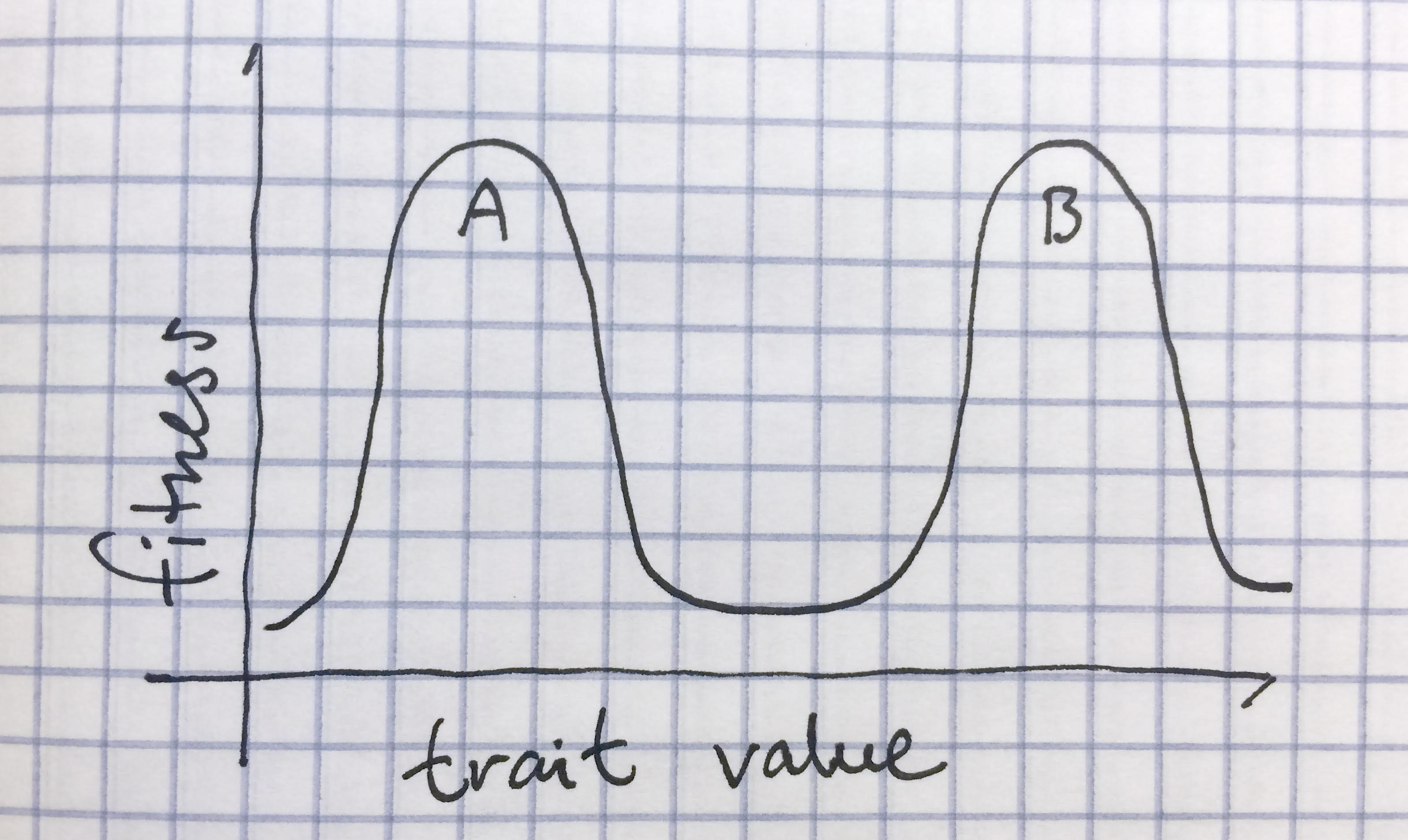
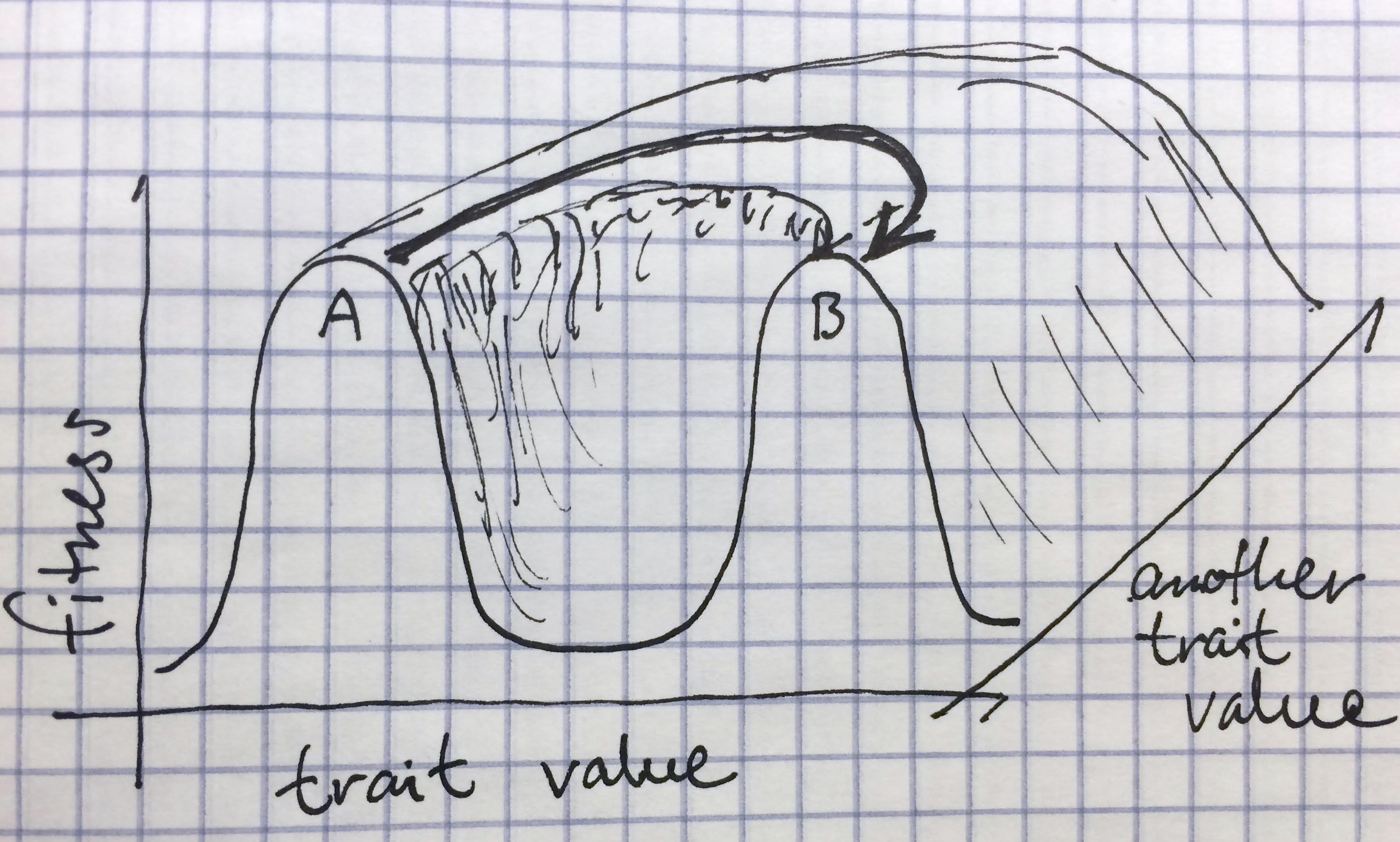
-
Deletion by Streetlight X of my post on Race Realism and the Moral FallacyThe PM you're referring to - about insults - was sent four days ago regarding your interactions with other posters in other threads, and has nothing to do with your recent histrionics. Feel free to check its time stamp. Your recent post was deleted with consultation with at least one other mod. That's all I've got to say on this.
-
With a Jury of Scientists No Man Would be Found Guilty of Murder - Proving IntentI have also explained to you on at least three separate occasions now that the intent of the op is to discuss the lack of intentionality when dealing with subjects such as the universe or evolution. — MikeL
Dude, the entire OP was a discussion of intentionality with respect to an imagined court case. The very words 'evolution' and 'universe' quite literally do not appear, even once, in the body of the text. So yeah, I'm whining about the fact that you've changed goal posts after the fact - guilty as changed. Apologies for following the letter of your posts. -
With a Jury of Scientists No Man Would be Found Guilty of Murder - Proving IntentNothing of what I have written or cited has anything to do with psychology. The field drawn upon is dynamic systems theory, which is indeed worth a look at if you're interested in these questions. Again, the sciences are brimming with 'ideas on how to approach intentionality', if you'd care to look. As it stands, it seems entirely obvious that you've not done even the most cursory of research. Not with entirely uninformed statements like this, which is what I was objecting to:
In science parallels, most people like to argue there was no intent. The nerve impulses caused the arm to raise and pull the trigger. It was an unlucky coincidence that the baker was shot. And so, the butcher would be acquitted of shooting the baker every time. — MikeL -
With a Jury of Scientists No Man Would be Found Guilty of Murder - Proving IntentThey do this by suggesting environmental constraint is causing the action... — MikeL
Nope, false again:
"But to repeat, the environment does not function as a trigger the way behaviorism would have it. The agent's own dynamics, albeit continually reset and recalibrated through contextual constraints established as a result of interactions with that environment, partition the space of alternatives and thereby structure and automatically cull the agent's options. ... The agent's intentional organization ... is the set of semantic constraints whose control loop, once again, threads partly through other dynamics and attractors, as well as through the agent's environment and past."
Seriously, study the things you're attempting to talk about. As it stands this entire thread, including your responses, remain a mixture of ignorance and projection, if not projection because of ignorance. In any case whether or not one agrees with the specifics of Jurrero's position is largely beside the point, which is that the caricature of science presented in the OP is awful. The scientific study of intention is far richer, more interesting, and far less anaemic than what is presented in it. -
With a Jury of Scientists No Man Would be Found Guilty of Murder - Proving IntentHowever, saying that the action arose in the mind and commanded lower processes to perform the action only demonstrates that the behaviour of shooting the gun was traced back through the nerve impulses to the brain or the mind. It doesn't suggest that the intent was to shoot the baker. — MikeL
No. Sticking with Jurerro as our exemplar, she is explicit about this: any intention is ultimately governed by a control loop that runs circuitously from body to environment and cannot simply be 'traced back to the brain' in a unidirectional manner. She refers to this as an intentional control loop that is 'threaded through the environment':
"Dynamical systems theory tells us that because they are embedded in history as well as in a structured environment, people are not independent, isolated atoms just plunked into a completely alien environment that affects them through mechanical forces. ... By means of second-order context-dependencies established by persistent interaction with the environment, agents effectively import the environment into their internal dynamics by recalibrating these to incoming signals. Over time, that is, both phylogenetically and developmentally, people establish interdependencies between the environment and their internal dynamics such that the former becomes part of their external structure: their boundary conditions. Context-sensitive constraints established by positive feedback weave both the environment and history into the agent's cognitive and cognative states, thereby achieving the embeddedness in space and time that characterizes those complex systems. The way adaptive systems function therefore strongly suggests that, as dynamical structures, intentions "ain't just in the head" either.
[...] It is nonsense to claim that we end at the contours of our body, or that our individual concepts and intentions exist independently of our experience and surroundings. ... This embeddedness in time and space allows us to act quickly and efficiently—and intelligently and meaningfully—without requiring that higher levels of self-consciousness be involved at all times in the details that execute conscious, meaningful orders".
Again, this is the science that you seem so eager to claim to somehow not exist. -
With a Jury of Scientists No Man Would be Found Guilty of Murder - Proving IntentWas there intent?
In science parallels, most people like to argue there was no intent. The nerve impulses caused the arm to raise and pull the trigger. It was an unlucky coincidence that the baker was shot. And so, the butcher would be acquitted of shooting the baker every time. — MikeL
Perhaps you should consult the scientific literature before putting words in it's proverbial mouth. There are most certainly scientific approaches to intention, and the stuff in the OP is largely a narrow, almost entirely fake caricature based, it seems, in no existing reality. Here is, for instance, Alicia Jurrero speaking precisely about intentionality and the ways in which it can be approached scientifically - without, by the way, doing pretty much anything you accuse 'science' of doing:
"Behavior constitutes [intentional] action (a wink, as opposed to a blink) when the brain's self-organized dynamics, as characterized by consciousness and meaning, originate, regulate, and constrain skeleto-muscular processes such that the resulting behavior "satisfies the meaningful content" embodied in the complex dynamics from which it issued. ... The global dynamics of self-organizing complex adaptive processes constrain top-down their components (motor processes in the case of behavior). ... An intention's constraints would be embodied in the meta-stable dynamics that characterize the intention's neurophysiological organization." (Juarero, Dynamics in Action).
It could only be out of sheer ignorance that one could say, with a straight face, that "in science... most people like to argue there was no intent". -
The Survival of the Fittest Model is Not the Fittest Model of EvolutionI haven't read your paper in a lot of detail yet, I will save that for the weekend, but on the face of it calling Natural Selection 'baggy' is really just saying that Survival of the Fittest didn't really fit isn't it? — MikeL
I'm not sure what you mean by 'didn't really fit' - fit what? For what purpose? Just remember that 'survival of the of the fittest' is just a phrase used to nominally designate a theory. It isn't the theory itself. For the most part it isn't even a very good nomination in my opinion, precisely because it misleads so easily (an undergrad friend of mine just told me the other day in fact that the first thing she was told by her biology professor was that 'natural selection is not survival of the fittest'). Furthermore, the baggyness of natural selection isn't a bug, but a feature: it works to drive evolution because of it's looseness, not in spite of it.
Can't speak for the studies you're looking for, unfortunately. Also, Re: the paper, just read the Introduction and the Discussion, unless math is your thing. -
The Survival of the Fittest Model is Not the Fittest Model of EvolutionWhat is fittest? What is adequate? — Rich
The term is relational of course - what is adequate depends on the environment in which a species finds itself. The idea is that evolution has contingency built into it - all life is indeed an experiment, 'going forward without knowing what will happen'. This is just the lesson of evolution. -
The Survival of the Fittest Model is Not the Fittest Model of EvolutionApart from the survival of the fittest the only factor I can think of is randomness (including mutations), even when accounting for humans meddling with the situation on purpose, so I'll consider those the only relevant factors. — BlueBanana
Again, it's not survival of the fittest but survival of the adequate. And as for other factors, again, to list: sexual selection, niche construction, phenotypic plasticity, developmental robustness, evolvability, genotype networks, genetic 'mutations', gene flow, symbiogenesis, horizontal gene transfer, artificial selection, population isolation - all of these and more can and do 'factor' as relevant mechanisms of evolution. -
Irreducible ComplexityAnd of course we don't need 'mind' and 'life' to work against entropy because entropy already works against itself (in the form of mind and life, among other things) - the production of local negentropy accelerating and advancing the production of global entropy.
-
The Survival of the Fittest Model is Not the Fittest Model of EvolutionThere is a distinction though between the two which is in the opening OP. In a situation where an animal can diverge evolutionarily, without interference, does the current model of evolution predict increased conservation of successful alleles or increased prevelance of alleles in the population? — MikeL
The trick is to think in terms of genotype and phenotype instead of simply alleles, because what matters is not just any variation, but heritable variation. Moreover, it's important to think at a population-level, rather than at the level of genetic sequence because the looseness of natural selection allows for a crap ton of unexpressed genetic variation which is 'hidden' from selection pressure, across a 'fit-enough' population. This ability for variation to 'hide' from selection pressure is in fact what allows so much variation to take place in the first place. Check out this paper by Andreas Wanger that addresses what I think your concerns are. From the abstract:
"Mutational robustness and evolvability, a system's ability to produce heritable variation, harbour a paradoxical tension. On one hand, high robustness implies low production of heritable phenotypic variation. On the other hand, both experimental and computational analyses of neutral networks indicate that robustness enhances evolvability. ... To resolve the tension, one must distinguish between robustness of a genotype and a phenotype. I confirm that genotype (sequence) robustness and evolvability share an antagonistic relationship. In stark contrast, phenotype (structure) robustness promotes structure evolvability. A consequence is that finite populations of sequences with a robust phenotype can access large amounts of phenotypic variation while spreading through a neutral network. Population-level processes and phenotypes rather than individual sequences are key to understand the relationship between robustness and evolvability." (my bolding). -
The Survival of the Fittest Model is Not the Fittest Model of EvolutionA preliminary point: despite the popularity of the phrase, natural selection does not select for 'the fittest', but for the 'fit enough'. That is, evolutionary pressure is always somewhat 'baggy' - within the constraints it imposes, it leaves a great deal of space for variation. Hence the somewhat misleading nature of the phrase 'survival of the fittest'. It's more like 'the survival of the good enough', or 'the survival of the adequate'. This should already stand as a clue that one should not see natural selection as a mechanism that is somehow 'opposed' to variation. That is, it is not - and never has been - a matter of pitching a 'natural selection' model against a 'creative evolution model'. Rather natural selection has always worked in tandem - symbiotically, as it were - with mechanisms of variation in order to produce and shore-up diversity.
In fact, what is here called the 'creative evolution model' has been the subject of biological investigation for quite some time now, insofar as it's becoming widely acknowledged that variation is not wholly explained by natural selection alone, but a host of other, interlocking evolutionary mechanisms. The key difference is that in the biological models, 'creativity' is not some kind of primordial ontological force (as with vitalism), but a product or outcome of evolution. The key term used here is evolvability: this being the capacity of a biological system to engender novel heritable traits, a capacity that can be selected for in evolution.
How this works can be pretty complex, but the abridged version is that a hell of a lot happens in the 'space' left by the looseness ('baggyness') of natural selection which, when taken together, all help to produce variation. The mechanisms that underlie these happenings don't get as much popular press as natural selection - genotype networks, phenotypic plasticity, biological robustness, sexual selection, to name a few - but the cool thing is that if you study them, you realize that they harness the looseness of natural selection so that they work 'with' and not against it to drive evolution. The long and short of it is that natural selection needs to be understood as one component among an entire assemblage of evolutionary mechanisms which, only when taken together in complementary fashion, constitute the full picture of how evolution works.
(Some references: Andreas Wager - The Arrival of the Fittest, Mary Jane West-Eberhard - Developmental Plasticity and Evolution, Richard Prum - The Evolution of Beauty). -
Currently ReadingPeter Brain and Ian Manning - Credit Code Red: How Financial Deregulation and World Instability are Exposing Australia to Economic Catastrophe
Some light, local reading while I wait for my Rose book to arrive : ) -
Irreducible ComplexityI guess any situation in which all environmental variables are kept stable - ceteris paribus conditions. Such conditions by definition force unitary explanations insofar as they are engineered to isolate context and exclude anything else that would influence the phenomenon under investigation.
Incidentally, 'reduction', as I understand it, means nothing else but context-invariance. -
Irreducible ComplexityI think part of the problem is that neither phenomena nor the explanations that account for them are unitary things: different aspects of any one phenomena may involve different explanatory schemes/levels. That is, any 'explanation' must be coupled with the question - explain what? Thus while an 'explanation' for a system may be furnished in purely reductionist terms, such an explanation may not exhaust the range of things to be explained about that system.
So with respect to the scenario in the OP, I think the reductionist is both right and wrong: yes of course the ecosystem can be 'explained' in purely physical terms - any system can be explained in purely physical terms. But would such an explanation exhaust what there is to be explained about that system? I don't think so. Thus I think even the irreductionist ought to answer 'yes' to Janus's question: yes of course all our experiences are the result of interactions of particles. The question is whether explanations furnished at the level of those interactions exhaust what there is to be explained about experiences. Again, here is where the divergence between the reductionist and the irreductionist really ought to be situated. -
Features of the philosophicalThe impression I have is that people think science is where you go to get all the answers and philosophy is some weird mystical shit, an anachronism or something. — darthbarracuda
Yeah, this is unfortunately true. I'd suggest that a large part of the problem is social and political rather than merely intellectual however: the humanities as a whole - which include literature, history, linguistics, sociology and anthropology - have been largely devalued because they don't directly contribute to the accumulation of capital. Not merely philosophy but a classical education more generally is seen as a matter for hobbyists. If many so readily agree with the views of mono-sighted scientists, it's because they are in some sense ready and primed to agree with them to begin with. The bright-light proper names of 'scientism' are less causes than symptoms. -
Features of the philosophicalWhile I agree "the public" has lost its understanding of philosophy, it is informed by the pop-scientists who continue to label themselves as "rationalists" and who erect a false dichotomy and misunderstanding of science and philosophy. — darthbarracuda
True, but if anything I think the trick is to simply ignore them when possible, and focus on the much more fulfilling and positive work of looking for opportunities of rapprochement and bridge-building. On the side of science one can look to writers like Massimo Pigliucci, Lee Smolin, and Claus Emmenche (among others) who are largely philosophically literate and don't buy into that conflictual approach. As far as public perception goes though, conflict and black-and-white line drawing are alot more fun, so it's unsurprising that Dawkins and others find such an audience. Again, just best to not play into it.
My point, I think, still stands though: that the questions philosophy tackles are by and large the most interesting and difficult questions, and that many other things get their interest by being relevant to some philosophical questions. I am not antagonistic to science - I am antagonistic to the philosophically-illiterate scientists of today. They are brazenly arrogant and have little understanding about anything they're talking about.
I think it's kinda presumptious to say what is and is not categorically 'interesting'. One imagines some hack on a science forum saying that same thing as you, only in opposite terms, to some general murmur of agreement. Again this strikes me as largely as an exercise in dick-measuring, itself uninteresting.
Are you familiar with A. W. Moore, and his book The Evolution of Modern Metaphysics: Making Sense of Things? Moore sees metaphysics as the broadest way of making sense of things, including making sense of sense (which we see as effectively started by Kant)
No but thanks for the rec! My primary inspirations for this view are precisely Wittgenstein and Deleuze, so it's awesome seeing something that takes both for it's approach as well. -
Features of the philosophicalI don't see the necessity of pitching philosphy and science in an antagonistic relationship, and if anything the strange animus towards science in the OP seems more like 'little discipline syndrome' than anything else. I also think what reigns in the public is not 'jealously' of philosophy so much as sheer mis- or non-understanding. Philosophy remains largely opaque as to what exactly it 'is' to alot of people, who for the most part encounter it only ever as bumper-sticker quotes to append to those Sunset-inspiration posters.
For my part I'm more and more inclined to see philosophy as something like a second-order sense-making enterprise: that is, philosophy examines how we make sense of the world - it makes sense of our sense-making (hence 'second-order'). Another important function of philosophy is to propose new ways of sense-making: we should understand the world like so, instead of like so. 'Sense', I think, being perhaps the most important question of philosophy, underlying even that of truth; thus the question of truth - 'what is truth'? - ought to be understood to ask not after this or that truth, but the very meaning and sense of truth itself.
And this approach ought to translate to the questions asked in the OP: Not What is the good life, but What is the good life? Not What is real? but What is real? That is, we can't take for granted what is even meant by 'the good life' or 'the real': it's a matter instead of making sense of the questions themselves, asking, as it were, what this question even is asking. And these questions might not be 'static'; their sense we make of them might well respond to extra-philosophical imperatives: historical, political, conceptual, psychological, etc. Hence the importance of 'archaeological' approaches to philosophical questions, which relate concepts back to history and ongoing 'real life' practices (as practiced by say, Foucault, Nietzsche, Agamben, and others). -
What is the most life changing technology so farImma say tie between crop rotation and sanitation systems, with penicillin just after. Although the fridge and the printing press are also my favourites, for hopefully obvious reasons.
-
Currently ReadingMelinda Cooper - Life as Surplus: Biotechnology and Capitalism in the Neoliberal Era
Nikolas Rose - The Politics of Life Itself: Biomedicine, Power, and Subjectivity in the Twenty-First Century -
'It is what it is', meaning?It can be seen as an ability, an ability to understand the rules (i.e. the presuppositions) of the game. Being able to recognise this, enables one to continue (and improve) the game, not to resign. — Πετροκότσυφας
I suppose resignation itself doesn't necessarily have to have a negative hue, to the extent that one can resign oneself to play by the rules, and be a better 'player' for it. I was going to propose another, even more emancipatory reading as well, that to the extent that something 'is as it is', one ought to dispense with what is altogether. As in, one can give a non-reformist, revolutionary reading to the phrase as well. Not unlike Daenery's promise to 'break the wheel', if we have any Game of Thrones followers among is. -
'It is what it is', meaning?I see this phrase used in conversation to explain a powerlessness in a given situation. It is beyond my control, it is what it is. Usually in a negative connotation, I rarely see it used with positive news. Perhaps it can be considered as a euphemism or verbal short cut, like an unwillingness to explain all the complex details in a convoluted situation... idunno, it is what it is. — Harkatscott
Yeah, this. 'It is what it is' is usually a statement of resignation, or inability to affect a change -powerlessness, as you put it. It tends to stand as a reluctant justification for the status quo. As if the sotto voce of 'don't question it' follows in the wake of it's use. -
Good PartnersAs a heuristic I'd imagine a good woman is one who thinks a thread like this is bullshit.
-
Request for Explanation as to Why my Discussion regarding Race as a Social Construct was Deleted.Can't speak for the Admins, but I'm 90% sure re: mods.
-
Request for Explanation as to Why my Discussion regarding Race as a Social Construct was Deleted.Moved. It's no longer possible to view the post.
-
Request for Explanation as to Why my Discussion regarding Race as a Social Construct was Deleted.I nominated the thread for deletion on the grounds that (1) it cited no sources, (2) it did not acknowledge the contentiousness of regarding IQ as a purely heritable trait, (3) it did not acknowledge the debates regarding the specificity of IQ as a measurement of intelligence, and (4) it's polemic tone was not suitable for a topic that deserves to be - if at all - treated with extreme nuance. The mod who carried out the deletion understood the whole thing to be simply flat out racist, which, to speak again for myself, is not an unfair inference. Finally, I'll simply cite the full text of Statement 5 of Genome Biology's well regarded Guiding principles on using racial categories in human genetics:
Statement 5: We caution against making the naive leap to a genetic explanation for group differences in complex traits, especially for human behavioral traits such as IQ scores, tendency towards violence, and degree of athleticism
Among the most pervasive and pernicious claims of genetically determined traits are theories on the racial ordering of intelligence [21, 22]. Despite the weak scientific basis for such ordering, the consistent return to the rhetoric of racial hierarchies of IQ reflects the powerful role that science has historically played in promoting racist ideologies [23]. Current evidence suggests that for most complex behavioral traits, contribution of any one gene to normal variation is small and these traits may be more fully explained by variation in environmental factors.
We therefore caution against making the naive leap to a genetic explanation for group differences in a complex behavioral trait, where environmental and social factors clearly can and do play major roles
Statement 4 is well worth reading as well.
I will not discuss this further. -
Studying PhilosophyThe trick with studying philosophy is that you actually have to practice it in some way - that is, write out or even just hash out arguments in a way that you yourself can follow. It's not enough to read and recite what Descartes said, in other words: you need to be able to explain to yourself not just what he said, but why he said it. Even more productive is doing comparative analysis: hashing out two different positions on an issue and examining the motivations and concerns that underlie each. In every case you're going to have to do some writing or some 'work' beyond merely absorbing what the position itself merely says. You need to be able to explain - to yourself, ideally - what is at stake in a position.
Do this over and over again, and you'll start to figure the whole thing out eventually. Also, read everything - like your life depends on it.


Streetlight
Start FollowingSend a Message
- Other sites we like
- Social media
- Terms of Service
- Sign In
- Created with PlushForums
- © 2026 The Philosophy Forum