
-
Abortion: What Does it Mean to Be Human?After we run over the 5, can we back up the trolley and finish off the guy tied up by himself? Or is that against the rules, for some odd reason? It should go into reverse, since it doesn't appear to be a cable car.
-
Should people be liberated from error?I didn't make it up. From his recordings. — Wosret
Of course you didn't make it up. At least back then they weren't messing around with all this inclusive, opinion-neutral inclusive language bullshit. People's feelings were upfront and openly expressed, which made for faster more accurate communication. "Faggy" -- hey, I know instantly and exactly what he means, where I stand, and whether I should just leave or not. Identifying faggy fags clarified all sorts of things. For one thing, he was keeping track of where all the faggy fags were. I very much wanted to know where faggy fags were in 1968, and just couldn't find them. I should have just called up Dick and said, "Hey, Dick -- where is the best place to find a bunch of fags?" It would have saved me a lot of time. -
Should people be liberated from error?↪Bitter Crank Only because Nixon saw through the homosexual agenda to dominate the fashion industry, and fool women into wearing ridiculous things making them less appealing, and less attractive. — Wosret
Thanks for noticing.
Like most of the slurs cast against Homosexuals, yours is 100% true. The agenda continues, of course. I'm not involved in this particular area of destroying Western Civilization, but whenever I check in on fashion reports in the NYT, it is encouraging to see such good work being done. Women (and some men as well) are even more unattractively dressed, ridiculous, and unappealing this year than they were during the Nixon Administration.
I'm retired now, but I served in the program to saturate public parks with obscene sex acts so that nuclear families venturing into them would be totally scandalized and would experience nervous collapse. Children living in the vicinity were, of course, at total risk of being exposed to alternate sexual lifestyles. What questions they must have asked of their mortified parents!
I pioneered the effort to scatter bits of obscene literature masquerading as AIDS education material all over the city streets. Children would pick it up and bring it home, handing it to enraged mothers, who would call City offices to complain about the filth. They taught their children to fear bits of paper on the street. They were harangued to stay away from city centers where the most vital culture is. In this way, the culture of respectable Americans was further impoverished.
Since our campaign in the 1960s - 1980s, families now restrict themselves to their fenced in back yards. Even the Internet is a risk for them, because of our Total Degradation web sites which are awaiting the clicks of their innocent (but ever so curious) babes.
And how does Donald Trump fit into all this you, you ask? Heh, heh, heh... -
Regarding intellectual capacity: Are animals lower on a continuum or is there a distinct difference?Going on rather old memory (30 years back, at least) what Koko's handlers were looking for was combinations of words that were novel. They kept track of what they had taught her, so knew when she was repeating what she had learned, and what she was generating from scratch. She might have learned "want" and "visitors" in very separate sessions, ad might not have ever heard those two words used in combination. If she saw "visitors" nearby, initiating the phrase "want visitors" would be language generation. Not very complicated but... language none the less.
It seems to be the case that primates possess very limited language ability, but how much, how little, isn't settled. Some primate specialists doubt that Koko generated anything spontaneously.
Humans do both -- imitate and generate speech. Baby humans spend quite a bit of time learning how to generate sound -- baby talk. They don't generate "ma ma" or "pa pa" without having sounds, words, and meanings, modeled for them. Eventually they go beyond imitation to generation. Then they won't shut up. -
Should people be liberated from error?Donald Trump arouses many worries. One of mine is that he would be a very unpredictable loose cannon rolling around the White House -- one that could go off (be fired!) at a very inopportune moment with very unfortunate consequences. Aside from that, it is very difficult to predict what actual policies Trump might pursue.
At the very least I would expect gifts for the rich and hard work and frugality for the rest of us.
Trump would be way too "interesting". Presidents should not be carnival side shows. They can be inspiring, but otherwise they should be boring and efficient.
I loathed Nixon; I expect I shall also loathe Trump as president. I hope to god that it won't be necessary. -
Regarding intellectual capacity: Are animals lower on a continuum or is there a distinct difference?whether or not they have anything to say — anonymous66
Not many primates have been taught sign language (or some other system) but it seems to be that at least one that had learned did initiate communication. The first thing Koko said was "Heidegger sucks." Then it asked for things that it liked: scratches, tickles, pieces of apple.
I would expect a primate to have rather simple concerns, like wanting something pleasurable, be it food or getting tickled. The life of a wild primate, probably a lab primate too, is fairly complex. How would it talk about any of it's complexity until it had learned words that described this? We have to learn the right words and concepts before we can describe our experiences. We generally need some sort of motivation to talk. (Yes, I know, this sounds contrary to fact since a lot of people seem to need no motivation whatsoever...) We don't just start talking about the difficulty of finding good and affordable rental units when we live on a farm and have no plans to move. Or, we don't start talking about the details of our feces while at a fancy dinner (or, probably, anywhere else except at the gastroenterologist's office). A verbal animal would probably also need a reason to talk about the unpleasantness of one's mate, for instance (its mate, not your mate). -
Abortion: What Does it Mean to Be Human?I think she did better, but her quippy comment is fun, anyway.
-
Poll: The anti-vaxxer movementThere is a set of people who
- distrust authority and/or expertise
- distrust the government
- distrust large institutions (like WHO, Abbott Laboratories, Pfizer, etc.)
- distrust public water treatment
- distrust multiply validated theories about disease
- and more...
These are the people who buy bottled water, even though they live in cities with excellent public water, and even though the bottled water is no better (it often is local tap water); people who trust homeopaths, naturopaths, quackopractors, and psychopaths more than medical doctors; believe in conspiracies; trust the counterculture because it is the counterculture; believe that meditation, prayer, positive thinking, up-beat attitudes, and so forth make a significant difference in disease outcomes (sorry, nothing fails like prayer); fasten on to "new diseases" like celeriac disease, lactose intolerance, "multi-chemical sensitivities", think massage which involves no physical contact by the masseur (energy adjustments) improve physical function; and more. Much, much more.
It isn't stupidity, it's anti rationalism. It's superstitious thinking. It's a way of claiming person authority: ("I know what is best for my children. No vaccination for them, nosiree. Whoever heard of anybody getting polio and tetanus anyway?")
When AIDS surfaced in the early 1980s, before the HIV test; before even the bad side-effect loaded drug AZT, AIDS victims (oops, sorry -- they aren't victims...) flocked to whatever group offered comfort--and thank god there were some! Bogus therapy can be comforting. Quacky groups can provide real community; if you have nothing to lose, by all means meditate with candles and healing crystals and have a Reiki 'therapist' wave their hands around you. If it makes you feel better, go for it -- as long as nothing else is available.
What was pathetic was that some of these groups continued on spouting this stuff, after the highly effective anti-retroviral therapies came on line. Some people had a "medical libertarian streak" which led them doubt the whole business about retroviruses.
At the other extreme are people who are so fearful of actual germs, that they maintain home environments which are so deficient in natural substances (like dirt, pollen, bacteria, etc.) that their children's immune systems don't learn enough about the real world and go crazy with allergic reactions when they encounter the real world. [This theory might be erroneous. Don't stop cleaning the bathroom and kitchen, please.]
I'm sympathetic with the ignorant and deluded, in so far as the tons of good, solid, reliable, useful information are not always accessible and actionable; are not always readable (too complicated); and aren't always practical. If you live in Brazil and just got pregnant, there may not be much you can do about avoiding mosquitos and Zika virus. -
Abortion: What Does it Mean to Be Human?However, if it were only men that might get undesirably pregnant — David
"If men got pregnant, abortion on demand would be a sacrament." Gloria Steinem. -
Abortion: What Does it Mean to Be Human?...there is a sizable percentage of people that believe it qualifies them for being killable. — David
It seems to be the case that lots of people - prenatal and postnatal - are killable if there is sufficient reason. Most people say "killing is wrong" (God himself says that) but at the same time we are perfectly willing to support killing people when it is reasonably well organized and in pursuit of a more or less suitable goal (so is God, apparently). We frown upon individuals opting to kill other humans for their own screwy reasons on an ad hoc basis.
Some people have a fetus fetish. Of course a woman's fetus is human -- what else would it be? Clearly a fetus is on it's way to becoming a being, provided something doesn't go wrong. (I say "becoming"; Maybe an hour-old newborn isn't quite a being yet, either, but it is a lot closer to being a being than a 5 month-old fetus.) That said, I don't think abortion needs to be "celebrated". Whatever else it does, abortion terminates a being-in-the-process-of-becoming, which is a at least a freighted decision. I find it OK if there are serious reasons for doing it.
Pretty much everybody has engaged in, supported, paid for, grown food for, or made bullets for war at one time or another. We are quite comfortable with killing people in an organized way, even if a lot of the people who actually die aren't the cause of our anger/anxieties/discomfort/annoyance/etc. Generally we don't know them, so... bombs away.
Does being anti-abortion (killing of innocent people) require one to be a pacifist as well? War involves killing innocent people a good share of the time. The "guilty" generally don't make themselves available for target practice. It also seems like people who are anti-abortion, pro-life, anti-contraception, and so on should also be ardent funders of orphanages. They are, generally, no such thing. "You made the choice to get pregnant with the brat that we wouldn't let you abort, so now you'd just better support it on your own, and don't come whining to us about it." -
Reading for August: poll"Rules for the Human Zoo" is good, but so is the Bullshit article. The Human Zoo seems especially current, what with the question "Are Trump and Clinton one of us or are they different than us?" Why are we proceeding to chose one of them to be our shepherd?
-
The promises and disappointments of the Internet
Possible reason for online interaction being more appealing to some...
- online communication eliminates non-verbal aspects of communication
- written communication draws on a set of communication traits different than spoken language. Most people have separate (but overlapping) vocabularies for comprehending and generating speech and text. People also think in another overlapping vocabulary.
- some people find it easier to express thinking through a keyboard than with a pencil or speech.
The differences between speech and writing have been noted for quite some time, but the printing press (Guttenberg died in 1468) brought the issue to the fore. The invention of readily usable typewriters (19th century) introduced a new element in communication: direct thought to print. A typewriter produces a line of print which is, apparently, psychologically quite different than a line of script. Electronic "word processors" (ghastly name) were introduced in the 1970s. A CRT screen displayed the pages of text entered by way of an electronic keyboard. The text was outputted to what was essentially an electronic typewriter. It wasn't quite WYSIWYG.
The Apple Macintosh introduced real WYSIWYG screens. The personal computer presented users with something different than ink on paper output of typewriters: now you could see what you were going to get, and it was easy to edit. No more frustrated ripping the paper out of the machine, wadding it up, and throwing it across the room. Now the writer could redo it at no psychological cost at all.
I experienced the progressing from manual typewriters to electronic typewriters to word processors to personal computers. I can vouch for the significance of the method of expression. -
Leaving PFGM (Standard Oil, Firestone Rubber, et al) at least a rational business plan: get rid of the mass transit systems and sell more cars. I don't approve, mind you, but at least there was a plan. Plus they weren't (presumably) laundering money -- they were syphoning it off.
-
The promises and disappointments of the InternetAge flattens everything. — The Great Whatever
It's not flattening my gut. Clearly your theory is flawed. -
Leaving PFBuying something that has value and then wrecking it sounds more like a money toilet than a money laundry. Don't you have to get the money out, in some way, to erase the odor of sleaze?
-
Just what do you mean, "The Market..."The exchange of goods and services through the use of money. — Thorongil
The "Longfellow Market" sells groceries in exchange for money.
I don't generally use the term "market" to talk about a "store". To me "market" is a rather abstract term that names large impersonal forces, of the sort that can "freeze up" which is a catastrophe. In 2007 central banks acted to prevent this from happening by creating money. The theory is that if nobody trusted anybody else, an infusion of cash into the system would help. Maybe it did. Some places haven't really recovered 9 years later.
The market is operated by very large institutions and very rich individuals. Not just the stock market, which of course serves institutions and very rich individuals, mostly. But there are other markets: the Chicago Mercantile Exchange (The Merc), Nasdaq, exchanges around the world, and various financial institutions like the World Bank, International Monetary Fund, and so on. There are future markets, and markets on the fluctuating value of currencies.
I don't look at "markets" as some sort of conspiracy (I'll be the last one to find out, most likely) just very big and under no individual's thumb. The markets are everywhere, and in some senses, nowhere, or maybe better, everywhere at once. Markets are like "the climate". Everywhere, subject to influence, not under control. -
Naming and identity - was Pluto ever a planet?I don't see any consistency in our naming. Pluto was a planet until some size queen decided it was too small. Perhaps Jupiter is not a planet because it is too big. Maybe it is a failed star. (Perhaps Jupiter feels it could have been a contender.) Why should gas bags like Saturn and Jupiter, and a small rock like Mercury all be planets? Maybe Ceres is a planet, since it is the largest of the non-planets within the orbit of Neptune. Gee whiz, shouldn't it get some credit for that? It was big enough to get itself together into a ball by dint of its own gravity, after all.
Pluto has suffered enough. Return it's dignity as a planet. FAIR PLAY FOR PLUTO! -
The promises and disappointments of the InternetNo, I would have been a monk. — Thorongil
It's not too late. Even though the Middle Ages are over, some of the institutions spawned back then are still in business. You can still become a Benedictine monk, live a monastic lifestyle, wear a dark brown wool robe, and practice poverty (been there, done that), chastity (horrors) and obedience (double horrors). You could even be a cloistered monk and never have to type www again. (Even cloistered monks have web pages these days ... http://www.carmelitemonks.org) -
The promises and disappointments of the InternetBullshit. — Thorongil
One theory is that some people are prone to becoming "addicted" to whatever gives them pleasure, be that drugs, alcohol, gambling, sex, exercise, pornography, etc. Couple that with the tendency of some people to behave impulsively or in obsessive/compulsive patterns, quite apart from any addiction. "Some people" is a small minority of the population as a whole. Most people occasionally use drugs or drink alcohol; gamble; have sex; look at pornography, and so forth. They find them pleasurable, but not so compelling that they become addicted.
If 10% of the population becomes "addicted"or "dependent" or "compulsively attached" to drugs, alcohol, gambling, pornography, and so on, the 90% who do not need not be "protected" from exposure.
I understand the desire of persons who have been harmed by addictive substances (directly or indirectly) to restrict access to adults. It is unreasonable, though, to restrict access to everyone because some people are harmed. -
The promises and disappointments of the InternetI would add pornography to the list of the Internet's ills. Its effects, especially on young people, I think are being greatly understudied and underestimated. — Thorongil
Pornography hasn't been understudied. There have been efforts to nail down the effects of sexually explicit, and explicit violent material, for many years, without conclusive results. I like porn, and my guess is that yes, it probably does have effects on young people, just like reading Jane Austin or becoming very interested in mycology or baseball has effects on young people. I'm not sure what the effects are, of course, and nobody else does either.
Pre-pubertal children should absolutely not be surfing the XXX Internet; maybe children should not peruse hard core porn before they are...13? 14? 15? At some point, though, like it or not, porn is available and has been available in one form or another since sometime in the mid-20th century. Teen agers (boys, especially) will, sure as the day is long, use it for masturbation. IF they don't mingle, mix, socialize, rub up against each other, and so forth, that's about all they will be doing. Elites had access to porn. It could be explicit, but it was drawn rather than photographed.
Films depicting (not documenting) gang rapes, S&M, etc. should be reserved for consenting adults.
One certain effect of pornography is that it defines what sex is for the uninformed. That's why younger children shouldn't be exposed to porn -- they are not biologically, psychologically, or socially ready yet. Once they are ready, it would be much better if they saw porn devoted to basic heterosexual or gay sex. Save the four-ways, double entry, S&M, and all that for a bit later. Young people should have good, ordinary, vanilla sex before more... exotic experiences. -
The promises and disappointments of the InternetNo we don't. Everything you mentioned is superfluous garbage. People need to read, think, and be compassionate. All else is howling in the void. — Thorongil
"Life together" is howling in the void?
How do you suppose the people of the middle ages carried out their lives, if not by mingling, mixing, socializing, gossiping, agitating, organizing, arguing, making love, making war, making peace, etc? Literacy levels weren't very high in the middle ages, so they weren't doing a lot of reading. As for compassion, one has to be in real personal contact with other people in "life together" to be able to exercise compassion. (That's still true.)
Life in the middle ages, at least where it can be documented, wasn't all that bad, at least in good weather and between outbreaks of major illness, crop failures, etc. People sat together, ate together, talked, laughed, danced, worked, all that real stuff. -
The promises and disappointments of the InternetThe pioneers of the World Wide Web thought it would usher in an era of people power and the free flow of knowledge.
> era of people power
> free flow of knowledge
> serious journalism accessible to all
> nation states would become obsolete
> social hierarchies would be dissolved
> emerging conventions would ensure a pleasurable and accessible experience for all — jamalrob
That is rather a lot of transformation to expect in 25 years. Expecting all these things from the Internet is similar to the early high expectations for photography, telegraph, telephone, recorded sound, radio, and television. Wired and broadcast communications have had huge benefits, and some drawbacks, true enough. But so did Johannes Gutenberg's printing press. Both the sublime and the fecal would end up in book stalls.
It may be that electronics will yet deliver but more likely, counting on wiring schematics and total digitalization of everything to deliver the goods will be a non-starter. That's because the listed benefits of the Internet derive from social activity, not from bytes and bits flowing along wires or through the air.
To the extent that the Internet improves social activity, it can be a good thing. But freedom and totalitarianism are both outcomes of human social activity. To the extent that the Internet fosters acedia, alienation, angst, anomie, atomization, and all that, it is a bad thing. But "all that" depends on individual and social actions.
We all need to get out more to mingle, mix, socialize, gossip, agitate, organize, argue, make love, make war, make peace--real stuff, not virtual reality. -
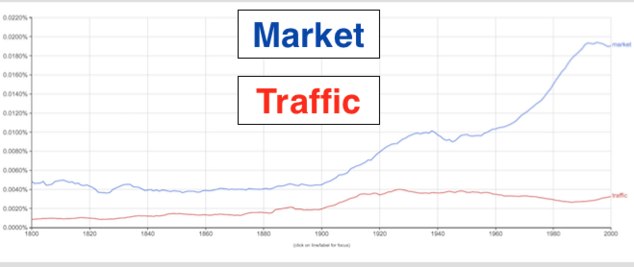
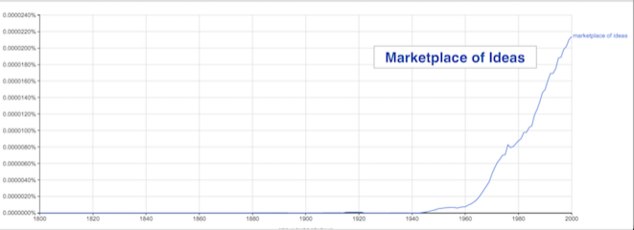
Just what do you mean, "The Market..."Google Ngram will find the frequency of words in its db used between 1800 and 2000
-
Just what do you mean, "The Market..."
I made an addition or two to the article. Your definition is one that many people would suppose to be the case. But in political discourse, (or traffic, or in "the political marketplace) "markets" mean something more, less, and other than mere "exchange of goods and services through the use of money". -
Regarding intellectual capacity: Are animals lower on a continuum or is there a distinct difference?1000 nouns won't get anyone very far; one needs verbs, particularly forms of TO BE and TO HAVE.
none possesses the idea that the researcher exists as an individual being, let alone could she be a repository of knowledge. — tom
A dog might know that someone is an individual (has a unique set of odors). But no, I wouldn't think a dog would recognize anyone as a repository of knowledge. (Dogs, and some other animals, will solicit assistance from others, though. But doing so doesn't require verbal knowledge.) -
Regarding intellectual capacity: Are animals lower on a continuum or is there a distinct difference?However dogs (etc) are pre-rational; yogis (etc) trans-rational. 'Falling short' is not the same as 'going beyond'. — Wayfarer
I wasn't being serious about dogs and yoga. -
Regarding intellectual capacity: Are animals lower on a continuum or is there a distinct difference?Is the human mind a single cognitive power, however complex, one that involves the functioning of our senses and whatever follows from their functioning, such as memory and imagination, or should the human mind be divided into two quite distinctive cognitive powers-sense and everything to which sense gives rise, on the one hand, and intellect, able to understand, judge, and reason, on the other? — anonymous66
I think the mind is a single power composed of cognition, emotion, sensing, memory, imagination, and what flows there from. We can parse out very specific capacities (like vision acuity or memory competence) but that doesn't mean the capacities aren't integrated.
The entity of each 'self' is a whole. How we perceive, think, feel, remember, and act is blended together.
We trip ourselves up all the time, but just right now we are talking about animals. What trips us up is that dogs--an animal people are very familiar with--are also whole entities, and we connect with them where there is common ground, like emotions, perception, memory, behavior. That's enough on which to build very strong bonds. Any signs of thinking are extra gravy.
The sense of "self' isn't the same as awareness of mind. A number of species pass the "self test"--elephants for instance. Dogs have not. Dogs are unique among animals in following our gaze. I don't think wolves are so abled. But following our gaze doesn't mean they recognize mindedness in us, or possess mindedness themselves. The ability of humans and dogs to follow each other's gaze is a fairly big deal, but it doesn't require "mindedness".
Many animals with whom people become very familiar (pigs, horses, cattle...) also reveal a package of capacities which not only allow us to work with domesticated animals, but provide rewards as well. Small herd dairy farmers (like 30 to 40 cows) really know their cows as individuals. Same thing for horse people, pig farmers, and the like. (Pigs are pretty bright animals, actually. That we raise pigs in rather inhumane conditions distracts us from the mental resources they possess.) -
Regarding intellectual capacity: Are animals lower on a continuum or is there a distinct difference?I might not be heartbroken if it turns out that there is no evidence.... — anonymous66
I might not be heartbroken either, if it turns out that there is no evidence. And in any case, I don't expect ever (well, not in the next 2,000,000 years anyway) to find a wolf or a whale thinking about God, angels, infinity, souls, the great chain of being, or such topics.
Apokrisis point about grammar makes sense. A grammatical language seems to be required to think and talk about abstractions. Dogs do seem to live in the present--something people practicing Yoga strive to do. "Be present in the moment...." Hey, my golden retriever was an ace at that. At least as far as I could tell. For all I know, she wasn't just laying on the couch staring out the window;; she may have been communing with the Mind of God, or reviewing the various resentments I am sure she harbored. But I can't say.
Oliver Sacks wrote a book about sign language, and the dramatic impact it had on adults, particularly, adults who had recently learned it. Concepts that had been invisible before suddenly became possible. Their experience of time, for instance, was greatly enriched.
But, perhaps your (Bitter Crank) point was that there isn't much evidence now, but if people actively look for it, they might derive ways to find it? — anonymous66
Well yes, that was my point. My conception of "animal thinking" is that their thinking is rather simple. I'm well aware how easy it is to assign more "thought" to a pet than their behavior requires. As we establish our relationship with a puppy, for instance, dog and human are each learning how the other one operates. Dogs make good pets because their species interacts in groups just by nature. They have to learn how to do it, but they are well equipped. They are sensing, learning, and remembering, the same way a young child senses, learns, and remembers.
Some dogs, parrots, and primates have learned word lists, for instance. They can learn that the word "shoe" matches a shoe-shaped object. This genius border collie in Germany managed to learn 1000+ words (each for a unique object, which it was able to fetch on the basis of the spoken word]. This is outstanding performance for a dog, but it is the sort of things dogs do all the time. Include the world "walk" in a sentence, and the dog is likely to pick that word out and start agitating to go for one.
One of the things about animals learning language is that it doesn't seem to do anything for them. WE like teaching them, and WE think it is exciting to watch them learn and perform, and since the animals are rewarded frequently, they like it as long as the rewards last. But knowing 1000+ German nouns probably didn't enrich the dog's mental life. (Just guessing.) What our dog found life enhancing (going by body language) was getting fed, drinking water, being let outside on demand, going for walks, playing, and being scratched and petted. She had a stiff knee so she started soliciting scratching from us--which she found superior, apparently. She liked our furniture and our food a lot, and appreciated heating and AC. That's about it. She refused to learn commands (aside from speaking for food, sit, lay down, and shut up). No paw shaking, no rolling over, no sitting up, etc.
Our language makes anthropomorphizing almost inevitable. We ascribe thinking to animals when we say "she wants...", "she doesn't like...", "she looked disgusted about..." and so forth. Our language works on people, of course (reasonably well), and dogs are as anxious to please (more so, usually) as people. Interpreting their behavior as sentient just comes naturally. Hell, we ascribe sentience to our cars sometimes. -
Economists Lead Lives of Bad PrognosticationI think population growth is directly related to improved living situation for all. — Cavacava
Cities that have experienced enormous growth over the last 50 years generally have meant better living conditions than isolated villages, small towns, and gawd-awful places like Podunk, Mississippi.
The residents of Rio's favelas, urban but still poor, probably live a better life than they did in the villages whence they came. (That's why they went to Rio.) The water may be dirty; the air may stink; crime, violence, and corruption may be rampant; but the air and water probably weren't pristine where they came from. Ugandans living in agricultural counties can grow their own food (if they have enough cash to buy seed), but their water likely comes from an inconveniently located dirty river, which might dry up. Nairobi's slums keep growing because people find that they can't survive very well in rural Kenya. The bread-basket Midwest and great plains have become less populated because a lot of people went to the coasts--not just during the dust bowl of the 1930s, but just last week when the weather was great.
But if Nairobi's slums are better than the villages of Kenya, that doesn't mean they are great places to live. Water supplies are fitful if available at all; there are no sewers and GI disease is common. Medical facilities are not plentiful and neither are schools. Many people are malnourished, very poorly housed, and quite possibly not employed. But most likely, all those conditions apply to rural life, too.
However good cities are, I find it difficult to believe that the principle of more=better will always apply. 10 million people can not manufacture a great urban lifestyle out of nothing. Resources, production, and markets are needed, and that depends on a larger area than the city itself. -
Regarding intellectual capacity: Are animals lower on a continuum or is there a distinct difference?
Studies in animal behavior (including emotions, cognition, memory, perceptions, etc.) will either validate your intuition or they won't. Personally, I bet that it will be shown that your intuition is correct: Animals (including humans) occupy a continuum of capacity and performance in both emotion and intellect.
The details of the continuum probably won't be fully elucidated in the lifetime of any readers here, but the subject is being studied now and results, like Nim's picture sorting, trickle in.
(There is a lot of background noise, like discussions about whether computers are capable of sentience, that needs to be filtered out.) -
Regarding intellectual capacity: Are animals lower on a continuum or is there a distinct difference?elephants and whales have much bigger brains than man. — Cavacava
Elephants and whales have big brains because they have a lot of body, and the brain runs the body. Voles and sparrows can get along with much less brain, because they have much less body to run. A good share of our vaunted brains have little to do with philosophizing. Large hunks of our brains keep us upright and taking nourishment. We have some hunks of brain that specialize in thinking. Canaries have enlarged lobes concerned with singing. Dog brains have quite a bit of territory devoted to smell. I would expect that whale brains have enlarged lobes dealing with sound imaging.
(But then, horses are a lot bigger than us and they don't have bigger brains. Ditto for hippos. Elephants and whales are, of course, thought to have more extensive mental lives than horses or hippos.)
On being:
I think a dog is a being. It experiences all of the bodily sensations (more, actually) that we do; it feels the same unreflective emotions we feel; it has memories. It anticipates future events (like your arrival at the front door every day at 5:30 p.m.) An old arthritic dog won't respond with its former enthusiasm to the prospect of a walk, but it's still glad to see you. When they have had a stroke, they display the same confusion and uncertainty that people display.
This isn't to humanize the dog. It's to 'animalize' the human. It's in the realm of the body and the way our body enables us To Be that we find common ground with other animals. People who place an over-emphasis on their mental existence, and devalue their physical existence are likely to see less continuity with the rest of the animal kingdom.
Dogs don't/can't worry about the meaning of life? Lucky them, maybe. -
Are you doing enough?Effective Altruism (EA) is a social movement which focuses on improving our utility towards others — darthbarracuda
are you doing enough — darthbarracuda
Obvious answer: of course not. Mea culpa. I have not done those things I ought to have done, and when I did do them, I didn't do a very good job of it, and I resented your needing assistance to start with. Next time, solve your own damn problems.
But "utility toward others" involves complicated relationships, even if altruism is a simpler helping relationship.
Purchasing the game console was not an altruistic act, but it had definite utility to the salesman whose livelihood depends on selling game consoles. Accepting the pamphlet about Jesus from the street preacher (which you tossed in the trash can) wasn't an altruistic act, but it had utility to the street preacher: taking the brochure was a small validation of the preacher's efforts. Buying the farmer's sweet corn is an act of commerce, but it contributes directly to his livelihood.
Millions of people are engaged in work which is officially altruistic: the helping professions -- everyone from psychoanalysts on down to nursing assistants who change the diapers of bed-bound patients. Many of the tasks for which helping professionals are paid are also acts of altruism.
We (society) expect parents to take care of their children. Doing a diligent job raising children isn't an act of altruism, but there is great utility in doing the job well, and it is a blessing on everyone concerned when the job is done well. And so on.
We are tied up in webs of mutual utility to one another. Many people act altruistically to the people in the immediate community.
Now some people, presumably, avoid interaction with other people; They buy as little as possible; they perform jobs which only most remotely benefit anyone (if then). They are single. They do not have children. They do not maintain a relationship with their family. They are social isolates, sort of Ebenezer Scrooges. They may not commission harm to anyone, but they omit a great deal of benefit to anyone.
Be a good citizen, be a good parent (or child), be a good neighbor, be a good worker. Involve yourself in your community. Help others when you can. Avoid harming others. It's not that hard to be effectively altruistic. -
Regarding intellectual capacity: Are animals lower on a continuum or is there a distinct difference?We are, to a large extent, as shut out of other animal's minds as we are shut out of each others'. We can only judge other minds by behavior (including speech). I think we are on a continuum with other animals.
As far as I know, neurons work pretty much the same way throughout the animal kingdom. The differences among species in "thinking" is in brain mass and architecture. Birds and animals all share some architecture. A limbic system is present in birds and mammals both, for instance. Animals have emotional capacities. We all have varying sensory capacities--to a greater and lesser degree--memory, problem solving, etc.
There seems to be a distance between the brightest animals and humans, though, both in kind and quantity of intellectual activity. It isn't that we have better neurons--we have a lot more of them arranged in far more complex architecture. Presumably, our mental operations and consciousness are more complex and expansive than that of Chimpanzees, elephants, and parrots.
But... all animal species struggle to survive in a hostile world, and they all use their mental resources to do that. Once they are secure enough, they can feed, seek a mate, and rear their young. Some animals (various species) seem to engage in play--rewarding behaviors not required for survival.
How much of "a being" an animal is maybe depends on how well we know the animal. We get to know our pets very well; they seem like "beings" like us. Biologists who study animals closely find that even insects have a few individual differences. One can "befriend" a squirrel in the back yard and it being an opportunist, will interact with you for food. It's a pleasant experience to have a squirrel sitting on one's knee eating out of one's hand. It will come looking for you at the usual time. It will take on individuality.
Biologists have observed squirrels and birds that store food to fake it if they think a competitor is watching them, or if watched, they may return to a storage location and move the food. Such maneuvers seem to require a kernel of self-awareness. -
US Senate Rejects Gun Control BillsYea. But nobody's kids should be exposed to drive by's. We'd have to take their kids away from them first. — Mongrel
OK. Take their children away from them first. -
US Senate Rejects Gun Control BillsNRA members should be required to visit families who have experienced loss.... or something like that. — Mongrel
Maybe they should be required to reside in neighborhoods with high levels of gun violence. -
What turns someone into a smarter stronger being?"IQ" isn't a precise measurement of intelligence; it's a score produced by various tests. Even if it were precise, what counts in life is performance. There is generally some kind of connection between a specific IQ score (80, 100, 120, 150, 200...) and performance, but IQ scores are only somewhat predictive. Furthermore, we get smarter as we get older - at least we like to think we do.
How much of intelligence is genetic and how much is environmental isn't precisely known and is probably variable from person to person. Your theory places quite a bit of emphasis on experience, which I think is right. Whether adverse experiences are especially good at boosting intelligence... don't know.
It does seem to be the case that intelligent people are better at problem solving than stupid people are.
Getting strong enough to defend one's self from aggressors is an intelligent response, but there are others. Lots of intelligent people don't seem to have become intelligent on the basis of abuse, and abusive behavior probably stunted more people than it ever helped.
The Wikipedia article you cited also noted that very high scores are unreliable, and I would add, perhaps nonsensical. Is someone with an IQ of 200 twice as intelligent as someone with an IQ of 100? How do we measure the difference between IQs of 100 and 200? -
A handy guide to Left-wing people for the under 10sAs David Harvey says, the current economic system is predicated on 3% annual growth forever, which is impossible given the finite resources of the planet, some of which are nearing complete exhaustion. This means that at some point, probably several decades from now, we will be forced into thinking about a zero growth economy.
In the meantime, let's please try and get as many people and countries on board with the secular rule of law and the respect for human rights. — Thorongil
Totally agree. -
A handy guide to Left-wing people for the under 10sI meant the industrialized world and the aspirations of the developing world — Thorongil
Some people think that we should all aspire to a lifestyle of high consumption, and that with cheap and clean energy, there will be enough of everything for everybody.
An old joke (from the 1960s...
First the good news: The water is 100% polluted.
Now the bad news: There won't be enough to go around.
Even IF we had as much cheap clean energy as we wanted, we can not conjure fish from the sea that are not there, grain from harvests that have failed, and apples from orchards for which there are no bees. The mass of the earth may have more of every mineral than we could possibly use, but that doesn't mean it can be extracted without high cost in terms of capital, pollution, destruction. No environment will support an indefinite number of people living high consumption lifestyles.
So, "the lifestyle you want nothing to do with" might be the lifestyle which we should all have nothing to do with, if we are to make it through to the other side.
The view that we should live with less materiel is anathema to many. "No, no, no." they say; "technology can solve all supply problems. There will be enough for everybody's wants and wishes." The only reasonable response to this approach is "Bullshit!"
What aspirations can be met, should be met, and what can not be met is something that we really need to settle. -
How would you describe consciousness?Can "consciousness" even be described by the conscious entity? How do we exteriorize ourselves to our own consciousness so that we can observe it, and still be conscious?
-
A handy guide to Left-wing people for the under 10s[we] face being literally impaled by a nut screaming Allahu Akbar — Thorongil
And we really, really hate it when that happens. If anyone out there has a sure fire method of predicting who the next Allahu Akbar-screaming jihadist lunatic will be, please notify your local defense department.
your posh, materialistic lifestyle and rampant consumerism — Thorongil
Or our posh, materialistic lifestyle and rampant consumerism? If you missed out on the lavish, luxurious lifestyle that the rest of this philosophizing crew rolls around in, I am sorry you were standing in the wrong line.
BC

Start FollowingSend a Message
- Other sites we like
- Social media
- Terms of Service
- Sign In
- Created with PlushForums
- © 2026 The Philosophy Forum