
-
Reversible progress: Gay rights, abortion rights, the safety net...Yes, sexual debauchery definitely was also in the list. I highly advise you to start by reading this article: http://people.uncw.edu/kozloffm/glubb.pdf — Agustino
OK, I'll check this article out -- but it is a fairly long article, I'm heading off to a funeral right now (just ushering -- never met the man) and I may say something before having the alleged enlightenment to be derived therefrom. -
Reversible progress: Gay rights, abortion rights, the safety net...Yes it was the harems. — Agustino
The last Osman was encouraged by the Young Turks to spend as much time in his harem as possible. Why? To keep him busy and out of the way. When the time came he was relieved of the harem and hustled off to some other location. It wasn't the ladies in the harem that collapsed the Ottoman empire, it was done by the usual methods of bringing down deadwood elites. -
Reversible progress: Gay rights, abortion rights, the safety net...If sexual debauchery didn't collapse the Roman Empire, what did?
1. effective military resistance and offensives by various peoples on the borders of the empire
2. reliance on slave labor and a slowing down of economic growth (linked to decline in geographical expansion)
3. splitting the empire between Rome and Byzantium
4. paradoxically, both the end of the empire's expansion and earlier unsustainable expansion
5. corruption
6. adapting Christianity as the state religion destabilized the previous sustaining value system
7. the infiltration of "barbarians"--less of an invasion and more a migrant movement
and numerous other causes.
Rome didn't so much "collapse" as gradually subside. The western empire didn't end in an apocalyptic event as much as it gradually fizzled out. From year to year, the fizzling out was probably not all that noticeable in many places; decade to decade and century to century, yes. My guess is that world civilizations are being slow-cooked like the proverbial frog in the pot of heating water. We won't notice it on a month-to-month basis. Too slow, too gradual. One day somebody will find a still-intact old magazine (LIFE or National Geographic) and see what the world used to be like, and then it will all become very clear. The curtain had long since fallen. Sic transit gloria mundi and all that. -
Reversible progress: Gay rights, abortion rights, the safety net...What is enjoyable or pleasurable needn't be "good" for a person
— Arkady
In which case it is immoral. Desire for something other than the good is immoral. — Agustino
Some people like diet no-caffeine Pepsi. It is clearly not good for people because it contains no nutrients (other than water). Carbonated water is harmful to teeth. Animals have no need for artificial sweeteners. Caramel coloring may be harmful (don't know). This product does not even have the salutary effect of offering a mild stimulant, yet it costs as much as full sugar caffeinated Pepsi. Clearly it is a fraud in a can (one of my favorites).
Drinking it is immoral?
Drinking excessive amounts of soda or pop or tonic, whatever one calls it, is probably unhealthy to some degree, the same way that eating excessive amounts of bacon is unhealthy.
Being unhealthy doesn't make it immoral, it makes it ill-advised.
Bungee jumping is ill-advised too (imho) but its ill-advisédness doesn't make it immoral.
"Morality" is a useful guide, but conservative rules on sex are not the only appropriate guidance we can use for achieving a good life. Doing what is salutary for the maintenance of health, and avoiding what is clearly bad (for health) are also appropriate - and demanding - considerations. Promiscuity in the form of unprotected sex is clearly a bad practice in this time of HIV, Ebola, Zika, and increasingly antibiotic resistant gonorrhea. People who insist on reckless sex and fail to reduce risk and harm achieve immorality, in my opinion, in the same way that people who refuse treatment for TB are immoral. Putting others at needless and life-threatening risk becomes immoral by a different route than your rules of sexual propriety.
Sex-for-nothing-but-fun or "treating your body like an amusement park" (as Mrs. Costanza accused George of doing [Seinfeld], is not harmful and won't be harmful if risk and harm are reduced to negligible levels. Husbands and wives secretly whoring while at conventions, on the other hand, introduces a probable harm into a marriage even if not so much as a virus particle is transmitted. The harm is in acting on a downgraded valuation of one's spouse. -
Reversible progress: Gay rights, abortion rights, the safety net...Kudos to PayPall for cancelling it's operations center plans in NC.
— Bitter Crank
I know this is way off-topic, but for the love of god, people: "its" is for the possessive. "It's" is a contraction of "it is." I give non-native English speakers a bit of a pass on this, but you're from the American Midwest, where English is the lingua franca (sort of). >:o — Arkady
Actually I do know the difference between "it's" and "its". I aim for perfection but sometimes I miss. It's my fingers' fault -- they have a somewhat independent existence on the keyboard, separate from a brain that is apparently associated with me. Note that I correctly made the plural "fingers" own their fault by placing the necessary apostrophe after the "s" and not before, which would have fingered only one digit as the guilty party.
If you read the entire corpus of my work, (please don't) you would find more egregious errors than possessive errors. You would, no doubt, notice that my use of the semicolon is inconsistent with the level of competence expected by the National Council of English Majors, of which I am a member. I also seem to have a compulsion to use dashes and parentheses more often than is advisable. I am also ambivalent as to whether a comma and a period must always be inside of quotation marks, or may be on the outside sometimes and if so, when.
It may also be the case that my use of the perfect continuous conditional is sometimes in error, and I am not sure how to distinguish the p.c.c. from the subjunctive just off hand.
Mea culpa, mea culpa, mea maxima culpa. -
When is political revolution acceptable behavior?At what point does a political revolutionary, a "patriot", become a "terrorist"? — darthbarracuda
Revolution activity is, presumably, different than terrorist activity.
A revolutionary activity might involve calling in the police of a given city and convince them that the Revolution is in their best interest. A revolutionary activity might involve carrying out attacks against the armed forces of the state.
A terrorist attack, on the other hand, might involve a series of bomb attacks on police stations that serve to deliver the message to the people that the police can not protect themselves, let alone the people Terror is intended to fracture the society as a whole, indiscriminately. Killing the head of the secret police might be an appropriate revolutionary act, while killing a woman who was shopping for food would be more a terrorist attack.
Revolutionary acts are designed to degrade the effectiveness of the regime by destroying specific parts of the government. Terrorist acts are designed to degrade the life of people in general. -
Panama PapersI don't think the liberty of people should be affected, but rather that real justice ought to exist, and people who do such things be punished for it. The problem in the West is that we live in a society which no longer punishes breaking the law properly. Or it punishes the wrong people for the wrong reasons. It punishes the guy who steals a chicken with years in jail, while it leaves the one who steals millions of dollars and causes thousands of people to lose their jobs unpunished. — Agustino
If society is no longer properly punishing people who break the law (and by this I mean the right people with the right kind of punishment) it is probably because the justice system and the criminals are cronies. For instance, major crimes are occurring in the financial sector, but few trials are being initiated. Why? Because there is a revolving door between regulatory agency personnel and financial business personnel.
...there no longer exists a code of honor, and social structures do not exist to properly enforce it. That's why we end up with such weak leaders who are unworthy and immoral people. — Agustino
Possibly, but this is limited to certain areas within the various layers of society. If it was generally present, then society would have fallen apart already. It hasn't, but there are definitely pockets of corruption.
We have a growing middle class — Agustino
The middle class is shrinking, not growing; this is a significant problem contributing to the collective problems of society. People lose faith in a society which seems to be facilitating their downward economic and social mobility -- as well they should. When modest dreams of advancement are frustrated (because you couldn't afford to date a new girl twice a month, let alone every night) people
begin to withdraw their loyalty--again, as well they should.
The problem with this is that they end up treating people (women for example) as means to an end, instead of ends in themselves, and my whole point is that people are ends in themselves and ought to be treated as such. — Agustino
I agree that people are ends and not means and should be treated as such; the master narrative in the degraded capitalist culture is quite the opposite: "If you can't help me get ahead, what good are you?"
...Trump is right on this point - there just is no respect for politicians anymore... — Agustino
Politicians getting no respect is a problem that he has compounded several times over. ,,,
These are issues that can be resolved by returning to traditional Western virtues. — Agustino
Maybe, but it depends on which Western virtues one wants to return to. Before the present moment profit became a traditional virtue. Solidarity of the masses is another western virtue. Freedom of speech, even for corporations, is a virtue. Marriage is a virtue, in a sense, whether it has become a nightmarish experience or whether it is blesséd.
I'm all for virtue, but I think that as we go about reclaiming our traditional virtues, we need to clarify just what, exactly, is virtuous and what isn't. -
Reversible progress: Gay rights, abortion rights, the safety net...I'll focus on what we agree on here.
Sexual responsibility and appreciation of human life should be promoted, like they have always been promoted in all healthy societies through human history. — Agustino
Yes. In developed countries, there are several means available to prevent unwanted pregnancy before the pregnancy begins -- condoms, birth control pills, IUDs, implants, vasectomy, tubal ligation, and so on. If a woman does not want to get pregnant, there are means at hand to avoid it. Mistakes can happen of course, like, "Oh no! I didn't know the gun was loaded."
The destruction of moral values was the beginning of the collapse of the Roman Empire as well. — Agustino
I don't think so, but that's a different discussion.
This woman's right to choose is bullshit. If it's my baby, I have as much of a right to chose whether they are born as the mother does. Exclusive rights for women on this issue why? They can't have the baby without the man, and therefore they can have no exclusive rights over what happens with the baby. If they don't want to have a baby, and if they don't want to take the risk that comes with sex, they shouldn't have sex. It's quite simple. — Agustino
I am moving in that direction; people do have a right to their own body, of course, but we limit that right. IF, for instance, one has a readily communicable disease like multi drug resistant TB, we say "No, you can't just do whatever you want. You will take this medication every day on time, or you will be institutionalized until you are cured." Similarly, if one has HIV, doing nothing about it is not a socially acceptable option IF one is going to have sex with uninfected people. True, prophylactic treatment (Truvada) is available for the uninfected, but still, if you have HIV, then do something about it or don't have sex.
Where there is involvement in a relationship, then the decision should not be unilateral.
I don't understand why people want to have their cake and eat it too... — Agustino
Really! People always want to both have their cake, and to eat it too. I think chromosome 8 is devoted to this behavior.
Respect for gay people (though not unquestioned approaches towards the morality of homosexuality) should also keep being promoted. Gay people, because they are first and foremost human beings, deserve to be respected and treated with dignity. Nevertheless, this does not mean that their moral choices with regards to homosexuality should not be questioned. — Agustino
Right. Gay people are first and foremost human beings. Being human at all and moral choices go together. I don't think sex is morally problematic more than lots of other moral choices (like deciding to not serve in the military, or becoming a vegan, or not lying on one's tax forms.
Regarding gay marriage, I don't understand what's the need for it. — Agustino
We've hashed this out before, but I am not a gay marriage enthusiast. Love is love, true enough, but two men do not bring the same elements to a relationship that a man and a woman bring. I am happy about that, actually -- as a gay man I never wanted to marry. (I wanted a long relationship with another man, I had it, and it was voluntary.) It is the case that gay and straight men can both be nurturing, but there seem to be clear advantages to having a heterosexual couple model marriage for a child rather than 2 men. (This assumes that the heterosexual couple are capable of modeling the best aspects of marriage. A lot of straight couples are no more capable of modeling happy marriage than two kangaroos are.)
Almost all people are heterosexual. Granted, sometimes some people stop being straight for a period of time, but they generally resume straight behavior later. Only a small proportion of the population is always gay, (like moi) and it seems to me that we are best off focussing on the advantages to us of a male/male relationship rather than attempting to imitate a male/female relationship.
And, of course, morals apply within a gay male relationship. -
Are delusions required for happiness?Whether delusions are necessary for happiness, and whether depressed people are more accurate and honest in their perceptions, not sure. Probably sometimes yes, perhaps sometimes not. The big danger is believing one's own bullshit--something that is very easy to begin doing without being aware of it.
We are thrust into a world that was never organized for our personal happiness -- a thing we all desire greatly. Sometimes the only way we can get through the day is to shield ourselves from the savagery of existence by some pleasant illusions. For instance, if a couple is poor, has 7 children to take care of, and all the necessary hard work and poverty threatens to smother one, then it is helpful to hold on to the delusion/illusion/truth (take your pick) that one's sacrifices will lead to a better, and good life, for one's children.
Maybe one is middle aged, depressed, and taking stock; perhaps in the harsh light of a ruthless self-examination one can find no significant achievements, no meritorious labor, no beneficial consequences to one's life. Overly negative conclusions are no better than overly positive ones. Whether one ends up thinking that one's life has been a total waste, a flop, or instead thinks that one has had a career of simply incredible accomplishment and high value may both be wrong.
A more balanced view of one's self, one's history, one's performance, will generally reveal a mix of successes and failures and a mix of assets and liabilities from the very beginning. Maybe finishing college with a C average [which you never planned on attending anyway] was a big achievement. Magna cum laude would have been nice, but hey -- it was a miracle you finished high school, let alone finishing college. Maybe, given your inherently unstable personality, you accomplished much in holding a few really good jobs, even if they didn't last more than a few years and might have turned into a career had you been someone else. Maybe with your early adult criminal record (armed robbery, assault, bribery, etc.) you accomplished olympic gold in just staying out of prison and holding a job for the last 20 years.
There are some depressed leftist guys I know who run a radical bookstore. I have liked and admired these men for... 30 years, but a more depressing, darker, thoroughly discouraged and discouraging group of people you will not find. Their analysis of capitalist society is in many ways accurate, except that they have come to view everything in such negative terms that they can no longer see anything but conspiracies. The milk of human kindness has soured.
These guys desperately need some helpful delusions, and fast. -
The Stanford Encyclopedia of Philosophy as a model for online informationOops. No longer timely. Toss it.
-
Reversible progress: Gay rights, abortion rights, the safety net...Here's a piece of news for you, Wosret, and it's funny too.
-
Panama PapersAs many of you are probably aware, there was a huge data dump/leak/sharing extracted from one of the largest law firms in Panama, which inculcates a huge number of politicians/children-of-rich/rich/divine rulers of world for money laundering. Here's the link. — discoii
Thanks for bringing this text and sub-text to the fore.
The text -- how the oligarchic pigs are protecting their piles of plunder -- is important. There are also several sub-texts here of some importance. I do not expect that congress will hold hearings on any of these matters.
1. Who all is involved in "The International Consortium of Investigative Journalists" and why did the NYT know nothing about this? If the "first paper" (newspaper of record, newspaper serving the heart of the beast on the Island of Manhattan, etc.) didn't know about this, what else do they not know about?
2. The story should be generating more heat here in the US than it is. Tax sheltering is a critical piece of how the 1% gets by. Of course, some tax shelters, like inversions, are done in broad daylight. The companies even hold press conferences to announce them (like when Pfizer becomes a corporate citizen of Ireland, say, to avoid taxes in the U.S.).
3. Did the U.S. government know about this, how much, and when, and if they knew about it, did they consider doing anything to stop it? Or, was the USG, like the NYT, not privy to the good works of the International Consortium of Investigative Journalists? Were any prominent Americans involved in the tax evasion operation? (And if not, what better tax evasion schemes are they using?) -
Panama PapersThe Public Editor of the New York Times thought it was amiss that the Times did not produce anything of their own until last evening. There was not much in today's paper, and nothing on the front page. The management explained that they hadn't seen any of these papers yet, and want to find out more about them before they go with a major story. The Washington Post didn't seem to be carrying much about it. The WSJ wears a veil which one must pay to rip through. Don't know what they ran.
-
Panama Papersthe media is completely silent. An hour ago, I went to CNN, MSNBC and Fox news websites and searched for "Panama Papers" and nothing at all came up, (CNN suggested some tourist hotspots when I visit there). — swstephe
NPR covered it. Did you check out CBS, ABC, NBC? PBS? Newspapers? -
Responsibility and Admiration, Punishment and RewardWe can set up a regression where the actions of this moment were determined by the conditions of the immediate prior moment, and so on. How far into the past? Practically, we can't determine pre-existing conditions very far back, so let's just stick with everything since one's individual conception. [...]
For most of us, most of the time, our behavior is a combination of external determination and internal decision, mixed together somewhat so it isn't crystal clear at any given moment why we are doing what we are doing.
— Bitter Crank
If the argument sketched in your first paragraph is sound, then the claim in your last paragraph (with which I agree) is false. It would rather follow from it that everyone, all of the time, has their behavior entirely determined by conditions outside of their control (since they were conditions that already held prior to the time of their conception). — Pierre-Normand
My first paragraph was misleading; my fault. We can set up this regression, but it is impossible to prove -- there is no way of knowing all the events and thoughts that are in the regression from conception forward to say, age 35 and a murder trial, or a triumphant tour by a musician. Determinists suppose that one can (at least theoretically) account for what causes any given behavior. I don't think we can do that.
C. elegans is a 900 cell nematode. This little creature has been so thoroughly studied, biologist know how each cell develops from conception forward. It's 250 neurons have been mapped. It's genome has been read. We know just about everything there is to know about this creature. A regression could actually be set up for little C. elegans because there every aspect of it's life can be controlled.
Some parts of our beings are established in a deterministic way -- to some extent, the biological platform on which our lives are lived is determined by genetics. Genetics affects the brain structure too, but mental activity once born affects it even more. And fairly soon there is a self at work in the young child.
At some point we start becoming increasingly responsible for who we are, what we are, and what we do. While fetal development may determine that someone is born psychopathic, even the psychopath can exercise restraint and self-control. "control" isn't the critical absence in psychopathy, it's guilt. Pedophiles feel guilt just fine, but they can not 'not desire' what they desire. They can choose, however, to pursue, or not pursue, their desired object. And so can the rest of us. -
Responsibility and Admiration, Punishment and RewardWe can set up a regression where the actions of this moment were determined by the conditions of the immediate prior moment, and so on. How far into the past? Practically, we can't determine pre-existing conditions very far back, so let's just stick with everything since one's individual conception.
Many states (state = nation, state = province) acknowledge that pre-existing conditions may render some destructive behaviors beyond one's own control. They provide for the "rehabilitation clinic" (often a life sentence in a mental hospital), imprisonment, parole, and so on. It's not very humane, but at least we aren't collecting a mob and stoning the person to death or burning them at the stake. Some states incarcerate people at extraordinary rates. Louisiana imprisons people at a higher rate than any other jurisdiction on earth. (See Karl Menninger, The Crime of Punishment).
An example of an unwilled criminal act would be pedophilia. Having, or attempting to have sex with children is decided illegal, these days, and people have been prosecuted for owning drawings or animations depicting pedophilic sex. (I'm not arguing in favor of pedophilia here, please note.) Pedophilia is a "paraphilia", and presumably are formed very early in life--long before one is legally responsible. Pedophilia doesn't seem to be curable, and it is difficult to suppress desire.
Another example is the extreme psychopath--something that happens to one; people don't choose to be psychopaths. No one chooses to be a psychopath, and it involves suffering and unhappiness (usually -- I gather. Don't know that I know any psychopaths.) While a psychopathic killer should certainly be secluded from society, we should also seek to find effective therapy to help psychopaths. We do that for other people with serious brain defects -- why not psychopaths?
Between these extremes, are people whose history may very well include causal factors, and/or deliberate decisions which predispose future criminal actions.
As for people who are talented and good at what they do, nobody gets to Carnegie Hall without practice, practice, practice. Becoming a recognized master at the violin, piano, or piccolo requires talent and a lot of work. The star performer didn't choose to be talented.
So, yes, we are sometimes shaped by pre-existing conditions. But the star performer had to choose again and again to practice and study their instrument. Maybe they spent 15 years before they were really world class. One might be predisposed to want sex with children or youth, but there are some choices that can be made: like not seeking out sex with children, seeking therapy -- some drugs blunt or suppress the sex drive. One might carefully avoid situations where temptation exists -- not becoming an elementary school teacher, boy scout leader, Sunday school teachers, and so on. This isn't going to lead to happiness, but it could keep one out of prison.
For most of us, most of the time, our behavior is a combination of external determination and internal decision, mixed together somewhat so it isn't crystal clear at any given moment why we are doing what we are doing. -
Why I no longer identify as an anti-natalistYou must be very privileged if you think that all those things you describe comes without costs or with as much as you purport here. — schopenhauer1
I have not lived a life of "privilege" at all. Good luck, yes; bad luck, yes. No privileges.
None of the things you so poetically describe there actually come in the idealistic ways in which you convey them in your list (one suggested great moment after another) — schopenhauer1
Nonenot all, the things I describedalwayscome in [as you say] the 'ideal' package. Surely not. Once in a while somethings might come achieve the 'ideal'. But every experience doesn't have to be ideal or great. Sex and love are not peak experiences every time (that would undermine the very idea of peak experiences). But it the case that is either perfection or horror. There are a lot of pleasant gradations in sex and love after perfection and before one gets to the bad experiences.
If you and the other fatalists cum antinatalists can describe everything as inevitably leading to a shit pile, I don't see why I can't describe the same things as at least possibly leading to a rose garden--just no promises.
For every person who has their ideal mate, there is a sad lonely person. — schopenhauer1
Maybe. Have you done a census and determined that the world is 50% perfectly mated and 50% sad and lonely? I've been sad and lonely. It happens to people. Being sad and lonely might be the fault of the sufferer, maybe not. I know for sure that some people are sad and lonely as a result of the way they look at the world.
Intellectual discovery- I think most of us here value this. — schopenhauer1
Right, and you don't have to discover the next previously unknown sub-atomic particle or previously unseen star. Most (all?) of the territory 99% of us discover, somebody else has already lived on. Remember when you "discovered" Schopenhauer? I imagine that was a pretty good day for you.
Great sex- Well, besides sexually transmitted disease, this comes with the cost similar to love. Some people have a lot of it, some get none or very little. — schopenhauer1
Do STDs cause suffering? You bet. I've had STDs. Most men who were or are out there playing the field (especially before AIDS and condoms) got STDs. Ditto for women. People considered STDs a tolerable risk for having sex long before the discovery of penicillin. (I'm all in favor of individuals and institutions observing public health precautions, however. Recklessly spreading disease is a decidedly unfriendly action.)
There are no guarantees that one will get sex. Wanting sex, and not being able to find a partner, is an unhappy experience. In parts of the world where parents have skewed the birth rate in favor males, a lot of men are without partners -- just not enough women to go around. There are solutions to the problem, but don't hold your breath.
I've had gone for years without sex. When I was a young gay guy in rural Minnesota (way before Stonewall) finding suitable sex partners was a problem I didn't solve until I got the hell out of the rural midwest. Was I unhappy and miserable between the age of puberty and 26? No. One finds alternate means.
No doubt, your greatest defense for all this is to probably say that the person not experiencing any of these things is just not trying hard enough or is simply not seeing the joy. — schopenhauer1
No, happiness can't be forced. Happiness in this world is certain not automatic, but I don't think strenuous efforts can be counted on to produce happiness, either.
"Happiness" is not a state of the world, it's a condition of individuals, and we have some control over how they feel.
1. People can and do (at times) prevent happiness from existing in their lives. People have been known to torpedo their potential happiness by setting up self-fulfilling prophecies of doom, or of preventing the good by demanding the perfect.
2. People must be careful about "how they talk to themselves". Bad experiences are real enough, but one can enshrine the experience by dwelling on the event. Sometimes one has to say one's regrets and move on. Some people work hard at talking themselves into a negative view of life.
Millions of people have been subjected to horrible experiences, and are no longer intact. I don't expect victims of war-time atrocities (or peace time equivalents) to "just get over it". They might not be able to experience happiness. Such people are a suffering minority in need of care. -
Heroes make us bad people
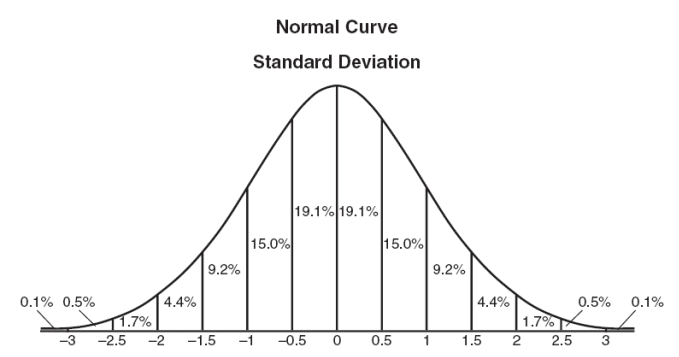
In a normal distribution from heroism to depravity, only a few people will find themselves at the tail ends--Satan at the end of the left tail of depravity, or Hitler, Idi Amin, Pinochet... take your pick, a few hairs down. Jesus, Buddha, or Frodo are on the right tail end of heroic goodness, and further down on the tail, some unusually good contemporary people--Raoul Wallenberg or Dag Hammarskjold, maybe. Or Dorothy Day, the Delai Lama, Mahatma Gandhi... whoever.
Most of the people are in the middle--not very good, not very bad, not very smart, not very stupid. The real differences that ordinary mortals will notice are in the deviations to the right and left of the central section --15%, 9%, and 4% of the population. We're not going to be close to the 1.7%, .5%, or .01%--the elites of good and evil. People like Cruz, Clinton, Sanders, and Trump come from the middle in terms of intelligence, imagination, honesty, and such (meaning, they might not be that smart, might be quite dull, and might be somewhat dishonest -- like most people) but are toward the tail end when it comes to ambition, drive, ruthlessness, and so on. These days being a successful politician of necessity moves one out on at least the low end of depravity's tail (the end closest to the anus).
Rather than heroes or devils discouraging us, mostly we just don't have it in us to be heroically good or hideously depravèd. -
Why I no longer identify as an anti-natalistI mean suffering, not little whiny bitching about having to fill up your gas tank) — darthbarracuda
For suffering I was thinking of something considerably worse than spoiled cupcakes or bitchy tasks like filling up one's gas tank. I was thinking of cases known to me among real people I know (knew) and love (loved). Some of these I've suffered too.
metastatic cancers in several people, producing death, but not before producing all the suffering of function destroying cancers
AIDS - people with shingles in their anuses, (immensely painful), tumors, nausea, diarrhea almost all the time, wasting syndrome, running sores, etc.
shattered bones, scraped flesh, ripped muscles (that from a bad bicycle accident)
concussions with significant loss of function among previous very intellectually gifted persons
heart disease, strokes, Crone's disease, Parkinson's, Alzheimers, blindness, cysts in the brain stem
burn victims, gunshot victims, auto accident victims
polio (resulting in partial paralysis), hepatitis, influenza, staph infections
manic depression, psychosis, schizophrenia, catatonic depression, OCD, etc.
That's the kinds of suffering I'm weighing here as a possible cost of being born. What sort of pleasures and satisfactions could possibly balance out all that?
Love, intellectual discovery, great sex (not once, but over and over again for years) laughter, religious ecstasy, art, film, opera (often about suffering -- like Madam Butterfly from the Met today), great books, wonderful bicycle rides, swimming in the ocean and almost drowning, beach combing, laying in the warm sun, desires both met and unfulfilled, wonderful food, like the lamb chops at Figlios (they stopped making them, so life is a bit less worth living), the scallops and clam chowder at Legal Seafood, the fried clams at the little fly-spec shop in Mattapan--Simco's on the Bridge, chocolate, blueberry pie, etc.) massage, beautiful handsome men (or for you, maybe, beautiful women), dogs, squirrels...
It's a long list--both suffering and joys. Each of them is thick, deep, rich--and in the case of suffering, harrowing; in the case of joys, heavenly.
The sufferers I have known never said that they wish they had not been born. Why not? Because they had lived enough (joys and sufferings both) to see for themselves that life is worthwhile.
If I may make a modest suggestion, why don't you stop this pointless philosophical sniveling about the hardness of life (life is hard, sure enough) and move on to the greatest possible enjoyment of the life you have. Do good. That is one of the satisfactions there is. Love. Be loved. Feast and feed others. Give great sex. Make music, or share it. Make art, or share it. Laugh. Tell good jokes (jokes that make people laugh.) Scratch an old dog's ears--hell, scratch the whole body -- the dog will be forever grateful. Go for a swim, go for a bike ride, do a workout at the gym -- and enjoy it.
Have you -- will you-- suffer? Oh, almost certainly. When it comes, endure it with grace. -
Why I no longer identify as an anti-natalistP4. Producing something worthwhile is itself worthwhile. — Sapientia
Why isn't P4 a tautology?
How does one prove
? It seems like that life as an end in itself can be asserted, and then one has to stop. "End in itself" can't be proven, can it?"that life in general is an end-in-itself" — Thorongil
i'm content with the idea that life is an end in itself. What vouches for something that is an end in itself, other than that thing itself? -
Why I no longer identify as an anti-natalistIt just makes me wonder why you then go on to say that it is perfectly acceptable to force another person to go through these trials, unnecessarily. — darthbarracuda
I say that it is good to have children because, in my personal -- and valid for me -- experience, life is on balance a good thing. Is it all good? Obviously not. Is it all bad? Just as obviously not. On balance... it's quite a bit better than a poke in the eye with a sharp stick--which is more than I can say for the antinatalist argument.
All the arguments I have read here about how having children is an inherently bad thing boil down to "Life sucks" and "having babies is forcing them to suffer". This line of reasoning doesn't strike me as mature, insightful, wise, or anything of the kind. It strike me more as juvenile, uncomprehending, stupid, and... stop me before I say something harsh.
What I find remarkable, darthbarracuda, is that someone (you) who has written as many intelligent posts as you have is spouting this stuff. -
Why I no longer identify as an anti-natalist... they 1.) want a child, 2.) believe deeply that their child will come out fine. — darthbarracuda
First a reasonable statement, then you plunge off the rails into the snake pit of twisted logic.
The first argument is one of selfishness and desire, one that makes a child out to be an aesthetic object rather than a human being. — darthbarracuda
"Wanting a child" does not, in any way, shape, manner, or form, make a child into an aesthetic object. Most people want children because... they want children. They like children. They like the idea of raising up children to be good people. And, by and large, most children turn out to be "good people". They may be flawed; but they are basically "good".
The belief that "the child will come out fine" is justified by experience. True enough, some children are born with significant physical or mental deficits. The rate of normal births is, however, very high. The cause of childhood death is usually insufficient food and clean water or disease. Are disease and starvation good reasons not to have children? Quite possibly. If one is in the middle of a war, plague, or mass starvation, yes--probably a good time to hold off on having children. -
A handy guide to Left-wing people for the under 10sThe Spectator opposed: — jamalrob
- American slavery in the 1850s and 60s and came into conflict with the conservative establishment because of this.
- In the late 1920s it ran a campaign to raise money for the miners of Aberdare, where unemployment was 40%.
- It opposed Britain's involvement in Suez.
- It has supported the decriminalization of homosexuality since 1957 (perhaps before).
- It opposed America's involvement in Vietnam.
These are not exactly contemporary issues. Over a century and a half one would expect editorships and dominant themes to change somewhat.
The New Yorker is a Spectator-type local magazine with a national following; glossy paper, excellent editing, publishes sometimes too long thoughtful articles, poems, cartoons, and lots of local NYC event info, is way too posh (appealing to those with substantial disposable income in an expensive city) to be a truly 'liberal' paper. It's an "A list" magazine. It appeals to the elite. Regular elite readers will be better informed, but that doesn't make them less elite. The interests of the elite limit their liberality.
Media that cater to the prospects and problems of the elite do have plenty of interesting material to work with, like the problems of upward-mobile young elite families struggling to find just the right property in the best neighborhoods, the joys of the local bistros, restaurants, fine merchandise stores, the travails of long vacations, fascinating shows at the theater, remarkable art work at galleries, yada, yada, yada.
One doesn't hear about the problems of the folks at the other end of the economic scale, except for the occasion feature story about some poor, but interesting, slob in the long balance of the economic continuum--where most of us live, like it or not.
There are magazines for the quite well educated, reasonably comfortable poor slobs -- the Nation, Mother Jones, the Progressive, In These Times, Z, and some better-paper heavy duty Marxist publications. Maybe it's the times we are in, maybe they are running out of cash (they rely on non-advertising sources of income, like donations, subscriptions, etc.) but they aren't all that interesting -- the furrows their plows turn over are pretty much same old, same old. It isn't their fault, of course, that the lives and problems of the sub-elites are monotonous. "Not enough rent money", "empty cupboards", "car-broke-down-lost-job-now-homeless", war, war, war have the same flavor from decade to decade. Exploitation of the masses is a game of Monotony.
So let's talk about how to find a really nice weekend cottage in a quaint New England village (or a quaint village in Olde England).
THE CRITICAL PROBLEM for leftist papers of all shades of pink and red is finding a strategy to achieve economic justice that has better than a snowball's chance in hell of succeeding. -
The media↪Bitter Crank I'm picking up what you're putting down. — Shevek
I don't really disagree with what you have posted so far. My main reservation is that I don't believe advertisers can jerk us around like puppets. I am not dismissing advertisers, PR, opinion makers, et al as irrelevant. They are not.
we're much more likely to see our commodities, our property, as extensions of not only our ego but of our self-constructed identities. — Shevek
God yes, and too bad, too. Too bad because the commodities come with a lot of pre-loaded meanings (developed by advertising, PR, etc.) so that someone is authoring our self-images more than we know. Google and Apple have some code in my self identity (even though I'm 70) and so do a slew of others. My self identity was formed long before Google and Apple were conceived, but hey -- never too late to update one's self-image. It might be VW or Toyota, Trek or Bianchi, polyester or linen, Buddhist or Baptist, Payless or Allen Edmonds, Kmart or Bloomingdales, blue chips or junk bonds. Whatever.
This isn't all bad, of course. Bloomingdales is a fine store and I am sure there are nice Baptists. Lots of guys like Ford pickups (hauls them to the office). -
The mediaEdward Bernays, the father of modern public relations, penned the following in his book Propaganda: — Shevek
I am generally familiar with Edward Bernays; I grant some truth to his theories about the relationship between 'mass messages" (advertising) and mass behavior. There are, oh, maybe a dozen different methods governments, corporations, religious leaders, parents, peers, teachers, and so on have at their disposal to manipulate behavior. There is modeling, threat, suggestion, leading questions and pat answers, limiting or distortion of of factual information, repetition, group dynamics, stimulation of existing desires, experience, personal fantasy, and so on. We are exposed to these various influences, having sometimes very contradictory aims, simultaneously.
Let's say a conventional ground war is in the making. A Quaker youth taught, modeled, and encouraged by his parents and religious peer group, intends to become a conscientious objector. The Selective Service Administration, the Army, Navy, Air Force, Marines, and Coast Guard will be airing notices about registration and all kinds of information encouraging youth to sign up with a particular armed service. (All depictions will involve similar nouns -- valor, bravery, courage, loyalty, service, and so on.)
The SSA and Armed Services messages will fall on fertile ground in many cases. Why does the Quaker youth resist these messages and register as a CO -- something that will involve few if any personal benefits, considerable derision from the public, and risk? Because there are competing contradictory messages, and he sides with those most deeply inculcated. The general's son will immediately sign up to join the marines. Why? Because there are both individual and public messages which happen to be complimentary.
Why doesn't everyone buy the same car? The same computer? The same shirt? The same dog food? Because there are competing messages, and personal preference is capable of discarding most of the messages as 'irrelevant'.
Much advertising runs parallel with desires that are independent of advertising. Ego enhancement, for instance, doesn't require advertising to exist. Someone intent on ego enhancement, however, will be susceptible to whatever enhancement that strikes his or her fancy -- and 'fancy' will vary across the board.
People fantasize about how to enhance their ego (their sense of importance, their engagement with the world, etc) and when they fantasize, they prime the pump for advertising. Someone intent on enhancement may begin looking at ads for $35,000 cars rather than $10,000 cars (new rather than used). Ads for big Macs (from Apple) may have more appeal than a generic off-the-shelf assembled computer that costs $450, rather than $2000.
Both the used car and the cheap computer will fulfill the individual's practical needs, but not provide many ego-strokes. The big Mac will be just much nicer. Especially if ambitious parents planted the seeds for high quality goods. -
The mediaBut let me ask: if it were shown that sympathy for ISIS and Islamic ultra-conservativism were significantly higher among Muslims than among other people, would you want to suppress this fact for fear it would cause bigotry? — jamalrob
I would not suppress the fact (if it were shown to be a fact).
Hindu India has a number of appalling social practices owing to it's religious-cultural history. Of course it is not the case that every Indian Hindu is responsible for the caste system, for instance, nor the sufferings of the untouchable castes. The Brahmin castes deserve the benefits they receive as little as the untouchable castes deserve their neglect. The caste system is a fact, like it or not.
Within the Muslim world, there are groups of people whose religion, social experiences, suffering, history, grievances, and so forth lend themselves to extremism. It is sometimes surprising that there are not more Islamic extremists than there are, considering how fucked over they are, by oppressors both near and far away.
Christian Fundamentalism didn't just spring into existence from a manure pile either. There were events such as Darwin's publications on evolution, new biblical criticism, secularism, modernity, and so on that greatly disturbed a variety of conservative, less-educated, socially insecure Christians. The fundamentalist Christian ideology spread, over the course of decades--eventually a century. It happened that a lot of the conservative, less-educated, and socially insecure Christians were southerners--deep south and southern California. It is factually wrong to equate southernness with fundamentalism. Many southerners (in THE south and in southern California) are not at all conservative.
Change may be the only constant, but quite often it is very destabilizing. Groups experienced unwanted and forced change quite often rebound into rigid, doctrinaire positions in order to resist change and preserve their core belief systems.
The fact that there are processes that produce fundamentalist ideology and perhaps violent opposition doesn't make it OK -- it just makes it comprehendible. ISIS has a history. History doesn't make bad things good, but it can be instructive. -
Corporate DemocracyThere are all sorts of angles here one can look at to determine whether it makes sense to require people to serve all comers. — Hanover
"The Law" one hopes, "is not an ass"ª and will not stoop to negotiating frosting. There are more substantive issues in public accommodation.
A hotel-owning klansman white supremacist, or a restaurant-owning lesbian separatist (maybe they could go into business together) deal in materially significant goods (shelter and food) and services. Same for real estate brokers, plumbers, bankers, carpenters, doctors, lawyers, and septic tank clearing services--all materially significant services for which equal public accommodation is important -- both constitutionally, but also for purposes of public safety, health, and prosperity.
ª1838, Charles Dickens, Oliver Twist, ch. 61: "If the law supposes that," said Mr. Bumble, squeezing his hat emphatically in both hands, "the law is a ass..." -
A handy guide to Left-wing people for the under 10sUnfortunately the link didn't work for me. At least they had a novel "404" message.
Just a quick perusal of their site (couldn't read much without subscribing) made me think it was kind of a NEW YORKER type magazine -- longish (too long) articles, cartoons, upscale advertising, that sort of thing. I would expect it to be at least sort of liberal.
-
Corporate DemocracyIMHO, the matter of cake decorations seems too trivial to take up time in the judicial system, but public accommodation in general is a weighty issue. Thanks for your response.
-
Corporate DemocracyFor example, if a baker didn't want to bake a wedding cake with two grooms on it, then the law would protect their right from a lawsuit or other sanction for that discrimination. — Hanover
It seems to me that public businesses are bound to serve any customer who walks in the door and makes a reasonable request. If I asked a bakery to sell me a large pie with four and twenty live blackbirds contained within the delicious flaky crust, they might reasonably refuse -- no blackbirds in stock, no knowledge about how big a pie to make, no knowledge of how to actually bake a blackbird pie without ending up with dead blackbirds, and so on. Fair enough. Maybe the bakery down the street has the recipe.
On the other hand, they wouldn't be entitled (as a public enterprise) to refuse to write "Happy Gay Pride" on a sheet cake -- a task which they are more than adequately capable of performing. Just because they don't like gay pride, or the Irish, or railroad buffs, or whatever cake decoration is needed, is no basis for the bakery to refuse service.
Right? -
Corporate DemocracyOf course, I'm glad the bill was vetoed by the governor.
It's always possible for some corporate committee or executive (whoever is able to speak on behalf of the company) to be on the side of the angels. Agents of Apple, Corp., for instance, have been on the 'correct side' of rights issues a number of times.
But still, I'm not happy about corporate executives leveraging the wealth of their corporations (the employment it provides, contributions to state economies, etc.) to influence politics. The president of Apple has every right as a citizen to speak on issues. The head of the Southern Baptist Convention, or the president of Emory University has a right to speak as a citizen about whatever they please. I would prefer to see both of these men speak as the individuals they are, rather than leverage the prestige of the organizations they head up.
It's one thing for Frank Page, citizen, to say "I am against gay rights." It is (IMHO) improper for him to say "As president of the Southern Baptist Convention, I am against (or for) gay rights."
The CEO of Target, Corp. (or someone able to make the decision) decided to make a corporate contribution to the anti-gay marriage campaign in Minnesota a while back. The donation garnered a lot of local negative publicity for Target. It would have been as inappropriate for Target to have donated the money, instead, to the pro-gay marriage campaign. Target employees (including the CEO) could make their own donations to whoever they pleased.
"The Corporation" isn't a citizen, isn't a voter, isn't a person, and doesn't have opinions or positions on political issues. -
Voting for the Lesser of Two EvilsRoses are red;
violets are blue.
Let's all vote
for a Socialist Jew. -
The mediaThere are, granted, more thoughtful appraisals of world events than what one sees on ABC, CBS, CNN, NBC, Fox, PBS, New York Times, et al. However, I don't really think government-university publications count as "part of the media". Not being "part of the media" doesn't place them on Mount Olympus; the tanks of policy wonks have their own virtues and vices apart from "the media" which is another good topic.
If you read that research more carefully you'll see that what it shows is that recent Western intervention has opened up space for the spread of terrorist activities that have a special character owing to the historical development of Islamic culture and ideology. — jamalrob
One of the very common alternative narratives has the same effect, structures real events in the same way, and is equally shallow. The idea is that the acts of ISIS, al Qaeda, the Taliban, and Palestinian terrorists are the rage of the oppressed, that the West (and its allies) has made them crazy. It ignores the logic of Islamism and how it fits historically in the specific circumstances of the Middle East. — jamalrob
It seems to me that the average peasant in the Middle East would be hard pressed to decide whether Western imperialism and colonialism (with its attendant flaws) had oppressed them less, about the same, or more than their home-grown, traditional, usual, and customary oppressive tyrants and corrupt, rotten, deadbeat regimes.
Some ME governments are better than others, of course, but a good many of them are a malignant burden on their populations. Obviously this is not unique to the Middle East. Corrupt, incompetent, and oppressive regimes exist on all continents. And clearly, ISIS, al Qaeda, et al are not liberation movements inspired by ideas of freedom, liberty, equality, democracy, enlightened values, or any of "that crap that the West keeps trying to force down their throats" (as one narrative would have it). -
The End of Bernie, the Rise of the American Maggie "the Witch" Thatcher and an Oafish MussoliniThank you for the additional details. There's no excuse for this sort of thing happening. After a century of mechanized and digitized data processing we know how to keep track of details. When we don't, it's usually not an accident. It's either malfeasance or incompetence.
Yes, the vote should be held again--this time with accurate lists--and more polling stations. -
The End of Bernie, the Rise of the American Maggie "the Witch" Thatcher and an Oafish MussoliniA number of states have been disenfranchising voters by fresh, new approaches -- like eliminating polling stations, requiring identification documentation that not everyone has, and such. That this has been going on isn't exactly a secret, but the implications haven't been adequately explored by the [mainline] media. But this is typical. The media honestly report that there are long lines (like, really long lines) and usually this is chalked up to heavy turnout. A little background story would show that heavy turnout was paired with elimination of many voting sites (in Arizona).
Requiring more identification documentation really is a barrier, and not just to undocumented aliens who are maliciously crossing the border in order to screw up the electoral system. I'm a WASP with unimpeachable American standing, but I don't drive and don't have a driver's license. I was in my 60's before I finally went to the trouble to get a non-driver state ID--equivalent to the license. (I used to need a registered voter with a legitimate ID in my precinct to vouch for my legitimacy.) Getting an ID wasn't a terribly difficult procedure--i already had a birth certificate and could leave work for a couple of hours to go to the courthouse. Birth certificates aren't technically hard to get, but there is a small cost, some bureaucratic procedures, and often a substantial time delay.
Bureaucratic rigamarole is often a sufficient barrier preventing people from getting something they want. It is easy for conservative legislators to contrive targeted voter disenfranchisement plans. Poorer people, and certain minorities, tend to vote for liberal candidates. Putting one or two barriers in the road on the way to the polls can shift the vote enough to help conservatives win. -
The mediaWhile I'm talking about crazy narratives, a lot of what I hear about the Middle East follows a pretty shallow narrative. "Moslems in X country are blowing up women and children in markets, parks, etc." It's all religious bigotry. They're all crazy." (They don't say they are all crazy -- one infers that.) Take Assad in Syria. They never tell us why people are against Assad. Why is Assad doing what he is doing? These people are not (possibly) all crazy. Presumably there is more at stake than just petty religious bigotry.
It is difficult for people to make sense of what they hear when news stories about real events are structured in such a way that the active agents involved don't seem to have apparent and rational reasons for behaving the way they do. -
The mediaSo, what you said in your two posts above indicates that you are a fairly good reality tester. You had learned that you were on reasonably safe ground in the bad parts of town -- probably because your clothes, behavior, general appearance identified you as "belonging" and "not a risk" to everybody else. I've had some of those experiences too -- where, when you look like you belong, you do, more or less, and people don't bother you.
The trouble with the conspiracy theories about the media is that the ruling cliques that supposedly are in charge of the conspiracies would have to be extremely and unbelievably knowledgeable to have enough insight to know how to manipulate 300 million people in the right way (for their advantage). They would have to know how millions and millions of people would react to a given story, and know the upsides and downsides of all their media manipulations. They would have to be unnaturally imaginative, insightful, ingenious, clever, inventive -- all the time, for decades on end.
99.999% of the population, including the wealthiest people, just aren't that clever. wise, smart, ingenious, insightful, inventive, or anything else. Besides, we know there are simpler ways of controlling people. Like the police, like bread and circuses, like debt, and so on. Privileged people, and this certainly applies to wealthy parasites, do not seem to have their heads screwed on very well.
Having said all that, the way stories are shaped into narratives does affect the way people think. It isn't so much the content of the story as the form of the narrative. For instance, the stories about shootings I hear follow the "crazy behavior" narrative. We hear on the news, for example (and this is an actual example) that some guys drove by a corner in the black ghetto and opened fire at a group of children. "Crazy. Bizarre. Irrational. Stupid. But that's what happens down there. They are insane."
Well, it is kind of insane, but there was probably more to the actual story. We only heard the narrative about crazy black youths shooting children as they drove by. Another situation here in Mpls: Someone had gotten into a fight at a party and had gotten hurt. The police were called; an ambulance and police arrived. While the EMRs were dealing with the injury and loading the injured into the ambulance, some guy from the party was doing something (never made clear) to interfere with the medics, and was shot. Dead.
Big uproar. Black Lives Matter has been shutting down freeways, the airport, subways, bridges, etc.
Nobody knows (or isn't saying) what this guy actually was doing. All we hear on the news is the narrative of the irrational, "Crazy black guy was interfering with ambulance and was shot." It may very well be the case that the guy was crazy. Don't know. But nobody in the media has been able, or willing, to go out there and question people and try to develop a rational narrative of what happened.
All news stories are not like this. A lot of the stories follow a narrative form where "real problems lead to unfortunate results". Like, a building owner cut corners on fire safety and the building burnt down. Or a house was set on fire in order to collect insurance. Or the gas company had been negligent and a gas leak had caused the house to explode. Cause and effect. They don't just say, "Terrible, a building exploded on Third Street this evening." or "A car came out of nowhere and crashed into the store." No, buildings explode for a reason, and cars don't just appear out of nowhere and crash into store windows. There are causes, and these are usually detailed. It's a difference in narrative.
Much different than the ghetto drive by shooting. Oh hum, another crazy drug dealer/gang banger/... whatever flipping out. Next! -
The mediaWhether it's accurate, true, complete bullshit, or whatever doesn't ultimately matter as long as it's captivating, and people are willing to watch it and take it seriously. So that it really depends on your faith in the viewer to decide the quality of the news, in my view. — Wosret
You, obviously, have no faith in the viewer who is only interesting in watching captivating content, whether it is totally non-sensical farce or not.
Now, I am a cynical believer in H. L. Mencken's view that "Nobody ever went broke underestimating the average American's intelligence." He thought we were mostly a nation of rather stupid rubes. (He covered the Scopes Trial in Tennessee in 1925. That's the famous "Monkey Trial" -- should evolution be taught in schools case.) But... if we really believe that people are hopelessly duped into believing whatever crap they see, then we have nothing to discuss here. All is lost for 80% of the people.
But I don't think that. People do want to watch entertainment -- so do I. My entertainment is a lot more highbrow than the dreck that is on in the early evening, (much of the time, unless I'm slumming) but we want the same thing: Pleasant escape. I think most people, at least, can tell the difference between bullshit and sensible content. But maybe my perceptions have been very skewed by too much highbrow entertainment.
Everybody has to perform reality tests, every day, all the time. You're walking your white self down the street at 1:00 in the afternoon. A black guy is approaching you. Is he a threat to you or can you safely pass him by without getting shot or stabbed? If you live in Chicago (about a third of the population is black) you'll probably make a quick scan and decide he's not doing anything you need to be worried about. That's going to be right about 999 times out of a thousand. (I'm assuming you are not wearing very expensive clothing while walking down the street on the South Side of Chicago at midnight. If you are, then you maybe aren't testing reality very well.) -
The mediaI suggested studies that showed that people's values are not significantly altered by media exposure. — Wosret
Last year, the advertising industry had revenues of 180 billion dollars. I don't believe that companies would be making these huge outlays if they could not see a relationship between consumer behavior and advertising. It works on me -- highly intelligent, anti-consumerist commie pinko faggot -- why wouldn't it work on everybody else?
I suspect the evidence is the usual 'middling' sort of stuff -- it's hard to nail down exactly what caused someone to have or alter a particular opinion. There is some evidence (so I have read, but not just recently) that individuals who watch the most local news on television (like, Eyewitness News at Six and Ten) tend to believe that the world is much more dangerous than it is. Why? Because of the tendency for news editors to go with action stories -- if it bleeds, it leads. People who watch a lot of local TV news thus develop a skewed view of their world. Journalists could do better.
But then, there is the intersection of the business and the journalist: "Joe," the producer says, "We're dying out there. Ratings show people are bored to death of your sociology reports on the 6 pm segment. You'd better come up with better material fast, or you will be dead meat yourself."
The News can't be too boring to sit through--even if you're telling the absolute truth.
Chicago has seen something like...600+ shootings this year, of which 135 were fatal--and this isn't the worst year so far. A 60 year old woman living on the 80th Floor of the Hancock Tower in Chicago who watches the local news every night might well conclude that she should never leave the building, or at least go no more than a block or two away.
Of course: people make sense of their experiences, and their experiences are more real than news stories or advertising. But... what guides our interpretation of experience? Well, other experiences, of course. Experiences like seeing news stories; experiences like seeing advertisements; experiences like seeing political debates.
BC

Start FollowingSend a Message
- Other sites we like
- Social media
- Terms of Service
- Sign In
- Created with PlushForums
- © 2026 The Philosophy Forum