
-
Causes of the large scale crimes of the 20th CenturyI think it was the latter. — frankWhich makes more sense to you? — frank
You raised interesting and difficult questions.
I agree that impressively large scale crimes against humanity were carried out in the 20th century, from the Turkish genocide against the Armenians to the Tutsi genocide against the Hutus. But the centuries before the 20th century saw the genocide of the aboriginal people of the western hemisphere by Europeans. Genghis Kahn wiped out a lot of people during his reign in the 13th Century. The history of bad things happening doesn't stop there.
In the big picture, people have not changed. The Germans had good organization and technical prowess at their disposal, in addition to a wall-to-wall social coercion program. Maybe he was the first to carry out killing industrially--not that the method makes much difference to the dead.
Are we crazier now than in the past? No. We've been crazy for a long time. Why? Because we are primates with big brains, opposable thumbs, and ancient emotions that know nothing about ethics, justice, or fairness. We get emotionally twisted out of shape over one thing or another, and then we call on our big brains to figure out how to destroy entire peoples who were just too annoying to tolerate.
What can be done about it?
Back to the drawing board, 10,000,000 years ago? Do it over and this time avoid agriculture, living in cities and everything that followed? No can do. We are collectively screwed. Individually, we can be as good as the Holy Men taught us to be. Collectively, we can't get ourselves organized to fix a tire on a bicycle.
There's always a handy Yiddish word. Pascal knew of Sitzfleisch. The word is German (though widely appropriated in Yiddish) and it literally means "butt flesh". (The meat of your ass, in other words.) But the figurative use of "sitzfleish" means: "The amount of endurance a person has for sitting still on his/her butt for the hours and hours and hours of time that it takes to get important work done."
Sitzfleisch is sort of the opposite of Ants In Your Pants.
The amount of sitzfleisch you've got will directly influence how much work you can produce. How long can you stand it, to sit there and push through? Inspiration is beautiful, imagination divine, and we all love soaring dreams. But sitzfleisch? Ass meat? THAT'S how you write your novel. That's how you compose your symphony. That's how you paint your masterpiece.FLEISCH. -
Murphy's law: "Anything that can go wrong will go wrong." Does this apply to life as well?Welcome to The Philosophy Forum!
"Anything that can go wrong will go wrong." Does this apply to life as well? — niki wonoto
The idea that "if something can go wrong, it will" reflects the fact that the universe was not organized for our convenience or happiness. We exist, but we have no evidence that the universe actually intended us to happen. It's possible that the universe resents us, and wishes to be rid of us.
We, smart apes that we are, can attempt to arrange our world to our liking, but we don't have the last word. Physics, chemistry, and biology (let alone human behavior) are complicated, and long term results can not be predicted accurately. Never the less, we proceed merrily along our way, thinking everything is just fine, until we come to a bridge and it collapses. We end up dead or near to it. Why?
Well, there were undetected flaws in the construction 40 years ago that were leading to collapse. Finally it happened. It wasn't personal -- the bridge wasn't out to get us. Our being on the bridge just then was a matter of chance.
Now, there is another axiom: Inanimate objects are out to get us." I believe this. Everyone has unpleasant experiences with physical objects that result in injury. Even very careful well protected people are injured by inanimate objects. You go to a soccer game. You are cheering your team. All the happy, excited jumping up and down causes a brick to take that opportunity to fall off the stadium and land on your head. Inanimate object 1, human 0.
I hope this helps explain certain aspects of reality. -
The Prevalent MentalityWhat do you think of these thoughts? — Bug Biro
Have you read The Sane Society by Erich Fromm? Pretty good book.
There are people who are crazy without reference to society--people experiencing the severe depression and mania which is often manifested in bipolar disease are an example. Schizophrenia is another, as is OCD and a few other mental illnesses.
Then, as you say, there are a lot of people who have been driven crazy by the crazy society they live in.
However people arrived at 'crazy', living in a nuthouse society makes things worse.
The interesting cases are the very decent, imminently sane people who manage to live in crazy societies without suffering. -
Cavemen and LibertariansWe have always experienced 'authority,' even in tiny groups — universeness
Is that really true? I can't imagine any authority imposed on prehistoric homo sapiens other than satisfying basic needs such as food, clothing, and shelter. — Shawn
The only authority to which stone-age hunter gatherers had to submit was the authority of their familial group (or possibly a competing group). Ethnological studies of the few contemporary hunter gatherer groups reveals some level of control by elders, for instance.
How effective was this control? Probably it had limited effectiveness, just given our species' predilections. Surveys of skull injuries among catalogued archeological remains show that there was a fairly high incidence of blunt force trauma. That is, injuries from stone axes rather than accidents.
Stone-age people were sparsely scattered. Density presents additional behavioral and policing problems which didn't arise until the Agricultural Revolution and city building--last 12,000 years, +/-. The bigger and more complex the urban environment, the more some sort of state control was needed to maintain minimum levels of order.
The modern world (say, last 600 years) features large and diverse populations operating under various systems of "proper conduct". Maintaining peace, order, and production requires police control.
I hope libertarians are not using Stone Age models to define what will work now. There are various flavors of libertarianism -- like left-wing anarcho-syndicalism. They all tend to be at least somewhat utopian.So here's a free society; everyone knows his place and what her role is. Everyone somehow knows and follows the minimal set of unwritten rules.
Utopias might have a snowball's chance in a cool hell, but take a modern metropolitan area where 20 to 50 million people live, and things will fall apart very fast.
Large populations (millions) do not have the intellectual, emotional, or physical wherewithal to control themselves. That's why we have, and need, states with police power. -
Analytic philosophy needs affirmative action?My impression is that the way to career success in academia is shooting down orthodoxy and coming up with novel ideas — Welkin Rogue
[I'm not an academic] but my impression is that your description of academia is at least somewhat on target. It's not hard to find an orthodoxy that is flawed; the trouble is coming up with a novel replacement that isn't just as flawed, or worse. Too much of this and we end up with unintelligible (and perhaps just plain loopy) theories in history, literature, social science, philosophy, et al.
Which Red Scare are we talking about? I ask, because it seems like analytic philosophy has been a going concern for most of the 20th century, during which there were two Red Scares -- the first following WWI and the Russian Revolution; the second following WWII. In both cases, the US emerged with an enhanced dominant role in the world. The capitalists were strong, confident, and ready to suppress political deviance, whether in the factory workplace (1919) or the cultural workplace (1949).
Maybe academic philosophers weren't much affected by the Red Scare of 1919. They would have been affected if they had been paying attention. The 1949 (McCarthy) Red Scare was 'scarier' for academic, cultural, and government employees. In '49 it wasn't the union organizers that were getting busted, it was white collar political and sexual deviants. Your basic Hollywood writer, State Department employee, pr commie pinko fag in the Philosophy Department. (I am, btw, a commie pinko fag).
I haven't read a lot of history about what longer-term effects the '49 Red Scare had on academia. At first there was a definite liberal chill, but then..., say by 1969 or 1979, what?
The best model for the market place of ideas is unfettered free trade. No quotas, no diversity programs, no affirmative hiring. Mao Tse-Tung said, "Let a thousand flowers bloom, a hundred schools of thought contend". Seems like a good idea for Academia, but as in China, eventually the management will have had enough odd flowers and weird schools, and the brakes will be applied.
Are you in Academia? -
Antinatalism Argumentsdukkha — Shawn
A Sanskrit word meaning 'axel hole'.
The word has been explained in recent times as a derivation from Aryan terminology for an axle hole, referring to an axle hole which is not in the center and leads to a bumpy, uncomfortable ride. According to Winthrop Sargeant,
The ancient Aryans who brought the Sanskrit language to India were a nomadic, horse- and cattle-breeding people who travelled in horse- or ox-drawn vehicles. Su and dus are prefixes indicating good or bad. The word kha, in later Sanskrit meaning "sky," "ether," or "space," was originally the word for "hole," particularly an axle hole of one of the Aryan's vehicles. Thus sukha ... meant, originally, "having a good axle hole," while duhkha meant "having a poor axle hole," leading to discomfort.[5]
The philosophical up-shot of dukkha is that off-center axel holes can be fixed.
Philosophical pessimists, riding (not trudging along with the peasants and cattle) would rather complain about the annoying thud which accompanies every turn of the wheel then get the fuck off the wagon and fix the damned axel hole.
Pragmatists have a positive, practical view that bad axel holes can be fixed.
all the magic of the invisible hand — Shawn
WTF?
technogurus in Silicon Valley, Stanford, and Caltech who seem to be the positivists of our day and are creating new gadgets and devices that sustain and improve our daily lives. — Shawn
Hey, I like a Mac, iPhone, or iPad as much as the next consumer, but let's not get carried away with paeans to Silicon Valley. [paean = song of praise] Technogurus are hired hotshots who think of things to sell, NOT sustain and improve our lives.
I like the Economist; it's a good source of information, but it isn't the Oracle of Delphi. Of course it takes an upbeat tone when talking about Silicon Valley. It's pro-capitalism. Surprise, surprise.
And yet, what occured to me as rather peculiar about humanity is that we do not submit to this pessimism about life or not all of us at least. — Shawn
Unlike the funny characters in a Monte Python sketch, digging in the mud who pause to discuss political philosophy. we are more or less programmed to keep on keeping on. It's the needs of the organism that drive us onward, not philosophy--that comes after we have made it to a safe harbor and can pause to philosophize.
-
What should be done with the galaxy?There's 100,000,000,000+ non-Earth planets in the galaxy. — Leftist
And on several of the 100,000,000,000 worlds some very smart lizard overlords are wondering what more productive use could be made of a blue marble planet, 3rd one from its star, out toward the edge of the galaxy.
Hmmm, is "leftist" and "nihilist" a logical combination? -
Ukraine Crisisdo not waste your precious time in something worthless as Catalonia-Spain conflict — javi2541997
Actually, the Catalonia-Spain conflict resides on level 1197 of my things-to-worry-about queue, just above the future of Nursultan Nazarbayev, deposed boss of Kazakstan. -
The new Help sectionI see why BC changed names. — Metaphysician Undercover
Perhaps a good idea but it took me many years to do so. One doesn't want to rush into these things. -
Ukraine Crisishypocritical — SophistiCat
What I was thinking of when I typed 'hypocritical' was countries terming the Russian action in Ukraine as "immoral". Countries like the USA, for instance, who have carried out invasions in the pursuit of national interest. To whatever extent the USA claimed its invasion of Iraq or Afghanistan was in pursuit of 'moral ends' was hypocritical in several ways.
So, I don't think the USA is supporting Ukraine for solely moral reasons (though supporting Ukraine seems moral enough to me).
Does this clarify my use of the term? -
Ukraine CrisisCalling the invasion of Ukraine an atrocious breach of etiquette and appallingly bad mannered was an attempt at sarcasm which, apparently, failed.
Presumably it is in Russia's interest to possess Ukraine, whatever the Ukrainians want. It is in Nato's and the EU's interest to resist.
That "states follow their interests" is an axiom that has exceptions. At least, it is sometimes damned hard to figure out what the interest is. China might want to occupy Taiwan, but it seems like it would not be int their interest to do so. If they invade Taiwan, it probably won't be an act of national interest -- it will be something else--like satisfaction of a long-standing resentment that Taiwan got away. -
Ukraine Crisishypocrisy. The states and organisations only act when they see it is worthy for their own interests — javi2541997
Why is self-interest hypocritical? Am I being hypocritical if I look after my own interests first? Are you?
States do not have ethics as much as they have interests. The USA invaded Iraq and Afghanistan because the government thought it was in this country's interests to do so. It didn't make sense to me in either case, but then... who am I?
I think it is in the interests of NATO states to oppose the Russian invasion of Ukraine. One could oppose the invasion on moral grounds, but that might be more hypocritical than self-interest. Europe didn't care that much about the USSR invading Afghanistan--who, outside a small circle of friends, did care? But Ukraine is WAY TOO CLOSE for comfort, being right up against NATO's and the EU borders.
The invasion of Ukraine is just appalling -- absolutely atrocious manners. Total disregard of international etiquette. Euro-invasions just aren't done these days! Didn't Vlad get the memo? That's all ancient history. Ukraine isn't going back to Moscow and Catalonia isn't leaving Madrid. -
Respectful DialogContext is important here. There is a significant difference between a barroom and a classroom, but even so... incivility in a barroom might earn a punch in the nose. Even between friends, incivility might not be tolerated. There is certainly a place for raucous slash and chop discussion (usually lubricated with beer), as long as everyone accepts the terms of discussion.
Otherwise, keep it civil. -
Economic, social, and political crisisMoms for Liberty — T Clark
Oh yes, they will be picketing outside the elementary school. But so will Feminist Fascists For Matriarchy, because Dick and Jane teaches frankly patriarchal dogma, oppresses women and disabled people, and erases lesbians and racial minorities.
I mean, Look: See Mother and Father. Perfectly patriarchal!
Father, Alpha male that he is, has time to play with the dog but mother doesn't have time to sit and pet puff. Dick, helmet on and balls in hand, is playing too. Little Sally is being trained to be a household drudge just like her mother.
Where is Jane? Mothers for Liberty might well ask where Jane is--certainly not being supervised by here mother and father. She's probably out on the street being tricked into prostitution. She'll be seeing a lot of dick. -
Economic, social, and political crisisYour story has been the experience of millions of Americans whose lives have been made miserable by capitalism and the policies of both conservatives and neoliberals. These ill effects cut across the working class, gender, geography, and race. That's it in a nutshell.
Our (working class) experience isn't universal. Another class called the ruling class, or upper class, has a much different experience. The functioning of the economy was designed to deliver, cradle to grave, a steady stream of substantial benefits for the top class, through the labor and at the expense of the working class.
Our loss has been their gain. -
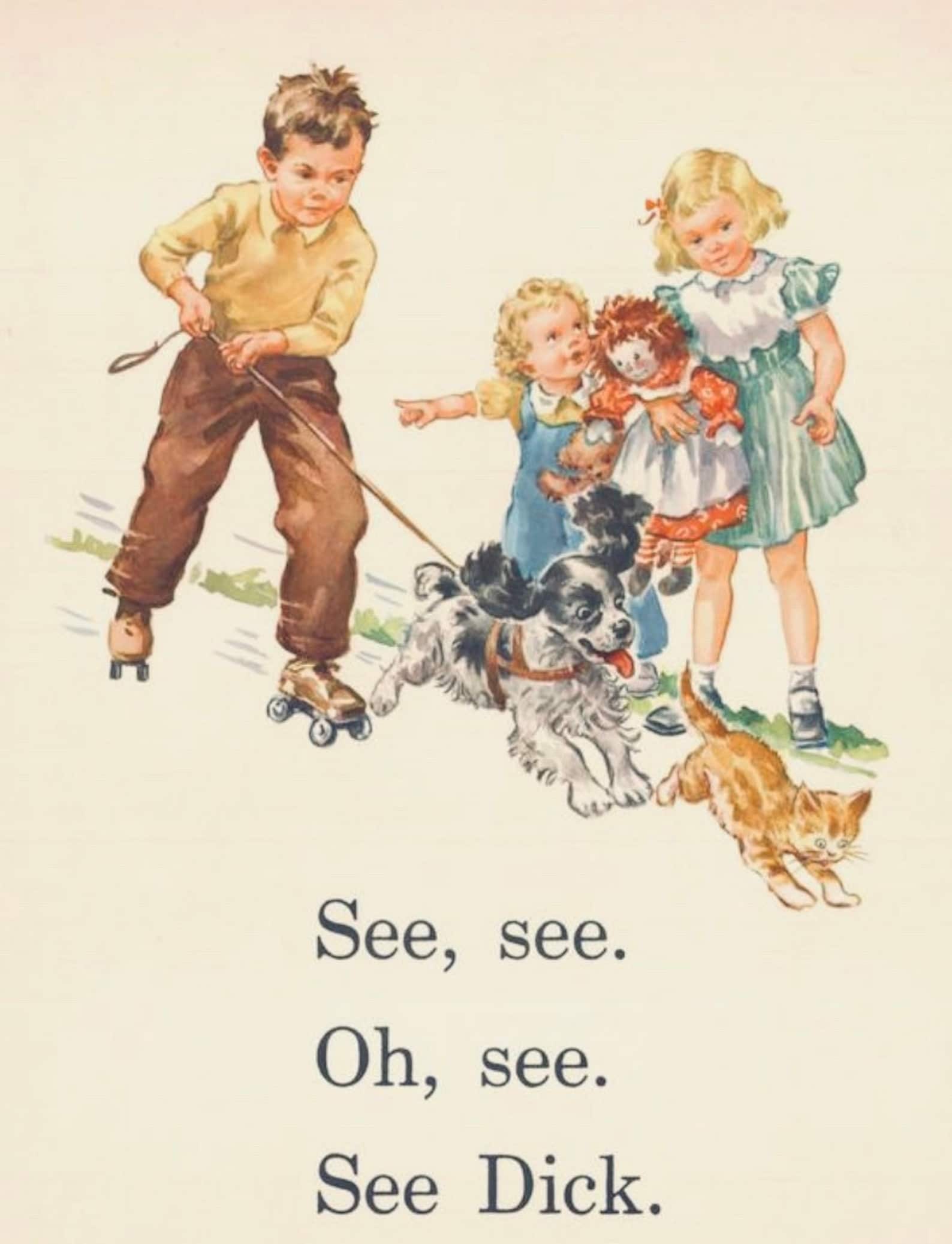
Economic, social, and political crisisThe above post counts as a short story (prompted by Athena's mention of the dick and Jane readers published by Scott Foresman) and the use of Spot On is designed to annoy @T Clark.
I was subjected to Dick and Jane's Weltanschauung which bore scant resemblance to my reality.
-
Economic, social, and political crisisIt dawned on me this morning what a mess we are in because of failing to use the democratic model for industry and failing to prepare our young for good citizenship. — Athena
"Oh, look, Dick," Jane said. "Athena just had a major theoretical breakthrough."
"No, Jane," Dick said. "Athena had that breakthrough before she found this joint 4 years ago. She woke up and smelled the coffee some time back."
"Oh, oh, oh Dick," Jane said. "Let's not be unkind. Athena is quite right, after all."
"Yes, Jane," Dick said. "It is not nice to be unkind. And for god's sake, Jane, stop twisting Puff's tail. Puff already hates you forever."
Dick said, "Athena is quite right; I was only commenting on her statement that she woke up this morning and noticed that we are in a big mess. She did not."
"Oh, oh, oh. Here comes Sally," Jane said. "Sally and Spot On are both big socialists. Let's ask them what Athena should do."
Dick and Jane told Sally and Spot On what Athena had written.
"Oh, dear," Sally said, "Athena is recognizing class and gender oppression at a most inopportune time, given that the Tea Party is going to wreck the US Government."
"Yes, Sally," Spot On said. "But unfortunately, Sally, oppressed workers develop class consciousness when they do, convenient or not.
"Spot On said, "What we need to do is organize a demonstration against the capitalists planning on oppressing us with Artificial Intelligence agents. Do we have any of the 10,000 blank protest signs left that we bought 3 years ago?"
"Yes, Spot On, you do," Dick said. "You have been storing them in my garage, and I'd like to park our three cars in there. It's about time you put them to use by starting the revolution. Otherwise, I'll sell them to anti-democratic forces on eBay and keep the proceeds."
"Right On, Sally, Dick, Jane, and Puff. GO REDS SMASH STATE Soon we will hang the last capitalist with the intestines of the last Neoliberal!" Spot On screamed in a frenzy of revolutionary zeal.
Dick and Jane went into their house, the one with the big garage full of blank protest signs. Jane mixed a pitcher of martinis and Dick rolled a couple of joints. Puff retired to her safe place under the porch. Sally and Spot On went back to their damp basement rooms and started thinking up stirring slogans.
Hang on, Athena! Help is on the way. -
Should humanity be unified under a single government?The US should be at least eight separate countries, maybe more — Vera Mont
If you haven't read it, you might like The Nine Nations of North America. That's one; other devolutions have been proposed, and they have some merit.
I can understand the idea of doing away with nation states intellectually, but I definitely don't feel it. I prefer a certain level of territorial exclusiveness. "We are over here; you are over there; let's keep it that way." -
Should humanity be unified under a single government?Right. So, business, conflict, persecution, economic exploitation as usual, until the climate puts an end to us - or our super weapons do. Fair enough. — Vera Mont
Maybe so. But in a way, you are more pessimistic than I am,
I think our best bet is to put together effective, democratic, humane governments. Well governed societies have (I believe) a better chance of maintaining peace with other well governed societies than societies which are badly governed.
Achieving effective, democratic, humane government is Very Difficult, never mind the impossibility of establishing world peace among governments and societies which range from crazy to just plain bad. The USA, for instance, has not achieved our good goals in full -- we've done it in small bits and pieces here and there, That goes for the other G20 countries, like UK, France, Italy, Germany, Spain, Japan, etc.
We are a difficult species, loaded with brains and strong irrational emotions. We have proven ourselves incapable of the highest and best on a mass scale.
Capitalism is a massive problem and we should get rid of it; but doing so--by itself--won't usher in the Peaceable Kingdom. -
Should humanity be unified under a single government?How long, do you figure, before that's all perfected enough to give up standing armies? — Vera Mont
"Effective, democratic, humane government" does not guarantee peace, even if it is the best government possible. However, if countries agree to not develop the means to attack one another by any means, then THEORETICALLY no means of defense -- standing armies or other measure -- would be needed. Trust but verify, as Reagan said.
War between nations may occurs when one country decides that its interests are no longer compatible with the other country's interests, and that the level of incompatibility is unacceptable. This could happen between effective, democratic, humane governments, even if it isn't all that likely.
An example: A severe shortage of a vital resource might lead to war between otherwise good neighbors. Let's say a river supplied two nations with plenty of water. Fine and dandy, until severe drought reduced the river so much that it could not supply both countries with enough water. Country A might take all of the reduced flow of water for its own people, placing the other nation's survival at risk.
Country B might go to war to get more water.
There are some places on earth where exactly this scenario might develop. If the states depending on the Colorado River were nations, there might be a war over reduced supplies if the Colorado dried up. Several nation-states might decide that California was taking way too much of what there was. Colorado, Arizona, and Nevada might cut off the supply to California, and war would begin. That, despite all four countries being the very models of peaceful democracy. -
Should humanity be unified under a single government?War is just diplomacy, negotiation, value clarification, psychotherapy, and so forth carried out by more aggressive means.
Joking, of course.
The "idea" of one-world-government sounds great, at first glance. in a perfect world, with perfect people, and perfect systems, it could work. Alas, there is no perfection here.
Let's try for effective, democratic, humane government starting with existing countries, and try to get good government at every level, from township councils up to parliament. That will prove plenty difficult.
Then try small-region government, 2 or 3 nations.
Then try for slightly larger blocks, all democratic, effective, humane, sophisticated.
That should take us out to around 2500, A.D. -
Should humanity be unified under a single government?One question: "Could humanity be united under one government?" Another question: "Should humanity be united under one government?"
I vote NO in both case. Can't be done; shouldn't be done. -
Jesus, Miracles, Science & MathSancta Trinitas — Agent Smith
I've never heard a good explanation of the Trinity. At any rate, Jesus didn't have anything to do with it. The idea of the triune God was cooked up, starting in the 4th century. Seems to me that it was in response to several heresies which, as it happened, had many followers. Some of the heresies make more sense than some of the official doctrines.
As for the miracles...
a) they never happened
b) something explainable happened and was later embellished
c) they might have been invented at a later date to strengthen the claim of Jesus' divine power
d) Jesus was divine and literally raised Lazarus from the dead, among other things
Pick one. -
The Shoutbox should be abolishedYou need to get out more. People need places where they can exhibit their normal human irrationality, and yell at each other, or just yell.
The "still small voice" belongs to the Holy Ghost, not to mere mortals--everyone here. People can shout reasonably. -
What is harm?But if you take the alternate stance that not all pain is bad then who decides how much pain is acceptable and why? — Andrew4Handel
The person experiencing the pain decides. We don't have a way of measuring pain in an objective way. I have quite a bit of pain from arthritis in various joints. I find it manageable, if unpleasant. Somebody else might find the same level of pain intolerable. Would I opt for less pain? Of course. Arthritic pain is a damned nuisance. On the other hand, the new and different pain of a still-small cancer is helpful.
Some persons excepted, most people prefer to minimize pain whether they are avid natalists or antinatlists.
True enough, a very small percentage of people running marathons drop dead during the 26 mile course. Why so few? Probably (just guessing) because runners have to train up to 26 miles. They don't hop out of their rocking chair and run their first marathon. And, remarkably, most runners don't seem to suffer from it, either.
Pain is also a biological alert. It helps one respond to getting too hot or too cold, for instance. Antinatalists and natalists alike prefer to avoid having their feet or hands become severely frostbit. -
What is harm?I view harm as an unpleasant experience of any kind and something only conscious beings can have — Andrew4Handel
Sweeping definitions often lead to problems. This formulation leads to defining all sorts of good things -- dentistry, running a marathon, dieting to lose excess weight, surgery ... -- as bad, which they clearly are not.
(At least some species of) trees can sense when they are being attacked, execute countermeasures, and warn other trees. Some trees can also tolerate certain insects that would otherwise be a danger, like ants. Tree responses are not fast or dramatic, but they help the tree survive.
There are, obviously, good things and bad things. They might not be as obviously different as red round balls and blue cubes. -
An eye for an eye moralityIf you punch someone back after they punch you? Are you any better than them? — Benj96
Rather than arguing whether one is better or worse than somebody else, it might be better to look at the assault pragmatically. Maybe you had it coming. Maybe responding in-kind risks escalation to a more severe assault. Maybe somebody just boiled over and you happened to be the closest target.
Restorative justice attempts to deal with crime by helping the bad actor restore trust from the community by paying back the wrong with good. This requires the cooperation of the victim. Restorative justice on a neighborhood level is designed to deter young people from developing a habit of criminal behavior. Restorative justice for serious crime requires the involvement of the state.
Real community is the key to dealing with petty crime. If a group of people are characterized by anomie, alienation, oppression, lack of opportunity, transience, and so on (in other words, a failed community), then punishment is likely to be impersonal, ineffective, and coarse, at least. -
What is a person?A person is an indivisible whole of body and mind. Parts can be missing -- a leg, speech ability, vision, and so on. A person ceases to exist when the indivisible whole is broken -- either the brain is dead or in permanent dysfunction; or the body is dead, with the brain following immediately after.
We don't extend "personhood" to other species; this may be outdated. We know more about animal minds than we once did. A dog may be treated like a person. People talk to their dogs, the dogs listen and respond -- probably without much comprehension of word meaning, but they can perceive emotional content and body language. A smart dog has some limited language ability. They can initiate interactions. Some animals, like chimpanzees, elephants, dolphins ... seem to have more brain power, and perhaps they will be granted personhood. I think we can --we must-- respect other species without giving them "human-type personhood". -
Papal infallibility and ex cathedra.Yes, you are right Crank. Nevertheless, there are some doctrines and dogmas who see the Pope "above" of Jesus. I mean, as a pure representation of God. — javi2541997
Maybe some popes were hoping to be the Fourth Person of the Trinity, Father, Pope, Son, Holy Ghost, an elected incarnation.
The Protestants have plenty of problems, but at least they don't have a pope. -
Papal infallibility and ex cathedra.I think this issue makes me wonder a lot of questions because my failure is see the Pope as someone different from God but probably a Catholic sees him as the pure representation of the idea of God. — javi2541997
I'm not Catholic, but I deeply and most sincerely hope that the Pope is entirely different from God. As I understand it (several times removed from a catechism class) is that the Pope is, at most, the on-site human representative of Jesus -- the vicar,
The meaning of "vicar" is "a representative"; think "vicarious". (In different denominations "vicar" has different meanings.)
There are old fashioned Catholics who reverence the Pope and look to him for ultimate earthly guidance. Many Catholics would say hello to the Pope if it was entirely convenient, and there are new-fangled Catholics who don't give a rat's ass about the Pope.
Whether one is a Catholic, a Protestant, a Buddhist, a Jain, a Moslem, Hindu, or Zoroastrian, animist or atheist, in the end the individual has to personally decide what to do. That's why some Catholics have abortions, why some Methodists and Moslems are alcoholics, why some Buddhists strain their water through a sieve to avoid eating a possibly sentient being, why some Jews like pork, and why any individual might take out a knife and stab you in the heart. -
In the end, what matters most?Sci-fi doomsday stories almost always have a surviving remnant. One that did focus on the remnant was A Canticle for Liebowitz--a great novel. A nuclear war, a 2000 year slog back to full recovery, and then another nuclear war. In On The Beach, another excellent novel, there is a nuclear war and the end is The End, no survivors.
How the global warming doomsday will work out is unclear.
One thing, though: Civilization requires a minimum to survive--literacy for instance. Once literacy is lost, it may not be recovered. A couple of generations of illiteracy, and writing / reading has to be invented again. Technical knowledge may be lost among the survivors. If I survived as part of a remnant, I could not reinvent antibiotics or antipsychotic drugs. I could not tell you how to identify blood types. I can not shoe a horse, let alone train it to carry me around or pull a plow; I can not diagnose a sick milk cow or a sick pig. I do not know how to turn raw wool into cloth (I get the basic idea, but that's not the same as knowing how to do it). My ignorance goes on and on,
In Earth Abides, a third great story (written in 1949!) some sort of virus wipes out 99.99% of the earth's population. A healthy tiny remnant survives, but in two generations literacy is lost. The younger survivors could see no reason to learn to read. Their reality had become hunter-gatherer. -
In the end, what matters most?At my age, anything longer than short-term survival has been foreclosed.
I could manage a slow exit (weeks, months) or I could arrange a faster one during the early days of disorder. For a pleasant departure, I'd want Haydn, Handel, and Mozart; a nice tranquilizer; a little Moody Blues the Doors, and a couple of others. A playful dog would be nice for company and amusement.
A nice sandwich, a beer, a comfortable couch, and a little time. Then sic transit gloria mundi. Exit stage left.
For those intending to hang on: Don't count on it. We flourish because we have a dense fabric of cooperative society. Rip that up and we will soon be back to "nasty, brutish, and short". -
The Limits of Personal IdentitiesAre we same person through time or have we changed in many ways without realising it? — Andrew4Handel
Something persists in me that allows me to know I am the same person over time. It may be a soul or spirit or just a persistence of core memories. — Andrew4Handel
To start from the position that our personal identity is largely consistent over our life time makes practical sense because we cannot monitor ourselves as objective external observers. We do have some capacity to compare who we seem to be now with who we now think we were 30, 30, 40 years ago. I don't feel disassociated with the past 76 years, so... I suppose I am a lot like the 'me' that I was in 1965 or 1975.
I gain confidence in life-long continuity because we can observe others more objectively as external observers. Other people seem to remain "who they are" -- until they don't. Dementia means a diminution of mind -- a terrible thing to witness first or second hand. People with dementia are NOT the same people they used to be.
Could our sense of continuity be 'illusory'? Just for discussion purposes... it could be. In fact, to some limited extent "personal continuity over time" probably IS an illusion--to some extent. But of our personal continuity is an illusion, how is it that we can see continuity and discontinuity in other people?
I prefer to keep spirits out of this. -
Cupids bowChaucer might have suggested the big O two or three times, but John Donne doesn't seem like the type. He was, after all, a priest and priests are not supposed to whore around or jerk off. As for his misogyny, it was endemic in the 16th century. (We, of course, are totally innocent of misogyny!!)
Misogyny was SO common in the 16th centered it no longer had cultural weight. That women, especially lovely ones, would be unfaithful (with lecherous men) was a given--amongst men. Real women, of course, xhibtrd uc mo police viollll///////////////////////////////////////////////////////////////////////////////////////////////////////////////////////////////////////////////////////////////////////////////////////////////////////////////////////////////////////////////////////////////////////////////////////////////////////;;;;;;;;;;;;;;;;;;;;;;;veg/////////////////////////////afgqFFFDCVVVVCZZZZZZZV. /d////////////////////////////eeg
Ooops, dozed off. I was about to make a brilliant point, but I fell into the arms of Morpheus before I could bestow it upon the world. -
Cupids bowClearly, Frank Sinatra inspired George Herbert, even though they were just three centuries apart. The big question is how: Was the Frank Sinatra we knew a reincarnation of a crooner from a much earlier time, or did George Herbert intuit where music and poetry was heading and simply divined how, by the 20th century, Frank would be singing songs about Strangers in the Night?
It's a conundrum. -
The Limits of Personal IdentitiesShould we be able to identify however we like? Would that be problematic and is there an ethical dimension? Should identities be challenged? — Andrew4Handel
My identity is very important -- to me. Important enough that I spend quite a bit of time dithering about it -- privately. No, I have no doubts whatsoever about my past, present, or future sex, gender, or sexual orientation. I know where I come from, though my background is not necessarily consistent with where I find myself today (retired old gay man). I presented myself frankly: what you saw was what you got.
I have a strong preference for other people presenting themselves in their true colors. I do not like discovering that you (any 'you') is not who you seemed to be.
An example: When I went into a gay bar to pick up a trick (haven't done that in years) I wanted some certainty that the trick was, in fact, like what he seemed to be like. Once in a while, a trick turned out to be other than what he seemed to be -- not dangerous, just not as advertised. Annoying.
Same goes for work relationships, casual friendships, and the like. BE your identity. If you are actually a ruthlessly competitive SOB, be up-front about it. I can deal with ruthlessness; I can't deal with ruthlessness masquerading as gentle and loving good works. If you are pretty much a crook, own it. If you are practicing for sainthood, that's your problem. Just don't act like a bureaucrat to cover it up.
As a general existential principle, I don't believe we can be just anything we want to be. Nature and nurture stacked our decks before we could hold the cards. People are best advised to honestly be who they are, for better or worse. -
Cupids bowHow can you memorize all these gods — god must be atheist
I have not. Google enables me to sound erudite on the Internet, and nobody knows I am actually a dog. But yes, in English literature too, there are period where knowing a fair amount about Greek and Roman culture would help one out a lot. I had no opportunity to study Classics until long after I completed a degree in English Lit.
"Baroque style" covered / smothered European culture. Holy Mother Church had a lot to do with it -- being educated meant learning Latin and Greek, whatever one's native language was. There are poets I find dry-as-dust who were all about marinating their output in classical referents. John Dryden comes to mind. (He was hot stuff in his day among the literati).
Still, some of the baroque era poets were among my favorites, though, on a poem by poem basis. Here's one by George Herbert (1593 -1633) which is "metaphysical" (an English Baroque form):
Love bade me welcome. Yet my soul drew back
Guilty of dust and sin.
But quick-eyed Love, observing me grow slack
From my first entrance in,
Drew nearer to me, sweetly questioning,
If I lacked any thing.
A guest, I answered, worthy to be here:
Love said, You shall be he.
I the unkind, ungrateful? Ah my dear,
I cannot look on thee.
Love took my hand, and smiling did reply,
Who made the eyes but I?
Truth Lord, but I have marred them: let my shame
Go where it doth deserve.
And know you not, says Love, who bore the blame?
My dear, then I will serve.
You must sit down, says Love, and taste my meat:
So I did sit and eat.
John Donne, (1572-1631)
Song
Go and catch a falling star,
Get with child a mandrake root,
Tell me where all past years are,
Or who cleft the devil’s foot,
Teach me to hear mermaids singing,
Or to keep off envy’s stinging,
And find
What wind
Serves to advance an honest mind.
If thou be’st born to strange sights,
Things invisible to see,
Ride ten thousand days and nights,
Till age snow white hairs on thee,
Thou, when thou return’st, wilt tell me,
All strange wonders that befell thee,
And swear,
No where
Lives a woman true, and fair.
If thou find’st one, let me know,
Such a pilgrimage were sweet;
Yet do not, I would not go,
Though at next door we might meet;
Though she were true, when you met her,
And last, till you write your letter,
Yet she
Will be
False, ere I come, to two, or three.
The English baroque (or other) poets I like do not lard their lines with classical bric-a-brac. -
Cupids bowWas Mars the Roman equivalent of Eros? — god must be atheist
No. Mars is Roman. "Ares was the ancient Greek god of war or, more properly, the spirit of battle. He represented the distasteful aspects of brutal warfare and slaughter. Ares was never very popular, and his worship was not extensive in Greece." (Brittanica)
Amor (“love”), also known as Cupid. Kupido ( Cupido – “thirst”) was a Roman god and the embodiment of love. He was considered the son of the goddess Venus and the Mars. He was identified with the Greek Eros who fell in love with Psyche.
BC

Start FollowingSend a Message
- Other sites we like
- Social media
- Terms of Service
- Sign In
- Created with PlushForums
- © 2026 The Philosophy Forum