
-
Can this art work even be defaced?Art is.
Some people like to make art things so they make art things.
Some people like to look at art things, so they look at art things.
The art things have to be in the right place, usually where other art things are..
Some of the people like some of the art things, and some don't.
People have been buying and selling art things ever since there was some extra money laying around.
One of the earliest art things was a white sea shell with a hole and some ochre coloring added. Found object, modified. Sorry, Marcel Duchamp: somebody beat you to the idea by 40,000 years.
There may be a consensus among 5% of the population about what the best art thing is, on down to art garbage. 50% of the population will follow the lead of the 5%. 45% don't give a rat's ass one way or the other.
When it comes to buying art, one either has to like it, or one has to think it will be worth more money in the future. Both schemes (art I like is good / art that will appreciate is good) are in operation.
My partner bought a painting of Hereford cows standing in snow on the prairie; there are a couple of dead cottonwood trunks in the foreground. So there is blue sky, white snow, a few mostly brown cows, and grey tree trunks. He liked it a lot; the artist was a neighbor in Worthington MN. I like it because he liked it. It doesn't matter what it is worth, or who who thinks it is good. It isn't highly realistic, but it manages to communicate the feel of the cold open space of SW Minnesota in winter. -
The Holy GhostIn addition to thinking of God as 1 person (no trinity), Unitarians also believe in universal salvation. I'm not quite sure how that works out, but it sounds like a generous approach. My guess is that they do not buy the idea of original sin, and a batch of other ideas found in Christianity (virgin birth resurrection, etc).
-
The Holy GhostI was under the (false) impression that Chrstianity owed much of what it is, doctrinally speaking, to sound, well-crafted argumentation. — Agent Smith
An uninformed person might think that. Christianity came together out of a melange of wildly varying beliefs. There were periodic efforts to rationalize the whole shooting match, and some of the efforts were, maybe, well-crafted argumentation.
"Out of the crooked timber of humanity, no straight thing was ever made" said Kant. -
The Holy GhostUnitarians believe there is 1 god, 1 person, period. Simplify, simplify, simplify.
Michael Servetus, b. 1509, was an early proponent of unitarianism. He was condemned by the Catholic Church as a heretic in France. He fled to Switzerland and was burned at the stake by the Calvinists, another bunch of heretics.
These days it is quite safe to be a unitarian, and eminently sensible. -
Can this art work even be defaced?I'm in favor of the examined life. What is difficult about it is doing it in time for it to make a difference. I have examined my life, and yes, it made a difference. It's just too bad I didn't have the insight at 25 that I have at 75. Shucks.
-
Proof of Free WillI find dog behavior interesting. Dogs share a repertoire of behaviors. For instance, most dogs will signal you to keep scratching them if you stop. "More!" they signal. Dogs will signal a need for assistance. "Hey you, the ball is under the couch -- don't just sit there, go get it." Dogs can follow our gaze, and they can follow a point. They all make use of couches in the same way (if they are big enough)--laying at one end with their head on the arm. They show eagerness in the same way: Eyes wide open, mouth half open, tail wagging vigorously.
They don't have much free will. We don't want them to have much free will -- they can cause enough trouble just by following certain determined behaviors, like their need to chew. Like their ability to win at "Catch me if you can", as one chases them when they have gotten off the leash.
What is true of dogs is true for cats, chickens, cows. crows, et al. Not too much invented behavior.
The BIG question is "How much of this characterization of animals applies to us, as well?"
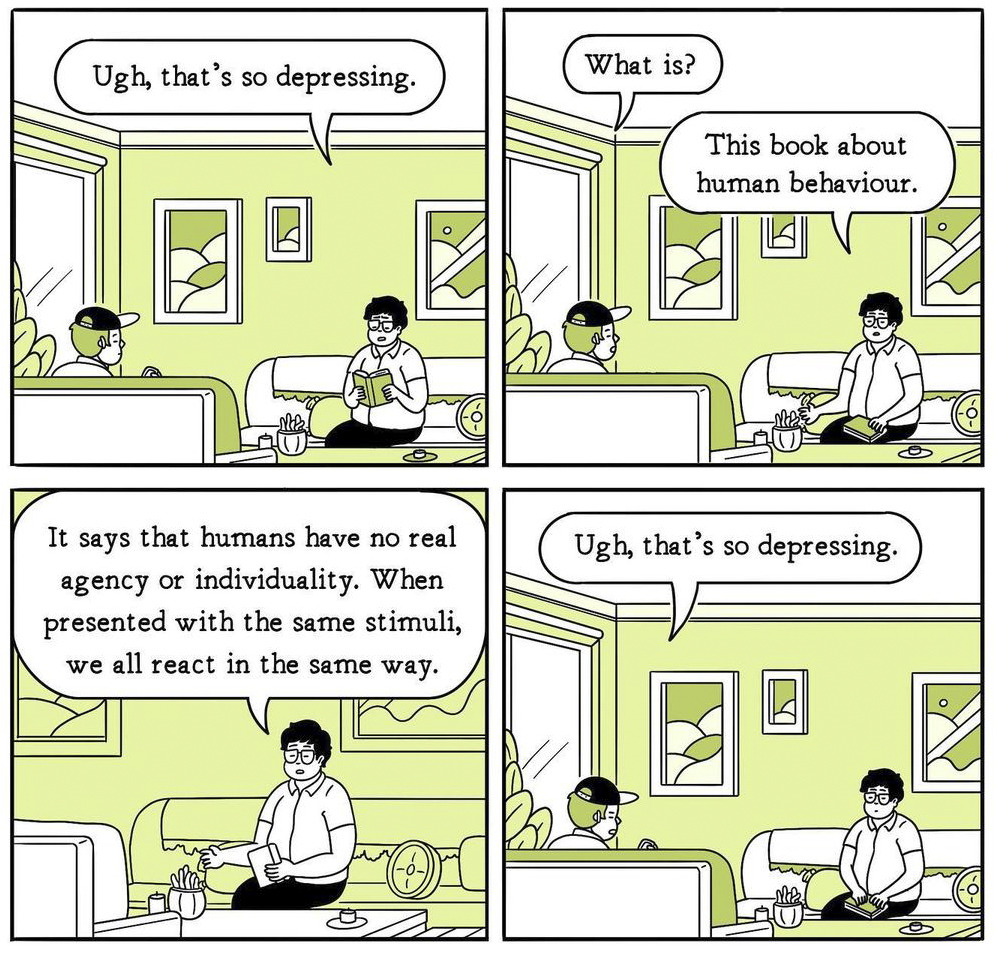
Some, for sure. We do have at least a substantial range of behavior autonomy and invention. But we also have more determined behaviors (like the cartoon). The many truisms or adages about human behavior that we say, like "Be careful how you talk to yourself when you are dealing with a big problem. You can make things better or worse by feeding yourself the right or wrong messages."
"Happy families are all alike; every unhappy family is unhappy in its own way." (Leo Tolstoy). Social workers see the same bad results from bad habits, bad behaviors, bad choices, etc. all the time.
In my opinion, people are more alike than they are different. That's not about free will; it's about how we predictably respond to certain stimuli, even if we do have free will. -
Can this art work even be defaced?Our job here is to transcend the gravitational pull of enculturation and group mores. — Tom Storm
Why should we do that? Is that really our job, or is that just one option among several others? -
Can this art work even be defaced?There is something more than personal opinion and public acclaim that makes good art. — T Clark
Personal opinion and public acclaim do not make any art at all, any more than a stadium full of cheering fans make plays on the field.
There's artistic vision, truth, technical mastery, surprise, emotional insight, playfulness, complexity, narrative, simplicity, clarity, depth, history, humor, community.... and on and on. I don't know how to put all that together. — T Clark
The artist puts all that together. IF he or she is successful in putting it all together really well, there will be individual and public acclaim for 'a great work of art'. Probably -- it might take quite some time to appear, but it usually does, eventually.
People like good art. That good art is better than bad art, just like good food is better than bad food, is just my personal opinion. You can prefer bad art and bad food if you like.
BTW, I do not feel inadequate, or that I am shirking my responsibilities by not posting THE definition of art, or a list of the elements of great art (or bad art). A) IF I were to post those things, there would still be disagreement. B) The question of what makes good art good has not been finally answered by many others.
Culture is changeable, and so does the definition of cultural products. Opinions are personal because we each experience the world (and art) individually. What meets the criteria of greatness today may not be on the list tomorrow. Johan Sebastian Bach was the IT composer, then he wasn't. A century later, he was revived. . -
Can this art work even be defaced?My view that, "The quality of porn is easy to measure", was more of a joke than a major plank in art theory. It either does it or it doesn't. From what I can tell, the porn industry has solved the problem of matching content to customer.
-
Can this art work even be defaced?I don't really care what others think. — Tom Storm
Really? Not at all?
Or are you suggesting with your term 'collective process' that there is an intersubjective agreement about what art can be considered good? — Tom Storm
Some important 'decisions' are made socially, collectively. For instance, how does a worker in a plant know he is working "hard enough"? The workers collectively define what "working hard enough" is, and discourage fellow workers from not working hard enough, or working too hard. Workers define what "good performance" is. Collectively, they define quality performance, and sub par performance, too.
We observe each other; observe many cues; look for positive and negative responses; adjust our behavior to fit what others are doing. The effort to fit is made more or less automatically -- because we are social animals.
Within our social milieus we determine what a proper cocktail party is; we determine what kind of public religious activity (including speech) is acceptable, and not. We determine what attractive landscaping is; what a nice house looks like; what 'well dressed' means; what kind of car is acceptable, and not.
We determine what music is popular among us (our milieu) and what is not; what novelists are 'good;, which are not. [Ayn Rand has been judged bad by many of the TPF milieu.]. We learn what kind of art is acceptable and what kind is not. There are certain films that won't be discussed at a proper dinner party. Certain jokes can be told, others can not.
There is nothing mysterious about how this process works: we are social animals and we do look for clues among our people, our milieu, about what is considered good and not good.
We may be inclined to consider WHY what our crowd, our milieu likes what we do, and why it is defined as good or not good. We'll remember that in a college class we used a text on criticism; [that class is now 55 years in the past. Sorry, don't remember.] some of the authors had ideas about what constituted "high quality art". We might do google searches, look for criticism books on Amazon. We might find exactly what we were looking for: a cookbook for thinking about art.
In the cookbook we would find chapters on the history of art forms and the value they were given. We would learn how to look at the structure of a painting, a piece of music, or a novel. We would be directed to evaluate the content, the symbols, the sources, the interplay of characters, and so on. Through reading the book, and applying it to paintings we look at, music we listen to, novels we read, and so forth we would find ways of supporting our preferences. Preference (personal opinion) might stay the same, but we would be better grounded. -
IQ Myths, Tropes and insightsI'm going to start with the fair, I think, if somewhat sycophantic assumption that the average IQ of posters here is noticeably higher than the general population. — Reformed Nihilist
What on earth would make you think that? -
Can this art work even be defaced?The quality of porn is not easy to measure. Not by a long shot. — john27
That hasn't been my experience. -
Can this art work even be defaced?@Tom Storm Fortunately we do not have to come up with criteria for good art, bad art, art at all. Culture, I hear, is a collective process, a cooperative product.
Culture, tradition, elites, — baker
and others. What constitutes good art, good music, good literature, good landscaping, good architecture, good sculpture, good... whatever is determined by the votes of everyone interested in the matter. If you stand and look at a Pollard for 75 seconds, you are voting yes, even if you don't get it. It was significant enough to keep you looking for longer than 5 seconds. Some votes count for more than others, of course. If the Guggenheim or MOMA or Alabama State Museum of Spittoons includes a piece, then it has been deemed important, excellent (or influential). Same for music. Orchestras record and perform music they consider excellent. Museums and orchestras are gate keepers; arbiters; mavens; taste makers. What are the standards they use? Read the notes under the picture and in the concert program.
By participating in cultural events we absorb the collective idea of "what is worthy" and why. It isn't necessary that you like everything that is considered 'worthy'; it is enough to recognize that it has been so rated, and to have some idea of why.
The cash nexus also enters in to the picture. How many people will buy a ticket? How much can I get when I unload this thing at Sotheby's? Christies? (Somebody mentioned 'cartel'...)
There are market results. How many records were purchased, streamed, swiped, played on air, etc.? Who's in the top 10? Top 100? top 100,000? I would imagine that Godsmacked best recording may make it all the way up to solid lead. -
Can this art work even be defaced?And we are yet to arrive at any foundation for what 'good art' might be. Just calling it good only does half the job. — Tom Storm
So, what are you going to do about this deficiency? -
Can this art work even be defaced?including porn — Tom Storm
The quality of porn is easy to measure. -
Can this art work even be defaced?Art is anything that is presented by someone for aesthetic judgement. It's similar to saying that it's art if I say it is, but not exactly. It's a rule that's easy to apply. — T Clark
I do not know why some people think it is an upgrade to put a beautiful seashell in a case and hail it as art. Or, for that matter, to give the display case treatment to a dehydrated dog turd. Maybe because it's just easy to do that.
The entire visible universe is available for one's aesthetic judgement (see Van Gogh, Starry Night). The world is a beautiful place (often enough). It doesn't have to be art to be worthy of contemplation. There are many other things beautiful, awesome, ugly, horrifying... interesting objects can be. Folded, uplifted rock isn't made more amazing by being called "art". "Uplifted folded rock" is really amazing enough.
Aesthetic judgement doesn't kick in just because we are in a museum displaying art. It also kicks in when we see an interesting, almost cadmium yellow fungus. Beautiful! What's its name? What is the coloring composed of? Interesting how the yellow fades to brown over a week's time. How many shelf fungi start out as bright yellow? Et cetera. -
Can this art work even be defaced?Yes, but throughout this thread we have been discussing more than personal taste - potential objective criteria (you suggested effort and quality) by which to assess a work. It's even been suggested that bad art isn't worth calling 'art'. — Tom Storm
Getting back to Mozart. Genius though he was, he still had to do the work, which he had to do under much more difficult circumstances than Haydn worked under. Professional musicians have commented that Mozart's scores are not polished in the way Haydn's are. Of course not: Mozart was a free agent working in the rough, open market; Haydn was a residential employee of the Esterhazy family.
Mozart's Don Giovanni and Adams' Dr. Atomic both demonstrate what effort and quality look like. So do many rock albums. So do great short stories and novels, movies, New Yorker covers, etc. Levendis, the main character in Harlan Ellison's short story, "The Man Who rowed Christopher Columbus Ashore", is a demon--an unlimited being in a sadly limited world. He is timeless. Anyway, great story. Levendis makes the observation that "it is not surprising that there is a lot of bad art. "What is surprising is that there is so much good art -- everywhere" -
Can this art work even be defaced?On what basis are you saying it is not art - personal opinion? — Tom Storm
Let's say, "personal judgement". How else would anyone decide?
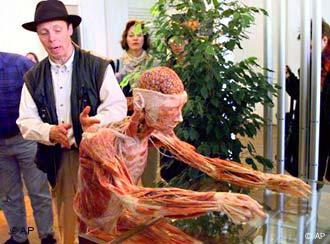
The starting point for von Hagens' corpus (so to speak) are dead bodies, for which he can claim no credit. The rest is taxidermy for which he can claim credit. As such it is, as I said, interesting. It isn't art for the same reason that a seashell isn't art, even if it is mounted in a nice display case. The clam did the work, not the finder. That doesn't mean seashells shouldn't be collected and displayed; it just means they aren't a "work of art" in themselves.
had von Hagens started with clay and made a sculpture in the form of a skinless body, it would not be in the not-art zone. It would be art, period, like Alberto Giacometti's sculptures: "He didn't sculpt heroes on horseback; he depicted everyday humans — and animals — struggling to get through the day. below, his 1951 bronze sculpture Dog (Le chien)

-
Can this art work even be defaced?There are many people who think Norman Rockwell is a better artist than Picasso - how do we establish if they are right or wrong? — Tom Storm
They are not right or wrong about what they like, and what they like is probably what they judge to be better, more artistic. That's altogether understandable. Rockwell's Saturday Evening Post illustrations are part of my childhood, certainly; Picasso was not. Picasso and Rockwell aren't equivalent artists -- different times, different places, different environments, different sources of income, etc.
Picasso's imagination seems to have been much wider than Rockwell's, and he worked in several different forms. His "Mask" sculpture in Chicago is an example:
On the other hand, Grant Wood is underrated as a result of over-exposure and caricature. If this image were seen only in a museum, instead of a thousand cartoons...

-
Can this art work even be defaced?What do you say to the music academic who says that all pop music is junk — Tom Storm
I would say that the music academic probably doesn't like pop music and is a musical snob besides. I can relate to his dislike. Once upon a youthful time, I was something of a musical snob and looked down on the popular music of the 1950s and early '60s. There was a lot of popular music I missed out on, because I was paying attention to archive folk music and classical stuff, or gamelan music, or whatever.
As I got older, I payed more attention to the pop music I had formerly shunned and found it had a lot more merit than I had previously credited it with. -
Can this art work even be defaced?tell the difference between art and non-art — Agent Smith
I am content thinking that shoveling the snow off the sidewalk is not art and that Swan Lake is art. Granted, there is a fringy region between art and not art. Example: in 1968 I found a 90mm brass shell casing in the surf at Marconi Beach on Cape Cod. The shell had exploded, ripping the casing into a ragged 'V'. (The shell would date back to WWII.) The surf had smoothed the edges and given it a matte finish.
This found object could be mounted on a nice hunk of wood and be called a sculpture. I'm pretty sure it would pass muster as art for a fairly large number of people. I really like it, but I don't think it is art, any more than an interesting mollusk shell is art, beautiful though it may be. It's in that border zone where objects seem "artful" and are not.
From the other direction there are things that seem more like not-art objects, though they are claimed as art. Take Gunther von Hagens, known for his displays of preserved human corpses stripped of skin and dissected. They are 'plasticized' for preservation. Hey, very interesting! Not0-art, though.
-
Can this art work even be defaced?Since art hasn't yet been defined, to talk about good/bad art is to put the cart before the horse. — Agent Smith
We may not agree on the definition, but art has been defined and we have a working definition of it in our heads. Defining art again is a pleasant enough pass time, but it is not a requisite for most purposes. It might seem like a necessity to define the term before we can begin sorting out good from bad, but sortition (sorting out) contributes to the definition.
A lot of the ink spilled on the definition of art is actually in support of what we like and do not like, and why. THAT is what we quite properly care about. -
Can this art work even be defaced?
The difference is that Taylor and The Rolling Stones are decent examples of pop music, whereas Godmack is not. — Noble Dust
I sampled the codsmacked video. The visuals supported some sort of story, apparently. The instrumental part didn't interest me much, but it seemed competently performed, such as it is. The vocal parts were more often screamed than sung --presumably screaming is not singing, There were passages where the vocal parts were actually sung, and for this genre, sung well enough.
This isn't my cup of tea at all but I'd allow that it qualifies as "musical art"; probably not good--and certainly not great--musical art. What keeps it fro being "good"? extended effort, maybe. Pieces like this seem slapped together and the many edits make it more difficult to judge the visual part. In addition to being screamed, the text was inarticulate. I googled the text and decided that I hadn't missed anything; it doesn't add up to much,
Now I've told you this once before
You can't control me
If you try to take me down you're gonna break
I feel your every nothing that you're doing for me
I'm picking you out of me
You run away
I stand alone
Inside
I stand alone
There are so many good, very good, and great pieces of music art, all genres. What are some commonalities?
Performers are sufficiently articulate that they an be understood, (except in 'high art' opera or oratorio pieces where a vowel may be carried for sever bars up and down the scales)
Musicians perform professionally (high quality)
The content is complex, complete, adult (it's not bubblegum, like the Ohio Express's repulsive 1969 horror Yummy Yummy Yummy I got love in my tummy)
Quality and effort shows whether it's Mozart's Requiem or the latest chart topper, and so do a lack of quality.
(Lack of quality wouldn't prevent a piece from being popular among some group. The Ballad of Ethel Pump is disgraceful, but some people like it. Nobody ever went broke underestimating the taste of the buying public. -
Can this art work even be defaced?In general I don't think it is useful to ask if something qualifies as art. — Tom Storm
Hrrumph. It would make some people unhappy when the answer is "No! Now go to your room and practice perspective drawing." -
Can this art work even be defaced?I am in favor of a free and open society where people have a right to do what they want to do as long as it doesn't interfere with the rights of other people, and if it hasn't been explicitly forbidden for the good of all (like drunk driving).
Raising the bar for what constitutes art, and what constitutes decoration (and they are both valuable) doesn't infringe on anybody's creative activity or enjoyment there of. The bar should be raised and artists should try harder to meet it. If they don't meet a higher bar, it isn't like they are going to be hanged till dead. Except Thomas Kinkaid: His gooey, treacly, cloying sentimental village scenes are a criminal aggravation of the diabetes epidemic.
BTW, @Jorndoe, @Tom Storm, and @T Clark Cosmic Latte starts out as a tiresome shade of pale and goes downhill from there. Yet another way the universe sucks. -
Can this art work even be defaced?The occupying allied army in Iraq was probably as nice as the Babylonian occupying army was.
-
Can this art work even be defaced?I've had the opportunity to insult you not once, but twice — T Clark
Duly noted. At least you haven't slung any more dang ding walla walla I Ching at me. -
Can this art work even be defaced?Also - I like it. — T Clark
Actually, I find the image pleasant enough to look at. There are many a dismal hallway and dreary tunnel that would benefit from the application of this sort of content. Decoration, however, isn't art, in my opinion.
Decoration - wall paint, wall paper, plaster moldings, wood, miscellaneous objects, floor coverings ceiling treatment, lighting fixtures and light color, furniture fabrics and shapes, murals such as this, and so on contribute to the comfort or discomfort we experience within inhabited spaces. They require craft to create and their use involves careful aesthetic judgement, but the elements are not "art works" in themselves.
Painting a wall color #F0EAD6, otherwise known as eggshell (type of bird not defined) is not art in any way, shape, manner or form. Putting navy blue carpet on the floor is not art. Furnishing the room with goods from IKEA (or Ethan Allen) is not art. The room may be splendid: attractive, comfortable, relaxing, etc. but it isn't art.
Hotels, hospitals, and clinics buy cheap reproductions of recognized art work to hang on the wall. They also buy framed photographs of trees and flowers, hills and mountains, water etc; truckloads of occasional furniture of various styles, even manufactured assemblages of bits and pieces that have a Duchampian 'found art' appearance, but are not. The overall effect is kind of neutral, not bothersome, sort of pleasant. Just not art. Interior designers (not artists) have found that guests, clinic and hospital patients and visitors find the stuff on the walls usefully distracting.
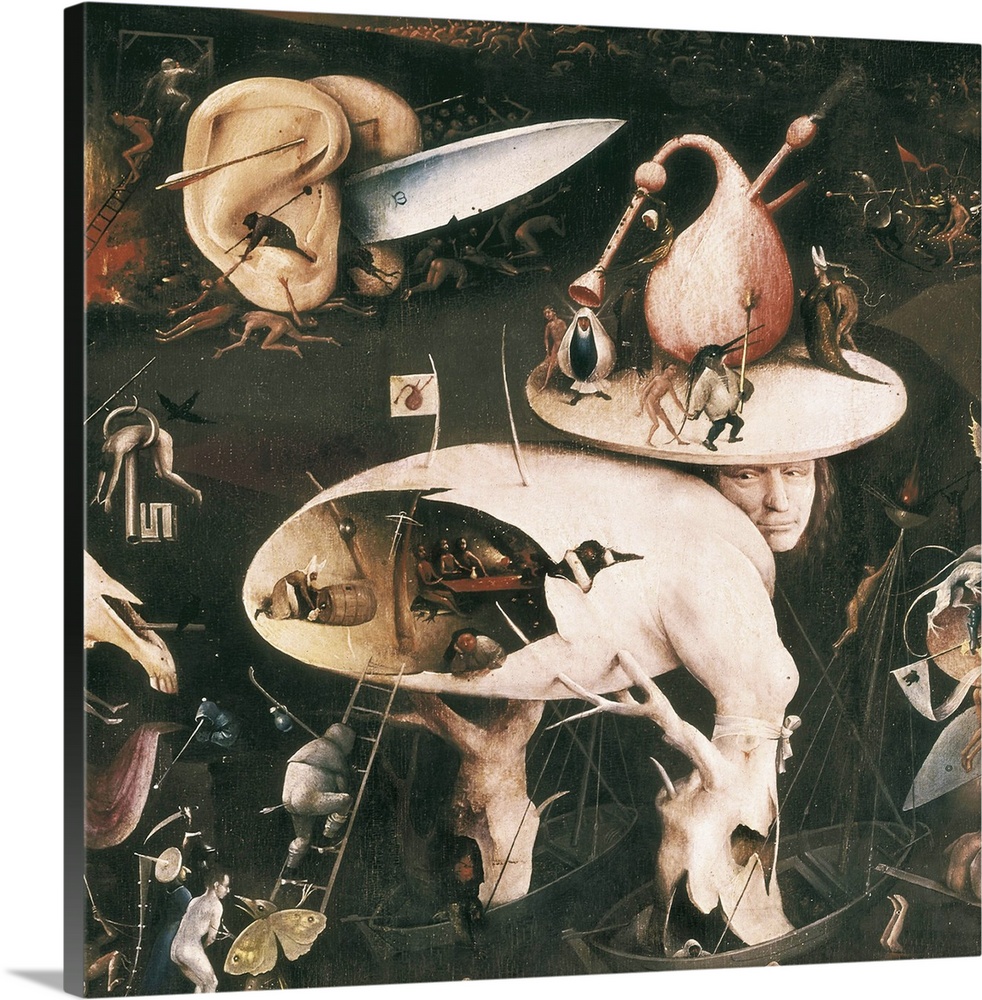
Someone stuck in an exam room will look at the bland photo or painting on the wall because that is the least anxiety-producing thing in the room. "Guernica" would not be good. Bosch either.
-
Can this art work even be defaced?Well, it is art by the praxis criteria - It is presented with the intention that it be judged on an aesthetic basis. — T Clark
It also conforms to Duchamp's criteria: If the brush holder calls it art, then it IS art. That leads to this:

Or, your crooked snowman is art if you so designate it. (You are required to publish the announcement in the official Art Register, however.) Without proper documentation, millions of snow art pieces are lost forever. Just fucking tragic. -
Can this art work even be defaced?It clearly represents the journey and return of a soul - that orange blob in the middle - to a spiritual realm and then back. — T Clark
No,no -- you totally missed the point of the piece: the green splotches represent the sacredness of commercial activity in capitalist economies, threatened by the insidious creep of socialism--performed by the red blotches. I don't know how you could have missed that -- it is so obvious. -
Mediocrity's PerfectionTao Te Ching — T Clark
How long is this Ching thing you've got going to last? -
James Webb TelescopeThey should probably supply champaign by the truck load for disasters, when fast effective relief is really needed.
-
Why You're Screwed If You're Low Income@L'éléphant You're Screwed If You're Low Income
Yes, of course. The screwedness of the poor is what keeps those who are not low income YET working, striving, and persevering. It's essential to have some unemployed and low-income workers in the economy to serve as a reserve and a warning, A reserve in that the non-employed can start working when there is a big demand for unskilled labor (not so much these days). As a warning for compliant unorganized workers to stay that way. Step too far out of line and you'll end up being one of the poor scum we all know and loathe. You can be replaced, if not by an unemployed person, then a robot. So just shut up and get back to work!
It's helpful to have a few homeless, hungry, and addicted people living in misery on the streets as a further reminder of how arbeit macht frei, or at least keeps workers out of the gutter. The working poor have lives that are better than the broke homeless.
Lots of people are devoted to upward mobility. So focused on that as they are, they have not noticed that downward mobility is a real possibility, even a likelihood in some situations. "So you think you've reached bottom? Oh no, there's a bottom below! There's a low below the low you know, you can't imagine how far you can go
DOWN..."
By means of inflation and stagnant wages over several decades, American workers have experienced downward mobility. Generally they don't want to acknowledge it.
Go ahead and acknowledge it. Admit it: you've been had by your capitalist employers. The sons of bitches ripped you off. They don't care about you. You are free insofar as you are profitable. -
James Webb TelescopeI'm still amazed that the delivery vehicle was able to descend into the Martian atmosphere, brake close to the surface, hold the position while it lowered the latest Mars Rover to the ground by cable, disconnect itself from the rover, and then crash landed at a safe distance. The rover didn't get tangled up in the cable, remarkably. The delivery vehicle didn't crash land on top of the rover.
An alternate method of landing is also impressive: the delivery vehicle descended towards the Martian surface, ejected the rover package which consisted of the rover surrounded by large balloons which inflated before the package reached the surface. The balloons bounced a few times before settling. Then they deflated and detached and somehow did not get tangled up in the Rover's wheels, camera, etc.
It would make an engineer ill if the whole mission was successful up to the point where the rover couldn't drive off because a balloon had jammed its wheels.
Same thing for James Webb: How nauseating it would be if everything worked perfectly up until the last preliminary step, and then the ignition switch was jammed (using "ignition switch" as a figure of speech here). I don't see how they stand the tension and the disappointment when things do fail, as they sometimes do. -
Can digital spaces be sacred?I'm not enthusiastic about people declaring this or that actual, material location as "sacred" let alone web sites. So the intersection where George Floyd died has been declared "sacred space". Nonsense to me. It's just the seedy intersection of Chicago Avenue and 38th Street. George wasn't/isn't a saint. What happened is unfortunate, one more misfortune among thousands that happen everyday.
Martin Luther King's motel in Memphis or the Ford Theater in Washington, D.C., aren't sacred--in my mind, at least.
Stonehenge, the Wailing Wall, the Kaaba, the Golden Temple, the Church of the Holy Sepulcher, and so on are all sacred spaces by virtue of time and emotional investment. Stonehenge is becoming "re-enchanted" I suppose, but not so enchanted that the English wouldn't like to put a road through it (really stupid, even if nobody thinks it is sacred), -
Can digital spaces be sacred?What works against cyber space, or particular web sites, being sacred are:
a) they are too new (at the present time)
b) they are not sufficiently static--that is, they can too easily be changed, erased, moved, etc.
c) they are ruled by technology's values
Web sites just haven't been around long enough. Sacred status takes time and emotional investment to accumulate spiritual weight. Just guessing, but Jesus' tomb probably wasn't sacred space upon the alleged events 3 days after his crucifixion. Locations associated with Jesus probably became 'sacred' by the action of the religion founded upon Jesus. That took centuries, not years. (I'm making assumptions here -- where is The Philosophy Forum's time machine?)
An aside: the compilers of the New Testament did not live in the Roman province of Judea; like as not, they had never been there. 99.9% of the New Testament readers (in the first couple of centuries after it was finished) hadn't been there. Places like Bethlehem and Golgotha became sacred to most people at a distance, over time. But those place were still real, and the people on site took care of them, and in time they were memorialized with large worship buildings.
What happened to Bethlehem can't happen to Tumblr or YouTube.
What you see when you sign on to Tumblr or YouTube is likely to be altogether different than what I see, or anyone else sees. So, what part of these sites would be sacred? The pictures of Egyptology or the gay porn? The zillions of cat and dog videos or the videos of railroad switching yards? The discussions of atomic fusion? WWII films? Right wing political ranting? Leftwing political nattering?
Even Bible or other religious text sites are not sacred, in my opinion. Religious texts can be sacred, but when served up digitally, by the verse, along with advertisements, I don't think they have the same emotional value--as web sites.
Cyber space locations might become sacred at some point in the future, provided a given site remain the same for a long time (a couple of centuries maybe). Provided that people invest emotionally in the site. Provided it shifts from being "a technological artifact" to a "spiritual artifact". -
James Webb TelescopeI'm hoping for wonderful results from James Webb. At the same time, we have great examples of things that should have worked out well that just didn't. For instance, there is Millennium Towers in San Francisco, a 58 story up-market residential tower. It's now leaning 22 inches out of plumb, and the various fixes (mostly more piles next to and sort of under the building) haven't stopped the gradual tilting.
Bridges sometimes fall; big passenger planes crash--even if only once, it's a big deal; rockets occasionally miss the planet. Very sad engineers
So much the better if this very complicated piece of machinery unfolds itself, powers up, and does everything it is designed to do.
and Adding a camera to take selfies would provide one more thing to go haywire. You are right, Wayfarer: the designers/operators of this machine know it, through and through, better than they know the backs of their own hands (which are valued at considerably less than $10,000,000,000 apiece). Little sensors register when shaft #52 is fully extended, when wheel #8 has turned 2.88 times, when the temperature at location #22 is within the specified range, etc. tell them exactly what is happening.
Their sensors are more informative than the "engine" light on our old VW's dashboard which could mean anything from "the engine will explode in 10 seconds to a sensor is sending a meaningless warning, or maybe both. You can interpret it however you like."
BC

Start FollowingSend a Message
- Other sites we like
- Social media
- Terms of Service
- Sign In
- Created with PlushForums
- © 2026 The Philosophy Forum