
-
Help ambiguity problem"Did you or did you not go to the market yesterday" — Robint
"I am a good player, if not the best" — Robint
You are correct in identifying these two constructions as ambiguous. "Did you go to the market yesterday?" is clear. The 'rhetorical' purpose of the first statement's construction is to bear down on the witness [or the husband, the wife, the maid, the child...] with imperious phrasing.
The second statement isn't a good example, as written. I would expect to hear "I am an excellent player, if not the best." There is too large a gap between "good player" and "the best". In any case, the speaker is leaving himself a little space to maneuver. He wants to boast, but isn't quite bold enough to claim the top spot. Mohammed Ali (the boxer) was bold enough; he proclaimed "I am the greatest!"
Ambiguity just goes with the territory of language--any language--as people use it in their customary habit. Maybe in 90% of everyday conversation ambiguous language is precise enough. In the remaining 10% confusion demands clarification: "Which scalpel do you want, doctor?" Any speaker can speak (write) more precisely, less ambiguously, with practice and when required by circumstances.
I don't know whether English is the most difficult language to learn, or not. Children can learn any language, even two or three unrelated languages at the same time. -
Why doesn't the "mosaic" God lead by example?Do you think in America that maybe patriotism merged with religion around the 1950s (ie the pledge of allegiance), resulting in part of the difference between Europe and America? — ZhouBoTong
No. Religion and patriotism had gotten into bed together long before the 1950s. The Civil War broke several denominations apart, as churches in a given region aligned themselves with local politics. The United States was not very religious in the colonial period, some reports have it. The Second Great Awakening was a 19th century affair. The latter part of the 19th century and early 20th century was maybe "peak politics and Religion" time.
At the end of the 1950s, religion in America crashed. Millions of people -- Catholic and Protestant -- left their churches and did not return. Since the 1960s hemorrhage, membership has continued to bleed away, just not quite as fast.
I do remember when the Pledge of Allegiance was changed -- I think I was in 3rd grade, so... 1954 or '55. I remember learning the "under god" bit. There was that conflicting drive -- to add god to the pledge of allegiance, and Madeleine Murray O'Hare's drive to get "In God We Trust" off the money, and to ban school prayer. Official prayer got banned. I think the drive to put "under god" in the pledge of allegiance may have been more an anti-communist angle than a "religious" angle. But I'm projecting backwards. I certainly wasn't thinking about that at the time.
Time for the 3rd Great Awakening? — ZhouBoTong
Your guess is as good as anybody else's on this question. We, or the Europeans, could certainly experience a great awakening of some kind. But... who the hell knows?
How similar are the beliefs of Christians in China to those of Christians in the US? — ZhouBoTong
I really don't know.
Well, this has been very interesting. -
Why doesn't the "mosaic" God lead by example?Baroque is the one with the tinny noise? Harpsichord I believe? — ZhouBoTong
Harpsichords were in use for quite a stretch. Johann Sebastian Bach would probably object strenuously to "tinny noise". But baroque composers didn't have the benefit of later technology -- like the piano, where the strings are struck by the hammers producing nice solid base notes, instead of the strings being plucked in the Harpsichord--producing that finicky plucky sound. The strings on their violins were made out of gut -- literally, dried out guts. Nothing wrong with that -- we still make products out of cow gut. Dissolving sutures in that cut you got stitched up? Gut. Plastic and metal strings produce more sound. Quite a few instruments that we consider essential hadn't been invented yet in the baroque period.
here's a piece that will sound 'tinny': Vivaldi's Mandolin Concerto in C Major. Here's another 'tinny' piece,
one written by Bill Monroe in his later years for mandolin; he died in 1996 at 84. Monroe was one of the 'inventors' of bluegrass music. He isn't playing in a 'tinny' way; it's just the sound of the instrument.
So what about folk: Where Legit Folk leaves off and protest songs or labor ballads and so forth pick up is not of much interest to me. A good song is a good song. Here's a song sung by Country Joe McDonald, who began back in the 1960s doing anti-Vietnam War songs. One of his later albums are WWI songs which he set to music or he reads. My favorite on that album is the Ballad of Jean Deprez. It's a poem by Robert Service about WWI (or could be the Franco-Prussian War of 1870). It's quite stirring.
https://www.youtube.com/watch?v=xMCBOXTPOVo
Actually, I like most music from the Medieval to the John Adams' opera, "Nixon in China" or Dr. Atomic. Rock and Roll, opera, Big band, brass band, dance band, and organ -- it's all good. -
Why doesn't the "mosaic" God lead by example?Yes. It does seem like a stretch that an immortal, invisible, God only wise; most blessed, most glorious, the Ancient of Days; Almighty, victorious; Unresting, unhasting; not wanting, not wasting--and more besides--could be rationalized from naturalism's perspective.
Smith's hymn is quite popular among ex-Anglican and ex-Methodist atheists.
Here's William Blake's Ancient of Days, applying his compass to the earth.
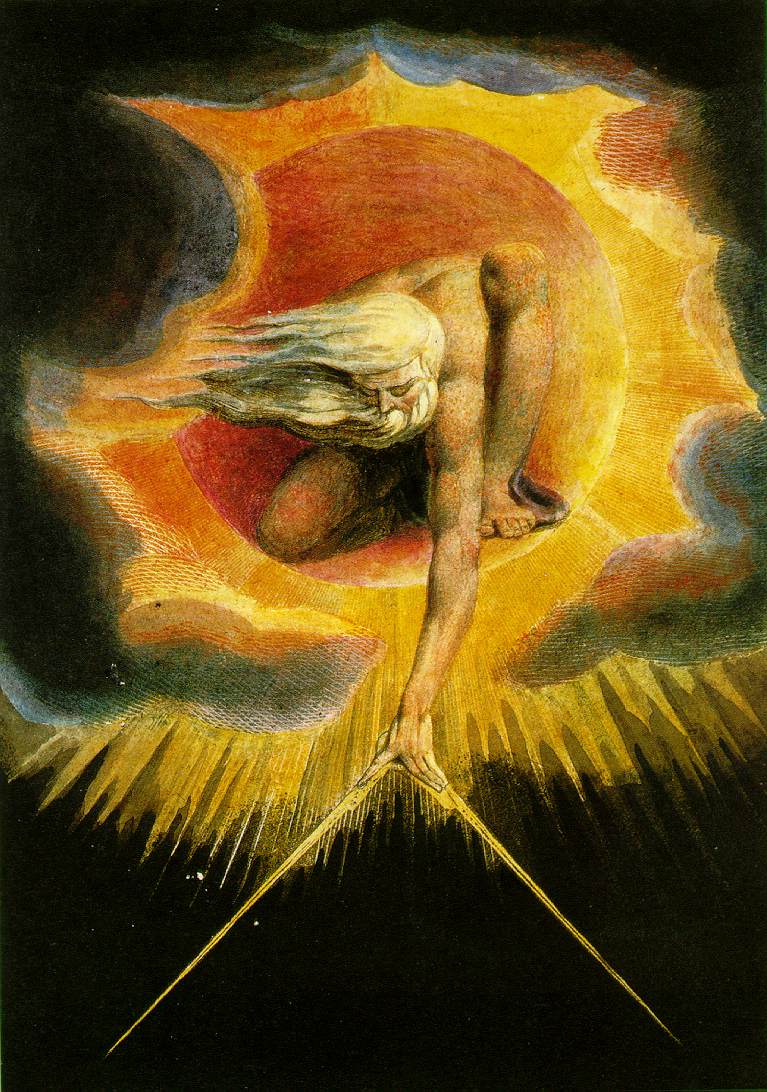
-
Why doesn't the "mosaic" God lead by example?I also think it meets a need that not everyone has. — ZhouBoTong
Quite so. And if religion is a need (I don't think it is) it's an itch that can be scratched in various ways.
they prefer an answer that soothes their emotions vs an answer that soothes their intellect — ZhouBoTong
Well, cradle atheists and ardent believers alike both like and need their emotions and intellects soothed regularly--by some balm or other. And atheist and believer alike can find it difficult to find just the right content cocktail to keep themselves happy. This is so because LIFE, whether one is an atheist, deist, or theist, is difficult, annoying, full of irritations (other atheists and other believers, for instance) and hard. It is a struggle to find the right "bar" that is serving up the right "content cocktail" at the moment.
As Karl Marx said, "Religion is the sigh of the oppressed creature, the heart of a heartless world, and the soul of soulless conditions. It is the opium of the people." Marx wanted to abolish what he identified as the capitalist / industrial exploitation that drove people to desire and need the comforts of religion.
So for Marx, religion is a consequence of oppression and the abolition of oppressive conditions makes it possible for religion to decay and disappear.
I like Marx here. Let's compare the United States and Europe--the former where religion has remained very strong and the latter where religion is very diminished. Europe, despite or because of two world wars has built a pretty strong social security system that considerably softens the effect of capitalism.
The United States has maintained a harsher version of capitalism with fewer shock absorbers (social services). Exploitation has been somewhat more naked here. A connection? Probably. Of course, there are other reasons too -- the American church (broadly speaking) has experienced regular renewal over the last two centuries -- up until the 1960s. Since 1960, religious participation across the board had dropped significantly. But "religiousness" is still more common here than in Europe.
Interestingly, there are now 67 million Christians in China. There are other religions too, like Buddhism and Islam. China's religious population seems to have grown while the country was becoming better off. But then, China isn't like Europe or North America.
Baroque music is one of my favorite comforts, Vivaldi, et al. That and folk. Folk and Baroque. That and good books. My current top read is THE GENIUS OF BIRDS by Jennifer Ackerman. Go Birds! -
Is it an unwritten community laws/custom, to demand factual proof when making a reasoned opinion?I've never said anything that sensible.
-
Brexitwhen either say predicts the end of the UK if they do or don't Brexit — Coben
The sceptered isle of Britain won't sink into the sea on the basis of Brexit. But the United Kingdom could come apart and not be the UK anymore. Scotland, part of the UK for 300 years, could sever its union. So could Wales (probably won't). Northern Ireland--god only knows. So, theoretically, Brexit could scuttle the United Kingdom.
England will probably remain England. Maybe Cornwall will decide to reclaim itself. Maybe SE England will shed the poorer northern portions. Maybe London will become a city-state. Or maybe London will get swamped by rising ocean levels. -
Is it an unwritten community laws/custom, to demand factual proof when making a reasoned opinion?I do think reasoned opinions should flow quite naturally from source texts though, and be demonstrable on demand. — Pantagruel
Where did you steal this idea from, exactly? Sources, please. :naughty: -
Is it an unwritten community laws/custom, to demand factual proof when making a reasoned opinion?How would one go about telling these people that they are asking for something that is not available or not necessary? — god must be atheist
I make statements all the time based on years of reading; I often do not know exactly where something came from. The accumulation of ideas you will pick up from reading become your ideas. I didn't invent the theory of evolution -- I picked that up from lectures, reading, discussions. Evolutionary theory is now part of my thinking.
If you don't have specific sources for a statement (and you might not--this isn't a graduate seminar, after all) then just say so, or ignore the request.
Why the ongoing badgering, then? How does one stop such badgering, which included egging-on insults, like "you haven't shown anything", "your reasoning is faulty", etc, when these are empty accusations without merit? — god must be atheist
Some people are badgers, and that's just what they do. I've seen this kind of repeated response quite a few times over the years in various threads--"you didn't explain anything", "you still haven't answered my question", "you haven't shown anything", etc. The badgers quite often have no more insight into the issue at hand than they accuse their targets of having.
Sometimes you just have to move on, and ignore some people.
but why does one need to defend against false criticism? — god must be atheist
If someone has made a serious criticism, like "You have completely misunderstood Hegel", and you believe you have not misunderstood Hegel or Kant or Socrates or Joe Blow, it is worth your time to answer -- if possible. Like, ask the nabob of negativity, "How have I misunderstood Hegel? You've made a serious claim -- prove it." But again, this isn't a graduate seminar. Sometimes it's a fair response to ignore people.
Why is it a fair response in this forum to ignore people sometimes? Well, batting the ping pong ball of a disagreement back and forth too many times makes for tiresome reading, and it wastes time. It might look like productive engagement (it might even be productive, under some circumstances) but often it is just tedious mental ping pong. "No you didn't", Yes, I did", ad nauseam.
All purpose rule of thumb: A lot of people are just annoying. -
Is it an unwritten community laws/custom, to demand factual proof when making a reasoned opinion?I noticed that often when I appeal to common sense, people will want some background reference, or statistical or other evidence to support an opinion. — god must be atheist
Some rhetoric teachers recommend NOT appealing to common sense. For one, common sense is perhaps a good deal less common than we hope, and for two, it either doesn't mean anything in particular, or it means nothing. I don't care if you use the phrase "common sense" but it does have rhetorical deficiencies.
If you say something that somebody else doesn't particularly like the sound of, an easy negative response is to ask for evidence, or a reference. In many cases, we can cite actual evidence and give references for our statements, but it's a lot of trouble to track it all down. Everyone knows this.
If I say, "Gay is good." I have stated a personal opinion with which others can only respond to by stating their own opinions. So you can say "Yes, gay is good" or "Gay is not good." Either way, it's merely your opinion, and my opinion is merely mine.
If I stated that "The human species will be wiped out by 2200 because of global warming." I am making a statement which may be factually based, may be factually erroneous, may be misinformation, or may be wishful thinking. In this case, people can, should, and ought to ask for the evidence behind my statement.
I can't say, "Oh, it's just my opinion." I need to cite scientific reports that suggest that global warming from greenhouse gases will make life untenable by 2200, or that disease and starvation will wipe us out (because of global warming), or something else.
As it happens, I don't believe that we will be wiped out by 2200. I would expect to see population levels dropping steadily by that time, heading toward a new, lower, equilibrium level. Disease and starvation, massive flooding, hot weather, high humidity, bad storms, etc. will probably be the new normal. I believe there is some evidence that if trends continue, the environment which we are accustomed to will gradually disappear and be replaced by the one I just described.
The trick is to not make really bold claims without providing information (or a source, at least) to back it up. If you make a statement of shocking opinion, then you should explain why you hold that opinion.
People may (will, pretty much) still give you negative feedback. There's nothing anyone can do to prevent that. It goes with the territory. -
On Antinatalismthat apparently balances out the cosmos — Andrew4Handel
I've never been able to get petty cash to balance, so even thinking about balancing the cosmos is well above my competence level.
even if one is not an antinatalist there is a case for reducing the number of people to reduce the amount of suffering — Andrew4Handel
On this I agree wholeheartedly. The growing number of people in the world are exceeding the globe's carrying capacity. Reducing the population by means beyond normal attrition will also entail great suffering. Population reduction is not something we need to plan for or execute. Natural processes will intervene at some point and carry out the reduction for us, on us.
We could work harder to reduce birth rates, however. Greater prosperity tends to lower birth rates, but it will not lead to zero population growth soon enough. Birth control must be pursued much more aggressively. More aggressive birth control--not for extinction of suffering--though fewer people means fewer people suffering--but for survival of the species. -
Donald Trump (All General Trump Conversations Here)Sorry for the lack of precision. I tend to lump them at that level all together. CEOs, one would expect, would bring proven performance ability.
-
Why doesn't the "mosaic" God lead by example?As a whole is the paragraph sort of saying, "common decency should be, and typically has been, common"...? — ZhouBoTong
Yes.
People get along with each other most of the time because people are social animals, life is difficult and requires cooperation, and social cooperation is rewarded in the form of peaceful, productive societies where life is better. Religion usually helps promote peaceful productive societies by encouraging people to get along together (unless it doesn't). Religion also helps assuage the suffering that leads to dying, and the existential fear of death itself. They might take care of the sick and dying, or offer consoling words about sickness, dying, and death.
Is it the case that ONLY RELIGIONS can do what religions do? Probably. Religious work, like civil engineering, is specialized -- requiring a preference for such work, training, practice, support, supervision, and so forth.
Religions are the organization most ready to answer people's "existential questions" Philosophy might also be able to answer those questions, but philosophy isn't organized to go forth and comfort the world's existential fears. Philosophers committed to an open-ended search the truth might irritate people too much. Mourners at the grave side want to hear something like "I am the resurrection and the live everlasting" and really don't want to hear about the lack of proof for or against a cold afterlife. An overly persistent and obtuse philosopher might end up being at his own burial, as the outraged mourners, armed with handy shovels, close up the ends of the philosopher's insistently open-ended thinking.
I think the Monty Python comedy group would have been the people to dramatize the philosopher's last funeral (were they still in business). -
Donald Trump (All General Trump Conversations Here)Biden-Warren, I can see it. — Wayfarer
Have you had your vision checked recently? (jokey quip)
You might be right. I feel neutral toward Biden, positive toward Warren. Warren is loaded with policy ideas, true enough, and expresses her ideas in a forthright and an articulate manner. However, in order for her to be able to DO GOOD POLICY (outside of executive orders) she would have to have a Democratic majority in the Senate and House, and not just for the first two years. The house/senate limitation applies to everyone, of course, for good or for ill.
The Republican Party has executed a long-term policy of getting control of state houses (where redistricting for Congress is done after the Censes) and has also been working on courts and state legislatures to protect rather old-fashioned methods of voter barriers like gerrymandering and "voter fraud" initiatives. Voter fraud has become a true rarity, so voter fraud is code for barring minorities and the elderly, both of whom are more likely to vote liberal. Poll taxes aren't going to work and neither are literacy tests. What they are using now is restrictive rules to deter minority and elderly voter registration.
This far sighted, patient projected is paying off. It reminds one of the long-term patient, hard working effort to block Roe vs. Wade. The secular right and the religious right have been working on this since 1973, when Roe vs. Wade was handed down.
The Democratic Party does not seem to have anything like the same long term, patient, strategy in place like the Republicans have. The Republicans have done well in the research and development department where they have discovered routes to long-term power that had eluded them for quite some time. I have not heard of anything similar in liberal circles. -
Donald Trump (All General Trump Conversations Here)I think he'll be re-elected, so my long term plan involves ignoring the news. — frank
This is an understandable response, and fairly sensible. The news coverage highlights the steady progress of a malignancy, and who needs that? -
Donald Trump (All General Trump Conversations Here)Our timeline on American politics is too short, here. If you look at politics in America since 1960, you can chart a steady trend away from substantive candidates and campaigns. Richard Nixon "lost" the Kennedy-Nixon Debate" because (the pundits said) he had a 5 o'clock shadow and looked tired. Looking tired? 5:00 shadow? Election by election the importance of clever theatrics has grown and the importance of content in the campaign has decreased.
The Platform Committees of the two nominating conventions used to receive attention. Not any more. Who cares what the platform is when you have fascinating personalities?
There are significant differences between the Republic and the Democratic Party, of course. For the last 40 years, the Republicans have paid more attention to their long-term project of reducing government--both in its regulatory guise and in its social services guise. Conservatives have resented the New Deal for the last 85 years. Democrats have tried to maintain and extend it.
It was under a Democrat (Bill Clinton) that "Welfare as we know it" was ended (i.e., reduced). It was under a Republican (Ronald Reagan) that the government response to the AIDS epidemic was poor. It was under a Republic (Bush II) that we became mired in a middle east war, and it was under a Democrat (Obama) that we stayed there.
Trump illustrates two personal characteristics that are relevant: First, as a CEO, he behaves in the presidency as if was a CEO--with lots of prerogatives, and not part of a government. Secondly, as has been noted, he doesn't deal with specific issues as much as incite political arousal toward easy targets.
And it isn't just Trump, of course. There are also many millions of voters who find in his incitements an answer to their many (some quite justified) resentments. How many millions? Enough in the right states to get him elected in 2016 by an Electoral College total of 304 electoral votes to 227. One may not like the Electoral College, but until the constitution is changed, there It is.
The Democrats should not compete with Trump in a race to the bottom of the barrel of electoral strategies. They have plenty of good issues and good rhetoric that can incite and inspire their base, and even steal some Trump voters--provided they focus on winning majorities in the crucial states of the Electoral College.
It will be a tricky high wire act. -
Donald Trump (All General Trump Conversations Here)During the 1960s and into the 1970s, "Love It or Leave It" was a common taunt. It meant that you should love the country the same way the taunter did: get behind our military (even if the current war was stupid); support the troops; honor the flag; get a hair cut, get a job -- all that. I was told to love it or leave it many times.
It seems to me that "go back where you came from" or "go back home" has about the same loading as "love It or Leave It." If you don't love the country now the way the taunter does, the taunter in chief, especially, it means you don't share the dominant paradigm. Back in the day, when the Black Panther Party was in the news a lot (even though they were actually pretty small potatoes as organizations go) they incited a lot of hatred. Black activists of all sorts were told to "go back to Africa".
Love It or Leave It, Go Back Where You Came From, Go Back to Africa (or wherever), are taunts to "get with the program". More often than not the taunts come/came from working class whites who were not, when they were taunting long-haired hippies or blacks, in the armed services. Working class whites were drafted at a higher rate than white college students (who might have been working class too). They felt they were bearing an unfair 'class burden'. Their burden was lighter than the black working class who got drafted a lot more often than white working class men.
White working class men end up taking the side they do because they are more or less conventionally patriotic, and even if they have been ill served by the system, they feel they have a stake in it. Working class blacks are conventionally patriotic too, but are generally have no delusions that they have a very deep stake In the system, or that the system is on their side.
The object of Trump's taunt was no congresswoman. It was his electoral base: They, of course, like the attention Trump gives them (that's the most they're going to get out of Trump, too) and they easily respond to the resentment-pandering that Trump does. It's entertaining. "Lock her up" / "Send her back" -- are just obvious chants for Trump audiences to use.
Any speaker who so wishes can coax a crowd into a frenzy with the right suggestions. Different folks need different strokes. A Sanders crowd or a Warren Crowd or a Trump crowd can all be turned on with the right--but quite different--words. Trump seems to have a feel for his people, which is important for him since his whole strategy has been to pander. -
BanningsMemo to everyone who feels a bit schitzoidal: Some of us are not good diagnosticians. Please be as blatant as possible. Mention your medications. Tell us your symptoms. DSM references are always helpful. Share your worst hospitalization experiences. were your parents a form of cruel and unusual punishment? Have you been cruelly jilted recently? Any really weird hallucinations? Is God talking to you a lot? All that sort of thing.
-
BanningsI couldn't get him in focus on my radar. It didn't occur to me that something might be seriously wrong with him. So much for my diagnostic skills! :down: Sometimes it is just blatantly obvious, but... not this time.
-
Hotelling's Law in US PoliticsDoes or should Hotelling's Law apply to potential democratic candidates-who would want to win, quite obviously-against Trump in 2020? — Wallows
In as much as candidates have to be marketed to potential buyers (voters) this 'law' or effect will probably come into play. I doesn't help us determine which candidate has the best ideas, the cleanest record, the most sordid history, or the greatest leadership skills. But it is handy to think about candidates the way one thinks about mustard. Which one to buy? Maybe French's--the standard yellow variety [Biden] or a coarse ground one with a touch of honey or horseradish [Sanders/Warren]?
Shampoo, mustard, beer, and political candidates have to fall within a fairly narrow range of acceptability. "standing out against the background" of other candidates is a necessary risk. If all of the candidates form the undifferentiated background, then none of them can become 'visible'. if they stand out too much, they will seem like a gang of outliers.
Bernie Sanders stands out; I like the way he stands out, but I fear that for many Democratic voters, or disaffected Republican voters, he will seem like an outlier. "Socialist" sounds good to me, but I am in a small minority of the electorate who actually like the sound of that word. Elizabeth Warren is also attractive, but may stand out (from the other candidates) a bit too much. She, like Sanders, is a highly differentiated candidate -- both in what she says, and the sharp focus with which she presents her views.
Amy Klobuchar, from my state, is pretty close to being a gray cypher of a presidential candidate. She seems too undifferentiated. She's sort of like Seth Moulton, not memorable. Biden also has too much history, too differentiated because of his long service in the middle of the road.
Pete Buttigieg is also too differentiated, and not very experienced. Were he a straight guy with a wife and 2 children, I think he'd be raising far less money and getting less attention. I like the idea of a gay president, but I really have very little idea what Peter would attempt to accomplish.
Whoever comes to lead in the nomination race needs to be able to articulate sound programs aimed at global warming, a national health finance system, the trillion or so in college loan debt, and the like. Out Trumping Trump is a losing strategy. In the election, it is important that there be a clear programatic choice. -
The effect of paranormal and "ghost" tv showsYou two are complaining about the TRVL Channel and the History Channel, no doubt right on target. I'd add that National Public Radio and Public Television aren't as good as they used to be as well, but both at least still bear a strong resemblance to organization with intact integrity.
So, what is the problem?
#1, quality programming costs money, and really great programming is quite expensive.
#2, quality programming requires really (A) smart and (B) creative people to produce it.
#3, there are too many channels of programming to supply for there to be enough quality programming to go around.
#4, as H. L. Mencken, the Sage of Baltimore, wrote [or should have written, if he didn't] "Nobody ever went broke underestimating the level of American taste [or intelligence].
Some people, none of them associated with this site directly or indirectly, actually prefer schlock*** to quality. Many people actually prefer high quality television programming, but tire of higher-brow English accents, which the BBC does so well. But Masterpiece Theater can't be on 24/7. David Attenborough is getting pretty old. Here's a keepsake memory of the old boy:
***Yiddish, trash -
Donald Trump (All General Trump Conversations Here)Trump doesn't make speeches. He makes sporadic remarks strategically aimed at incite. — Metaphysician Undercover
Exactly. -
Does the bible promote Veganism?People pick and choose what they want to abide by according to their interpretation of the scripture. — chatterbears
And this is EXACTLY what people should and must do. — Bitter Crank
Chatterbears: Do you believe the Bible (OT or NT or Koran) is inerrant? Do you believe that everything in the Bible or the Koran must be applied as literally and precisely as possible?
If you don't, then you should be quite happy to have people pick and choose what they want to abide by. If you do, then of course you would expect people to march in lock step with everything the Bible or Koran says.
By the way, you may have noticed that religious law is not secular law, the law of the land. People in most societies are required to abide by secular law, first and last. If they practice slavery, then they will subject to severe punishment. If they burn witches, they should expect either the death penalty themselves, or at least a long prison term.
Some societies follow religious law (like strict sharia law). If the community and civil authorities are willing, maybe one can get away with burning witches or killing homosexuals. At one time, in some later-enlightened western European countries, it was possible to get away with burning/hanging/drowning witches. In New England, at one time, one could get expelled from the community for disagreeing with John Calvin. Pretty strict, they were.
What kind of society do you want? One where people obey secular law and pick and chose which religious rules to pay attention to, or a society where secular and religious law are the same, and may not have a choice?
Pick and choose, Chatterbears. -
Why doesn't the "mosaic" God lead by example?I'm willing to say some religions are just plain bad. Westboro Baptist Church Christians are bad. The Aztec religion was bad. Heretic burning Christians were bad. The Islamic State lunatics are bad. Bad, not merely wrong.
From the standpoint of atheism, all religions which posit supernatural beings are wrong, no matter how good they are. Maybe the best versions of atheist Buddhism manage to be both good and right, but I am not sure. Buddhists in Burma have been behaving badly, recently. So there is that.
Most people in the world do, and probably always have, lived sort of parallel lives, believing in this or that religion on the one hand. On the other hand they have followed the otherwise secular rules of society. One either barters at the market for dried fish, or one just pays the asking price. One doesn't throw one's garbage on the neighbors lawn whether one is Hindu, Zoroastrian, or Animist. -
What good is a good god, when people want an evil god?Our very own Esoteric Ecumenist Humanist.
-
My idea on dreams in one's sleep -- why we do it, what its function is, what its mechanism isThere are several theories about dreaming: Freuds, of course: dreams are the work of the subconscious expressing its hot mess in a way that the conscious mind or ego can tolerate.
Another theory is that dreams are a by-product of the nightly task of organizing the memories of the day. Psychologists determined quite a while ago that students who go to bed after a day of study remember more the next day than students who stayed up all night trying to learn more.
IF the brain is organizing material, then it must employ some obscure operations.
your mother can morph into your dog, your job can become your knapsack, and they house you live in in the middle of the forest becomes a song, or a lover, or hunger. — god must be atheist
I opt for the obscure operation theory. Brains evolved a long time before we appeared. The so-far inscrutable methods of the brain don't have to be "logical" -- they just have to work, and for the most part they do.
If we constantly rehash an event, there is no room in our minds to rehash new, other events. — god must be atheist
The old saw about us using only 1/10th of our brains is totally erroneous. We use the whole brain all the time. And the capacity of the brain to remember things seems very large, but it can't be infinite. At some point, our brains get 'full'. And fortunately we forget, not just because some memories are really inconvenient, but because a lot of them are just useless. What is the point of remembering every glass of milk one ever drank?
Maybe new memories are plugged into empty slots, sort of at random, and a memory about your mother and your dog end up in adjacent slots. In the process of nighttime organizing, the brain trips over "mother/dog" and suddenly your dog is scolding you or you are petting your mother-- well, lets not get into all that too deeply. You and your analyst will have to sort that out. -
Why doesn't the "mosaic" God lead by example?I don't quite understand your Christianity. You almost seem to be culturally christian, but less so on the supernatural (but not entirely absent?). Are your beliefs anything like Thomas Jefferson who took all the miracles out of his bible? That does not seem quite right.
If this does not seem overly personal, — ZhouBoTong
My up-bringing was quite conventional and I was raised as a Methodist, which is mainline Protestant. I have an abiding interest in Christianity, but I rejected the beliefs of Christianity as presented in the 3 creeds. This rejection took a long time to work out, because it was so central to my personhood. I may be an atheist now, but I do not hold a grudge against believers.
I sometimes come off as an oddball Christian because I don't believe in the religion I am discussing, even though I have some positive feelings toward it.
I had conflicted views about homosexuality and Christianity for a long time. Those conflicts wee resolved in favor of sexuality. So, if I couldn't be a Christian and a homosexual, then Christianity would have to go. That sort of choice is much less urgent now than it was 40 years ago, because some mainline churches have decided gays are OK.
But the Church accepting homosexuality was not enough.
I suppose I am a 'cultural Christian'. I don't believe in 'literal miracles' -- turning water into wine, raising people from the dead who were decidedly dead and starting to rot (Lazarus), or women getting pregnant with an incorporeal angel (the BVM).
People can be "good without god" as the atheist slogan says. I don't believe in a life after death, heaven or hell, god, resurrection, miracles, and so on.
That said, I don't feel the hostility that many atheists have toward Christianity and the various works of the church over the last 2000 years. There is a lot one could get torqued out over, but... life is short--a lot shorter at this point in my life than it once was. -
Does the bible promote Veganism?I'm not convinced that meat was a common source of food for most people (not rich ones) in the ancient world. Only if you owned many livestock could you afford to regularly eat from your walking supply. If you had only a few animals (more likely) eating one of them would have decreased one's wealth, perhaps quite significantly.
Among non-Jews, and those not engaged in agriculture or fishing (urban dwellers) the pagan temple sacrifices would have been a source of meat for some people outside of whatever priesthood was in place.
Many people did practice hunting, however: Western Hemisphere Amerindians; Northern Europeans outside of the Roman Empire; Africans; Asians. One large problem of meat eating was storage and distribution. The meat would spoil quickly. It would have to be consumed soon after slaughter and locally wherever the weather was warm.
Places with difficult winters were also problematic for hunters.
The Roman Empire supplied BREAD and CIRCUSES not pot roasts and circuses to its population.
The upshot of all this is: Large numbers of people in the ancient world had access to an at least adequate source of calories, mostly vegetarian; meat was a highly desired supplement. Only the rich could afford to eat meat frequently. -
Does the bible promote Veganism?Yes. IF the kingdom was at hand, then it was irrelevant because distant future generations wouldn't be happening, presumably. But it soon was apparent that the world wasn't coming to an end immediately after Jesus' death.
In fact, most people live in the present, and their momentous experiences belong to that day , rather than to "all time to come".
An analogy: I remember the Moon landing on July 20, 1969, at 8:17. It was a stunning event at the time; out of this world, very significant. 5 moon landings followed, which deprived that first landing of its stand-alone monumental status. Had an attack on a skyscraper happened 5 more times after 9/11, the WTC destruction would not be as significant in our memories as it is.
As time passes, even startling events fade to some degree. By 1975 I probably wasn't still amazed about the moon landing. I'm not amazed any more about 9/11, either.
So, as time passed, the events that people witnessed in Jesus' life would have faded too -- not over night, certainly. But in 25 years? Probably. New experiences connected to the previous generation's witness of Jesus' ministry would have been primary. Their high points might have been remembering what they had heard about, but not seen themselves. Another generation, and another... before long the events in the lives of people living several generations after Jesus would have been of primary concern.
After several generations, with some growth in believers, it would have become apparent to the leadership that the history of the nascent organization needed to be captured and frozen, else it would escape them altogether.
So it was, and the loose ends have been bothering people ever since. -
Does the bible promote Veganism?In the days of Jesus, Mary, and Joseph (give or take a millennium) a meaty diet was a rich man's diet. Most people would have been de facto vegetarians a good share of the time, rather than de jure vegetarians. Animal products were welcome when they could get them. Otherwise their diets relied on grains, legumes, fruit, and vegetables in season.
One of the benefits of having a temple (of any sort) in town was the chance to share in the meat of sacrificed animals. It wasn't the mainstay of anyone (outside of a priesthood), but it helped.
Fish was the most readily available meat (or locusts, if one was waiting out in the desert for inspiration). -
Does the bible promote Veganism?Very true. Jesus is presented by the Gospels and Paul as an indisputable fact, very much like Caesar Augustus or any other famous person. The problem is "minding the gap"--the disconnect between Jesus and the witnesses, the disciples, the camp followers, orally transmitted accounts, writers, redactors, editors, et al.
Jesus isn't the only problematic person in ancient history. 99.9% of ancient writings were lost over time to all the threats that prey on paper, vellum, and the spoken word. It would help us enormously (or not) if somebody had bothered to chisel into stone or baked clay tablets what Jesus had to say. Fortunately or unfortunately, that didn't happen.
There's never a Time Machine when you need one. -
There is no Real You.What a bunch of bullshit. He's a songwriter, not a poet. I like some of his stuff, but people worship him. And yes, his voice is crap. — T Clark
Pronouncing Dylan Nobel worthy was, as you said, a bunch of bullshit, but in that case I don't really believe my own bullshit. I have no desire to listen to anything beyond his early work. If all his later works were to burn up in a music warehouse fire (shit happens) I'd not weep.
Songwriter vs. poet... I quarrel with this, because a lot of song lyrics read just exactly like poetry. It's amazing. Whether a great hymn lyric, broadway musical lyric, or protest song lyric, great lyrics read like great poetry, and I'm fine with that.
Let's make a deal: I'll now say that the Nobel Committee was full of Swedish shit (in awarding the prize to Dylan) and you can now start calling Bob's lyrics poetry. -
There is no Real You.we all got old — god must be atheist
Growing old is a very good thing, because otherwise one is dead. -
Does the bible promote Veganism?People pick and choose what they want to abide by according to their interpretation of the scripture. — chatterbears
And this is EXACTLY what people should and must do. Unless you think the Bible is inerrant, there are passages (like the levitical rule about not mixing wool and linen thread together in cloth) that are now irrelevant. All the rules about temple sacrifice are now irrelevant, because there is no more Temple, and hasn't been for roughly 2000 years (the Romans destroyed the Temple).
The rules about cleanliness were directed much more toward spiritual cleanliness than physical cleanliness. Women weren't impure during menstruation because menstrual blood was unsanitary; they were impure for obscure tribal reasons. 2000 years later, ritual purity is still applied by some people (Orthodox Jews), and some people practice ritual purity as a form of OCD.
Most believers consider the Ten Commandments still in effect; similarly they consider the prophetic writings and the psalms to be still in effect. Christians believe that what Jesus had to say is still in effect. -
Does the bible promote Veganism?Jesus even tells slaves to obey their masters. — chatterbears
You're thinking of statements by the Apostles Paul and Peter.
Slavery was not just in the Bible; it was the modus operandi of the Roman Empire which ruled Israel before the Christian Era. Slaves were expected to obey their masters, and apparently a large enforceement system was not required to keep slaves in line. For one, many heavy labor and agricultural slaves worked on chain gangs, so there wasn't much choice about obeying. But domestic servants weren't chained, and were in [potentially dangerous] intimate contact with their masters.
The "social contract" certainly didn't require masters to be nice to slaves. The slaves were property, and as such, masters could do with them whatever they wished. Practically, however, it made sense to be reasonably pleasant to one's slaves, because they were up-close and personal a good share of the time, and outdoor slaves were much more efficient if they were well fed, well rested, reasonably healthy, and so forth.
Slaves who didn't obey their masters weren't ignored: they were generally punished, and they didn't have a lot of rights to protect them. So, as long as slavery was in force, it made sense to be a good slave, rather than being beaten up a lot for mis-behaving.
That slavery is wrong is an idea whose time was quite a long way off. -
There is no Real You.Excellent choice. Dylan deserved the Nobel for his poetry. For some of his singing, he should walk the plank.
-
There is no Real You.Something about such questions seems very fishy. — Wallows
He probably thinks there are no real fish, as well. It's like all the "How do I know I am not a brain in a vat... I am not in the Matrix... I am the only person that exists... other people are not real... nothing is real... the universe isn't real... get real... etc. -
There is no Real You."The child is father to the man." I think William Shakespeare. — god must be atheist
Thank god I majored in English! No, it was William Wordsworth (1770 - 1850).
My heart leaps up when I behold
A rainbow in the sky:
So was it when my life began;
So is it now I am a man;
So be it when I shall grow old,
Or let me die!
The Child is father of the Man;
And I could wish my days to be
Bound each to each by natural piety.

BC

Start FollowingSend a Message
- Other sites we like
- Social media
- Terms of Service
- Sign In
- Created with PlushForums
- © 2026 The Philosophy Forum