
-
The Parker solar probe. Objectionable?In other topics here, everyone seems to be a science-hater and an evolution-denier. — Michael Ossipoff
Well, there are a few science haters and evolution deniers here -- far less than in the population as a whole.
But getting back to a sub-topic of your post, the formation of the solar system...
One of the questions that arises, for which I don't have an answer, is how did the nebula from which the solar system is derived, pick up spin in the first place? They say nothing does not move in the universe--everything is always in motion--motion of some kind. We can see (thanks to the Hubble telescope) very large nebula (large on an astronomical scale) where stars are forming. What we can't see (given distance and time) is any circular motion. Still, the galaxy spins, stars spin, solar systems spin, and the disco ball of public relations spins (very fast).
Whence all this spinning? -
The Parker solar probe. Objectionable?Troll-talk.
One part of the definition of a troll is his asserted assumption that what isn't in agreement with him must be wrong. — Michael Ossipoff
By that definition, your insistence that the planets are derived from the sun is trollish.
Bitter Crank, maybe your astro-history teaching needs a little work. Don't quit your day-job yet. — Michael Ossipoff
Michael Ossipoff, au contraire, it wasn't my astro-history, it was taken directly from a NASA page describing the formation of the solar system.
I don't know where you acquired the idea that the planets were derived from a big ball that flattened out and would later turn into the sun. This erroneous belief will not interfere with your life in any significant way that I can think of, so carry on. -
The Parker solar probe. Objectionable?Definitions can be different, but not wrong.
Except when they are wrong. -
The Parker solar probe. Objectionable?Michael Obstinate:
Before the solar system, there was a nebula in this general region of the MW. Some disturbance (a big one -- probably a relatively nearby super nova) roiled the amorphous nebula and the dust in the nebula started moving. Particles collided, and got bigger, and began to accrete more particles. In the fullness of time, the accretion of particles begat little blobs, little blobs begat bigger blobs, bigger blobs begat still bigger blobs. The nebula, now kind of lumpy-bloby, started to turn--first slowly. As it turned, and as very slight gravitational pull of little blobs gradual attracted more matter and became bigger blobs, the messy-shape of the nebula began to be pulled by gravity into a flattened disk, still with a great deal of dust (organic and inorganic molecules). The biggest blob collected the most stuff and became the center of the disk, and the other blobs were stretched out away from the center, in some sort of order.
The biggest blogs attracted the most dust -- and the WINNER was... the envelope please, the sun! However there were two runners-up -- the blobs that would in the far distant future bear the names of Jupiter and Saturn.
The proto-planets and future sun began sweeping up most of the dust in the system, except the stuff out at the edges which has it's own less well understood history.
Meanwhile, back at the ranch, the big ball of stuff at the center of the disk got so big that it fell in on itself and got denser and denser and denser until it ignited. The proto-plannetary blobs also compressed themselves and the heaviest material sank to the center of the compressing bodies and became extremely hot. The planetary bodies (the inner ones especially, being rocky) heated up so much they were balls of molten stuff.
Besides dust and the planets, there was a big batch of chunky matter that had formed, here and there. The big outer planets' gravitation stirred up this stuff and it began to move, but it was shepherded by the various gravitational pulls of the planets. This chunky hard matter started moving toward the center, and was thrown this way and that by the rotating planets, and bombed the daylights out of the rocky planets (Mercury, Venus, Earth, Mars...).
So, here we are, a few billion years ago: A sun, a string of planets -- all arising independently from one nebula, and a bunch of asteroids and comets. -
Lee Harvey Oswald Paradoxproblem lies in thinking good and bad are relative concepts. They're not. They're absolute concepts with a clear well-defined boundary. — TheMadFool
↪TheMadFool Oswald is a bad man. Jack Ruby, who killed Oswald, is a bad man. Hitler, who directed others to kill millions, is a bad man. We don't have to weigh how bad these bad men were. — Bitter Crank
So, Oswald isn't a good man. He's a bad man just as Hitler. However, within the class of bad men, he's ''better'' than Hitler. — TheMadFool
There you go. -
What right does anybody have to coerce/force anybody into having an identity?"Identity" isn't a new concept. Births and deaths of persons have been recorded by religious and civil institutions since the medieval period, if not before. If everyone is unique, a person unto themselves, then they have an identity. In small communities where travel rarely, if ever, occurs the members of the community can keep track of each person by memory of name, face, voice, gait, social status, and so on.
Maybe we can do that in a community of 100 or 200. Once we expand communities beyond a few hundreds, our ability to remember names, faces, voices, gaits, social status, and so on fails.
It isn't having an identity that is problematic, it is tracking the actions of each person bearing a unique identity that is the problem. Governments do this, but this is done even more intensively by corporations.
Google, Bing, FaceBook, Twitter--all sorts of social media corporations track billions of us. Trans Union, Experian, Equifax and other credit reporting companies track billions of individuals; credit cards, email accounts, the unique number of your address on the internet, your cell phone, your social security number, your drivers license, your license plate, your trip through an airport--all enable intensive tracking, and many corporations track actions, if not the individual identity (but they could be connected if someone so desired).
What do they do with all this tracking data?
Mostly, it's used to facilitate commerce. XYZ Data Mining corporation isn't really all that interested in YOU, unless they are being paid to be interested in YOU, particularly. They gather data to move merchandise and services through the market. They want to extract every piece of loose change you've got. Hence, an infinity of banner and video ads, junk mail, robocalls, and more -- trying to get you to go buy, buy, buy. And, being suggestible, we do.
I find LLBean ads very seductive. Their stuff looks so good in their ads and on their web page. Some of it really is good, but one only needs so much stuff - good or not. But YOU, identity # 20934848390230498, need to get out there and buy it, or LLBean is just whistling in the wind -- and they don't like that. -
Lee Harvey Oswald ParadoxDoes that mean that if Mahatma Gandhi, who preached non-violence (Ahimsa), could've killed just one man and still be considered good? After all he saved millions from oppression. — TheMadFool
Yes, Gandhi could have killed one man and still have been considered good. (Gandhi didn't personally save millions from oppression. He organized and led an independence movement in which millions of people participated.) Pick a great man or woman -- someone noted for their really fine accomplishments -- and somewhere in their history are actions that were not good. No matter who you pick, any real person for whom we have solid history, you will find a mix of actions over the course of a lifetime. Most of their actions will be of an indifferent nature; some will be exceptionally good, some will be quite bad. That will be true in your life, as well as mine. It's a universal feature of human existence.
There is a wide range of goodness and badness about any action that we judge, and there will be a range of goodness and badness in a whole life. Black and white all or nothing thinking leads us to very dubious conclusions. Take the situation where some people want to erase names because their whole lives were not 100% good. Take Woodrow Wilson and Princeton University. Wilson, born in 1858, was president of Princeton University starting in 1902, and had a distinguished career in public service.
Wilson is now accused of racist actions during his public life, actions which in the minds of some outweigh all the other accomplishments of the man, and they want his name removed from the Wilson School of Public and International Affairs. Thomas Jefferson is another case. Wilson and Jefferson are just two of many who are being judged anachronistically. By the standards of some 21st century activists, they were very bad. Wilson is accused of watching the film "Birth of a Nation" (1915) which is about the Ku Klux Klan while he was President of the United States. Well, of course -- the film was released while he happened to be President, and he -- and many other people -- arranged to see it.
Wilson didn't integrate the armed forces. Neither did Harding, Coolidge, Hoover, or Roosevelt. Harry Truman did, 30+ years and 4 administrations later. Wilson didn't act to open up Princeton to black students in 1902 - 1912. Neither did the president of any other Ivy League University.
Again, every life contains a mix of good and bad, and if we apply anachronistic standards, the record is even more mixed.
Some evil e.g. hate speech seem morally redeemable. — TheMadFool
You have named a very soft, squishy target in "hate speech". Such speech has been variously defined so that many statements which are quite neutral can be defined as hateful, if for no other reason that they do not fulfill the wishes of some group. For instance, taking the view that marriage is a heterosexual arrangement that doesn't properly apply to homosexuals can be considered homophobic hate speech. (I think it is legitimate for people to disagree about homosexual marriage.)
Others like murder are unforgivable. Some good like self-sacrifice are high up in the moral landscape while others like donating to charity aren't very laudable. — TheMadFool
Is murder unforgivable? And why is donating to charity not very laudable?
Pastor Dietrich Bonhoeffer, an anti-nazi Lutheran pastor, participated in the plot to murder Hitler. Is his action unforgivable? (as it happened, the plot failed -- the bomb injured but didn't kill Hitler.)
Is it that morality is comparative, or our judgement about morality is comparative?
Our general moral code says that murder is immoral. The law defines gradations of culpability, but law isn't morality. We judge actions by comparison, but our judgements aren't "morality"-- they are applications of morality.
Comparing Lee Harvey Oswald to Adolf Hitler, or Woodrow Wilson to Jefferson Davis, or John F. Kennedy to Richard Nixon are not morality, or moral actions, or moral judgements. What we do in making these comparisons is an act of historical judgement. Yes, I think Hitler was very much worse than Oswald, Davis was worse than Wilson, and Nixon was worse than Kennedy.
I'm not dismissing morality here, and it may play a role in our historical comparisons. But how does morality figure into a comparison of Ghengis Kahn and Caesar Augustus? Or Attila the Hun and Vlad the Impaler? Or St. Theresa and St. Catherine? Or Benjamin Disraeli and William Gladstone? -
What is Evil?Good.
Now, I think it is important to apply our concerns for human dignity, human rights, and minimization of suffering to the workplace where production goes on. Granted, there are many workplaces which are far from the 'dark satanic mills' of Victorian England. Though, some of our workplaces are brightly illuminated, air conditioned satanic mills (because the work is so excruciatingly dull and dehumanizing).
Then, a lot of primary production sites (like slaughter houses, auto plants, etc.) are in physical terms, very bad places to work, and while some unionized workers receive decent pay, only a fraction of workers are unionized, and most workers are at the mercy of the profit extracting companies. Suffering is hardly minimized.
Human rights are a nuisance in the workplace, so best not be too concerned about them. Workers in America, for instance, do not have "freedom of speech" in the workplace. Workers can be ordered to not talk about certain subjects (like the deficiencies of management or the need for a union) and can be fired for disobeying those orders.
If human dignity, minimized suffering, and human rights isn't honored where we spend the bulk of our time for the largest chunk of our waking lives (at work), then we are getting cheated. -
What is Evil?How do abstractions like "good" or "evil" transcend productivity? Just explain it. I'm always suspicious when people use the word "transcend".
-
What is Evil?So you did -- I widened the concept, since production is always part of a system. Well, can you or can you not transcend production?
-
What is Evil?They denote moral and immoral behavior that can be irrelevant to and transcend productivity. — Thanatos Sand
CAN someone "transcend" the economic system? Wage slavery (per dclements) is an evil that is part and parcel of the economic system. There are many things about society (not just the western society of crooked white people, but the societies of crooked colored people as well) that are inherently evil and are part and parcel of the social/economic/religious institutions of those societies. -
What is Evil?I often have philosophical thoughts. — Shar
You are very fortunate to live in a time where effective treatments are available to suppress philosophical thinking. >:)
How about an old definition of evil: Radix malorum est cupiditas. Greed is the root of all evil. The expression was famously used by the Pardoner in Chaucer's Canterbury Tales. The Pardoner was an itinerate preacher (who always preached on the subject of... Radix malorum est cupiditas and sold promises of forgiveness. He also used fake relics as part of his racket.
Note, it is not "money" that is the root of all evil; it is a love of money that is the root of evil. -
The Parker solar probe. Objectionable?if the sun is the source of the matter of earth, then something from earth falling into the sun is only solar matter heading back whence it came.
-
Lee Harvey Oswald ParadoxNo. Rhetorical terms such as paradox, irony, coincidence, contradiction, metaphor, simile, comparison, etc. all have specific meanings. What you are talking about is not a paradox in my opinion. Its not being a paradox doesn't lessen the value or meaning of the statement that "Hitler is worse than Oswald who is worse than Ruby who is worse than ..."
"Hitler had good traits and bad traits." is only to acknowledge that there were contradictions in his personality and character. A comparison of his good traits and bad traits leaves us with the conclusion that he was much more bad than he was good. That he could preach extermination of Jews and at the same time be concerned about the humane treatment of animals is a gross contradiction in values.
Did you invest in Paradox, Incorporated--that large company that deals in "contrary to fact" statements? -
Lee Harvey Oswald ParadoxExactly. But then how do you make sense of Lee being good (compared to Hitler) and bad (compared to us)? — TheMadFool
It doesn't make sense as paradox. it makes sense as comparison. As you say, Hitler is worse than Oswald and Oswald is worse than you or me. But then, everybody is worse than me and thee. (I want to deflate my earlier statement that bad is bad--not reject it, but give it less emphasis.)
Paradox:
a statement or proposition that, despite sound (or apparently sound) reasoning from acceptable premises, leads to a conclusion that seems senseless, logically unacceptable, or self-contradictory: a potentially serious conflict between quantum mechanics and the general theory of relativity known as the information paradox.
• a seemingly absurd or self-contradictory statement or proposition that when investigated or explained may prove to be well founded or true: in a paradox, he has discovered that stepping back from his job has increased the rewards he gleans from it.
• a situation, person, or thing that combines contradictory features or qualities: the mingling of deciduous trees with elements of desert flora forms a fascinating ecological paradox. — Dictionary
What is paradoxical about Hitler is that he cared about the welfare of animals. It's paradoxical NOT because he was both good and bad (everybody is a combination of good and bad traits), but because it is a stunning contradiction.
Yes, 'worse' and 'better' are used all the time -- for comparison -- and comparisons are not paradoxes. "This peach is better than that peach" is a comparison, not a paradox. "John is better at math and French and worse at art and biology than Martha." A comparison, again, not a paradox.
OK, so Oswald is better than Hitler and you are better than both of them. Again, it's a comparison and not a paradox. -
Lee Harvey Oswald ParadoxOswald is a bad man. Jack Ruby, who killed Oswald, is a bad man. Hitler, who directed others to kill millions, is a bad man. We don't have to weigh how bad these bad men were.
Was Hitler 10 millions times worse than Oswald, Ruby, or some thug who kills 3 strangers by firing a gun from a moving car? No. Bad is bad.
Hitler, Oswald, Ruby, and the thug are distinguishable by the characteristics of their crimes. Comparing badness isn't very helpful. They all may have been involved in criminal enterprises -- one on an international scale, two possibly in some sort of CIA/underworld scheme, and one in local gang activities.
The maximum punishment for all of them would have been the same: execution. We can't kill Hitler more than the thug. -
Is monogamy morally bad?Why are people saying that cultural practices are not "natural" anyway? It's culture, not biology. — WISDOMfromPO-MO
As for biology, as Kinsey (supposedly) put it: "The only unnatural act is one you cannot perform."
Whatever humans do--not matter how appalling--is "natural". Appalling behavior is part of our nature. We may not be appalling all the time, but most of us have, at one time or another, done things that we ourselves felt were appalling and were very embarrassed by what we did. Lots of appalling acts that people have performed are also powerfully sanctioned, and people still do them -- like murder for instance.
There are better adjectives: appalling, disgusting, nauseating, revolting, repulsive, annoying, ugly, trashy--all kinds--that better describe human behavior than "unnatural". -
The Parker solar probe. Objectionable?I just don't think it's necessary to garbage the sun too. — Michael Ossipoff
Doing anything that would detract from the sun's character is beyond our operational capabilities. -
The Parker solar probe. Objectionable?It's just the energy-source, immediate physical origin, and immediate physical reason for for Earth's life. — Michael Ossipoff
While the sun IS the source for solar energy, it isn't the immediate physical origin of the earth. already pointed this out. The disk of dust that spawned our system spawned the sun along with the planets.
Eventually the sun will take back everything it allegedly gave us. Towards the effective end of its yellow*** star life, it will enlarge beyond the orbit of earth -- which won't be vaporized, but will be rather thoroughly fried. Eventually the sun will collapse into a dwarf and earth will be a ball of rock which won't host life again (not enough time, not enough energy, no water, no more water-bearing bodies falling on it in huge numbers, etc.)
The sun is entirely capable of dealing with anything we send its way.
If you want to worry about a long term problem, worry about plastics. The billions of tons of plastic that we let loose into the environment are practically immortal. The plastic out of which your oatmeal bowl was made may not be in the shape of a bowl by the time the sun overtakes the earth and burns up all the crap once and for all time, but all of it will be in little pieces somewhere (unless it gets incinerated first by our efforts).
***Bob Dylan said the sun isn't yellow, it's chicken. -
Goodness requires misfortune or malfunction to have meaningMicah puts it this way: He has told you, O man, what is good; and what does the LORD require of you but to do justice, and to love tenderly, and to walk humbly with your God?
-
Bushmen PhilosophyMuch of the work that people do in industrialized societies is unnecessary work. A good share of the work that needs to be done is being performed by machines (automation, robots, computer analysis of data, etc.)
If society was organized to produce necessities and not profits or luxuries such as 20,000 sq. ft. mansions for 2 or 3 people to live in, we would not have to work 40 hour weeks. Maybe 15 to 20 hours a week would be sufficient (but not all jobs work this way; strawberries have to be picked when they are ripe whether it takes sun up to sun down or not. Complicated surgery may take many hours. A broken pipe under the street has to be fix IMMEDIATELY, even if it takes all day and all night. -
Psychology and Psychiatry.Studies show that depression can also be improved by diet for instance, which is one way that psychiatrists can help and inform patients. — Joseph
Science has shown that good food is better than bad food, but good food won't cure many psychological problems.
Some of the problems people have are brain disorders rather than personality disorders. Such as the case with bi-polar disorder, or schizophrenia, as pointed out. -
Psychology and Psychiatry.From this perspective, I feel as though I will cynically approach my studies and become disheartened in my studies, as with everything else I take on doing. What are your thoughts? — Question
With that attitude, you may well approach your studies cynically and become disheartened.
Namely, psychology would be a field of study where I would achieve a sense of flourishment. However, there are some ideological roadblocks that I wanted to bring up. — Question
It is unclear why you would go into clinical psychology at least, with your belief system about psychological disorders. Whatever you do in psychology, you won't be prescribing medications. So... you don't have to worry about that part.
A bachelor degree in psychology may not qualify you for very interesting work. You would probably need a masters or PhD. How much advanced education you need depends on what kind of job you want.
Some psychologists, for instance, consult. That is, they evaluate patients using standardized measurements of IQ, personality, and behavior. A psychologist may be called in to evaluate a client who has suffered trauma and may have impaired mental functioning. Or, it may be to assess prospective employees or applicants.
Psychologists may provide talk therapy or CBT for clients. Clients may have been diagnosed with bi-polar disorder, for instance. Your task might be to provide weekly support counseling, helping the client to cope with the problem. If this kind of work interests you, you might want to get a professional doctorate -- not quite a PhD, but solid training beyond a masters level.
Successful therapists have come to terms with their own problems (even therapists have problems), understand the dynamics of how they, themselves, tick and can identify non-judgmentally with the client's situation. So, if someone came to you for help with depression, you would need to be able to work with their diagnosis in an accepted way, and in a way which the client can believe in. Telling a depressed client there is no such thing as depression might not be terribly helpful.
There are various schools of psychology: Rogerian, Adlerian, Rational Emotive Therapy (Albert Ellis), Behavioral, psychoanalysis, and so on. You would need to find advanced training in a college or institute that taught that particular approach. -
Nonreligious asceticism?Philosophizing and having a good sense of humor and being perceptive are great, but in themselves they rarely help people or significantly contribute to society or those in need. So, I still don't see the ethics in their asceticism. — Thanatos Sand
Maybe you haven't spent enough time around people devoid of a sense of humor to understand how valuable a sense of humor can be. As for philosophizing... That's what we do here. Is it of any value? I think so.
"They also served who have the time to talk and laugh." There are a lot of lonely people out there. They have a great (and perfectly normal) need to connect with someone who will patiently listen to them for a while, in a friendly empathic way. Someone who has time to listen to them. -
Nonreligious asceticism?Their live styles are ascetic by necessity
— Bitter Crank
Then they aren't ascetic. Asceticism must be voluntary or else it quickly becomes destructive and immoral, which asceticism isn't in itself. — Thorongil
Their asceticism was voluntary--no one forced or coaxed them into living that way. The phrase "ascetic by necessity" is confusing. so just ignore it. The point is that one can't live out an authentic ascetic life on a well endowed trust fund. Were they making a virtue out of necessity? "We have no money, so let's profess the advantages of poverty." I suppose that's possible, but most of these men (1 woman) were capable of earning an income, and did earn what they needed. (Larry the philosopher/used-book seller was probably doomed to not work. I don't know who would have hired him, looking the way he did. Later on, he went on a social program which included Medicaid and they paid for a set of dentures.)
Larry is a good example of what happens when one fails to live up to marketplace standards. If one falls too far below the minimum acceptable aesthetic standard, one is an untouchable, no matter how bright one is. -
Nonreligious asceticism?How exactly is their motivation ethical if it doesn't make it easier for them to help their families or others? It would seem to lower their ability to do either. — Thanatos Sand
These guys (mostly guys) couldn't have supported and didn't have families. There are ways of helping people that don't involve money; two guys operated a used book store (which they also lived in) and were available to philosophize. One of the guys--Larry--was at least in his 50s. He was toothless, not too healthy, dressed in old clothes; a decrepit guy, looked like a bum. But Larry was smart and well educated and had many theological and philosophical interests. He also had a good sense of humor and was quite perceptive. -
Nonreligious asceticism?I wonder what their motivations are for living a poor life, a life that is more than just being monetarily poor? If there isn't a religious conviction, is their choice purely selfish? If it is selfish, then I find that contradictory with asceticism's goal, which is to limit one's desires and attachments to the world and what's in it, which includes one's own self! — Heister Eggcart
Not working a great deal frees up ones time for other pursuits -- quite possibly of considerable benefit to other people. The people I'm thinking of had desires and attachments a plenty. WHAT they desired was freedom from the constraints of the work/market place.
Yes, there are inherent contradictions in choosing poverty. -
Nonreligious asceticism?There are people (not too many) who practice voluntary poverty who are not religious, and are quite capable of earning a decent income. It isn't just 'simple living'. Their live styles are ascetic by necessity, but asceticism as such isn't their goal.
They have opted to be poor as a way of largely freeing themselves of the expectations of the market. Their motivation is ethical and they do not sponge off parents or social benefit programs. Generally they do work to maintain themselves in independent poverty (food, shelter, minimal essentials).
Not many people do this because it is difficult, and one needs a very strong motivation to fail marketplace expectations. I know maybe a half dozen people who have done this for a period of time (the longest was about 15 years).
It has become increasingly difficult to succeed at this. The cost of minimal food and housing have risen enough that unreliable episodic or part-time work no longer produces enough income. One ends up needing to work close to full time (in low paid, low-commitment work) which undermines one of the goals of voluntary poverty--ample free time. The other effect of rising costs is to push the would-be ascetic back into more demanding work, which requires them to meet marketplace expectations. -
Is monogamy morally bad?I wasn't aware that monogamy had become a burning issue. Where are you coming across this groundswell of anti-monogamy? Faithful monogamy--now, that's a problem for a lot of people. Monogamy may be honored more often in the breach than in strict adherence, but that isn't what you were asking about.
I don't think there is anything morally bad inherent in monogamy, but it is certainly possible to implement monogamy in a restrictive, oppressive, demeaning manner. This was far more true in the past than in the present in some countries, and still is in others.
Some people think that sex-defined marital roles are inherently oppressive. This would probably be especially true for those who think biology has nothing to do with destiny. Like, "Just because I'm a woman, why should anyone think it is my responsibility to take care of the children?" But sex-defined parenting doesn't have anything to do with monogamy. Whatever the official marital relationship, whether it is polygamy, polyandry, monogamy, or origami, sex roles in relationships can be an issue. -
Progress: If everything is going so great...People confuse change with progress, until it gets explicitly adverse. So, more cars in 1955 equaled progress. It wasn't progress, but it certainly was change. In many ways (I'm sure you know the drill) automobiles have been an ecological and actuarial BAD thing. Yes, they gave millions great mobility with privacy to boot, but it was mostly a change in mobility -- not something new. After decades of smog, few people in LA, Beijing, or New Delhi think that unbreathable air is a sign of progress.
Air travel = progress, too. Gee, you can travel from London to New York to LA in a matter of hours. Amazing! Progress? Mostly an increase in speed--just change. One could go from London to New York in a very nice boat and then New York to LA in a very nice train.
Did you catch my bit about "punctuated progress"? Most of the time, we are not experiencing progress. We're just experiencing the sloshing back and forth of change. Once in a while something is invented or discovered that revolutionizes our understanding of the world and gives us new powers.
These periods of punctuated progress are usually not long. The innovations I mentioned--photography (1840), telegraph (1850), electrical generation and application (1880), telephone (1880), and radio (1900), appeared within a short period of time. Punctuated progress is one-time-only, not repeatable. Electrical generation can only be invented once. The late 19th century was a period of intense innovation -- and then that period was over. What followed was "digestion" -- integrating inventions like radio into life, and finding the possible applications for it.
A tremendous amount of new business activity is generated by the inventions of this punctuated progress, but eventually the benefits of increased economic activity level off then decline (because you can't reinvent the wheel, so to speak. You invent the wheel once, it finds it's best applications, it becomes part of life, and then your done with the innovation of wheels. Same thing with electricity. It's a once off discovery.
So progress isn't continuous; it happens every now and then (just a few times in the last 1000 years) and then what is new becomes routine, and it's back to the sloshing back and forth of restless change. -
Progress: If everything is going so great...You're basically asking mankind not to invent things or to find and exploit more resources. — VagabondSpectre
"WISDOMfromPO-MO" is doing that. He also seems to hold the idea that progress should eliminate human problems. Lots of people expect that. "Well, with all these inventions and progress life should be damned near perfect!"
But it never is. Being animals, as we are, we are always treading the trail from the cradle to the grave, and invention, innovation, and progress do not change that fundamental fact. Progress has made life more pleasant in-between the cradle and grave (much to most of the time for many, at least) but in the end we get sick, injured, or aged and we die. Our deaths can be just as unpleasant as death has ever been.
The trail between the cradle and the grave can not be made a friction free, problem free, paradise either. Life can be quite wretched for individuals DESPITE material progress, and it always has been. We human beings are able to overcome our potential for happiness, peace and harmony and visit misery, violence, and harsh abrasion on each other for years on end, and we are quite able to do this on a one-to-one basis too -- and we do! -
Progress: If everything is going so great...That strikes me as extreme ethnocentrism. — WISDOMfromPO-MO
Well, progress is ethnocentric, because some group is responsible for each piece. Humans in all environments innovated appropriately to their settings. Amerindians have a list of innovations which is quite impressive. For instance, the glue they extracted from birch bark ( a slow heating process) is very strong. You probably have eaten some of their innovations within the last 24 hours -- tomatoes, potatoes, and corn (maize) for instance. These food crops had to be developed from very primitive, unimpressive progenitors over a long period of time.
That Europe benefitted from the innovations of western Asia isn't the fault of Europeans. It was luck that western Asian innovations could be readily transferred to Europe (as well as south and east Asia). Innovations in agriculture, animal traction, metallurgy and so forth travelled east and west along a narrow geographical parallel.
The innovations of Western Asia couldn't go south and north because the climate kept changing ever few hundred miles, and what worked at one parallel didn't work at the next parallel closer to the poles. The Amerindians had the same problem. Innovations that worked in what is now Washington couldn't work in what is now Arizona. Innovations in Central America could only go so far north and south.
As a consequence of geography, Amerindians weren't able to accumulate and transfer technology as easily as Europeans and Asians (from the Island of Britain to Japan) could. They didn't have draft animals, true, and there were no candidates for draft domestication in the western hemisphere. Llamas aren't quite big enough and they aren't 'built' for traction. Buffalo do not tolerate the sorts of things that domestication would ask of them.
Could the Amerindians have used wheels? Sure they could have. It would have been much easier for humans to pull a load on wheels than drag it along behind them. But again, their north/south distribution (rather than east/west distribution) made accumulating innovation less likely. If they had brought cattle with them (a highly impractical idea), the cattle would have had a lot of difficulty adapting to everything from the tundra to the desert. That's why Africa didn't have the same animals as Europe and Asia -- Cattle don't do well in the tropics. Neither does wheat. Neither do wheels.
If you don't like that, blame the planet.
True enough, killer diseases did arise from domestication. Close proximity to domesticated animals enabled bacteria and viruses to adapt to humans, and so they did. Of course, there were diseases that didn't come from domestication which remain just as problematic today as ever. Amerindians had diseases which are troublesome which didn't come from domestication of cattle, horses, donkeys, chickens, camels, goats, sheep, and dogs. -
Did Cornell's suicide cause Bennington'sWhat the graph shows is the frequency of appearance in the corpus of words extracted from all the books Google has scanned. It does not, by and large, reflect spoken language, or privately communicated language -- letters, journals, diaries, etc.
So, no - this graph (and google n-gram) do not show the number of individual people who used the words or in what context. One would have to go to the OED for some of that. What it shows is the corpus of authors who got books published. There isn't any way of capturing past language usage by all the people, except by sampling. There are, for instance, transcripts of court proceedings (including what witnesses said); later on, there were sound recordings of people speaking, and a few transcripts have been made of that. Then television, now youtube, Facebook, Twitter, and the like. But none of that is represented in Google N-gram.
btw, this kind of research was begun by linguists in the 1960s and on -- and maybe earlier. The University of Goteborg in Sweden published a book of the English language corpus, back in the 1980s. It's just a very long list of words a frequency figure after it, arranged in order - most frequent to least frequent. It could have been done earlier, of course, but one really needs a computer and a big database. -
Progress: If everything is going so great...Skeptics might say that such progress as eliminating slavery or equal rights for women were correcting errors that should not have been made in the first place. In any case, any improvements are welcome, even if the specifics are arguable. Though it somehow feels all too precarious... like everything could be lost in a flash, or like the entire culture is in a game of high-stakes poker. — 0 thru 9
All true. -
Progress: If everything is going so great...Some people think progress is punctuated, others think it is continual. The punctuated theory makes more sense to me than continual progress.
Change is what is continual. In a society where no new innovations have been introduced in 500 years, there is still change: people die and people are born; houses fall apart and houses are repaired or built. Some years the weather is better than other years. There is happiness and tragedy, but life goes on pretty much the same as it has for centuries. A lot of human history is like that.
Sometimes there are major discoveries. Metal extraction and metal working were very big innovations thousands of years ago. Writing, of course. Stirrups were a major innovation. Likewise the wheel in the form of carts and chariots; horseshoes; improved plows; improved yokes for horses. The capture of power in waterwheels and improved gearing (late Roman); improved sails on boats to capture wind power. Much more recently, (late 18th century) the capture of power from combustion by steam engines, and so on.
Some people think that the major 'punctuated changes' of our contemporary period were pretty much finished up by the early 20th century. The changes between steam and radio occurred in a very short period during which major innovations cropped up all over the place. During the past century (1917-2017) we have been digesting all these innovations. Transistors were not equivalent to the wheel, they were a miniaturized vacuum tubes which were invented for radio. Telephony, telegraphy, photography, and radio made possible motion pictures, then television. Computing began with the punch card well over a century ago. (It was an innovation of manufacturing and data processing.) The cards enabled fast, mass counting and sorting operations.
Don't get me wrong -- I love my very fast miniaturized powerful computer, in the same way I loved typing on the IBM Selectric typewriter introduced in the 1960s -- the little ball replacing the levers of the typewriter. But the Selectric typewriter was only an improvement on the manual and electric typewriters of the latter 19th century. And before computers there was the Comptometer, a multifunction machine which could mechanically carry out computations in a series. (These were replaced by electric calculators in the early 1970s.)
The punctuated progress theory holds that we are at the end of major technological invention. What we will see for a long time is continual change and only slight improvement. Electronic gadgets may end up being implanted in our heads at birth, but that will be possible only because of much earlier innovations. Atomic powered flying cars will still be cars, and the morons driving them will still be morons. -
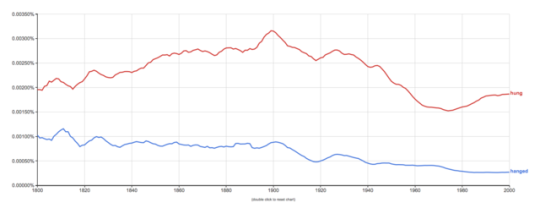
Did Cornell's suicide cause Bennington'sVery small point: pictures are hung; people are hanged. — tim wood
But why? When was this differentiation made? Here's a Google Ngram showing the difference of use between 1800 and the present. Why the decline in people hanging things--the wash, the blame, cloaks in cloakrooms...

BC

Start FollowingSend a Message
- Other sites we like
- Social media
- Terms of Service
- Sign In
- Created with PlushForums
- © 2026 The Philosophy Forum