
-
The terms of the debate.But if certain individuals just make a habit of provoking the ire of others, why not ban them? — Metaphysician Undercover
Well, the possibility of being banned is part of the deal when joining a forum like this. So, if some people want to play the role of a demon with a trident and just keep sticking it into people to see them flinch, then ban them back to hell.
Some people are sensitive, and sometimes it may be just a matter of reading one sentence and it's already too late. — Metaphysician Undercover
This I know all to well. In the past (before PF or TPF) I was in a bad state and often experienced a state of really intense ire before I could do anything about it. There are, sadly, quite a few people in this bad state. "Self-help" doesn't always deliver salvation. Major life changes which I didn't engineer gave me new life circumstances which solved my problem. -
The terms of the debate.Is it really possible to ignore that thing which invokes your ire? If it were, then how would it invoke your ire? — Metaphysician Undercover
It is really possible, but it requires practice. A large part of ignoring ire-provoking people, places, things, and actions is avoidance. Avoid by thinking about something else. Avoid by registering one's reaction, but not ruminating on it. Avoid by understanding what it is about the thing that is ire-provoking, accepting the uncorrectable reality, and moving on.
This all works best when one is not in a state of intense ire to start with. -
God will exist at 7:30pm next FridayFirst comment out and you're reinventing Milton's plot. If god is coming into existence next week, we may presume that our previous guesses might have been at least a hair off the mark.
On the other hand, Sapientia probably mistook the end of the world for the appearance of god. (It might be hard to tell the difference between the two.)
That is the time the world ends;
This is the world that god upends;
There is the stairs that god descends;
Here are the ashes and sackcloth to rend. -
Counterargument against Homosexual as InnateBut, hypothetically,if we called it paedosexuality, and it wasn't abnormal and almost universally condemned...? — Sapientia
Big IF. Sexuality has more than one axis. It isn't just gay or straight. There's also object choice (boys, girls, men, women, horses, corpses, etc.). Apparently some people are even attracted to Donald Trump. There are mating patterns: 1 mate for life, as many mates as possible, 2 or three mates, and so on. There is frequency of mating: once per male bee (but mostly never) and continuously for bonobos of both sexes. (BTW, humans and whales (one other animal, can't remember) are the species that have menopause. Cows, for instance, can continue calving until they drop dead from old age. (Some of these old gray cows look like they really need a rest with menopause.)
So, to be more accurate we could devise words for various positions on the several axes, but that would get very complicated.
Sex between adults and minors (sex between minors, for that matter) is a too-hot-to-handle topic in most settings. Some sort of sexual contact between adults and older minors--hebephilia and ephebophilia--seems common enough that one might wonder if it is possibly "normal" and tolerable. By "normal" I don't mean to suggest that it is a matter to which we should be indifferent.
The problem isn't that pubescent children (and older teenagers) aren't interested in sex. The problem is that adults are interested in the youths as sexual objects, and youth and adult can not enter into a sexual relationship without some sort of complicating leverage being applied by the adult. Many youth (talking teenagers here) are really, really naive, and can't assess an adult's trustworthiness.
MAYBE if we were very good about education children and youth about sex and sexuality, teen agers could better deal with hebephiliacs and ephebophiliacs. Paedophilia (pre-pubescent children) is unacceptable because, as has been observed many times, young children can not give informed consent to sexual activity with an adult. They are incapable of informed consent at that age. Prepubescent children are also not physically and/or psychologically equipped to engage in sex.
Puberty, of course, is not the enlightenment and many physically capable youth know jack shit about sex and sexuality, and that may remain the case well into adulthood. -
Counterargument against Homosexual as InnateI'd want to see scientific evidence that this is always a paraphillia or fetish or whatever, and cannot, by its nature, possibly be the same sort of thing as homosexuality or heterosexuality under any circumstance.
The fetish theory is just a theory, and not a proof, isn't it? And not a theory quite like the theory of evolution or the big bang theory? — Sapientia
I'm not sure that a huge amount of research has been done on paraphilias or fetishes. After all, it's mostly "not very important". If preferring red heads and green eyes is a fetish, so what? Or, if liking plump women and not twiggy thin women is a fetish, who cares? It's not worth a big grant to study it.
Paedophilia, hebephilia (sexual interest in pubescent children--11 to 14); and ephebophilia (sexual interest in late adolescents--15-19) is a different story. Where an odd-ball fetish, like requiring a kitchen setting to have satisfying sex might be inconvenient or problematic, paedophilia, hebephilia, and ephebophilia has been criminalized with severe punishments.
Where sexual orientation and paraphilia match is in permanence: Like sexual orientation, fetishes are established early and they don't change. Again, not a problem with most fetishes, but it is a problem when the fetish is criminalized: It's illegal and the person can't change their preference.
We don't have a solution to this problem, just like there isn't a solution to the moderately psychopathic personality. It has been practice in this state (and others) to sentence paedophiles to prison and then place the parolee in mental health facilities after the prison sentence is served. What it amounts to is indefinite institutionalization for which there is no end. Last year the state supreme court ruled that this practice was unconstitutional, and an end point to institutionalization had to be provided. We don't know, at this point, how this decision will be put into effect. -
Counterargument against Homosexual as InnateA couple of thoughts on lesbians...
You are right that lesbians get omitted or get scant attention from homosexual-topic discussions, most of the time, and not just here.
when one condemns homosexual relations as "disgusting," one gets the feeling they have male-on-male anal sex in mind, and not, say, "scissoring" between two females) — Arkady
Many heterosexual men seem to find lesbian sex interesting and stimulating (ask Hanover), where they definitely do not find males performing sex with each other stimulating or interesting. That's one. The other is that, historically, it hasn't mattered what powerless low status women do between themselves anyway, so who cares.
there are presumably as many gay women as there are gay men, and yet they often seem to be omitted from the discussion — Arkady
Surveys consistently show that a significantly smaller percentage of women identity as gay, than men identifying as gay. Homosexual women have tended to self-identify as gay somewhat later in life than homosexual men. I haven't read a lot about bisexuality in women, so I don't know.
[The distinction, "gay men / lesbians" happened to the early 1970s. Initially, there was the Gay Liberation Front, gay liberation, gay people, gay community, gay pride. Within a few years that changed to "gay, lesbian, bisexual" or GLB, and in a couple of decades, gay, lesbian, bisexual, transgender or GLBT, and sometimes GLBTQ (questioning, confused...) Why all the initials? It is part of the culture wars, where every minority needs to be allocated status, I suppose.) -
Counterargument against Homosexual as InnateI don't think anyone can reasonably claim that the gay community (to the extent that gays even had the comfort of a community; presumably many didn't, especially those living in small towns) weren't beleaguered at that time, or that they were not disproportionately affected by the AIDS crisis. — Arkady
Oh, well... gays have been lamenting for decades that "the gay community" is more a figure of speech than anything else. A few parts of the gay population form community in large cities, but large parts of the gay population are not part of a gay community. There is less sense of community now than previously.
I've heard some commentators refer to this period as a gay "genocide," which strikes me as extremely wrongheaded. — Arkady
Yes, totally wrongheaded. Some people were convinced that AIDS was invented (maybe at Ft. Detrick in Maryland) for the purpose of getting rid of homosexuals (or blacks). Some people were convinced that HIV didn't cause AIDS (and not just in the first 2 or 3 years of the epidemic, either.) Some people were convinced that the U. S. Government did absolutely nothing on their behalf; that the science establishment dragged its feet; nobody cared; pharmaceutical companies were cashing in. and so on. All lies, except that Big Pharma was cashing in. Big Pharma is always cashing in. It's what they do. That's why they're Big Pharma and not Little Pharma.
The HIV virus is a naturally-occurring phenomenon, and one which disproportionately affected gay men as a result of their sexual behavior. The outbreak was to a certain extent self-inflicted. — Arkady
Had HIV 'landed' someplace else, it would have been a different epidemic, true enough.
As it happened, HIV landed in the middle of a pool of professionally successful, culturally sophisticated, highly promiscuous, gay party-circuit travelers. Quite a few of these people were members of the artistic elite, and were interconnected with people all over the country. They networked. Had it landed in the middle of some gay cowboys in Montana, it wouldn't have amounted to much.
There were clues before HIV landed that some gay guys were going overboard on sexual exuberance. Intestinal parasites, various odd infections resulting from too much penetrating, and so on were booming in the late 1970s. But... nothing incurable, nothing too debilitating. Most people got over hepatitis infections, syphilis, and gonorrhea; and parasiticides cleared out the can of worms some guys were carting around. (That kind of worm problem is much more common in Africa.)
My guess is that the elite gay men's lifestyles in New York, San Francisco, Los Angeles, Miami, Atlanta, Chicago, and so on were everything I imagined them to be, anchored as I was in the boring Sodom on the Upper Mississippi of Minneapolis. On the one hand, I longed for that kind of exhilarating life; on the other hand, that's one of the reasons I'm here and they are not. That and luck. -
Counterargument against Homosexual as Innaterevolve around homosexual men more than around homosexual women. — Arkady
This gay man, having lived in a large city where there was sort of a community, learned fairly early on to not speak on behalf of lesbians. Ever. In the 70s Minneapolis had a relatively large group of ferocious lesbian feminist separatists. Their coffee house on Fridays in the basement of Plymouth Congregation Church discouraged mothers from bringing even young male children with them. A 10 year old boy was anathema, let alone a man.
In Minneapolis, lesbians and gay men didn't mix a lot. So, brothers, I don't speak for our lesbian sisters, and thereby I lived long and prospered. -
I fell in love with my neighbors wife.It could, obviously, unless one were doing it alone.
As Irving Berlin says,
if you've got something that must be done
And it can only be done by one
There is nothing more to say.
But I hope whatever you've got to do
Is something that can be done by two
For she'd really like to stay glued to you
And would be so happy to be doing you, dude...
You probably didn't know Old Berlin used "dude". He was way ahead of his time. -
Counterargument against Homosexual as InnateNo, it would be a fetish--a paraphilia.
-
Counterargument against Homosexual as InnateAs cynical as it may seem, AIDS gives us a chance, however brief, to establish ourselves as a victimized minority legitimately deserving of America’s special protection and care." from AFTER THE BALL By Kirk and Madsen — Wayfarer
The capacity to think that way strikes me as far more deviant than the most perverse sexual activity I have ever heard of.
One of the reasons for the public's improved view of gay men MIGHT be the loving devotion that men displayed in taking care of each other as partners and as a community. In 1987 there was zero indication that the AIDS epidemic was going to be brief. It would be another 9 years 1996) before the AIDS cocktail was shown to be effective, which changed the picture of certain death (but killed off the sympathy angle for Missures Kirk and Madsen).
The gay community was beleaguered, particularly up to 1995-1996. In the HIV hot spots (New York, LA, Miami, San Francisco, etc.) the seropositivity rate was 40% to 70%, depending on location. The over-all rate of fatality for untreated AIDS (prior to 1996) was between 80% and 90%. (It's lower now, with "highly active AIDS retroviral therapy"). So, large swaths of the gay community were wiped out.
True enough, a lot of people were never very sympathetic toward any problem the gay community might have, but quite a few people came to understand that gay men had not cause the virus, and had the virus been introduced in some other community, then that community would be dealing with 80-90% fatality rates instead of gay men and IV drug users (another never very popular group).
There was a discussion on NPR a few days back about how the far right and Trump's campaign strategized cynically to make it difficult to think reasonably about Trump's candidacy. Very similar to the crap cooked up by the twisted sisters Kirk and Madsen. -
Counterargument against Homosexual as InnateIt would be wise, here, to distinguish between sexual orientation and fetishes. — Heister Eggcart
I take it that's a request for clarification.
Sexual orientation determines whether one is sexually attracted to men or to women, homosexually or heterosexually. There's more to it, but we can go into all that another time.
Fetishes are objects which some people find necessary adjuncts for sexual arousal. A fetish isn't the object of sex, per se. For instance, a heterosexual male who finds black lacy underwear stimulating, wants to see the underwear on a woman -- not in a box by itself. Similarly, a homosexual male who finds military clothing arousing, wants to see the clothes on a guy, not on the shelf.
There are some people who like sex objects other than people. The black lacy underwear could be a sex object on it's own. So could an old running shoe. (But not a new running shoe. No, no; that would be totally beyond the pale. Lock that person up!). -
Counterargument against Homosexual as InnateWhat's the harm? This is obviously where the analogy fails. I wouldn't ask those questions about paedophilia. — Sapientia
OK, I get your point. Of course I agree that pedophilia (paedophilia) is harmful. It's just that attraction to pre-pubescent children isn't a sexual orientation, and neither are any of the other paraphilias. It's an attraction to children of one sex or the other. Most of the other paraphilias are pretty much harmless. They might be annoying or embarrassing, but they don't result in much harm. -
Counterargument against Homosexual as InnateI had the opinion that Alfred Kinsey has been discredited as a social scientist. — Wayfarer
Kinsey's research is still relevant, to some people's pleasure, other people's disgust. Who was it that discredited him? (The Kinsey Institute is still doing research at the University of Indiana, btw.)
Kinsey's studies were observational. He and his team conducted interviews and he observed sexual behavior. There was little formal research on sexual behavior at the time he began his work in the 1930s.
Gay rights and gay identity is a minefield nowadays - say anything other than to express unqualified admiration and support, is to be categorised as a racist or a bigot. It's a binary choice. This is a consequence of a successful communications and media strategy, whichwas laid out in a 1987 article called The Overhauling of Straight America (later published as a book). — Wayfarer
Sexuality and gender in general has become something of a minefield.
"The Overhauling of Straight America" was an interesting piece...
As a strategy, it might be effective, I don't know. It sort of sounds like Trump's and the right wing's approach to overhauling democracy, and that seems to be working.
One of the features of the article that bothered me was that it seems very anachronistic. Gay liberation began in the 1950s-and 1960s; Stonewall was in 1969. A lot of gay rights work had been accomplished between Stonewall and Marshall Kirk and Hunter Madsen. Gay marriage was elevated to a critical issue by the "gay-political-elite" in the 1990s, so maybe Kirk and Madsen succeeded. I was struck by the small presence of AIDS in the piece. It got mentioned as a major hazard for the cause of universal acceptance. But for the average gay man of 1987, it was more like an existential threat.
In any event, it is a great demonstration of what happened to gay liberation between the time the homophile Mattachine Society (1950) was organized and 1987. What started as a claim for human dignity, then sexual liberation became a program for assimilation into middle class straight society.
As you said, it seems, these days, that advocacy groups of all stripes pretty much require total assent or one is labeled as racist, sexist, homophobic, classist, ableist, ageist, elitist, or something. I blame cultural politics which have been rolling along since the 1980s. Sure, some gay people contributed to this by calling everyone homophobic who wasn't explicitly pro-gay. -
Counterargument against Homosexual as InnateHowever, I find there is a problem when we start comparing it with other innate but unaccepted characteristics, such as pedophilia or psychopathy. — NukeyFox
You should have a problem, because homosexuality isn't the same kind of thing as pedophilia, and psychopath shares nothing with either homosexuality or pedophilia.
We don't know how, exactly, people develop what are called "paraphilias". Quite a few people have fetish objects which were, are, and always will be necessary for their sexual arousal -- perhaps black, lacy underwear, or perhaps wearing the opposite sex's clothing for their own sexual arousal. Three controversial paraphilias are pedophilia (sexual interest in pre-pubescent children; hebephilia (sexual interest in pubescent children--11 to 14); and ephebophilia (sexual interest in late adolescents--15-19.) People are generally not very successful in changing a paraphilia, though they can avoid the object of desire (young children, exposing themselves in public, prostitutes, etc.).
Psychopathy is a brain disorder which prevents emotion from acting on thinking in the normal way. A psychopath may perfectly understand that stealing is wrong, but they don't feel guilt about stealing (or killing people). It isn't that they don't want to feel guilt -- they can't feel guilt. Psychopathy presents as a range of pathology, from slightly psychopathic to extremely psychopathic. -
Counterargument against Homosexual as InnateSexual orientation is not binary, or all one thing or all another. Kinsey's scale (which does not at all represent percentages of straights, gays, or bisexuals) is worth a look:
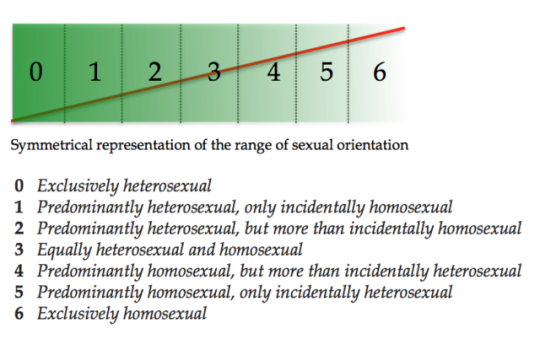
Some people engage primarily in heterosexual activity, but sometimes engage in homosexual activity. Similarly, some people engage in mostly homosexual activity, but sometimes engage in heterosexual activity. A much larger percentage of the population is exclusively heterosexual than is exclusively homosexual (maybe 66% exclusively heterosexual, 3 or 4% exclusively homosexual). Around a third of the population sometimes engage in sexual activity in which they do not usually engage. "Sometimes" might be once, twice, for a few months; or a couple of years. -
I fell in love with my neighbors wife.Marko would say something like that, of course, and no matter how you slice it, the way through the world is tortuous. Whether lust and desire are the deepest, most dangerous pits into which we might fall while we traverse this veil of tears) is open to dispute. Lust, in particular, is quite dangerous and finds its objects in wealth (avarice), food and comforts (gluttony), vengeance (wrath), or achievement (pride) as well as S*E*X.
Desire is pitched much higher. We don't 'lust' after the good, we desire the good. We desire love--eros, philia, agape, storge, ludus, pragma, philautia, of which eros (sex) is but one (albeit double-edged) form.
Love in all ways:
Philia, or deep friendship
Ludus, or playful love
Agape, or love for everyone
Eros, or sexual passion
Pragma, or longstanding love
Philautia, or love of the self
Storge, or familial love
If we only aim for eros which is the easiest love -- hard wired by nature to assure our continued existence -- then we are more likely to get tripped up. But there are other forms of love that are compatible with eros which will keep us balanced. -
I fell in love with my neighbors wife.And, quite frankly my excessive (previous) indulgence in pornography has made me quite unhappy. — Question
My take on us people is that we are much more alike than we are different, and that we tend to be unhappy a lot because we think we have failed to live up to society's high standards (and have made the unobtainable social ideals our own). A lot of us beat ourselves over the head for failing to live up to both our own, (and society's) often quite unreasonable expectations.
Everything connected with sex tends to be connected to some sort of high ideal, high standard, or religious rigamarole. It's easy to fail with sex. We either had too much; too little; were too casual about it or too serious; didn't do it the right way or didn't do it with the right people; took too long, didn't take long enough, and so on ad nauseum.
Try forgiving yourself more and do more of what makes you happy. -
I fell in love with my neighbors wife.virginity isn't physical — Agustino
Sorry. Psychic virginity does not compute.
matriarchies — Agustino
Please list the extant matriarchies where men are considered property the way women are considered property under patriarchy (as if there were such a thing as matriarchy and patriarchy).
Yes that's Victorian England — Agustino
Victorian England, he says. Double standards preceded Victoria Regina and survive into the 21st century.
chastity — Agustino
Chastity schmastity.. My guess is that chastity has been honored everywhere more in the breach than in the observance. -
I fell in love with my neighbors wife.Why do you suppose virginity applies only to women? — Agustino
This should be obvious. 1) Men do not have a hymen which can be breached, thus providing evidence of virginity or not. 2) Women were sexual property of men, not visa versa. 3) Men were expected to have sexual experiences prior to marriage, women were not. You have heard of the double standard?
Of course, a man can be a "virgin", not that it was much of a virtue.
Actually chastity is precisely one characteristic that is specific of civilisation, not of savagery. — Agustino
I think Michael was making a joke which you didn't get.
Besides, chastity can be taken on, whereas virginity once lost can not be regained. Nuns and monks who have had sex (even a great deal of sex) can become chaste, poor, and obedient, if they have nothing better to do with their time. -
I fell in love with my neighbors wife.Indeed, but their society obscures spiritual aspects from coming under consideration in how words related to sex are used. Us individuals don't just pop into being out of nowhere - we are created and molded by our society, and hence our stupidities, more often than not, end up being the stupidities of our own society. — Agustino
Since it is the case that we haven't agreed on what might and might not constitute sex, and since it is the case that we haven't agreed on what exactly spirituality is, I don't think a spiritual interpretation of virginity is going to help much.
Virginity makes some sense in a society where either the woman has some sort of 'property value' or where women have been tasked with maintaining a sentimental notion of purity (which doesn't apply to their potential mates). Virginity does not make much sense where women are free of property value and where sentimental ideas of purity are pretty much history.
Vaginal sex — Agustino
versus
masturbation — Agustino
Masters and Johnson were doing laboratory research, and the required instrumentation of measurement may have leveled off the experiences the subjects were having. No one would dispute that really great sex (whatever that might be) is better than humdrum sex (whatever that might be). What M & J were claiming is that the basic physiological response was no different. It's like, good food is better than bad food.
Psychological satisfaction is more complicated (obviously). The oral sex lady could count herself as a virgin because her psychological investment in both the act and the guy was probably minimal. The energy required to perform various sex acts varies and one will feel more or less exercised when it is completed.
So, when President William Jefferson Clinton claimed he did not have sex with that woman, he was speaking the truth as far as he was concerned. Ms. Lewinsky apparently thought they had had some sort of sex. "How else could I have a Presidential semen sample in my closet?" she cried. -
I fell in love with my neighbors wife.Yes, I think you're right, most heterosexual people probably think that sex is first vaginal, then anal, then maybe oral, but maybe oral is counted as foreplay, and a hand job just would not count. Some gay men think that sex is first anal, then oral. But a fair number of gay guys would count oral and anal as equally "sex". A hand job is not intercourse, except in a vaguely 'digital' way, one's digits wrapped around a hard dick.
What counts as "sex" is not important in actual sexual contexts. But in discourses about sex, like public health advisories on how to avoid sexually transmitted disease, precision about what is "sex" matters a lot. For instance, quite a few teeny boppers, those teen age lovers, don't think that oral sex is actually sex. It doesn't count.
"It doesn't count" until one discovers a sore on the roof of one's mouth (primary syphilis lesion), a dripping infection from one's penis (primary gonorrhea), blistering on the lips or penis (genital herpes), or some such. One might go to a clinic and discover that one acquired a venereal infection while not having "sex".
What is "sex" also matters in discourses about sexuality and sexual identity.
BTW, Masters's and Johnson's research showed that there is no physical difference in the physiology of arousal and orgasm, whether the sex is anal, oral, vaginal, or digital, gay or straight, single or double. So, as far as the body is concerned, masturbation is indistinguishable from vaginal sex. -
Convince the bomb not to explode.Why do you think god being lonely suggests that god is vain?
-
I fell in love with my neighbors wife.Well, in my experience at least, solo masturbation, for example, doesn't get called "sex" in common parlance, and it is commonly understood in contrast to sex. But it is obviously sexual. Likewise with flirting, but it seems even more absurd to call that sex.
I'd say that "sex" primarily means sexual intercourse, but perhaps can also include oral sex. I think that it makes sense to say things like, "We didn't have sex, I just gave him a blowjob". — Sapientia
Right, people usually reference sex in the context of at least two people. As for flirting, I was thinking of fairly aggressive flirting, not the sort of flirting that a waiter or waitress does to increase the tip size. Flirting isn't "sex" so much as it is "sexual".
"We didn't have sex, I just gave him a blowjob"... not sex? It seems to me that a blow job is definitely sex, and so is a hand job performed on someone else. I think if you asked 100 people if you could perform oral sex and a hand job on them, at least 95% would think you had ask them to have sex with you, and wouldn't think you were suggesting something on the order of a scalp massage. -
I fell in love with my neighbors wife.Hmmm... but it's a different experience with a partner than without. I think most people would agree. — Agustino
Of course, and I would agree; I'd also suggest sex with a partner is usually better than without.because I loved her, and so I found no need for "imaginary partners". — Agustino
Sure -- people in love don't need to add the internal video track. But... as you know, people aren't always in love with the people with whom they are having sex (and are often married to) so that added video track helps performance. I mean, sometimes one is expected to get it up and a woman can fake pleasure more easily than a man can fake orgasm (at least for a money shot). So, again, the mental movie in one's head helps one get it up, as per expectation.
What defines something as being sexual? — Agustino
The person who is experiencing it.
I included flirting as sexual because when people do it, it "feels sexual". One's dog might show a lot of interest in you while you are eating, or when it wants to go for a walk. but it does not feel sexual. It''s either annoying or amusing. One's lawnmower, pencil, or refrigerator don't feel sexual (one would hope).
I think the sex drive is different from the pleasures of sex. The sex drive is like an energy source, it depends how one learns to make use of it. — Agustino
Good clarification. It isn't the pleasure that is sublimated as much as it is the 'drive' or energy. -
Justification for continued existenceWhat reason or justification is there for us to know we will still continue existing for the next day, if any — Ephrium
We have nothing to go on but the past (morning after morning we woke up and continued to exist that day). You might hope that you will continue to exist, you might fear that you will continue to exist, and you might not care all that much one way or the other whether you continue to exist.
There is, of course, only one guarantee, which is that one day you won't continue to exist. You might know that that fated day will be soon, or you might not -- but the final day will come. -
Convince the bomb not to explode.Mongrel
The universe is the result of God's loneliness. — Mongrel
Exactly.
Have you seen the rest of Dark Star? It's quite good; nice satire. There is a monster on board, and the cryogenically preserved (but oddly conscious) captain of the ship provides a possible solution to the Bomb's problematic desire to detonate: "Discuss phenomenology with the Bomb." -
The Act of TranscendenceHmm, but who's to say all these are ways toward transcendence? Is praying and fasting and the like acts of transcending? And how would you know until you're actually transcendent? At that point, it would seem that you wouldn't even have knowledge of having gone from A to B.
Kant thought it was outside experience--which for us, I guess means we don't transcend and tell about it.
— Bitter Crank
This makes the most sense to me. — Heister Eggcart
I agree with Kant, too. I don't know that prayer and fasting are effective for anything at all, but some people think they are and the do these things for some end. -
I fell in love with my neighbors wife.What counts as sex? This is a very interesting question... Psychologically it seems that it's not only intercourse that is of significance. For example oral sex probably still counts as sex. Some would say masturbation counts as sex, others would disagree. Others would say even holding hands with a significant other is a manifestation of sexual energy... Where is the boundary between sexual activity and non-sexual activity, and how are sexual activities distinguished psychologically? — Agustino
I classify genital/genital, oral/genital, oral/anal, oral/oral, and manual/genital contact as sex. While the last doesn't involve an actual partner, an imagined partner is often present, sometimes several. Sometimes those imaginary partners are present along with a quite real partner. Flirting (all gesture, no touching) may be tantamount to sex, and just sitting next to somebody and "casually" touching feet, knees, arms, etc. might be very sexual (usually not, though). Getting sexual under the table requires reciprocation of the casual "accidental" touch of knees, for instance.
People are inherently sexual whether they engage in sexual activity or fantasy, or not. The organs and hormones are there whether employed or ignored. Sometimes life events can charge one up sexually. Once I needed a job, I wanted a particular job, and I was hired. I was 'sexually on fire'. The job made me feel very puissant, potent, and grand. Sadly, the effect wore off, but it was great while it lasted.
The sex drive, the pleasures of sex, can be sublimated--transferred to some other--non-sexual--activity. The enormous productivity of well organized societies seems to involve sublimation, as people pour into their work their creative, libidinous energies. (Not that actual sex robs one of creativity; I think good sex adds to one's creative efforts.)
The absence of sexuality in the environment -- a cold, sterile corporate setting for example -- is usually felt as oppressive. Some buildings are sexual, others are sexless. Much of the built urban environment --freeways, strip malls, featureless apartment and office buildings, highway interchanges, cookie-cutter warehouses -- is damned near totally sexless. -
I fell in love with my neighbors wife.Well, I've taken care of myself for a long time on my own and think I will continue that way. — Question
That method is probably the most common of all methods of having sex. -
I Robot....why is life and other things you have in mind inexplicable in terms of science? — TheMadFool
I wasn't clear enough. While we can get along without reductionism (getting down to very small parts which together become the whole), there are limits to our application. We are limited because we don't have all the information we would need to account for everything, and we probably won't get all that information in the next few weeks.
I didn't want to name some things, like life or mind, as "inexplicable and beyond science". I look to science to explain the world, but our knowledge is limited, so some things remain inexplicable, for now.
But what I was objecting to was waving a physics textbook over the termite mound and saying "This explains everything." It doesn't, it can't. Not because life is beyond science -- but rather, our science isn't quite that capable yet. -
I fell in love with my neighbors wife.Maybe those folks are all nice and healthy but... — Hanover
Beware of all enterprises which require a change of costume and a trip to the basement. -
I fell in love with my neighbors wife.It sort of seems that the allure of it to you is that it appeals to your general laziness, as in you can sort of lay there and let someone else do the work. Not only would you not have to take any initiative, you'd be specifically forbidden to do anything, which would be right up your alley. — Hanover
I think whether Question could just lay there and "enjoy" having a dominatrix whip him into shape (so to speak) depends on the scene he ends up in. It might very well be that the mistress dominatrix would expect her male to be a quite active slave, bucking up against the restraints, thrashing about, howling in real or fake agony, and so forth. After all, there isn't much fun standing in spike heels on somebody resembling a corpse.
My theory is that a preference for BDSM is formed as a result of dictatorial toilet training. The thing I don't like about S&M is that there is entirely too much stage business to deal with. "OK, now that we're all dressed up, tied down, and hanging from the ceiling of the dungeon, when do we get around to fucking -- which I though was the whole point of this dreary affair!" -
I Robot....It's one thing to be a reductionist (the idea that the laws of physics can, theoretically, account for reality). It's something else to be an intelligent reductionist who has some scheme to explain HOW reality can be accounted for with the principles of physics (and chemistry, if you like). I'm not an intelligent reductionist; I can't explain a fish leaping out of the water and catching an insect (or an eagle swooping down and catching the fish). I can't explain how my own mind composes these sentences and sends instructions to my fingers to type these letters.
You, Mad Fool, can't either, it seems. At least, you haven't demonstrated that you can. You too are not an intelligent reductionist. You are making a reductionist claim, but I don't think you have the means to make reductionism work in all the manifest complexity of reality. We are in the same crowded boat.
Some things can be accounted for with physics and chemistry, and those "some things" account for big hunks of reality. But there is a lot which we really can not explain with stuff like inertia, waves of light, gravity, and conductivity. Or, just in case you were thinking of it, quantum mechanics.
Beyond a certain point, there is a lot of stuff that just isn't explainable--given what we know, and given what we don't know. -
On Fascism and Free SpeechQuantity has no bearing over the amount of noise a small group of anarchists and marxists can make, I can assure you. I have never been fond of the academic leftists and I have never appreciated the smug conservatives either as both appeal to methods of a peculiar kind that contributes unfavourably to rational progress. I was battered and beaten when studying graduate political science by marxists, conservatives and the academic leftists that tore my thesis design apart as I stood sandwiched between the tussle of the three attempting to convince me which method I should conform to. I ultimately dropped out mostly from the isolation I felt. The worst of the three, though, was the Marxist who constantly insulted and degraded 'me' when I opposed taking his suggested routes, even went so far as to ostracise me from conference funding and publically insulted me at graduate meetings. The academic leftists and conservatives are at least bearable. — TimeLine
I'm sorry you had such a wretched experience in graduate school.
I think there is a difference between "real-world" and "campus based" marxists. Real-world marxists are usually not academically oriented, usually tend the sacred fire of an old socialist organization (Communist Party-USA, Socialist Workers, Socialist Labor, socialist something or other...) These are the marxists I'm most familiar with. They are usually a pretty decent group of people--not terribly effective, though.
My information about campus-based marxists is mostly second-hand. The thing about campuses (as you know) is that there are snake pits in many departments, from business administration to dance. Get a bunch of ambitious, highly competitive people together to fight over limited resources and some marginal issues and a snake pit will form.
the question of whether the Bias-Motivated Crime Ordinance was - though unconstitutional - wrong? — TimeLine
I am not a fan of 'bias-motivated" crime ordinances.
People have a right to certain things: equal access to public educational opportunities; access to employment for which they are qualified; equal access to a standard level of health care; access to equal public accommodations (transportation, restaurants, hotels, etc. entertainment), and so on. These rights can be readily upheld by straightforward law-enforcement.
"Bias motivation" is not necessarily clear from the start. Was I robbed and beaten at gun-point because I was gay, or was it because I looked like I might be worth robbing? Was the man shot because he was black, or because he seemed to behave in a dangerous manner? Was the woman raped because she was female, white, and alone, or was it because she was a communist, atheist, lesbian?
The crimes committed against these example-persons are bad enough. Frankly, I don't care whether I was robbed and beaten because I was gay, or because I looked like I might be worth robbing. I would deeply resent the beating and robbery, either way.
Comparatively, one can think that restricting hate speech is a type of affirmative action. What do you think? — TimeLine
I don't think of hate-speech-restrictions as affirmative action.
I would rather live in a society where it is permissible to say "I hate fags" than live in one where it is illegal to say "I hate fags". I want to be free to express my opinions, and if I am free to say what I think, others should be similarly free. We have limits on free speech at the extreme edge: We are not free to encourage everyone who hates fags to get together and actually target and kill any gay men they might know of, or suspect. The limit here is on conspiring to kill people, not on hating fags. We are not free to engage in conspiracies to commit crimes--even ones involving no bias at all -- like robbing a bank. -
I Robot....And how different are we from robots? — TheMadFool
I can't speak for you, but I am as different from a robot as a fish is from an iPhones. -
I Robot....Isn't that what IBM Watson is being used for now, having ruined Jeopardy?It turns out the world’s smartest supercomputer is a pretty good doctor, too.
Five years after dominating geniuses in its debut on Jeopardy!, IBM’s Watson is still putting human intelligence to shame.
The artificial intelligence machine correctly diagnosed a 60-year-old woman’s rare form of leukemia within 10 minutes — a medical mystery that doctors had missed for months at the University of Tokyo.
I personally would prefer a smart retriever over a computer to keep me company in a Senior Citizens Storage Tower, but a robot doesn't shed hair, doesn't have to urinate 8 times a day, defecate once or twice a day, doesn't chew up shoes, etc. On the other hand, a robot wouldn't lick my feet, nuzzle me, couldn't look deeply into my eyes to assess the condition of my soul, or decide to rest on top of me with her sharp elbow digging into my ribs. -
On Fascism and Free SpeechI think anarchists and marxist rioters are being labelled academic liberals. — TimeLine
Anarchists and marxist rioters on the one hand, and academic liberals on the other are quite distinct. For one, the number of the former are very small. The latter are far more numerous and whatever they might say, they are upwardly mobile professionals who aren't going to put their lifestyle at risk by throwing rocks through bank windows.
"Serious marxists" came to the conclusion a long time ago that when it comes to political violence, the state is much better at it than anybody else and taking on the police, national guard, or army is a good way to end up dead in the street.
And perhaps - being Australian - I am unable to ascertain the historical and certainly deep rooted influences that would enable people to burn crosses in front of an African-American families' home (R.A.V., Petitioner v. City of St. Paul, Minnesota) which is a clear symbol of hate, while criminalising some peculiar offences such as topless sunbathing and yet seems downright passionate about justifying obscene political messages by hiding behind the first amendment; for instance, in Ohio v. Wyant that confirmed the unconstitutionality of bias-related crimes. — TimeLine
The contradiction between not prosecuting cross-burners and arresting nude sun bathers arises from unrelated sources. The problem with the ordinance in the cross-burning case was that it was overly comprehensive, forbidding protected political speech:
Whoever places on public or private property, a symbol, object, appellation, characterization or graffiti, including, but not limited to, a burning cross or Nazi swastika, which one knows or has reasonable grounds to know arouses anger, alarm or resentment in others on the basis of race, color, creed, religion or gender commits disorderly conduct and shall be guilty of a misdemeanor. [St. Paul Bias-Motivated Crime Ordinance]
It isn't relevant to the law, but the "cross burning" was an extremely inept performance by 1 teenager, not a dozen adult Ku Klux Klaners doing a "proper" cross burning.
Laws banning public nudity, nude sun bathing, recklessly exposed genitalia, and such have altogether different roots. One root is a common and long-standing squeamishness about sexual parts. This isn't unique to the US. Another root is the collective sense of propriety. It isn't proper for some people to remove all of their clothing in public where other people are not doing so. It's impolite. A third root is dislike of homosexuals who seem to be the most likely to remove their clothes or recklessly expose their genitalia in public to facilitate lewd, lascivious, polymorphously perverse sexual purposes. And what about INNOCENT CHILDREN observing adult sexual organs!
So, contradictions abound.
So, do you think the protests are an outcome of your legislative failures? — TimeLine
No, I don't think the recent political protests (such as in Berkeley, California) are the result of legislative failure.
People engage in protest activity for various reasons, some of them far from straight-forward. Generally, though, people become politically active around economic issues (directly or indirectly).
Tensions between groups in society, friction, rifts, upheavals, and so forth generally have economic causes. Blacks, gays, and women, for example, didn't/don't demonstrate because they aren't getting good press or because they aren't winning enough Oscars. They demonstrate because they feel they are getting the short end of the economic stick. Whites don't want blacks to move into their neighborhoods because their main piece of wealth -- their homes -- will be devalued, even if that is somewhat a self-fulfilling prophecy. Workers don't like seeing too many immigrants who will be competing with them for jobs and wages. Poor blacks don't like seeing gentrification because it raises rents and/or taxes and reduces the stock of affordable housing in a given area. Nobody wants to see half-way houses for released felons in their neighborhoods, nobody wants a large garbage burner anywhere near them.
Sometimes people demonstrate on behalf of others, or engage in vicarious struggle, when they have no skin in the game. Such is the case when white, middle class and above, college students join Black Lives Matter demonstrations and "lay their lives on the line" [sic] along with their recently acquired black brothers and sisters. Frankly, I don't believe them. When they graduate from school and pursue whatever profession they choose, they are not going to continue showing up at BLM demos. They will be living in nice enclaves with their own kind -- which is only reasonable. If they move to the slums it won't be in solidarity, it will be as urban pioneers leading the gentrification charge.
A few decades back, in the early days of AIDS, some straight people suddenly wanted to identify with the suffering and oppression of gay men. My reaction at the time was "Go find you own oppression, damn it, and leave mine alone." Allies are one thing, parasites are something else.
The anarchists and marxists -- or whoever the hell they were -- who were rioting, throwing rocks at big windows, spray-painting walls, and so forth were going for a free ride on the free-speech bus. The rioters may have disliked the guys speaking at Berkeley, but their small rioting was pretty much guaranteed to have adverse consequences. ("Infantile adventurism" the old time communists called it.)
There is nothing inherently wrong with destruction of private property during a riot. BUT, it has to be for a good reason, and it has to contribute to a larger cause. Such is not usually the case. Riots are very blunt instruments; way too blunt. For instance... IF during an anti-war riot some property belonging to the manufacturer of cluster bombs or landmines was wrecked, as part of the action to end an illegal, unpopular, and possibly illegal war using landmines and cluster bombs, that would be fine. But wrecking the same property during a women's march against Trump would be absurd, stupid, and counterproductive. -
Political Spectrum TestI was writing in support of you when I said, "Makes perfectly good sense to me."
I disagree with the sentiment "my country, right or wrong" because I don't think the idea of "country above all else" deserves that kind of fealty. "Nations" and the elites that run them pursue various goals. Some of the goals are in the interest of the the nation as a whole: public health measures, sound currency, navigable rivers and ports, and so on. Some are not: failure to regulate commerce, for instance--banking, mining, slaughterhouses, and so on. A failure to monitor international affairs and defend the country against real enemies would be against the national interest. Engaging in corrupt financial dealings by members of the government (or anybody else, for that matter) is against the best interests of the country.
There are contradictions, of course. What I may think are improper national policies may be somebody else's idea of criminal acts (like revealing the existence of massive CIA spying on domestic communication). Inflation is very bad for some people, great for others. For whom should inflation be managed? Etc. -
Political Spectrum TestBeing critical is one thing, but fighting injustice is another. You can be both loyal to your country and critical of it, if being critical of it is in the best interest of the country. But if the injustice stems from your country, then you can't both fight that injustice and be loyal to your country. — Sapientia
Makes perfectly good sense to me.
There are numerous examples of patriots raking their country over the coals, being scathingly critical. And there are situations where people acted treasonously against their country, in its best interests (the plots to kill Hitler, for example, or Germans who did what they could to contribute to Germany's defeat--most of them were executed).
Several Americans have performed acts many considered treasonous: Snowden, Daniel Ellsberg (the Pentagon Papers), Deep draft dodgers and deserters in the Vietnam War, and all sorts of people who become antibodies in a sick body politic.
BC

Start FollowingSend a Message
- Other sites we like
- Social media
- Terms of Service
- Sign In
- Created with PlushForums
- © 2026 The Philosophy Forum