
-
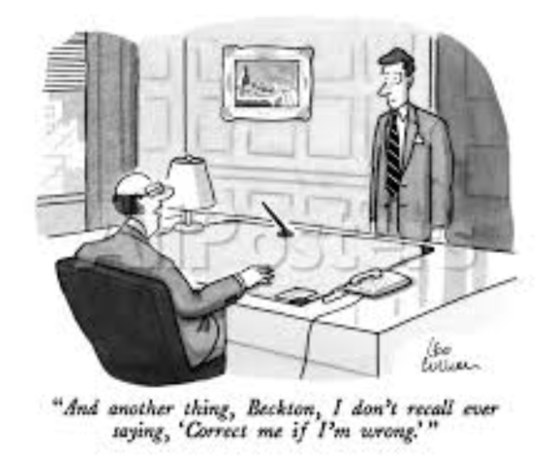
Cartoon of the dayHere's another one of my favorites, from the New Yorker, probably early 1990s. I was going into my boss' office one morning and it was pasted to the door. He had crossed out "Beckton" and written in "Clark."
-
My favorite verses in the Tao Te ChingIt's beginning to sound like that Kenny Rogers song, The Gambler
You've got to know when to hold 'em
Know when to fold 'em
Know when to walk away — Tom Storm
As they say, three chords and the Tao. -
My favorite verses in the Tao Te ChingEffortless action or not-doing is similar but not identical to wu wei, and I think T Clark and I agree more readily here. Not-doing I think corresponds to the phrase ‘let it be’. It’s about trusting the dynamic of existence, instead of trying to wrest control over everything that happens. — Possibility
As we've discussed before, I think this is a misleading interpretation of wu wei. To me, it doesn't have much to do with avoiding fame and fortune, only with not taking those factors into account when you act. This is from Chen's translation of Verse 63 - "The Master never reaches for the great; thus she achieves greatness."
When we act, it’s not always consciously intended, but we’re still responsible for those actions and their consequences, intended or not - sometimes more so than when we act in accordance with logical process or rational thought. — Possibility
Your perspective on the TTC, in particular the differences between mine and yours, has been really interesting and helpful.
What you've written above sounds to me like we wei is the same as going with your gut feeling. It's not that at all. And, yes, clearly, we are just as responsible for our actions as we are with our more familiar way of acting. Wu wei is not irrational, it's non-rational. Most of the day to day things we do we do without reflection. That doesn't mean those actions are somehow less reliable or that they don't take what we know about a situation into account.
the problem that occurs when we do act without acting: activists, politicians and celebrities, all well versed in the art of being seen to be acting, assume credit for the progress achieved by wu wei. — Possibility
Agreed. -
"A cage went in search of a bird."Ah, mais naturellement !! — Amity
Finally, someone agrees with me about that. -
My favorite verses in the Tao Te ChingThere's no Taoist equivalent to Buddhist Maya (illusion) unless one interprets the innate drive of humans to view reality in terms of fixed generalities, something that figures prominently in the West and in Buddhism, as the most perniciously persistent illusion of all. — TheMadFool
First, as I've noted, I have not spent much time with Buddhism. I think the dichotomy between the illusion and reality in Buddhism is analogous to that between the 10,000 things and the Tao. No need to get into a long discussion about this. I don't have much ammunition to defend this position.
I'm not as certain about this as I'd like to be but "...awareness of internal experience..." is a part of Western philosophy as well — TheMadFool
Agreed. I discussed this earlier - many people say that Kant's noumenon is analogous to the Tao. I've also read that Schopenhauer read texts from China and was influenced by them. From what I've seen, these references to internal experience are an afterthought, a sidebar, to the real story. In Taoism, they are at the heart.
This was probably because logic as it existed back then during the times of the Buddha and Lao Tzu could comfortably handle the ideas of Buddhism and Taoism — TheMadFool
It is my understanding that study of logic was extensive under Confucianism and other earlier philosophies. I don't know how it compares to western logic.
In addition, Western philosophy has science as an important collaborator as the latter has constructed a library of empirical knowledge which can't be ignored or, more accurately, must be given due consideration when philosophizing about anything, the mind/the self included. — TheMadFool
This isn't a direct response to what you've written, but I find that the Taoist view of reality is really helpful in my understanding of science. I think the scientific, western view of reality is misleading scientifically. That's a long story. -
My favorite verses in the Tao Te ChingNon-dualism is one thing... effortless action or not doing is something I need to apprehend in place to understand. I am not asking for a diagram or for someone to step it out, I guess I'm wanting to experience it. — Tom Storm
What helps me is to focus on the experience of being motivated, acting. In an earlier post I described how it feels to me - like a spring bubbling up from underground, the part of me that is hidden from myself. I can see from this discussion this way of seeing things is not helpful to a lot of people, but I think that really is the point of Taoism. It's the wordless experience that's at the heart of everything. -
My favorite verses in the Tao Te ChingI'm hoping this kind of compliments Possibility's post above, albeit my background is more from comparative religion rather than psychology per se, but in my view it's right on the mark. — Wayfarer
This is a really helpful post. -
My favorite verses in the Tao Te ChingWhat the heck is wu wei really? — TheMadFool
Wu wei is one of the most important aspects of Taoism. It has been extensively discussed in previous posts in this thread. You should go back and check. -
"A cage went in search of a bird."For me, this thread has really brought home to me how our various interpretations reflect our own selves and what is important to us. — Amity
I think you'll find, if you ever have a question about an interpretation, mine is probably the correct one.
So, how might this be 'sinister' ? — Amity
In my first response on this thread, I included two quotes that the bird aphorism reminded me of. They were both pretty sinister, especially the ersatz Trotsky quote. Either for that reason or some other, the cage quote just felt threatening. I see a shifty-eyed cage going out hunting so it can trap the bird under it's control. -
My favorite verses in the Tao Te ChingI'm more intrigued by T Clark and Wayfarer discussing that which can't be discussed. — Tom Storm
Actually, I was really interested in what you and @Possibility were discussing. Not the Lincoln part, but the general approach. -
My favorite verses in the Tao Te ChingI think the idea of wu wei is to get past the need to be attributed with acting, to forget about establishing and consolidating cause and effect or giving credit where credit is due. When we act without acting, we forego any recognition for certain actions, and instead work collaboratively with the world. Action is then seen as spontaneous, random or a natural movement within a dynamic balance, and there is no sense of individual success, advancement or personal recognition. — Possibility
As you say, wu wei is spontaneous and natural. But it's not random. There is no thought of avoiding recognition or credit, only of acting without consideration of them. Wu wei is something very simple. You're just doing things without trying to do them. -
My favorite verses in the Tao Te ChingI think you’re still trying to isolate 10,000 things from the Tao, but I don’t see that as Lao Tzu’s intention. It is the naming that is illusory - being is as much an aspect of the Tao as non-being, regardless of naming. — Possibility
As I said in my post on whether or not the Tao exists, I give up. I don't give up on the idea, but I give up on trying to convince people. For now. I've tried three or four times and just end up tongue-tied. Or keyboard-tied.
As for the Tao being the same as the 10,000 things, if that's what you're saying, the TTC is pretty ambiguous about that. Which is how Lao Tzu does things. Is my family the same as my wife, children, siblings, nieces, step mother, and cousin? I say "no." But in at least one of the verses, I don't remember which verse or which translation, the TTC says the oneness of the Tao and the 10,000 things is the capital "m" Mystery. So I guess I say "yes."
To me, that Mystery is the heart of the Tao Te Ching. If I ignore the distinction between them, I take away half the Mystery. Then I guess it's one hand clapping. -
My favorite verses in the Tao Te Chingbut this is not the thread to hash it out. — Wayfarer
I really want to!!!! But, yeah. Let's not. -
My favorite verses in the Tao Te ChingI am glad you mention that because I was introduced to these ideas as guides to a practice. It was only after a long time of reading that I became aware of the thinking behind it. It is difficult for me not to see the work as a manual of instruction. — Valentinus
I am practicing Tai Chi, but at a pretty basic level. Definitely not at the point where I feel a connection between the book and the practice. -
My favorite verses in the Tao Te ChingReality doesn't exist, it simply is. It is that from which all particular things arise and back into which they fall. That is something that can only be understood by non-action, wu-wei. — Wayfarer
Come on. "Is" is the first person singular of "to be," which is the root of "being," which is a synonym for "existence." No need to go back and forth on this. I've given up trying to make the case that the Tao doesn't exist. For now, anyway. -
My favorite verses in the Tao Te ChingThe traditional cosmology of Buddhism is no more compatible with science than Ptolmaic astronomy....But I don't know think the basic truths of Buddhism are threatened. — Wayfarer
That makes sense to me. -
Do you relate to this speech?Do you relate to this speech in the linked video below? — Lost1023
You should tell us what you think of it. That's the way it works here. -
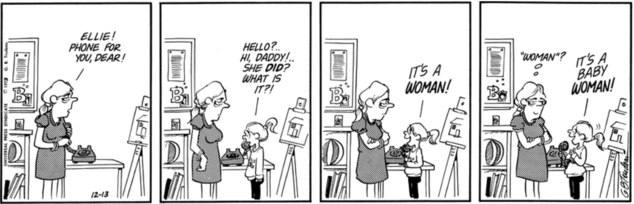
Cartoon of the dayDoonesbury was always one of my favorite comics. This is from 1973, one of his best. I never forgot it.
-
Cartoon of the day
-
My favorite verses in the Tao Te ChingAnother tradition springing from the study of the Dao (which is closely related to medicine as treatment) was the development of the many "gongs" or training methods that lead to exercises for breath, mind, and energy. Those gongs also relate to "dances" such as the Five Animals Frolics of Hua Tuo. The language of Chinese martial arts also draws from the Tao Te Ching. — Valentinus
One of the members of my TTC reading group is a Tai Chi instructor. He brought a really helpful perspective to our discussions. -
My favorite verses in the Tao Te ChingI think perhaps when we get to the verses about the self, we might gain some more clarity on our differences here. I get the sense that you have an essentialist view of the self - that we ‘discover’ the self rather than construct it? — Possibility
Yes. We have plenty of time to work on this. Your insights have been really helpful. -
My favorite verses in the Tao Te ChingI guess that depends on what you mean by ‘exist’. Non-being is not the same as non-existent. For me, ‘seems’ would refer to a phenomenal existence, appearance or being, but ‘seems perhaps’ refers to the contradiction at the heart of the Tao. I think it is misleading to think of the Tao as only existing, without acknowledging the possibility of it not existing, and vice versa, if that makes sense. — Possibility
The question of whether or not the Tao exists is one I have thought a lot about. To start, in English, being and existence mean the same thing. From the way Lao Tzu uses them, it seems like they do in ancient Chinese too. One way of looking at it is that calling the Tao "non-being" and the 10,000 things "being" is figurative, poetic. I believe that's correct, but in the TTC, two conflicting understandings can be correct at the same time.
For what it's worth, I have never convinced anyone that it makes sense to think that it doesn't exist. I've found that whenever I try to explain how I see it, I have a hard time. Someone asked me "When you're asleep, does the world disappear. My answer - yes of course...but. If I can't conceptualize or describe something, I can't think about it. I can't put it in my world. In that case, I think it makes sense to say it doesn't exist.
“It seems to be the ancestor of 10,000 beings” - this description takes the Tao beyond the notion of being. — Possibility
Lao Tzu's audience was scholars and bureaucrats. Educated people. Or are you talking about us as his audience?
“It seems to be the ancestor of 10,000 beings” - this description takes the Tao beyond the notion of being. — Possibility
I'm pretty sure when Lao Tzu says "10,000 beings" he means the same as when he says "10,000 things."
Perhaps he doesn’t want to imply a Creator-Being, which also makes sense as he then describes it as “an image of what precedes God” — Possibility
A bit later we'll get to Lao Tzu's creation story. It's ambiguous and contradictory too.
Boy - I'm not happy with how this turned out, but it's the best I can do. Maybe I'll try again later. -
My favorite verses in the Tao Te ChingWell, I think we disagree markedly on our interpretation of wu wei. It seems to me that you see it as acting subconsciously, as if there is an aspect of our thinking, feeling and acting that renders our experience of it as a passive bystander. I’m not convinced that either of us is correct, but if your interpretation is the case, then I wonder what benefit this ‘non-intending’ ‘action without reflection’ serves for the Tao? — Possibility
I think it's a misconception that acting without prior conscious intention is acting as a "passive bystander." When I write, words pour out of me without conscious control. Sometimes it feels like the words are writing themselves. Writing me. I sometimes feel the same with with other types of behavior. I feel the most there, the most me, when that happens. Do you ever have that kind of experience? It is not uncommon. That is my understanding of "wu wei." -
My favorite verses in the Tao Te ChingHow do you send a download to your kindle ? — Amity
Let's see...
Go to Amazon and check in.
Go to Manage your content and devices
Up at the top, click on Preferences
Scroll down and click on Personal Document Settings
There should be different email addresses there for all of your devices.
Compose a new email with the Kindle email addresses. Attach the downloaded file. They'll send you an acknowledgement request. Say yes. Wait a little while. Look for your document under "Docs" on your Kindle.
Good luck. -
My favorite verses in the Tao Te ChingThanks, I will take a look at this too. Downloadable here: — Amity
Downloaded and sent to my Kindle. Isn't technology wonderful. -
My favorite verses in the Tao Te ChingI don't want to derail the thread any further than I already have. — Wayfarer
I appreciate your vigilance at avoiding tangents. So far, I've been really happy with how people are bringing outside sources into the discussion. -
My favorite verses in the Tao Te ChingWu wei is when effective change cannot be traced back to you as action. — Possibility
I think you brought up something similar in one of your other posts. I'm having trouble keeping track of them all along with what I've responded to. There's a theme in the TTC about the danger of desiring and attaining status and prestige. There's also the theme of action without action. I think those are two separate factors. Wait. Do I really believe that?...Wu wei is not concerned with achievement or recognition, but action without concern for achievement is not necessarily wu wei. Am I nitpicking? ...Maybe. -
My favorite verses in the Tao Te ChingThere’s a scholar, Donald Lopez, who has written a lot about this. — Wayfarer
Cool. I've seen some of his work in passing but not read it. Thanks. — Tom Storm
I just looked him up. He's an American specializing in Buddhist studies. He's married to a Japanese women who specializes in European History. -
My favorite verses in the Tao Te ChingBuddhist principles overturned by scientific discovery must give way. — Wayfarer
I wonder if there could be Buddhist principles which would be in conflict with science. Buddhist thought is so much more sophisticated, if that's the right word, than psychology. -
My favorite verses in the Tao Te ChingOn a side note, I saw that the Dalai Lama (and yes different tradition) has made several comments on the urgent importance of action on climate change. — Tom Storm
Gunga galunga... gunga, gunga-lagunga.
Forgive me. -
My favorite verses in the Tao Te ChingWhat are the similariities/differences between Buddhism and Taoism? — TheMadFool
Popular wisdom says that Chinese Buddhism in particular was deeply influenced by Taoism and that Ch’an Buddhism (Japanese Zen) had many Taoist elements. — Wayfarer
I've been in discussions about whether or not it is appropriate to bring Buddhist ideas, such as "illusion," into discussions about Taoism. I generally say "yes," keeping in mind that while I have spent time with the TTC, I have only flitted around Buddhism. One important thing they have in common is the focus on awareness of internal experience rather than ideas and rational thought, which is how most western philosophy works. That focus makes it possible to find common ground between Taoism and Buddhism . -
My favorite verses in the Tao Te ChingI know this is taking the thread away from the original intention.
However, I thought this small excerpt might be useful and wouldn't harm... — Amity
I'm really happy with the way people are bringing texts in from outside. So far, they've all been relevant and have helped my understanding. I appreciate your regard to the purpose of the thread, but please continue to bring in things you think will help open our eyes. -
My favorite verses in the Tao Te ChingThis may seem unrelated, except that the TTC is very clear about us being bound by affect (desire), and the implications this has on our ability to understand the Tao (objective reality). — Possibility
Not to be pedantic, but I think it is very important to recognize that the Tao is not objective reality. In a sense, that difference is the difference between eastern and western ways of seeing the world.
...he’s talking about the role of affect in how we make sense of the world. Beautiful, ugly, good and bad are the “manifestations” we see (that we construct) while “caught in desire”. I think it helps for us to understand what affect is and how we construct these value hierarchies from our affected relation to the Tao. — Possibility
Do you think that all affect is desire? I remember reading about people who had damage to the part of the brain where emotions are centered. After the injury, they could no longer intend and act. They were perfectly capable of recognizing what was going, but were unable to do anything. Even action without action requires affect.
The bottom line is this: the human brain is anatomically structured so that no decision or action can be free of interoception and affect, not matter what fiction people tell themselves about how rational they are. Your bodily feeling right now will project forward to influence what you will feel and do in the future. It is an elegantly orchestrated, self-fulfilling prophecy, embodied within the architecture of your brain. — Lisa Feldman Barrett, ‘How Emotions Are Made”
Seems like this is the same thing I am talking about. -
My favorite verses in the Tao Te ChingI agree with your description here of not-doing, but I’m not sure if I quite agree with wu wei as spontaneous action. I think perhaps this has something to do with intentionality. It’s more about our insistence on being the one to act, which relates again to seeking personal recognition. We can intend an outcome and set up conditions for it to occur without being the one to perform any action that can be credited with the outcome. For me, wu wei is collaboration that resists localised attribution of success, advancement or recognition. — Possibility
I try to pay attention to the experience that is going on inside me when I think, feel, and act. There is a visual and aural image that represents how that feels to me. I picture a spring bubbling gently up from underground, making a little pool around itself. I can hear the gentle gurgle and, if I want to, I can reach down and touch the cool water. This represents my experience of where motivation, intention come from when things are working right. That non-intention can go directly into action without reflection. That's what I think of as wu wei. Intending without intending leading to acting without acting -
My favorite verses in the Tao Te ChingAffect consists of valence/attention and arousal/effort, and is measurable only by one OR the other of these - like a photon. When we quantitatively measure one aspect, that measurement is in necessary qualitative relation to the other aspect. — Possibility
I really don't know what your post means. The terminology you use is not familiar. Are they psychological? Philosophical? -
My favorite verses in the Tao Te Chinga translation of a Taoist doctor's journal from around 400 or 500 AD — Wayfarer
Do you remember what book it was. Sounds interesting. -
My favorite verses in the Tao Te ChingJust regard it as a footnote to the conversation, that's all. — Wayfarer
I don't mean to give the impression that your post is not welcome. -
My favorite verses in the Tao Te ChingMy image of a Taoist sage is aged, bearded, oriental. OK maybe that's a cultural stereotype. The Taoist practices are like forms of yoga, that are intended to retain vitality and increase chi, and are associated with magic, alchemy, dietary rules and martial arts. That is what it takes to 'follow' or 'practice' taoism in practical terms. — Wayfarer
It is my understanding that Taoism is both a philosophy and a religion. They both grew out of Lao Tzu's and other sage's work, but they are different. Taoist philosophy does not include magic, alchemy, sexual practices, immortality, or any of the other practices sometimes attributed to it. Certainly the To Te Ching does not. Or do I have it wrong? -
My favorite verses in the Tao Te Ching
What you've written in this post is a very good summary of the issues addressed in the TTC. You have a way of talking about the text that's different than mine. It helps me see things from a different direction. Speaking of which, you posted a response before this one that I haven't responded to yet. That's because I'm struggling with it a bit. I'll get back to you.
In Western culture, we don’t like these words. There’s a sense of humility to them that undermines what we tend to think of as individual achievement. — Possibility
Throughout the TTC there are verses that make this point over and over - The danger of success. The damage done by the struggle for advancement and recognition.
Not-doing refers to the earlier verse: to act without doing anything, — Possibility
I was thinking about this too. Not-doing and acting without acting are certainly related, but I don't think they are the same thing. I've gotten in discussions previously - "So, is Lao Tzu saying we should just sit back and wait for things to happen?" Well.. I guess sort of. For me, not-doing is a reflection of patience and trust in the natural way of things. Letting things take their natural course. Wu wei, acting without acting, refers to action that is spontaneous. -
My favorite verses in the Tao Te ChingVerse 4 – Stephen Mitchell
The Tao is like a well:
used but never used up.
It is like the eternal void:
filled with infinite possibilities.
It is hidden but always present.
I don't know who gave birth to it.
It is older than God.
Here’s Ellen Marie Chen’s translation, which I like better. Mitchell takes liberties with the text when the mood strikes him. Chen has included the Chinese words in parentheses in some cases:
Tao is a whirling emptiness (ch'ung),
Yet (erh) in use (yung) is inexhaustible (ying).
Fathomless (yuan),
It seems to be the ancestor (tsung) of ten thousand beings.
It blunts the sharp,
Unties the entangled,
Harmonizes the bright,
Mixes the dust.
Dark (chan),
It seems perhaps to exist (ts'un).
I do not know whose child it is,
It is an image (hsiang) of what precedes God (Ti).
According to this verse, the Tao is:
- A whirling emptiness
- Inexhaustible
- Fathomless
- An image of what proceeds God.
Emptiness doesn’t whirl, does it? Inexhaustible in doing what? Maybe in creating and recreating the 10,000 things. There is a theme of return in the TTC. It comes up more in later verses. I struggled with the idea for a long time. Now, I’ve come to think the Tao doesn’t create the world once, but is creating it over and over again, continuously.
And what about “an image that proceeds God?” So, the Tao is older than God. That means, I guess, that God is one of the 10,000 things. That can’t be right. Can you imagine a more radical idea than that? This is my favorite line in the TTC.
According to this verse, the Tao seems:
- Not to be anyone’s child
- To be the ancestor of 10,000 things
- To exist, maybe.
I’m not sure what Lao Tzu means by “seems.” It usually means “appears” and may imply that appearance is misleading. Nothing can be before or greater than the Tao. It comes before God. The Tao can’t be “anyone’s child.” It is the ancestor of, creates, the multiplicity of things. Lao Tzu sometimes uses family relationships to describe spiritual connections. This is Chen’s translation of a stanza of Verse 52:
The world (t'ien hsia) has an origin (shih),
Which is the world's (t'ien hsia) mother (mu).
Having reached the mother,
(We) know her child.
Having known the child,
Return and abide by its mother.
As for “It seems perhaps to exist,” I have always thought that the Tao doesn’t exist. It is, after all, non-being. Does “seems” mean that it is misleading to think of the Tao as existing? I don’t know.
T_Clark
Start FollowingSend a Message
- Other sites we like
- Social media
- Terms of Service
- Sign In
- Created with PlushForums
- © 2026 The Philosophy Forum