
-
External world: skepticism, non-skeptical realism, or idealism? PollI just think the attempt to frame that mystery in terms of mind or matter, or any of our categories of understanding, or their absence, is a fool's errand — Janus
Whereas I see it in terms of the quest. (Take a look at the poem currently pinned to my profile page.)
Might be easier to explain them to dinosaurs, although I’m finding it tough going. ;-)So now we need Kant and Quantum and relativistics and Husserl to explain dinosaurs. — Banno -
External world: skepticism, non-skeptical realism, or idealism? PollSo, the above doesn't answer the question as to how there could be time prior to humans if time is observer-dependent and there were no suitable observers back then? We can't even say there was a "back then" because that presupposes time. — Janus
I know! That's the point! The objection to idealism will frequently be raised 'how can you claim that "mind creates world" when we know the world is far more ancient than the emergence of h. sapiens?' Which from a realist point of view is a slam dunk.
So I'm appealing to the Kantian distinction which enables him to say that he is an empirical realist - yes, this is empirically the case - but also a transcendental idealist - nevertheless, it is still in some sense mind-dependent - but not in a simplistic or obvious way. As Bryan Magee notes in his Schopenhauer's Philosophy:
This, incidentally, illustrates a difficulty in the way of understanding which transcendental idealism has permanently to contend with: the assumptions of 'the inborn realism which arises from the original disposition of the intellect' enter unawares into the way in which the statements of transcendental idealism are understood, so that these statements appear faulty in ways in which, properly understood, they are not. Such realistic assumptions so pervade our normal use of concepts that the claims of transcendental idealism disclose their own non-absurdity only after difficult consideration, whereas criticisms of them at first appear cogent which on examination are seen to rest on confusion. We have to raise almost impossibly deep levels of presupposition in our own thinking and imagination to the level of self-consciousness before we are able to achieve a critical awareness of all our realistic assumptions, and thus achieve an understanding of transcendental idealism which is untainted by them. This, of course, is one of the explanations for the almost unfathomably deep counter-intuitiveness of transcendental idealism, and also for the general notion of 'depth' with which people associate Kantian and post-Kantian philosophy. Something akin to it is the reason for much of the prolonged, self-disciplined meditation involved in a number of Eastern religious practices. — Bryan Magee
And the reason I mention Andrei Linde is because I think he articulates a version of 'the observer problem'. The observer problem raises questions about the role of the observer in determining the reality of the quantum world. And I think the 'Kantian' resolution to the problem is the most elegant. -
The Hard Problem of Consciousness & the Fundamental AbstractionWhich "etymological dictionary" are you referring to? — Paine
There used to be an explicit statement that 'ontology' was derived from the first-person participle of 'to be' (i.e. 'I am') on one of the online dictionaries, but it's gone now.
Isn't Kahn's point that existence is not an adequate translation of einia because to "step out" is to step out from something? — Fooloso4
I'm trying to grasp the distinctions that appear in pre-modern philosophy between existence, being, and reality. The verb 'to exist' is derived from 'ex-' (apart from, e.g. exile, external) and '-ist', 'to stand' or 'to be'. So to exist is to be separate, to be this as distinct from that.
I think it is generally assumed in the modern lexicon that 'existence' and 'being' are practically synonyms, that there's no significant distinction between them, but that in pre-modern thought it is a distinction that was recognised. See for instance from the Internet Encyclopedia of Philosophy:
Degrees of Reality
In contrast to contemporary philosophers, most 17th century philosophers held that reality comes in degrees—that some things that exist are more or less real than other things that exist. At least part of what dictates a being’s reality, according to these philosophers, is the extent to which its existence is dependent on other things: the less dependent a thing is on other things for its existence, the more real it is. Given that there are only substances and modes, and that modes depend on substances for their existence, it follows that substances are the most real constituents of reality.
God Exists and is a Substance
Furthermore, each of the philosophers we will discuss maintains (and offer arguments on behalf of the claim) that God exists, and that God’s existence is absolutely independent. It is not surprising then, given the above, that each of these philosophers holds that God is a substance par excellence. — 17th C Theories of Substance
But even that is misleading in saying that they believed that God exists. God is transcendent, and 'existence' is what He is transcendent in respect of - beyond the vicissitudes of coming-to-be and passing-away.
I think, generally, in ancient Greek philosophy, there was scepticism that we know 'what truly is' by sense-perception. That is the subject of the 'knowledge of the equal' in the Phaedo. -
The Hard Problem of Consciousness & the Fundamental AbstractionHow would your respond to the suggestion that to return to Aristotle from the vantage of the 21st century is to filter his ideas through the entire lineage of Western philosophy that came after him and transformed his concepts? The implication is that for someone who has assimilated the insights of Descartes and those philosophers who followed and critiques him, to prefer Aristotle over Descartes is to re-interpret Aristotle from a post-Cartesian perspective — Joshs
My knowledge of Aristotle is slight but I've been impressed by the way that Aristotelian-Thomist philosophy preserves metaphysics. Accordingly, I don't agree with the wholesale rejection of classical metaphysics that pervades modern philosophy, although I agree it has to be constantly re-interpreted. It's not a matter of return to any kind of golden age.
That is also the origin of my interest in the nature of the reality of intelligible objects and Platonism in mathematics. My intuition about it - and it is only that - is that there was in pre-modern philosophy a conception of there being greater or lesser degrees of reality, whereas the empirical tendency in modern philosophy understands reality solely in terms of what can be determined to exist by science (within which something is either existent or not). In doing so, it looses contact with the category of 'the unconditioned'.
Like Macbeth, Western man made an evil decision, which has become the efficient and final cause of other evil decisions. Have we forgotten our encounter with the witches on the heath? It occurred in the late fourteenth century, and what the witches said to the protagonist of this drama was that man could realize himself more fully if he would only abandon his belief in the existence of transcendentals. The powers of darkness were working subtly, as always, and they couched this proposition in the seemingly innocent form of an attack upon universals. The defeat of logical realism in the great medieval debate was the crucial event in the history of Western culture; from this flowed those acts which issue now in modern decadence. — Ideas have Consequences, Weaver
I don't think Descartes plays a significant role in the work being done in cognitive science, but he does play a role in historical accounts. — Fooloso4
You misunderstand. What I'm saying is that Descartes' conception of 'res cogitans' as a literal 'thinking thing' - 'res' means thing or object - is the source of the self-contradictory notion of the 'thinking substance' and of Ryle's depiction of it as 'the ghost in the machine'. Whereas the scholastic depiction of reason, based on elements of Aristotle, was much more subtle. In the Aristotelian scheme, nous is the basic understanding or awareness that allows human beings to think rationally. For Aristotle, this was distinct from the processing of sensory perception, including the use of imagination and memory, which other animals can do. For him then, discussion of nous is connected to discussion of how the human mind sets definitions in a consistent and communicable way, and whether people must be born with some innate potential to understand the same universal categories in the same logical ways. This is predicated on realism concerning universals, which is nowadays generally rejected (hence 'modern decadence'.) -
The Hard Problem of Consciousness & the Fundamental AbstractionNow a few more words about @Dfpolis' essay. I generally agree with his diagnosis of the malady of the 'post-Cartesian conceptual space'. I don't exactly agree with the specifics of his critique of it, but that this problem exists, and that its consequences are pernicious, I generally agree with. In my analysis, it basically stems from Descartes' designation of mind or consciousness as 'res cogitans' which means 'thinking thing' ('res' being Latin for 'thing or object')*. This leads to the disastrously oxymoronic conception of 'a thinking substance' which is the single biggest contributor to modern physicalist philosophy. So this, I entirely agree with:
Similarly, metaphysical naturalists project nature onto an a priori model defined over a restricted conceptual space. With historical myopia, they tend to see dualism as the sole alternative to physicalism. — DfPolis
:100: :clap:
I also agree with the gist of the 'fundamental abstraction', although again, I differ somewhat in my analysis of it. I trace the 'fundamental abstraction' to early modern science - a consequence of Cartesian dualism, and equally, the division of the world into primary and secondary qualities or attributes, with the primary qualities being the objects of physics and the secondary being assigned to 'mind' and thereby subjectivised and relativised**. I agree that Aristotle's hylomorphic model is vastly superior to the Cartesian, and also note that Aristotelian metaphysics is enjoying a comeback in the biological sciences.
There are other points that I agree with, and disagree with, but that will have to do for now.
-----
* I also have the sense that, had Descartes lived longer, or had had better successors, he could have answered many of the critics of his philosophy and elaborated it in the face of many of the objections. I have respect for Descartes' genius and his seminal contributions to the establishment of modern culture.
** Leading to the 'Cartesian Anxiety': "Cartesian anxiety refers to the notion that, since René Descartes posited his influential form of body-mind dualism, Western civilization has suffered from a longing for ontological certainty, or feeling that scientific methods, and especially the study of the world as a thing separate from ourselves, should be able to lead us to a firm and unchanging knowledge of ourselves and the world around us. The term is named after Descartes because of his well-known emphasis on "mind" as different from "body", "self" as different from "other".
Richard J. Bernstein coined the term in his 1983 book Beyond Objectivism and Relativism: Science, Hermeneutics, and Praxis. -
The Hard Problem of Consciousness & the Fundamental AbstractionKahn's essay mentions Aristotle in a few places. I've gone back and looked at the passages I highlighted. My original contention is that there is a distinction to be made between 'being' and 'existence' that is not generally made in the modern philosophical lexicon. Naturalism presumes that what exists, and what is, are co-extensive or coterminious. Whereas, I argued, the original meaning of ontology was not simply an exhaustive catalogue of everything that exists, but is nearer to 'the meaning of being'. In support of this, I quoted an etymological dictionary which pointed out that the term 'ontology' is derived from the first-person participle of the verb 'to be' - which is, of course, 'I am'. (This is the point which the ex-moderator used to hysterically denounce.) Note also the resonance with the Biblical definition of God, viz, 'I am that I am'.
One passage which I refer to in support of my contention is:
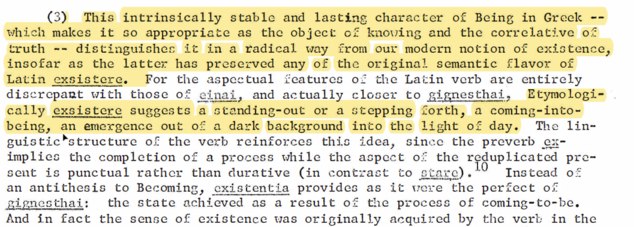
This makes almost exactly the point I am seeing to make: that 'what exists' is only ever an aspect or facet of 'what is', which has to be grasped through the 'unitive vision' which I believe the fragmentary poem of Parmenides is testimony to. Of course, this is grounded in my interpretation of the mystical basis of Parmenides vision of 'to be' - Parmenides and the other early Greek sages are much nearer in spirit to the Buddhist and Hindu sages than modern philosophers generally (cf. Peter Kingsley, Thomas McEvilly). Of course, there is always a resistance on this forum to such ideas on the basis of their affinity to religion, this being a resolutely secular (not to say misotheist) ensemble of individuals (which incidentally I respectfully differ with on the whole).
In any case, 'knowing' in this sense is much nearer to a form of gnosticism - not in the sense specific to the gnostic sects, but in the sense that the kind of knowledge or insight being sought was itself transformative and not simply propositional or formulaic. -
The role of observers in MWII'd be interested if you could see what I was driving at in this OP on Physics forum particularly #11 and #14. I was trying to argue that the probability wave is outside of space and time, although (probably predictably) the physicist who responded thought this 'gobbledegook' and preferred the (I think inane) dogma that 'particles interfere with themselves'. I don't know enough physics to really articulate the intuition I have about it.
-
Who Perceives What?The perceiver is at one end of a causal chain of intermediaries — RussellA
And what is the nature of this chain? -
Donald Trump (All General Trump Conversations Here)Even the mighty Rupert abases himself for the holy $.
-
Donald Trump (All General Trump Conversations Here)‘Donald Trump has attacked Rupert Murdoch in a blistering statement, accusing him of betraying his Fox News television hosts by admitting that he doubted their conclusions about the 2020 election.
“Why is Rupert Murdoch throwing his anchors under the table,” the former US president posted to his platform Truth Social.’
https://www.smh.com.au/world/north-america/trump-attacks-murdoch-for-throwing-his-anchors-under-the-table-20230302-p5cor5.html
Trial hasn’t even started yet! -
External world: skepticism, non-skeptical realism, or idealism? PollThe relativity of simultaneity is not at issue in this discussion.
-
External world: skepticism, non-skeptical realism, or idealism? PollI said that it is a matter of empirical fact.
— Wayfarer
But it's not an empirical fact. Emprical facts are observables. So, what is it? — Janus
I am saying that the fact there was a time before humans existed is an empirical fact supported by the fossil record and an abundance of geological and paleontological data which can be observed. Iis that not so?
I'm not asking you to explain time, I'm asking you what you mean by time if you are positing it as something different than the subjective experience of duration, and the subjective understanding of time as 'past, present, future'.
It is obvious that there was not such a time prior to human life. So, I am asking you what you mean by saying that there was a time prior to humans. — Janus
There was a time prior to humans, but time itself is not completely objective - it is in some fundamental sense dependent on the observer. That is what I had hoped to convey with the quotation from Paul Davies, who says that the passage of time is reliant on there being an observer, and that if the state of the universe is described in the equations of quantum cosmology, then time simply 'drops out'. This 'observer dependency' is what ultimately underminees physicalism, as physicalism presumes that the objects of physics are real independently of any mind. It is also at the basis of the overall 'observer problem' in physics generally.
And the reason I said that this can be related to Kant is because of this passage:
I understand by the transcendental idealism of all appearances the doctrine that they are all together to be regarded as mere representations and not things in themselves, and accordingly that space and time are only sensible forms of our intuition, but not determinations given for themselves or conditions of objects as things in themselves. To this idealism is opposed transcendental realism, which regards space and time as something given in themselves (independent of our sensiblity). The transcendental realist therefore represents outer appearances (if their reality is conceded) as things in themselves, which would exist independently of us and our sensibility and thus would also be outside us according to pure concepts of the understanding. (CPR, A369)
The transcendental idealist, on the contrary, can be an empirical realist, hence, as he is called, a dualist, i.e., he can concede the existence of matter without going beyond mere self-consciousness and assuming something more than the certainty of representations in me, hence the cogito ergo sum. For because he allows this matter and even its inner possibility to be valid only for appearance– which, separated from our sensibility, is nothing –matter for him is only a species of representations (intuition), which are call external, not as if they related to objects that are external in themselves but because they relate perceptions to space, where all things are external to one another, but that space itself is in us. (A370)
I would have hoped that, given the challenging nature of the issue that this is about as clear as it can be made. If that will not suffice, then I won't press it any further. (I'm also intrigued that Kant appears to concede dualism in that passage.) -
External world: skepticism, non-skeptical realism, or idealism? PollI said earlier in this thread, my main aim is to argue that humans are intrinsic to the universe, not an accidental byproduct.. That remains the case. In earlier times that would be an assumed implication of religious mythology, now it has to be established on the basis of philosophy.
-
External world: skepticism, non-skeptical realism, or idealism? PollI tried to give as direct an answer as possible to this question:
What could it then mean to say that there was a time before human beings existed? Are you able to say? — Janus
I said that it is a matter of empirical fact. But in a philosophical sense, taking the empirical facts as the last word constitutes the 'naivete' that the passage about Husserl refers to.
Of course I am not going to pretend to be able to explain time. Many minds much greater than mine have attempted that. I am simply pointing out that it has an inextricably subjective element, and not in a trivial sense.
I keep acknowledging that I think the empirical world, as conceived, and to some extent as experienced, is a collective representation, so I fail to see what purpose you think there might be in lecturing me about ideas which I am probably more familiar with than you are. — Janus
That is at odds with many of the objections you raise, but then, maybe it's just for the sake of argument. -
The Hard Problem of Consciousness & the Fundamental AbstractionWhich would be a great question, and one which I am in no way qualified to answer. I will find the passages I thought significant a little later when I have some time.
-
External world: skepticism, non-skeptical realism, or idealism? PollIt depends on what you mean by 'time'. If it is taken to mean the subjective sense of duration, or the conception of past present and future, then of course it cannot exist independently of subjects by definition. Beyond that, how would we know? — Janus
It's not a trivial matter. There was a time before humans existed, as is well attested by empirical science. But the entire framework within which empirical science depends is first and foremost noetic or intellectual. 'From a phenomenological perspective, in everyday life, we see the objects of our experience such as physical objects, other people, and even ideas as simply real and straightforwardly existent. In other words, they are “just there.” We don’t question their existence; we view them as facts.
When we leave our house in the morning, we take the objects we see around us as simply real, factual things—this tree, neighboring buildings, cars, etcetera. This attitude or perspective, which is usually unrecognized as a perspective, Edmund Husserl terms the “natural attitude” or the “natural theoretical attitude.”
When Husserl uses the word “natural” to describe this attitude, he doesn’t mean that it is “good” (or bad), he means simply that this way of seeing reflects an “everyday” or “ordinary” way of being-in-the-world. When I see the world within this natural attitude, I am solely aware of what is factually present to me. My surrounding world, viewed naturally, is the familiar world, the domain of my everyday life. Why is this a problem?
From a phenomenological perspective, this naturalizing attitude conceals a profound naïveté. Husserl claimed that “being” can never be collapsed entirely into being in the empirical world: any instance of actual being, he argued, is necessarily encountered upon a horizon that encompasses facticity but is larger than facticity. Indeed, the very sense of facts of consciousness as such, from a phenomenological perspective, depends on a wider horizon of consciousness that usually remains unexamined. Any individual object, Husserl wrote:
“Is not merely an individual object as such, a ‘This here,’ an object never repeatable; as qualified ‘in itself‘ thus and so, it has its own specific character, its stock of essential predictables which must belong to it … if other, secondary, relative determinations can belong to it.”
that is the constant theme of this debate. What is called 'the natural attitude' is the default and anything that questions it is fiercely resisted, as can be seen. -
Spinoza’s PhilosophyI was referring to Descartes' use of the term 'res' in 'res cogitans'. The Latin term 'res' is translated as thing or object. You claimed not to be able to see where the conflation of 'substance' in the sense meant by 'ousia' in Aristotelian philosophy, and 'substance' in the everyday meaning of 'material with uniform properties' originated. I'm saying that it originated with Cartesian dualism.
It is not inconsistent with general usage to think of a thing as a being. — Janus
Inanimate objects are not referred to as 'beings', and beings are not referred to as 'things'. It is precisely the tendency to reify beings as things which is at the basis of modern materialism. -
External world: skepticism, non-skeptical realism, or idealism? PollAgain I submit a passage from Paul Davie's book about the sense in which time itself is a projection of the observing mind, to wit:
The problem of including the observer in our description of physical reality arises most insistently when it comes to the subject of quantum cosmology - the application of quantum mechanics to the universe as a whole - because, by definition, 'the universe' must include any observers. Andrei Linde has given a deep reason for why observers enter into quantum cosmology in a fundamental way. It has to do with the nature of time. The passage of time is not absolute; it always involves a change of one physical system relative to another, for example, how many times the hands of the clock go around relative to the rotation of the Earth. When it comes to the Universe as a whole, time loses its meaning, for there is nothing else relative to which the universe may be said to change. This 'vanishing' of time for the entire universe becomes very explicit in quantum cosmology, where the time variable simply drops out of the quantum description. It may readily be restored by considering the Universe to be separated into two subsystems: an observer with a clock, and the rest of the Universe. So the observer plays an absolutely crucial role in this respect. Linde expresses it graphically: 'thus we see that without introducing an observer, we have a dead universe, which does not evolve in time', and, 'we are together, the Universe and us. The moment you say the Universe exists without any observers, I cannot make any sense out of that. I cannot imagine a consistent theory of everything that ignores consciousness...in the absence of observers, our universe is dead'. — Paul Davies, The Goldilocks Enigma: Why is the Universe Just Right for Life, p 271
I submit that this supports the Kantian assertion that 'time is one of the forms of our sensibility', rather than something that exists objectively and independently of any observer. Which is not to deny the empirical fact that there was a time before human beings existed, as Kant was also an empirical realist. -
If we're just insignificant speck of dust in the universe, then what's the point of doing anything?Everything that we do, all that we do, just seems so minuscule & insignificant, when seen from the bigger picture of everything. — niki wonoto
That 'bigger picture' is something that only h.sapiens can be made aware of, as far as we know. So you're scaring yourself. -
Spinoza’s PhilosophyAs far as I know it means "thing" or "being"; — Janus
It emphatically does not mean, 'being'. It means a thing, matter, or object., and is also the root of 'reality'. So in answer to the question, how did the meaning of the Aristotelian ousia (the original root of 'substance') become conflated with matter, or 'thinking stuff' - there's your answer. It is at the root of almost everything said or thought about this question, here and everywhere else. -
Spinoza’s Philosophythe conflation of substance with subject is completely alien to Spinoza, and I can't think of anywhere else it could be found. — Janus
What is the direct translation of ‘res’ in ‘res cogitans’ (Descartes)? -
External world: skepticism, non-skeptical realism, or idealism? PollYou could see it as another milestone in the gradual erosion of faith in reason. After all reason and causation are you would think intimately linked. I think I’ll start a thread on it.
-
Spinoza’s PhilosophyThat’s ok you’re asking good questions but I’ll leave others to tackle that one.
-
The Hard Problem of Consciousness & the Fundamental AbstractionWhat was the problem? — L'éléphant
Basically the problem was that this particular mod hated my guts and would initiate or join any pile-on concerning myself. All water under the bridge. -
The Hard Problem of Consciousness & the Fundamental AbstractionSee e.g. this post and subsequent criticism. SLX posted a link to an apparently classic article by Charles Kahn, which I read pretty carefully, and which I think supports my interrpretation.
-
The Hard Problem of Consciousness & the Fundamental AbstractionAre you guys referring to a specific OP? — Paine
I am of the view that the word 'ontology' refers to exploration the nature of being, as distinct from the study of phenomena or the analysis of what kinds of things there are, which I said is the domain of science proper. I was told this was highly eccentric and idiosyncratic (in no uncertain terms) whenever I mentioned it (this was by a former mod, streetlightx, who is no longer a contributor. He was highly educated but often vitriolic in the extreme). Anyway, carry on, this is a digression. -
The Hard Problem of Consciousness & the Fundamental AbstractionWhenever I mentioned my take on the meaning of 'ontology', SLX would go completely ballistic, but he's not around any more.
-
The Hard Problem of Consciousness & the Fundamental AbstractionAfter all, not all beings are conscious. — Fooloso4
In my taxonomy, beings are differentiated from things precisely because they are animated (by soul, in Aristotle’s terms.) And you can see it in that even the simplest organisms embody intentional actions even if not conscious in any real sense, although that will sound too near vitalism for most. -
The Hard Problem of Consciousness & the Fundamental AbstractionIt is as if you said: "Hard problem? What hard problem? There is no hard problem. Consciousness just is. No further explanation is needed or possible." — Fooloso4
The ‘hard problem’ argument is aimed at a specific audience namely those reductionists who claim there is or can be a physical explanation for the nature of consciousness. It’s a hard problem for naturalism. But there is no such problem for those who don’t make that claim.
:up: -
Donald Trump (All General Trump Conversations Here)hopefully they’ll get their just desserts at this forthcoming trial.
-
EmergenceWhich physical laws, AP, prevent us from building / growing a 'self-aware AI' — 180 Proof
No physical laws accurately describe sentient beings except insofar as sentient beings are subject to physical laws such as the law of gravity. But sentient beings operate by principles which can't be reduced to the laws of physics, such as the ability to act intentionally, heal, maintain homeostasis, reproduce, and so on. None of these operations are necessarily reducible to physical laws.
A computer, as I'm sure you're aware, could theoretically be constructed from pipes and water, or stones and rubber bands, although it would obviously be wildly impractical, as micro-electronics offer efficiencies of scale that could never be realised in such media. But, in principle, a computer is just a fantastically advanced abacus that performs calculations and outputs results. So why would it ever be possible for such a device to become a being? You could, as Kastrup says, symbollically represent kidney function on a modern computer with great accuracy, but you would not expect the computer to urinate. -
Spinoza’s Philosophyit has to be shown that the definition of the divine essence or substance involves its existence — Copleston
Without reference to Spinoza in particular, let's recall that substance in philosophy has a meaning nearer to 'being' or 'subject', whereas 'substance' in everyday speech has the connotation of matter ('substance - a material with uniform properties') . I think, however, the phrase 'the divine subject' conveys the gist of the idea more accurately than 'the divine substance'.
Part of the definition of the divine being is that He IS - (compare Exodus 3:14 'I AM THAT I AM') - in other words, God is 'necessary being'. So the very possibility of the idea of God implies the reality of God - which is the ontological argument as Copleston says.
Note this passage:
The notion of necessary being, applied to God and withheld from man, indicates that God and man differ not merely in the characteristics which they possess but more fundamentally, in their modes of being, or in the fact that they exist in different senses of the word 'exist'. ...
Paul Tillich...emphasises the distinction to the extent of using different terms to refer to the reality of God and of man respectively. Human beings and other created things exist; God, on the other hand, does not exist, but IS. This is the most recent way of formulating a discrimination which has been classically expressed in the history of Christian thought by the idea of the necessary being of God in contrast to the contingent being of man and of the created order.
There are, however, two importantly different concepts which have been expressed by the phrase ‘necessary being’. ‘Necessity’, in a philosophical context, usually means logical necessity, and gives rise in theology to the concept of a being such that it is logically impossible that this being should not exist.' — Cambridge Dictionary of Theology
assimilating causal dependence to logical dependence
I interpret this phrase to mean that, as God is the sole real substance (or subject), then causal relations are subordinate to logical dependence. What we see as contingent is in reality strictly determined by God's omnipotence of which logical necessity is a manifestation.
I think nowadays it is customary to say that logical necessity and physical causation are not bound in such a way, and in fact are not even necessarily connected, although I'm not sure about that. -
External world: skepticism, non-skeptical realism, or idealism? PollYou have been affected by an idea, not by anything physical, so it is quite a different matter to physical causation.
-
External world: skepticism, non-skeptical realism, or idealism? PollThe optic nerves, responsible for transmitting electrical pulses to create an image is another. You know... light passes through the pupil, etc. In other words, there is energy there, too. — L'éléphant
What if I write something that makes you so annoyed your hands begin to shake. What kind of causation would that be? -
External world: skepticism, non-skeptical realism, or idealism? Poll. The idea that science is entirely constructed and not in any way determined by the world seems patently absurd. — Janus
I think your addition of 'entirely' and 'not in any way' completely changes the meaning of what was quoted. One may perfectly accept that there is an enormous domain of objectively-verifiable fact to which we all must conform. They are indeed physical constraints - but don't forget that Berkeley himself frequently stated, he did not for one minute deny the reality of the objects of perception, only that they don't have the attributes that we normally credit them with, of being real independently of perception.
I remember when I first encountered Peter Berger's book The Social Construction of Reality. I too thought it absurd and declaimed angrily about it in a tutorial. 'Do we put the stars in the sky', quoth myself, banging fist on table. But I gradually came to see that I was misunderstanding his point. It's more that our world, the 'lebenswelt' of humans, is constructed from meanings, because we interpret experience according to our cultural constructs and so on. (One of David Loy's books, that I haven't looked at, is called The World is Made of Stories.) -
External world: skepticism, non-skeptical realism, or idealism? PollI'm starting to think - actually I made this point at the outset - that a better term than idealism might be constructivism (grabs bit of random text from internet):
Originally proposed by sociologists of science, constructivism or social constructivism is a view about the nature of scientific knowledge held by many philosophers of science. Constructivists maintain that scientific knowledge is made by scientists and not determined by the world. This makes constructivists antirealists. Constructivism here should not be confused with constructivism in mathematics or logic, although there are some similarities. Constructivism is more aptly compared with Berkeley’s idealism.
Most constructivist research involves empirical study of a historical or a contemporary episode in science, with the aim of learning how scientists experiment and theorize. Constructivists try not to bias their case studies with presuppositions about how scientific research is directed. Thus their approach contrasts with approaches in philosophy of science that assume scientists are guided by a particular method. From their case studies, constructivists have concluded that scientific practice is not guided by any one set of methods. Thus constructivism is relativist or antirationalist.
Many of the cognitive scientists who emphasise the role of the brain in 'constructing' reality are like this in many respects - not that they all draw the same philosophical conclusions, but many are anti-realist in this sense. You can also see how it maps against Kuhn, Feyerabend etc.
That is specific to Nagarjuna's philosophy. No Theravadin would ever agree with that. Furthermore even Nagarjuna adds that grasping the precise meaning of this teaching is of basic importance, comparing it to picking up a poisonous snake - don't grasp it correctly, and it will kill you!you have the idea in Buddhism that nirvana is samsara — Janus -
Donald Trump (All General Trump Conversations Here)The Dominion Voting Machines v Fox News has produced a wealth of incriminating evidence even before going to trial in April. NY Times reports that Murdoch admitted under oath that he should have reigned in his commentators from spreading The Big Lie, but did not (link copied as 'gift article' so should open without paywall).
Rupert Murdoch Acknowledges Fox News Hosts Endorsed Election Fraud Falsehoods
Rupert Murdoch, chairman of the conservative media empire that owns Fox News, acknowledged in a deposition that several hosts for his networks promoted the false narrative that the election in 2020 was stolen from former President Donald J. Trump, court documents released on Monday showed. ...
...Dominion has said the actions of Fox hosts including Mr. Carlson, Mr. Hannity, Ms. Bartiromo and Mr. Dobbs — and the producers and executives overseeing their programs — were anything but a dispassionate recitation of newsworthy claims of fraud. Rather, Dominion has argued, the internal communications it has uncovered point to how Fox employees behaved with “actual malice” — the legal standard required to prove defamation.
Wayfarer

Start FollowingSend a Message
- Other sites we like
- Social media
- Terms of Service
- Sign In
- Created with PlushForums
- © 2026 The Philosophy Forum