
-
Can we see the world as it is?Where did you get that pronunciation from Olivier? — Daemon
New York. It’s meant as a parody of a smart ass talking. -
Can we see the world as it is?When I put on my glasses, the world is well focussed, but when I put them off, the world is all blurry. Funny how the world is...
-
Can we see the world as it is?Besides, Kant is wrong. I know this, because I’m a naive realist! — Wayfarer
Right, and you never saw an optical illusion or perceived something wrongly in your entire life so you are confident in the total accuracy of your senses. Likewise, your judgement is pure of any error and of any subjectivity, ya kna? So when you look around here and see a bunch of jokers who never cared to think, it’s not just your opinion... it’s the Philosophy Forum AS IT IS. :-) -
What are you saying? - a Zen StoryNo need to apologise, it’s my fault for not noticing how old this thread was.
like a koan, how to read a book and not read a book — Punshhh
Easy: you read it and then you forget it. :-)
I’m only half joking. In my experience, forgetting the details is a good way to focus on what’s important. -
Reason and its usagesMaybe are certain ways things have to be in order to exist. So, perhaps, as order appears, then it is incipiently mathematical, because there is repetition, and repitition is countable. Just thinking out loud. — Wayfarer
Good intuition. I would only rephrase slightly: there are certain ways things have to be in order to EMERGE. Mathematics are heuristic. They describe how things emerge. Take a set of axioms, and you can develop a world from it, heuristically. Life does something quite similar, with gametes and seeds, and Darwin tells us it evolved heuristically over the eons. So the life forms that emerged throughout evolution took certain shapes because those shapes were ECONOMICAL in terms of emergence (emergence of new forms being rare and difficult, the forms that emerge are the easiest ones to ‘build’) and therefore those forms have a LOGIC of emergence, a certain way of building things up than COULD and DID happen. François Jacob wrote about that.
Now, here is an example of how a simple biological process of reproduction generates the Fibonacci sequence:
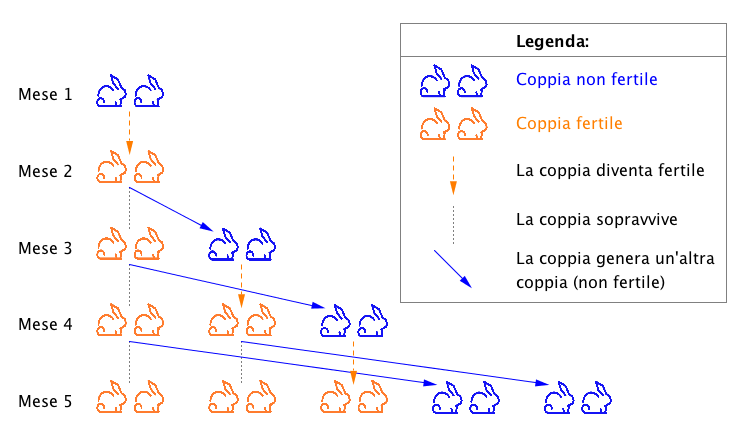
From this simplified example, one can see how any population emerging from an initial couple would (at least theoretically) follow the mathematical Fibonacci sequence. And plants and animals are populations of cells. So it s logical to assume they recycle the same processes of growth than populations do.
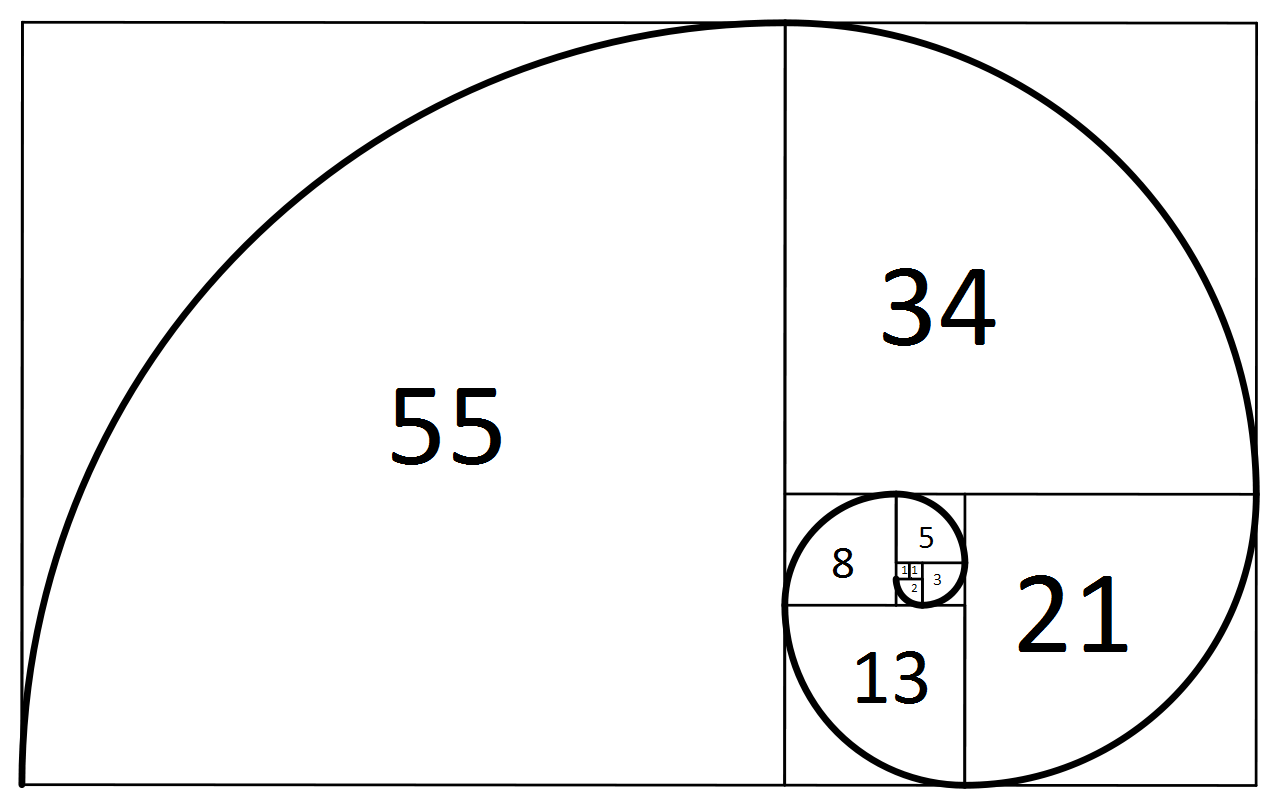
Here is something else the Fibonacci sequence can be used for:
-
Nothing to do with Dennett's "Quining Qualia"Anyway, I appreciate that you're taking an embedded approach rather than viewing objectivity and subjectivity as opposing duals. I can agree with that. — Andrew M
In fact, to move from subjectivity to objectivity, one needs more subjects, adding and comparing their observations, So in a sense you get to objectivity by adding subjectivity to subjectivity, not by taking subjectivity away. -
Nothing to do with Dennett's "Quining Qualia"Dennett has introduced this confusion through his misuse of the term 'qualia — Luke
Yes, and I think he did so on purpose, in order to confuse the simple minded. -
What are you saying? - a Zen StoryAnd as you say it is not scripture, but rather a collection of personal thoughts forming a lineage from teacher to student through the generations. So all that is being lost is this lineage some personal thoughts therein and an emotional attachment and significance of such a document.
There is a sense that those significant insights had by the teacher have been conveyed to the student already, verbally. That any significant insights conveyed from the previous generation by the teacher of the teacher along with the six generations before that would have been conveyed only verbally and any attempts to formulate them in the written word in the book would loose some verbal direct transmission and would rather become a confusing distraction from the task at hand. — Punshhh
I see another (additional) dimension, or possibility opened by the burning of the book. Of course the act of burning a book is sacrilegious or at the very least shocking but that’s part of the style. It’s a hyperbole coding for something less shocking: the necessary distance one should take with tradition. Maybe the student wanted to write his own book, based on tradition evidently (the oral teaching of his master is seen by the student as primordial), but also radically departing here or there from tradition. Maybe he was not content with writing comments in the margins of someone else’s book. -
Reason and its usagesThe capacity to reason evolved, plainly. But what of the 'furniture of reason' itself - the laws of logic, natural numbers, and so on? They did not come into being as a consequence of evolution. What came in to being was the capacity to understand them. — Wayfarer
Yes, our capacity to hold on or assess logical inferences evolved, but unlike other things that evolved, it seems to touch on universals. For instance, Mathematics are universal. It’s not like some of us humans naturally think of space as having 7 dimensions for instance. We all have a 3D euclidian geometry ‘in mind’, when we drive or move around, or do geometry. And even when geometry tells us that nothing stops us from postulating a 7D space and from calculating motions within it, we still can’t imagine such a 7D space in our mind.
There are other cases of universals in evolution, that always have something mathematical about them: e.g. the DNA/RNA code, quasi universal body symmetry, or the use of folding to create 3D shapes from lines and filaments.
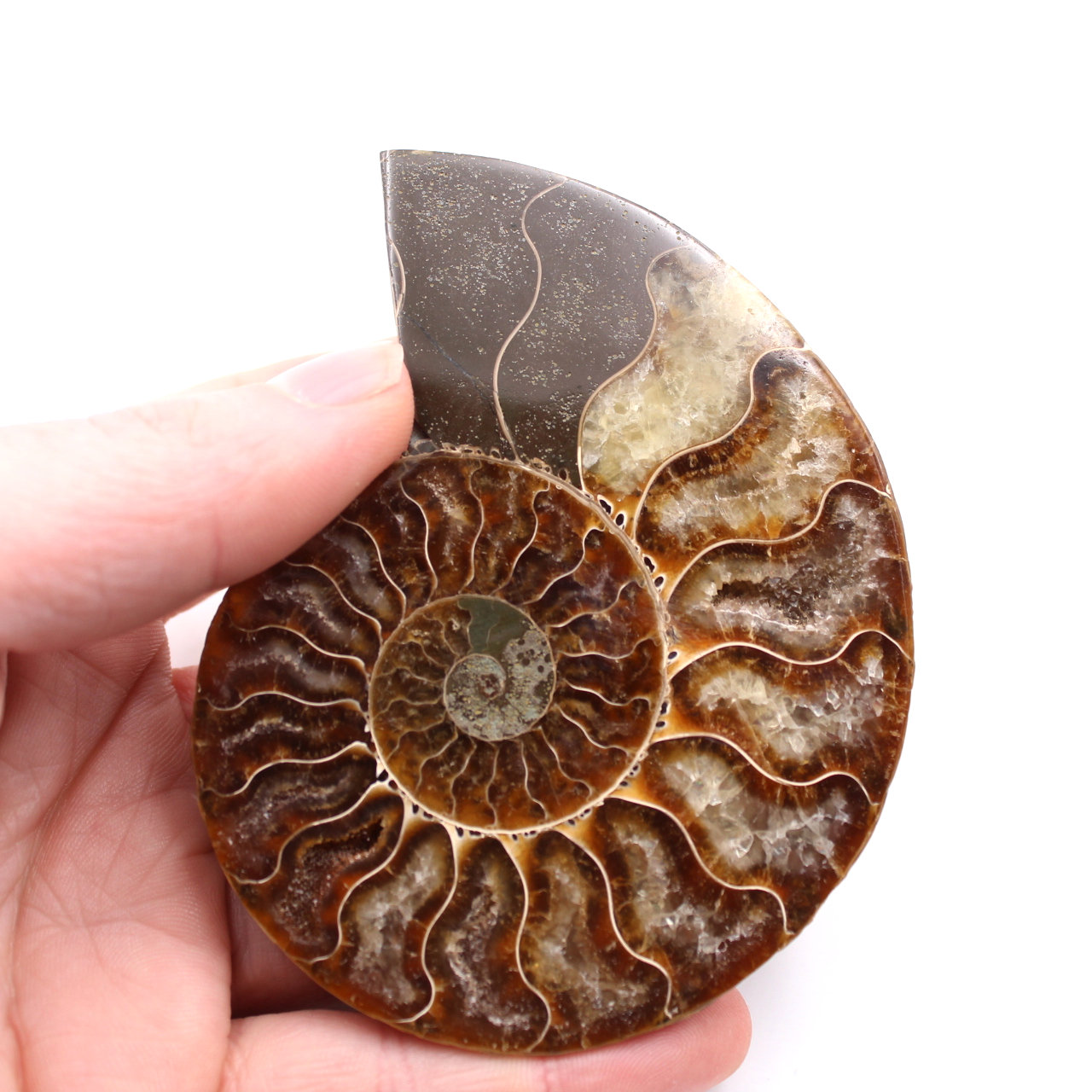
An example of this is helicoidal folding, ubiquitous in DNA, in proteins, or in large scale structures like snail shells, horns or flowers. In flowers and plants, the Fibonacci numbers and spiral seem to appear in countless structures (pine cones and the likes).
There seem to be some advantages to spirals. E.g. the shell of ammonites, and ammonites themselves could grow in size without changing their overall shape. It’s a very economical solution to the equation of growth.
Do you think there's much awareness of 'the unconditioned, the irreducible', in most current philosophical discourse? I read a lot more about the 'provisional nature of science'. The idea of 'the unconditioned' seems to me to have been dropped, on the whole. — Wayfarer
It’s still an ideal I think, an horizon, something we tend to even if we know we might never reach it. -
Nothing to do with Dennett's "Quining Qualia"An even better gem: let’s obsess and argue over qualia for dozens of pages and several threads to show how totally useless that concept is...
-
Nothing to do with Dennett's "Quining Qualia". I recall his analogy about philosophical scepticism being like the Uroboros, the snake that eats itself - ‘the hardest part’, he would say, with a wry grin, ‘is the last bite’. — Wayfarer
And that is an excellent philosophical joke for the (cartesian) logical impossibility of doubting the doubter... -
Nothing to do with Dennett's "Quining Qualia"Stove on Kant: — Banno
That’s about as funny a joke one can make about Kant. The irony is that Stove remembered Kant’s answer to his own noumena-phenomena question so well that he obsessed about it a great deal and called it the Gem, without ever (apparently) recognizing where that idea originally came from (ie Kant). -
Nothing to do with Dennett's "Quining Qualia"Do you think this joker, David Stove, ever heard of the noumena-phenomena distinction in Kant?
-
CoronavirusI have driven at excess of 300kph. — Book273
If you do that in a city you might kill someone, so it’s forbidden. Likewise you are more than welcome to not wear a mask when you’re alone in the wilderness, hugging grizzlies, but not in a shop or in an office. -
Nothing to do with Dennett's "Quining Qualia"Could it reflect how we're bound to think about the world, but not how the world really is? — frank
How could we ever know that? It is the way the world is for us. -
Nothing to do with Dennett's "Quining Qualia"Yes, it’s an a priori, in the sense of ‘intuitively necessary yet unproven’.
-
Nothing to do with Dennett's "Quining Qualia"Still, we don’t know what matter is. We only know the forms it takes.
— Olivier5
I'm not sure the question as to what matter is is really coherent. We may find other particles in the future, but how would we ever know if we had arrived at an "ultimate constituent" or if the idea of ultimate constituency is a valid one? — Janus
IMO, the question is moot (rather than incoherent) and thus ontology is moot. The shapes that matter takes is what is accessible and important to us, not what it is ‘in itself’.
The thing is their are bodies without minds, albeit vegetative or dead; but we know of no minds without bodies, so what supervenes on what seems fairly clear in the light of that. — Janus
I’m not sure a dead body is ‘really’ a body. It’s more a pile of rot. As for minds without bodies, I agree they don’t exist, although that is of course unproven, it seems quite likely to be true. But minds supervene bodies all the time, e.g. in committing suicide. -
Nothing to do with Dennett's "Quining Qualia"In other words, it's form all the way down and thus there is no ontological separation between information and matter, because there’s no such thing as matter... But to me, form cannot exist without matter and vice versa, so it’s two sides of the same coin, or to extremities to the same rope. And I have no problem calling that ‘duality’ or ‘dualism’. Never understood what was so compelling about monism, personally. I’m more of a ying-yanger.
Thanks for Rovelli’s quote by the way, Aristotle often gets unfairly attacked by positivists. -
Nothing to do with Dennett's "Quining Qualia"Agreed, though I would say that [objectivity] is grounded in human experience, rather than human subjectivity, which I think captures the empirical nature of the enterprise. — Andrew M
I would say subjective experience. It helps show that objectivity stems from subjectivity, rather than be the opposite of it. -
Nothing to do with Dennett's "Quining Qualia"First of all that sentence says that subjectivity is a flaw, not that it itself is flawed — Isaac
Semantics.
secondly it is attributing such a view to a rhetorical opposition, not claiming it as my own — Isaac
Well then your rhetoric is misdirected, because I never ever said subjectivity was a flaw.
Why are you so pissed all the time? You can’t take a little contradiction without behaving like a petulant child? Or is it some misplaced sense of entitlement? You should work on this. -
Nothing to do with Dennett's "Quining Qualia"↪Olivier5 I see the mind as being an activity of the body. — Janus
Or vice versa, in the sense that the body without the mind becomes vegetative. -
Nothing to do with Dennett's "Quining Qualia"
( emph added)Oliver's post about someone not knowing what matter is. They say they know the world is material because they were told that by their teacher. — Marchesk
It’s not someone... it’s everyone. -
Nothing to do with Dennett's "Quining Qualia"Sure, it's not impossible that we have the wrong understanding of what constitutes matter. But it does seem vanishingly unlikely, given the predictive success of quantum physics, that it could be completely wrong — Janus
Still, we don’t know what matter is. We only know the forms it takes. -
Nothing to do with Dennett's "Quining Qualia"Another thing is, i’ve had the same weight plus or minus a kg for the past 20 years. It’s not like I weight nothing, nor that sometimes I weight three tons and sometimes one gram. So by body seems to behave as a somewhat stable material object. My mind of course is another... matter?
-
Nothing to do with Dennett's "Quining Qualia"Consider that not everything in the intersubjective world was created by humans; a good deal of it is discovered - principles such as non-contradiction, natural numbers, all of the other 'furniture of reason'. — Wayfarer
I think of logic as an a priori. So it’s either a part of our operating system, or a world with its own rules that we tap into. I tend to lean for the first solution: a part of our operating system. So in this sense it was indeed not produced by humans, only codified (aka translated in symbols) by them. Likewise we have certain neurons recognising the first few natural numbers when they show up in a pattern or scene. Octopuses too, BTW. Now of course, this leaves totally open the questions of why logic as we know it may be in our operating system, and whether it works or not. -
Nothing to do with Dennett's "Quining Qualia"How do you know you're made of matter if you don't know what matter is? — Janus
That’s what they taught me in school. -
Nothing to do with Dennett's "Quining Qualia"
Because I’m evidently made of matter. If you know what matter is, kindly share.How do you know that staying away from matter is difficult if you don't know what matter is? :confused: — Janus -
Deep SongsI am an island underneath the setting sun
In an ocean that is churning
For all I know there might be nobody nearby
Still, the world, it keeps on turning
And when that sun goes down
It gets brighter in my heart somehow
I don't know why this is
But it's what I’d like to know
Sometimes we start over
And go solo
We're looking for
That summer home
Beside the sea
And for the future
Since I left you I'm a gold balloon that wanders high
I won't sing through rainbows and showers
Taking lovers just might keep my tears at bay
But the dam will break at any hour
By candle-light you seem
To deepen in your mysteries
Confusing forces move
At the tides of these seas
Sometimes we start over
And go solo
Are we're looking for
The ones we've hurt
Just to forgive us
In the future
Sometimes we start over
And go solo
No metaphors
Are needed from
This time onwards
In this song
-
Nothing to do with Dennett's "Quining Qualia"
Interesting, didactic, nicely put.
As an aside, in Popper’s three worlds theory, world 1 is the physical world, world 2 is the subjective world of individuals, and world 3 is the world of ideas as historically produced by world 2 (us humans), therefore it is an intersubjective world where human ideas collaborate or fight with one another a little bit like Dennett’s memes do. Popper’s world 3 is of course based on worlds 1 and 2, and made possible by the invention of language and writing. It’s all one world in the end.
What I find interesting in this view — which must have many precedents — is that the Platonic world of ideas is not ‘out there’ and objective; rather it is grounded in human subjectivity, and built by our intersubjective dialogue and intellectual efforts generation after generation. -
Nothing to do with Dennett's "Quining Qualia"OK. I think of dualism as an ontological separation thesis, where each dual has its own nature and principles for understanding them. — Andrew M
Fair. But ontology is elusive. We don’t really know what matter ‘is’, for instance. Personally I try to stay away from it. (ontology I mean, not matter, as staying away from matter would be difficult) -
Nothing to do with Dennett's "Quining Qualia"
Here:
This seems to be the perennial trick of the idealists and woo-merchants. To point out that empirical data has flaws (subjectivity, the necessity of an observer etc) and then for some reason assume this counts as an argument in favour of alternative methods of discussion. — Isaac -
Nothing to do with Dennett's "Quining Qualia"I don't recall making a claim about objectivity. Could you quote me that post? — Isaac
You presented or assumed subjectivity as flawed. I’m trying to show you that this is not the case. Subjectivity is the bedrock of scientific objectivity.
Science has to reconcile itself with subjectivity. It’s a mistake to try and banish it, or to treat as an illusion, or as flawed. -
Nothing to do with Dennett's "Quining Qualia"You’re crossing a line there. But then, I think you’re a ‘continental philosopher’. — Wayfarer
Yes, this idea that human subjectivity is the cradle or bedrock of scientific objectivity — this idea may be to philosophical zombies what garlic is to vampires. And as is well known, us continental philosophers eat a lot of garlic...
Olivier5
Start FollowingSend a Message
- Other sites we like
- Social media
- Terms of Service
- Sign In
- Created with PlushForums
- © 2026 The Philosophy Forum