
-
What School of Philosophy is This?What makes it subjective, is that it's about the perceptions and opinions of subjects, aka persons, about themselves and other subjects. That's why any moral or political opinion is subjective, including opinions about how best to set the law. It's part of the territory. And your yet to be described process can't escape that either.
In his Confessions, Jean-Jacques Rousseau tells the following anecdote: he was in Venice, in the bedroom of a courtisane whose company he enjoyed, when he complained about the shape of her left nipple, in his view not as beautiful as her right nipple. She was obviously pissed, and stayed silent for a while. Then she retorted: Zanetto, lascia le donne e studia la matematica!
(Johnny, leave women alone, and study mathematics instead)
Like her, I think you should leave philosophy and study mathematics instead. -
What School of Philosophy is This?
-
What School of Philosophy is This?Simply put, I think we already have a process to take moral decisions, called our moral sense. We also have a process to set socially important moral standards, which is called the law. Hamurabi invented the concept a while back. And we also have a theoretically just process to set the law and apply it, called democracy.
It worked for a while, in some places, not too poorly. It was slowly taking root. Of course the failure of the German Weimar Republic to contain the rise of antidemocratic, ultranationalism and racist elements and rhetoric had led to the Nazi accident along the way, but democracy passed that test ultimately.
In the 1990s, with the fall of the Berlin wall and of apartheid, it looked like democracy had finally won. Then a strange thing happened. At the very moment when democracy could have reached new hights, unburdened by external enemies, some of these triumphing western democracies, chiefly the most victorious among them, the US, started to to rot. To get sick.
Washington got gridlocked by technicalities, drained of energy by lobbies, financially burdened by an enormous military system, and yet it was deregulation after deregulation, and tax break after tax break. And the rich became richer and the poor poorer.
And that's how the system was conned, from the inside. Of course Israel manipulated it too, and now so do the Russians and the Chinese...
Democracy fell victim to its own success. For it was only the fear of the alternative (communism, by then) that kept the elites of liberal democracies firmly in the socio-democratic camp, faithful by and large to the ideas of the New Deal. Once democracy (and with it, capitalism) became victorious in the 1990s, the political urgency for the capitalist class to keep the working class afloat and engaged in social dialogue decreased. Reagan and Thatcher were just the beginning of it. Now we've come to a state of affairs where democracy is perverted, maniulated and gutted out of meaning by the filthy rich.
It's a classic phenomenon in ecology: species "need" predators, otherwise any new (or old) disease can wipe the whole population out. In this case, the disease is called plutocracy: government by the wealthy, under the guise of democracy.
So if you ask me what we need to do now, I would say reclaim democracy, rebuild it without this corruption, rejuvenate it with better rules, etc.
We don't need your mysterious new process for adjudicating moral claims. We already have one, called democratic law and order. Let's make it work better.
The only question in my mind is how. I believe some democratic revolution à la Sanders is needed but it hasn't fulfilled its promises so far. -
What School of Philosophy is This?Thus proving that any process can be perverted. And if you were to propose a process to transparent adjudicate moral claims and if it was ever adopted, it would soon get corrupted by the people who don't like the idea or the result.
In that sense your approach is naïve and unrealistic, in that it assume a degree of good will and concord that just isn't there. It ignores the forces of evil.
Another related weakness of your analogy (which I like, conceptually, but all analogies have their limits) is that studying nature scientifically is more staightforward and objective than studying man scientifically. For the latter ( often called human sciences or social sciences: linguistic, psychology, history, sociology, political science, economy, etc.) the biases are far stronger, because these sciences are about our own subjective selves, so subjectivity is part of the territory. And even more so in philosophy.
So the second weakness is that your analogy ignores the inherent subjectivity of moral questions and agents. -
What School of Philosophy is This?people with bad intentions have gotten very skilled at generating widespread popular support for things that are actually against the interests of the very people they're getting the support of — Pfhorrest
Indeed, they conned the public, defunded public education, created media like FAUX specialized in lying, gerrymangered districts and more. Hence the current denial of democracy in the US. It's a fake democracy now. -
What School of Philosophy is This?That sounds optimistic and doesn't concur with recent political evolution in the US and a number of other countries. It seems that someone far worse than Charlemagne is making a come-back.
An important ethical question, I guess, is how does one deal with evil. I think you are right that it calls for people's mobilisation, à la Sanders. But sometimes it's hard to believe... We don't have much time before the climate gets all wacko. Western civilisation as we know it is getting toast fast. -
What School of Philosophy is This?
Except where there is a denial of democracy.changing people’s minds is both necessary and sufficient. — Pfhorrest -
What School of Philosophy is This?
Note that even the due process of science -- which you see as something effective enough to emulate in the moral or legal sphere -- can be actively corrupted by the forces of money, as has been done for two or three decades now with paid-for climate change denialism. -
What School of Philosophy is This?
Yours is a very theoretical framework. Politics are not primarily about ethics, they are about power.
The dilemna is that political power is both necessary to set up and enforce a just legal system, and deeply corruptive on the people who have it.
Take the US right now. I think we can agree that Washington is deeply, structurally corrupt at this point in time. The filthy rich control the system via lobbies, super PACs, etc., the people's vote don't count for much of anything, science is denied and as a result the nation contributes massively to climate change, thus endangering our children's future.
Even if Biden wins, as I certainly hope he does, it won't fix Washington because he is a product of that system.
So how do you fix this by moral discourse alone? No can do. The bad guys are not going to let you just reason them out of power. Only a revolution can work, and a revolution will make its share of collateral damage: murders, looting etc.
The alternative is to do nothing and leave our kids in their misery.
Sometimes there's no moral choice in politics. Quite often it's a choice between two evils. -
What School of Philosophy is This?the point stands: a large point of doing ontology and epistemology is to make sure that the research we teach to everyone is as little false (as close to true) as we can manage, and likewise a large point of doing ethics is to make sure that the laws we enforce on everyone are as little bad (as close to good) as we can manage. — Pfhorrest
As long as you understand that this is a process, not a final destination, and that what is deemed moral in certain times can be seen as immoral in others and vice versa, you should be fine.
Another caveat is that the laws are not just enforced: they are voted, adopted, interpreted and enforced. And there is often due process for that, in which ethical considerations crank in, as they should, but also politics. And in politics, individual morality doesn't quite work, as Macchiaveli showed us. -
What School of Philosophy is This?
No one can be sure to be always true, or always just.
People with no scientific education often hold unrealistic expectations of science. The scientific method is about learning from trial and error. There is no such thing as a scientific theory that would be proven true once and for all.
A teacher who would try to teach only true things would be a bad, essentially mute teacher. I have much contempt for Wittgenstein -- a poseur -- but his ladder is a good way to think about education.
Science is transient. It's about making progress on the road towards truth, not really about reaching it. Likewise morality is about doing better, not about being always just. -
What School of Philosophy is This?
In most countries there is some due process to set the law, to interpret and to apply it, with parliaments, courts, etc. IMO, representative democracy provides an adequate framework for societies to make 'moral' (i.e. including legal, in your terminology) decisions.All of those "should" questions are moral questions in the sense I mean. You're not asking what is the law, but what ought to be the law, — Pfhorrest -
What School of Philosophy is This?Why do you want people to leave your thread? What pleasure are you trying to maximize by having the thread to yourself?
-
What School of Philosophy is This?They try to convince each other why their moral opinions are correct and the others' aren't. I'm saying that that's the right way to do things, instead of either appealing to authority/faith/popularity/etc, or else saying it's impossible to resolve. You [Isaac] seem to be saying it's impossible to resolve; if people disagree, tough, nothing to be done there. I say that that's just quitting. — Pfhorrest
Do people really try to convince one another of their moral views? I don't think so, not in my world.
Your moral sense is like your sense of equilibrium: it's useful to you, but not necessarily to others. They have their own personal, subjective sense.
In fact what people spend time discussing is their legal views: what should be allowed or forbidden, what should be taxed to extinction, what should be made more accessible, etc. This the topic of those 'culture wars', not individual morality.
It makes sense to argue about the law because the law is the same for all. And mind you, there are well established processes to set the law.
So your problem results from a faulty premise, a category error: the idea that morality, a private and subjective sense, can and should be agreed by all in a given society. It cannot and should not. The correct objective social 'thing' on which a community or society needs to reach agreement, is the law. -
Does Size Matter?Nor are those sightless stars a whit more wise,
Impotent silver dots upon the dice
The lords of heaven each night and morning throw,
In some tremendous hazard of the skies.
Omar Khayyam -
What School of Philosophy is This?I certainly hope we can keep yelling at one another... otherwise where's the fun? :-)
-
Moore's Puzzle About BeliefBecause the mind's reflexivity makes it impossible for the self to disagree with its present self that blatantly. Macintosh can't at the same time agree and disagree that it is raining. Not if he wants to make any sense anyway...
One can disagree with one's PAST self of course. Macintosh can say: I USED TO think it wasn't raining but I was wrong. -
If Brain States are Mental States...Their communication reflects their mental states; the words used in their communication express the mental state that cause them, but are not about the mental states that cause them. I can use words to express a mental state without talking about the mental state. — Daniel
Yes. Similarly, music is but acoustic waves... and supposedly it takes some specialized knowledge to speak competently about acoustics and waves. And yet two average folks can still talk about the music they like or dislike without knowing much about sonic waves... -
What School of Philosophy is This?You're asking the questions and providing the answers now... Very nice, please carry on this discussion with yourself.
-
What School of Philosophy is This?
Says who? Moral discoursers?Incomplete insofar as a grand metaphysical system of some kind is required for moral discourse — Mww
What part of "in philosophy" don't you understand?and wrong insofar as ambiguity is not everywhere, re: mathematics, logical and general physical law
Of course not. One can often right a wrong.and, moral choices are always irreversible..... -
What School of Philosophy is This?I would like to point out that the scientific method provides no certainty of being 'right'. All its conclusions are temporary by nature, subject to being falsified one day. And often, several interpretations of the same facts are possible.
By analogy, even if we were to agree on a method for adjudicating moral claims, it would provide us with no certainty of being "right". -
What School of Philosophy is This?
You're most welcome. You may find my answer banal and you'd be right: it is just plain, banal common sense to not trust oneself too much, and to think harder about irreversible choices than about reversible ones.
I'm neither into grand metaphysical systems nor into tedious analytical bean counting. Life is complicated enough as it is, no need to make the matter worse through inoperative philosophy. -
What School of Philosophy is This?Okay. Pretty coherent system. Sorry to have misunderstood you. Where can I read more?
-
What School of Philosophy is This?So what does knowing what we can’t do, tell us about what we can? — Mww
We can try and reduce, or otherwise deal with our own ambiguities. Ambiguity is the stuff of philosophy and singularly ethics, and you find it everywhere and in me as well. But we're not obliged to wallow in it. When called upon by others we should try and be more honest and transparent with ourselves and others.
About incomplete information, we can use trial-and-error: make reversible choices, if they work you keep on, if they don't you backtrack. Sometimes you have to make an irreversible choice though, and that's when you think about it real hard. -
What School of Philosophy is This?
So your want to discard concepts or notions that are not based on observation, and only those ones. Seems like a good idea, like a plumber who would discard a broken tool... -
What School of Philosophy is This?
Ok. What do you call the ethical field analogous to 'ontology'? -
What School of Philosophy is This?senses and appetites are the criteria by which to sort through things that might be true or might be good. That sorting process is a whole thing unto itself — when concerning reality, we call it epistemology — and that’s where the handling of ambiguities and weighing of different imperfect solutions against each other happens. All I’ve said so far here is what the aim of such a process is, how to gauge whether a proposed solution is the perfect one or not, and if not, why not. — Pfhorrest
Interesting comparison between epistemology and ethics. There are a priori rules (of thumb) in epistemology, such as reblicability of observations (e.g. if I truly see a pink elephant crossing Times Square then others must see it too). Therefore by this comparison there might be a priori rules (of thumbs) in ethics, such as Kant's C.I. (e.g. if I am allowed to do it, others should be allowed to do it). -
What School of Philosophy is This?Because it's hard to do any philosophy without the use of human concepts. Concepts are tools for the mind. They are necessary to understand anything, especially in philosophy.
Have you ever heard of a plumber who got rid of his plumbing tools so that he could become a more accurate plumber?
He should rather make sure he uses good, efficient tools. Likewise to do good philosophy you need concepts, preferably good ones. -
What School of Philosophy is This?
On the OP, I don't know what philosophy tries to "strip away human concepts to gain a more accurate understanding of the world", but I know that philosophy is self-defeating. I wouldn't recommend it either. -
What School of Philosophy is This?Which tends to make the right/wrong dichotomy regarding choices, an improper perspective. — Mww
My point entirely.
So where is the line drawn — Mww
Wherever you feel like drawing it. To seek advice or not in a given situation is a personal choice.
There’s no doubt we sometimes.....often.....rationalize conditions to suit our own best interests, so perhaps that is a better example of what the human condition is about, rather than the choices which follow. — Mww
I'm not trying to arrive at the ultimate definition of the human condition, just saying it includes a) ambiguity, and b) making choices based on incomplete information. These two points are enough to show that an exhaustive and objective analysis of all the implications of our actions is not something upon which we can based our decisions.
But I appreciate your sentiment. The human species seems to have fallen into at least partial disgrace, and we may have even evolved ourselves right out of the capacity to rectify it. The ingredients are still within us, nonetheless, if for no other reason than we are still human, with all its fundamental entailment included. — Mww
Man is the "one who is existing", far more than other existing species: free, he must free himself; human, he must humanize himself. If man was fully man by birth, he would then merely be an individual example of the species Homo sapiens. But he is a person, and already we see this person defining himself as escaping any a priori definition, as having constantly to be his own being, as being indefinitely capable of seeing himself in hindsight to write his own story, to reflect about his existence, change his way of being, or swear allegiance to himself.
Le Problème moral et la pensée de Sartre, by Francis Jeanson
Translated with www.DeepL.com/Translator (free version) -
What School of Philosophy is This?It's based on the idea that morality and ethics are purely human inventions, which only exist as thoughts in our heads. — Avery
Similarly, the idea that morality and ethics are purely human inventions, as well as the opposite idea, and the whole of philosophy for good measure, only exist as "thoughts in our head"... -
What School of Philosophy is This?Regarding the impossibility of exhaustivity in any 'accounting' of outcomes and motives, and the need for a priori rules of thumbs and values, consider the problem of "analysis paralysis".
Every human issue can be seen as almost infinitely complex, as it relates through trade offs and synergies with zillions other issues. If one tries to know and understand everything there is to know about, say, Black Lives Matter before deciding to support it or not, one's lifetime won't be enough, and so one will never be able to take side.
But if you believe strongly in equality before the law as an a priori value, you know they are right to assert that Black lives matter. Because as per your values they do matter, or ought to matter, just as much as white lives, including when facing law enforcement officials. -
What School of Philosophy is This?We've yet to be graced with any details on this 'accounting' process, which sounds suspiciously like providing some post hoc rationalisation to one's personal 'appetites' to lend them an air of objective authority. — Isaac
Yep, that's the danger. We are ambiguous by nature, we're prone to dishonesty, including with ourselves. Pfhorrest seems to trust our capacity for exhaustive and honest accouting a little too much. -
What School of Philosophy is This?prescriptions are to be judged by different criteria than descriptions, by appeal to our appetites rather than our senses, but to all of our appetites equally, just like when describing reality we have to account for all of our sensory observations equally. — Pfhorrest
That would be impossible to do, because both our sensory observations and our "appetites" are much too numerous to be all accounted for equally. The human condition is about making choices -- including choices about what is relevant to consider in a given context, and what is irrelevant.
These choices are always made with insufficient information, e.g. no one knows how things are really going to pan out if one does A rather than B.
AND we are prone to lying to ourselves when considering such pros and cons, to rationalize our greed, or cowardness, or envy into something we can agree to wholeheartedly.
So not only are the future outcomes of our choices unpredictable; even our motives (our "appetites") are not totally transparent to ourselves.
Hence the need to get counsel from others, and for some rule-based ethics. -
"Turtles all the way down" in physicsI’m not sure what you mean there. For what I have in mind, refer to figure 6.2 in this excellent paper - https://www.mso.anu.edu.au/~charley/papers/LineweaverChap_6.pdf — apokrisis
Interesting, though quite speculative of course. We know little, still. E.g. i suspect panspermia theories would throw a wrench in those math. -
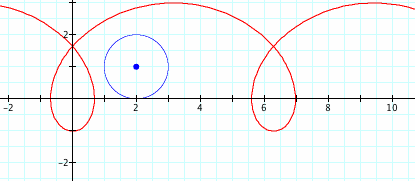
"Turtles all the way down" in physicsIn the gif you shared, the curve is traced by the sine dot going up and down on the vertical axis of the wheel, not by the dot on the circumference.
The dot on the circumference traces a curve called a prolate trochoid, ie something like this:
-
"Turtles all the way down" in physicsI think he is right. A dot on a circle spinning along a straight line traces a cycloid.
Olivier5
Start FollowingSend a Message
- Other sites we like
- Social media
- Terms of Service
- Sign In
- Created with PlushForums
- © 2026 The Philosophy Forum