
-
Logical Nihilism
A professor I had told me about a reading of Kant more in line with an Averroist "material intellect" shared by all men. That's another solution for the slide towards solipsism I suppose. And I believe it was also somewhat normative too, the constructive mind is the "mind of Europe," in which all participate and which has been so marked by Newton and modern science
Unfortunately, I don't recall the name of the person advancing it. -
There is only one mathematical object
If two things are equivalent, A<->B, does that mean they represent the same math object?
Barry Mazur has a really neat paper on this question, and at least parts of it are quite accessible. He ends up advocating (maybe just "showing the benefits of" is a better term) of an approach grounded in category theory.
https://www.google.com/url?sa=t&source=web&rct=j&opi=89978449&url=https://people.math.osu.edu/cogdell.1/6112-Mazur-www.pdf&ved=2ahUKEwjZhPfV0qCJAxW9vokEHYuQCMwQFnoECB4QAQ&sqi=2&usg=AOvVaw0j1f7DfoQP7OKuvRZ37rIU
Mathematics thrives on going to extremes whenever it can. Since the “compromise” we sketched above has “mathematical objects determined by the network of relationships they enjoy with all the other objects of their species,” perhaps we can go to extremes within this compromise, by taking the following further step. Subjugate the role of the mathematical object to the role of its network of relationships—or, a
further extreme—simply replace the mathematical object by this network. This may seem like an impossible balancing act. But one of the elegant–and
surprising—accomplishments of category theory is that it performs this act, and does it with ease.
In a very loose sense, there is a neat parallel here to Roveli's Relational Quantum Mechanics or some forms of process metaphysics. I am less hot on those than I used to be, coming around to views that still include a role for the nature/essence of objects (e.g. Aristotle, or some interpretations of Hegel—things might be defined by their relations, but they are not just collections of atomic relations, rather relations are defined by what a thing is as a whole), or Deely's Scholastic-informed semiotic view of things existing in a "web of relations," which still holds on to "realist" intuitions re essence—a "balancing act." (Well, that's all vague I know, but the paper IS interesting!)
And there is also a neat parallel to St. Maximus the Confessor's philosophy and the Patristic philosophers' conception of number, which I will perhaps return to elucidate if I have more time. But basic idea is that things are not intelligible in themselves (although they do have intelligible natures, logoi). For instance, the idea "tree" is only fully intelligible in terms of other ideas such as the sun and water that are necessary for the tree, the soil it grows in, etc. You cannot explain what it is in isolation. Numbers and figures (following the old division between magnitude[discrete] and multitude[continuous]) are included here, in that they only exist where instantiated, in minds or things, and are not wholly intelligible on their own.
This makes even number dynamic in an important sense. To be fully intelligible, things must exist in the absolute unity of the Logos (Christ as Divine Word, but due to divine simplicity we might say God as a whole as well—on this view the entire cosmos is incarnational).
Anyhow, this sort of relates back to the OP. The idea is that, yes, there is a sense in which everything must be one (i.e. unity in the Doctrine of Transcedentals), but there is obviously also differentiation and intelligibility in the many (the old problem of the "One and the Many").
Another interesting thing is how this relates to knowledge. In Metaphysics, IX 10, Aristotle distinguishes between two kinds of knowledge/truth:
-Asytheta: truth as the conformity of thought and speech to reality (whose opposite is falsity); and
-Adiareta, truth as the grasping of a whole, apprehension (whose opposite is simply ignorance).
Obviously, we follow relations discursively, through asytheta. But then it is by coming to grasp the whole (via adiareta), the principles by which these relations obtain, that we gain a more full understanding (St. Maximus gets at this in Ad Thalassium 60). Likewise, in the Arithmetic Diophantus*, although generally dealing with problems whose principles he cannot discover, makes the case that solutions are virtually present in the principles that will allow for solutions (the "many" contained in the "one," e.g. many shapes, with their own distinct quiddity/whatness, flowing from Euclid's postulates).
*Interesting bit of math trivia, Diophantus, living in the third century, seems aware of Lagrange's four-square theorem, and if he had an actual proof of it then it was effectively lost for 1,500 years (we only have some of his books). -
Logical Nihilism
I also have ulterior reasons for taking dialetheism seriously, namely Marx and Hegel. Marx's notion of contradiction I have a good feel for (but because it's more extensional it's easier to untangle Marx's notion of contradiction from the logical one by dividing wholes into parts that differ), but Hegel's continues to mystify me.
Hegel's contradiction is pretty far from most paraconsistent logics, given the unity and "development" of opposites. If you're interested though, formalization attempts have run through category theory and Lawvere is the big name here.
https://www.google.com/url?sa=t&source=web&rct=j&opi=89978449&url=https://philarchive.org/archive/CORMAA-3v1&ved=2ahUKEwjrxdPIz6CJAxURlIkEHUmyEkcQFnoECCEQAQ&usg=AOvVaw3XxnDtBEih45jE5c2zfW2d
Nlab has some stuff on this too.
I have read many commentaries on the Logic at the point. Houlgate and Wallace are my favorites (Wallace isn't quite a commentary, but he does focus on the Logic), but Taylor was useful too. Despite this and now years of effort, I find the essence chapter largely impenetrable lol. But better minds then mine might have more success. -
Logical Nihilism
It's a book, so sadly not wholly available from what I can see. Google books sometimes has a decent number of pages. There is a review by Erik Stei though and his recent book would be another example for how monists frame their own case.
https://ndpr.nd.edu/reviews/one-true-logic-a-monist-manifesto/
I have to say, I love the cheekiness of the cover.
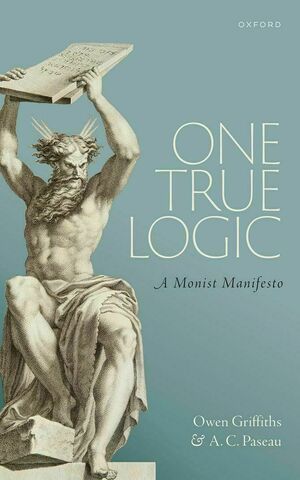
It's:
If you know something, there is no need to inquire about it because you already know it.
If you don’t know something, you wouldn’t know what to inquire about or how recognize the answer when you find it.
And how will you enquire, Socrates, into that which you do not know? What will you put forth as the subject of enquiry? And if you find what you want, how will you ever know that this is the thing which you did not know? (Plato, Meno, 80d1-4)
It sometimes gets brought up in discussions of systematic search.
It is sort of related to P = NP as well. You might be able to tell if you have a correct answer easily if you are provided with one, but finding that answer can be effectively impossible, even if you have a description of what you are looking for that is a ridged designator. -
Logical Nihilism
My intuition is that the rules which bind coming up with mathematical formalisms are the same as those which govern writing fiction. They're in general loose, murky, descriptive, but you can tell a good description from a bad one.
Yes, I would agree with this.
If I understand correctly, you're using "deflationary" to mean restricting the interpretations of a theory to all and only the ones which are syntactically appropriate and clearly within the logic's intended subject matter. Like propositional logic and non-self referential statements. Effectively removing everything that could be seen as contentious from the "ground" of those systems. Which would then ensure the match of their conceptual content with whatever objects they seek to model, (seemingly/allegedly) regardless of the principles used to form them. Which 'deflates' truth into unanalysable, but jury rigged, coincidence.
Well, as you say:
The paper gives lots of strategies for coming up with schematic counter examples to many, many things. You can come up with scenarios where even elementary things like "A & B... lets you derive A" don't hold. So much would need to be jettisoned, thus, if The Logic Of All and Only Common Principles was taken exactly at its word, in the sense of intersecting the theorems proved by different logics.
And that's kind of a knock down argument, when you consider X is true in system Y extensionally at any rate (which is AFAIK the standard thing to do)
It is a knock down argument, but it seems to miss what monists are claiming (at least from what I've seen). Or even what the pluralists say; Beall and Restall only endorse classical logic and a few sub-classical logics.
And I agree in terms of the standard, at least that seems to be a very common way to look at it in the discipline. But I am not sure it is a useful standard in this context since it seems to allow for refuting the dominant position(s) in terms in which its advocates wouldn't recognize it.
For instance, G&P frame the position they want to argue against as: "we define logical pluralism more precisely as the claim that at least two logics provide extensionally different but equally acceptable accounts of consequence between meaningful statements." -
Abortion - Why are people pro life?
This doesn't seem very hard. If the question is: "let one person die (to make it easy, assume they are 100 years old) or every woman in the early stages of pregnancy in the world miscarries, it seems an easy choice to make.
Even excluding the (potential) children themselves, a great, great many women very much want to become pregnant. Some sort of scenario (however bizarre) where they have become pregnant and would otherwise give birth but will lose the children if there isn't some sort of sacrifice isn't without moral valence.
Plus, abortion is generally not about zygotes. -
Abortion - Why are people pro life?
But you've switched the example. The example was ordering men to make a last stand where they are sure to die. That the men not retreat or surrender but instead fight to the death is the intention. -
Logical Nihilism
:up: :up: :up:
Thank you, I am glad someone else also seems to understand what the topics is about and why there is even debate. I felt like I was going insane here lol.
It is interesting that you bring up the No True Scotsman because I think the monist can often be accused of something like this.
Anyhow, this is why I think avoiding any trace of metaphysics entirely seems impossible here. The CD paper uses counterexamples that involve abstract objects almost exclusively (occasionally propositions about proofs), and people's willingness to accept these as strong counterexamples seems linked to the sense in which they can be said to "exist." CD seems to suppose that if they exist in any formalization that they "exist" in a univocal sense. I imagine monists are generally going to just deny this, because monism is about logical consequence relative to some non-arbitrary context (although which one varies).
Maybe no "metaphysical" notion is needed and we just speak in terms of "plausibility" and "usefulness" but these seem to easily become even murkier notions. The two most common versions of pluralism (Beall and Restall and Shapiro) cited have very different notions of which logics should "count" for instance. -
Abortion - Why are people pro life?
Well, presumably in virtually all cases of elective abortion the woman having the abortion isn't acting in order to have an abortion. I can't imagine the abortion is ever the end being pursued (barring your extreme outlier cases).
The intended goal will be something like avoiding poverty, not detracting from the care of one's existing children, etc.
And yes, we might rank "stop the Confederates from reaching Washington and preserving slavery for another 100 years" differently than an individual family's desire to avoid poverty, but double effect doesn't make the distinction cut and dry. -
Abortion - Why are people pro life?
I think you're right. At least in the US, the estate of a deceased person has "rights" and the executor of the will is supposed to enact the intentions of the deceased, and you can have lawsuits related to "the estate of..." but this does seem materially different. I mean, it's also about the rights of the inheritors, but they are alive. -
All Causation is Indirect
Causal analysis is pragmatically indispensable, to be sure. But pragmatics is tightly entangled with human concerns. The more one tries to objectify the story, the harder it becomes to tell in causal terms, because it then quickly collapses under the weight of metaphysically suspect ceteris paribus clauses and time-reversal symmetries that are antithetical to causation. Pragmatic considerations eliminate most of these difficulties: ceteris paribus clauses and time-reversal symmetries can simply be dismissed (or not even brought up in the first place) as pragmatically irrelevant.[/quote]
Which symmetries? Physics is time asymmetric at both the macro and micro scale, although there are time symmetric processes and "laws." Time is obviously asymmetrical in a big way at the global scale, and depending on how one views quantum foundations it is asymmetric in another way: collapse/decoherence occurs in only one direction. The latter can be interpreted in many ways though.
The reality of local becoming is still a popular, if minority opinion if physics and the philosophy of physics.
The argument then is that causation, despite it pervading our thought and practice, is not an objective feature of the world at large, in which humans are but a speck. This is not quite right, though, because we as intelligent agents could not have succeeded in this world without having an essentially accurate understanding of it. What we can say then is that causality, like regression towards the mean, is at least a good heuristic. But there is no metaphysically fundamental "law of cause and effect."
Well, fair enough on the last part. I think framing in terms of the classical "law of cause and effect," has been a dead letter for about a century. But as you say, it has to get something right, barring a sort of radical skepticism.
Pancomputationalism is very popular in physics and this would make causation a computation-like process where prior states entail future states.
I am not sure what our size relative to the universe would have to do with it one way or the other. It's not like if the universe were just the size of the Milky Way or we the size of gas giants it would change anything material. -
Logical Nihilism
I think it's ok for people to add on whatever significance they like to the word truth in truth-preserving. In the same way, if you lean toward ontological realism or anti-realism, you can add that onto whatever shenanigans you're doing. It doesn't change the shenanigans either way.
A pluralist will say that there is a certain type of logical consequence that is appropriate for a particular context. A nihilist will deny this.
A monist will claim there is only one logical consequence relationship, though no doubt they are aware that consistent logics have been constructed with other consequence relationships.
So why do you think there is any controversy here? -
Logical Nihilism
Right, which is why their position is generally something like G&P's, which is that correct logics are those which capture the logical consequence relationship at work in natural language and scientific discourse, or perhaps "preserves-truth" relative to some metaphysical notion of truth, etc.
But you have acted like this is unfathomable, so I'm not really sure what you think this debate is about. Feel free to describe what you think the difference between the three views would even be in your view. -
Logical Nihilism
Well, in virtue of what would a law be considered a "general law?" The monist says the general laws are those which hold in "correct logics," which is why they aren't forced to abandon their position on, say, LNC, due the mere existence of dialthiest systems. -
Logical Nihilism
But presumably correct logic for a monist would be only those logic s that make use of the general laws of logic, whatever they might be.
Doesn't that sound a bit tautological to you? If correct logics are just those logics that utilize the general laws then monism is true by definition.
Your understanding of each of the positions seems to make them trivial rather than controversial. -
Logical Nihilism
Appeal to popularity? So you are seeing the traction in the arguments here
No, I'm just trying to figure out your understanding of the topic.
Which is why I ask, what exactly do you think the monist is claiming? That every logical system people have created has the same entailment relation? Isn't this very obviously false? I'm mystified as to why you think this is a subject of controversy given your understanding. -
Logical Nihilism
Because what it means to be "truth-preserving" and thus a "correct logic" will depend on what is being preserved. -
Logical Nihilism
Come on. When it has a use.
Do some logics lack "a use?" Or do they all have one?
What does it mean to hold in generality?
On your understanding of this, why would monism remain the dominant position? It seems obviously false. -
Logical Nihilism
When Russell call nihilism "the view that there is no logic," do you think she is denying that any logics exist?
Am I being trolled here?
To be sure, it's not a term I would use. Logics are useful, applicable, valid, consistent, incomplete and so on, but not so much "correct".
This isn't an answer to the question though. What do you think is being meant by "correct logic" in these articles?
To clarify, this is the opening sentences of the article you wanted to discuss:
"Logical monists and pluralists disagree about how many correct logics there are; the monists say there is just one, the pluralists that there are more. Could it turn out that both are wrong, and that there is no logic at all?"
You're acting as if this is some bizarre concept it is impossible to understand though. -
Logical Nihilism
In the same way moral pluralism is nihilism? Yes
I don't think so. The pluralist says there are multiple logical consequence relationships that preserve truth in different contexts. The nihilist would be saying there is no logical consequence, or put another we "we decide which logical consequence we want to consider correct." Or, as Russell puts it: "there is no logic."
You can see the difficulty of equivocating or refusing to elaborate on what the "truth" in "truth-preserving" means here.
Truth deflationists usually think of truth as having a social function. It's just something people say. That's different from using the truth predicate in a technical way as Tarski did.
Indeed, there are different flavors of deflation. "Using the truth predicate in a technical way" isn't deflation at any rate. Deflation would involve the claim that truth just is whatever technical definition one decides to use. If one justifies STT with the claim that it "mirrors correspondence," "is the closest we can get to truth," or something to that effect, one isn't being deflationary.
To be sure, it's not a term I would use. Logics are useful, applicable, valid, consistent, incomplete and so on, but not so much "correct".
In virtue of what is a logic "applicable"?
what follows is that there are logical laws that apply within each system. What does nto follow is tha there are no logical laws.
How about this, why don't you explain to me why you think pluralism and nihilism are even different positions? And why do you think monism remains the dominant position?
So there are multiple logics?
This is an ambiguous question (which the articles shared here generally tend to point out in the introduction). If the question is "have people created systems with different logical consequence relationships?" the answer is obviously yes. But given your line of questioning this seems to be what you think the debate is about. -
Logical Nihilism
Does that mean that correspondence gets to decide between logics?
When people writing on this topic discuss "correct logics," what exactly is it you think they are referring to? If all logics are correct logics then nihilism is obvious.
Is the correctness of logic to be decided empirically?
Yes, this is why G&P refer to the challenge as "broadly epistemic." Personally, I think the correspondence theory of truth is deficient, I only use that as an example because that is how it is most often conceived of.
And it remains unclear to me why you introduced deflation into the conversation.
If you assume deflation, I don't get how nihilism isn't a consequence. Truth just is truth as defined by some system. There are systems that both define a notion of truth and variously dispense with each of the proposed "laws of logic." Ergo, there are no laws of logic. What else more is there to say? If there is a logic that dispenses with LNC, then LNC cannot be a law of logic, etc. -
Logical Nihilism
Well Beall & Restall at least have a tighter definition. Shapiro's "eclectic pluralism" is based on "being interesting." But triviality is interesting. Does this mean logics where everything expressible can be shown to be true are "truth-preserving?"
I think you need to assume deflation here for that to make any sense. If we aren't willing to go that far then we can still speak of how they "preserve truth," internally, in an equivocal sense, but that's it. -
Logical Nihilism
So, formulation doesn't cause the truth of something. It simply presents the reasoning in an arguably unnatural way. The truth of things is constrained by the facts and the state of affairs, not the way I choose to write it down.
I agree with underlined point completely. The scientific and metaphysical arguments for monism tend to be abductive arguments based on this idea. This is why deflation is problematic as a background assumption. It needs to be an explicit premise, else we end up talking past each other, since the disagreement is really about what is properly "truth-preserving" in the most perfect* sense, not about what is true of formal systems and the logical consequence relationships each uses.
As for the bolded part, I think this is something many monists, pluralists, and nihilists would agree with. Logical consequence is about truth preservation in arguments, not causation, or "that in virtue of which something is true."
Yet, we might ask, "is cause unrelated to logical consequence?" That's a common presupposition in contemporary discussions of logic. It was not a popular position for most of the history of logic though. The ideal argument is propter quid, explaining why something is true (demonstrative syllogism). Not all arguments are thought to be of this sort of course, only some.
This sort of thinking is still alive and well in relevance logic and occasional attacks on material implication.
Anyhow, I think you get at a good point, in that I can imagine that many who subscribe to "classical metaphysics" (i.e. the serious "neo-neoplatonists" today, or Thomists) might actually agree with the nihilist that laws, as in short, stipulated formulae, are incapable of capturing the logical consequence relationship because they cannot capture analogical predication of truth and being properly. But I think they would disagree in concluding that the logical consequence relationship can be either arbitrary or unintelligible as a unity. Just for an example, I don't think Eriugena's four-fold distinction of being where "to say 'angels exist' is to negate 'man exists'" (when using exists univocally) is going to fit nicely into formal context. You could add four distinct existential quantifiers related by some sort of formalism of analogy, but I don't think that's going to cut it.
* I couldn't think of a better term here than "perfect" in the sense that scholastic logic uses it. In this context, blindness is a perfect privation for a dog or a man because, by nature, these things see. Whereas we can say "non-seeing" of a rock or tree, but this is not perfect privation. The differentiation here is that truth might be said analogically of something being "true relative to some stipulated formulation of truth," but this is not true in the same way "George Washington is dead," is made true "by the world." -
Logical Nihilism
Now what do you make of this? I've understood you as saying Tarski is unavoidably deflationary, and that this is a bad thing.
As I've said repeatedly, STT need not be deflationary. It is often taking as a means of modeling correspondence truth and this leaves the door open for judging "correct logics" in terms of their ability to preserve correspondence truth not simply truth relative to some formal context.
But STT can also be rendered deflationary, and Frank has given us some sources indicating that this is more how Tarski himself considered the theory (which jives with what I've read of his work).
As for it being a "bad thing," that's an entirely different conversation. The question is: "is deflation question begging or at the very least a highly relevant and contested premise when considering logical nihilism vs pluralism vs monism, such that its implicit assumption is problematic?"
I don't see how the answer could possibly be anything but "yes." If one starts with a strong deflationary position it seems trivial to show that no laws of logic hold with generality. But monists are normally arguing for monism in a non-deflationary context, in terms of "correct logics." Monism is true for "actual truth preservation" not "truth preservation relative to an arbitrary context."
For example, G&P's target is the natural language logical consequence relation. The scientific position's target is entailment in the sciences. The metaphysical position is talking about logical consequence from the perspective of metaphysical truth.
And nihilism also seems to need to avoid deflation because nihilism is a position about logic in general or "all correct logics." If the nihilist adopts a strong deflationary position for the purposes of undercutting monism then they are guilty of equivocating when they try to tell the pluralist that there are no laws of truth preservation for logic as a whole. Deflationary nihilism is simply pluralism, the nature of truth preserving logical consequence varies by context.
But again, virtually no one wants to claim that truth should be both deflated and allowed to be defined arbitrarily. So we still have the question (even in the permissive case of Shapiro) about what constitutes a "correct logic." The orthodox position is that this question is answered in terms of the preservation of "actual truth." But we also see it defined in terms of "being interesting" (e.g. Shapiro). Either way, we are right back to an ambiguous metric for determining "correct logics," hence to common appeals to popular opinion in these papers. -
Abortion - Why are people pro life?
That's not quite right. If there were a vote in 'merca, it would be legal. And elsewhere - in roughly comparable nations - it is a non-issue. Those nations in which it remains problematic are authoritarian, so whatever consensus there is remains hidden behind ideology.
It's not an absolute non-issue. Almost all European states have a limit at or below 15 weeks for elective abortion, most at 10-12, which is a good deal more restrictive than many US states, including some conservative ones. The US is bipolar in allowing abortion at any gestational age or at 20+ weeks in several states (only Iceland, Singapore, and Vietnam have national limits this high) but also banning it in almost all cases.
Quite a few European states have gone in the opposite direction. For instance, in Estonia, where close to 70% of conceptions ended in abortion at one point, is now down to eleven weeks. -
Abortion - Why are people pro life?
Wouldn't the more pertinent issue be wills or a person's expressed desires about what should happen to their body and property after their death?
Seems to me there are obvious limits here, but there also doesn't seem to be no rights. For example, if a person spends their life trying to protect an ecosystem by acquiring land to create a nature reserve, all else equal, it seems unethical to ignore their will and sell the land off to loggers.
Now, wills are a legal issue, but their presumably a legal issue because they have some degree of ethical valance. If people's identities and rights completely vanish at their death it's not even clear why their children should inherit their estate. But "dispossessing the widow and the orphan," is one of the key things railed against as sin/wickedness in the Bible and plenty of other cultural and religious contexts as well.
Is it never warranted for military officers issue orders that are almost certain to result in the deaths of their innocent men? Suppose that the soldiers are conscripts and haven't had a choice in joining the military.
I am not sure this is obvious. The Third Reich's invasion of the Soviet Union couldn't have been repelled without these sorts of acts for instance, and so refusing to do them also essentially dooms many innocents to death. -
Logical Nihilism
Is that conclusion supposed to follow? That there are no universal laws does not deny that there are laws specific to each logic.
Yes, that's the pluralist response. Like I said, I think they can accuse the nihilist of equivocating here to the extent that their argument relies on assuming deflation. But nihilism ultimately has to be about a broader notion of truth preservation across all correct logics, else it is demonstrably false. LNC holds "generally" if we only look within one context for very many contexts, etc.
Hence my example, statements like "propositions must be either true or false" are ambiguous in a deflationary context. The answer is: "it depends, LEM and bivalance aren't universal." It's like saying "marijuana is legal," without specifying a jurisdiction, and then equivocating on the relevant context.
I don't know how to respond to the rest of what I wrote because you keep on responding to things that obviously are not what I'm saying, e.g. "This paper uses 'exists' univocally" for "I don't think logic has existential quantifiers."
I point out that STT allows for relativity in the context of discussing a paper that is almost entirely using examples of such relativity and you suppose that I am confused and referring to the level where it isn't relative.
Suffice to say, STT can be interpreted in a deflationary manner and was developed with that in mind. If the point in question the existence of a general logical consequence relationship applicable to truth preservation vis-á-vis science or to metaphysical truth it is question begging to assume deflation.
It is maybe worth pointing out that if someone proposes a new logic, they are obliged to set it out for us to see it, and we can judge it's consistency within itself, as well as its applicability to various situations in comparison to other logics.
Either all logics are correct logics, in which case nihilism is "true" but truth becomes essentially meaningless or there are just some correct logics. Since many people are not willing to embrace the former (full deflation, truth is arbitrary) they need some criteria for deciding which logics are correct. So, we are back to ambiguous definitions anyhow, we've just obfuscated this fact. -
Logical Nihilism[
This seems like a useful clarification of terms. Where I have seen the term used, and how it is used in the papers we have been discussing, the idea is that there is no logical consequence relationship. It is not that there is no general consequence relationship that obtains in all cases. The idea that there are truth-preserving rules of logical consequence but that they might vary is called logical pluralism.
This is why deflationism is question begging. You can set up the argument like so:
1. Truth is defined relative to different formalisms.
2. Different formalisms each delete some supposed "laws of logic," such that there are no laws that hold across all formalisms.
3. The aforementioned formalisms each have their own definition of truth and their systems preserve their version of truth.
C: There are no laws vis-á-vis inference from true premises to true conclusions.
A deflationary pluralist could well say this equivocates between "truth tout court" (which doesn't exist) and qualified truth relative to some system, and that the nihilist is just a deflationary pluralist with an edgy name.
The non-deflationist of any variety can say the entire argument hinges on the premise of deflation and that we are only speaking of "correct logics," which preserve truth qua truth, not a stipulated truth condition that is defined arbitrarily.
What if there were several puzzles mixed up?
Sounds like pluralism. You need to find the structure of each discrete puzzle.
Nihilism seems more to me like we all have wood blocks and jigsaws and we can cut out whatever we please. Which, as an analogy for "how does one derive conclusions from true premises," seems like a poor one if one has any notion that truth is not some sort of post-modern "creative act." -
Logical Nihilism
Well, logical nihilism is not the position that true and false are always relative, it's the position that nothing follows from anything else. It is certainly easier to argue for it if truth is relative, but it's the claim that truth cannot be inferred. You could presumably claim that there are absolute truths, just not that there is anyway to go from one truth to another.
In terms of a puzzle analogy, this seems more like claiming the pieces don't fit together, in which case it doesn't even seem like a puzzle any more. -
Logical Nihilism
If you have university access you can read Susan Haack's article, which lays out explicitly how we know Tarski did not see himself as offering any definition for truth in natural languages. Just Google Haack on Tarski.
:up:
Yeah, as I mentioned, I recall reading somewhere where he says truth in natural language was "meaningless," but I wasn't sure if this was a later position. So this would make sense to me.
So, STT is originally/intended to be deflationary I guess, which jives with how it is often used. -
Logical Nihilism
Either way, what I'm hoping to convey is that logical theories like Russell's are attempting to accommodate any metaphysics of truth -- else it would be begging the question on truth.
Well there I wholeheartedly agree. However, the thesis that there is no truth preserving logical consequence is necessarily going to be at odds with many conceptions of truth. What is coherence truth of nothing follows from anything else?
The difficulty here is that the strongest arguments for nihilism, or at least the most popular, implicitly deflate truth. -
Logical Nihilism
It doesn't model correspondence theory
That's how it's generally been interpreted and how it was originally presented, but yes, I agree, it need not be interpreted that way and often isn't. -
Logical Nihilism
You're telling me I don't have to keep consulting my truth tables for statements like "P"? :rofl:
I don't think it's redundant in the context of trying to model correspondence though, since it's saying "the sentence P is true if what P claims is actually true." The claim and what makes the claim true are (often) distinct. But perhaps we should instead say something like: "S(P) iff P" However, it seems problematic for correspondence truth if logical nihilism is the case and there is no logical consequence relationship, such that P cannot entail S(P).
Of course, the history of philosophy is full of challenges to the correspondence formulation as well. -
Currently ReadingI started Taylor's "A Secular Age," but it's quite long so I'll see how long it takes me. I do find such historical treatments interesting though, and I agree with the thesis that "modernity is just sloughing off superstition and cutting away useless custom" explanations of the emergence of secularism leave much to be desired.
One of my favorite!
Is it any good? I have liked some of DBH's books, others I found a bit plodding. -
Logical Nihilism
This is simply using unclear terms. It's "P is true in L iff P is true in L." Whereas "P is true it and only if P," would simply be meaningless or ambiguous.
It's a sort of relativism. Perhaps not a pernicious sort in its original context, where the idea was to model correspondence, but the very paper we're discussing turns it into a cultural relativism of "communities."
Shapiro's eclectic pluralism says a logic is correct so long as it is useful for any "interesting" application. Trivial systems are interesting though. I assume the bar for "interesting" must be tightened up somewhat so it isn't the case that "correct logics," that is "logics that preserve-truth," are inclusive of those that show that anything expressible is true. -
Logical Nihilism
First , I didn't say formal logic ignores being I said the arguments in the paper use "exist" univocally in a way that makes them facile.
Second, there seems to be a pretty strong abductive argument for "there are many cases where truth does not depend on how we choose speak."
One of the benefits of STT is that is based on notions of correspondsnce truth, and it is certainly often used it with the idea in mind that there is a "real truth." However, stripped down to mere form and taken alone as the final word on the issue it is relativistic. IIRC, Tarski claims truth is "meaningless" outside formalism. If we accept this, not as a useful tool, but as a claim about truth tout court, what exactly makes STT a better theory of truth than any other? Can it be truly better? True relative to what, itself? If we say its more useful, we might ask "is it truly more useful? Truly more useful relative to what? Why not any other theory that might justify itself?
If I am candid, it seems to me that your fears are ill conceived and unfounded
Well, that makes sense if you read the post as "I don't think logic has existential quantifiers." -
Logical Nihilism
On deflationary accounts, “all that can be significantly said about truth is exhausted by an account of the role of the expression ‘true’... in our [speech] or thought,” and we might add formal systems here. Thus, notions of truth are neither “metaphysically substantive nor explanatory.”
This is clearly going to be a problematic background assumption to have going into an analysis of a metaphysical case for a single entailment relation applicable to being.
I guess the obvious question is, if you know what truth is, apart from formal systems, then tell us. Otherwise, it seems to me that we could do far worse than Tarski's account of truth in terms of satisfaction.
Ah, but this is perhaps the cardinal sin of contemporary philosophy! "X is difficult to define or account for, let's eliminate it." We've seen this done with Goodness, Beauty, Truth, meaning, and finally, in eliminitivism, our own consciousnesses. What philosophy worth doing shall be left?
Not to mention, consider this same question on other finicky definitions, such as "life." We might very well run with some sort of formal definition for expediency on some issues, but it clearly won't do to for others. A bad definition can be worse than an ambiguous one.
Now I get, the metaphysical and scientific sections are just two parts of the article. It's too much to expect a deep dive into different theories. But just consider a very influential one, Aristotle. For Aristotle, "being" is said many ways, but it is said most primarily of substances. Mathematical entities aren't substances. They don't exist simplicitier, but with qualification. So obviously the arguments in those sections that use "exists" univocally throughout are problematic, particularly since this is hardly unique to Aristotle, but common, I would guess, to most thinkers.
It doesn't seem that different from looking at contradictory stories told about superheros, saying both "exist" and declaring an exception to LNC. This is missed if one supposes that we're talking about a blanket prohibition on "a and not-a" as opposed to a prohibition on something actually being and not-being, without qualification.
As a side note, while I know the example of different mathematical objects is intuitive, but I am not sure if a lot of these even require different entailment relations. -
Logical Nihilism
I've seen that paper before. I give it credit for at least addressing the issue of metaphysical truth, but it is a prime example of implicit question begging re the deflation of truth. "Truth just is something to do with formalism, and how can you pick between formalisms? According to which one is true? Well, you have to use a formalism to discuss truth, and different formalisms say different things."
The background assumption throughout, and what the arguments routinely rely upon, is that truth is simply formalism.
What is wrong with the standard answer? Even if ‘the Goldbach Disjunction is a logical truth’ is determinately and unambiguously true out of our mouths, it is not true out of another possible community’s mouth.6 They may use ‘logical truth’ to mean, say, intuitionistic validity. Goldbach’s Disjunction is not an intuitionistic validity. So, there are two relations: validity Us and validity Intuitionistic.
There is no dispute that both relations ‘exist’ if either does.7 The only dispute is about which of these we happen to pick out with ‘logical truth’ (or about what is packed into the concept of logical truth that we happen to employ). The monist and the pluralist, understood in the standard way, agree on the non-semantic world. (Indeed, one could make classical logic the One True Logic, in the standard sense, by indoctrinating children with the classical truth tables!)8
Of course, it is often of metaphysical and methodological import what a sentence is about. The fact that another possible community means ether by ‘dark matter’ hardly undercuts the interest of the debate over dark matter. But the logical case is not like this. It is more like the case of pure (rather than applied) geometry. Hyperbolic lines exist if Euclidean lines do, qua pure mathematical entities. So, all we would learn in deciding ‘’whether the…relations so defined agree…with the pre-theoretic notions’ would be something about ourselves. We would just learn which line-like things we happened to refer to with ‘line’... The only factual question at stake is what we happen to mean by ‘valid’. If there were a (meta)logical analog to the question of which geometry is true of physical spacetime, then the logical case might be like the dark matter case...
...But the choice of (meta)logic under which to close cannot itself be made on the basis of the physical facts. We need a metalogic to state them in the first place! For instance, do they include that either there are gravitons or that it is not the case that there are gravitons (or the denial of the 15 claim that there both are gravitons and are not gravitons)? It depends on whether the Law of the Excluded Middle (or Noncontradiction) is valid
But what's good for the goose is good for the gander. This is exactly the same charge leveled at pluralists by G&P. "Show pluralism is the case in your correct logics," or more strongly "show us it's the case in all of them. We think you'll find that quite impossible"
The response from Shapiro and others is, "well, the argument for pluralism is abductive." Fair enough (although G&P still point out that abduction involves deduction). But it's hard to think of a thing it is easier to make a strong abductive argument for then "things can be actually true, not just true as respects an arbitrary formalism." How do you choose between logics in this respect? The issue is epistemic, it cannot be handled by formal systems, at best they are an aid. And this is demonstrated that whenever the author wants to bring up a case of apparent conflict, they always resort to examples from formal systems, even when discussing the metaphysical view.
"The Goldbach Disjunction is a logical truth" and the like are simply ambiguous. They are claims about stipulated sign systems without reference to which system. I think the retreat into formalism covers up the obvious here. If bishops could move to the left in Pakistani chess, we could say the truth of "the bishop cannot change its color" is ambiguous and varies with context. Different systems, different logical truths. But the issue here is simply that the term "chess" is unclear.
This is not the case when we move to "all men are mortal," which isn't situated in a stipulated system. If we ask, "what does being mortal actually entail?" then "it depends," is hard to swallow as a good answer. So, the case the pluralism has to make in this respect is that there is no one intelligible pattern unifying the preservation of truth vis-a-vis this sort of (metaphysical) truth.
The study of form cannot tell us about things like "all men are mortal," but this doesn't mean that what constitutes a correct logic is unrelated to them since we care about "truth-preservation," not "truth-preservation relative to x formalism." -
“Distinctively Logical Explanations”: Can thought explain being?
IMO, Rorty offers a much stronger critique of a particular modern view of "objectivity" than a positive case for considering all uses of "truth," "dependence," or even "objective" as "old epistemological honorific."
The argument always felt to me like:
A xor B
Not-A
Thus, B
But we can simply deny the premise "A or B," because we have C, D, E, etc. Plus, there is the issue of accepting B seemingly allowing for "A and/or B, your choice!"
Count Timothy von Icarus

Start FollowingSend a Message
- Other sites we like
- Social media
- Terms of Service
- Sign In
- Created with PlushForums
- © 2026 The Philosophy Forum