
-
Mutual relationship between Idealism and Materialism.Are you claiming to have even any understanding of the second of Wick's paragraphs you've troubled to provide If you do, you're a better man than I am. My impression at the moment is that he must be being paid by a combination of syllables per word, obscurity, nonsense, and the density thereof. — tim wood
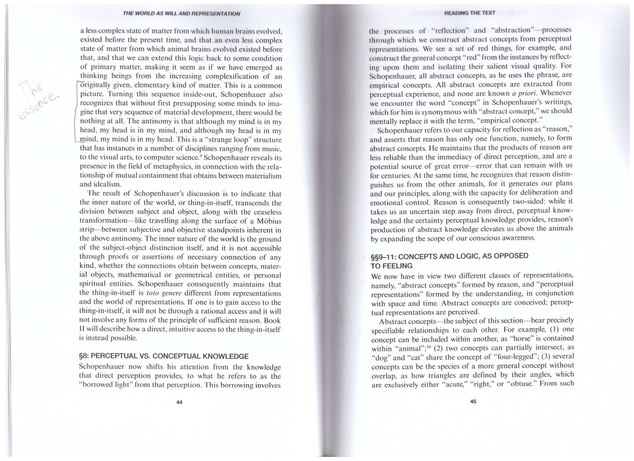
Here a pic from the Wick's book to give you more content:
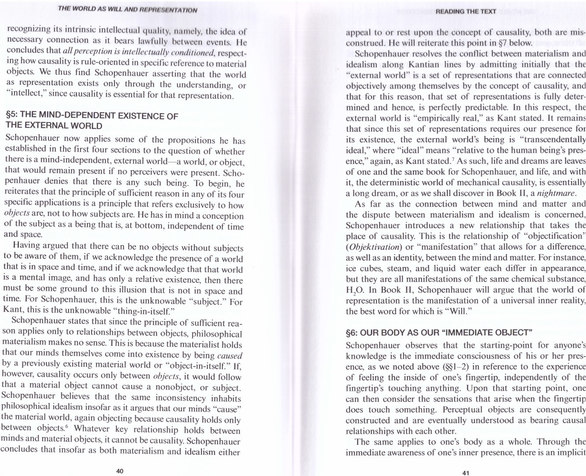
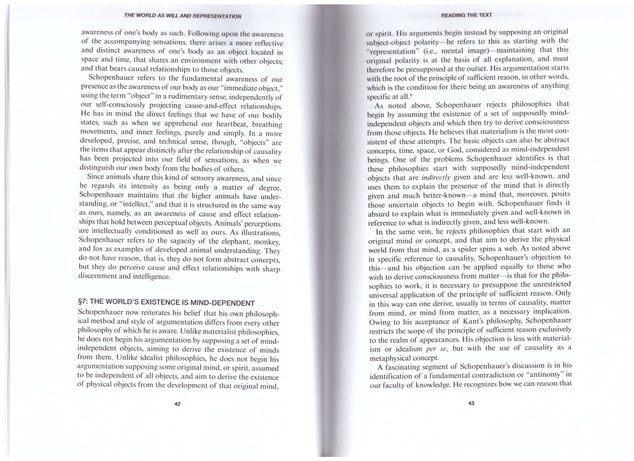
Now this I think I understand: it amounts to this: your idea of a brick is not a brick, and if you want access to the brick (in itself as it is in itself), it won't involve the principle that "nothing is, without reason." — tim wood
Yes, preliminarily that's the idea. But, Schopenhauer isn't a subscriber to transcendental idealism. He stipulates that the Will is manifest in all living entities, including nature. -
Mutual relationship between Idealism and Materialism.Second: the ideas of mind and and matter (head) have to be carefully defined and laid out. Michelangelo's David, for example, is just stone, yes? The mind, then, that rises out of matter is just matter, yes? — tim wood
Yes, but, for the sake of discussion we are talking about sentience or consciousness.
And your author's "strange loop structure" seems language on holiday. Until and unless you can add more of Wick's idea that develops it a bit more, I'm compelled to dismiss it for lack of substance (for the moment). — tim wood
He does go on to say the following:
The result of Schopenhauer's discussion is to indicate that the inner nature of the world, or thing - in - itself, transcends the division between subject and object, along with the ceaseless transformation - like traveling along the surface of a Mobius strip - between subjective and objective standpoints inherent in the above antinomy. The inner nature of the world is the ground of the subject - object distinction itself, and is not accessible through proofs or assertions of necessary connection of any kind, whether the connections obtain between concepts, material objects, mathematical or geometrical entities, or personal spiritual entities. Schopenhauer consequently maintains that the thing - in - itself, is toto genere different from representations and the world of representations. If one is to gain access and it will not involve any forms of the principle of sufficient reason. — Robert L. Wicks
What do you think? -
Mutual relationship between Idealism and Materialism.Clearly we can say that your brain is in your head, but not that your head is in your brain. — Janus
No, that would be nonsensical. To say that your mind is in your head and your head is in your mind seems like a legitimate linguistic expression. Is it?
Does that mean its existence is dependent upon your experience of it? — Janus
Yes, it is. Again, the subject/object divide crops up and is in a constant state of perpetuity when we have an observer observing their own behavior. -
The voice in your headThe voice is your mind (whether consciously or subconciously prompted) 'thinking' out loud. The listener is your awareness, which is separate. — Tim3003
Interesting. I take it that the goal of Buddhism, Zen Buddhism, and others is to quiet down the mind and focus on the awareness part or listening part. Do you know where I can read more about this? I am quite interested in this view of matters or taking this perspective. -
Music as a Form of Communication?We learn how to identify a melody, and whether it is a happy or sad melody; we learn how to recognize a rhythm; we learn how to recognize harmony; we observe the tempo, the timbre of the instruments and voices, and so forth. We learn that certain melodies, rhythms, tempos, and instrumentations have certain uses. — Bitter Crank
Chicken or egg? It seems to me that we come to know "emotive content" before we come to learn it's an effect on other people and thus affect in ourselves, through learning. Something hardwired or baken in already from birth.
An Irish jig or a polka wouldn't be appropriate at a funeral. A dirge wouldn't suit a wedding. A military march might not fly at a peace conference. — Bitter Crank
Yes, it might not be "appropriate" in some socially derived sense; but, why that so seems to be the question.
The meaning of music isn't natural; it's a human invention, pretty much, and it's a physical thing. The fact that we have two feet and not 5 makes marches and polkas what they are. We can only sing so high and so low, and one can hold a note only so long. If we didn't have fingers, the piano (harpsichord, guitar, flute, bassoon, etc.) would not exist. Our ears can only hear a range of sounds, and our bodies can produce movement (on a keyboard, for instance) only so fast. — Bitter Crank
I disagree. I think it is something that is Platonic. Why do we still appreciate Mozart, Chopin, or Bach to this day? It evokes a sense of aesthetic appeal through emotion or nostalgia further through quite unknown means... -
Music as a Form of Communication?Music has evolved so much. If I'm not mistaken, it began with songs sung by our ancestors. Then came along instruments. What followed was a combination of the two. Have I left anything out. — TheMadFool
Yes, you have left out the harpsichord organ, and the piano!
Regarding music and its relationship with us, I'd like to say it began as an expression of emotions. — TheMadFool
Yes, indeed. We seem to have some sort of output in terms of the need to express emotions and feelings.
But then it evolved and a lot of songs these days have congitive content. Some songs are philosophical, others political, etc. — TheMadFool
But, for the sake of argumentation and simplicity, then we experience only melodies and instruments.
Combing logic with good rhetoric is very hard to come by. Don't you think? — TheMadFool
Yes, that is possible. :) -
Music as a Form of Communication?Music does communicate, but we have to learn its language. — Bitter Crank
How? If math is the language of the universe, then what's music the language of?
Wonderful piece of music by the way. -
Naming and Necessity, reading group?Definite descriptions can be rigid designators, and Kripke acknowledges this. However, ordinary descriptions used in natural languages are typically not. — Snakes Alive
Where does he acknowledge this in Naming and Necessity? Quite interested. -
Music as a Form of Communication?Something I have noticed on these forums is the fact that posters often end their post with a poem or music. What is trying to be conveyed here when you end a post with a poem or piece of music? Is it a sign of sophistication or rather an attempt to appeal to emotions to "get the message across"? What is being conveyed to a poster when you end a post with a piece of music or poem?
I have never been musically talented or learned an instrument, although I would like to learn the piano. I'm also quite poor at picking up the deep nuances of poetic art. Am I missing out on something quite deep and profound? -
The voice in your headWhat do you mean by a 'performative contradiction ? — Amity
Well, that might not entirely be a performative contradiction. What I meant to imply is that the self seems to be a unitary entity. When someone speaks about oneself, it's usually in the singular and not plural in ordinary language. So, I thought that talking about having 'multiple selves' as a performative contradiction if you assume this unitary stipulated definition of the self. -
The voice in your headThere is more than one self. — Amity
Isn't that a performative contradiction? -
The Chinese Social Credit System?Just some tangential thoughts, but if you combine this social credit system along with China aggressively pursuing Generalized-Artificial-Intelligence, (there's a 50/50 chance they'll be the first to it), you have something straight out of a sci-fi novel. They're really on another level.
-
The Chinese Social Credit System?It's the Chinese government that I detest. — andrewk
Hasn't it been pretty uniform in manner and policies since the ruling of the communist party? I'm not very informed about the political science of China since Mao. -
The voice in your headAnd are you still wallowing in your bed? — Amity
Always.
Context matters. — Amity
There isn't much to provide.
Tell me more about 'the voice in your head'? — Amity
It's anyone's inner voice. But, there's some sort of duality here. When you read this text, don't you "hear" yourself reading it to yourself? That inner voice. I do. The part I'm interested in is the part of you that does the listening to hear that voice. What do you make out of it>? -
The voice in your head
I can "hear" your voice when I read your response. Every time I read a book or anything in language I have a voice in my head reading it aloud to me. There's a technical term for it in psychology or cognitive science which I can't find at the moment. Sometimes I engage in a dialogue in my own head when doing philosophy.
But, in all this there's a part of me that listens to this voice in my head. What is it? -
Naming and Necessity, reading group?
I'm confused creative. What's the problem with first person reports and third person descriptions here? -
The Chinese Social Credit System?It is yet another instrument of the police state. — andrewk
So, I take it you don't like China. Many people don't but I'm more inclined to take a step back and ask is a social credit system a necessary evil? Banks already have a credit rating system. -
Naming and Necessity, reading group?
Well yes, to an observer. But this is trivially true and the author didn't seem to state otherwise. -
Naming and Necessity, reading group?Your point? — Banno
Not to confuse the meaning of a description for rigid designators. The two co-exist; but, can differ in meanings in other possible worlds, de re. -
Naming and Necessity, reading group?
It’s important here that ‘one meter’ is not introduced as a synonym for ‘the length of the standard meter bar.’ If it were, it would pick out different lengths in different possible worlds. Rather, it is introduced as the name for a particular length, the same in all possible worlds. We identify this length by pointing to the standard meter bar. The meter bar serves to fix the reference of ‘meter’, not to give its meaning. Compare: I hereby dub the island we’re standing on ‘Newlandia’! When you move on to a new island, Newlandia is still the name of the island you were originally standing on. ‘Newlandia’ does not mean ‘the island I am standing on.’ So, it seems to be knowable apriori that the standard meter (if it exists) is 1 meter long, even though this is a contingent fact.
What then, is the epistemological status of the statement ‘Stick S is one meter long at t=0 ’, for someone who has fixed the metric system by reference to Stick S? It would seem that he knows it a priori. For if he used stick S to fix the reference of the term ‘one meter’, then as a result of this kind of ‘definition’ (which is not an abbreviative or synonymous definition), he knows automatically, without further investigation, that S is one meter long. On the other hand, even if S is used as the standard of a meter, the metaphysical status of ‘S is one meter long’ will be that of a contingent statement, provided that ‘one meter’ is regarded as a rigid designator: under appropriate stresses and strains, heatings or coolings, S would have had a length greater than one meter even at t=0 . [NN, p. 56]
By rigid designator, Kripke just means that it denotes the same thing (here, the same length) with respect to every possible situation. Other examples? ‘I am here.’ ‘I am thinking.’ ‘I am this tall’ (putting your hand on your head). — John MacFarlane -
Naming and Necessity, reading group?
Today, a meter is defined as the length of the path traveled by light in vacuum during a time interval of 1/299,792,458 of a second. A second is the duration of 9,192,631,770 periods of the radiation corresponding to the transition between the two hyperfine levels of the ground state of the caesium-133 atom. So in effect, we have substituted the caesium-133 atom for the standard meter bar. The same points could still be made, but we’ll stick with the meter bar for simplicity. -
The misery of the world.I think charity is limited to addressing symptoms of a problem and not the problem itself. Would you agree with this @DiegoT
-
The misery of the world.You may think I´m Mr Scrooge, but actually I´ve been a volunteer in the past with Cáritas, Manos Unidas, green groups, and helped people I did not even know. I´ve also been on the receiving end of charity when I was in dire straits. But precisely those experiences taught me that there was a much more ethical and healthy way to act in the world. — DiegoT
Bravo. Kudos for your contributions and being a realist. :praise: -
Naming and Necessity, reading group?So, it is a rigid designator. — Snakes Alive
I feel as though this is just changing the axioms or premises for the framing condition to only "actualize" a certain fact into a framing condition for all possible worlds, hence rendering a description as rigid. Nice, technicality though.
This would be trivially true in a logical space that you had control over, such as the logical space of a computer or artificial language. But, you can alter the software and not the hardware of a computer, so there are limits to this concept also. A Turing machine would be a good example, to your point no? -
The misery of the world.Are your universities also free? In fact only the UK is comparable in tuitions to the US. — ssu
If this answers your question, then credit has made this issue redundant. Although, as far as I'm aware, credit cannot be discharged even through bankrupture in regards to student debt. So, moot point on my part. -
Naming and Necessity, reading group?A description can be a rigid designator, if its descriptive material happens to pick out the same individual in every world. — Snakes Alive
Yeah, so my point seems to be that descriptions or more aptly states of affairs are as important as individuals, as individuals cannot exist without descriptions of their states of affairs. I don't like the hard line being drawn between the two. You can have both co-existing, and drawing a hard line tends to make people confused about what's being talked about.
using a technical device like a modal actualizer, so that "the actual, current president of the US" picks out Trump in all worlds. — Snakes Alive
Can you expand on this "modal actualizer" thing?
For the most part, descriptions made use of in natural languages are not rigid designators. But this is a contingent, and so interesting, fact about language. In constructing an artificial language, there is no problem with constructing rigid descriptions. — Snakes Alive
Interesting. I have no idea what a language with contingent properties being rigid designators would even look like. Do you have an example in mind? -
Naming and Necessity, reading group?Yes, but we can only imagine possible or counterfactual states of affairs as involving actual particulars and individuals. — Janus
This isn't necessarily so. Or is it, according to Kripke?
'What if that house had burned down' is not the same as 'what if that house had never existed'. — Janus
Well, I tend to take quantification of particulars (like the house) as representative of assigning them a name in the structure of the world through adhering to treating circumstances and states of affairs in logical space.
There must be some minimum of actuality in our counterfactual imaginings or it just becomes 'what if everything had been different' and then the whole notion of counterfactuality is without any reference to actuality, and hence becomes meaningless. — Janus
So, we're getting into metaphysics. I think, that we can treat any state of affairs, as tantamount to a 'name'. Just, that the de-re/de-dicto assertion crops up when speaking about existential quantification from a birds-eye perspective or from a particular individual. -
Naming and Necessity, reading group?So the man who won the election is a rigid designator only in the actual world... — Janus
Yeah; but, quantification can occur across possible words, so meta-logically you could even have states of affairs as obtaining (not instantiating) for all possible worlds. This is where I think, the cart has been placed in front of the horse. We should treat possible states of affairs and descriptions as ontologically above particulars (clumps of things) and individuals. -
Is it immoral to do illegal drugs?Not before they've had a bedtime story and a kiss good night. — S
Okay... Haha. -
Naming and Necessity, reading group?A description can be a rigid designator, right? The man who won the election can be a rigid designator. — frank
That's actually a good question. Does anyone want to address it? -
Is it immoral to do illegal drugs?"Unhealthy, therefore immoral" is about as good an argument as "Illegal, therefore immoral". — S
But, we're talking about validity, so arguments can rest now. -
Is it immoral to do illegal drugs?Except I said nothing whatsoever about validity. — S
Great, so maybe we can talk about validity(?) Is it healthy to be a drug user? Again, the consensus seems to point towards a flat 'no'. -
Is it immoral to do illegal drugs?Given that there are flat-Earthers, saying that "The Earth is universally considered to be spheroid" is wrong, isn't it? It doesn't matter how invalid or "proven wrong scientifically" they are. It would still be false to say that "The Earth is universally considered to be spheroid." — Terrapin Station
That's not even an argument, is it? Sure, I can hold the belief that Earth is flat; but, that just doesn't make it so. -
Is it immoral to do illegal drugs?No. Nothing - or maybe next to nothing - is universally accepted, and this is certainly no exception. — S
Forgive me, but you sound like one of those flat-earthers that insist that their opinion is valid even if science proves them wrong countless times.
What you're talking about is not an uncommon opinion, but not an opinion that is shared by everyone. — S
It's shared enough by my dealing with hearing about how meth destroyed lives or how heroin broke families apart.
These opinions can be contagious, but unless you've experienced it yourself, you can never know what it's like to the full extent, and sometimes that experience can turn out to be different in ways than what you might expect or have been lead to believe. — S
Actually, it's not a personal opinion. I am currently in a substance abuse program at my county clinic to address my own addiction stemming from the fallacious belief that I know what's best for me(!), when in fact it was a really bad idea.
Okay, good idea. So let's be clear that drugs are drugs - a physical substance - and considerations are considerations - something like a judgement in this context. You won't find "badness" under a microscope, no matter how hard you look. — S
Yeah, sure it's just a drug until consumed, which them alters your mind in unpredictable ways. In ways that might not be in your best interest. -
Thank you.
-
Thank you.unenlightened gets thanked by name and he’s not even a moderator whereas jamalrob, Baden, and above all I get passed over as if we don’t matter. :groan: — Michael
Unenlightened does a lot of undercover moderating. He's like the heavy water in nuclear reactors that prevents it from melting down.
Shawn

Start FollowingSend a Message
- Other sites we like
- Social media
- Terms of Service
- Sign In
- Created with PlushForums
- © 2026 The Philosophy Forum