
-
The Ultimate Question of Metaphysics
Well this is likely the ultimate metaphysical question, the biggest of them all. Many perspectives can be given.
The best I can do is, we are not equipped with the correct apparatus to clearly understand why something is less problematic than nothing - at least for nature.
So here we make the usual mistake of attributing issues that arise in the mind to nature, that are not a problem for nature. -
Is there an external material world ?I'd like to add here, though I maybe already said it: what is gained by saying "material" in between "external world"?
Does it add anything that is not a distraction from a more problematic issue? Because we are now discussing some version of materialism, instead of the world. -
Ukraine CrisisRussia and Ukraine near to grain export deal: UN, Turkey
https://www.aljazeera.com/news/2022/7/13/russia-and-ukraine-near-to-grain-export-agreement-un-turkey
That's a bit of good news, given the horrors here. When this will end, who knows. But it's still on going, it's been way too long and way too dangerous. -
What is mental health according to Lacan?I went down that rabbit hole for about two to three years, and could salvage very little information of value. But, I do have a tendency to really dislike willful obscurantism, which Lacan recognized. Having said this, I can tell you what I could salvage:
He's not clear on any topic. Some Lacanian psychoanalysts even go as far as arguing that a person with a drinking problem may do well to continue drinking or that "anxiety" is the one emotion that does not lie. Why? It's not argued for.
The best sources I found on Lacan were Using Lacanian Clinical Technique by Phillip Hill and the various books on Lacan from Bruce Fink, especially A Clinical Introduction of Lacanian Psychoanalysis.
I hear that Lacan's published seminars are easier to understand than his Ecrits (his main work), but have not read them. Many were not published when I was into his thought back in 2011 or so.
Finally, the best Lacanian, by far - and even he has problems in his scholarship (bad sources, makes up information, etc. This is documented) - is Žižek. He is entertaining and sometimes says interesting things. His lectures (of which almost all) can be found on YouTube, and are superior to his books.
His documentaries on films are interesting. Take them with grains of salt.
I know that doesn't answer your question and I would recommend you listen to a few of Žižek's lectures and call it a day, as I've seen people go down the Lacanian rabbit-hole and never come back.
I hope your experience on this end up being more useful than mine. -
James Webb Telescope
Thanks for sharing!
What an amazing, amazing achievement. One can only be in awe of these images. -
How to do philosophy
There's a lot of territory covered in your post, much of it of high quality. But I'm unclear on the main question being asked.
These answers obviously will vary depending on which school of philosophy you believe is on the right track, phenomenology will differ from analytic philosophy which will differ from strands of continental philosophy and so on.
An even bigger problem is that we have to assume the apparatus that allows us to have knowledge (modes of understanding, realized in the brain, stimulated by the environment) is itself not explainable. We have to assume that our mode of understanding must be right in different circumstances, without giving it a foundation which we are able to account for.
Many of these questions seem to me to be well argued for by Hume, who says, that despite our ability to cast very serious doubts on the most evident things, we have no choice but to postulate them. What nature causes us distress through reason, nature too relaxes our doubts. -
James Webb Telescope
It's insane. Finally we are getting the images after several months, I think they are going to share 4(3?) pics tomorrow.
Can't wait to see what new things they discover. -
The Interaction problem for DualismThe interaction problem boils down to defending monism or pluralism.
The monist can ask "what is gained in saying that there are multiple properties that are so different such that they are incompatible? Would we say that the "hearing capacity" is ontologically distinct from the "seeing capacity"? This isn't an ontological matter, but an epistemic one.
The pluralist can ask "what's the point in trying to categorize all these different properties under one heading, when so many properties are obviously different from each other?" The hearing capacity is radically different from the seeing capacity: there is an unexplainable interaction happening here.
However, to single out mind over, say, gravity or electromagnetism, is anthropomorphic. While it is true that without experience we wouldn't be able to discover anything about nature, the same would be true if the world lacked gravity: we would not exist.
Having said this, I prefer monism. We simply do not understand how experience and matter (and much else) could be compatible with one another, yet they are. -
Currently ReadingThe Mental Life of Modernism by Samuel Jay Keyser
The Patient's Secret by Lorenth Anne White
Keyser's book is extremely interesting, very provocative and suggestive of our mental makeup, would definitely recommend for people interested in how the arts and innatist philosophy of mind interact. -
What's your ontology?
Sure man, it's something that took me (and continues to take) time to figure out. One may disagree with a lot of what the positivists believed in, but clarity in language use, ends up being important, otherwise one starts to say things one doesn't clearly believe.
I have nothing against science, it is the greatest intellectual achievement of human beings. But with that, you get a lot of things masquerading as science or exaggerating the expertise of certain professions.
I think one should be on guard in these situations.
:victory: -
What's your ontology?
It's merely a matter of emphasis: I would add that picking out a TREE by the features we pick out it by, is very curious. We don't, for instance, consider the dirt the tree is on to be part of the tree, but nothing in nature should prevent us from doing this.
Having said that, yes, you are right. It is an interesting fact about the way we do science, that we do manage to extract very particular information about specific configurations of matter, and discover all kinds of stable relationships between members of the same group of thing. So I think your point is a better illustration than mine.
I know it sounds like stoner talk, but it's nonetheless intriguing. -
What's your ontology?
Yes, and this is quite an interesting case you point out. I'd even argue that this is even slightly more philosophy than science, in so far as we are using concepts to stipulate a class of objects in nature as being different from each other, which we then categorize as TREES, ROCKS, FLOWERS, and so on.
After we do that (and it's done virtually automatically), we can begin to do the more refined empirical work which science deals with such as, what is this rock composed of or what biological phenomena interacts with this tree such that the tree has X and Y property, and so forth. -
What's your ontology?I am not evading anything here, I'm replying to what I think you're asking, by giving you answers that approximate what happens in my experience, that and trying to be as clear as I am capable of being, is all I can do in these conversations.
We may differ in our experiences and our intuitions and that's fine.
In your interpretation of the above examples, "good" or "useful" are not sufficiently specific, and I think you know that. — ucarr
Which is why I said the word "science" can be used in various ways - as it is in fact used.
The emphasis is upon logical, focused efficiency in getting to the goal. This definition is much closer to the scientific method, and thus the examples are not loosey-goosey applications of what "science" denotes. — ucarr
If that is what you take the scientific method to be, OK. I wouldn't disagree that it has those components, but clearly the results and depth achieved in physics are very different from the results achieved in sociology.
You give no reactions to two important words I used. "Claims," formally speaking = proposition. "Inquiry," formally speaking = experimentation. The formal versions of the two words, as you know, are firmly rooted within science. — ucarr
No, I did not know that the "formal versions of the two words... are firmly rooted in science". I don't know what this means.
So if I claim that Putin is a war criminal, I am making a scientific proposition? It seems to me I'm giving a moral opinion, to which, I'm sure many people would agree, and other would not.
If I inquire into the causes of the invasion of Ukraine or the invasion of Iraq, I am doing experimentation? That's sounds strange to me.
My hunch is that you wish to avoid committing to a position that says humans conduct inquiries culminating in claims that are emphatically non-scientific.
I make the above conjecture in relation to. . . — ucarr
If you read what you quoted, I never said that the work done in international relations (IR) is "non-scientific".
It can be good research or bad research, and you may call it "scientific" if you wish.
I hesitate to call work done in IR as "scientific", not because there isn't good work done in the field, I think there is, but because most of it, especially the "theory" division or IR, is pretty awful and has virtually no relation to what happens in the world.
So if I say that IR is "scientific", I think that lowers the achievements of physics and biology. But it does not follow that if something isn't science it's bad or irrational.
If you think elementary particles & their interrelationships are simple, it must be the case you've merely glanced at studies of these phenomena. — ucarr
What phenomena is simpler than physics? It studies (for instance) what happens to a particle as it goes through a slit. That is much easier to study than a human being, which is composed of trillions of particles.
Physicists can ask hard questions about simple things, using complex mathematical formulations. In human affairs, we are mostly guessing: just read the news. -
What's your ontology?I've been supposing this gap between the two explains the scientific limitations you describe.
My underlying premise is that human, as a product of natural earth, has no gap separating it from natural earth, unless human, in addition to natural earth, has another source for its identity.
I say this to make clear I assume all attributes of human identity (including "selves", "identity", "free will" and so on) have their source in nature.
My other underlying premise is that science is the only judge of truth. — ucarr
I don't posit a gap between human beings and the rest of nature. In so far as you include all these topics (identity, etc.) as belonging to nature, I agree.
The third claim, I don't agree with. I don't think science can say a lot about truth in relation to literature or art or culture. It says a bit, but not much that is illuminating. Could that change? Perhaps, but I'm skeptical of this.
Putting these "high level" topics aside, yeah, I think science is a much better source of reliable information than any alternative, religious, spiritual or mystical.
Do you believe there are types or sets of claims that are non-scientific?
Do you believe there exist humans who make non-scientific claims about themselves and the world, and, in so doing, make claims that possess truth derived from inquiries correctly vetted & verified non-scientifically? — ucarr
We enter into semantic territory here. You can use the word science, to mean "good" or "useful", as in "that person has his cooking down to a science" or "that politician has his negotiation tactics down to a science", but I don't take these claims to be theoretical.
So, if we put the semantics aside, yes, I do think there are things which science cannot tell us much about, namely, international relations and inter-personal relations (among other topics), they are simply too complex. Physics works so well, in part because it deals with the simplest structures we can discover.
It's not clear that saying "this is a non-scientific truth" is helpful. I prefer to say that science does not say much about X, Y or Z. -
What's your ontology?
On the topic of the self and the continued existence of external objects.
It's in the Appendix of the Treatise. -
What's your ontology?In this thread, do you propound a premise that claims something like saying “the natural world contains parts inscrutable to science”?
Furthermore, is it your view that science is a distinctly human contrivance involving more than simple observation & imitation of natural processes?
I ask these questions because, if so, then there is an unbridgeable gap or break between human identity & the natural world.
By assuming humans are direct products of the natural world, along the lines of Darwin’s Theory of Evolution, I don’t see how this unbridgeable gap could exist, unless humans, in your ontology, are NOT entirely products of the natural world. — ucarr
Yes.
And I don't think there is an unbridgeable gap between human identity and the natural world. Human identity is something we have to deal with, it's a phenomenon of nature, realized in human beings, of which science can say very little about.
I believe you are using "naturalism" in a sense that excludes things like "selves", "identity", "free will" and so on. I don't think so.
Take Hume, clearly a philosopher respected by most scientists and surely a naturalist. He is famous for his discussion of identity, among other thorny topics. It was his contribution to the "science of man".
But, as you may be aware, he admitted defeat, he could not solve these issues. Though he made fascinating observations and posed difficult problems.
I use the term similar to him. Or Galen Strawson. -
Bannings
I agree. And one can speak and write coming from a perspective of being angry at something or someone, it's allowable and even normal - on occasion.
That's a far cry from being bitter, vengeful, provocative (in the negative sense of the word) and insulting. That does not achieve anything, if rational discourse is the goal here (at least a good deal of the time.)
Makes you ask: What good does all this reading and studying do when you’re constantly angry, hostile, demeaning, and vulgar? — Xtrix
It's a good question. I suppose (guess actually) to feel superior to someone else, in some manner.
Again, sad, but, it is what it is. -
Bannings
A person who has been here for 7 years? No, it cannot possibly have been an easy choice at all, clearly we've lost a good contributor here.
However, the bit that I have seen and have spoken to him, he must have known that his way of talking to people is hardly adequate, especially on a consistent basis. Everyone will have a bad day or get mad, the issue is the frequency of the matter.
In any case, it's a loss that must have been discussed thoroughly. -
What's your ontology?
We have, as have other species. The biggest changes emerge rather quickly, instead of slowly over long stretches of time, as is often believed.
We could conceivable go through another mutation that endows us with some different mental faculty. It is possible. But I don't think we are too malleable. Rather, we are malleable within rather strict parameters, which to us, look quite wide. -
What's your ontology?I've never heard any scientist attempt to exclude the above from the domain of the natural world.
Do you believe humans to be entirely of the natural world (as I've described it here)? — ucarr
It depends on how rigorous or loose you want to be when using the term "science". Yes, there is "political science", but it's very far from the "hard sciences" (physics, chemistry, biology) and it is questionable to think that it is science in any useful sense of the word.
That aside, yes, I would agree with you characterization of the natural here.
If you do, then you don't believe humans have attributes that don't intersect with the natural world out of which they are created. — ucarr
Your phrasing here is a bit difficult to follow. I think that for whatever reason, we happen to have capacities to do some sciences, such as physics and biology, in these domains, some internal cognitive capacities do manage to capture some aspects of the external world, but not others, which I can't even name.
I believe we have a rather rigidly determined nature and this is what allows us to view the world we we do. But as a consequence, others aspects of the world, we don't have access to.
But we should be grateful for this, for without these restraints, we wouldn't be able to form any picture of the world at all. -
Climate change denialThis "Supreme Court" want everybody to die:
https://www.wsj.com/articles/supreme-court-limits-environmental-protection-agencys-authority-11656598034?mod=hp_lead_pos1
Fuck conservatives. -
What's your ontology?If there exist human attributes parallel to the natural world, then, to some extent, humans are not entirely of the natural world, and thus science of the natural world cannot reveal & explain those parts of human. Moreover, human composition is only partly natural. As to the other part, is it super-natural?
Did you intend to imply the above? — ucarr
Not at all. I think there is an unfortunate trend to associate the word "nature" and "naturalism" to mean whatever science says there is. But there is clearly more to the world than what science says there is (art, morals, politics, human relations, etc.)
But why should art, morals, human relations and so on not be considered natural things: things of nature? On this view, nature is everything there is, the opposite of reductionism, while not steering into supernaturalism, which is not even clearly stated.
If there are parts of the world fundamentally unlike human, then human science faces parts of the natural world it cannot understand. — ucarr
I think this is the case regardless of how like or unlike us, the world is.
Note - Human can embrace immaterial spirit, but that entails non-scientific acceptance of a body/spirit duality. — ucarr
We soon enter into the terminological, rather than substantive by this point. You can call nature "immaterial", "material", "neutral" or anything else, the term does not affect our understanding or ignorance of the world, I don't think. -
What's your ontology?
I borrow Sellars' terms because I think it's a useful distinction, but aside from that, I'm not a fan (nor do I dislike him), and he has not he been an influence on me, despite his important contributions in epistemology.
Do you think their interrelationship important enough to work out a detailed characterization? — ucarr
That's a very hard question. It seems to me that, if I look at any ordinary manifest object, whatever science can tell me about it, falls considerably short of my experience of that object. I assume this points to our rich cognitive constitution and how much it adds to the world itself.
Given this, I don't think that a detailed characterization can be given: one can always add more aspects of experience (phenomenology) to a manifest object.
When possible, the way we are happens to coincide with some aspects of the way the world is, when these interact, we have a possible science. If not, we don't.
Skepticism, as I'm using it here, means withholding judgment on principle until rational examination (and possible experimentation) are conducted. Accordingly, examination evaluates skepticism just as it evaluates truth claims. — ucarr
This sounds to me like reasonable skepticism, so, I have no reason to disagree here. -
What's your ontology?Is the distinction to the effect that manifest ontology = via the senses and scientific ontology = via reasoned understanding based upon experimentation? — ucarr
No. Although it is tempting to put forth such distinctions, as it looks neat and saves us from doing more work, I don't think it holds up.
There is plenty of understanding and experimentation done in the manifest image, and the scientific image ultimately rests on whatever sense data tells us about the phenomena of the world.
If you are skeptical to some degree, do you ever apply it to your manifest ontology? — ucarr
Depends on what you mean by skepticism in terms of scope and depth. A healthy does of skepticism is good, but figuring out what "healthy" amounts to is not easy.
Anything stronger than that would be self-defeating, and there are no definitive answers against skepticism, even after thousand of years. -
Is there an external material world ?
It's a good question.
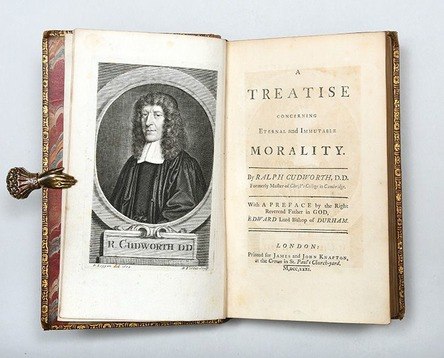
It doesn't really have a label per se, recognized as such by most of the historians of philosophy, save for Arthur O. Lovejoy, nevertheless, Chomsky, who knows about the classics of this period (17-19th century phil.) referred to it as "rationalistic idealism."
He has in mind Descartes and the Cambridge Neo-Platonists, Henry More and particularly, Ralph Cudworth.
Virtually unknown today, but, quite persuasive, IMO. -
Is there an external material world ?
Sure. But the plucking can happen by something "external", say, seeing a stone, or a hallucination of a stone.
The actual object need not be in the world, for us to react to it the way we do. -
Is there an external material world ?Well, as presented by Lucy Allais (it's a long quote to quote by hand at the moment), it seems to me that a Cartesian account of perception is correct, over Kant's actually. The thing is, Kant attempts to show how perception usually happens in ordinary life.
But the principle of perception is better explained by a Cartesian framework: what matters is what the subject reacts to, now what's happening in the so called external world.
But Idealism got a bad start by being usually associated with Berkeley, in denying the existence of a mind independent world. It need not be that at all.
Sure, Kastrup may argue differently, but, he's not convincing, I don't think. -
Consciousness Encapsulated
Ah, then it is a good point.
Ah well, if its behavior, then, that's a different thing. But behavior can be very misleading, in terms of, not confusing the data (which is what behavior is) from the theory (that which causes the behavior). -
Consciousness Encapsulated
Oh, that's interesting. It looks tricky to me, because, why use consciousness when intelligence can be way more efficient? -
Consciousness Encapsulated
That's probably true. The issue then become, to what extent is it intelligible to create a separation between consciousness and intelligence?
Because if these aren't thought about carefully, we might attribute a lot of intelligence to almost all living creatures. And that's tricky. -
Consciousness Encapsulated
I think the problem here already lies in the premise, that consciousness is a kind of AI. Or that it could be somehow transcribed to AI terms and relevant technology.
It seems to me that this is the immediate stumbling block. Brains are biological organs that have gone through billions of years of evolution. Machines, are things people do, and are much less sophisticated (by far) from anything that could be done with any technology.
There's also the issue that there are no machines in nature, we could choose to think of nature as a machine, but this would be misleading taken literally.
As for the general question, I think we don't know anywhere nearly enough about experience to even know where to begin on how to create consciousness. And we likely never will, given our cognitive limitations as natural beings. -
Do drugs produce insight? Enlightenment?
Sure insights come in all shapes an sizes. But I'm guessing the OP had in mind the deeper kind of insights, which, for me at least, are difficult to verbalize merely because many experiences cannot be put into words in a way that renders them intelligible.
But aside that, yes, other kinds of sensations and perspectives can be described rationally. -
Currently ReadingThe Philosophical Writings of Descartes: Volume II by Descartes
The Kind Worth Killing by Peter Swanson -
Ukraine Crisis
Not just the US, if that makes you feel better, Europe too. Send as many weapons as possible, care virtually nothing about diplomatic negotiations (minus France, and initially, Germany) and let the war continue as long as possible.
With the Republicans, it's a gamble. If Trump wins again, maybe? Then again, you've surely seen comments by members of the House saying to "call Putin's bluff". Yeah, ok. Neither party is good here at all.
If they cared about Ukrainian lives prior to the war, they would have agreed to implement the MINSK II agreements, and avoid all of this, which has been warned about for decades now, never mind Putin.
It is despicable, but it is also a fact. That's how power works. -
Ukraine Crisis
The point, so far as the US is concerned, is to weaken Russia as much as possible, paying for it with Ukrainian lives, not just dollars.
Nevertheless, this might well be a game of who "blinks" first. Either there is a miscalculation and Russia goes crazy, or it exhausts itself and demolishes all of Ukraine and decides to leave. It's not a good gamble.
But you are correct. The US (nor any major country, let's be honest) cared about Ukraine, until this war happened. Now they are getting the support victims should get.
But as soon as the objectives are completed, I don't think the US (meaning the military and the high echelons of power) will care much about Ukraine.
Hope I'm wrong. -
Ukraine Crisis
Which is all very good. But who supplies most of the weapons in NATO? Who controls the vast majority of budget in NATO? It's not Europe. This article does not show how Europe should proceed to become "autocratic".
One thing is to follow the remarks made by Merkel, that Europe should have it's own defense and foreign policy. That makes sense.
But that's not what Europe is doing, it's simply expanding US controlled NATO, by rendering countries with less control of whatever foreign policy they had.
Manuel
Start FollowingSend a Message
- Other sites we like
- Social media
- Terms of Service
- Sign In
- Created with PlushForums
- © 2026 The Philosophy Forum