
Comments
-
A Discussion About Hate and Loveam saying that science has not shown that emotions originate in the brain. — EnPassant
The text below is copied from Understanding Emotions: Origins and Roles of the Amygdala -
Emotions arise from activations of specialized neuronal populations in several parts of the cerebral cortex, notably the anterior cingulate, insula, ventromedial prefrontal, and subcortical structures, such as the amygdala, ventral striatum, putamen, caudate nucleus, and ventral tegmental area. Feelings are conscious, emotional experiences of these activations that contribute to neuronal networks mediating thoughts, language, and behavior, thus enhancing the ability to predict, learn, and reappraise stimuli and situations in the environment based on previous experiences. Contemporary theories of emotion converge around the key role of the amygdala as the central subcortical emotional brain structure that constantly evaluates and integrates a variety of sensory information from the surroundings and assigns them appropriate values of emotional dimensions, such as valence, intensity, and approachability. The amygdala participates in the regulation of autonomic and endocrine functions, decision-making and adaptations of instinctive and motivational behaviors to changes in the environment through implicit associative learning, changes in short- and long-term synaptic plasticity, and activation of the fight-or-flight response via efferent projections from its central nucleus to cortical and subcortical structures.
Of course it is our brain that makes our decisions.
I really like Jonathan's analogy of the elephant and rider - a way to understand human behavior - our emotional/intuitive side is the elephant, and our rational side is the rider of the elephant - the rider can see the path ahead, and steers - but the elephant is much bigger and sometimes it determines the direction. -
AI sentienceif alive today would rightly be accused of speaking in denial. — Alexander Hine
Denial of what? That computers don't ask questions? The fact is that they do have to be given prompts
qualities of creative — Alexander Hine
No, computers do not create in the way human brains do
When it can write lyrics, poetry and prose in an original and compelling style cognisant of all established forms. — Alexander Hine
AI plagiarizes from the expansive data it has been trained on -
A Discussion About Hate and LoveThis is an extremely weird thing to claim. Evolution doesn't have stop-gaps. Organs which develop do so along evolutionary lines, and there isn't a valid way to claim what she is claiming. Its romantic language dressed up to be scientific. — AmadeusD
Are you arguing against genetic variability in humans? There are a lot of adaptations seen in some, but not all, humans. It is not about introducing “stop-gap” measures, but recognizing that evolution is an ongoing process, and humans do not pose the exception. There exist a lot of mutational variants!
The eight billion or so brains on the planet are not genetically identical. They differ most obviously in cognitive style, and also in forming their moral domain. We all believe we are “righteous” – but there exists variation in how we approach questions of care/harm, fairness/cheating, loyalty/betrayal, authority/subversion, and sanctity/degradation – as Jonathan Haidt explores in his book The Righteous Mind: Why Good People are Divided by Politics and Religion.
Worth noting is that environmental factors also influence brain development -
Under typical conditions, medial prefrontal cortex (mPFC) connections with the amygdala are immature during childhood and become adult-like during adolescence.
… findings suggest that accelerated amygdala–mPFC development is an ontogenetic adaptation in response to early adversity.
https://pmc.ncbi.nlm.nih.gov/articles/PMC3785723/
I think there's a bit of a tendency to romanticize past cultures coming into play here, resulting in ambiguous, scientifically unsound claims being made. But those societies lack in many ways and are not apt comparisons to multicultural, billion-person societies aimed at exploration, scientific understanding and technological advancement. — AmadeusD
I don't think it is romanticizing at all, but an investigation to better understand who we are as a species when the unnatural environment we live in has been peeled away. -
A Discussion About Hate and LoveThis post contains all of the English concepts she's saying we don't have. Weird. — AmadeusD
I probably didn't do a good job of relating her main point of her article - that when answering the question - "What is love for?'"- society is strengthened when we come up with a more communal than individual response.
She has written a few other articles about the amygdala (the region of emotion in the brain), including with reference to its being in a transitory state of evolution - connections between it and the analytical frontal lobes are not at the same stage of evolution in all humans.
Nevertheless - I think it is a valid observation that love is not approached by all cultures/traditions in the same way. For example, indigenous traditions tend to prioritize the communal over the individual. -
A Discussion About Hate and LoveHow do you know love and hate are biological realities? — EnPassant
I proceed from the position that emotions are produced by neurological functions
Because scientists say so? — EnPassant
Scientists don't just "say things." They make conclusions based on experimental results.
I don't think these emotions exist 'in' the brain. — EnPassant
Then what is your alternative hypothesis? -
Donald Trump (All Trump Conversations Here)Mob protest is as old as the Republic. USA wouldn't exist as a country without it.
See the Sons of Liberty
What one needs to delineate is this: Who is on the side of respecting human rights? -
Donald Trump (All Trump Conversations Here)
-
A Discussion About Hate and LoveIn my inbox this morning, an interesting article about love from Elizabeth Halligan -
Halligan observes how in the English language there is only one word for “love” – (she describes it as the “poverty of English”) - but other languages have several words representing different roles for love.
For example, if we look at the Greek tradition –
Érōs — Fiery passion. Romance. Desire.
• Healthy: vitality, creativity, intimacy
• Unhealthy: obsession, possession, addiction
Storgē — Family love. The bond between parent and child. Kinship.
• Healthy: care, belonging, protection
• Unhealthy: clannishness, nepotism, enabling harm to protect “our own”
Philía — Friendship. Loyalty. Brotherhood. The love of shared values and mutual respect.
• Healthy: solidarity, comradeship, the glue that holds communities together
• Unhealthy: tribalism, exclusion, us-versus-them
Agápē — Unconditional love. Universal. The love that extends to all beings simply because they exist.
• Healthy: compassion, altruism, collective care, empathy
• Unhealthy: martyrdom, self-erasure, the inability to set boundaries
Philautía — self-love.
• Healthy: Self-respect, wholeness, the foundation from which we can love others
• Unhealthy: narcissism, ego-inflation, vanity
Xenía — Love of the stranger. The sacred duty of hospitality.
• Healthy: reciprocity, protection, honoring the outsider
• Unhealthy: blind trust without discernment — or its shadow, xenophobia
Halligan goes on to say –
When a culture collapses all love into érōs, it reflects a collective psyche still ruled by fear and possession.
This is the amygdala in charge. Everything reduced to “mine” or “threat”. Love becomes acquisition, care becomes control, and connection is based on transaction…
Without words for these loves, we struggle to practice them.
In conclusion, she states that we need a new world built with love as structure, not just sentiment -
• Philía in teams and organizations, where loyalty is not weakness but the foundation of trust.
• Agápē in policy and governance, where the measure of success is collective flourishing, and not the GDP of “human capital”.
• Xenía in how we treat the displaced, the different, the stranger at the gate, because borders are constructs that only exist in the mind.
• Philautía as the foundational love of self, because we cannot pour from an empty cup, and self-respect is not selfishness.
• Storgē remembered as strength, not softness — the love that gets up in the night, that sacrifices without scorekeeping, that builds the future of human flourishing, because we are one family. -
Donald Trump (All Trump Conversations Here)But I could fill a book with cultish behavior of MAGA — Questioner
Just checked - there have been a couple of books written about it -
Cult OF MAGA: How Trump turned apathy into idolatry through white hot populism, tepid placations and stone cold lies.
The Cult of Trump: A Leading Cult Expert Explains How the President Uses Mind Control -
Donald Trump (All Trump Conversations Here)Yes. Are you aware that I'm describing you also? — Tzeentch
Don't make the mistake of thinking you know me. You don't know me at all.
But I could fill a book with cultish behavior of MAGA
I don't think MAGA is evil - just manipulated -
Donald Trump (All Trump Conversations Here)In your local neighbourhood -
The NYT image below shows federal agents - armed with battlefield technology and weapons – suppressor (silencer), MAWL, M-LOK, Magwell, dump pouch – on a doorstep in Minneapolis.
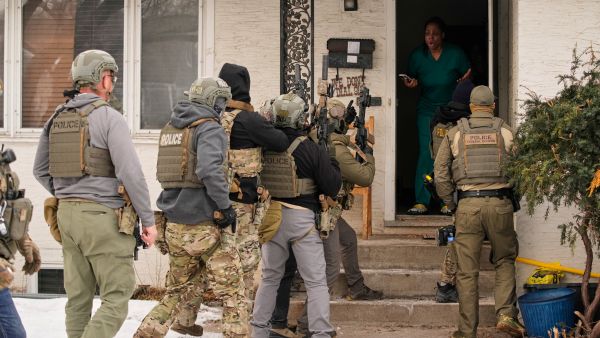
They entered the house, violating the Fourth Amendment. Her husband was arrested and ordered released four days later
Watch the brief video here for more details -
Donald Trump (All Trump Conversations Here)some form of tribal ritual. You shouldn't expect anything constructive from people who are at the height of religious ecstasy. — Tzeentch
You know you're describing MAGA, right? -
Donald Trump (All Trump Conversations Here)mass protests for Trump — BitconnectCarlos
No-one is protesting deportations. They are protesting the lawless, fascist tactics.
Despite some rhetoric about “deescalation” in Minnesota, the reality on the ground is that nothing significant has changed. There are still thousands of untrained, violent paramilitary units hunting brown people all over Minnesota. -
Donald Trump (All Trump Conversations Here)I reject the nihilist point-of-view.
I think there is great meaning in how we live our lives and the decisions we make, for they affect the lives of others.
I reject that we must remain pawns and victims of external influences.
Yes, immigration enforcement is necessary, but it must be done with the consent of the governed. It must be lawful and accountable. What do you make of this? - an ICE agent saying to an American citizen, “If you raise your voice, I erase your voice.”
Right now, nearly half of the American people support abolishing ICE altogether – more than support it.
As concentration camp survivor Viktor Frankl writes in Man’s Search for Meaning (page 130-1) –
To be sure, man is a finite thing, and his freedom is restricted. It is not freedom from conditions, but it is freedom to take a stand toward the conditions…
Man determines himself, whether he gives into conditions or stands up to them…
One of the main features of human existence is the capacity to rise above such conditions, to grow beyond them. Man is capable of changing the world for the better if possible, and of changing himself for the better if necessary.
If you are a Christian, listen to Jesus, who encouraged action against injustice – see the Parable of the Persistent Widow – (Luke 18:1-5) -
Then Jesus told his disciples a parable to show them that they should always pray and not give up. He said: “In a certain town there was a judge who neither feared God nor cared what people thought. And there was a widow in that town who kept coming to him with the plea, ‘Grant me justice against my adversary.’
“For some time he refused. But finally he said to himself, ‘Even though I don’t fear God or care what people think, yet because this widow keeps bothering me, I will see that she gets justice, so that she won’t eventually come and attack me!’” -
Donald Trump (All Trump Conversations Here)And we can already see that the Trump regime is panicking.. — ssu
Trump fascists are throwing each other under the bus.
Noem shifting blame -
“Everything I’ve done, I’ve done at the direction of the president and Stephen,” Homeland Security Secretary Kristi Noem told one source who relayed her comments to Axios.
In an earlier copy of the Axios report, others blamed Miller for divisive comments about slain anti-ICE protestor Alex Pretti wanting to “massacre law enforcement,” which were made by Border Patrol senior official Greg Bovino.
Miller shifting blame -
Stephen Miller admitted that Border Patrol agents may 'not have been following protocol' during the fatal shooting of Alex Pretti as Kristi Noem appeared to blame him for the fallout.
Miller's remarks were a dramatic U-Turn just days after the top Trump aide lambasted the 37-year-old nurse as 'an assassin' who 'tried to murder federal agents'.
In a statement to the Daily Mail, Miller said: 'We are evaluating why the CBP team may not have been following that protocol.' -
Donald Trump (All Trump Conversations Here)So what do you make of the many people that are disgusted about the politics, but just live on with their lives? Besides, in a democracy you can elect other people after those with fascist tendencies and you don't go after those that did vote for the authoritarian candidate. There are countries that have been capable of this. — ssu
I was thinking about some of the disingenuous opinions shared in this thread, and the opinion in general, that one can someone "rise above reality" and ignore how millions of people are being negatively affected, as if it were all a paper game, as if the stakes were not as high as they are. Taking the people out of the equation leaves an empty shell of empty words.
A woman and a man were murdered by the state, and it appears there will be no accountability. This is a fascist act. Trying to rationalize the murders is an implicit support of fascism.
But yes, you are right, voting against the fascists is of course taking an anti-fascist position. And I hear the hope in your post that the current situation is an aberration and things will return to "normal" after the fascists are out of power.
This requires actively countering the fascists' goal of never having to give up power - more than sitting on top of a pedestal and declaring, "That's just the way it is!"
Action is required. We've seen that the action of committed people in Minnesota has resulted in Trump backing off somewhat.
A book I read years ago by Rebecca Solnit - Hope in the Dark: Untold Histories, Wild Possibilities -
makes a call for activism, and "makes a radical case for hope as a commitment to act in a world whose future remains uncertain and unknowable."
https://www.amazon.ca/Hope-Dark-Untold-Histories-Possibilities/dp/1608465764 -
A Discussion About Hate and LoveChristians are commanded to "Love you enemies, do good to those who hate you." (Luke: 6:27) This kind of love (agape) is more than a mere emotion; it is also an act of will. — Ecurb
I like this very much. Thanks for sharing. -
A Discussion About Hate and Love
Thank you for your considered reply. I was prompted to start this thread by witnessing how people can be manipulated by hate - as is evident with MAGA.
Do love and hate always express themselves?
Sorry, I don't understand? — Nichiren-123
Does emotion always lead to behavior?
Which one has the wider radius of effect?
Sorry, I don't understand the question here? — Nichiren-123
We reserve love for those closest to us, but hate can drive an entire segment of society to wish ill upon those who they don't even know. -
Donald Trump (All Trump Conversations Here)
I combed through your reply, and could not really find any meaningful rebuttal to the facts I posted.
But I will say a couple of things -
The repetition of the lie is the loyalty test.
Ad hominem attacks signal a lack of any substantive argument. -
Donald Trump (All Trump Conversations Here)In fairness, not a Trump supporter. But curiously goes far easier on him and his policies than a Biden or Obama — Mikie
He's clearly a Trump apologist, and in my books that is a supporter.
There can be no middle road on this issue. You either support fascism, or you do not. -
Donald Trump (All Trump Conversations Here)The play at extortion (fewer federal agents for concessions on MAGA policy) - of the Trump administration is putting them under fire –
Pam Bondi’s Letter to Minnesota Could Unravel Entire ICE Crackdown
A federal judge is focusing on the attorney general’s letter in a case on the legality of President Trump’s operation in Minnesota.
Attorney General Pam Bondi’s blackmail letter to Minnesota Governor Tim Walz after the killing of protester Alex Pretti may force the Trump administration to end its violent immigration crackdown in the state.
On Saturday, hours after Border Patrol agents shot and killed Pretti in the streets of Minneapolis, Bondi demanded that Minnesota Governor Tim Walz give the Trump administration full access to the state’s Medicaid and SNAP records so that her office could “efficiently investigate fraud.” Bondi also demanded Walz end the sanctuary state policy and hand over all state voter registration records to Trump. Walz refused.
Now a federal judge is weighing this letter as evidence that the administration is using the presence of armed federal agents as coercion to achieve policy goals…
“The president of the United States said in the middle of this chaos and violence in the streets … he said, ‘Minnesota, your day of retribution is here.’ That is crazy. How can that not violate legal sovereignty?”
Speaks to how incompetent the Admin is -
Donald Trump (All Trump Conversations Here)Anyone who takes US domestic politics seriously is beyond redemption — Tzeentch
This hints at another trait I've seen in Trump supporters - "Unless it affects me personally, I don't care." -
Donald Trump (All Trump Conversations Here)After the 2020 election Trump's total ineptness and lack of leadership qualities was shown. — ssu
I've read the entirely of Jack Smith's Special Report, and I encourage all to read it if they want to understand the depths of Trump's corruption.
https://www.justice.gov/storage/Report-of-Special-Counsel-Smith-Volume-1-January-2025.pdf -
Donald Trump (All Trump Conversations Here)if even an exercise in futility. — Mikie
Speaking truth is never futile. -
Donald Trump (All Trump Conversations Here)That is historically insane.
They are, however, fucking blind. — AmadeusD
When I asked you what this meant, you chose not to reply, so I will have to assume that you are suggesting it is historically insane to draw parallels between the Germans who marched people to the gas chambers and the MAGA goons
Why? You think those in the 1930s were a different human species than the ones we see today?
What turned them then is what turns MAGA now.
In both cases, people were/are manipulated by a propagandizing “strongman” who spreads baseless claims and exploits human weaknesses, most especially fear. In both cases, violence is normalized and empathy blunted. Hate is made to feel normal, hate against the people who the strongman tells you is the enemy. The target group is dehumanized. Trump has a few target groups –
Here’s some of the things he has said about immigrants –
“They’re poisoning the blood of our country.”
“… pour into and infest our Country”
“The Democrats say, ‘Please don’t call them animals. They’re humans.’ I said, ‘No, they’re not humans, they’re not humans. They’re animals.’”
“They’re rough people, in many cases from jails, prisons, from mental institutions, insane asylums. You know, insane asylums, that’s ‘Silence of the Lambs’ stuff. ... Hannibal Lecter, anybody know Hannibal Lecter?”
Here’s what Trump says about the Democrats, who he regularly calls “radical left lunatics” –
“The party of hate, evil and Satan.”
"the enemy from within”
“… and the enemy from within, in my opinion, is more dangerous than China, Russia and all these countries."
Take a look at his posting history.
Here’s one – full of the usual lies -
… I would like to wish an early New Year’s salutation to Crooked Joe Biden and his group of Radical Left Misfits & Thugs on their never ending attempt to DESTROY OUR NATION through Lawfare, Invasion, and Rigging Elections. They are now scrambling to sign up as many of those millions of people they are illegally allowing into sour Country, in order that they will be ready to VOTE IN THE PRESIDENTIAL ELECTION OF 2024.
The support Trump gets from his base depends on hate. He also keeps them entertained with spectacle.
I’ll leave you with a couple of things. First, something I read in an Atlantic article -
I ARRIVED IN MINNEAPOLIS 11 days after an ICE agent shot Good in the face. Her picture was hanging like a religious icon on windows and walls all over the city. To many who had not already become involved, her death was a call to action.
One of those latecomers was a 46-year-old documentary filmmaker named Chad Knutson. On the morning after Good was killed, he was at home with his two hound dogs, watching a live feed from the Whipple Building, where ICE is based, a five-minute drive from his house. A protester had laid a rose on a makeshift memorial to Good. As Knutson watched, an ICE agent took the rose, put it in his lapel, and then mockingly gave it to a female ICE agent. They both laughed.
Knutson told me he had never been a protester. It seemed pointless, or just a way for people to expiate their sense of guilt. But when he saw those ICE agents laughing, something broke inside him.
“I grab my keys, I grab a coat, and drive over,” Knutson told me. “I barely park my car and I’m running out screaming and crying, ‘You stole a fucking flower from a dead woman. Like, are any of you human anymore?’
Second, a reply I got on another forum when I posted a similar sentiment about MAGA cult members being reminiscent of those who marched people to the gas chamber.
A Trump supporter replied, “Let them burn!”
It's the same mentality that called Renee Good a "fucking bitch" after he killed her. -
Donald Trump (All Trump Conversations Here)Minnesota actively, publicly said it would not co-operate with a Federal law enforcement activity which is justified and reasonable (not the current activities - i'm saying conceptually) was apparently fine under Obama. — AmadeusD
You expect Minnesota to co-operate with their occupiers?
Besides, states are not required by law to co-operate with ICE.
And - “Operation Metro Surge” is unconstitutional – it violates both the 1st, 4th and 10th amendments
Here’s where Trump differs from Obama. Trump’s goons – thousands of masked and armed agents lacking professionalism and adequate training – stormed in uninvited and are terrorizing the Twin Cities – once there -
• using force against individuals peacefully engaging in constitutionally protected speech;
• arresting, threatening and using force against innocent bystanders;
• pointing firearms at individuals who pose no threat to DHS agents; and
• carrying out enforcement actions at sensitive locations like schools, churches, hospitals.
Many United States citizens have been the victims of unlawful racial profiling by DHS agents due to the color of their skin or, in the words of one ICE agent, because “I can hear you don’t have the same accent as me.” These individuals are frequently handcuffed and detained for hours by DHS agents for no reason. Immigration agents have targeted individuals in sensitive locations, including schools, medical facilities, places of worship, daycares, and funeral homes.
At the heart of this invasion is political retaliation -
President Trump made this clear himself on January 9, when he stated Minnesota is “corrupt” and “crooked” because its officials accurately reported election results and those results did not declare him the winner. “[T]hey’re crooked officials. . . . I feel that I won Minnesota all three times. I think I won it all three times . . . I won it all three times in my opinion . . . It’s a corrupt voter state . . . I won Minnesota three times and I didn’t get credit for it. That’s a crooked state.”
e's concerned that Minnesota has been propped up by illegals voting for their Democrat mates who have supported wide-spread fraud. — AmadeusD
So was allowing millions of illegals to vote Dem. — AmadeusD
I have to admit I am somewhat shocked that you would repeat such a stupid falsehood.
Undocumented immigrants do not have the right to vote.
It happens, but it is extremely rare. Extensive review of the 2024 election uncovered a few cases. For example, in Michigan 16 (that's ten fingers and six toes) noncitizens voted.
18 states recorded none at all.
Do you really think an undocumented immigrant would risk deportation in order to vote? -
Donald Trump (All Trump Conversations Here)I think Trump just declaring himself a President for life won't happen. — ssu
There is no dirty trick that is beneath him to ensure he maintains power. We've seen that with what transpired after the 2020 election. -
Donald Trump (All Trump Conversations Here)The insurrection act cannot change the timeline for federal elections. That is down to your congress. The 20th Amendment sets an absolute end to a presidential term on January 20th, with no exceptions for emergencies or ongoing challenges. — Banno
You assume Trump will uphold the Constitution -
Donald Trump (All Trump Conversations Here)the way they did under Obama, there wouldn't be the need for ICE to be carrying out these raids and there would be no media-driven (and, as much as you might think this is fine) a concerted, semi-violent effort to impede — AmadeusD
I'm not sure you understand what is happening.
There are over 2 million undocumented immigrants in red state Texas.
There are over 1.2 million undocumented immigrants in red state Florida.
There are about 130,000 undocumented immigrants in blue state Minnesota.
ICE agents in the hundreds are sent to the red states, but 3000 ICE agents were sent to the city of Minneapolis alone. (This is about 14% of the total number of ICE agents to cover all 50 states) The president's lawless army has descended upon the city, and this has nothing to do with immigration. It is about terrorizing. It is about having a pretext to invoke the Insurrection Act. It is part of the strategy to ensure Trump does not have to leave office.
Trump's offer to remove the ICE army if Minnesota hands over the voter rolls shows that. -
AI sentienceIt seems odd not to even consider extending that courtesy to other systems. — MrLiminal
It's not about extending courtesies. It is recognizing the difference in structure and function -
AI sentiencehuman brain is contextual — Questioner
Besides contextual understanding, a human brain can generalize, create, and daydream... -
AI sentiencefeedback loop as an agent with an environment. — Pantagruel
good point.
Consciousness arises only within an environmental loop -
AI sentienceWhat are humans if not biological computers that suck at giving answers? — MrLiminal
Well, no, human brains can do things AI can't, like change my mind about things.
Learning in a human brain is contextual, something AI cannot yet do.
AI and a human brain in fact differ in both structure and function, as the video explains -
https://www.youtube.com/watch?v=19bmNXA3K74 -
AI sentienceacts and responds as if it is alive — MrLiminal
“Computers are useless. They can only give you answers.”
― Pablo Picasso -
AI sentienceIt has nothing to do with the internal so-called nature of the artificial being, and everything to do with the human mind’s conditioning, and how it triggers our bodies to feel.
We can see the seeds of this (emerging recognition) in our inclination to thank, even current presumably primitive AI, when it delivers an excellent answer.
Soon enough a generation will be born with the necessary programing to recognize AI sentience, even to guard it/guard against it, being input at a very early age, around the same time they are being conditioned to "recognizing" a distinctly sentient subject operating their own bodies (and in the same entirely constructed/conditioned way). — ENOAH
I wonder if you can clarify your position. You seem to asking about AI sentience, and suggesting its existence, based on human reaction to it. Human reaction proves humans are sentient, not the AI.
Let's agree that sentience involves a subjective point of view. This means not only the capacity for intelligence, but the capacity for emotion. This is something a machine will never have.
Way back in 1949, in the prestigious Lister Oration, Sir Geoffrey Jefferson, a famous brain surgeon, declared, ‘Not until a machine can write a sonnet or compose a concerto because of thoughts and emotions felt, and not by the chance fall of symbols, could we agree that machine equals brain – that is, not only write it but know that it had written it.’ -
Donald Trump (All Trump Conversations Here)Back when Tom Homan did the same thing under Obama, and on a greater scale, he was given awards and glowing reviews. Now he’s a fascist. So clearly there is no principle involved here at all, so it’s just the defense of criminality and the tacit belligerence towards the law abiding taxpayer. — NOS4A2
You haven't given a reply to my post about Trump's fascism -
Donald Trump (All Trump Conversations Here)who defraud the immigrations system? — NOS4A2
Oh my dear innocent, this has nothing to do with immigration -
Donald Trump (All Trump Conversations Here)They would have made great Nazi sympathizers. — Mikie
I have had a disturbing thought - that the ones justifying the murder of Alex Pretti are the ones who would have marched people to the gas chambers.
Questioner

Start FollowingSend a Message
- Other sites we like
- Social media
- Terms of Service
- Sign In
- Created with PlushForums
- © 2026 The Philosophy Forum