
Comments
-
Donald Trump (All General Trump Conversations Here)When did Benjamin write, the 1920s the 1930s? — Tobias
1940 - the same year he took his life while running from the Nazis. You can read the whole thing here. As for the rest, one only has to look at just where the attempts to 'channel class warfare and encapsulate it in discourse and consensus politics' have gotten us. Here. That to me is more utopian than any revolutionary aspiration. To look at everything burning down and say that we just need a bit more of this. Power always wins. The arc of history bends to the barrel of a gun. Only question is who has it. -
Donald Trump (All General Trump Conversations Here)You heard glimmers of it when there was talk of his "annoying voice" and his "scolding tone" or whatever phrases I half-remember from the time. It was definitely in the wings.
-
Donald Trump (All General Trump Conversations Here)Ah, that social democracy. I think Benjamin made the right measure of it long ago:
The conformism which has marked the social Democrats from the beginning attaches not only to their political tactics but to their economic views as well. Nothing has so corrupted the German working class as the notion that it was moving with the current... Social Democratic theory and to an even greater extent its practice were shaped by a conception of progress which bore little relation to reality but made dogmatic claims. Progress as pictured in the minds of the social Democrats was, first of all, progress of humanity itself (and not just advances in human ability and knowledge). Second, it was something boundless (in keeping with the infinite perfectibility of humanity). Third, it was considered inevitable— something that automatically pursued a straight or spiral course.
In other words, it trades on an optimism that was always bound to fail on account of its inability to grasp that class warfare will always be waged - and won - by those who always had a far more realistic understanding of how power works in society: the capitalist class. It's the same reason Sanders failed. He played by the rules as every institutional weapon was brought to bear upon him even as he had mass support. The Democrats would rather Trump win than ever let a man like Sanders near the presidency. They play on the same side. Ditto Corbyn. That will always be the record of social democracy, agreeable as it is. It cannot reciprocate the class war that will always always always be waged upon it. -
Donald Trump (All General Trump Conversations Here)If Trump is good for one thing, it's that he makes clear who the enemy is. The political field becomes arrayed in a very neat way. The mushy liberal 'consensus' of the 90s and 00s - which just so happened to mark the definitive triumph of neoliberalism - gave way to show that the whole thing was rotten to begin with. Social democracy hasn't been forgotten, so much as its been shown to be a facade stung together by tape as workers lost their rights, pay stagnated, inequality ratcheted up, state supports dismantled, debt became structural, and the Global South was left to rot by the Global North - all long before Trump came to the scene. Trump is nothing but a crest on this wave, but he does a good job defining its contour. Biden on the other hand is like a band-aid tossed into the ocean, right after he finished propelling the waves.
-
Jurassic Park ReduxThen we'd be bringing back an extinct species into a world they didn't evolve for. — Marchesk
Then we engineer them otherwise. Promethean dreams or barbarism! -
Roll20 experience?Me and some mates play every other Sunday. I'm not a DM, but as a player it's pretty good. Can't speak for how busy it is for setting things up as a DM.
We use it in conjunction with Discord, and that set-up works pretty well. -
The Essence Of WittgensteinWell typically a hypothesis is what you test for confirmation or disproof of a theory: if your hypotheses are confirmed, your theory is given credence. It's just another way of saying the same thing, and I wouldn't read too much into it.
And for the 'must' - I think it just follows from what I termed before as understanding language as a resource or a fund. Say you have a stock of wood. Can you stipulate in advance all the uses of that wood? I mean you can try. You'd probably be wrong. You'd end up like those old-timey futurologists:
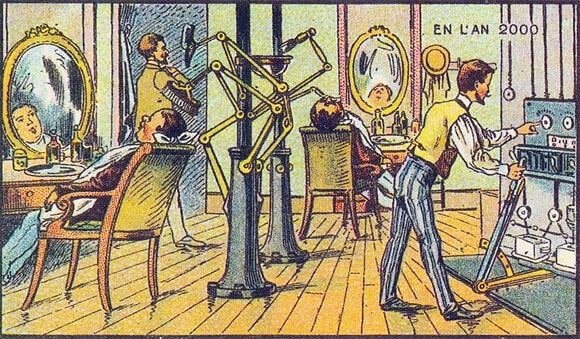
And language is far, far more flexible than wood. Also, the citation is from §109. I mis-cited it as §100 before I edited it. -
The Essence Of Wittgenstein2. Which naturally leads to something like hanaH's view that all of these uses and possible uses, even the ones we can't imagine now, have something in common: they are solutions to a coordination problem faced by living creatures like us. — Srap Tasmaner
I think even this constraint would be too much. The 'untotalizable' character or uncountability of types of use is a positive, "built-in" feature of 'use'. Wittgenstein says as much:
§23: "But how many kinds of sentence are there? Say assertion, question and command? - There are countless kinds; countless different kinds of use of all the things we call “signs”, “words”, “sentences”. And this diversity is not something fixed, given once for all; but new types of language, new language-games, as we may say, come into existence, and others become obsolete and get forgotten. ... The word “language-game” is used here to emphasize the fact that the speaking of language is part of an activity, or of a form of life" (emphasis in the original).
§23 also contains a list of examples of such types of uses - Giving orders, and acting on them, singing rounds, Cracking a joke, are just a few of them. The point is that these types of uses are derivative of our forms of life: there are as many types of uses as they could be forms-of-life. This is why further down, in discussing why he is not offering a theory, Witty says that the point is to do away with any sense of explanation, and to stick wholly with description:
§109: "And we may not advance any kind of theory. There must not be anything hypothetical in our considerations. All explanation must disappear, and description alone must take its place" (emphasis in the original). This can only make sense if we drop even minimal conditions like "language use has in common the fact that they are solutions to a coordination problem faced by living creatures like us". Witty's strong thesis is: there is and can be no such condition of commonality. The very capaciousness of this approach to language is also mercilessly eliminative: it expels all efforts at welding even minimal conditions upon what language is. -
Donald Trump (All General Trump Conversations Here)Says the propaganda box spinning peans about liberalism and haiographies of Biden :lol:
Anyway, everyone remember the time Biden trapped students in inescapable debt at the behest of credit card companies and enabled sexual abusers on the supreme court? Can't forget the global warcrimes he heartily supported too. And now a Trump accelerant. Ah, good times. Just a small sampling too. Wonder where all the liberals who cried crocodile tears at Trumps 'kids in cages' went since Biden continued the border policies whole cloth. Such a mystery. It's like liberals believe in nothing so long as they are comfortable. -
Donald Trump (All General Trump Conversations Here)Say, are you a Trumpette? Just want to know if I should ignore you or not. — James Riley
That would ruin the fun. I much prefer watching you spin in incomprehension from inside the little parochial political box you've set up for yourself. -
Donald Trump (All General Trump Conversations Here)I guess you don't know your history. Liberals gave you all that is good. — James Riley
It's crazy that Americans think only other countries engage in propaganda.
I love this. I didn't realize parodies could be this real. -
Donald Trump (All General Trump Conversations Here)Liberals never gave anyone anything, apart from maybe worldwide colonial genocide in pursuit of capitalist profits. Anything every wrested from the powers of conservatism was done so by the exercise and threat of violence by the working class the world over.
Also American 'liberals' simply are conservatives by any sensible measure, so it's not really a distinction worth any difference. -
Donald Trump (All General Trump Conversations Here)Also what is it about liberals and Hitler? If he didn't exist, I'd imagine liberals would have to invent him because otherwise they would have no way to orient themselves politically.
-
Donald Trump (All General Trump Conversations Here)Liberal is the fount of all that is good, including that which conservatives now want to conserve, and which their forebears fought against. — James Riley
:lol:
Keep going, Kim Ill James. -
Donald Trump (All General Trump Conversations Here)Amazing.
And people wonder why Trump remains a threat - they think he is some kind of aberration, and not cut from exactly the same fabric as Biden is. -
Donald Trump (All General Trump Conversations Here)It means something to Americans. — James Riley
The opinions of morons don't count. But sure, keep up the propaganda. Maybe one day people like you will look into Biden's congressional record, but I don't hold out much hope. See you at the next Trump presidency. -
Donald Trump (All General Trump Conversations Here)Biden is better than Trump. — James Riley
I don't know why people like to say this like it means anything. Or even think it's true. Biden was the condition that enabled Trump to get to where he is, and surprise surprise, he's being that very same condition again. And Biden has done more long term damage to the States in his career than Trump has - although a second Trump term might even the odds. Except people act like Biden popped out of thin air a couple of years ago or something. Biden's a fucking monster, an absolute ruiner of lives. Trump just wears it on his sleeve like a brand. -
Donald Trump (All General Trump Conversations Here)I don't think people care about Trump satellites like Flynn. Trump's the draw.
Also Biden is less than useless and is a and always has been a slightly longer detour to Trump anyway. -
Donald Trump (All General Trump Conversations Here)Barring a miracle, he'll almost certainly be back.
-
You don't need to read philosophy to be a philosopherAs I've noted in several other posts, I regret the flippant tone of my OP. I've offended people and made it harder to have a friendly discussion about this. Forgetting about this discussion for a moment, based on my history on the forum, am I a two-bit thinker? Am I trash at philosophy? I don't think I am, but if I am, that answers the question I asked at the beginning. — T Clark
No, because I don't think - thank God - you practice what you preach. -
You don't need to read philosophy to be a philosopherThen what we have here is a matter of difference of how we are interpreting the OP. I think Cornel West makes a good distinction between "philosophy as a profession" and "philosophy as a way of life". We can add to that philosophy as a hobby or amateur philosophy, which needn't mean bad.
By now, if you aren't teaching in academia, it's hard for people to call anyone a philosopher. There are very, very few exception. Raymond Tallis is the only one that comes to mind and perhaps Bernardo Kastrup too. — Manuel
There are interesting questions to be raised by autodidactism - questions which are at once social and ethical, and go way beyond the question of the individual. There's this inverview with Reza Negarestani, where he makes the point that the autodiadact needs to be understood in the relation to an entire social system:
"I would trace such ideas of auto-didacticism back to ancient philosophy, and also works of Islamic philosophers such as Ibn al-Nafis and Ibn Tufail. For them auto-didacticism did not solely mean being self-taught. It was something much more, almost a cosmological conviction about what thinking is and what it can do, and of course what the philosophical individual Will can achieve or contribute in this cosmological scenario of thinking without established arbitrary limitations. The central theme is, as you mentioned, education. Comprehensively understood, education is an extension of philosophy of mind and autonomy. This definition, however, requires a far more expansive formulation of the concept of mind than how it is addressed today.
...What is the solution to the current pathologies of mind as manifested in our systems of education? I think the first step to address the problem coherently, even before attempting to resolve it, should be that of a coordinated movement across the socio-political spectrum. The aim of this movement should be to update our existing educational system, both methodologically and theoretically in the sense of alterative theories of education which are as much informed by developmental psychology as they are refined by neuroscience and computation, while at the same time developing a much more expansive concept of education, where the latter would be construed as a goal rather than a premise for autonomy and collective self-determination. The task then would be to coordinate our existing systems with the all-encompassing radical concept of education, whose concrete realization is our long-term goal. But to take any of these steps we need to first concretely acknowledge that it is politics that should treat education as an unconditional factor, not the other way around."
https://www.neroeditions.com/docs/reza-negarestani-engineering-the-world-crafting-the-mind/
The OP of course simply doesn't even begin to raise the same issues, because it doesn't even rise to the level of advocating for autodiadictism. It literally says that ignorance is fostered by learning. It's insane and intensely stupid and frankly embarrassing. But it is also understandable - as a symptom of a society where the only choices are that of engaging in a rarefied system that is cold, alien and inaccessible, or else heroically 'going at it alone', traditions be damned. The OP is a reflection of social failure, and a sadly understandable response to it. -
You don't need to read philosophy to be a philosopherThe OP is very clear about the need to pay attention.... The OP may resent this but it seems to me closer to a mystical tradition of the contemplative. — Tom Storm
And if people want to go off and be mystics, by all means, mysticize away. But don't say that you sat in a room writhing for an hour and now you're a philosopher. I also think this 'attention' business is a MacGuffin. I have no idea what it means. A plumber pays attention when he fixes pipes. A CEO pays attention when she cuts staff for the sake of efficiency. -
You don't need to read philosophy to be a philosopherWhat was Socrates doing? He was asking questions to ordinary citizens. He's called a philosopher. Why wasn't he called a lawyer? Or a historian? — Manuel
Sure, but Socrates was Socrates by doing the exact oppose the OP suggests - he most decidedly did not stay in his room and have the world 'writhe at his feet'. He literally wondered the agora looking for trouble.
I'm saying that if you look at many of the threads here, they are often made by people with little by way of knowledge of traditional figues. yet many times the question are perfectly legitimate and difficult. ... But feel-good is far from my intent in believing philosophy should include many traditions and perspectives not limited to the classical Western figures. — Manuel
I agree. That's the cool thing about a forum like this, is that you can have philosophical discussions without being a philosopher. Most, if not everyone here, is not a philosopher. And that's OK (why is this not-OK for so many people? What fragility requires that they prostitute philosophy for themselves out of some feeling of inadequacy?). I also agree that philosophy should include lots of non Western-canon things - but I have never insisted that it should. -
You don't need to read philosophy to be a philosopherSome of these are of some interest. But soon it loses the immediacy connected with the human condition and will keep people who might otherwise be interested very far away from topics most people should find interesting, because they are intrinsically interesting. — Manuel
But this doesn't follow. History is wildly interesting and vital. Yet people don't run around calling themselves historians. Law, which affects our lives at every point in a manner far more intense than philosophy, is interesting and important. Yet no one starts threads on how they are, in fact, a lawyer, by virtue of the world writhing at their feet. And no one then goes on to claim 'if we keep law in the hands of lawyers law will become uninteresting and unimportant'. I don't like people treating philosophy as a whore. No suprise it's usually men who do so.
As for 'what is philosophy?'- well you know as well as I do how contentious that is. But I'll be brave enough to lay out at the least a minimal condition for it, which is continual encounters with things which provoke and problemetize. Thought is excrcized under conditions of compulsion, constraint, and even inability. Philosophy, whatever it is, begins with failure, the other side of wonder - the failure to make oneself equal to the richness of what one is confronted by, and the subsequent attempt to work through the concequences of that failure. And failure requires risk, chance, encounter. With the material of the world. The problem with the feel-good 'we're all philosophers in our own way happy happy joy joy' bullshit is that it is safe, sanitized. Is it any wonder that the OP can be read simply as a post-hoc justification of simply being lazy? I don't think so. I think the OP is after validation, the coziness of doing nothing under the disguise of 'discussion'.
I mean God, it is really so bruising to people's egos to have to simply say: I have an interest in philosophy, just as people say "I have an interest in history" without calling oneself a philosopher or historian? Like, you're not a philosopher in the same way you're not a historian. Get over it. -
You don't need to read philosophy to be a philosopherNot to be harsh, but what distingushes this list from, say, a list of good qualities of a government bureaucrat? Or a marketing manager? Or town planner in charge of sewerage system? With the exception of (4), which even then just kinda gestures toward the name of philosophy?
That's my problem with all this feel-good inclusivity of "staring at walls is philosophy". What, exactly is philosophical about it? Where's the specificity? What makes this anything more than an attempt to turn a personal failing into a dignified quote-unqoute principled "philosophical" stance?
These aren't questions for you, per se. Just using your words as a sounding board. -
The Essence Of Wittgensteinpresume an opposition between an inside and an outside. — Joshs
But this opposition is what you wield like a cudgel everytime any sense of sociality that isn't 'original sociality' is raised. Your position is oppositional through and through. It doesn't deconstruct it. It reinforces it with metaphysical steel. Do you notice that your writing is so often exclusionary? In your efforts to isolate an original sociality, you proceed by excluding, excising, distinguishing, always this core of pristine sociality from any outside. But you do this by abusing language and saying, ah but the outside is already inside - but you only do this so as to better and more rigorously exclude the 'wider' outside, the outside beyond original sociality, to which you oppose each time like a immigration agent at the border wall. It's like the solipsist who says: of course I don't deny the existance of the world - the world exists in my head!
And yeah, Devitt is great. Realism means being indifferent to the activites of monkeys on a space rock. As it should be. -
The Essence Of WittgensteinNot the solipsism of a closed system but a continuous exposure to and being affected by an outside. — Joshs
Been through this before. Your particular construal of an original socialtiy is just solipsism redux. It is relies on, is constituted by, defining a closed off region of the "self", then, by fiat, declaring this self to already be public, which - and this is the real problem - is apparently then all the more reason to discount the actual public. The issue isn't with the notion of an original sociality as such; it's the idea that this original socialtiy itself is cut-off, self-enclosed, uncontaminated, with sociality writ large. It's metaphysics in the bad sense. A reengineered metaphysics of presence wearing Derridian garb, even though no one who would take Derrida seriously would subscribe to it. The issue isn't with an original sociality as such, the issue is that by constantly making a hard and fast distinction between original sociality, and socaility in the normal sense (and then constantly retreating back into the shell of the former, as a pristine, self-enclosed space), is to not take seriously enough the idea of an original sociality, which ought to contaminate - in the Derridian sense - this very distinction. There is an original sociality. But it can in no sense be "proper" to the self without the supplement of society writ large. -
You don't need to read philosophy to be a philosopherDon't know anything about jiu jitsu but I've been practicing to develop skills in oil painting. That discipline and be broken down into various aspects of performance, such as shape, value, edge, color, and composition. Each of these elements can be focused on to improve overall performance. In order to improve edge quality, for instance, a practice method might be to study masterworks that excel in that quality and practice recreating them. Whatever method is used, specific goals for improvement and reliable feedback are essential, as well as lots of challenging practice. — praxis
No, no, no. Why are you painting? You can become a good painter just by reflecting on the world around you. You just need to have some awareness. You don't need to paint or study other paintings to become a good painter. -
You don't need to read philosophy to be a philosopherTrying to do philosophy while rejecting the basic readings and any formal tutelage sounds like trying to build a car without training or looking up an instructions or even looking at the building plans for other cars. — Artemis
More I think about it the more silly the OP is. "You don't have to study architecture to be an architect"; "You don't have to study literature to be a literary critic"; "You don't have to study cooking to be a chef". You just need like, awareness maaan. Utter joke.
Sorry, but no, just because you're a lazy two-bit "thinker" doesn't mean a whole discipline has to be redefined to accomodate your fragile ego. You don't want to study philosophy, fine, no worries. But you're going to be trash at philosophy. Pretty simple. -
Phenomenology and the Mind Body Questionit cannot be explained where it goes when it isn’t, re: deep sleep — Mww
It sure can, and it has been done on enactivist terms directly inspired by M-P too. -
Currently ReadingMichel de Certeau - The Practice of Everyday Life
Tony Norfield - The City: Global Finance and the City of London
Georges Dumezil - The Plight of the Sorcerer
Vladimir Propp - Morphology of the Folktale -
Phenomenology and the Mind Body QuestionHave you read M-P's Phenomenology of Perception? The entire book is nothing other than a series of demonstrations as to how to cash out the statement of his you quoted: space, time, depth, colour, movement, orientation, freedom, scale, intersubjectivity - all shown to depend on the body. At the very least the book's negative results, it's 'dispatching', as you say, of what M-P calls 'empiricism' and 'intellectualism', are timeless contributions.
And if you haven't read it, why the anticipation of 'additional befuddlement' in advance?
Edit: Also, M-P is easily among my favorite prose stylists in philosophy. Reading him makes one feel aerial. -
The Essence Of WittgensteinWhy does he insist he's not offering a theory? Is he mistaken about that? Is he actually offering a theory about language? If he's mistaken about that, surely that's pretty interesting, and we should all be talking about why LW doesn't think his theory is a theory. — Srap Tasmaner
The simple answer is that Witty thinks language can be many different kinds of things, none of which can be specified exhaustively in advance. On his understanding of 'theory', a 'theory' of language would say something like: language is such and such, and that which does not fall under such and such specifications, would not be a language. For the most part, Witty's target is himself: the Witty of the Tractatus that tried to specify a 'general form of the proposition'. But on (later) Witty's reading, language is something like a resource, or a fund: it can be used for very many different things, perhaps things we can yet not imagine. Language is as language does (or what is done with language), as it were. And what is done with language is un-theorizable in advance.
One could, in a manner of speaking, call this a theory, and in an expanded sense it is. I think, to be finicky, I'd call it a meta-theory: a theory about theories of language, which basically says: "don't do it, bad idea". -
The Essence Of WittgensteinThis makes me wonder whether, on your interpretation, Wittgenstein would count religions or theologies as language games. — Janus
I don't think so. But Witty had... interesting views on religion. If you haven't, take a read of his Lecture on Ethics [PDF]. It's about 8 pages long, and it quite explicitly sets both religion and ethics outside the realms of what can be said. That is, what can belong to a language-game:
"[With respect to ethics and religion] we cannot express what we want to express and that all we say about the absolute miraculous remains nonsense. ... My whole tendency and I believe the tendency of all men who ever tried to write or talk ethics or religion was to run against the boundaries of language. This running against the walls of our cage is perfectly, absolutely, hopeless. – Ethics, so far as it springs from the desire to say something about the ultimate meaning of life, the absolute good, the absolute valuable can be no science. What it says does not add to our knowledge in any sense. But it is a document of a tendency in the human mind which I personally cannot help respecting deeply and I would not for my life ridicule it".
So although it is, in Witty's technical terms, nonsense, he still accords it a great deal of respect. A charitable reading would be to say that ethics and religion fall on the side on the side of 'pure showing': a showing that cannot be said. Hence the rather enigmatic 'wonder at the existence of language itself':
"Now I am tempted to say that the right expression in language for the miracle of the existence of the world, though it is not any proposition in language, is the existence of language itself. ... For all I have said by shifting the expression of the miraculous from an expression by means of language to the expression by the existence of language"
Notably this lecture was given pre-PI. It has a very Tractarian ring to it, and it's not clear how, if at all, the renovations in the PI might have altered these views. -
The Essence Of WittgensteinIs there a common fumble, a contemporary example in mind that illustrates "words that are misused in contrast to words said that are not actually used" I don't really know what the difference is in practice. — Saphsin
Wittgenstein's go-to examples are often questions which aim to elicit instances of non-use (as answers). A nice illustrative one is §88: "If I tell someone “Stay roughly here” - may this explanation not work perfectly? And may not any other one fail too? “But still, isn’t it an inexact explanation?” - Yes, why shouldn’t one call it “inexact”? Only let’s understand what “inexact” means! For it does not mean “unusable”."
Notice that the standard for a 'useable' expression is simply: does this explanation work (to get one to 'stay roughly here', so that I can, say, find them again in a bit?) Yet, the person who does not understand 'use' asks the question: "does 'roughly' indicate some measure of inexactness"? But already this question abstracts from the purpose of the command. It is qua command - it's use as a command, for the purpose of speaker and receiver to find each other again - in which the word's meaning is to be found. The use is bound up in a complex of actions and goal-directedness. But as soon as you abstract from that, you can begin to ask questions which treat of the command something other: you begin to ask questions about 'exactness', about measurement, boundaries, and so on. If I had to name this distinction I would call it the difference between treating words intensively and extensively.
The PI is filled with these kinds of 'bad questions': what counts as a 'simple'? What is a game? What counts as the general form of a proposition? -
The Essence Of WittgensteinThe problem, it seems to me, is that in the chess example, i.e., throwing a piece across the room, that doesn't even look like a move in chess. At least in language, it appears that you are doing something with the word, because of the grammar of language. Maybe the chess example should involve something not so radical, to bring it more in line with what's happening in language, but I'm not sure what that would be. Maybe something like, after you have learned the moves, you keep trying to move the rook diagonally, to fit some notion you have about rooks. — Sam26
Ha, that's fair. But yeah, you're totally right, the problem is 'non-moves taken for moves' - diagonal rooks, or, to be more precise: 'rooks' that move arbitrarily. Whose moves one cannot learn to 'go on' from, because not subject to the constraints of a purpose - a doing of things with words.
Okay. Now you've done it! I have to reread PI. Thanks. :brow: — 180 Proof
:cheer: -
The Essence Of WittgensteinNo "private language" is implied by "incorrect use" (or misuse) of words failing to mean – make sense – in a language-game, only confusion, especially, for Witty et al, the kinds of confusions of which many "philosophical problems" consist. — 180 Proof
Missed this - look, within a language-game, yes, there can be something called 'misuse'. As in: "that's not how you move a rook". But Wittgenstein is largely totally uninterested in this. His menagerie of linguistic ills - language in idle, being mislead by grammar, being captured by a picture, and so on - all bear upon words employed without a language game; that is, without even a role like a rook that could, even in principle, be said to be 'wrong'. This distinction is what is novel and important in Witty. Everyone knows words can be used wrong. That's trivial and uninteresting. Witt is ultimately concerned about words which are, as it were, 'not even used' (to paraphrase the old 'not even wrong'). Employments of language which do nothing, which serve no purpose. It is one thing to move the rook qua rook in the 'wrong way'. It is quite another to throw thehorsecastle shaped piece across the room and call it chess. In the one the piece at least has a role. In the latter it does not (incidentally, the issue of "role" appears over and over and over again in the PI - and it is almost criminally under-remarked upon - unlike 'misuse' which, again, doesn't appear even once in the entire book). The 'philosophical problems' that Witty diagnoses belong entirely to the latter category.
Streetlight
Start FollowingSend a Message
- Other sites we like
- Social media
- Terms of Service
- Sign In
- Created with PlushForums
- © 2026 The Philosophy Forum