
Comments
-
Does systemic racism exist in the US?This was very good. The more people hear and understand the impact of redlining, the better:
"The Federal Housing Administration institutionalized the system of discriminatory lending in government-backed mortgages, reflecting local race-based criteria in their underwriting practices and reinforcing residential segregation in American cities. The discriminatory practices captured by the HOLC maps continued until 1968, when the Fair Housing Act banned racial discrimination in housing.
But 50 years after that law passed, the lingering effects of redlining are clear, with the pattern of economic and racial residential segregation still evident in many U.S. cities — from Montgomery, Ala., to Flint, Mich., to Denver. Nationally, nearly two-thirds of neighborhoods deemed “hazardous” are inhabited by mostly minority residents, typically black and Latino, researchers found. Cities with more such neighborhoods have significantly greater economic inequality. On the flip side, 91 percent of areas classified as “best” in the 1930s remain middle-to-upper-income today, and 85 percent of them are still predominantly white".
It's possibly the biggest injustice in modern American history that almost goes totally unremarked upon. Not that it's all down to redlining of course. But gosh was it terrible (in fact it still exists). Unsurprisingly, it's roots are economic. -
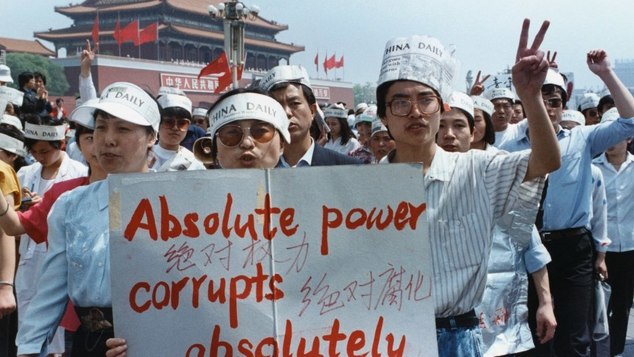
Hong KongToday is the anniversary of the Tienanmen square massacre. This is what it was like just before:
-
The WLDM movement (white lives dont matter)Anyone who does not understand 'black lives matter' to precisely mean that 'all lives matter' misunderstands what 'black lives matter' says.
-
Systemic racism in the US: Why is it happening and what can be done?The main thing to address, I think, is how to combat prejudices and biases that may exist at the subconscious level. — Wolfman
With due respect for your post, there are two things that worry me about what you've said. First, that prejudice is the main thing to address. It is something to address, but in isolation, I don't see how it can be effective. This is because prejudice is a result, and end-product, and not a starting point or origin. A few pages back I posted a link to some evidence that addressing racism on an individual level among police is largely ineffective. What does seem to work are concrete mechanisms of accountability that translate into structures of incentive and disincentive that shape the emergence - or non-emergence - of prejudice in the first place. And those structures by definition cannot be instituted at an individual level but only at an institutional one.
That means oversight boards with teeth, not governed by police, or not only police. It means changes to funding structures, tied directly to policing outcomes. It means making changes to use-of-force policies like these ones. And it also means addressing prejudice on an individual level, just as you said. The point you make about dark glasses, and learning history, and arrogance are great. But only as part of a suite of reforms that must necessarily be trans-individual and institutional. If incentive structures are not changed, if these reform is not tackled at a 'population level', it's hard to see why these changes will take root. I'll add too that taking pressure off individual cops by instituting institutional change can only ever be good for cops themselves, who can rely and lean on those larger structures for support.
They only know that they are angry and I wear the uniform. — Wolfman
Second worry: is this really the case? This strikes me as an underestimation of their epistemic position. Literally 'what they know'. I - and others - have been watching in horror as police forces have quite literally unleashed terror upon peaceful demonstrators in the last few days. I'm not saying this to be hyperbolic, I really mean it when I say that there have been acts of domestic terror worthy of that title. And I simply don't believe this can be put down to 'bad apples'. The scale of brutality - across multiple cities, coast to coast - points again to structural issues. I don't think it's fair to say that police are just protecting small mom and pop businesses, even if they may also be doing that. They are also charging at protestors, shooting non-protestors outside their own homes, destroying city-approved medical aid stations - a literal war crime in any other circumstance -, and radio calls to run protestors over. And these are tiny samplings. These things too, are what protestors know, above and beyond a uniform.
I don't think this can be put down to 'godd cops' and 'bad cops'. Something else is at work here. And this is not directed at you personally, but where is the widespread condemnation of widespread police violence by police? Why, given what we've seen, have there not been outrage on behalf of the police themselves? Why is there not universal denunciation, from police departments all across the US, and promises to do better? Why are police seemingly not holding themselves to high standards? If these are bad cops - where are the good cops? Why are they not speaking? This absence is also, I think, something people know. I hope this doesn't come off as attacking you. I don't mean to do anything of the kind. I do want to push back a little, and wonder what you might say to address concerns like these. -
Systemic racism in the US: Why is it happening and what can be done?Don't you think 'white grievance' populism is a (not so) new - hyper-mediated - false consciousness? — 180 Proof
White grievance populism is identity politics at its worst. It abstracts whiteness as a cultural identity in a vaccum, disconnected from economic and institutional bases and then constructs, as its Other, black, brown and other 'identities' which function as threats. Tethered to no real life conditions - only the exponential power of concocted imagary and narrative to 'identify' with - it has the capacity for unlimited violence. The right perfected identity politics - in practice - long before the left even gave it a name.
I guess it could be called false conciousness, although I have theoretical gripes with that notion. -
The Road to 2020 - American ElectionsWhile it's an appreciated sentiment, unity is not a goal unto itself. There's little point in unity if no change happens, and things go back to where the way they were before. In many ways that would be even worse. The slogan: 'no justice, no peace' brings this out clearly.
"They dress the wound of my people as though it were not serious. 'Peace, peace,' they say, when there is no peace." Jeremiah 6:14. -
Systemic racism in the US: Why is it happening and what can be done?The class-race connection StreetlightX highlights has the interesting implication that a lot of structural racism can be fixed without explicitly addressing race at all. If you help all poor people equally regardless of race, you disproportionately help black people automatically because the poor are disproportionately black. — Pfhorrest
I just want to add that this is a basic Marxist point, and a reason why, among socialists, you will always hear the refrain that race issues and gender issues cannot be addressed without at the same time addressing class issues. The primacy of class analysis is not to the exclusion of race, but to its augmentation. The same can be said of gender issues too. If affordable and easy to access childcare, for instance, is largely inaccessible, the burdens of this largely falls upon women, who tend do the labour of child-rearing in disproportionate rates.
Or to take an issue that links all three - consider domestic abuse. Rates of domestic abuse are always higher among the poor (a lack of financial options means abused women lack the independence to escape abusive partners, for instance), and if the poor are disproportionately black - well, lo-and-behold, black (and hispanic women, in America) experience double the rate of battering compared to their white counterparts. Things like this is why it’s not a matter of tackling individual ‘bad apples’ and so forth. Structural issues are complex because things are always so interconnected and harder to see because of it. Without an eye for it, one can simply draw the conclusion: black people beat their wives more, therefore.... (and yes, the correlation drops off as soon as you compare well-off blacks with well-off whites).
Alternatively, the MLK speeches that @boethius has been posting say all this far more eloquently than me. -
The WLDM movement (white lives dont matter)I’m sorry to hear about your experience. I think it’s tragic, and you are undoubtably a victim of racism - but not only in the way you imagine. Among the most pernicious effects of racism is the way its effects bleed out and spill beyond its immediate targets, hurting everyone and everything involved. Racism is a cancer, and a society afflicted by its blight is worse off as a whole. Everything and everyone gets dragged down in its wake. It’s like a black hole. And it sucks everything in, including and maybe especially people like yourself.
Any community systematically deprived of opportunity and paths out, for which the means of social mobility - education, steady work, decent public facilities and infrastructure - are lacking, will largely turn out wretched. There will be ‘bad people’. Gang members, thieves, murderers, and worse. And their immediate targets will be people like you, deemed outsiders, rightly or wrongly. You can draw a direct line from the institution of systemic racism, through the wretchedness of your neighbours, to the awful things that have happened to you.
None of this absolves those who hurt you of responsibility. The additional tragedy of it is that they are in many ways even more responsible, lacking any social structures upon which they can lean and which can support them - upon which more fortunate communities can draw support from. The American dream of individual responsibility is nowhere more upheld than among its most wretched. It’s a nightmare, not a dream.
As for you, you have the choice and ability to not perpetuate the cycles which lead, inexorably but silently, to the kind of structural racial imbalances which ruin everything - including white people. Which is a fancy way of saying: of not being racist. I doubt you will be convinced by this. The immediacy and tragedy of your experience - which is concrete and individual - will always work to obscure these extra-concrete and extra-individual forces which inform your situation. You can see and hear a thief or a 'thug'. You can't see and hear a lack of social mobility - at lest not in the same, visceral way. It's hard work - unfair work - to have to learn to acknowledge those other forces. All I ask is that you keep it in mind. -
Systemic racism in the US: Why is it happening and what can be done?And I guess you are going to say much the same thing now. — ernestm
Actually no. I'm writing a reply to you, in your thread. -
Donald Trump (All General Trump Conversations Here)Although if Trump had his way it would be water canon, police dogs and teargas* — Wayfarer
*Bullets. -
Systemic racism in the US: Why is it happening and what can be done?
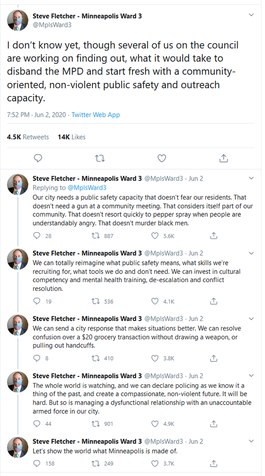
This is wonderful news. But also look!:
-
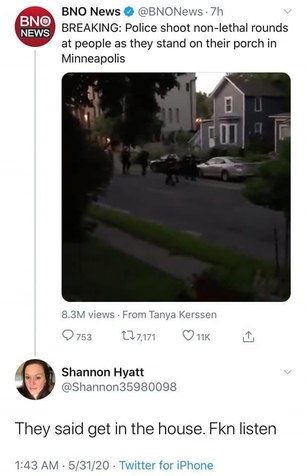
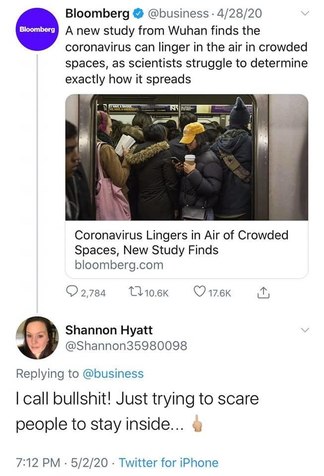
Donald Trump (All General Trump Conversations Here)Oh and I forgot one more one more permutation. I mentioned what COVID and the protests have thought us about the intellectual depravity of the American right. I forgot to mention both in combination. I present to you - fuckwits of American conservatism:
1.
2.
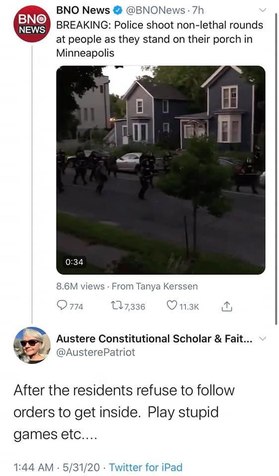
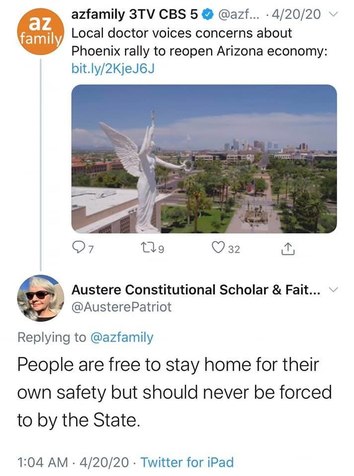
3.
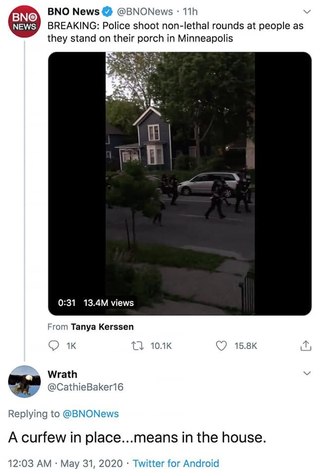
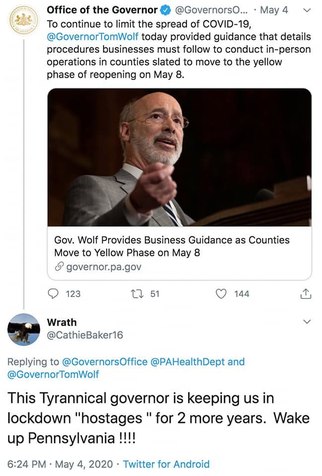
Reminds me of a certain bloodsuking poster here... -
Systemic racism in the US: Why is it happening and what can be done?unless they adopt a mindset to achieve something greater than the ghetto like Eminem for example. — EpicTyrant
You really need to watch your language.
But yes, unless America becomes more socialist indeed, it will remain a shitty, unjust nation. -
Systemic racism in the US: Why is it happening and what can be done?I don't think you get to tell black people what they 'fail to realize'.
-
Systemic racism in the US: Why is it happening and what can be done?And so the blacks that rise with the tide gets immune to racism and accepted into society, while the bottom remains that the bottom because of the capitalism society structure of America. — EpicTyrant
Except this is not what is happening. And again, if the 'bottom' remain - and are kept - disproportionately black - that's structural racism. -
Donald Trump (All General Trump Conversations Here)My grim vision of where things are headed is roughly in line with Jodi Dean, who offers a delightful conceptualization of what she calls neo-feudalism. If you would like to cry yourself to sleep, I highly recommend reading the piece.
And before someone starts shouting that we're overreacting, you're not there yet, but authoritarianism and the continued erosion of constitutional rights is the clear direction of travel. Does anyone imagine that Trump won't take it absolutely as far he can?) — Baden
A fun exercise. Watch the following speech. Every time Trump talks about about 'violence', 'assaults' and 'wanton destruction', consider that he's talking about his state-sponsored terrorist cops, rather than the protestors. The effect is quite cool, and worth listening to that vomitus timbre:
-
Systemic racism in the US: Why is it happening and what can be done?A rising tide can raise all boats while those on the bottom remain on the bottom. Remember: this is about disproportionate social distributions of social goods. And as far as police violence goes - the very reasons for the recent protests - blacks are most certainly disproportionally affected.
-
Donald Trump (All General Trump Conversations Here)They already are :( Even Australia is getting worse.
I love the opening line: "Australia is now in line with the United States, Ghana and Botswana in terms of civil freedoms." Like - ew, not in line with the US! -
Donald Trump (All General Trump Conversations Here)Mm. What been worrying me somewhat is that this fiction can also no longer be used to play the 'moral high ground' card in international politics. In some ways, the abdication of the US from its position as geopolitical steward is to be welcomed, but when fucking Iran tells the US to stop gassing its citiziens, you know they're doing it with total, utter glee. And that's to say nothing of how China will use this to further fuck Hong Kong. Or anywhere else for that matter. What moral cards can a neo-fascist fuckstick like Trump hold against a concentration-camp China? None.
-
Systemic racism in the US: Why is it happening and what can be done?Lives for black people are already being improved for colored people around the world, which is made true by politics, you don't have to start a violent protest about it. — EpicTyrant
This is manifestly false. -
Systemic racism in the US: Why is it happening and what can be done?Ahh what a fucking legend.
-
Donald Trump (All General Trump Conversations Here)Absolutely agreed. COVID (re)thought us that about the economy ('every life is sacred'? Not if 'the economy' is in trouble; 'we can't afford that' - trillions thrown at the stock market); This is (re)teaching us that about their 'small government'/'I care about the constitution and freedom of speech' bullshit. It's always been hypocritical trash mind you - these just happen to serve as painful, timely reminders.
-
Systemic racism in the US: Why is it happening and what can be done?It can get worse but according to the narrative and how much less racism there is compared to before, the evolution of a more tolerant society is on a positive scale and has been since the dawn of time — EpicTyrant
I agree things have, in broad outline, 'gotten better' for some people. But they have done so because of the kind of active, political intervention of the kind that you're seeing play out on American streets right now. People had to fight and bleed and die for this progress. It did not spring up out of some natural progression of history. -
Systemic racism in the US: Why is it happening and what can be done?This is wrong, because the effects of those origins work to entrench racial inequality at the present day. You said it yourself: poor black people are more likely to be raised in bad conditions, thus ensuring that they stay poor. These cycles of poverty perpetuate themselves across generations. They become self-sustaining. This is not a matter of linear growth, as if whites just got a head start on a straight road. These issues are intergenerational and cyclical, and thus ensure that they poor (and disproportionally black) stay poor. This is why things won't simply 'get better over time' without active intervention to change the structure of things. There's every chance things will get worse. Indeed, more black men are killed by police in recent times than they were at the height of lynching in the US.
-
Systemic racism in the US: Why is it happening and what can be done?:up:
King was dangerous. And he's all the more a hero for it. The whitewashed fantasy of a kum-bay-yah peace loving King is just that - a whitewashed fantasy. King was a frikkin Marxist - albeit one critical of Marx, and who understood and spoke about the intimate link between class struggle and racial freedom. -
Systemic racism in the US: Why is it happening and what can be done?Right, but because poverty disproportionally affects black people, this means that class issues are directly race issues. It means, for instance, that not addressing poverty equally means disproportionally not addressing race issues - i.e. that one race, on the balance, get more affected than another - even if you're not trying to directly do this. That's what 'structural racism' means. It doesn't require anyone saying or thinking 'I hate black people'. It simply requires that ones actions, because of certain distributions of goods in society, disproportionally affects a certain race. One could be nothing but kind to black people - and still partake in this kind of racism. It's a kind of 'objective' racism that has nothing to do with what one thinks or feels.
-
Donald Trump (All General Trump Conversations Here)In case anyone actually has any niggling doubts that Trump is a cuntfuck who needs to fuck off and die:
-
Systemic racism in the US: Why is it happening and what can be done?Why don't you think it's true? — EpicTyrant
Because I don't believe the drive to high achievement is specific to white people at all (which would mean what? Other people don't have that drive?). In fact, it simply isn't a generalizable trait for white people - or really any 'kind of people'. -
Systemic racism in the US: Why is it happening and what can be done?It is expected of a white man to be an achiever and to strive to reach higher goals. — EpicTyrant
I don't think this is true at all.
I would probably put a low class society criminal black person in the same category as a "white trash" person. — EpicTyrant
'White trash', is, curiously, more about class than race, although it's obviously a racial concept. It's far more specific than your equation suggests. -
Systemic racism in the US: Why is it happening and what can be done?This is a misunderstanding of what 'privilege' - a misnomer, I think - is meant to convey. Watch this to understand it.
-
Systemic racism in the US: Why is it happening and what can be done?Black people in low class society should rise up against themselves and really show the world that they're ready to make a change and be left out of the typical "afro american" stereotype that you see in movies, that would be beautiful and remarkable human feat to see. — EpicTyrant
This is a nice sentiment but it partakes of the trope of the 'model minority' which is, at it's core, a racist one (to be as clear as possible, I'm not calling you racist, but the trope employed in what you said, probably unconsciously). You can read about issues with it here and here. The problem with it is that it ties race to action in a way not expected of others: white people are allowed to be trash human beings without it being tied to their race - why not black people? Perhaps the most freeing element for any race is to be able to be perfectly average or utterly flawed and not have those flaws and failings reflective of their 'race'. To not have to bear responsibility for an entire race just because one is black or any other skin color.
One measure of freedom from racism is: the ability to be an utterly awful failure of a human being and not have people pin that on to your race. Most white people don't have this happen to them. They can be garbage without it being said of them: 'ah, they're not very good representatives of white people, they're really letting down the white team'. It should not happen to black people either. -
Systemic racism in the US: Why is it happening and what can be done?A proposal: tie federal funding of police departments to incidences of use-of-force complaints, as assessed by a third party civil rights (i.e. non police) department.
-
Currently ReadingMariana Mazzucato - The Value of Everything: Making and Taking in the Global Economy
Mariana Mazzucato - The Entrepreneurial State: Debunking Public vs. Private Sector Myths
Sicc'd on to these by @Maw I believe. -
Systemic racism in the US: Why is it happening and what can be done?More reform responses to the protests dripping through:
https://www.kron4.com/news/bay-area/san-francisco-da-to-prohibit-officers-with-history-of-misconduct-from-being-hired/
"[San Francisco]: A resolution to prevent law enforcement from hiring officers with a history of misconduct was announced by District Attorney Chesa Boudin and Supervisor Shamann Walton on Tuesday. They are urging the Civil Service Commission to forbid the police department and sheriff’s department from making such hires."
Still barely anything. But this stuff is working. -
Systemic racism in the US: Why is it happening and what can be done?Ah we've decended into parody now.
Some easy arithmetic that's been doing the rounds: if you have 10 bad cops, and 1000 cops who don't speak out, you have 1010 bad cops.
Given the scale of police violence and brutality we have seen - in response to protests against police violence and brutality - all cops are bad cops. Which is a children's-book way of saying state-sponsored terrorists, at this point.
Streetlight
Start FollowingSend a Message
- Other sites we like
- Social media
- Terms of Service
- Sign In
- Created with PlushForums
- © 2026 The Philosophy Forum