
Comments
-
The Notion of Subject/ObjectTo be fair, the distinction between 'being' and 'existence' is a well founded one that has its roots in Aquinas and alot of medieval Christian philosophy, and still can be found in alot of contemporary philosophy. You can find a rough explanation of the distinction here: https://www.newworldencyclopedia.org/entry/Being_and_Existence
Wayfarer's equation of being with the living however, is a different matter and largely unique to his own homebrewed idealism. -
In the defence of the Anime Girl (important)"Feminists"? Name at least two who have written and published on this.
-
Why do you think the USA is going into war with Iran?Those options are not particularly specific to the situation. Two far more relevant ones might be that both the Saudis and the Isrealis, for their own reasons, want nothing better than the destruction of the current Iranian government, and the US, who have their own reasons for sucking up to both, is willing and keen to oblige. It also helps that this serves as a nice distraction to any process of impeachment.
-
The Notion of Subject/ObjectIn English, the word ‘being’ applies to living creatures. Chairs and other object are artifacts, objects, tools, etc, but they’re not designated as ‘beings’. As I say, this is simple English albeit with philosophical implications. — Wayfarer
Can you please stop this. No one in philosophy limits the use of 'beings' to humans. This is just your idiosyncratic rubbish that no one but you spouts. It is misleading, off-topic, and you have been told this multiple times before. You are knowingly spreading misinformation. Stop. -
Cantor’s MistakeThere are enough threads going on Cantor and mathematical infinity right now with active discussion, we do not need another.
-
My own (personal) beef with the real numbersThe OP seems to me to be a particularly bad idea. Part of the excitement of learning is to learn what you do not know - to understand one's own ignorance so as to all the better situate what you do know. To keep away even the introduction of the reals in order to coddle the apparently effete minds of the young would leave them with an impoverished understanding of the natural and rational numbers themselves. One of the more exciting moments in my math education in high school was learning about imaginary numbers, even if the work we did with them was incredbily basic. It spoke to a wider world of number, and ramified back upon the little I did know of the rest of math, and made me appreciate it in a new light.
It strikes me as both condesending and and an injustice to the excitment that math can elicit by treating kids as idiots just because they can't engage in construction. It seems a way to suck any exploratory spirit out of math, and kill any joy that might be gleaned from it. -
Why x=x ?Ah right, now to make a grammatical abberation philosophical: "to be be, or to not be be?; that is the question".
-
Why x=x ?The arrogation of logical terms into metaphysical posulates is a cardinal sin for which philosophers ought be be expelled from the academy for.
-
Why x=x ?Maybe if you have a bad teacher, but think you just don't fully understand the word "description." — Artemis
No seriously - if someone says: "describe this dog to me", and you reply "it's a dog", there are a few possibilities - you misheard the question; you were being cheeky; its so obvious what the dog looks like that it'd be redundant to describe it any further; you don't understand English; you're unacquainted with the dog so are unable to elaborate. What you have not done, is give a description of the dog. -
Why x=x ?One is the statement of x, the other is describing something about x. It's the difference between saying dog and saying a dog is a dog. — Artemis
In what English class did you learn that "x=x" or "it is itself" counts as a description of something, and not earn you a detention for being cheeky? This is a misuse of the English word 'description'. -
The Notion of Subject/ObjectA distinction of provisional use, tends to be more obfuscating than clarifying, has led hundreds and thousands of people astray for the most part. Liked it better when the terms used to mean the opposite of what they do now. A decade or so moratorium on it's use - to usher in the new year, say - would probably leave everyone better off.
-
Is homosexuality an inevitability of evolution?There are no inevitabilities in evolution, sans death.
-
Why x=x ?in natural language "A is B" can mean different things, depending on context. It can indicate class membership (people are animals), it serve as a reduction (people are [nothing other than] animals), and so on. In the case of this Spir fellow, what he has in mind would be more precisely called permanence, or more generally, invariance. That is not the same as the simple equality/identity used in logic and math. Such sloppy use of language has occasioned a lot of miserable sophistry (cf. Ayn Rand's abuse of the "principle of identity"). — SophistiCat
Yeah, exactly. That's why the idea self-identity speaks to anything at all without further specification is so silly. That it has some kind of univocal extension, ranging from math to biology as if some kind of meme, is so egregiously bunkum as to not warrant serious response. As if one could simply say "a thing is identical to itself" and think one has said anything meaningful at all. Those who talk of 'proving' or 'disproving' that x=x simply know not of what they talk. -
Why x=x ?The principle of identity displays the essence of reality: only that which is identical to itself is real, the empirical world is ever-changing, therefore it is not real. Thus the empirical world has an illusory character, because phenomena are ever-changing, and empirical reality is unknowable.
See. This is what happens when one hews to the principle of identity as some kind of metaphysical postulate. You have to leave the world behind. Religious tripe. All the more reason to be suspicious of metaphysical extrapolations with respect to it. The closer you get to Platonism, the more off-track one is. -
Why x=x ?However, when we formally define equality, we do have to explicitly postulate self-identity - it doesn't fall out of other postulates. — SophistiCat
Totally. Insofar as one is setting out a grammar for logic, this makes total sense. But this speaks to a certain use of language - it certainly doesn't amount to some kind of biological or even metaphysical principle. -
Why x=x ?The implication is then that X does not equate to any value but its own. X=X. — Mac
Except this is totally wrong. An apple is an apple. It is also a fruit. That something is itself says nothing. It is semantically empty. As are all tautologies. Tautologies cannot be exclusionary because they are not even inclusive: they say nothing.
The most you could say is that an apple being an apple precludes it from being a not-apple (¬X), but this too says nothing at all. It is an extentional and not intensional distinction.
The only way around this is Leibniz's way, which was to pull the entire world into the 'identity' of any one thing, such that relations of inclusion and exclusion are relations of compossibility and incompossibility of entire worlds. Leibniz needed God to balance the whole equation, so that seems like a bit of a lost cause too. -
Why x=x ?Ok.
That people have tried to wring conclusions from tautologies has always puzzled me. I remain puzzled. -
Why x=x ?If identity is 'representitive of distinction' then I simply don't know what you are talking about. Once words stand for their opposites, there are no longer rational grounds for discussion.
-
Why x=x ?Babies take a long time to develop the awareness that they are themselves. — Mac
Again: what does this mean? Babies certainly develop a sense of self, but an 'awareness that they are themselves'? What else would they be? What else could they even in principle develop an awareness of? Does this question have any stakes? Seems like wordplay to me.
If anything, self-awareness arises out of a certain recognition of invarience in relation to an environment; distinction and not identity is primary. -
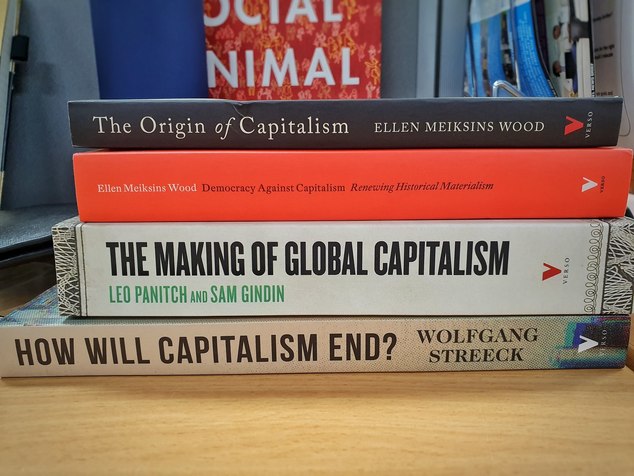
Currently ReadingEnd of year reading summary! 42 books, which is a little less than last year, but was definitely slowed down by the Cavell readings - The Claim of Reason alone took me two months. Was worth it though. Three themes that I revolved around - Wittgenstein and math, Deleuze, and a bunch of politics/political theory (especially regarding debt). Still working on getting a decent gender balance. Bold indicates favourites.
Wittgenstein(ish) + Math
Jose Bernadete - Infinity: An Essay in Metaphysics
Ludwig Wittgenstein - Remarks on the Foundations of Mathematics (Also got 2/3s of the way through the Lectures on the Foundations of Mathematics, but DNF, so it doesn't count!).
Henry Staten - Wittgenstein and Derrida
Noson Yanofsky - The Outer Limits of Reason: What Science, Mathematics, and Logic Cannot Tell Us
Stanley Cavell - The Claim of Reason: Wittgenstein, Skepticism, Morality, and Tragedy
Stanley Cavell - Must We Mean What We Say?: A Book of Essays
Stanley Cavell - Conditions Handsome and Unhandsome: The Constitution of Emersonian Perfectionism: The Carus Lectures, 1988
Sara Ellenbogen - Wittgenstein's Account of Truth
Peter Winch - The Idea of a Social Science and Its Relation to Philosophy
G. E. M. Anscombe - Intention
Hanna Pitkin - Wittgenstein and Justice: On the Significance of Ludwig Wittgenstein for Social and Political Thought
Deleuze (Logic of Sense reading)
John Sellars - Stoicism
Carlo Rovelli - The Order of Time
Piotrek Swiatkowski - Deleuze and Desire: Analysis of "The Logic of Sense"
Gilles Deleuze - The Logic of Sense
Andrew Culp - Dark Deleuze
Eleanor Kaufman - Deleuze, The Dark Precursor: Dialectic, Structure, Being
Slavoj Zizek - Organs Without Bodies: Deleuze and Consequences
Gilles Deleuze/Leopold von Sacher-Masoch - Masochism: Coldness and Cruelty & Venus in Furs (two books in one, technically!)
Political Economy / Debt / Neoliberalism / Political Theory
Michel Feher - Rated Agency: Investee Politics in a Speculative Age
Christian Marazzi - The Violence of Financial Capitalism
David Graeber - Debt: The First 5,000 Years
Maurizio Lazzarato - The Making of the Indebted Man: An Essay on the Neoliberal Condition
Maurizio Lazzarato - Governing by Debt
Maurizio Lazzarato - Signs and Machines: Capitalism and the Production of Subjectivity
Wolfgang Streeck - Buying Time: The Delayed Crisis of Democratic Capitalism
Yanis Varoufakis - The Global Minotaur: America, Europe and the Future of the Global Economy
Yanis Varoufakis - And the Weak Suffer What They Must?: Europe, Austerity and the Threat to Global Stability
Wendy Brown - In the Ruins of Neoliberalism: The Rise of Antidemocratic Politics in the West
Patchen Markell - Bound by Recognition
Hanna Pitkin - The Concept of Representation
Jodi Dean - The Communist Horizon
Jodi Dean - Crowds and Party
Misc
Natasha Lennard - Being Numerous: Essays on Non-Fascist Life
Jane Goodal - The Politics of the Common Good: Dispossession in Australia
Matthew Warren - Blackout: How is Energy-Rich Australia Running Out of Electricity
Joseph Carew - Ontological Catastrophe: Žižek and the Paradoxical Metaphysics of German Idealism
Giorgio Agamben - Opus Dei: An Archaeology of Duty (reread)
Thomas Moynihan - Spinal Catastrophism: A Secret History
Giovanni Maddalena - The Philosophy of Gesture: Completing Pragmatists' Incomplete Revolution
Paolo Virno - Deja Vu and the End of History
Henry Staten - Nietzsche's Voice
--
Still reading the Virno book, but will probably start the new year catching up on some Judith Butler books, before going back to political economy again. So to prempt:
Judith Butler - Excitable Speech: A Politics of the Performative
Judith Butler - Notes Toward a Performative Theory of Assembly
Merry Christmas and a Happy New Year to everyone :) -
Why x=x ?“A thing is identical with itself.” - There is no finer example of a useless sentence, which nevertheless is connected with a certain play of the imagination. It is as if in our imagination we put a thing into its own shape and saw that it fitted. We might also say: “Every thing fits into itself.” a Or again: “Every thing fits into its own shape.” While saying this, one looks at a thing and imagines that there was a space left for it and that now it fits into it exactly.
Does this spot [O] ‘fit’ into its white surrounding? - But that is just how it would look if there had at first been a hole in its place and it then fitted into the hole. So when we say “it fits”, we are describing not simply this picture, not simply this situation. “Every coloured patch fits exactly into its surrounding” is a somewhat specialized form of the law of identity."
(Wittgenstein, PI, §216) -
Currently Reading
-
Moral harassment causes 35 suicides. Really?I imagine this to be a huge clash of cultures and those workers caught caught in the middle and didn’t have the skills to adapt. — Brett
This was not about having the skills to adapt or not. Orange deliberately placed staff in roles they were not suited or trained for, assigned tasks and timeframes that were unachievable, didn't offer the needed training, under-assigned personel for projects and so on. This was a deliberate ploy to ensure that staff would fail and feel so incredibly miserable that they would quit. Not a 'clash of cultures'. A malicious, designed attempt at cost-cutting though immerseration. -
Moral harassment causes 35 suicides. Really?Why didn't they just lay them off? — frank
Because laying them off would have required severance payouts. It was more economical to terrorize their employees into leaving than offering them redundancy. -
Chomsky & GradualismIf one or two excrescent lines of barely engaged questions amounts to 'critique' then I can only wish for better critics.
-
Chomsky & Gradualism. And it's not a question that can be answered by telling someone to read up on functionalist grammar. — Snakes Alive
Except it is, which you would know if you knew anything about the subject whatsoever.
Streetlight
Start FollowingSend a Message
- Other sites we like
- Social media
- Terms of Service
- Sign In
- Created with PlushForums
- © 2026 The Philosophy Forum