
Comments
-
What Is Contemporary Right-Wing Politics?Of what exactly? I simply disagreed that Peterson's divisiveness was all that surprising. He gets as good as he gives.
-
What Is Contemporary Right-Wing Politics?I'm afraid I do not see the link between "get your shit together and take care of yourself" and "SUBMIT TO THE PATRIARCHY WOOF WOOF." — Pneumenon
No, but then, if you think that caricature is the crux of the issue, then you have a very shallow read of his standing. -
What Is Contemporary Right-Wing Politics?I don't think it's surprising at all. Peterson is just about the only person - with maybe the exception of Sam Harris - who stands as a well-recognised and much engaged public intellectual in the Western world right now. And his admonishment to 'clean ones room' is equally an admonishment to not do other things - engage in activism, attempt to change the status quo - and equally cast scorn on those who do. And the issues he deals with, feminism, 'social justice', and so on are bright-light topics that attract huge commentary, and he stands as a bulwark for many as an inspiration for how to approach them. He may be a 'frog-voiced middle-aged psych prof who occasionally criticises the political left', but he is not only that. It takes a great deal of critical neglect to overlook that.
-
What Is Contemporary Right-Wing Politics?Oh I'm acid and vice and all things blithe, but I'm no public intellectual.
-
What Is Contemporary Right-Wing Politics?Okay, so criticizing the feminist movement makes you "acidic" and "vehement?" — Pneumenon
Yeah, nothing to do with the the 'murderous' quip at all. -
What is the difference between Gnoseology and Epistemology?But why we use one in sometimes and other in another time? — Pacem
Eh, just convention and linguistic fashion. Gnoseology in particular is a pretty archaic term that most people wouldn't use just on account of it being so unfamiliar. -
David Hume's Argument Against The Goodness Of The WholeBut though this topic be specious and sublime, it was soon found in practice weak and ineffectual. — Hume
Isn't language cool? Specious used to mean beautiful (as in 'having specular quality'), but is now used as a put-down meaning shallow or 'all appearance, no depth'.
Anyway, nothing doing. -
What is Scientism?Priest, but paradigmatically also Wilfrid Sellars, who famously and beautifully called for a synoptic fusion of both the scientific and manifest 'images of man', without which 'man himself would not survive'. This from one of the greatest granddaddies of the tradition.
-
What is Scientism?Oh come, let's not plonk analytic philosophy into the muck and mire of scientism, even if some of its quarters have been guilty of peddling it. For the most part it has more dignity than that.
-
Evolution and SpeciationThe 'living' status of viruses depends on one's definition of life (the issue being that viruses need to hijack the reproductive machinery of other organisms - in this case E. Coli - where most other living things have 'in-built' reproductive machinery), but it's not actually something that matters too much here, because the mechanism of reproduction isn't that important. To the degree that evolution is simply decent with modification, virus reproduction here exhibits just that, and in ways that also exhibit speciation. Whether the actual mechanism of reproduction is internal or external to the organism doesn't effect the results.
-
What is Scientism?Do I get the beret and the black polo-neck yet? — Pseudonym
Hemlock perhaps? Your questions are exemplary Socratic ones, after all (the bloke who founded, y'know, Western Philosophy). -
What is Scientism?But what is an 'excellent' question? What is a 'question' at all, and how could it possibly be excellent, what is it excelling in? How do we know what a 'question' is meant to achieve such that we can tell it is excelling in it's task? Can a question have an objective at all? What do we mean by 'objective'? What do we mean by 'have'? What do we mean by 'mean'? — Pseudonym
Yes, keep going, soon enough you might actually have an inkling of how philosophy operates. -
What is Scientism?You really need to reread the context of my 'being on Psudeonym's side'. :)
-
What is Scientism?What does it even mean to ask what does it mean? What would the answer to the question "what does it mean?" be like? What does it even mean to 'be like' something? What does 'something' even mean? What are questions anyway? How do we know when we have answers? What do we even mean by 'answer'?. — Pseudonym
Excellent questions! Much better than most of waffle most of this thread has so far been. -
What is the difference between Gnoseology and Epistemology?About terminology? Not particularly.
-
What is the difference between Gnoseology and Epistemology?I don't have any stake in the distinction.
-
What is the difference between Gnoseology and Epistemology?I don't think there are any strict, established or proscriptive distinctions between the two, although there are I think differences of emphasis: historically, gnosis referred to esoteric knowledge, knowledge 'hidden' from plain view, usually divine or relvelatory knowledge (knowledge of God, or else of the divine nature of things), so in this sense gnoseology can be understood to be a more constricted or narrower form of knowledge, a knowledge not of 'things in general', but of very specific things.
On the other hand, one can also understand gnoseology in a broader sense than epistemology, insofar as gnosology might include ways of knowing that not sanctioned by 'official' or theoretical understandings of knowledge: knowledge gained though meditation, practical knowlege, reflexive knowledge, local knowledges, etc. Walter Mignolo for instance, positions gnoseology as a 'third way' apart from the Greek distinction between doxa (opinion and 'mere' belief) and episteme (justified belief), with gnoseology incorporating both along with all kind of other manners of knowledge production (see here or here [PDFs]) -
The Body as a Diagram of Forces (with Diagrams!)I understand, but what took me some time to recognize in school, is the way forces move through the element as a function of position rather than time. That's what struck me as similar. A Mohr's circle or shear moment diagram presents all the views of forces in the elements at one time. A single view of everything that's going on in three dimensions. — T Clark
Ah, I see what you mean. I suppose what I 'don't like' about such diagrams is precisely that the abstract away the time element, and correlatively, the body. One way to think about this is that embodiment always entails an 'entemporalment': to have a body is to exist in time (which is why Plato - as Nietzsche put it - was a 'despiser of the body', and much preferred eternity to time - these two things are not unrelated). Trying to insist on the irreducible 'forceful' nature of time (and space) is something I tried to explore in my other recent thread on time and space. -
The Body as a Diagram of Forces (with Diagrams!)This also feeding into some of the Frei Otto's structure's that I posted in the Beautiful Structures Thread. You can see below how Otto translated his experiments with bubbles and surface tension to create his German Pavilion:
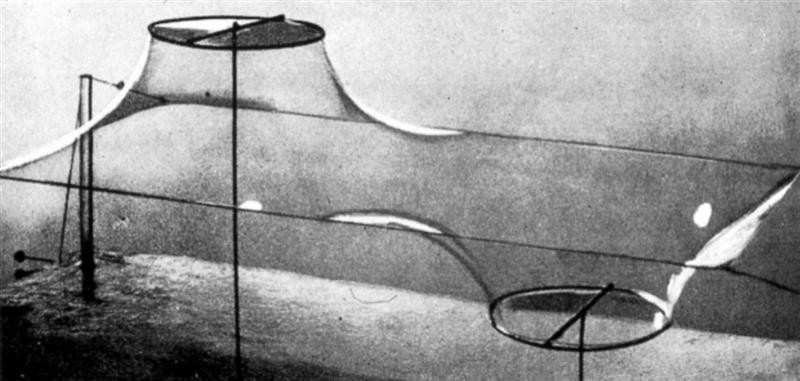

Like everything else here, Otto's structures are force diagrams. The sculptor Tobias Putrih creates bubble sculptures inspired by Otto's work:
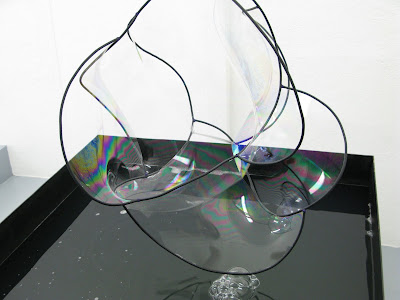
-
The Body as a Diagram of Forces (with Diagrams!)Also worth noting that the femur, with it's cross-hatched pattern of stresslines, was also (one of the) inspirations for the Eiffel tower, in what counts as one of the coolest applications of biomimetics I know:

https://www.wired.com/2015/03/empzeal-eiffel-tower/
"The Eiffel tower is incredibly well optimised to do what it was designed to do, to stand tall and stand strong, while using a minimum of material. Rather than hide its inner workings with a facade, Eiffel exposed the skeleton of his masterpiece. In doing so, he revealed its "hidden rules of harmony", many of the same rules that give your skeleton its lightweight strength." -
The Body as a Diagram of Forces (with Diagrams!)
It's the head of a fairbairn crane: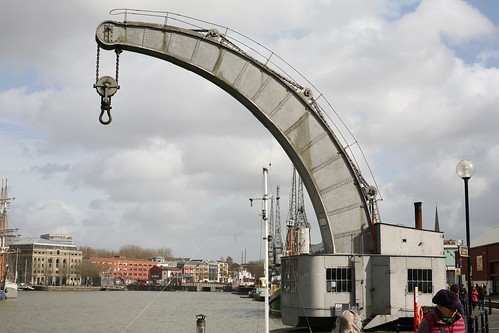
Also, thanks for the force diagrams but the most pertinant point is not to see forces diagrammed in the abstract (as 'graphs') but to see bodies themselves as directly diagamming forces. Bodies are diagramms (of forces). -
Word of the day - Not to be mistaken for "Word de jour."Yeah it's pretty Hanoverrated.
I did read this when it came out, I remember finding it inordinately cool. -
Word of the day - Not to be mistaken for "Word de jour."Astrolabe: a catcher of heavenly bodies, literally 'taker of the stars'; used to measure the incline of celestial objects and help find one's way. From the Greek astron, "star" (hence astrophysics) and lambanein, "to take". Said to be invented by Hypatia, one of the earliest female mathematicians and philosophers, and was used against her when the Christians - barbarians as they were - flayed her and tore her limb from limb; the astrolabe was said to be a pagan tool of divination, of which she was accused.

-
Word of the day - Not to be mistaken for "Word de jour."I wonder how the word came to also mean "speak carefully — T Clark
'String your words together carefully' (join them well). Wordsmithing. Like carpentry or woodsmithing. -
The Body as a Diagram of Forces (with Diagrams!)One can - and should - also see inorganic, macroscopic bodies as diagrams of forces too: bodies of water as diagrams of water flows:

Bodies of cities as diagrams of population flows:
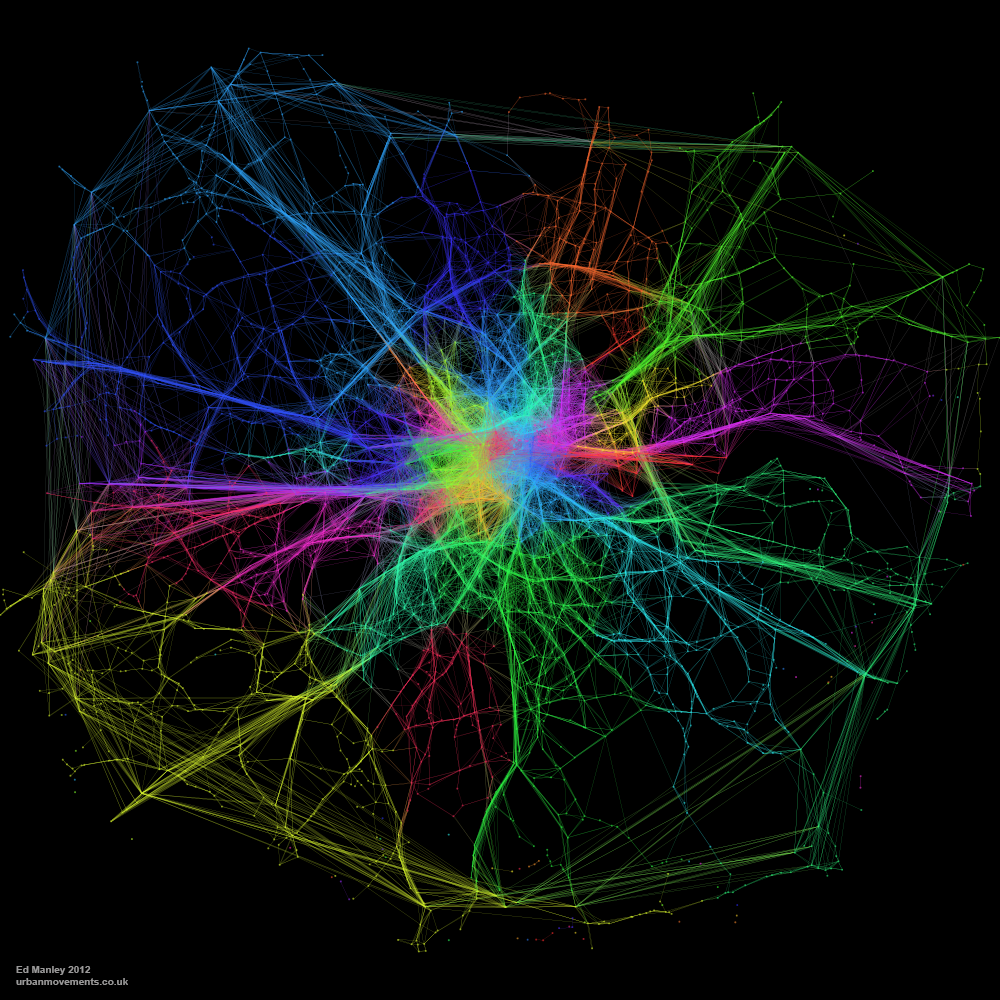
(data visualisation of traffic flows in London)
Airflows across an F-18:

All more examples of bodies - broadly construed - as diagrams of forces. Another way to put this of course is that all of these things are ecosystems... -
Word of the day - Not to be mistaken for "Word de jour."I've always loved the word 'articulate'. From the Greek arthron, meaning 'joint'. Giorgio Agamben glosses it as such: "arthron, an articulation; or rather, a discontinuity that is also a continuity, a removal that is also a preservation (arthron, like armonia [Harmony - SX], originally derives from the language of woodworking; armotto signifies to conjoin, to unite, as the woodworker does with two pieces of wood)".
Arthron was also just the word Plato used when talking about 'carving Nature at it's joints', the vocation of philosophy as such. Also related to the words 'particular' and 'article': 'a small part', the bits of wood which are articulated by the joint.
Continuum! Residuum! -
The Body as a Diagram of Forces (with Diagrams!)Rodin's The Kiss is probably another, awesome example of bodies as shaped by forces, although perhaps one can speak here of amorous forces, eroticism articulated in the bend of elbows and twist of torsos:

-
What Is Contemporary Right-Wing Politics?Hmm, I'm not sure about this connection. Politics derives from the Greek polis or city (as in metro-polis), which in turn has cognates to the Greek poly, many (as in, polyamorous). Politics is intimately connected to the city as a state of social organisation, in which strangers live together, and have to negotiate how to live with one another. One can further refine the political by noting that it is often set in contrast to the space of the family or the home (the oika), in which relations of kinship rule. Negatively speaking, political relations are those which are not kinship relations:
"The rise of the city-state meant that man received 'besides his private life a sort of second life, his bios politikos. Now every citizen belongs to two orders of existence; and there is a sharp distinction in his life between what is his own (idion) and what is communal (koinon)'. It was not just an opinion or theory of Aristotle but a simple historical fact that the foundation of the polis was preceded by the destruction of all organized units resting on kinship, such as the phratria (brotherhood) and the phyle (clan/tribe). (Arendt, The Human Condition, embedded quote from Werner Jaeger, Paideia).
Polite, as far as I can tell, has a Latin root, which at the very least, post-dates the Greek, and if it is related to it, would be derivative of it and not constitutive, as it were. Still, the idea of accommodating differences - I think I'd prefer to say negotiating, which has a less conciliatory air - seems about right, even though I quibble about the etymology. -
Currently ReadingWilfrid Sellars - Naturalism and Ontology
Wilfrid Sellars - Science, Perception, and Reality
I've read some of Amery's book on the holocaust, and it was, as far as books on the holocaust go, really good stuff. Plan to go back and finish it at some point. -
More Is DifferentOne point to note about Kim and some of the other authors who have written on the topic: Many of them come to it from the perspective of the philosophy of mind, and among their principle concerns are mental causation, epiphenomenalism, eliminativism (about the mental), and so forth. I find it frustrating that in their exclusive focus on the mental they often don't seem to see the larger context of such questions: science (not limited to cognitive science) and other explanatory projects. I am glad that this wider context is the focus of attention here, rather than the parochial questions of the "mental" vs. the "physical." — SophistiCat
I agree entirely. The focus on mind has always been a bit of sideshow I think - albeit a deeply interesting one - but a sideshow nonetheless. -
Any suggestions for undergrad senior paper?The philosopher that might be most relavent to an investigation like that might be Bernard Steigler, especially his Technics and Time trilogy, where, like you, he argues that technology is indeed part of 'human nature' (although of course to say this is to complicate what we mean by human nature). Steigler is a hard read though and alot of what he says is grounded in some serious phenomenology and deconstruction (i.e. Husserl and Derrida). There's alot of good secondary literature on him though, which might be a good place to at least explore and see if he's what you're after (if you can find it, the collection Steigler and Technics, edited by Christina Howells and Gerald Moore, is excellent).
Otherwise, David Wills (esp. his Dorsality and Prosthesis), Donna Haraway (Simians, Cyborgs, and Women), Katherine Hayles (How We Became Posthuman), Andre Leroi-Gourhan (Gesture and Speech), and Gilbert Simondon (On the Mode of Existence of Technical Objects), might also all be of relevance as well. -
More Is DifferentAs I said earlier, one can accept - one should accept, as a necessary condition of conducting science at all - methodological reductionism without at the same time acceding to any kind of ontological reductionism. Mostly because the latter is implicitly, if not explicitly anti-science.
-
More Is DifferentAhh, the Ellis comments are wonderful! This in particular:
"Whether we agree on causation or not depends on the weight you put on the words “nothing but” in the phrase “are nothing but constrained, structured, microphysical causal features”. I think the explanation above says it’s a mistake to use the phrase “nothing but”, because significant other causal effects are at work. Part of the problem for a true reductionist is that the electronic gate states are “nothing but” specific states of quarks and electrons; and these again are “nothing but” excitations of superstrings – if they exist, which may or may not be the case. Which level are you claiming is the true microphysical level? The embarrassment for a true reductionist is that we don’t know what the lowest level structure is – we don’t have any viable theory for the bottom-most physical states. Thus if we take your phrase at face value, all physics is “nothing but” we know not what. Why not leave those words out?"
At the very least, I like it because it chimes nicely with what I said regarding the use of '... is only' in reductionist discourse. And of course, the point that "the essential nature of the lower level entities is altered by the local context" - just is the point of this thread. Although the interesting question is then - just how 'essential' is the so-called 'essential nature' when if such 'essence' is altered by local context? What kind of plastic essence is really at stake here? The explanation regarding Cooper pairs and their literal non-existence before the formation of the corresponding lattice structure is also really cool. I'm going to have to keep that one in my back-pocket. -
More Is DifferentWhile the Merleau-Ponty school is headed towards a sense-data view - one that risks takes qualia too seriously as drops of conscious experience. — apokrisis
It's important to note that this is entirely implausible on any reasonable reading of M-P, who spends page after page in the Phenomenology arguing against such a view. -
More Is DifferentYes, I understand that. Crowther doesn't use the word either. She actually says "EFT" in order to avoid that. — T Clark
Just to clear up some terminology, Crowther does not use EFT as a synonym for 'emergence'; indeed, the whole question is whether or not EFTs admit emergence or not. EFT - effective field theory - is just a way of describing the behavior of a system at a particular scale, while ignoring parameters that, for the most part, are not relevant - parameters that might become more relevant at scales other than the one you're interested in. Thus, as you said, we ignore QM at macro scales, and we ignore relativity at velocities much smaller than the speed of light. And Crowther absolutely does use the word emergence: the crux of the paper is its attempt to provide nothing less than 'a positive conception of emergence', which is literally the bolded subheading of one of the paper's subsections.
Another important point to make is that Crowther's conception of emergence is theory-relative: it has to do with emergence between our descriptions of systems. She is explicit about this: "The conception of emergence espoused in this paper is presented as being one that is appropriate and important for understanding the relation between ‘levels’ of theories in physics". So it's not so straightforward as speaking about - as you put it - 'situations where higher levels "emerge" from lower levels in ways that are fundamentally unpredictable'. As I mentioned earlier to Caldwell, this is similar to Rosen's understanding of 'complexity', where what is complex is relative to our ability to model a system - specifically our ability to arrive at a 'largest model' capturing all the dynamics of a system. -
More Is DifferentI think the philosophical pursuit of truth is the drive for a single, all-encompassing explanation. — Dominic Osborn
No, that would be theology, not philosophy. Explanation follows the explananda wherever it goes, it does not subordinate it to prior stipulations.
In any case, give me arguments, not aphorisms. The latter are not worth much.
Streetlight
Start FollowingSend a Message
- Other sites we like
- Social media
- Terms of Service
- Sign In
- Created with PlushForums
- © 2026 The Philosophy Forum