
Comments
-
Why we should feel guiltyI'm not very interested in the cultural wars over race and gender, and I generally am no more than annoyed with it. — Bitter Crank
This, by the way, is precisely the kind of statement that discussions of privilege are meant to highlight. There are some who don't have the 'privilege' of being 'not very interested in the cultural wars over race and gender', but because those 'wars' are not abstract theoretical arguments, but a life that one has to live. Such wars may concern them whether they would deign to concern themselves with them or not. -
Why we should feel guiltyThinking back on that and other ways white people often act publically about that matter, it makes me thing well-meaning people feel some shame and need to prove publically that they're not guilty of sins of their ancestors, or KKK demonstrators. — Marchesk
I'm less interested in the 'is' of guilt here than the apparent 'ought' of guilt: the idea that apparently, acknowledging privledge entails a normative injunction to feel guilty for that privledge. I've seen lots of the first, not so much the second, and I'm wondering who exactly is supposed to be making such a link? -
Why we should feel guiltyOkay, but why are you talking about guilt? Is anyone but you talking about guilt? Especially guilt that one 'should' be feeling? Or is this just a bunch of introjection now projected outwards?
-
Why we should feel guiltyI've heard the references. I'm wondering about the 'implications' you're drawing from them, and how warranted they are. I'm particularly interested in the 'guilt' implication, and where you would have picked that up from. Sources would be good.
-
Why we should feel guiltyHowever, casting guilt seems to be the intention of referencing white privilege, male privilege, first world wealth, etc. — Bitter Crank
Is it? Has anyone in particular suggested that this is the intention, with respect to those who do make such mentions? -
Why we should feel guiltyWhy should you feel guilty? Has anyone in particular suggested that you should?
-
#MeTooI'm deeply disappointed by the tone and content on Streetlight's part (often a careful thinker). — Roke
I've been intentionally callous, but then, there's so little here worth taking seriously. Pseudonym reels off so many words, all the better to not talk about the me2 movement at all. The essential complaint being that the conversation occuring is not the one he'd like to have. How irrelevant.
And to criticize a movement built off of calling out actual, concrete instances of harassment involving named individuals as being too ambiguous? Snake oil undeserving of anything but contempt. -
#MeTooIt's the basic reactionary conceit: when faced with real life cases of concrete harm, retreat into abstract universals and ham up intectualized ambiguity, all the better to avoid the confrontation with actual, documented, and widespread hurt.
Yes real life concrete human being Weinstein was evil, yes real life concrete human being Louie acted unconscionably, yes real life concrete human being Nassar was a child predator, but this metoo stuff is just so ambigious! -
#MeTooOh right, so what you're saying is you're not talking about any of the concrete cases and real life incidents that have defined the major thrust of me2 movement so far, and are speaking entirely specutively about nothing in particular. Okay, cool.
Edit: I think I accidentally deleted my post (was trying to edit it), or it might have been deleted by someone else. Either way. -
#MeToo"Of course men can't control themselves".
"Women secretly like it".
"Consent is pseudo-ethical".
"It's all subjective tho lol".
Retroactive addition: "If you disagree you hate men lololol" -
Why were 2 of my threads deleted?If it helps, ProgrammingGod was banned a few days ago - and if you don't notice Mad's missing threads, it's because he hasn't yet complained about them.
-
#MeTooThe me2 movement has been the source of some of the most intense and widespread conversation regarding sexual conduct in the public sphere in a long time so I still have no idea what you are talking about. Not that this had anything to do with what I said or posted at all.
And the qualifier about gay men simply meant that the exact same thing applies to them, only obviously, with other men. -
#MeTooBut of course men can self-monitor. They do it with other men. The straight ones anyway. It's literally as simple as that.
-
#MeTooExcellent article by Sara Maurer on how Daphene Merkin's critique misses the dimension of labour in the me2 movement:
"Merkin may be faithfully representing the women she knows, but her picture does not reflect the concerns of most American women, almost all of whom work because they need the money and not because they are seeking sexual partners. I would like to suggest to Merkin that this majority of women sees the #MeToo movement not as about fragility but about labor.
...We also don’t want advancement at work to depend on labor not required of men. Did male comedians have to sit in a room and watch Louis C.K. jerk off in order to network? If they didn’t, why should female comedians have to do that work? Did any man working for or with the radio host John Hockenberry have to deflect multiple obsessive email solicitations, unwanted physical contact, and declarations of love? Did male graduate students of David R. Marchant have to put up with barrages of sexual insults to do field work with him?
Why should women have to do that work to get the same results? Why should we have to pretend that we don’t mind? Why should we have to be the ones to get over it? Couldn’t men just as easily self-monitor? Why not make men responsible for that labor?". -
Please allow upvoting and downvotingWe all know I'd upvote nearly everything SLX writes. — Akanthinos
(Y) + 1
:P
I remember being a little put out when we took it off here, but I've come to realise that it's just with better without. It puts a stop to a weird micro-politics that detracts from the substance of posts. -
Why was my comment to SLX deleted?The article linked to was a conspiratorial hack piece. Anything thinking it worthy of discussion is nothing other than just such a sympathizer. I'm not discussing this further.
-
Why was my comment to SLX deleted?"Racists, homophobes, sexists, Nazi sympathisers, etc.: We don't consider your views worthy of debate, and you'll be banned for espousing them."
To this list one can add, with no mental gymnastics, serial child rapist sympathizers. It's pretty clear cut, and yeah, I don't consider the topic worthy of debate. -
Why was my comment to SLX deleted?I deleted it. If you'd like to discuss the merits of defending convicted serial child rapists, I'd prefer it not to be in a perfectly good thread about interesting philosophical websites.
-
The trolley problem - why would you turn?Damn fine first post! Nicely summerizes why I reckon the trolley problem is basically toy ethics - fun to play with, but almost entirely unilluminating.
-
Exploding ElephantsBut that evolution locates local peaks in fitness is precisely the point! A mouse's metabolism along with its regulatory mechanisms is optimised for it's local evolutionary niche, and blowing it up to an elephant (or vice versa) and expecting it to work is precisely to ignore that local optimisation.
Sure, there are some mechanical limits to what regulation can do, as I said. I haven't found a mechanical limit with regards to temperature, just your assertion that the difference seems to be too big. — Agustino
Well given that the internal temperature tolerance range of mammals lies within the range of a single degree or so, and given that the kind of 'regulation' you're talking about would need to alter metabolic rates by 3600%, in comparison to the usual 2-11% intra-daily resting metabolic variation, again, you're basically arguing for magic. -
Exploding ElephantsDid dinosaurs have massive ears? :B This ears argument is nonsense. Sure, hippos spend PART of the time in water. But not all of it - they also spend part of the time in the sun. — Agustino
If by 'a part' you mean about 16 hours a day, sure. Long enough, in other words, that water would function as the environmental niche driving hippo morphology. And while the dinosaur question is still open, the evidence is that they were mesotherms (if not simply exotherms out-and-out), which means they employed a mix of hot and cold-bloodedness to regulate their temperature, which is (one of) the reasons they could get so big. They can't then be meaningfully compared to either the hot-blooded (endothermic) hippo or elephant.
The main point is once again that failures are unlikely to come from the organisms inability to self-adjust its functioning - they will rather be due to mechanical reasons. — Agustino
Sure, but the very limits of the mechanics would be themselves evolutionarily derived: that a heart wall is this thick and not that thick, that bone density would be such and not so, is not just an accident of mechanics but a function of evolutionary honing. The case is the same with respect to metabolic regulation; again, consider the numbers: the scaling difference in weight is 250,000x up or down, while the corresponding difference in surface area is a 'mere' 5000x up or down: any metabolic regulation would have to keep up with this 50 fold increase/decrease, which is just insane. It's literally nonsense.
As the gif above shows, an elephant would have to deform in an unimaginable - nonsensical - way for any such metabolic regulation to keep pace. You keep discounting the disproportion in rate of growth between surface area and volume. And let's further keep in mind that we're not just talking about a temporary limit-situation as with an atrial fibrillation event, but a permanent change. Even if it is granted that metabolic regulation might be able to kick into gear during a such a stress-event, no regulation would be able to keep up in the face of such permanence stress (and let's be clear: it's an understatement to even call 'stress' itself an understatement in the scenario we're talking about).
You keep leaning on 'regulation' as though it were some magical instrument that can simply alter metabolic and other rates willy nilly: but this simply flies in the face of any understanding of evolution and doesn't deserve to be taken seriously. Regulation is not magic, it is limited by 'expected' evolutionary ranges (which in turn, determine biomechanical limits), and would fail catastrophically in what could only really be described as a catastrophic biological event. Considering that a two degree difference is enough to set hypothermia at work in a human (and .5 of a degree change for hyperthemia), again, I simply can't take your recourse to regulation seriously. It's be like arguing that an oar could steer an oil tanker. It's magical thinking. -
Exploding ElephantsAh yeah, I saw that video when it came out but didn't remember it when writing this thread. But yeah, it basically gets at the thrust of one of the central planks of comparative physiology: big things are generally affected by gravity and not so much by surface tension, while little things are generally affected by surface tension and not so much gravity: and that this inverse relation has corresponding effects on morphology - the proboscis being something to keep an insect far away from liquids, something that isn't a consideration for a trunk.
-
Exploding ElephantsA contrario, we can observe that some living structures can be adapted (within reason) to multiple scale orders. Monkeys can be the size of mice or bigger than most humans. Feline will vary between 4 and 650 pounds. Yeah there are elephant species which are smaller than others, but you don't see any of the degree of variation present in, let's say, caniforms, feliforms or even ursidae — Akanthinos
+ @Augustino
But you're severely underestimating the significance of such a change here, I think. With respect to metabolism, we're talking about two creatures at almost the opposite end of the animal kingdom. The Etruscan shew spoken of in the video has a metabolic rate of about 6 Liters of O2/hour/kg; And African elephant has a rate of 0.164 L of O2/h/kg. That's a 36 fold difference, or a difference of 3600%. More numbers: an elephant on average weighs 250,000x that of a mouse/shrew; but following the scaling laws of surface/area to volume, a shew blown up to the size of an elephant would only have 5000x more surface area by which to expel the same amount of heat: thats a 50 fold difference. There is simply no conceivable way any kind of regulation would overcome the disparity in metabolism and size. It's just fantasy.
And this isnt' even to speak of the phyisological differences. As a furter instance, an elephant's skeleton makes up about 16.5% of an elephants total weight. This is a huge proportion - just under a sixth of it's body mass - one that is necessary precicely in order to support the elephant's giant weight. A mouse's skeleton by contast makes up about 8% of it's body weight, reflective of the fact that it simply doesn't need the kind of supportive structure that an elephant has. And this necessity carries over into other aspects as well: the musculature of an elephant would simply never develop in that way in a creature as small as a mouse or shrew. source (worth a read - covers the same ground as a video, possibly even inspired it. Actually, it's got a great gif of what the surface area of an elephant must look like in order to dispel the heat produced by the shew's metabolism:
 ).
).
Among the closest analogs of what an elephant might look like would be something like a mouse deer, which has a similar leg to upper body proportion to an elephant:

But notice the tiny, tiny girth of it's legs: which enable it to be both nimble, and are all that is necessary to hold up it's similarly tiny tiny weight. The girth of elephant legs on a small creature would be idiotic - without the nibleness they provide, they'd be hunted down and eaten in no time. They're evolutionary nonsense. And with respect to ears, Aug spoke of hippo ears, and seemed to forget that Hippos spend most of the time in water, which does the majority of their cooling for them, so have no need for the massive ears of elephants: in fact another testament to the fact that form is intimately bound up in the immanent conditions which give rise to it (and the engineering of a hippo in general also reflects it's aqueous nature: it's eyes, ears and nostrils are all located as far 'up' on it's body as can be, allowing their senses to be operative while underwater).
All in all: form is only ever the product of immanence. -
Currently ReadingD'Arcy Thompson - On Growth and Form
Adolf Portmann - Animal Forms and Patterns: A Study of the Appearance of Animals -
Exploding ElephantsYou would have to gerrywork your universe a lot to justify the existence of an evolved hamster-sized elephant. Why would an animal so small evolve a trunk? It doesn't need to apply as much force to lift any amount of water, it doesn't need large, unflexible joints to prevent his own legs from breaking, so it's going to be easier for him to lower his head without toppling over.
Perhaps a world with higher gravity? — Akanthinos
Exactly. Such a thought experiment proves nothing but a basic misunderstanding of how evolution works on the part of anyone who would propose it. An elephant is as bulky and meaty as it is precisely because of it's size - there's no way it would have 'got there' had its evolutionary path taken the 'small' route. Not to mention it wouldn't have those ridiculous heat expending ears, or, as you rightly point out, that trunk (a proboscis, yes! Because liquid surface tension will murder you at that size and you need to stay far af from any liquid). An elephant would make no evolutionary sense at the scale of a hamster. -
Exploding ElephantsNobody is stating the obvious. If you enlarge the mouse would the metabolism rate not change? I'm guessing it would, because the organism would seek to adapt if it gets too hot. — Agustino
Err, bodily regulation happens with values within expected ranges for a particular animal's environmental niche - a change from mouse to elephant and vice versa would be orders of magnitude different. No amount of regulation would prevent near-instantaneous death. If no one has yet 'stated the obvious' it because it's so far from obvious as to be flat out silly. Just so we're clear how much of a non-starter it is, here is where a mouse and elephant stand in relation to each other on a heat/size scale:
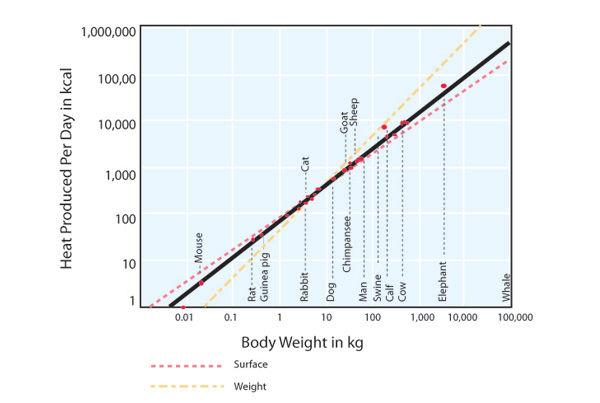
delicious sauce
Explosions and all round death, no ifs about it. -
Exploding ElephantsHmm, speaking of, Matt Damon's latest, Downsizing, really ought to be a kind of horror film, where people just die horrifically. And then there's Honey I Shrunk the Kids....
Stupid Aristotle, ruining films 2000 years after his death. -
Exploding ElephantsAhh, thanks for this! I love that he moves into a discussion of architecture at the end of the paper, and I think it's so important that these principles be seen as operating all across the scales of not just the living, but the non-living too.
The Gould paper T Clark linked actually talks about exactly this film. I think it's my favourite passage in the paper too, and it gets at what I was trying to say in the OP when I said that giants don't make much engineering sense:
"The creators of horror and science-fiction movies seem to have no inkling of the relationship between size and shape. These “expanders of the possible” cannot break free from the prejudices of their perceptions. The small people of Dr. Cyclops, The Bride of Frankenstein, The Incredible Shrinking Man, and Fantastic Voyage behave just like their counterparts of normal dimensions. They fall off cliffs or down stairs with resounding thuds; they wield weapons and swim with olympic agility. The large insects of films too numerous to name continue to walk up walls or fly even at dinosaurian dimensions.
When the kindly entomologist of Them discovered that the giant queen ants had left for their nuptial flight, he quickly calculated this simple ratio: a normal ant is a fraction of an inch long and can fly hundreds of feet; these ants are many feet long and must be able to fly as much as 1,000 miles. Why, they could be as far away as Los Angeles! (Where, indeed, they were, lurking in the sewers.) But the ability to fly depends upon the surface area of wings, while the weight that must be borne aloft increases as the cube of length. We may be sure that even if the giant ants had somehow circumvented the problems of breathing and growth by molting, their sheer bulk would have grounded them permanently."
Gould's invocation of the 'possible' offers a way into what would be a very interesting discussion about questions of modality - over which the pathetic efforts of analytic philosophers to construct 'modal metaphysics' would show themselves for the shame-inducing embarrassments they are - but I'll lay-by that to another day, I think. -
Exploding ElephantsThe material ontology consisting of inert, amorphous matter substrate as a distinct existent, with form and/or animating spirit or force or process acting on it as another distinct component of existence is both ancient and surprisingly ubiquitous and persistent. For example, ancient materialists, who you would not think of as natural allies of Plato, also believed something like this. And this sort of thinking is still current.
Of course, proponents of this view would not be much discouraged by your exploding elephant - they would just push "matter" to lower, sub-cellular scales (as, of course, has long since been done in the normal process of scientific reductionism). — SophistiCat
Yep, exactly - the entire hylomorphic schema inherited from antiquity - determinate form descending upon inert and ready matter - needs to be shot out into space, never to return again. While I think you're right our hylomorphic enthusiast would simply scale-down, I suspect the problem he will run into is that at a certain level he will simply lose the very phenomena he means to explain: form.
Another thing that this video reminded me of (again): You often hear people say how machine-like biological mechanisms appear to be - surely, a hallmark of design! I think this is just a superficial impression that is an artifact of the way we analyze and present scientific models, which is like engineering in reverse (or reverse engineering). The impression I get is the opposite. When you look at living things with an unprejudiced eye, as well as when you learn the bewildering array of biological facts, such as those described in the video, it strikes you just how messy and complicated and thoroughly alien these things are. They are so obviously not designed by anything like a human designer*, but grown, evolved through billions of generations across billions of individuals in a blind and unthinking, but massively integrated process: integrated across all physical scales, all the way to the bio-chemical and even quantum mechanical level — SophistiCat
Again, yes! Part of what at stake here is precisely the way in which constraints like size, gravity, heat, and surface area do so much of the 'heavy lifting' of 'design' that any need to posit some kind of singular 'engineer' behind it all can only come off as ridiculous. Behind the divergent paths of the mouse and elephant lie the same physical-chemical principles that quite obviously were harnessed by evolutionary processes in ways distinct to each, as their phylogenetic paths played out in real time. I just finished reading, not too long ago, Peter Hoffman's Life's Ratchet, where, after looking at a whole range of exquisitely 'engineered' molecular 'machines' (operating quite obviously at a way different scale from what are discussing), he ends up drawing the same conclusion:
"Looking at molecular machines has made me realize that evolution is the only way these machines could have come to exist. As we have seen, life exploits all aspects of the physical world to the fullest: time and space, random thermal motion, the chemistry of carbon, chemical bonding, the properties of water. Designed machines are different. they are often based on a limited set of physical properties and are designed to resist any extraneous influences. the tendency of molecular machines to use chaos rather than resist it, provides a strong case for evolution ... The ability of life to somehow incorporate thermal randomness as an integral part of how it works - as opposed to giving in to the chaos - shows that life is a bottom-up process. It is not designed from the top down."
This notion, that life is basically a scavenger, using all the bits and bobs it comes across as it tinkers away in real time, is similarly what comes across in the comparison between the mouse and elephant in the video above.
Streetlight
Start FollowingSend a Message
- Other sites we like
- Social media
- Terms of Service
- Sign In
- Created with PlushForums
- © 2026 The Philosophy Forum