
Comments
-
Problem with the view that language is useNah, my comment wasn't really directed at you in particular.
Unique, unconventional language use happens, but for the most part, language games utilize convention. — Mongrel
Sure, but it is vitally important that the notion of use in a language game is made categorically distinct from 'conventional use'. To conflate the two is render Wittgenstein unintelligible. -
Problem with the view that language is useMm, the 'use' in 'meaning-as-use' has never referred to 'conventional use' but 'use in a language game' - and to be in a language game is to be not 'conventional', but to be 'conventializable' - to be, in principle, the kind of thing that can be used conventionally, even if it never, in fact, becomes conventially used. A word employed in a particular language game may be used once in a particular way, and for whatever, totally contingent reason never be used that way ever again by anyone else living or dead, and it would still fall under the rubric of 'meaning-as-use'.
-
What is the essence of terrorism?One thing to note is that terrorism is largely born of failure. It is the resort of those who, lacking access to official mechanisms of power or legitimacy, exercise what little they have in the most 'accessible' and spectacular (as in 'spectacle') way possible. Terrorism for the most part is a sign not of strength, but of weakness. In some way, it's precisely as a 'compensation' for this weakness that acts of terrorism are generally so public and so 'spectacular' (they are made for 'spectators' - terrorism does not happen 'in private' or 'behind closed doors').
The idea is to make, as it were, ten armed men feel like a hundred armed men, to inflate strength by means of overloading the airwaves with a short, sharp, shock (which is all that can be sustained - terrorism is what happens when you cannot sustain protracted conflict for lack of resources). This birth-from-failure also explains why terrorists are often so willing to die for their causes - they simply don't have much else to lose: there is generally no community, society or polity to defend or return to in the aftermath of the terrorist act.
Another thing to note is that terrorism relies on countervailing power in order to be effective. Terrorism is designed to mock power, to show that despite whatever security apparatus might be in place, terror can nonetheless still strike. It's effects are meant to be extended in time - 'this' one terrorist act stands for a line of ever-possible terrorist attacks that can happen at any time in it's wake, because for all the strength that the 'enemy' has, he can not/did not stop this one attack. This is what lends it it's 'terrifying' dimension.
For a recentish take on some of this re: ISIS, see: http://time.com/4393398/isis-terror-attacks-turkey-iraq-bangladesh/ -
What is the meaning/significance of your avatar?
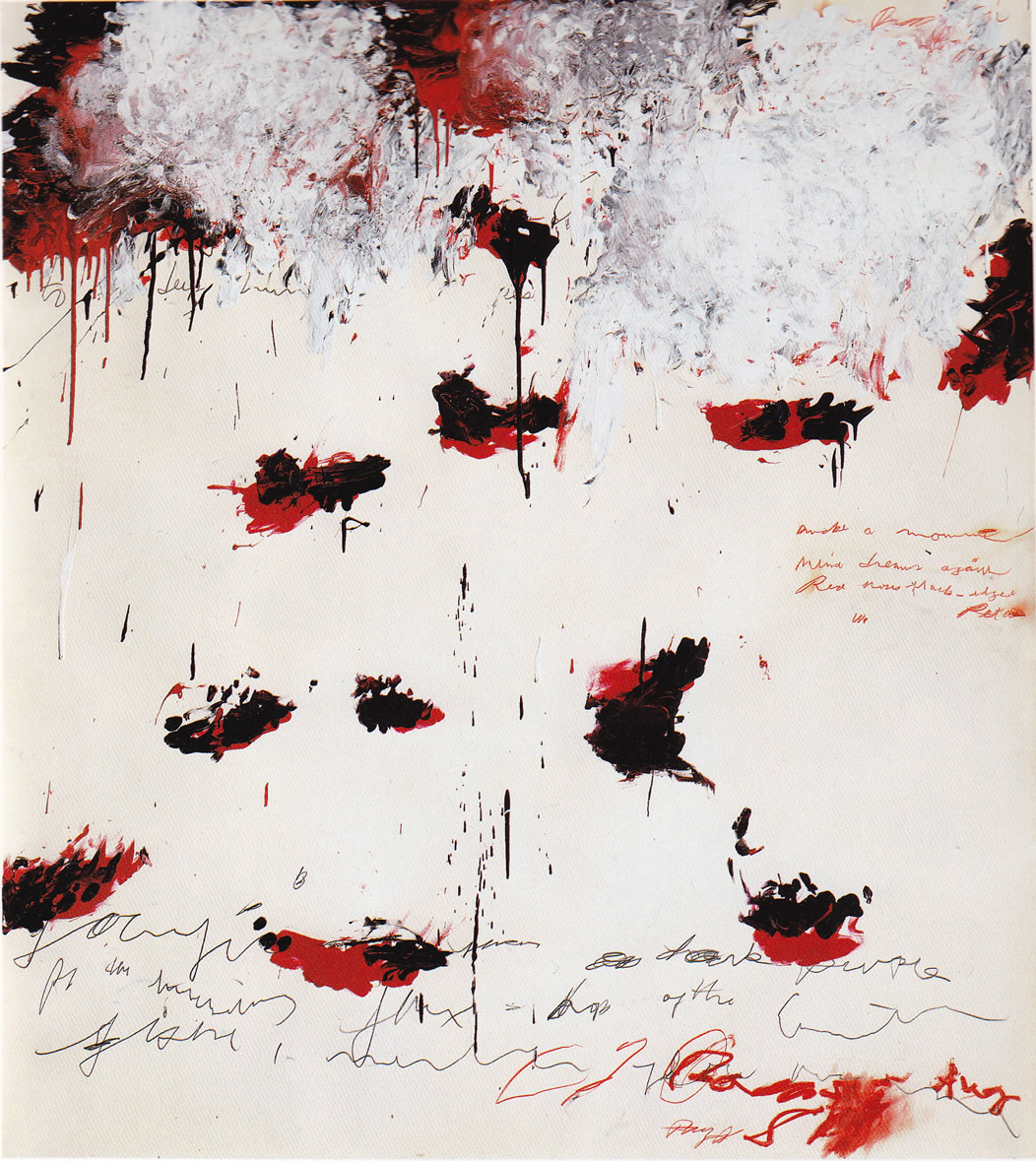
Petals of Fire by Cy Twombly. I think it looks pretty (and a little menacing too). -
Currently ReadingWendy Brown - Undoing the Demos: Neoliberalism's Stealth Revolution
Raymond Geuss - Politics and the Imagination (new copy :D ) -
Is Atheism Merely Disbelief?I don't see the relevance of any of these points. One can well be motivated - and indeed strongly so - by incoherent ideas, and those ideas may in turn be motivated by very real 'existential issues'. None of this speaks to the coherency or sensicality of those ideas themselves, be they the idea of God or anything else. I'm just pointing out that atheism for me means simply rejecting the entire theological problematic out of hand, which includes the need to even dignify the very questions about the existence of God or belief or other theological philosophemes.
-
Is Atheism Merely Disbelief?Does one 'not believe' in square circles? Or is to speak of belief already to concede too much? i.e. that there is anything coherent to 'believe' or 'not believe' in to begin with? Shouldn't a thoroughgoing a-theism not simply reject 'belief in God', but the very 'god-problem' to begin with? Let's not grant God the dignity of even being 'dead' - there's never been anything that was - or could have been, in principle - alive in the first place, and to even speak of 'non-belief' is already to concede far too much to theology - i.e. that the very issue is at all sensical in any way: that 'God' is anything more than a grammatical mistake for which even very idea of belief is already irrelevant.
-
Problem with the view that language is useYou simply can't help yourself from using words to point to states-of-affairs. — Harry Hindu
Sure, but this has no bearing on use-theory. Or if you think it does, then you don't understand what it entails. Which seems pretty clear from your posts here. -
Problem with the view that language is useSo no argument from you then OK thanks for playing.
-
Problem with the view that language is useBecause? Is no one able to make arguments in this thread?
-
Problem with the view that language is useI had a thread a bit back on Wittgenstein's meter, framed as a discussion of examples. Perhaps some might find it useful?
-
Problem with the view that language is useAgain, all that can be granted - however contentious and however wrong I think it is - without putting into question the use-theory. But my spade is turned. I do not think you know what it is you are objecting to.
-
Problem with the view that language is useOk, but that has nothing to do with meaning in language. Again, one can grant all you're saying without it being in any way an objection to the use-theory.
-
Problem with the view that language is useAgain, your objection simply isn't relevant. Whatever the 'cause' of your 'use of language', it does not bear upon a theory of how language comes to mean things. Even if it is granted that what you communicate is given by your 'intent', how you communicate it - that you have to follow certain grammatical strictures, that you have to use words, phrasings and expressions at least minimally familiar to others, that you have to follow certain temporalities of communication (e.g. subject-object-verb, in that order) - is radically shaped by the need to adhere to certain manners of speaking which are not given by your 'intent' nor 'will' nor 'feeling'. You have to, as it were, enter into a language that 'precedes' your intentions in order 'take-up' that language for your purposes, and you can only do so much with it before bending it out of shape. You're confusing the 'what' and the 'how' of language, and thinking that the former functions as an objection to the latter. But it doesn't. They are simply two separate issues. What you say is not 'wrong' per se, but irrelevant.
-
Problem with the view that language is useExcept meaning is use in a language game. A language-game may or may not be 'actual' (may not be actively employed by a community of speakers, or any speaker in particular), so long as, in principle, one can 'know how to go on' after being inculcated into the game. It is a question of grammar ("Essence is expressed in grammar … Grammar tells what kind of object anything is" - PI §371, §373) This is why, btw, any casting of Wittgenstein is a behaviouralist is wrong.
-
Problem with the view that language is useThe reason people use words is to communicate. How they use the words is what they communicate. You have an idea you want to communicate and if you don't use the words just right, then you end up not communicating at all. — Harry Hindu
Again, this is irrelevant to a thesis about how words come to mean. How words come to mean, and the motivations for their employment are two entirely different issues. -
Problem with the view that language is useI don't see the relevance of the question. The reason people use words has nothing to do with how words come to mean.
-
Problem with the view that language is useAgain, if meaning is use, then I can use any word, or any scribble for that matter, to mean anything I want — Harry Hindu
Yes, you can. You may not be very comprehensible to others, but in principle, this is exactly the case. -
Problem with the view that language is useAnd if meaning were use, then why are dictionaries full of definitions rather than uses of the word? — Harry Hindu
This is exactly wrong though. Dictionaries just are catalogues of word use. This is why dictionaries constantly introduce new words, and indeed, offer multiple definitions of words in some cases. They track how words are used. 'Definitions' in dictionaries track word use, not the other way around. -
Problem with the view that language is useMeaning as use has it's root in behavior, not cognitive science. — Marchesk
Not once in our exchange have you even used the word behaviour, let alone cognitive science. So no, you have in no way made that clear. But again, I see no argument here. I'll excuse myself. -
Problem with the view that language is useOK, and what does that have to do with meaning-as-use? This is the last time I'll ask I'm afraid. So far you've yet to present an actual argument - one that doesn't beg the question - and I'm tiring over asking for one.
-
Problem with the view that language is use2. Animals have their own language games were the meaning of signals is determined by use.
3. Animal language games lack abstract language features.
4. Therefore, there must be something about human language beyond use. — Marchesk
But this doesn't work either. All you've done is identify a distinction, and then assert without argument that meaning-as-use is not compatible with abstract language features. But this is another instance of begging the question. Why is meaning-as-use not compatible with abstract language features? What even do you mean by abstract language features as you understand them? What is it about (1) meaning-as-use on the one hand, and (2) abstract language features on the other, that makes the two incompatible? This is what I'm trying to get you to articulate. -
Problem with the view that language is use2. But, word use alone cannot explain the existence of universals, metaphors, math and logic in human language games. — Marchesk
But this is just the conclusion you're trying to establish. You can't use it as a premise without begging the question. This is the very thing im looking for an argument to underwrite. -
Problem with the view that language is useI'm still not sure I understand. Even if it is granted that 'our brains must be capable of thinking in terms of universals' (in order to designate concepts), what is the connection here with a theory of meaning? Perhaps try a syllogism? (P1)Meaning-as-use says... (P2)But... (C1)Therefore...? Fill in the ellipses?
It seems like you're trying to say that there are antecedent conditions that must be fufilled in order for the theory to work, but something like that could well be incorporated without putting it into question. -
Problem with the view that language is useMy suspicion is that use (alone) cannot explain abstract thought (or metaphor), and that's what I'm fumbling to get at. — Marchesk
But why not? What is it about concept use that puts the use-theory into question? I'm just trying to understand the actual argument behind the suspicion here. -
Problem with the view that language is usePart of the argument, to the extent that I understand it, is that there must be some sort of categorical difference between humans and animals with respect to the posession of a faculty called 'language'. But I don't understand why this ought to be the case. There can indeed be precise distinctions to be drawn with respect to different 'kinds' of language use - iconic, indexical, symbolic, or even analog and digital - but to say categorically that 'only humans posess language' (without elaborating on what is meant by language here), seems arbitrary and not a very useful way of thinking about things.
-
Currently ReadingHannah Arendt - Between Past and Future: Eight Excercises In Political Thought
Wendy Brown - Politics out of History -
Foucault and freedomHello - one of the classic resources on this is Johanna Oksala's aptly named Foucault on Freedom, which, if you're lucky, you might be able to find at your uni library or something similar. It's heavy on the phenomenology though, which you might find tough if you're unacquainted with it. There's also Charles Taylor's paper "Foucault on Freedom and Truth", which is one of the go-to papers on this topic, and which you can find online with a quick Google search. Joseph Rouse has a nice reply to Taylor in his article on Power/Knoweldge, which, while it doesn't deal with freedom directly, has things to say which are of direct relavence to your questions here. Also, you have have have to read Foucault's interview “The ethics of the concern of the self as a practice of freedom” collected in the edited collection “Ethics” (ed. Paul Rainbow). You can find it here. The distinction he makes between liberation and freedom is crucial.
My own approach to this question - it's one that's interested me for a long time - is shaped though psychoanalysis, which, although seeming somewhat tangental, has some of the best things - imo - to say about the way Foucault approaches freedom. In this vein, check out the first chapter of Joan Copjec's Read my Desire, the whole of Fabio Vighi's Zizek: Beyond Foucault, Aurelia Armstrong's article Beyond Resistance, and even Judith Butler's The Psychic Life of Power. A useful read might also be Wendy Brown's States of Injury, although that's a little bit more political theory based than 'philosophy proper' (but Brown is nonetheless among the best readers of Foucault on freedom, and has the merit of using and extending, rather than simply reiterating, Foucault's views). Not all of these approaches or authors agree with each other, but I think they're great reading to get a handle on this material.
Briefly though - no, there is no such thing - or rather than can be no such thing - as extra-discursive freedom for Foucault. Freedom is always imbricated with power and there is no freedom that can exist 'beyond' it. -
TPF Quote Cabinet"Theory depicts a world that does not quite exist, a world that is not quite the one we inhabit. An interval between the actual and the theoretical is crucial insofar as theory does not simply decipher the world, but recodes it in order to reveal something of the meanings and incoherencies with which we live. This is not simply to say that political and social theory describe reality abstractly. At their best, they conjure relations and meanings that illuminate the real or that help us recognize the real, but this occurs in grammars and formulations other than those of the real."
- Wendy Brown -
Discussion: Three Types of AtheismAh, but you forgot my favourite 'type' of atheism - serene atheism, in which the problem of God simply... isn't one; in which the only proper orientation to God is sheer indifference, where God's 'existence' or 'non-existence' are not even problems, beneath consideration, a triviality: "A tranquil atheism is a philosophy for which God is not a problem. The non-existence or even the death of God are not problems but rather the conditions one must have already acquired in order to make the true problems surge forth" (Deleuze, Dialogues). Put otherwise: the very idea of a God is a grammatical mistake - it doesn't qualify as a coherent object of serious reflection - either positive or negative.
-
Currently ReadingWendy Brown - Edgework: Critical Essays on Knowledge and Politics
Wendy Brown - Walled States, Waning Sovereignty -
Currently ReadingWas it a wild Geuss chase? — John
Take a Geuss :P
I'm so sad though, I left a bag in a taxi with Politics and the Imagination in it and it was such a good book :( -
Post-intelligent design*Yawn*. We've always-already been in a 'post-intelligent design' world, and the only people for whom this is an issue are those who've been under the illusion that we ever understood (or could, in principle, 'understand') - in anything more than a partial, interest-laden and provisional way - the forces at work in the world, along with the effects they have. Technology and its effects have never not outstripped our understanding of them, and it has always - and will continue - to play roles in shaping futures we can barely glimpse. It's only ever been within the confines of the four walls of the laboratory or the workshop - that is, in contextless, condition-fixed space - that anyone has ever had 'full comprehension' - and this because of the artificial (and useful) necessity keeping the scope at which that comprehension operates as fixed and small as possible.
So he's right about 'hyper-fragility', but this isn't something new or novel - this has literally been the condition of the Earth since the beginning of it's existence. -
What criteria do the mods use?Actually one of the unspoken rules we have is that we delete every 24th post which opens with the letter T and ends with the letter S, but if and only if it's a full moon that night. We've probably arbitrarily gotten rid of at least 17 posts that way.
#SecretAgendaRevealed -
TPF Quote Cabinet"The immediate disqualification of historical arguments as instances of “the genetic fallacy” often misses the point that a historical narrative is intended to make. Historical arguments often have a completely different aim and structure from purported refutations. They are not in the first instance intended to support or refute a thesis; rather, they aim to change the structure of argument by directing attention to a new set of relevant questions that need to be asked. They are contributions not to finding out whether this or that argument is invalid or poorly supported, but to trying to change the questions people ask about concepts and arguments. One of the effects that one type of historical account ought to have is that of causing it to seem naïve or “unphilosophical” simply to make a certain set of assumptions ...Historical enquiry will not by itself necessarily ensure that one asks the right ones, but it can contribute to helping to avoid certain ways of thinking that will lead only to confusion."
- Raymond Geuss
Streetlight
Start FollowingSend a Message
- Other sites we like
- Social media
- Terms of Service
- Sign In
- Created with PlushForums
- © 2026 The Philosophy Forum