
Comments
-
Condemnation lossAnother thought would be that without a Wrong we could never settle a moral discussion as there is nothing but conflicting opinions butting up against each other. — shmik
Without a Wrong, or a Right, I don't see how one could settle on one's own decision, never mind settling a dispute with someone else. There has to be some agreement on what it is that is most important.
If we pile up all the moral abstractions-with-or-without-concrete-consequences that we cart around with us, one or two of those values is going to end up at the top of the heap -- the thing that we reference most often to settle decisions within our own minds, or attempt to settle with others. What is most Right? For some it is Security. For others Wealth. Comfort. Motherland or Fatherland. Art. Peace. Knowledge. Victory. Sex. Independence. Food. Love. High Status. God. Liberty. Visible Success. Survival. And so on--one or two being most compelling for individuals.
People employ reasoning, but they are driven by emotions. The thing we really value the most is the thing that has the strongest emotional power. That thing is going to determine what we feel is most Right most of the time, and (I think) will drive our reasoning.
Love, Art, Peace, or Knowledge might be the thing we profess to value most, but it is more likely to be something like High Status (relative to one's peers) or Survival and Security that drives us. There is likely to be a difference between what we say is the most important value (like Love and Truth) and what really drives our behavior (like Sex or Comfort). A jarring difference would be the normal human situation.
So, we may reasonably object to everything the Nazis (or Communists, or Republicans) represent, and pronounce them Wrong, but what really makes us hate them as WRONG is that they are a threat to our own secure orderly life, our survival, and liberty to do what we feel like doing. Justice may not figure that highly in our motivation. -
Condemnation loss
The concept of Right and Wrong were flattened out for ardent Nazi Party members, ardent SS operatives, and like kinds: The Fuhrer's wishes are the only fact that matters. The further a German was distanced from this black hole, the more one could exercise one's own sense of right and wrong. It was the task of the Gestapo and National Socialist Party to make sure that no one felt that they were too far from the wishes of the Fuhrer, or your local Gestapo operative. -
HumdrumPer your link... Only the most philistine slobs would serve a cocktail in a plastic cup. Even if your vodka comes in a plastic bottle and costs pocket change a pint, you wouldn't drink it out of a plastic cup. (Cheap vodka is properly consumed directly from the bottle. It may be passed if it's a communion.
-
Humdrum
From the Sydney (AU) Post: Train running over man delayed 90 minutes. Passengers irritated by delay.
BTW, it wasn't an accident. IF the train had arrived on time, the bomb on the bridge would have exploded and the train would have crashed into the flood-swolen river. A woman had been asked to choose between throwing Banno under the train, or killing the one authentic, oppressed, colonialized, colored, transgendered, intersectional feminist on the train. Since it was a woke middle-class female adjunct philosophy instructor who did the choosing, she, of course, opted to kill the white man. (See the thread "wtf is feminism these days".) -
Wtf is feminism these days?!SINCE everyone may not be familiar with motte-and-bailey arguments, here is a brief discussion (This is at "Practical Ethics" an Oxford University site.)
From this page there is a link to an amusing discussion of motte-and-bailey arguments by a poster at Landover Baptist Church.

Green Alert: The site is satirical.
There is something similar about the threatening, edgy, hostility of right wing religious zealots and status-seeking, intersectional, oppressed, colored, female gendered, colonized zealots. There's a If you are not FOR us... (and we'll decide how "for us" you are, and whether you even can even count as "for us") then you are AGAINST us which you almost certainly are if you happen to have a penis, especially a white one. -
Radically Transcendent God, Ethics, Order and PowerAnd when Henry VIII wasn't divorcing or beheading a non-heir-bearing wife, he was busy burning monasteries -- partly to fulfill the Long Range Landscape Plan which called for romantic monastic ruins, but mostly because he was busy seizing their Roman Catholic wealth -- for his own use, and power.
-
Radically Transcendent God, Ethics, Order and PowerYour interesting OP is keeping me from getting to church this morning. I hope you are aware of the negative effect on my morals your writing has.
-
Radically Transcendent God, Ethics, Order and PowerThe pre-modern ages, on the other hand, were concerned with good and evil. ...if men did not, by a power structure, have to be devoted to their women, most of them would have treated women like nothing more than cattle that they would use and throw away after. — Agustino
What is the time of your dividing line between pre-modern and modern? 300 years ago or 3,000? 10,000--back to the time of the first buildings in Jericho?
This view of history is characteristic of modern consciousness — Agustino
Maybe intellectual discourse hasn't always been concerned with power structures, but those who had power or who were challenging a power have always been concerned about it. The Pharaohs, the kings of Babylon, the Roman emperors, the first feudal lord in his first small castle, the cruise director abroad a pillaging Viking longboat have all been pretty clearly concerned about power. And so have the recipients of exercised power. -
Radically Transcendent God, Ethics, Order and PowerBecause order still requires to be maintained. If it will not be maintained by the traditional power structures, then it will be maintained by the authoritarianism of the state - which is much worse. — Agustino
Well, I don't know... is order maintained by the state actually any worse than order maintained by other power structures--church, corporation, family...? If there is no state sufficiently strong to maintain order, then some other institution will become like a state, maybe the church, or the corporation, the local strongman. Is a secular authoritarian worse than a religious authoritarian? -
Radically Transcendent God, Ethics, Order and PowerThe state will move in to deal with this - it will take over children, how they are raised up, and so forth (out of wedlock birth is at 40% in US - up from 5% 50 years ago) - as a way to solve the problem that has been created. Soon we will slide once again into a totalitarianism - which is the necessary result of all forms of progressivism. — Agustino
The number of children born "out of wedlock" -- what a quant phrase that has become -- is yet another item in Hilary's basket of deplorables. [The out-of-wedlock rate in 2013 among Hispanic women was 53.2 percent. For African American women the rate was 71.4 percent. White women gave birth out of marriage at a rate of 29.3 percent in 2013, the CDC said. Aug 14, 2014]
But... while agreeing that 40% bastardy is deplorable, I'm not willing to agree that "totalitarianism is the necessary result of all forms of progressivism." You might, perhaps, have committed a sweeping generalization there.
The virtues will teach people how to be kind to one another, how to respect one another, how to care for the feelings of one another. — Agustino
Sounds good. We all like virtues, don't we? What, exactly, is the program for returning to the saving virtues of Aristotelianism? I'm thinking it would take a fairly robust exercise of power to throw the switch that gets the social trolley off the track leading to perdition and onto the track leading to salvation.
It's a bit tricky, because "virtues" are in themselves not active agents. The virtues of mutual kindness, caring, and respect are propagated by doing the virtues, not in teaching or being taught--though teaching virtue is a necessary thing. (Just "Be ye doers of the word...") -
Wtf is feminism these days?!Climate change, for example, is a racial issue because it's going to impact on different racial and enthic groups in different ways. Many parts of the world do not have the technology or capacity respond to the effects of climate change. — TheWillowOfDarkness
Headline in the New York Times: WORLD WILL END TOMORROW. WOMEN AND MINORITIES TO BE DISPROPORTIONATELY AFFECTED.
I don't think anybody has the resources to respond adequately or smoothly to the unpleasant challenges of global warming.
Just consider the cost of the intensified storms, flooding, droughts, and forest fires the US has experienced so far: In the last 6 years climate change has cost just the US around $150 billion. Two hail storms in Texas in March and April, 2016, lasting just a couple of hours each, cost $5.6 billion. How could that be? A lot of very large hail (up to 4.5 inches in diameter) and high winds struck the heavily populated area of Dallas - Fort Worth - Plano, TX. (Information from NOAA).
Granted, these are manageable in a multi-trillion dollar economy. But Hurricane Sandy cost $60 billion alone, and that damage is still being repaired. There are a lot of heavily populated flood-prone cities. A good share of Boston, for instance, was built on filled-in ocean-side marshes. New York took an unexpected beating from Sandy's flooding. So would Washington DC and other cities. Then there are the gulf-coast cities... New Orleans, for instance.
The US does not have the resources to smoothly relocate 20 million people from east and southern coastal regions, cope with a year round forest fire threat, periodic severe flooding anywhere a heavy, slow-moving rain front stalls, drought, tornados, hurricanes, forest fires heat waves, and other threats (insects, disease...) as the effects of global warming intensify. Let's hope the San Andreas Fault doesn't finally let loose the Big One.
So, Bangladesh is in far worse shape. There many millions of people live just a little ways above the average high-water mark, which keeps rising. They do not have the resources -- or the territory -- to move everyone into higher and dryer land. Where are these 30 million people going to go? India? Burma? Australia? China? California? Scotland? Uzbekistan?
I don't think it's a manageable problem. Global warming does and will disturb all plant, animal, and human ecologies and we probably will not be able to cope--which means the crises will not be met with adequate and graciously humane responses.
"We" didn't do "global warming" to "them". No one even suspected that there would be a long-term consequence to burning all the fossil fuel we could get our hands on until fairly recently--and already it was too late. The countries that burned a lot of coal and oil did so because it was there, and it was readily accessible, reasonably cheap, and it unleashed tremendous energy which we put to good use (more or less).
Global warming is a global disaster, a human catastrophe. -
Wtf is feminism these days?!I aIf rage is the rational response to these things, should I then project this rage at myself? — VagabondSpectre
No. You should not. It's not healthy for privileged males to feel as bad as relatively privileged feminists would have us feel. That advice, of course, is coming from an unrepentant W.A.S.P. male,
Not feeling guilty is a privilege, and since I'm privileged... I choose to not feel guilty. I don't feel guilty about the sun never setting on the British Empire. I don't feel guilty about manifest destiny, either, or the genocide of Native Americans. I don't feel guilty about the Holocaust. Guilt is the appropriate response for wrongful acts that one has committed. There are certainly many strong responses appropriate for all the wrongs of history, but guilt isn't one of them. Rage against the crimes of the past seems a bit beside the point, too.
I would not claim that everyone is a potential murderer (though there is some evidence that just about anybody might commit murder under the right circumstances) but I do insist that there is no group of like-minded people on earth who are incapable of launching atrocities against their enemies, their neighbors, and anyone who gets in the way. Were feminists to actually form a matriarchal state, they would be as prone to commit all the crimes of a patriarchal state, given the same amount of time in which to perform them--their high-minded rhetoric notwithstanding.
This isn't a reason to celebrate or gloat. It's just that there is no Promised Land of milk and honey. No matter where we go, there we are -- and we are a problem we have not come close to solving. -
Wtf is feminism these days?!I didn't listen to the whole talk, but long enough to hear that she has a coherent, reasoned view of history. From her perspective, big dick white males did indeed rape, colonize, co-opt, and corrupt the colored world, in oppressions of patriarchy, capitalism, colonialism, racism, sexism, etc. Rage is the appropriate response to this construction, though she wasn't raging here (as far as I watched).
From my perspective, what is universally true is that whoever happens to have superior power tends to expand at the expense of those with inferior power. Europe colonized so much of the world because it had superior power derived from superior technology (per J. Diamond's Guns, Germs, and Steel). It is also universally true that the recipients of colonization do not like it--no reason why they should. When they can, they revolt.
Homo sapiens behave this way. It's what we do. It's who we are. There isn't an acre of land worth having anywhere that somebody else hasn't tried to take it away from the previous occupants. This is true everywhere: in Africa, Asia, Europe, and the Americas. People accumulate, and those who are the most successful accumulators, as a rule, do not give very much away to less successful accumulators. Zama Joshi can look to her ancestral homeland (India) for vivid examples of this.
Identity politics focuses intensely on the specific over the general, which can (but doesn't have to) set the stage for an experience of continuous multi-point oppression. At any moment, in any location some specific aspect of an identity group is being oppressed, discriminated against, abused, disrespected, discounted, and so on. The narrow focus does not allow for a wider perspective (like, maybe at a particular moment nothing untoward was happening).
The longer, wider view doesn't miss the fact of maintained structural disadvantages and exploitation, but it allows one to also view the progress that has been made in reducing disadvantages and exploitation. The wider view makes it a bit easier to maintain emotional equanimity, which is damned useful in "the struggle". -
Wtf is feminism these days?!these kinds of people are a minority, but unfortunately they are the loudest and they are very very angry at times. — VagabondSpectre
The example provided in the video seems fairly far from ideology and much closer to someone who is in need of a sedative. Winding oneself up that way is either playing a "game of uproar" or it is uncontrolled anger. In either case, it was clinically interesting. -
How totalitarian does this forum really need to be?There is moderation and then there is immoderation.
-
Is addiction a genetic disease?When it comes to the nature/nurture debate I think it is clear that it's not really a matter of the one or the other. — Wilco Lensink
Right. Nature and nurture interact in enormously complex ways all the time. -
Is addiction a genetic disease?Are these phenomena "simply" chemicals having a mental effect? Does every psychological phenomenon have a biological counterpart or neural correlate or something like that? — Wilco Lensink
Animal cells communicate with each other electrically and chemically. Sometimes chemicals "cause" emotions, and sometimes chemicals "communicate" emotions. For instance:
If you are walking in the woods and you see a big snake on the path in front of you, you will probably have very strong feelings. Sighting the snake is the cause. The emotion "fear" is the response. As soon as the snake is recognized, a signal is sent to the adrenal glands (located on your kidneys) to squirt some adrenalin (the fight or flight chemical) into the blood stream. In just a second you feel a tremendous reaction and you jump back away from the snake, and a couple of seconds later you are ready for action. If the big snake turns out to be a tree root, you will still feel totally charged up for a little while, until the adrenalin is used up by the body's cells.
A new mother and father feel a rush of warm fuzzy emotion when they hold their baby. You also feel warm and fuzzy when you have wonderful sexual experience with somebody you love. Where does this warm and fuzzy feeling come from? The two parents went to a great deal of trouble to have a baby and they are very happy about it. This is the objective situation. So also is the good feeling of wonderful sex with a lover. But... Brain cells use electricity and chemicals to communicate. When the parents hold their baby, when you hold your lover close, the hypothalamus emits oxytocin. Oxytocin is the messenger that brings good feelings as a result of real experiences. The baby, your lover, is the cause. The chemical messenger is the result.
Now, if a researcher squirted some oxytocin up your nose, you would then feel warm and fuzzy and your reactions to the people around you would reflect the presence of the chemical. You would, it has been shown, trust them more under the oxytocin influence than you would have without it. (The effect wears off, but the added trust might linger for a while.)
The hypothalamus doesn't just pop off some oxytocin at random. It does so on the basis of real experience. Similarly, the adrenal glands don't just pop off some adrenalin because they're bored. Something has to trigger it. (And if someone has an anxiety disorder, lots of things will trigger it, and they'll be very jumpy anxious persons.) -
Is addiction a genetic disease?I have to wonder: what are feelings and emotions? Are they the same or somehow different? — Wilco Lensink
It depends how fussy one is. In common parlance, a feeling and an emotion are pretty much the same thing. There are some differences: "To feel" is a verb. "I felt like killing them" is the verbal expression of the emotion 'rage' or 'intense anger'. The emotion 'rage' is a noun. Some people "have emotions" other people "feel emotions". Maybe there are more "feelings" than there are "emotions". Maybe feelings are more specific than emotions. "I feel like you are putting me down because I am Chinese." he said. "He had feelings of inferiority." "He was feeling like he wasn't part of the group." "He was lonely."
One can go around and around on this.
There is a fairly specific and limited set of emotions. We experience this as feeling.
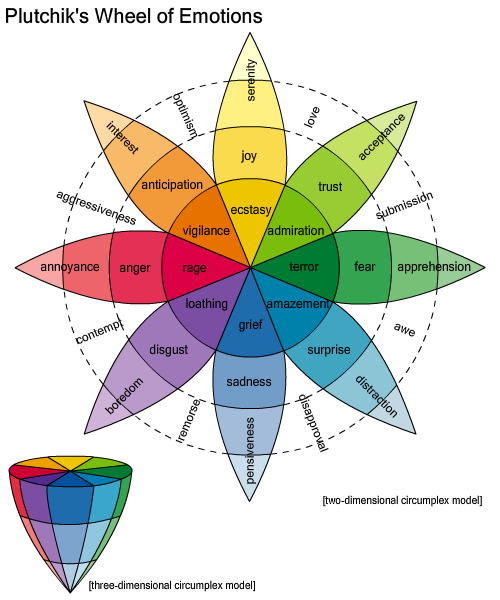
"To feel" also includes what we register from our senses. "I feel like it is too hot." "The stone feels very smooth." We feel the environment, and we feel our emotions. -
Is addiction a genetic disease?I may be nitpicking here, but I wonder how we (as humankind) have come to these conclusions. — Wilco Lensink
Not nitpicking at all -- it's a fundamental question.
We have been observing each other for a long time, and beginning with guys like Aristotle, we have been theorizing about how 'mind' works. We have had the means to tie our observations of behavior to the brain (and specific parts and processes) only just recently.
Functional MRI scans (fMRI) are one means. fMRI scans show which areas of the brain are active during certain activities. Subjects can be instructed to perform some mental task while they are are lying very still in the machine, and we can see what areas of the brain 'light up'. A Hungarian team trained dogs to lie still in the machines and measured their responses to different words and intonations. (human brains and dog brains work very similarly.)
Here's a picture of the dogs being instructed on how the fMRI machine works. As you can see, the dogs totally approve of the physics of magnetic resonance imaging.
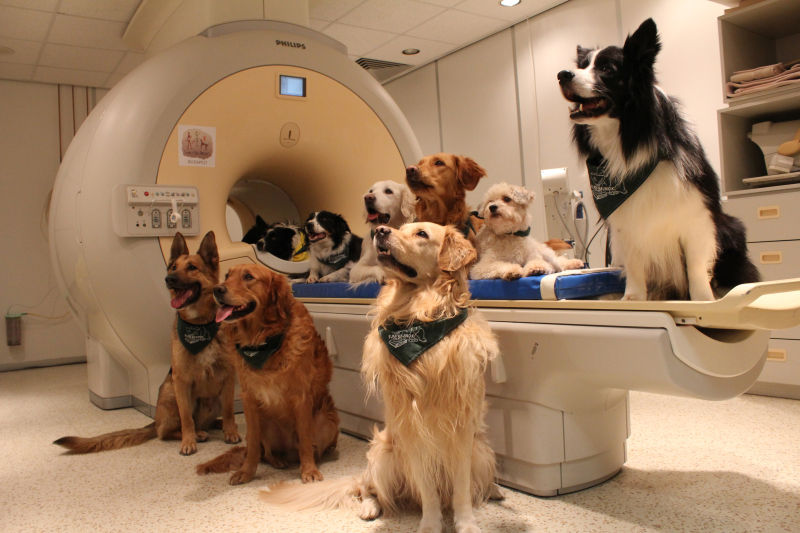
CT scans, fMRIs, EEGs, many years of dissection, study of stroke and brain injury patients, study of other animal brains, and so on have yielded a much clearer picture of how we operate. Sociologists, psychologists, biologists, entomologists, et al have been piecing together how and why animals behave the way they do. -
Is addiction a genetic disease?My thought is that genes do not "give us addictions" in the same way genes give us a disorder like Huntington's disease. Rather, genes shape the way the body metabolizes chemicals. Genes also shape the way we respond to stress. Genes shape the way our emotions respond. This shaping (which is a tendency, rather than rigidly determinative) may lead to addiction, or may not.
Take coffee. Genes control how fast we metabolize caffeine. Some people are fast metabolizers, some are slow. People who are slow metabolizers are going to be more affected by caffeine than fast metabolizers, who clear caffeine relatively quickly. If you are a fast metabolizer, you can afford to drink coffee in the evening -- and still sleep well. Slow metabolizers might not sleep well if they have coffee for their mid-afternoon break.
So, it seems likely that some people are prone (but not guaranteed) to become addicted to a given chemical IF they try it, and IF they decide to use it several times to obtain desired results. So, X tries a narcotic (probably not the first drug ever tried) to obtain an tranquility. Genes determine how fast the narcotic will be metabolized. Genes shape how quickly the person becomes habituated. Some people "know" they have found the drug they were looking for when they first take a narcotic.
Most people who receive narcotics for pain, experience relief, and when, through healing, the pain is diminished feel no further desire for the drug. They get no kick from the narcotic. They are very unlikely to be come addicted. I've had narcotic drugs several times for surgical pain and it didn't do anything remarkable other than reduce pain.
Alcohol, narcotics, and stimulants present a strong likelihood of addiction -- given the right set of circumstances. For instance, people who are depressed might resort to alcohol for self-treatment. Alcohol does dull discomfort for a short period of time. To maintain the effect, one needs to maintain a certain level of alcohol. Pretty quick the person becomes dependent on alcohol to function. They are addicted. Had they not experienced depression, they might not have resorted to alcohol as a solution.
Most people get through all the difficulties of life successfully (or not) WITHOUT becoming addicted to any chemical. A minority seem doomed to addiction. -
Party loyaltyThe Democrats are no different. If you have ever done anything political in America, you'd see that the Democrats are the cancer of the American left. They are the fairweather ruling class, and constantly throw most oppressed peoples under the bus. — discoii
I have often tossed Republicans and Democrats onto one manure pile, but there are differences. Democrats are almost always the party responsible for legislation that protects vulnerable and marginal groups, as opposed to Republicans. This difference manifests itself in various pieces of social legislation.
Where Democrats and Republics join in kicking the oppressed under the bus is in the area of trade and industrial/economic policy. Neither party is especially interested in the very large demographic block of working class people who have been rendered economically uncompetitive in a deliberately tilted world economy. Republican Trump and Democrat Clinton might both frequently and emotively reference this group, but for the most part both parties have have pursued policies that gang-bang this group. For Republicans, the Reagans and Bushes, screwing the working class was the least they could do.
(And a destabilized working class block of many millions of people ramifies negatively into other groups.)
Where Democrats and Republicans are not different (or are just slightly different) is in the area of defense spending, defense policy, financial regulation, and the like. Both parties are sensitive to military spending because this huge spending program showers funds on most congressional districts. Nobody wants to lose the local contracts. Both parties support a more or less aggressive policy overseas.
Historically, there were more nuanced variations. There used to be such a thing as liberal Republicans; there was also such a thing as Dixiecrats, southern Democrats who were pro-segregation, kind of KKKish, and such. All that started to fall apart in the 1960s in the fight between conservative Goldwater and Liberal Rockefeller Republicans. Ronald Reagan's two term presidency, followed by George the First, and after Clinton George the Second, were the result. The Republicans have continued their multi-decade trajectory toward the far, far right horizon.
The war in Vietnam and the Great Society Programs of Lyndon Johnson were the worst and best of times for the Democrats in the 1960s, and marked an end to the multi decade trajectory of the Democrats from Roosevelt, Truman, Kennedy, and Johnson toward the left horizon.
The democrats and republicans are nice good cop/crude bad cop. Neither of them are on the side of the guy in the interrogation room. "Nice" is appearance rather than substance. As some homosexual pundit put it, "The democrats and republics are both going to screw you, it's just that the democrats will use vaseline." -
Why the oppressed can be racistNazi-hunters — Barry Etheridge
There were Nazi hunters because the post-war West German government had demonstrated less than an enthusiastic commitment to carrying out the necessary detective work to find, arrest, and prosecute named Germans who were responsible for atrocities under the Nazi regime. These were not antisemitic Germans who kicked a Jew or two down the stairs. They were people who were directly responsible for the Holocaust--like Dr. Josef Mengele or Adolf Eichmann.
If the Allies were anxious to be done with the war crimes trials and denazification programs, it wasn't because of some inchoate sympathy with the Nazis. Rather, the Allies wanted Germany to take care of itself as soon as possible. Germany had been significantly damaged by the war, both in terms of physical infrastructure, but also in its human resources. The Allies felt that the trials and denazification programs weren't conducive to Germany becoming productive again.
In so doing the Allies didn't issue an amnesty to leading Nazis. They expected the Germans to pick up the task of prosecution. For the most part, that didn't happen. -
Why the oppressed can be racistnow thankfully ruled unconstitutional — Barry Etheridge
This just in... "A court on the French island of Corsica upholds a local ban on the burkina..." BBC -
Why the oppressed can be racist"Racism" has become an obsession. Where once there were three or four races, and if Asians didn't like Caucasians, they were "racist". Now if Norwegians don't like Swedes, they are "racist". If Christians don't like Moslems, they are "racist". Preserving cultural stability is a "racist" enterprise. "Racism" is out of hand.
A lot of people are probably "ethnicists" rather than "racist" but that requires more mouth-part movement than is convenient if you are going to utter the word 10,000 times a day.
Some people (some Danes, for instance) are willing to accept multi-ethnicity; they are not willing to accept multiculturalism. Danes have a long and valued cultural history which, like all peoples' history. involves the good, the bad, the ugly, and the indifferent. If they accept desperate immigrants from the Middle East and Africa, it doesn't seem like an enormous imposition to insist that the immigrants adapt to Danish / European folkways. This is doable for the immigrants. So, a Danish grand mosque was designed in the Scandinavian modern style. Religious food rules can be relaxed. One's children can be Moslem and eat the pork roast that their fellow Danish children are eating in school. Granted: some Moslems are much more observant than others. But isn't the decision to be very observant (like being ultra-orthodox or strictly Methodist) your problem rather than everybody else's?
Individual and group differences are spread out on several axes: religion, geography, ethnicity, diet, language, race, occupation, education, politics, recreational drug preference, sex, and so on. It doesn't make sense to boil all conflict down to "racism". -
We are 'other-conscious' before we are 'self-conscious'.I think awareness can exist without self-awareness.
The frog's eye receives photons; the cornea transmits signals to the frog's brain; the signals are processed and a moving object is detected and minimally characterized; instructions are sent. The mouth opens, the tongue is advanced according to the brain's instruction. The frog catches a fly. The tongue retracts; the fly is swallowed; repeat.
It's really very complicated, but what doesn't happen (as far as we know) is that the frog is aware of its achievements in fly catching. The frog's senses also track threats, and the frog moves, or doesn't move, accordingly -- as directed by instinct. Presumably the frog feels almost nothing--no fear; no pride; no boredom; no etcetera. It doesn't have a lot of brain, and if there is the ability to respond chemically to threat (a spurt of cortisol) the frog doesn't have to process the experience.
For a frog, minimal awareness definitely seems to require no development of frog-self-awareness. Frogs are a successful organism without 'consciousness'. (I'm assuming that self-awareness and consciousness are pretty closely related.)
It is less believable (to me, anyway) that an intelligent dog operates the same way a frog does. Dogs have much more brain with which to perceive, process, and evaluate. They interact on some level with other dogs and humans in such a way as to suggest that they have limited self-awareness, limited consciousness. Maybe not much, but some.
New borns? Infants? A normal baby will develop extensive self-awareness; I'm thinking this starts from scratch. The new borne suckling from its mother's breast doesn't need self-awareness, initially. But soon it starts to distinguish between me/not me. Two year olds are terrible because by that age (before, often) they have divined that they not only exist, but as beings have a fair amount of power. They can say "no" to everything, for instance. The little bastard tyrant has come into his own. -
Eliminating consistent identity to eliminate association fallacies: a good idea?The original idea (before I posted on this forum) was that a fully anonymous forum would be a bad idea because there would be no social pressure to post consistently (and possibly therefore think consistently). But I'm not sure how true that connection between public thought and private thought is. — Ovaloid
While I try to think consistently, it doesn't always happen. (A foolish consistency is the hobgoblin of a small mind? I don't know.)
It depends how an issue is presented. For instance, one could say that capital punishment is ineffective and inhumane. Perhaps it is. But locking up somebody for 50 years in a small cell isn't exactly a demonstration of humane sensitivity. Maybe capital punishment is more humane than life imprisonment. It depends on which aspect one focuses on. -
The Philosophers....after WWII, when many many Marxist professors, and other radicals fled from Europe to the US, and took positions there — Agustino
I was fortunate to escape the baleful influence of decadent continental intellectuals by attending a small state college in the midwest starting in 1964. "They" weren't here in that time, in this place. The English Literature faculty were all solidly pre-postmodern pre-continental infestation. The Social Science faculty were, maybe, a bit more secularized. But the most non-conformist history professor derived his non-conformity from his Unitarian church.
"The Beat Generation" ("beat" derived from "beatitude") of people like William Burroughs, Jack Kerouac, Allan Ginsberg, and the like were the home-grown American decadent immoral set -- I don't think they were brought into being by European decadence. I found them challenging enough in the 60s, though I like their poetry and novels now.
Maybe you have read some of them. -
Should torture be a punishment for horrendous crimes?The countries that have lower rates of crime tend to be those that have less vengeful justice systems. Finland has lower crime than the US, which has lower crime than Afghanistan. — andrewk
Post hoc ergo propter hoc?
I would be very surprised if milder justice systems cause lower crime rates. Likely there are some other factors that govern the rate of crime. For instance, states that are barely functioning are not in a very good position to effectively limit crime. Or, states that are engaged in civil war probably have very high rates of crime -- not necessarily as part of the civil war, but because society is in chaos. States that have extreme differences in wealth and privilege might have more crime. -
The Philosophers....There is a large class element to Burke's complaint. At the time, (250 years ago) the British Empire was in it's second century of colonizing North America. The colonies had been assigned to wealthy English investors (the people sending their sons to university to be corrupted) who set about populating what they viewed as "wasteland" with people who they viewed as next to worthless--the British poor.
The wretched refuse of Britain's (and others') teeming shores" weren't University-educated-philosopher-corrupted-atheists. If they weren't believers, they were pretty much solely responsible for their fallen state. Throughout the 16th and 17th century and beyond, the ruling classes had been ranting about the presumed evils of the poorest people: wicked, lustful, lazy, slovenly, disobedient, uncooperative, stupid, and so on. Once here, they turned out to at least be uncooperative. They weren't unbelievers, for the most part. They partook of such spiritual resources as were available to them -- whether that was Calvinism, Methodism, Shakerism, or Mormonism.
If there are more corrupted and immoral people now than in the past, I don't think we can blame that on the academy.
More likely, the collapse of the old time religion and the supposedly upright and moral masses of the past was/is due to paradigm shattering events like WWI and WWII, the Great Depression, The Pill, prosperity, mass media, etc. The watershed decade in American church attendance was 1960-1970. You probably are familiar with the stats, but it is difficult to grasp just how extensive the exodus was. Many millions of people left their churches, never to return.
Whether there are more corrupted and immoral people now than in the past seems doubtful to me. What is counted as immoral has changed (and I know you use a fairly severe standard to judge immorality and virtue) and I find that few people have thrown all virtue into the toilet. People have certainly not become less annoying, less stupid, and stuff like that. -
Is Absurdism the best response to life's lack of meaning?If when we became sentient doesn't matter, only that we are part of the process, that would suggest that the universe was striving toward meaning. Reminds me of the teleology of people like Teilhard de Chardin, for example.
-
Is Absurdism the best response to life's lack of meaning?Are you saying that thinking beings make the universe a meaningful place? But we didn't exist not so very long ago. When did we make the universe meaningful?
-
Is Absurdism the best response to life's lack of meaning?It is a paradox that we find meaning within the meaningless universe. There are no meanings hidden under rocks--or within our heads. We have to create meaning out of meaningless stuff. And, by and large, we do.
So yes, we think. -
The NumskullsThe phantasy of the numbskull or bureaucratic brain is compelling: Control rooms, warning lights or bells, teletype printers or LED screens, lots of printed circuitry, wiring, or pneumatic tubes delivering messages (depends how steam punkish one's brain is) -- it's a nice way of representing how we think we think. Here, as in the cartoon, there has to be a final (or ultimate) source of an idea, emotion, physical act, etc. Mental activity can't be represented in its full, multidimensional, multilevel, multi-sourced reality because we can't imagine too many complicated things happening all at the same time.
One could more accurately picture one's brain-control room as a large room filled with functionaries who are milling about, chatting, arguing, looking at dials, working at lab tables, and so on. The conscious mind is in the middle of the room trying to make sense of everything else. If Mr. Brainy is the conscious mind, then he needs the unconscious mind to be hard at work below deck and sending up messages to him, as needed, and whether needed or not.
More accurate, more verisimilitude, but I can't manage simultaneous dialogue and stage directions for more than one or two characters in this drama at a time. -
How is the placebo effect so strong even in mental conditions like SZ, depression, etc.The placebo effect seems to work across the board with illnesses--in a fraction of cases. Placebos have been reported giving beneficial effects on cancers, immune system disorders, and so on. However, the benefit isn't so certain that anyone would want to count on the placebo effect for something life threatening or serious. In addition, there are spontaneous remissions which are not related to placebos or interventions. Some people have gotten better on the basis of prayer. (Did the prayer work? I highly doubt it, it was likely a "spiritual placebo".)
How can placebos work? The CNS supervises the entire body down to the level of fine minutiae. The immune system and the CNS work together, most of the time, for reasonably good results. However, we know that without effective medical intervention a lot of people would be dead. One of cancer's strengths is deceiving the immune/CN systems--"Hey, I'm not here -- there's nothing wrong with us." Perhaps spontaneous remissions or placebo effects are the result of the Immune/CN systems getting wind of the cancer's presence and then coming up with an effective attack. After all, one of the theories about cancer is that it occurs very frequently and is immediately suppressed by the body's immune system.
My guess is that a placebo effect might help some people with certain symptoms of major mental illness like schizophrenia or bi-polar disorder, but I don't know. People who are mentally ill can certainly pull themselves together to some extent, at least when they are not acutely ill. I doubt if somebody who is acutely psychotic would respond to suggestion.
Bio-neuro-chemistry is complicated. I know of a fellow who has a degenerative nerve/muscle disease who was also chemically dependent, severely depressed, and delusional. His MI was life threatening. He received regular shock treatment for several years with limited but noticeable improvement. What turned his case around was a psychiatrist who was familiar with his particular degenerative disease knowing that a specific dose of caffeine administered immediately before the shock treatment was far more effective than a tranquilizer before ECT. The difference this approach made was very dramatic. He wasn't back to normal instantly, but within a relatively short period of time (several weeks) he began recovering personality traits (sense of humor, talkativeness, etc.) that had been missing for maybe 5 years.
As far as I know there isn't a good theory why caffeine works far better than a tranq, but it does--for patients with this nerve-muscular disorder. Placebo effect? Don't know. -
I hate hackers↪Baden I deliberately excluded that category. Sex isn't necessary in the slightest. — Thorongil
The hell it's not! -
Is Absurdism the best response to life's lack of meaning?The universe didn't provide us with meaning, but it DID provide us with the means to provide meaning. Absurdism is as much your imposition on a meaningless universe as any other philosophical or religious meaning-system is.
Perhaps there is some remotely distant meaning inherent in the universe; I can't claim any knowledge about such a convenience. But neither Nihilism nor Absurdism are the necessary system you must land on once you decided there isn't any meaning built in to the universe.
Spread your wings, gird up thy loins, pull yourself up by your bootstraps -- whatever metaphor you like, engage the search for meaning. You are a smart young man; but settling on meaning requires more than thought; it also requires life-experience. So... live, study, love, enjoy, suffer, bore and be bored, suffer, work, play, etc. There is no rush to settle the meaning problem. -
Are we conscious when we are dreaming?Im interested to know when do we become responsible for our actions. — NoWill
When you get caught, for starters.
I can't say that I have 'lucid dreams', or maybe I have but don't recognize the experience as such.
It seems to me that decisions "emerge" rather than are made. For instance, a poker player deciding to take another card from the dealer probably didn't consciously make a series of calculations about chance. However the decision was made to "hold", most--or all of it--was made unconsciously. Almost all mental processes are not conscious. I have no idea how the brain creates conscious experience, but it seems like the small pool of awareness is fed by a lot of underground springs.
I am aware of a recurrent dream (not very frequent) involving 3 elements: one is a complicated system of subways and elevated trains; a second concerns a river waterfront of dams, railroad tracks, and electric power lines, and the third involves some sort of dilapidated urban low-rise market area. I can map some of this against the city I live in, but mostly not. Of course there are emotions connected with these 3 urban elements -- anxiety about find my way to some destination, for instance, or people who skitter in and out of scenes.
I don't know why the brain generates these 3 situations. I can't tell whether it is organizing information, revealing emotions that my conscious mind can't deal with, or indulging the medulla oblongata's obsession with urban infrastructure. As dreams go, they are interesting, so I'm grateful for that.
Maybe dreams are an unintended peek behind the curtain of unconsciousness, revealing the frightening way the brain works all the time--frightening because it seems so utterly irrational. I sometimes wonder what "all of reality" would look like if we saw the world, ourselves and all our experiences, without the limitations of our several senses and maybe necessary restricted consciousness. Maybe "raw reality" is as irrational and chaotic as our subconsciousnesses. -
Self InquiryI'm the urban spaceman, baby; I've got speed
I've got everything I need
I'm the urban spaceman, baby; I can fly
I'm a supersonic guy
As stated in the testimony of the Bonzo Dog Doo Dah Band.
BC

Start FollowingSend a Message
- Other sites we like
- Social media
- Terms of Service
- Sign In
- Created with PlushForums
- © 2026 The Philosophy Forum