
Comments
-
DARK MONEY - the Corrosive Koch BrothersSome people ... use their money to protect certain interests they believe in — Agustino
True enough.
Take the Koch funding of climate change deniers. What's their interest? Carbon industries in general are on the defensive with respect to climate change. A large refinery south of Minneapolis was acquired some years back by Koch. Their source of crude oil is tar sand product from Canada. This refinery alone receives a large share of the oil exported from Alberta.
The refinery itself isn't problematic, as far as I know. What is problematic is the extraction of oil from sand. It's a mining process--not a pumping operation. The sand is scooped up and heated to melt out the oil. Its environmentally about as filthy a process as one could imagine.
At the other end of the pipeline and refining, there is a lot of residue that has low value and which is more like hazardous waste. (Quite a bit of it is sold as low grade fuel for ships.)
That's one interest the koches have that needs protecting. -
DARK MONEY - the Corrosive Koch BrothersJane Mayer's approach, or bias, is clear. She is doing investigative reporting and she doesn't find her subjects attractive--but not because they were aggressive capitalists. They were "aggressive" in the sense of 'hustle'. They expanded the core business prudently and made a lot of money in an industry (oil) that has been lucrative for quite a few people. They were (are) zealous in pursuit of their ideals -- again, not an inherently bad trait. The Koch children were subject to what most people would consider 'harsh' discipline by a father who was an authoritarian. He was pretty up-front about that, apparently.
The Koches were multigenerational libertarians, who had (have) sufficient resources to build a libertarian movement. They have preferred to pursue their goals covertly, using deceptively named front organizations under the umbrella of philanthropy. (Nothing illegal about that. It's a sensible strategy in a number of ways.)
I don't know if you are familiar with the John Birch Society. They were most active in the late 1950s, and 1960s. They were fervently anti-communist, and tended towards conspiracy theories which struck conservatives (like William F. Buckley) as outlandish. The Koches were supporters, and funders. While there may be "respectable" anti-communist libertarians organizations, in this country they tend toward the "kooky fringe".
Why "kooky fringe"? Organizations which have very extreme views and attract persons with the same, tend to become a bit unhinged. They exist in an echo chamber. This is true of the extremes at both ends of the political spectrum. -
DARK MONEY - the Corrosive Koch BrothersI heard once, probably a PBS history program, had not Benjamin Franklin suggested "happiness" the phrase in the DOI would have been "Life, Liberty, and the pursuit of Property" which Jefferson had supplied from Locke.
And Franklin didn't mean exactly what we mean by happiness either. They were looking for a word that would resonate properly on both sides of the Atlantic, in Boston and in London. And property mean more than just land -- it meant at the time the means of making a living -- a plantation with slaves on one end of the continuum, and a tradesman's tools on the other end, maybe a horse and wagon. So, life, liberty and the means to support yourself.
↪Bitter Crank Ask me and they're doing a great thing. Protecting private property :P — Agustino
So Agustino, what do you think of the Koch Brothers? -
Peter Kreeft and Ronald K. Tacelli - Twenty Arguments for the Existence of GodOh, certainly most people (everywhere) are taught, trained, and led into faith. A small number of people make a decision to move from atheism to some sort of religious belief, or change from one religious system (like Judaism) to another (like Buddhism). It does happen, but not frequently.
I agree: having a faith is a way of life. If the training has been thorough and has taken, one's thinking about life is heavily inflected by one's religious ideas.
Of course, it is also the case that religious ideas can be learned, and not make a great deal of difference. Joseph Stalin was educated by Jesuits. It doesn't seem to have done him much good. -
Peter Kreeft and Ronald K. Tacelli - Twenty Arguments for the Existence of GodBut if belief and faith are not based on argument, what is the point of complementing faith with arguments? What is the point of combatting faith with arguments? All this becomes nonsense. — Agustino
I agree that faith does not depend on argument. By definition (at least in a Christian context) it is a grace, a gift. Or from a psychological point of view, it is acquired very early and is trained in by example and teaching and becomes part of the person. Whether by grace or acculturation, argument isn't part of the process. No one changes their native language on the basis of argument either. No Frenchman was ever convinced by reason that English would really be better. And visa versa.
Certain faith (faith without any doubt) is likely impervious to efforts to convert or destroy it. People can shift their faith, though, like many Germans did at the time of the Reformation, from Roman Catholicism to Lutheran Catholicism, or from Roman Catholicism to Anglican Catholicism, and so on.
From a secular point of view, faith can be sought. Argument can, perhaps, derail seekers who are looking for a faith to adopt. (Some people without faith desire faith -- of some kind.) People can be fairly easily be persuaded to study French and not Russian for instance, or Mandarin rather than French, and so on (an analogy). A seeker might be persuaded to consider Buddhism rather than Hinduism or Islam.
Is the faith of seekers who set out to find a faith as authentic as someone converted by the efforts of a preacher? Don't know. -
The Emotional argument for AtheismWhether "this topic" has died -- don't know. Didn't see a coroner's report.
Sorry, this got rather long.
Mental operations are so inextricable tied into emotion that it seems unlikely that atheists and theists would not be motivated in their movements towards and away from. At least, that is the way I see minds at work.
The religious beliefs imparted to me (and the religious beliefs imparted to anyone--whatever they are) are generally a source of conflict as well as being a source of secure comfort. Most religions have a plan for proper behavior which involves curbing one's carnal enthusiasms, for instance, and that is a constant conflict for many people. Most faiths also provide assurance and validation, which we like.
Religion has been for me a source of intense frustration, disappointment, anger, irritation, peace of mind, blesséd assurance, and all that. Religion has best served me as a social vehicle, when I participated in that way. But it also provided my first world view and if it gets baked in (mine was) it is very hard to get rid of it, if not impossible. There is nothing particularly problematic about the spiritual enterprise of doing good for other people, having a strong sense of right and wrong (especially if it isn't all that different from a civic view of right and wrong), and so on. But the Abrahamic religions posit an activist God who intervenes in the world. I have always found that a severe problem. (If it was once in ever 10 blue moons, that might be tolerable, but intervention is invoked more like once a minute by some religious positions.
The activist god is constantly called into action to account for events, good and bad, that do and do not have obvious explanations: a cancer that doesn't respond to treatment, an unusual flood that causes 20 billion dollars of damage, a nice day for a picnic, the timely or untimely death of a parent, the unexpected (or even entirely planned on) loss or gain of a bundle of cash, good or bad sex, and so on.
God also gets called in for ultimate explanations, like, "How did the cosmos come into being?" Well, God did it--obviously. The conservative version god did it in 6 days, the liberal version god does it through long term natural processes which, apparently, were a divine tool. Either way, micro-manager or vague life force, God is in charge.
I wanted to get away from all that (this was a fairly mature change, occurring in my 40s). I actively desired and wanted a world that was entirely explainable on its own terms and never needed a deus ex machina to solve problems. I wanted to uninstall the ROM religious training of my youth (mainline Protestant) and replace it with an a-theistic system. Maybe one can pull out old ROM on a computer, I couldn't pull it out of my brain. It's still there, in the middle of everything. I count myself as an a-theist, but have to do periodic overrides on the still functioning ROM.
There is plenty for this a-theist to actively like about atheism. It isn't all about what I am against.
I am for science, secular civic governance, socialism (as distant a hope on these shores as King Arthur's Avalon), gay liberation, an 'open' society, end so forth. I like, value, am attracted to, believe in, these ideas. Of course I miss the idea of heaven -- but then no heaven, no hell either.
Science, secular civic governance, gay liberation, and a single-payer health system doesn't require a-theism of course. There are lots of Christians who believe in these things too. But human beings being entirely responsible for themselves and to themselves does, it seems to me, require no higher authority. -
Has Another Economic Crash Arrived?It really is the case that a few people do own a great deal of the wealth -- not just the wealth of the US, but the wealth of the planet.
The richest people in the world, according to Forbes Magazine--1,826 billionaires--are worth a little over 7 trillion dollars. Less than 2000 people. Who are they? Nameless, faceless, unknowns? No, for the most part they and their sources of wealth are very recognizable. Most of them own businesses of various kinds. They own product manufacturers, retailers, banks, heavier and lighter industries, real estate operations, all sorts of various kinds of businesses: Among them are:
Microsoft, Berkshire Hathaway, Zara, Oracle, Koch, Walmart, L’Oreal, LVMH, New York Mayor Michael Bloomberg, Amazon, Facebook, casinos, Google, ball bearings, Mars candy, H&M, George Soros, Nutella, Nike, Aldi, Trader Joe, publishing houses, newspapers, Sunglass Hut and Lenscrafter, beer, Dish Network, Lidi and Kaufland, Apple, Disney, Dell, BMW, Anheuser-Busch InBev, and various hedge funds, investment and real estate, oil, media, IT, pharmaceuticals, and so on.
These 1,826 people's wealth is greater than the combined wealth of much of the earth's population (assuming that the assets of the world population adds up to less than $7 trillion).
Of course, 7 trillion dollars isn't all the wealth, by any means. Real estate accounts for a lot of stored value. Other entities such as corporations (and their stock holders), account for a lot of wealth above and beyond $7 trillion. But as Landru has noted, however you look at it -- the wealth which exists is NOT divided up in any way approaching 'equitable'. -
What are you listening to right now?I was out in the streets early this morning searching for bagatelles. Sometimes one needs relief immediately. I discovered a luscious one lurking in the doorway of a modest brick colonial.
-
Has Another Economic Crash Arrived?The US is one of several nations producing more. The world will run on oil until it runs out of oil. It isn't as if everyone is pumping it up from the depths and then storing it in big tank farms, because no buyers are interested in burning it or making plastic out of it. China's economy has slowed down by one or two percent but it is still chugging along at 6% annual growth rate. My guess is that most of the oil is getting used -- just at a lower cost.
So what is "over production"? From a climate warming perspective, most of it is over production.
Correct me if I am wrong, but perhaps the margin between too much oil and not enough oil probably isn't all that large at any given moment. The margin nevertheless makes a big difference. If demand falls, the profits to be made are reduced, and then the product is worth less. If profits are reduced (not necessarily eliminated) some operators stop producing and wait.
The Saudis are, apparently, making enough money on oil to take the risk of lowering the price by pumping away, partly to drive US wells out of production (or producers out of business) and partly to keep Iran from getting too much income from its oil. In the US, leveraged operations can't stand a large fall in profitability, because they have a lot of loan payments to make. They go broke. Production is reduced. -
My Philosophy of LifeYou have a great many bullet points in your philosophy of life. If I asked you to speak for 20 minutes about what your philosophy of life is -- without any notes -- how many of the specific bullet points do you think would be included in your talk?
Supposing World War III begins while you are reading this. Nuclear warfare leaves the world without electricity or electric machinery. Very bad. Now, more than before, you are interested in developing a philosophy of life, but writing just got more difficult. You don't have a typewriter, you don't have much paper at all (just a a few sheets and some scraps) and a couple of pencils. You might have to write your philosophy out on sand, wood, or stone.
What is the shortest -- and most compelling -- way for you to describe your philosophy of life? -
Meta-philosophical quietismIt is quite interesting that philosophy is the only profession that has the ability to question itself. Unfortunately, I believe this ability has been neglected, leading to a general nihilism and apathy towards the field. — darthbarracuda
Somebody mentioned bullshit somewhere along the line.
O Darth Barracuda! So many ideas bubbling away in your capacious brain pan. I commend you in all ways for your long post. Why don't you edit this post to add some headings? You have lots of good material here, but it needs to be sectioned for the convenience of your reader. Leave it all here? or Spread it out in several posts? Don't know. Depends how much response develops.
And... what, exactly, do you want from us? You are laying a lot out here; do you want compositional criticism? Do you want argument? Do you need help in clarifying some of your ideas? -
Meta-philosophical quietismOf course, we could doubt our abilities to see the world around us as it actually is, which is what I referred to as the veil of ignorance. Although it is impossible to know for certain that our beliefs are true, it would also be begging the question to doubt all of our abilities when there is no good reason to doubt them. As far as we know, our reasoning skills have and continue to serve us well, is there any reason to doubt their abilities? Is there any reason why we should assume the world around us operates in a different fashion than what we perceive? How would it be that the external world operates differently from us, and yet we have a different modus operandi, when we are made of but the same stuff? — darthbarracuda
So, is there a veil of ignorance or not? -
Meta-philosophical quietismPhilosophy should not be worried about providing positive answers, it should be worried about providing clarification to questions and dispelling the anxiety surrounding them. Philosophical questions are inherently existential in nature; they speak to the "soul", so to speak. It is inevitable that a person asks a philosophical question: and it should be the duty of a philosopher to address these questions and attempt to create an environment of equilibrium in which uncertainty is no longer a problem. — darthbarracuda
WTF? -
Meta-philosophical quietismSo what is the purpose of philosophy?
The "traditional" approach to philosophy is that philosophy is an intellectual enterprise that aims to answer the fundamental questions about reality. This is not exactly wrong, but I believe it needs some tinkering.
Philosophy, in my opinion, should be aimed at clarifying and explaining concepts while staving off the threat of ignorance, dogma, delusion, and stupidity. — darthbarracuda
Is the supply of "fundamental questions about reality" unlimited? What if they have been answered to the best of philosophy's ability to do so.
I definitely do not want to leave "staving off the threat of ignorance, dogma, delusion, and stupidity" to philosophers alone. What horrors! Isn't this a common socialized task? "Philosophers" as such are frankly not carrying much of the load. Unless, of course, you want to define "philosopher" very broadly. -
Meta-philosophical quietismThis means that the pop-culture "war" between science and philosophy is a myth, a myth sustained by the increasingly large amount of ignorance regarding what the hell science and philosophy even are. — darthbarracuda
Right -- there is no pop-culture war. The pop-culture railroad couldn't possibly bear the freight of a war over science and philosophy. I just don't see gum-chewing nitwits getting into it.
But really, who is confused about this? probably not scientists. -
Meta-philosophical quietismBut what even is philosophy? Most of us know when we see philosophy, and also know when we smell bullshit. So where is the demarcation between the two? What are the boundaries of philosophy? — darthbarracuda
Experience should have revealed that the smell of philosophy and the smell of bullshit is not always so distinctly different. Consider processes again.
New mown hay has a lovely fragrance. Cows (bulls too) love hay. They bite it off, it goes into their 4-chambered stomach, they burp it up and chew it some more, swallow it again, ferment it, and produce milk and meat, leather, soup bones, and cute little calves once a year. And shit, of course. That's the process. The business of philosophy is, perhaps, not so very different than digesting hay.
Here we have a pile of bullshit and there we have a pile of philosophy. How do we tell the difference? -
Meta-philosophical quietismI originally posted this on the other forum but didn't get as many responses as I was hoping for. Maybe this forum will be more energetic. — darthbarracuda
You might be biting off more that you, or we, can chew in short posts. I don't want to read a semester course worth of posts.
One of the most fascinating parts of philosophy, in my own eyes, is one that tends to be neglected and taken for granted: that of meta-philosophy. What is the purpose of philosophy? How should philosophy be conducted? How do we tell the difference between philosophy and not-philosophy? Is philosophy even possible; is the philosophical method reliable and coherent? — darthbarracuda
Contrary to its being neglected, meta-philosophy seems to be doing just fine. Meta-something, anything is a characteristic of a very mature field, or a new endeavor. Philosophers have been flailing away at reality for 2500 years, now. What's left, but to return to old questions (or as the Bible puts it, a dog returning to its vomit).
...we must be extra cautious when theorizing to make sure we do not overstep our cognitive abilities. — darthbarracuda
Indeed. How do we do that? -
Meta-philosophical quietismDo you think philosophy is closer to being a "thing" or a "process"?
Baroque music is finished -- it's a thing. That is, the era is now long closed and there is a body of music written which can be played, arranged, and interpreted, but no one is writing new baroque music, and won't be in the future. [Writing music in the baroque style doesn't count.] Similarly, 18th Century British Literature is a thing. It's done. It can be read, enjoyed, discussed, and researched, but there are no 18th century writers any more (except in their graves and books).
Computer science and genetics, on the other hand, are more like processes, because new knowledge is being created (discovered) and this makes way for new avenues of research, machines, programs, and substances which feed back into new discoveries and knowledge.
Most of the body of knowledge called philosophy is a thing, Aristotle finished his career over two millennia ago -- he hasn't written anything since. One can read Aristotle for the first time, but it is unlikely that the latest new reader will produce any ground-breaking new insights. After all these years, the field of Aristotle has been plowed too many times for something new to be discovered. Still, Aristotle is worth reading.
Just because something is "finished" and is a "thing" doesn't lessen it's value. I love baroque music and listen to it a lot. But there are no latest hits from J. S. Bach. -
Double Standards and PoliticsDeterrence is a consequentialist notion which doesn't have much deterrence value. Capital punishment "deters most people from committing murders" who weren't likely to kill anybody in the first place. Many murders occur as an irrational behavior caused by rage, jealousy, despair, and insanity (probably in that order). Other murders occur because murderers experience a rather weak, fuzzy connection between crime and punishment. A large share of the murders in the United States are carried out in black-on-black violence. These crimes are neither investigated nor prosecuted with the same energy that white-on-white or black-on-white violence is. Many of these murders are unsolved.
Nothing will determine someone acting out of rage, jealousy, despair, or insanity. The crimes are committed at a time when the individual's critical judgement has been suspended. Capital punishment won't deter people from killing others if there is considerable support for the notion that they won't get caught.
Punishment in general has weak deterrence value. It is relatively easy to commit crime and escape detection--provided one has modest criminal aspirations and keeps his mouth shut. But the greater deterrence are the bonds that we have with other people. We value other people's opinions of us, we wish to be in good standing in our communities, we don't enjoy having to deal with guilt--so we behave ourselves (most of the time--we're fallible beings).
"Liberals" and "conservatives" might be able to agree that strengthening the bonds that tie individuals together into community (everything from work to worship of the gods) is a good idea. However, the more the communities are impoverished by a legislative and corporate unwillingness to invest in the warp and weft of social life, the more people there are who have no bonds with one another, and then, the more crime. -
Truth and the Making of a MurdererI think crimes are real, that people really do get murdered, and that various weapons and methods are used to commit murder (or any other crime).
There can be, however, the sense of a charade in a trial. In police procedurals, there are, for instance, debates between investigators and DAs about whether a case should be brought to trial. Then there is the matter of witnesses: we know witnesses have varying degrees of reliability. Eye witness accounts can be far off the mark without the eye witness realizing it. We know that the quality of the defense matters a great deal. A "presumed innocent" defendant represented by a really incompetent court appointed attorney may be screwed. Judges may not be impartial, and juries might be tampered with. Juries might also be swayed by factors that do not bear on the case, like the race of the defendant and the nature of the crime.
It's unlikely (I certainly hope so, anyway) that all of these conditions would occur in the same trail. But... we know that the wrong person has been accused, indicted, prosecuted, convicted, and punished by courts that were operating more or less normally.
All of this can make one wonder whether there is anything solid and rational about some courts, some trials. Was OJ Simpson innocent or guilty? I don't know, but it seems like he may have not gotten a fair trial. Perhaps he escaped justice -- beat the rap. Don't know. But one wonders...
Even if the court system is as crooked as can be, it is still all real. If there is deception, false recall of non-existent evidence, deceit, bias, and so on, it is real bias, real deceit, real faulty witnesses and real deception. Things that actually happen, and that have real world consequences. -
Has Another Economic Crash Arrived?...plus deregulation of credit default swaps... — Landru Guide Us
When and by whom were credit default swaps ever regulated? My understanding was that CDS were outside regulation jurisdictions (in practice, if not by rules). They hadn't been in use that long (13 years) at the time of the 1007 crash. Credit default swaps have existed since 1994, and increased in use after 2003. By the end of 2007, the outstanding CDS amount was $62.2 trillion, (Information obtained by Googling "credit default swap history".)
There is something facile about your dismissal of everyone else's interpretation of the way the economy works. It isn't as if the operations of the economy are so obvious that even high school drop outs can readily make sense out of it. Economists don't all agree on these things. -
[the stone] When Philosophy Lost its WayI would like to know more about "the brief window when philosophy could have replaced religion as the glue of society".
-
This is how Alasdair MacIntyre explained philosophy’s contemporary position of insignificance in society and marginality in the academy. There was a brief window when philosophy could have replaced religion as the glue of society; but the moment passed. People stopped listening as philosophers focused on debates among themselves.
-
[the stone] When Philosophy Lost its WayBorrowing from the authors book title, "“Socrates Tenured: The Institutions of 21st-Century Philosophy”, It's safe to say that Socrates would have found TENURE DENIED. Indeed, he wouldn't have been offered a tenure track job in the first place. He would probably have been lucky to get an adjunct instructor job (academic day laborer). Troublemakers don't do well in academic settings these days, if they ever did.
One could write similar Stone pieces about the baleful influence of the large-scale university on the various fields of the humanities, and maybe the sciences as well. Indeed, in the comments following this Stone piece was a letter very critical of the way PhDs in physics are produced.
Another responder noted "various bulls in the china shop" that may or may not be the fault of the modern university:
* materialism--the belief that human thought and values are purely mechanistic phenomena...
* radical relativism/subjectivism in support of radical individualism, which made it nearly impossible to talk about the actual truth or falsity of anything...
* utilitarianism, which reduced things to the algebra of value propositions identical to the calculations done by insurance companies...
* and a cluster of closely related, highly reductive approaches which assess ideas not only by their content, but by the social group, ethnic background, skin color, and gender of the people expressing them.
And, as Moliere pointed out, there is capitalism.
Large scale academic institutions (large scale institutions in general) under Capitalism or Communism, or whatever political arrangement prevails, crush the brave. -
How do you deal with the fact that very smart people disagree with you?Everything begins in mysticism and ends in politics.
-
The Yeehawist National FrontA lot of the western lands on which sagebrush rebellions might flourish are "marginal" lands in terms of their ability to recover from exploitation. They are rather dry, and some are at a fairly high altitude. They don't recover quickly from deforestation, over grazing, disruption of soils through mining activity, and so on. The reproduction of soil by natural process is VERY slow in these areas.
Native Laplanders likely live a more compatible lifestyle in forested land in Finland and northern Sweden and Norway. The rebellious sagebrush people are not native to the area, and are, for the most part, introducing lifestyles that were developed in much more forgiving ecological settings. What works in the well-watered, warmer, and lower parts of the US doesn't work so well in high, dry areas.
In the 19th century, railroads were built across the Great Plains of North America, and settlers encouraged to take up residence. (Hauling immigrants was one of the few income-producing activities the railroads had -- they were built without adequate economic justification.) The immigrants established farms and small communities and started farming. 40 years later, a lot of the immigrant farmers had packed up and left because the land was not actually capable of supporting agriculture. The soils were too dry and the climate was too harsh. One of the consequences of this settlement was the severe dust storms of the 1930s.
The Great Plains still do not have a bright future as agricultural lands, for the same reasons now as then. (Irrigation has helped, but the Oglalala aquifer which has supported irrigation isn't going to last too much longer.)
There have been proposals, not altogether unreasonable, to depopulate much of the Great Plains and let the land lay fallow. -
How do you deal with the fact that very smart people disagree with you?Perhaps we should make a different thread? — darthbarracuda
At last! A universally applicable principle. -
How do you deal with the fact that very smart people disagree with you?Belief about God is entirely possible. Knowledge about God is not possible.
Believers can have no more knowledge about God than atheists can have. Many believers claim to know a lot about God. They are deluded -- not in their belief that God exists, but in their claimed knowledge about God. Atheists assert that they do not believe in God, so there is nothing for them to know, nothing for them to believe, about God.
Believers who assert that they know nothing about the God they believe in are, paradoxically, on more solid ground than believers who have all kinds of "knowledge" about God. Why?
God is unknowable. You tell me how we very finite, narrow-minded, pig-headed, flesh-embodied beings can "know" anything about a being who is infinite, immortal, invincible, all knowing, and always present everywhere (and for Christians, is 3 Persons in 1 Being--just to make things a little more difficult than they already were). If God is our invention (which is what I think) then we have invented an "unknowable 'mystery". Unknowable mysteries of our own making are, of course, a contradiction in terms. That is the primary flaw in the "received religions" -- Judaism, Christianity, and Islam. The God that believers claim to know is unknowable. I say, believe, then shut up about the object of belief. There is nothing to say.
On the one hand, believers say "we don't know what God will do, God is a mystery, His ways are mysterious, etc." But then they will turn around and say that God did this, that, or the other thing. And, of course, God wants us to do x, y, and z, but not a, b, and c. They want it both ways. -
Climate change deniers as flat-landers.If historians 500 to 1000 years from now are worth their salt, they will understand what we were up against in the 21st century.
They would understand that we were accustomed and committed to a vast use of fossil fuel ever since the industrial revolution began. Fossil-based industrialization was, indeed, the root cause of climate change.
They would understand that those with the greatest financial investment in fossil fuel--energy corporations and allied industries (transportation, chemicals, heating, electrical generation, agriculture, manufacturing, etc.) were loathe to give up their wealth.
They would understand the extraordinary difficulty of making horrific changes in lifestyle to benefit unknown people of the future.
They would understand that even though many people perceived that a solar/wind/nuclear power alternative was possible, it would not mean life could go on without total disruption in every aspect of life.
I'm not quite sure how we would have escaped our limitations, such that there would be historians 500 in the future with a good view of what happened to us. It's not looking very promising now. The recent Paris agreement falls way short of reducing CO2 enough to avoid catastrophic consequences. I assume that we will pump oil out of the earth until it is gone. -
How do you deal with the fact that very smart people disagree with you?You mean... there are actual very smart people who disagree with me? Really? I don't believe it.
-
Je suis neoliberal?I like Chomsky. My statement about his not offering solutions was more or less from the horse's mouth at a talk he gave some years back (like... 1990?) And I like his ideas about self-organization (but I'm probably not a libertarian socialist).
Clearly the workers are not ready to self-organize the workplace and beyond. We (since all us have been, are, or will be workers of some sort -- except a rare few) are not ready to even organize ourselves into ordinary unions and force the owners of workplaces to engage us in collective bargaining. Granted, it isn't as if this failure to organize is the result of working class happiness and satisfaction with work as it is. The legal and judicial systems have together been very hostile to organized labor in the last 30 years (not that they were in love with us before).
And workers themselves have fairly often not seen any advantages in organizing (and in some cases, given the realities of their situation, they might have been right.) I was in a bargaining unit at the U of Minnesota, and I frankly didn't see much benefit in our union the way we were organized there at that time. -
The Yeehawist National FrontGood - I need the refresher. It's been a long time since I read Marcuse.
-
Je suis neoliberal?Well, once one has grabbed the bull by the tail and faced the situation, it's either accept it or let go of the tail.
The pursuit of national interests is, generally, not nice. It doesn't matter which national interest. Country A can not entertain country Z's interests with anything like the intensity and enthusiasm it displays for it's own. And visa versa. And in these matters, might at least makes way. The Soviet Union, The People's Republic of China, India, France, England, the United States, Germany, Spain, Portugal, etc. have, at various times, in the last 300 years pursued their national interests to the despair of other nations. And they got away with it, usually. Japan and Germany had a severe comeuppance.
IF China wishes to build islands on top of coral reefs, and IF that is inconvenient to the government of the Philippines, well, too bad for the Philippines. The Islands are getting built, and since this is in their back yard, I don't think the USA can or will do much about it. China is projecting its national interests into the western Pacific the same way the USA did. There may be much international bitching and carping about it, but... a billion people, Economy #2, atomic power, missiles, trade ties all over the place--they'll keep the new islands.
It wasn't nice of France to colonize North Africa and parts of West Africa, and Haiti, Indochina, Quebec, but they did. It wasn't nice of Germany to colonize SW Africa (now Namibia) but they did. Ditto for everybody else who has expanded it's real-estate holdings. It wasn't nice of the United States to seize northern Mexico, but look at the map. Obviously we were destined to have a nice bi-coastal rectangular country and Mexico was in the way. So was Canada, but they were in the still very powerful British orbit, so... no luck there. If some countries, or groups of European countries, for instance, now feel above all this, well... it's probably the case that they are never going to get to play this game to start with. The Empire of Slovakia? I don't think so. (The fact that a good share of the British Isles and parts of France are loaded with Scandinavian genes isn't due to summer travel. Remember the Norsemen?)
National policy of necessity involves behavior which, if it were carried out by individuals, would be considered at least somewhat immoral. Killing innocent people one by one is immoral and a crime. Wiping out whole peoples who are in the way is not good PR, but hey, it's ours now, so...
I just don't see how it can be otherwise--when it comes to national behavior. There is no superior court to which sovereign nations are answerable. (The UN? No, don't think so.) The only court to which nations are answerable is their own people or an equally or stronger nation or group of nations which are sufficiently annoyed to counterattack. Bad behavior by sovereign nations is endemic, and always has been.
Chomsky dislikes it when nations (like the USA) dissembles about what it is up to. As he pointed out, the only people to whom our secret wars are secret is the American taxpayer who is paying for it. Certainly the people on whom the bombs are dropping know about it. But expecting nations to be truthful the same way we demand truth on the witness stand is likely to result in disappointment. -
Je suis neoliberal?Are all governments "corrupt, hypocritical, and amoral"?
I don't think so.
There is the difficult issue of "governments as mega-institutions" which take on characteristics which transcend their individual leaders, managers, and employees. The United States Government, for instance, has 2.7 million employees, for instance. Then there are more millions of state, regional, county, and city employees. Add to that the employees of various Authorities (like the New York Port Authority). The range of behaviors of these many millions of employees are likely to be distributed normally, but probably skewed in the direction of honest, hardworking, responsible, and diligent. (I didn't say they were all those things, just skewed in that direction, mind you.) Some are crooked bastards who you wouldn't want to meet in a well lighted public space, let alone a dark alley.
The worst thing about government employees is that they tend to be phlegmatic - not easily excited to action or display of emotion; apathetic; sluggish. There are reasons for this phlegmish tendency: the layers of bureaucracy and control stacked up above them; the perpetual mobile of agency activity; the fact of political control at the top, and so on. There are, none the less, outstanding government employees who excel by delivering excellent service to citizens.
One of my favorite examples of sluggishness would be workers in employment security agencies. There is so little these people can do to solve worker problems, they can't help but have a flat affect, be apathetic and sluggish. Their jobs tend to be window dressing--which is not their fault.
Waste, Fraud, and Abuse (the Three Twisted Sisters) is no more common in government than anywhere else.
Human beings are, by nature, hypocritical, Noam, so stop complaining about it.
Institutions can be sort of amoral. Like, "Nations do not have friends, they have interests." We may like you (xyz nation), but if you are really in the way of our core interests, you're screwed. From the perspective of the top nation's citizens, this is not amoral -- it's down right reasonable. The bottom nation's citizens don't look at it that way. But we can't all be tops. Fortunately we are, and you are not, so... assume the position.
Individuals, on the other hand, can be (and often enough are) corrupt, hypocritical, and immoral, and more! Cruel, vile, deceitful, selfish, greedy, destructive, just plain insane, and so on. -
This forumDidn't Mao say, "Let a thousand flowers bloom"? Meaning, let there be many new approaches. He doesn't seem to have followed that idea real closely, but it's a good idea anyway.
There are institutions that I want to see endure for millennia. Just a few. But there are many organizations on their way to becoming institutions which should, I think, be terminated early. Not because they are bad, but just because they have been around long enough to accomplish whatever it is they are going to accomplish. Paul, over at PF, has seen enormous success over the years. He will never see that same success twice over.
I've worked for a number of non-profits which, after 20 or so years of functioning, had run out of ideas. Like some AIDS prevention or AIDS service organizations. They did what they were capable of doing, it either did or didn't work, and now they are just duplicating the same efforts over and over again without making much difference. This isn't because they are bad. It's just because a given bunch of people in a given kind of organization are going to exhaust their ideas.
What should happen is that they should figuratively run up a white flag, surrender, and dissolve the organization -- totally. If there are unmet needs, let some other bunch of bright guys figure out a fresh new approach. Let them have a 20 year whack at it.
If we are not doing something useful, we will go under. The market, referencing neoliberalism, will either preserve or destroy us, like the Goddess Fortuna. -
Je suis neoliberal?Noam Chomsky agrees. All governments are corrupt, hypocritical, and amoral. — Mongrel
That's Chomsky's problem: One you have decreed that all governments are corrupt, hypocritical, and amoral, where do you go from there? He doesn't like to propose solutions. He's great on diagnosis, lousy on cures. -
Has Another Economic Crash Arrived?Good link. Thanks.
Fairly extreme views are presented by media at times, and sometimes these poorly represent reality. For instance, declines in the DJIA is just about always described as a bad thing. It is perfectly normal and healthy for markets to bounce up and down (like a hookers drawers). What is relevant is long term trends -- not a week or a month long, but year and years long.
Employment and unemployment figures, GDP, trade figures, etc. are important too -- probably more important than the DJIA or the averages of other exchanges. Some of these figures conceal worrisome conditions that are not featured much: unemployment is down, but there are large numbers of people who are not working, not looking for work, and they are not idle rich. They are people who have dropped out of the labor force because they don't fit anywhere.
China needs economic growth. No growth is not an option. It has a huge population, it's population is growing, and large numbers of people expect opportunity and rewards. If 200 million people are grossly disappointed, watch out. So, slowdowns in China are more significant than slowdowns in Canada. (Nothing against Canada, of course...)
A lot of economic reporting is, to use the technical term, bullshit. American Public Media's "Marketplace" sometimes has decent content, but much of it is slop and fluff. Their 1/2 hour show sometimes is devoid of significance. Sometimes it's OK, but mostly it's easy listening happy chatter. -
The Yeehawist National FrontThe use of the words "tolerance" "toleration" and tolerate have had diverse careers in the last 200 years:
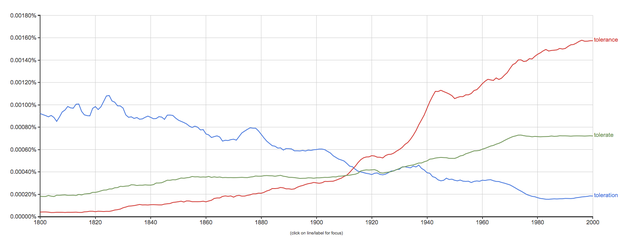
Herbert Marcuse coined the phrase "repressive tolerance", which is what you are probably thinking of, MOS.
Tolerance, to my way of thinking, is not intolerance disguised. They are opposites with quite different consequences. Lately the concept has been given a negative spin: pejoration. Tolerance is not used sometimes to mean "loathing without action". One 'tolerates' what one loathes, until one doesn't tolerate it anymore, then attacks it. So, in this school of thinking, tolerant people are a time bomb who will eventually explode all over some suffering minority.
I think that is quite wrong. Tolerance is not embrace, true. But it is a making room for, an acceptance of, more than a grudging willingness to interact with. I can tolerate muslims, but I won't be converting. Muslims can tolerate Christians without converting. And both without any sort of punitive action. Tolerance isn't rejection disguised. It's open rejection and acceptance of the difference. I reject the founding principle of Islam, for instance, but I accept others belief. And viva versa with respect to Islamic/Christian interactions.
Tolerance is a recognition that others are different. Not the same. and OK, but without a wish to become like. I can tolerate transsexuality. I accept that it exists. I don't feel anything that transsexuals report feeling. Much like heterosexuals who accept homosexuals don't feel what homosexuals feel. We get that each other's attractions are different, and we accept that. But we are not the same.
I don't need to be loved, embraced, celebrated, etc. by people who are not homosexual. They can even be appalled by my lifestyle to their hearts content. BUT, tolerate my existence. Leave me alone. You mate your way, I mate my way. If you don't want to come to my party, fine. I might not want to go to your's either.
Many people tolerate behaviors they decidedly don't like--all sorts of things. Toleration is what makes complex urban life possible. We don't have to look at every case of difference (like, people who decide to get their faces tattooed with pseudo-prison-style ink and feel a wave of warmth, "Ah, sweet diversity." Frankly, I'd just as soon people keep their ugly tattoos on their scrawny bodies to themselves. I tolerate their display. Now, if handsome hunks with great tribal tattoos want to walk around the grocery store naked -- I could tolerate that too. (So far, haven't had the opportunity. Too few stores tolerate tattooed naked handsome hunks walking the aisles looking for good deals in canned peaches. And the weather in Minneapolis is fairly unforgiving at this time of year -- the high for today is only 8F. The naked walk from car to door would be way too long, no matter how short it was. It would be... intolerable. -
The Yeehawist National Front...but funny thing is if they dropped the idealism we'd have very little to fight about in the first place. — Mayor of Simpleton
Now, now, you're just being silly. I hope.
Idealism isn't the same thing as fanaticism.*** Fanatics have an odor of mania and possession about them (smells like burning electric insulation), whereas idealists reference a standard of perfection; a principle to be aimed at: tolerance and freedom, the liberal ideals. Idealism smells like lily of the valley.
Realism, on the other hand, is neither fanaticism or idealism. Is there such a thing as being "too realistic"? No. Real is real. Reality doesn't get more real. (It can get less real, however, as when someone exclaims in exasperation, "Unreal!")
Ideals (Christ-like love, abolition, anti-war/peace, universal suffrage, organic farming, direct democracy, elimination of poverty...) become the subject of fanaticism when some narrow aspect of the ideal becomes the object of a very narrow focus. Christ-like love can be perverted into a life-denying obsession of self-denial which is no benefit to anyone. Political ideals about the rights and obligations of the people can be perverted into the "get government off our backs" obsession which boils down to 'no government except when I want something from it'.
Idealism is, I think, an essential leaven in societies which do (and must) run mostly on realism. Yes, idealists like Henry David Thoreau (check out his essay, Civil Disobedience) can be a nuisance. Massachusetts threw him in jail for not paying his taxes (Emerson paid them for him). His refusal wasn't libertarian tax avoidance, it was on behalf of either abolition of slavery or opposition to the Mexican American War (sorry, can't remember which. Probably the MA war...).
We really need idealists to challenge the status quo. (Leaven, as you know, changes a brick into a loaf.) Change-agents need their ideals, which we might not like. One of the most-loathed groups working for black civil rights in the south during the 1940s and 50s was the Communist Party, USA. They were on the side of the angels in their efforts. That was before they were effectively neutralized, along with much of the left by ruthless Republican realists like J. Edgar Hoover, et al.
***[ORIGIN mid 16th cent. (as an adjective): from French fanatique or Latin fanaticus ‘of a temple, inspired by a god,’ from fanum ‘temple.’ The adjective originally described behavior or speech that might result from possession by a god or demon, hence the earliest sense of the noun ‘a religious maniac’ (mid 17th cent).] [1 the practice of forming or pursuing ideals, esp. unrealistically: the idealism of youth. Compare with realism... a standard of perfection; a principle to be aimed at: tolerance and freedom, the liberal ideals.] -
Je suis neoliberal?I assumed that the author of the Guardian article was referencing the effect of ideology of those who consumed it. So, Nazi ideology didn't prevent some Germans from resisting. Liberal Arts departments maybe don't share the same thoughts as the graduate School of Management does. Communist ideology seems to have zero effect on stock brokers.
What makes ideology formidable, is that those who believe it become impervious to ideas outside of the ideology, and those who passively accept many of the tenets of the ideology can't figure out what is wrong with them. So ordinary people who aren't ideologues but who have accepted some of it assume that profit-making is either divinely ordained or is a natural phenomena like gravity. Like, how could it be otherwise?
Ideologues can escape from the grip of the ideology -- it usually doesn't act like a black hole. Something has to happen to create a lot of cognitive dissonance. (Like, maybe a previous hung-ho manager gets fired as part of a merger, and had his job lasted 2 years longer, or 6 weeks longer, would have been eligible for pension. He's lost his job, he's too old to be attractive on the market, and too young to retire. Suddenly, the ideology which he previously espoused might unravel.)
Or worse, he'll retain the ideology, stew in a caustic bath of resentment, and displace blame. He'll accuse all sorts of people for their misfortunes and his.
Large numbers of people who accept neoliberal/neoconservative/paleoconservative... WETF one wants to call them, form a fairly cohesive force dedicated to government gutting, privilege preserving ideology. There isn't a strong countervailing ideology. The left has small numbers, and in addition has the further handicap of not having a clear, coherent ideology. (I'm talking about someone to the left of Bernie Sanders). Sanders and Clinton are not far to the left, and accept a lot of the neo-liberal concepts. They couldn't function in their present, past, or desired roles (like Senator, POTUS, etc.) if they didn't.
Not everyone makes a good hook-line-and-sinker ideologue. One has to 100% get behind the theory, and get rid of all those niggling doubts, and questions about inconsistencies, and all that. -
Je suis neoliberal?I think Agares-Tretiak (above) is right when he describes paleoconservatives as being broadly anti-government, even including defense spending which isn't directly related to national defense. Sorting out who is neo-liberal, neo-conservative, and paleo-conservative and beyond is kind of a messy job -- like sorting out a bucket of chicken guts. Reducing government in as many ways as they can imagine (except where it affects their own and their clients' fortunes) is something most conservatives, these days, seem to agree on. The last liberal republican died sometime in the 1990s from advanced old age.
BC

Start FollowingSend a Message
- Other sites we like
- Social media
- Terms of Service
- Sign In
- Created with PlushForums
- © 2026 The Philosophy Forum