
Comments
-
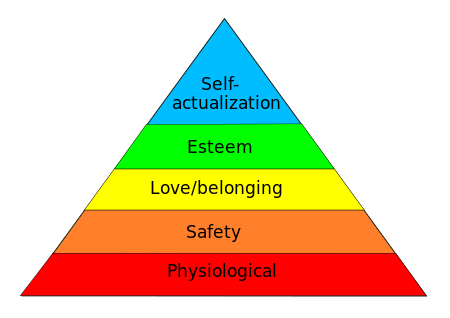
Maslow's Hierarchy of Needs (and similar theories)Chew on this: This is what Maslow thought a self-actualized person would be (self-actualization would be located at the top of the pyramid):
- Truth: honest, reality, beauty, pure, clean and unadulterated completeness
- Goodness: rightness, desirability, uprightness, benevolence, honesty
- Beauty: rightness, form, aliveness, simplicity, richness, wholeness, perfection, completion,
- Wholeness: unity, integration, tendency to oneness, interconnectedness, simplicity, organization, structure, order, not dissociated, synergy
- Dichotomy: transcendence: acceptance, resolution, integration, polarities, opposites, contradictions
- Aliveness: process, not-deadness, spontaneity, self-regulation, full-functioning
- Unique: idiosyncrasy, individuality, non comparability, novelty
- Perfection: nothing superfluous, nothing lacking, everything in its right place, just-rightness, suitability, justice
- Necessity: inevitability: it must be just that way, not changed in any slightest way
- Completion: ending, justice, fulfillment
- Justice: fairness, suitability, disinterestedness, non partiality,
- Order: lawfulness, rightness, perfectly arranged
- Simplicity: nakedness, abstract, essential skeletal, bluntness
- Richness: differentiation, complexity, intricacy, totality
- Effortlessness: ease; lack of strain, striving, or difficulty
- Playfulness: fun, joy, amusement
- Self-sufficiency: autonomy, independence, self-determining.[36]
Anyone here want to fess up to being fully self-actualized? -
Maslow's Hierarchy of Needs (and similar theories)How is it not sequential when it is a hierarchy? It isn't Maslow's List of Needs, but rather Maslow's Hierarchy of Needs. — Agustino
According to Wikipedia, Maslow didn't create the pyramid - or any other graphic representation of needs. An illustrator at a textbook publishing company is most likely responsible. "Maslow described human needs as ordered in a prepotent hierarchy—a pressing need would need to be mostly satisfied before someone would give their attention to the next highest need." The pyramid "may give the impression that the Hierarchy of Needs is a fixed and rigid sequence of progression. Yet, starting with the first publication of his theory in 1943, Maslow described human needs as being relatively fluid—with many needs being present in a person simultaneously."
The 'hierarchy of need" was but one of several profession topics in psychology which Abraham Maslow pursued. -
Right vs Left - Political spectrum, socialism and conservatismWell it is intolerance when you assume, without prior demonstration, that "equal rights" is universally a value, and therefore you can impose it on other people. Who are you to fight to impose "equal rights" on me? Maybe I don't like this "equal rights". Am I morally wrong if I don't? If you say yes, then you need to mobilise an argument which explains both the origin of this value "equal rights" and its universality. Something that is sorely lacking at the moment. — Agustino
Just so we're all talking about the same thing, here is the United Nations Universal Declaration of Human Rights.
Is it really "universal"?
Yes, by definition. The Declaration applies to the entire planet. (It's not called "the South American" or SE Asian Declaration of Human Rights.)
Does everybody agree with it?
Of course not. The declaration has been honored in the breach more often than in the observance.
If everyone doesn't agree with it, how can it be "universal"?
Because it is aspirational rather than contemporaneously descriptive.
What if I, personally, don't want the same human rights that everybody else has? Maybe I'd prefer fewer human rights for myself. Is that OK?
If you were an imbecile, a moron, or an idiot, it might be OK in a sort of imbecilic, moronic, or idiotic way for you to desire fewer human rights than everybody else has. (There is conclusive evidence that you are none of these three.) However, the universal declaration happens to apply to imbeciles as well as highly leftist and right wing philosophers with intelligences that are at least normal, if not above average.
What gives anybody the right to IMPOSE universal human rights on everybody else?
We live in a world where there are many powers counterposed against one another. No nation or group of nations has both the power and the unanimity of purpose to effectively IMPOSE much of Universal Anything on various groups of people.
It sounds like a bunch of autocratic left-wingers foisted this upon the oppressed peoples of the world. Where did this business of "universal human rights" come from?
The United Nations Universal Declaration of Human Rights was cooked up by a cabal of autocratic sort of liberal-to-left-wingers after the end of World War II, which (as you know) featured an unusually lavish display of utter disregard and contempt of even minimal human rights for millions and millions of people. It was an opportune time to issue such a declaration.
Isn't this Universal Declaration of Human Rights just another form of western imperialism being forced down the throats of third world dictatorships?
Some dictatorial, authoritarian, plutocratic, human-rights-abusing regimes have complained about that very thing, as a matter of fact. And they are right. If the United Nations could, they would and should deep throat any number of cannibal regimes with the big dick of Universal Human Rights. As it is, the UN can't pull off such an act of universal beneficence because it is pretty much hog-tied by the major and minor powers who could conceivably be found to fall short of universal human rights themselves. So... bad actors can rest, assured of their impunity for the short run, at least.
There is a difference between "the Regime" and "the People". The Universal Declaration of Human Rights applies to "the people" and not to "the regime". In human terms, no regime can be considered sacrosanct. In real politic, of course, it is the other way around: Regimes tend to be much more sacrosanct than "the people". -
Maslow's Hierarchy of Needs (and similar theories)I don't have a problem with Maslow's hierarchy of needs as long as one remembers that it is rather simple. It isn't exhaustive, it isn't sequential (from bottom to top), and it isn't prescriptive. There are additional needs not listed, like prowess or puissance, (physical ability to accomplish tasks), external status (and not just internal esteem), companionship, a community in which to meet needs, and so on.
If what Maslow was saying is that we tend to strive towards fulfillment, most people would probably agree with him. I know a few people who seem to prefer self destruction, but they are outliers. If he was saying we have many needs, few would disagree with him. The Hierarchy is an illustration -- it isn't a school of thought.
That's my two pfennigs.
-
What's Wrong With Brutalism? (It's the dirt and neglect)Apparently Habitat worked out pretty well. I've always liked it. It's still novel. I don't see the style being used in cold climates -- too much exposure, frozen pipes, all that, but given global warming... I've been following "Fuck Yeah Brutalism" for years.
The "little houses with front and back gardens" are every bit as prone to social dysfunction as Pruitt-Igoe in St. Louis, Missouri. A film, The Pruitt-Igoe Myth (available on YouTube) takes the view that it was the crashing economy In St. Louis that wrecked Pruitt-Igoe, not the built environment. Detroit has miles of once lovely street scenes that are now an abomination of desolation.
The high rise Gold Coast communities in Chicago that house the wealthy have not turned into slums, oddly enough. It isn't architectural niceties that keeps the rich riff raff from dealing drugs, shooting people in the lobbies, or urinating in the stairwells. To eliminate the racial issue, box up a couple thousand po' white trash from Alabama and transfuse them into an elite building. You'll have a shithole in a couple of years (if that long). -
Happy Christmas and New Year to allOne year closer to the end of the world. Cross fingers. — The Great Whatever
Indeed, but in the meantime, Merry Christmas, Happy New Year, Glad Yule, joyeux Noël, carpe diem, sic transit gloria mundi, auld lang syne, etc. BTW, are you crossing your fingers for a quicker end of the world, or a later one?
It is especially kind, gracious, and noble of you to give up social media in favor of your family. You'll probably experience withdrawal. More beer, in that case. -
On Weltschmerz...about the possibility of exercising political agency... — StreetlightX
OH, hey, good topic. Been looking for one.
But... Isn't it the reeking personal psychology (all that stuff between one's ears, between the cradle and the coffin) that does philosophy, that lives a life--one with more or less agency, more or fewer ethics, receiving/perceiving/deceiving/believing/positing/disposing and all that?
Philosophy seems (to me) to be too close to reeking psychology to be sniffy about it. Granted, one can be mired in alls sorts of personal, reeking, psychological shit and still turn out novels, plays, books, articles, monographs, emails, meals, batches of paper work, and so on. But... not everybody is sufficiently compartmentalized to do that. -
American culture thinks that murder is OKII attribute the rise of the rightwing agenda in this country ... to progressives who fail to oppose that agenda with passion and vehemence and even with white-hot hate. — Landru Guide Us
The 'progressive movement' does seem to have lost its balls somewhere along the line. Probably a result of straddling the fence so much. A lot of progressives seem to have a relatively weak belief in their own values. No fire in the belly. They have been 'going along to get along' too long. Tepid conviction just doesn't rise to the occasion of squashing their opponent's soft squishy ideas, like one steps on vermin in a damp cellar.
So, guess it's time to send the squealing Republican pigs to market.
How about this for a co-meme-mercial: Silent camera pans over Repubican meetings, featuring their candidates, no sound except for a recording of pigs grunting, snorting, squealing -- what pigs do. Brief video insertions of pigs squabbling in the trough. No captions till the end... "This is the best Reublicans have to offer."
Or, borrowing something from Dorothy Parker and Talulah Bankhead...
Have actors made up to match candidates, have a young Republican and a Bernie Sanders type meet at a doorway. Young Republican (Rubio? Fiornina?) graciously says, "age before beauty"' Sanders (or Clinton) character says, "Pearls before swine." and walks through open door.
VOTE DEMOCRAT. VOTE PEARLS, NOT SWINE. -
American culture thinks that murder is OKI have long claimed that philosophic types place too much emphasis on reasoning and insufficient emphasis on emotionwhen discussing behavior (which would include voting). Whether it's screaming memes or whispered insinuation, many decisions are made with more emotional than rational weight.
Donald Trump isn't merely babbling nonsense. In his person and in what he has to say he represents something particular to a certain aggrieved strata of white, losing-class Republican. He represents a hope to several million of these people because he is uttering statements which resonate with the aggrieved Republican's frustrations. These aggrieved people have real aspirations, real desires, preferences, and so on, and they feel like they are really getting stepped on left and right. I may not feel like they feel, you may not feel like they feel, but neither of us is one of them.
So, attempting to win MEME VS. MEME, is not very different than trying to win by slinging sticky, stinky, slimy mud at one's opponent. (Naturally, they sling raw manure; we sling pearls of wisdom and shovels full of facts.)
Elections of persons is prone to be about symbolic representations. "Who the man really is" is less important than "What does the man represent to whom?" The electorate seems to behave more rationally when the election is about facts (bond issues, recalls, referenda, that sort of thing). If the citizens of West Cupcake, Nebraska believe their schools are adequate as is, they probably won't buy the school board's memes in favor of a new building. Electing the school board might be all about memes, though, because that's all about persons and symbolic value. -
On WeltschmerzPeople do vary, and theories depend on what people the theorist had experience with.
If Freud hadn't grown up when and where he did, and provided therapy for a lot of frustrated bourgeois Viennese women, he would probably have come up with a somewhat different theory. (He didn't believe these women had had the rape experiences they related to him. These days, a therapist would practically assume his patients had been raped (one way or another).
Albert Ellis (Rational Emotive Therapy) clearly grew up in a much different environment and time than Sigmund Freud did. Carl Rogers, different time and place, again. B. F. Skinner, ditto.
The various theorists try to account for what they observe, and what they, themselves, believe to be true. Meanwhile, people do what they do, and damn the therapists and theorists. -
American culture thinks that murder is OKThe way to nudge them to vote on the issue is to use the meme that the other side is totally illegitimate and freakish. It happens to be true, but that doesn't matter. Political memes don't work because they're factual, they work because the frame the issue in terms that people resonate with. — Landru Guide Us
A political campaign might (or might not) be an appropriate place to totally delegitimize the opposition, and brand them as 'freakish'. Memes are good for that. The Irresponsible Right Wing in this country is quite practiced at this: "Guns don't kill people, people do." or "Obama Care is destroying the nation."
Inserting memes into even reasonably serious barstool discussions, however, is not appropriate. It's inappropriate because such rhetorical devices retard rather than advance understanding. It is true that freakish gun nuts exist, (Christ, I'm related to some of them), but using such rhetorical devices here isn't helpful or appropriate at all.
And in political campaigns, I want to see zero uses of phrases that merely resonate with the audience and have no truth value whatsoever. We aren't working for the Ministry of Truth, are we?
"Obama Care is destroying the nation." is a patently absurd, non-truthful statement. Obama Care just isn't destroying the nation. It may not work well, it may be too little to late, or it may have other flaws, but causing the nation to crumble, no. "Guns don't kill people, people do." is a very popular meme and has done a great deal of damage by asserting another logical absurdity. On the one hand, guns don't up and kill people on their own volition, true enough. But then, nobody ever suspected guns of doing that. On the other hand, guns are the most effective tools an individual can buy for the purpose of killing other people. The more automatic, the bigger the magazine, the more people one can kill. A gun in the hand can kill a lot of people, and quickly.
Blasting out memes to counter memes might work for a while, but ultimately it delegitimizes the process of reasoned discussion, reasoned persuasion and dissuasion, and reasoned decision making. There's way, way too much of that sort of dishonest crap as it is. -
On Weltschmerzrats in a rat race — darthbarracuda
John Steinbeck's term for Weltschmerz was "welshrats". For whatever that's worth.
Thanks for clarifying your situation.
Without distraction, we inevitably fall into boredom — darthbarracuda
So, in your model of personality, we are basically quiescent. Boredom is our basal state, our gravity, which we actively seek to climb or fly out of, but with difficulty. Peak experiences (up there on top of the parabola) are fleeting. Having obtained the parabolic peak, we often lose it and slide back down into the crevasse of boredom. I'm not criticizing what seems to be your view; it is one of a few basic positions. Freud's system was one of dynamic psychological forces in constant interaction, maybe "struggle". fOther personality theories posit that we are sort of inert until needs arise or until we receive external stimulation. We are, in this view, quite passive. Some personality theorists see us in constant motion, perpetually seeking stimulation except to rest.
Some people posit suffering as a constant and inevitable element in human experience (Schopenhauer1, for one); others find adventure seeking and discovery, outward questing, to be our natural state. Still others see our personalities as social constructs, determined extensively by the society we live within. Behaviorists see (saw) behavior as more learned than inherent. I'm sure that a post-modern behaviorist could not feel Weltschmerz, even if her life depended on it. -
Just for kicks: Debate FascismFascism doesn't have a long history (it was hatched in 1919 in Italy) and it is decidedly anti-intellectual. Consequently, there is no development of "fascist theory". Fascism is as fascism does.
Below are some characteristics of fascism, according to Stanley G. Payne. I underlined those that I think apply to Islamist "fascists".
- It is antiliberal, anticommunist, and anticonservative. It will ally with other groups for convenience, and destroy them later.
- mass mobilization with militarization of political relationships
- Emphasis on aesthetic structure of meetings, symbols, and political liturgy, stressing emotional and mystical aspects
- Extreme stress on the masculine principle and male dominance
- Exaltation of youth above other phases of life
- Specific tendency toward an authoritarian, charismatic, personal style of command
- Espousal of an idealist, vitalist, and voluntaristic philosophy, normally involving the attempt to realize a new modern, self-determined, and secular culture
- Creation of a new nationalist authoritarian state not based on traditional principles or models
- Organization of a new highly regulated, multiclass, integrated national economic structure, whether called national corporatist, national socialist, or national syndicalist
- Positive evaluation and use of, or willingness to use violence and war
- The goal of empire, expansion, or a radical change in the nation's relationship with other powers
From Wikipedia; searched for "minimal definition of facism"
The Islamic State or Boko Haram or Al-Qaeda... are not prototypical fascist movements like those of Mussolini, Hitler, or Franco, but they have some strong semblences of fascism. -
To know what the good is, and to live well.Pleasure is a good thing, but pleasure can get better. Simple pleasures -- sex, food, soaking in warm water, is probably not going to get better. It's sort of static, which is OK. We also need food and sex a warm bath, and a nice walk, and all that.
One is "supposed to get pleasure" from art. That's what the teacher said. Didn't happen. Not, at least until much later when I knew more about art, cared more about it, had much more specific tastes, and so on. Same with music, but much faster. In my old age I have started to get a great deal of pleasure out of architecture that I never had before, but now I have more understanding. Same with science. I find much more pleasure in (accessible) science than I did once.
The "good" in pleasure is gaining more capacity to have 'complicated' pleasure. Food and sex are still good, still pleasurable, but they haven't (in my case, anyway) gotten much more complicated. What I want from music is much more complicated. What I want from a novel now is more than I wanted 50 years ago.
Pain is a bad thing, for the most part, real pain, not just the soreness and fatigue after doing what one really wanted to do. Pain from tumors, pain from broken bones, gout, rotting teeth, shingles, bee stings, etc. Pain and sickness are, I think, inevitable, and are generally endured. Does it do us good to endure pain and sickness? I don't know. I think it is better to be able to cope with pain, because most likely one will be in serious pain at some point. I don't thin pain makes us "better". Good people before pain are good people after pain, and shit heads before pain are shit heads after pain. Too much pain might turn a good person into a shit head, perhaps, but the opposite seems very unlikely.
Boredom can be a quite serious pain, I think. Really bored people have difficulty connecting to pleasure, moving toward pleasure, having pleasure. Instead they have anhedonia.
Sleep is a pleasure and it is time to get on with it. -
On WeltschmerzWhat I really don't like is when people say, "Oh, you just haven't had enough EXPERIENCES in this wide wonderful world!" — Pneumenon
I probably sounded a bit like that, judgmental. Sometimes it might be true -- but one would need to know the person to have any idea about that.
I had a long dark stretch, decades ago. I could/would have called it Weltschmerz, had I known the word -- but I did not -- or it hadn't stuck, anyway. We feel what we feel, and if the world feels awful it is awful, and it takes great insight to see the world as not actually awful.
Then a few years ago I emerged into a very sunny period that I am still in -- going on 4 or 5 years now. With any luck, it will last as far as the grave. This time of good feelings isn't due to any virtue or achievement on my part. I am still kind of surprised that I feel this way. -
On Weltschmerzthis. is. the. way. it. is. going. to. be. for. the. rest. of. your. life is too full of certitude. I don't know what the rest of the evening has in store for either one of us, let alone the rest of our lives, and neither do you.
-
This kind of world view was widespread among several romantic authors such as Lord Byron, Giacomo Leopardi, François-René de Chateaubriand, Alfred de Musset, Nikolaus Lenau, Hermann Hesse, and Heinrich Heine. It is also used to denote the feeling of anxiety caused by the ills of the world... the idea that physical reality can never satisfy the demands of the mind.
I bet these giant romantics were thrilled to death with their discovery of Weltschmerz. "Ah HA", they burbled, "here is something we can really use!"
Look, I fully get anxiety, depression, doom and gloom (they are real, real, real), and have had episodes of glomming on to one literary diagnosis or another (like existential nausea). The thing is, some of this stuff just isn't healthy, especially if it feeds into Schmerzen that have quite non-literary causes, which in both our cases seems to be the case.
The idea that physical reality just isn't enough to ever satisfy the demands of the mind is, in a word, bullshit. Yes, Virginia, some literary (and philosophical) movements contain multitudes of bullshit. One needs to clean it off the bottom of one's boots before one comes into the kitchen.
I'm not saying mind and physical reality is the same thing. It's just the idea that "Oh Gawd, my huge mind (It's so HUGE, a la Monty Python) just can't be satisfied by what little there is here in this dreary physical world!!!" is unadulterated romantic bullshit.
You might want to be more careful how you talk to yourself. You may, possibly, be feeding yourself a line of baloney. Now, now, don't get all testy. It happens all the time that people tell themselves negative crap, and then they feel even worse afterward. Why don't you try a more positive line. It might work better. -
On WeltschmerzAre you old enough to suffer from Weltschmerz? Isn't there some sort of minimum age that one has to be before one can have that problem? I mean, 15 year olds can not claim Weltschmerz; they just haven't been around long enough. I would say, hmmmm, 50 at least, and that might be too young.
Probably you just feel bad much of the time. I wish I could snap my fingers and make all that bad crap go away, but... It didn't work for me the last time I tried it. Life can sometimes be just one fucking thing after another. -
American culture thinks that murder is OKSpeaking of evil, Landru, people have been excoriating evil (sin, blaspheme, bad behavior, picking one's nose in public, etc.) for a very long time -- what, 3, 4, 5 thousand years now? My guess is that evil has been a steady constant, more or less, regardless of how excoriating the excoriations were.
Gun nuts reject the argument that they believe their guns are worth any number of mass murders. I reject it too. Their guns, after all, were not the guns used in the mass murder. (Unless they were, then they should be arrested, immediately.)
Almost certainly, they are not weighing their guns and mass murder on the sale scale. That's appropriate. Just because one has a dick doesn't make one a rapist (some radical feminists to the contrary). The rightness of owning guns is one issue, the wrongness of mass murder (or one murder) is a another issue. Almost everyone will agree that mass murder (or one murder) is a bad thing.
If you, Landru, owned 100 rifles, shotguns, vintage revolvers, and modern Glocks, that in itself wouldn't make you a threat to anyone--especially if you had your guns locked up. The locus of the problem wouldn't be YOU -- the individual, law abiding gun owner -- even the law abiding gun amasser. The problem is elsewhere.
What we have here is a "supply side" problem. Gun manufacturers (and ammunition makers) are making far more guns and ammunition than are needed for the 33% of the population (or 40%, to be generous) who wish to own guns, and they are making way too many inexpensive models which are (I presume) of very little interest to gun nut gun collectors.
As long as gun manufacturers (or small-drone makers, or bow and arrow makers, or manufacturers of laster pointers or just about anything else) can sell what they make, it isn't of that much interest to them what happens to the product. Pilots have reported incidents of being temporarily blinded by small laser devices directed at them, and close calls with drones have been reported. Having one of the larger small drones sucked into a jet engine could be a disaster. Do the drone manufacturers care? Probably not all that much.
Apparently assholes who point lasers into cockpits or direct picture taking drones into the flight paths of big jets don't care all that much either. But the assholes are the FIRST guilty parties.
What gun manufacturers are guilty of is flooding the market with cheap products, and so are people who use cheap guns to kill themselves and each other at a disturbingly high rate. Police who don't investigate and prosecute murderers aggressively are guilty. Terrorists are guilty, of course. Officials who wittingly aid and abet terrorists are guilty.
But people who own guns (and don't kill people with them) are not guilty.
Look - I'm as anti-gun as one can get, but it seems obviously to me that there is a difference between owning a gun for self defense, owning guns because one has a gun fetish and is a gun nut, AND owning a gun with the intent to use it on other people. I am totally against even law abiding people carrying guns, concealed or otherwise, because in the open, urban market place, the kind of incident where one might use a gun if one had one, and that may lead to a killing (or an injury) are very frequent.
Most of the people using guns to kill each other, or themselves, are not gun fetishists. Why would a gun nut want to kill himself and leave behind the guns he loves? He wouldn't. People who are prepared to commit murder, are probably not very attached to the gun they use. It suddenly becomes a liability and needs to be gotten rid of--by giving it to somebody else, if nothing else. One can always get another gun for the next murder (thanks to a saturated market).
It would be nice if rounding up all the gun nuts, gun fetishists, and crypto-fascists and putting them on a remote island would end the slaughter of what... 30 to 35 thousand people a year? But it wouldn't. Restricting the supply of guns would help guys in the ghetto live longer and if the supply were restricted enough, a lot of people wouldn't kill themselves. Killing someone else, or one's self, is quite often a rash decision. Absent a gun, the decision can't be made so easily. -
American culture thinks that murder is OKAside from pandering to the gun lobby... — Wayfarer
Pandering, indeed.
To pander: gratify or indulge an immoral or distasteful desire, need, or habit or a person with such a desire) ... a pimp.
a person who assists the baser urges or evil designs of others: the lowest panders of a venal gun lobby.
Etymological credit for the term PANDER goes to Boccaccio, Chaucer, and Shakespeare. -
American culture thinks that murder is OKThe number of deaths by gunshot in the USA per head of population is entirely disproportionate compared to comparable OECD countries such as UK, Australia, Germany, France, Japan, and so on. ... That is a fact that it is impossible to either deny or rationalise in my opinion. — Wayfarer
And I am not trying to deny or rationalize the rate of murder per 100,000, which as you correctly note is the highest (by far) in the OECD countries. What I have been trying to point out is that gun deaths are by no means uniformly distributed, but are geographically and demographically concentrated (which, obviously, is no sort of excuse).
Passing "Concealed carry" and "open carry" laws is, IMHO, a sign of certifiable and serious mental illness, which like gun deaths, seems to be concentrated in certain geographic and demographic categories. Lunatic legislators who pass such laws should be confined in long-term treatment facilities until they can be cured of their anti-social tendencies.
I understand Sweden has offered to set up large treatment centers for demented American legislators who have demonstrated a reckless and callous disregard for normal human society. Even the oppressed buddhists in Tibet have offered the use of several remote and largely inaccessible monasteries that have been under-utilized of late. American legislators would be accepted there for long-term contemplation of their profound and ineradicable wickedness. -
American culture thinks that murder is OKI will not address suicide or terrorism here and now. So, private, 1 x 1 murders...
It is NOT the case that "really American society thinks that murders ... are OK". It doesn't. The vast majority of Americans just don't have to worry about being murdered, and are not inclined to murder someone themselves.
Of the 5700+ Americans who were murdered in 2013, the majority of the 3005 whites murdered were killed in the South by other white southerners. White male southerner on white male southerner killings, mostly. Proportionate to population, this is not a terribly high rate. 224 million Americans are white, 3000 is a low rate, over all. It's a much higher rate for southern whites, of course.
2,491 blacks were killed by 2,245 black assailants that year. NOTE the population ratio: Blacks make up only 13% of the population. Most blacks are killed in the south or in core urban areas where they are a largely segregated population.
The reason most Americans don't care about the 2500 blacks killed in 2013 is because they assume the dead were involved in criminal activity. That's true sometimes, but even if it is true, murders should still be taken very seriously. If the 3000 whites killed were perceived to be criminals, gang members, or drug users or dealers, then most Americans wouldn't care very much about them getting shot either. This is a critical mistake on the part of "most Americans".
We do have a violent streak in the country, and it is located largely in the south, for both blacks and whites, and where ever blacks have migrated to from the south: LA, Chicago, Detroit, and so on. This isn't recent. For much of the post civil-war era, blacks were subject to more violence at the hands of whites, and they were more violent towards each other, than whites were to each other. (There are numerous explanations for the peculiar cultural poisons of the south.)
If you eliminate killings in the south and in the ghettos, you end up with much much lower rates of murder in the USA.
What single approach would reduce murders in both the south and in the ghetto? Clearly, actual vigorous law enforcement.
The fact is, especially in the ghettoes, the efforts to solve murders by the local police are phlegmatic at best, and more like malignant neglect. Good detectives manage to solve most of their cases in the ghettos. It's very hard work, but it can be done. Most ghetto murders don't get anything like a full-court-press. The police go through the motions of investigation, then let the case go cold. Many of the killings are cold blooded murders of innocent men. The message this neglect sends to violent thugs is, "Hey -- we don't care!" The message it sends to the rest of the community is "Hey, you don't matter!" The message it sends to the outside white community is "Hey, 'they' are a hopeless cause!"
Compare: In Minnesota the Jacob Wetterling kidnapping case has been pursued for 26 years without ceasing. Heaven and earth were moved to solve the Dru Sjodin murder case in Grand Forks, ND. When a killing occurs in North Minneapolis, it gets some attention, then disappears. Nothing like a no-holds-barred investigation is carried out.
This neglect is the result of police and civilian policy -- it isn't that the ghetto murders can't be solved, it's that they are not subjected to intense investigation. This fuels further violence, because shooters are getting away with murder -- literally. Black Lives Matter should focus on the lack of police effort along with gratuitous police violence. -
Just for kicks: Debate FascismThanks. The article provides a good taxonomy of what is fascist and what is right-wing populist. Trump is the latter and not the former.
We all use terms rather loosely. I don't think that someone who says they don't like Islam is a bigot. People who would prefer to not have 1,000,000 more Moslem immigrants in the coming year are neither necessarily bigots, racists, nor xenophobic. They may well not want 1,000,000 more immigrants of any description. We don't accuse atheists that dislike Christianity, Judaism, or Islam "bigots" or "racists" or xenophobics. Why should Moslems, Jews, or Christians that don't like their associated religionists be automatically called bigots or racists (unless they have exhibited actual bigotry, hatred, or racial discrimination) or xenophobic?
I disapprove of lax control of borders and do not feel 10,000,000 Mexicans and Central Americans have earned a right to be here just because they managed to get here by evading border and passport control. About 1/5 of my block neighbors are Mexican or Central Americans and they make fine neighbors, to the degree that anybody makes (or doesn't make) fine neighbors. But 10,000,000 low to moderately skilled workers who find our low wages still better than their home-countriy's low wages has disrupted the labor market for low and moderately skilled Americans. I just don't see anything right about that. I don't think that makes me xenophobic, racist, bigoted, or right wing.
I don't especially like a lot of things -- I don't think I'm obligated to, for instance, like Bollywood movies, rap music, muzak, highly spiced food, eating insects, fundamentalists--whether Jewish, Christian, Hindu, or Islamic, thugs, fat people in spandex***, people who can't take their eyes off their phones, women who wear intense, (insect-killing) perfume, reckless drivers, dog shit on the sidewalk, and more besides.
I wouldn't vote for Trump just because he promises to ban spandex on fat people***. It's a laudable goal, but not worth a vote. I won't vote for him just because we might agree about illegal immigration, either.
***I am both too fat and too old for spandex. It is justly a fabric for slim youth. -
No Plan B in ParisWe can do something, but we never won't do anything as drastic you mention. I think a lot will be done. Yet I haven't ever been a great fan of the idea "We are on the verge of everything collapsing to a Mad Max future", the "After us, the deluge"-future. Besides, Peak Conventional Oil has been already hit in 2005. — ssu
No, I don't thing everything will "collapse to a Mad Max future" either. My expected scenario is that we will clumsily devolve into a dystopian future, over a period of time.
As for "drastic" -- success for the Paris Agreement requires and assumes a steady, continuous, and noticeable decline in fossil fuel use, that is steadily, continuously, and noticeably replaced by non-fossil fuel sources. Even if one is thinking of rather modest goals, the required "continuous and continuing progress" will be tough to pull off. No matter what a corporation, individual, neighborhood, city, county, state, or nation does, there will be continuous pressure to achieve the next goal. Falling behind means more difficult adjustments.
I can sign a 25-year lease for a dozen or so solar panels on a nearby solar farm. I then sell the solar generated power to the local electric company and get a guaranteed rate discount. The guarantee comes from a tax break for the electric company. The lease is transferrable, so if I die or move before 25 years is up, the break can be attached to the property sale.
The plan here is to replace fossil-fueled electricity, not to reduce energy use, per se. If I lived in a fully loaded mansion with a big power demand, I could lease maybe 250 solar panels. A factory might lease 1000 panels. The company here is small and can cover only a limited number of customers at one time. It needs to be ramped up a lot.
If this model worked, cities would be served by steadily enlarging rings of solar farms around the city. Electric cars could be recharged in this system, provided another company leased enough panels to power a large batch of charging stations.
Sounds like a great, obvious, and easy solution. But there are numerous uncertainties. The leasing companies don't have a long history. What happens if they dissolve in bankruptcy? What happens when or if the tax cut is eliminated? Can the power company, an essential intermediary, adapt to this new model? What about darkness? What about wind power? What about electrical storage? How much accounting complexity can this model tolerate?
This is just ONE of many fronts on a long battlefield. -
No Plan B in ParisFinally, I heard that the US, for one, needs approval from the senate, which is highly unlikely so close to a major election. — swstephe
The Paris agreement was structured so that it is not a "treaty" per se, and doesn't need Senate approval. What the Senate can do (along with the House) is fail to approve, block, and in all ways frustrate any Executive-requested funds to carry out the intent of the agreement -- especially appropriate funds to assist developing economies, approve tightened and tightening EPA rules on emissions, underwriting the costs of shifting from fossil fuel to solar/wind/nuclear, pass laws requiring reduced energy consumption, and so on and so forth.
The USA won't be the only developed country whose social, economic, and political system will have difficulty delivering. As I said, achieving the necessary reductions of CO2 emissions will be quite "onerous" (oppressively burdensome) and the consequences of failure won't be quite quick enough to provide the needed motivation.
Corporations (and their stockholders) are not capable of committing "hari kari" [Seppuku] for the good of the planet. Any reductions in energy usage require the implicit if not explicit consent and cooperation of the consumer, and 2 or 3 billion people living in developed economies aren't likely to consent and cooperate all together to the degree that is needed to prevent disaster. And the other 4 or 5 billion people that would like a better life aren't going to settle for nothing either.
I sadly conclude that the last gallon of oil will be sucked up and the last ton of coal will be dug up --regardless of consequences. -
Being Stoned on Stoicism and Post-Modernism and Its DiscontentsAssuming that what I'm going to do isn't influenced by what I think I should do. Which it is, for everyone but sociopaths.
— Marchesk
I think this is not a realistic view of human psychology, but okay. The wider point is that you can't derive a 'do' from a 'should.' People do what they more or less have to, not what they abstractly feel they ought to. — The Great Whatever
Hmmmm, not a realistic view of human psychology, you say,
It seems that what we are going to do is influenced by what we were just told to do, think we should do, what we want to do, what we think other people expect us to do (whether we think we should, or want to do that) what we are in the habit of doing, what we know how to do, and what we are afraid of doing. On a bad day, these are all in play at once.
We experience conflict in deciding what to do because we have wishes and we have ethics. No wishes, no ethics, no conflicts. Even if we have no ethics (rare) we find that we can't satisfy all our wishes at once (common).
What we end up doing depends on ethics, wishes, and external factors. Cameras and lights are likely to reduce the opportunities for action. Supervisors on the floor strengthen our performance of doing what is expected of us. Low grade temptations are easy to resist. "I wouldn't think of stealing your disgusting lunch." Given the cover of darkness or solitude, lots of high quality temptations, and our ethics may not stand the test.
In general, we are a little more crooked than we will admit. (But... we're not psychopaths because we do feel guilty, quite often.) -
Why is the World the Way it Is? and The Nature of Scientific ExplanationsThe universe is not programmed and must operate as it does.
Unless, of course, you believe in a "Primum Causum" -- First Cause -- like God. But for the obsessive question asker, that doesn't help because then the question becomes "Why did God do it that way?" and "where did God come from?" The answer to those is not on the way either. -
Why is the World the Way it Is? and The Nature of Scientific ExplanationsTo begin, one of the most fundamental question that has bothered me since I can remember is: why is the world the way it is? — darthbarracuda
There isn't very much that is necessary about the world the way it is. Astrophysicists say that "had the initial conditions of the newly emerged universe shortly after the big bang been just slightly different, there wouldn't be stars, galaxies, planets, volcanos, daffodils, apples, Newton, or darthbarracuda. The post bang universe would be altogether different.
"Why did it turn out this way and not some other way?"
"Because it did."
It wasn't necessary that life form on this celestial ball, but it did.
It wasn't necessary that methaneophiles should have gobbled up all the lovely methane that dominated the earth's atmosphere early on, and excrete oxygen as a waste product, but they did. It wasn't necessary that the sky turn from green to blue, but it did.
It wasn't necessary that the great extinctions occur, but they did.
It isn't necessary that you exist but you do, and we can be glad for that.
We have learned quite a but about the "how" of it all, but the "why" is simply not open to investigation. If it has bothered you thus far, it will either continue to bother you, or it won't. This may be one of the few things you can do something about. -
Spin-off of Vegan ArgumentCertain grubs, the larval form of some insects, are reported to taste like a shrimp omelet. Are larvae sentient? They are definitely animal.
What about adult insects? It is thought that insects have neither the complexity nor the organization of an animal nervous system to experience suffering, gratuitous or otherwise. Suppose we eat adult insects?
How about brainless sea cucumbers? Oysters? clams? Neither of these have CNS.
Eggs? Milk?
I ask because I am wondering whether strict veganism is the goal of your argument. Global warming is causing and will cause far more gratuitous suffering to all animals, whether they are eaten or not, than carnivory. -
Is an armed society a polite society?from the linked article "Texas is among eight states with provisions allowing concealed weapons on public postsecondary campuses, along with Colorado, Idaho, Kansas, Mississippi, Oregon, Utah and Wisconsin."
First point: As Erik Fromm observers in his book, The Sane Society, crazy societies invert the definition of sanity. What would be crazy in a sane society becomes sane in a crazy society. Surely allowing concealed guns in classrooms, the library, cafeteria, and the campus chapel for "protection" fulfills the diagnosis of a very, very crazy society.
Second point: In her book, Ghettoside: A True Story of Murder in America, Jill Leovy quotes a very successful homicide detective in south-central LA to the effect that "the reason the rate of black on black murder is so high is that the police are not doing their job." The same probably applies to Chicago, which is having a festival of blood lately.
Third point: In a civilized society, the state has a monopoly on violence. Why? Because one of the appointed tasks of the state is to protect citizens from enemies within and without. So, "enemies without" is not our concern in this thread; enemies within is. (This doesn't infringe on the Amendment II right to own a gun for hunting or to defend one's humble abode from thieves or worse.)
I feel that the state does a reasonably good job of defending it's citizens from violent attack in places where the citizenry is mostly inclined to behave reasonably civilly. Large swaths of of the civilized world, including large parts of the United States, conform to this pattern. Civilized, sane people behave in a civilized, sane way. If the citizenry is inclined to behave uncivilly, and suffers mass paranoid delusions, manifested in such activities as do-it-yourself-justice, do-it-yourself-peacekeeping, do-it-yourself-border control, grenade launchers in the kitchen, do-it-yourself-wild west mayhem, do-it-with-a-bullet-conflict resolution, and so on, then the task of protecting citizens is more difficult, but not impossible. More guns means more difficulty protecting citizens.
If one happens to live in a crazy society, like the land of Sheriff Joe Arpaio, one would do well to acknowledge the insanity of one's Mea Culpa County.
Arpaio has been accused of
abuse of power
misuse of funds
failure to investigate sex crimes
improper clearance of cases
unlawful enforcement of immigration laws
election law violations
and others.
Sheriff Arpaio has been:
found guilty of racial profiling in federal court
has a court appointed monitor to oversee his office's operations
has jails twice ruled unconstitutional
The U.S. Department of Justice concluded that Arpaio oversaw the worst pattern of racial profiling in U.S. history and filed suit against him for unlawful discriminatory police conduct.[
As of September 2015, cases involving Arpaio or his office have cost Maricopa County taxpayers $142 million in legal expenses, settlements and court awards.
Starting in 2005, Arpaio took an outspoken stance against illegal immigration, and became a flashpoint for opposition to Arizona's SB1070 anti-illegal immigrant law, which was largely struck down by the U.S. Supreme Court. Arpaio is also known for his investigation of U.S. President Barack Obama's birth certificate, and his continuing claim that it is forged.
No wonder his immigrant mother died giving birth to him. -
Review an argumentIf suffering is inherent in all compounded beings, you can't devise a plan to eliminate suffering.
Perhaps you could take an approach which is based on preserving a diversity of animals rather than preventing animal suffering but would still conclude with veganism. You can arrange it in P/C form, but...
IF human activity is destroying the basis for diverse life on earth--including human life--(global warming) we should adopt sustainable patterns of life.
Using animals for food production contributes to unsustainable patterns of life by aggravating global warming.
A vegan diet would be a more sustainable than a diet containing meat.
Therefore, we should switch to a vegan diet.
A vegan diet would improve life for humans and animals alike by making life more sustainable and maintaining a diversity of life.
This will eliminate our involvement in gratuitous suffering from animal husbandry and fishing. (It will increase my suffering, because I like meat, but we all have to make sacrifices for the greater good.) -
The Metaphysical Basis of Existential ThoughtExistentialism, Nihilism, Absurdism, etc. I've taken it for granted that the superficial way I see the world is the way it actually is. But I actually struggle to provide actual logical arguments that prove that the world is meaningless, or essence-less, or absurd. This kind of philosophy is beginning to look more and more emotionally-based and less analytically-based. — darthbarracuda
You're probably expecting too much from analytical thinking, logic, proof, and all that, and underestimating the grounding that can be had from thinking directed by good old emotions, which are just about as old as dirt. And certainly, one may stake his position in nihilism and all the fecal ideas that follow, like antinatalism because there is suffering in the world, but it smells of the manure pile.
What should you do? I don't know. Don't worry, be happy maybe?
It takes some courage to let existence (in all its ghastly glorious grittiness) precede (and lead to) essence. You are awakened by the alarm clock of existence every morning and have to drag yourself through another damned day. But we do, every one of us. Do we ever get to the essence? Sure we do. I hope you weren't expecting excessively exalted results. There's no reason to suppose that the essence of existence is like a terrific movie that concludes with our happy death in the last few feet of film. Like as not it isn't a great movie (full of exciting action and gauzy love scenes). We generally have frustrating lives, die inconveniently, or somebody else dies and we are left behind. And so on and so forth...
We have some choice about how to spend our days. For many people the slog through marriage and raising their family requires all the courage they can muster and more. It takes courage to make decisions for your own good, and follow through. It takes courage to commit to love. It take courage to assert that "this is the essence of my life" and stick with it.
If we are going to trash our lives, it will probably be through a failure of courage. "No. I'm not going to do (whatever) because, even though it would make my life more meaningful, it might harm my pension." Or "I want to become a medical missionary but this isn't a good time to sell the house." Or "I want to go to college and study Medieval French Poetry, but I can make more money at the auto body shop."
We opt for quiet desperation too often. -
What is love?A poem about love by William Blake
Love seeketh not itself to please,
Nor for itself hath any care,
But for another gives its ease,
And builds a Heaven in Hell’s despair.
So sung a little Clod of Clay
Trodden with the cattle’s feet,
But a Pebble of the brook
Warbled out these metres meet:
Love seeketh only self to please,
To bind another to its delight,
Joys in another’s loss of ease,
And builds a Hell in Heaven’s despite.
Homework assignment for tomorrow: compare and contrast the Clod and the Pebble. -
What are you listening to right now?I liked the Cointreau advertisement better than Dylan.
-
Is an armed society a polite society?What do you mean by the phrase, "hand waving"?
I wish there was such epi data, but alas...
A good book relevant to the topic is Ghettoside: A True Story of Murder in America by Jill Leovy. Leovy spent several years on the LA TIMES LAPD beat. The book analyzes the high rate of homicide in South Central LA. One of her conclusions is that the homicide rate is so high is that murders there are nowhere close to adequately investigated and prosecuted. Consequently, a would-be murderer (say, a gang member who needs to "take care of business") can be fairly certain of getting away with murder. Something like 1/2 to 2/3 of murders are never 'cleared'. Far too few detectives are assigned to the area, and the population is notoriously uncooperative with the police, while at the same time urgently needing their services.
She makes some of the same observations as Stephen Pinker about the kind of cultural condition (anywhere in the world) which produces the high volume of violence. Marginalization, a regime of DIY justice, statelessness, powerlessness, and so on. -
Is an armed society a polite society?It is essential to get down to a "granular" level when talking about American guns & gun violence. The 320 million Americans living in this 3.8 million square mile country are not a single environment. Look at census tracts or zip codes. A large number of the ZIP codes and census tracts have about the same level of gun violence as London, Copenhagen, or Amsterdam. There are some ZIP codes, though, that compare favorably with war zones. The different levels of gun violence are stark: 1-5 deaths per 100,000 people per year, in a low gunfire ZIP code to 100+ per 100,000 people per year in a violent ZIP code. Then there are zip codes that are pretty violent, but not war zones - like Mississippi or... Arizona?
Most Americans do not live in high-death-rate ZIP codes because most of us are not impoverished black people living in zones of extremity (i.e., the ghetto) or old fashioned southerners or wild west gunslingers. Most Americans are not engaged in high-risk occupations such as illicit drug sales or gang management. Most American are not hanging around in any of the various ghettos.
For the most part, we don't have a problem with guns! Exclude the ghettos, exclude suicides, exclude accidents, and it's not a terrible problem. The exclusions reveal the real problem: It isn't guns.
It's a dysfunctional economy and culture manufacturing death in the ghetto. It's a dysfunctional society driving suicides. Too many guns in the hands of amateurs and children leads to accidents.
The NRA has nothing useful to contribute to America's real problems. It's a fetish of conservatism. Liberals aren't doing much for America's problems either. I love liberals more, but to be honest, they're not really doing much for us either.
Just to be clear, I'm not blaming blacks. They are as much victim as perpetrator when it comes to violence. Nobody in the ghetto elected to be there. Social Dysfunction built the ghetto and social dysfunction governs the ghetto. That goes for Europe too. The various populations living in the outer arrondissements of Paris weren't hoping to end up in a dead end. The French didn't intend those arrondissements to be dead ends either, but such are the failures of policy.
Here John Fogerty makes the eternal much belovéd proposal (2007 - Revival)
-
How "True" are Psychological Experiments?Psychology covers a lot of ground. It includes studies of eye movement (which might slop over into the terrain of neurology and ophthalmology), intelligence, learning, perception, memory, concentration, consciousness, personality theory (which might slop over into sociology, neurology, philosophy, pharmacology, etc.), way finding, cognitive processes (which definitely slops over into neurology), feelings, emotions, social behavior (which definitely slops over into sociology), and so on. It's a sloppy field.
That said, some fields of psychology have better success than others: learning, memory, and perception deal with observable and precisely measurable behavior. This area of study has been going on for over a century, and (as far as I know) the results hold up pretty well. For instance, psychologists have shown that a variable schedule of rewards yields longer lasting behavior changes than fixed reward schedules. This finding (made quite some time ago) explains why slot machines are so addictive: the slots reward players on a variable schedule.
Psychologists have done a good job, so I believe, of studying the bare facts of perception. How does the eye, ear, nose, and touch work? What can people actually perceive, and what can they not perceive? (Psychological studies have shown that people who read braille can also have dyslexia. Neurology will explain how dyslexia occurs in the brain.)
Studies of perception shape the way advertising is constructed. I'm not talking about speculative topics like "is the shampoo bottle phallic or not" but rather, how the eye moves over a page or a screen, and where the most important information (like brand name) should be placed for most certain perception.
Psychology makes the most progress when it can use animals or direct human observation. It's possible to study animal behavior in a lab in ways that most humans just will just not sit still for. Fortunately, a lot of what rats do also applies to humans. Neurons fasten on to the connection between action and reward regardless of whether they are in a rat's brain or a human subject's brain.
Rats, however, have rather simpler personalities and social lives than humans do, so studying rat personality doesn't get us very far in understanding human personality. Rats grow up and die of old age fairly quickly. A human will normally outlive most researchers funding, several times over.
From what i have read, there is also quite a bit of schlock being passed off as research in the social sciences. Almost any study that relies on surveys as a source of data is suspect, especially if it is retrospective. Suppose you want to study how much time students spend studying. "During the previous six months, how much time did you spend studying history?" Would that number be worth anything? Almost certainly not. Would it help if students logged their time? (phones can be used for this purpose)? Yes. It would be more valuable. If there was some way of checking on self reports it would be more valuable. Like, does geolocation information show that they are in the library when they say they are in the library? Are they studying history on line when they say they are on line, or are they playing games? The most useful data would come from observing students in some sort of unobtrusive controlled environment. That, however, costs money. -
Is an armed society a polite society?Landru will defend himself, naturally.
Of course it isn't a black and white issue. There are all shades of gray from gun metal black to the faintest gray of smoke coiling out of the barrel.
If one fractions the 320 million American population into gun owners, then gun nuts, one ends up with maybe 13 million gun rights activists as a rough estimate. While 13 million is a small fraction of 320 million, it's still a lot of any kind of nut, whether it be the gun nut, anti-abortion nut, gay liberation nut, communist nut, or charismatic Anglican nut.
Pro-gun lobbying is carried out by a multibillion dollar industry. The interest of gun manufacturers is somewhat different the ideological gun nuts: The industry is about making money, and protecting access to a largely untapped market. 2/3 of adults don't own guns. The manufacturers don't want to see that potential market closed off by restrictive legislation.
Just consider the handgun business: more than 3,100,000 were manufactured in 2012. The list below is not exhaustive, and leaves out some of the military suppliers that also have products in the retail stream.
- Saeilo, Inc (Kahr Arms) Saeilo, Inc is the parent company of Kahr Arms. They produced 65,327 pistols at their Worchester, MA plant. -
- Kel Tec CNC Industries, Inc. Kel Tec produced 78,074 pistols at their Cocoa, FL facility in 2012.
- Beemiller, Inc (Hi Point) which made 82,700 pistols at their Mansfield, OH factory. -
- Taurus International Mfg, Inc. 92,074 pistols in Florida
- Kimber Mfg, Inc. 120,152 pistols manufactured
- Glock, Inc. 131,550 pistols in 2012 in Smyrna Georgia (more in Austria)
- Beretta USA. 140,670 pistols in 2012 at Accokeek, MD plant
- SIG Sauer, Inc.532,575 pistols in 2012
- Smith & Wesson 542,297 pistols at one plant, 216,150 at a second plant
- Sturm, Ruger & Co., Inc. 1,247,299 pistols and revolvers manufactured in 2012 -

BC

Start FollowingSend a Message
- Other sites we like
- Social media
- Terms of Service
- Sign In
- Created with PlushForums
- © 2026 The Philosophy Forum