
Comments
-
Left of the blue wallComparing children and rats... love it. You can't be all bad. Rats and children are also better at certain kinds of estimation than adults are.
Does language tie various parts of the brain together, or is language one of the parts that is tied together? Don't know. I'm inclined to think it is one of the parts that is tied, rather than ties. In any event, various parts of the brain in a rat have to interact. Sense of smell, vision, hearing, and memory all go into rat-navigation. -
I'm going back to PF, why not?Eventually a million posts will use up most of the interesting topics.
-
What's cookin?For mass-produced bacon, a single individual's desire for bacon has no effect on whether or not the pig is slaughtered. — darthbarracuda
It is literally true that your decision to fry bacon tomorrow will not result in a pig being killed today. However, you are part of a composite pattern of consumption which does result in pigs being slaughtered far enough in advance that you can buy a package of bacon and cook it.
The lead time before a pig can be turned into bacon is almost a year. (The boar impregnates the sow, the sow delivers a litter almost 4 months later; it may take up to 7 or 8 months to get a hog up to the ideal weight for sale and processing. Food crops like wheat, corn, beans, etc. also require roughly a year's lead time. It takes additional time to process food and ship in out to the local retail store.
Everybody -- farmer, processors, wholesalers, distributors, retail stores -- all want to know when you are going to buy bacon, and how much you are going to buy. No one can afford to assume that you (and everybody else) will eat every slice of bacon that is produced. A considerable effort goes into estimating probable food sales, so that over production does not occur. (Overproduction cuts profits.)
Agriculture is a very risky business, and so is food processing. There is a long supply chain between a pig in the barn yard and your frying pan. The goal of the supply chain is to achieve a steady flow of food at the highest level of profit possible. If farmers raise too many pigs, they lose money. If Hormel can not sell all of its ham and bacon, it loses money. If a retailer can't sell all of the turkeys in the freezer by New Years, he has to sell the rest at a loss. To avoid those loses, they try to tie your batch of fried bacon to killing a pig (only for millions of people, not for you alone). -
What's cookin?Darthbarracuda said "They would have been slaughtered regardless"
They don't kill the pigs regardless and then decide what to do with all of the dead, soon to rot meat. The process begins on the other end, with things like insinuating suggestions that we wrap smoked wienery type things with baconish slabs of dead swine flesh. Having read the suggestion we imagine how good that would be in a bath of brown, spicy sauce. We drool. Then we drive to the meat market (stimulating the drilling of oil wells) where we stare at the butcher, like dogs in the kitchen who KNOW we are eating better food than they are getting. The butcher eventually gets the message: "Bacon?" We shake our heads eagerly. "Wienery type things?" We stand up and bark. "I see." the butcher says. He calls up a connection on the Red Phone and yells, "KIll the pig!" To us he says, "go away and wait." Days later a text message pops up on your phone (intercepted by the dog who goes nuts): Bcn n wnry thngs r w8tng 4 u. -
What's cookin?Bribe them with enough liquor and you won't need to tempt them with anything.
Were I to come across the dietary abomination of bacon wrapped sausage in barbecue sauce at the buffet I would certainly eat several of them. -
Just for kicks: Debate FascismGood points. It seems like Paxton was saying that fascism is more about what it does, and less about a specific ideology. So Germany, Spain, and Italy could indeed all be fascist, but be quite different.
On the other hand, nobody has accused the USSR of being fascist (that I know of) but life under Stalin's government wasn't entirely unlike life under Hitler's government Life under Franco and Mussolini may not have been as good as the UK or France, but it wasn't as bad as Hitler's rule. -
Just for kicks: Debate FascismI think I have said this before and I'm not afraid of saying it again; but, if you leave out the parts about killing all the Jews and invading Poland, what specifically about the Nazi political platform do you disagree with? — Question
Robert Paxton says that fascism is best described by what it does, rather than what it's program is.
If we leave out killing all the Jews and invading Poland (and everybody else) we are still left with a pretty unpleasant mess.
Central to fascism was the führerprinzip. There was nothing representative or democratic about the Nazis. They used severe social conditions as a lever while they bullied, mauled, beat, imprisoned, and in general coerced gentile Germans into obedience. The German people were the first and continued object of Nazi terror, all the way up to the total collapse and surrender of Germany.
Yes, there were a number of very large concentration camps to which Jews and other undesirables were sent before they were transferred into either work-until-dead camps or gassing operations. There were a lot more concentration camps used to pacify German citizens who were either unreliable from the get go, or who gave evidence of losing their enthusiasm for the Nazi enterprise as time went on.
True enough, the Nazi state performed the usual functions of the state. But that isn't exculpatory. The state was operated in the usual way to facilitate the aims of the party which were, in a word, insane. -
Building ArtThe Sancaklar Mosque is magnifique!
stone, concrete, water, earth
exterior light reflected into the interior space
very abbreviated colors, textures--visually quiet
powerful embracing enclosure built into the Turkish plains
Excellence in architecture.
Robert A. M. Stern holds that “the design of a sacred space is one of the greatest privileges that can be given to an architect,” positing an ecclesiastical building is “nurtured by place and rooted in ritual.” -
Building ArtMore on FLW:
These three pictures show Wright's development over a 20 year period at the beginning of his career.



-
Building ArtTrump Towers and Aqua
In order: Aon, Trump, Trump, Aqua, Aqua
Trump Tower, including the shaft on top, is the second or third tallest building in the country -- behind the WTC replacement bldg. and Sears Tower. It is actually quite lovely to look at. Hopefully Donald Trump will not become POTUS. God FORBID! We walked through the first floor lobby -- a total non experience, there's nothing there -- but we were still discretely followed by an agent of the Bourgeoisie. The pictures indicate a VERY HIGH level of luxury for those who are supposed to be in the building. (Not us, obviously.)
The Aqua building is, I guess, a fairly ordinary glass curtain wall building with a very elaborate system of balconies. It looks less weird in Chicago than it does in its pictures. Chicagoans, all experts on architecture -- every one of 'em -- voted it their favorite building. Odd. I predict their affection will wear off. None the less, it is a very interesting building.
The Aon Building is an Object Lesson. It was built in the early 70s (maybe late 60s) by Standard Oil as a HQ building. It was faced in lovely marble sheets. The architects were not familiar, (apparently) with Chicago weather, which is not similar to Miami or L.A. After just a few years the thin marble, under the stress of frigid weather, ice, wind, heat, humidity, etc. began to crack and peel. It's one think to have paint crack and peel; it's something else to have large pieces of marble cracking, peeling, and falling off the building from... oh, 800 feet up. Standard Oil had to take off all of the thin marble and put on some nice looking but much tougher stuff. It cost as much to fix the problem as it did to build the building in the first place.





-
Building Art

The Robie House is near the University of Chicago; it is perhaps Frank Lloyd Wright's finest design. It's a very significant building in the category of houses. Completed in 1910, the house Wright designed for Frederick C. Robie is the consummate expression of his Prairie style. The house is conceived as an integral whole—site and structure, interior and exterior, furniture, ornament and architecture, each element is connected.
The dining room table and chairs (with built in lamps) are typical of Wright's furniture: it wasn't designed to make you comfortable, it was designed to express FLW ideas. Wright strongly objected to owners of his houses moving HIS furniture from the location HE intended for it.
The house now serves as a conference center and teaching facility.



-
Building ArtJAMES J. HILL HOUSE (St. Paul, MN)

James J. Hill (of the Great Northern Railway) built his little bird nest in St. Paul. It's not less luxurious than the Driehaus mansion, but it is much less ornately decorated. It uses a lot of wood (it's practically a deforestation project), it's very spacious with porches on the back side that are larger than my lot, just about. It's very, very large.
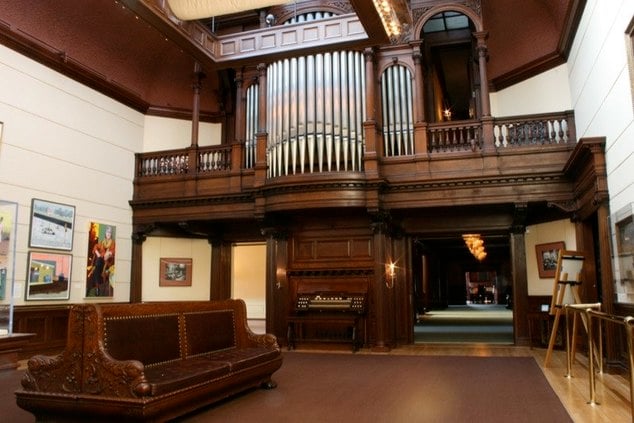




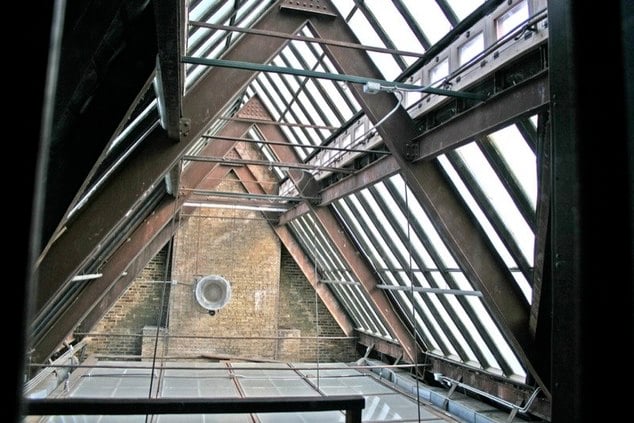
-
Building Art

The Driehaus mansion on E. Erie, near the north side luxury shopping area (and Trump Towers) is the restored Gilded Age (think Robber Baron) home of some very rich people.
It was opulently decorated (and opulently restored over a century later). Did the liquor dealers and bank presidents, their wives, her sisters, cousins, and his aunts, know so much about interior decorating that they could not only pay for all this, but could careful pick it out at the store as well?
No.
A. Fiedler & Co.: Designers and Manufacturers of Artistic Furniture, Upholstered Goods, Hardwood Fittings, Draperies and Interior Decoration will happily tell you what to do with your money (not that they have any interest in profiting from their own advice, of course...). They decree:
-
We strongly advocate the use of different styles in different rooms, to avoid the monotonous effect invariably produced by the fanatic apostles of the so-called Eastlake or Modern Gothic. For the same reasons it will be necessary for articles of luxury, as Easels. Hanging Shelves, Cabinets, etc., to use motifs from the Mooresque, Byzantine, Japanese, etc., though diametrically opposed to the prevailing style of the room.
The same rule should be followed in the selection of carpets, coverings etc., or in the decoration of ceilings, and walls, in which harmonious contrasts are preferred to harmonious analogies, known as “matching.” The mistakes committed by unskilled hands in the former are more easily overcome than the stupid blunders made in the latter.
See, now I would never think of mixing Mooresque, Byzantine, Anasazi, latter day Danish, and South Asian kitsch. I don't want yet another school of decorating to step forward wherever my gaze rests. I want harmony and matching. But then, they were selling to late 19th century people with money, not 21st century people with no money.
Did I mention that the restoration was opulent? The cleaned the exterior using a laser method. (I suppose they vaporized the soot and dirt 1 sq. mm. at a time.)
Note that the ceilings are covered in marble. This wasn't wretched excess. The builders had lost their previous house (a little shed) in the Chicago Fire and they didn't want that to happen again. The house is made up of a series of brick boxes--all of the interior walls and spaces between floors are very fire-resistant if not downright fire-proof. The marble on the ceiling is part of the fire proofing.



-
I'm going back to PF, why not?I don't understand the mass migration from PF to this nice forum. I honestly liked the formatting better at PF. I don't like how many posts seem like from a newspaper column. Any arguments and reasons that motivated you to move here rather than stay at PF that might dissuade me? — Question
The situation isn't exactly like some religions where, if you leave, you might get beheaded. You can come and go as you like. Post here, post there. -
Is an armed society a polite society?I used to do HIV prevention outreach to high risk populations -- this was back in the late 1980s. The bars and baths were safe from crime; the adult book stores, so so; the streets, questionable; and the parks -- potentially violent, especially at night after the parks were closed (which was when there was action) and I handed out condoms and info (to possibly be read later -- way too dark there to read in the park).
People did occasionally get murdered in the parks--maybe 1, 2 or 3 per decade. One morning (1:30 a.m {+/-) I was sitting on my perch on a rail fence waiting for guys to saunter by. A young guy joined me on the rail. We chatted a bit, and among other things he told me he had a gun on him. I wasn't happy about it, but there was nothing much I could do or say at that point that would decrease any risk to life or limb. Eventually he moved on, and there were no murders there that night. I was mugged on a downtown street by a knife wielding drugged out zombie around 11:30 p.m
I've never owned or carried a gun in even gun-shot risky areas. Did I think I was somehow invincible? Could be, I suppose. I rarely feel particularly threatened, and have learned the hard way that the best approach in strange situations is to act like you belong there. Like, don't stand on a street corner turning in circles trying to figure out where you are. One might as well pin a sign on one's back: MUG ME.
I'm not a fatalist either: I expect things to turn out OK. For a hammer, every problem is a nail. For the armed person, every problem might require shooting. There is quite a bit of self-fulfilling prophecy if one is, or is not, carrying a gun. No gun, fewer people get shot.
Supposing that early morning in the park I had a gun handy and pulled it out, telling the guy to go back the way he came. Having done that, I would know that this now angry person might be waiting for me when I decided to leave the park (only one way out) and stepped onto the sidewalk under bright street lights. Bang bang, maybe. Dead crank. -
Liberté, égalité, fraternité, et la solidarité.The amount of Eurocentrism on this thread is ridiculous. — coolazice
Guilty as charged. I am Eurocentric. Why should I not be? It would be odd if I were not. Why would it be better for you or me if I were Sinocentric, Afrocentric, Kiwicentric, or some other centrism?
The best vantage point for understanding other people in the world is to understand one's self. We are all more alike than we are different (as far as important matters are concerned). Where is the marvelous land of Omnicentrism? Where is the happy land that welcomes all migrations and diasporas, that universally embraces all differences, excludes no one, and is sensitive to every nuance?
Never Never Land, that's where.
I am more of an essentialist than a constructivist--another thought crime in some circles, no doubt. Granted, social input has a lot to do with the kind of people we are, but a lot of that content is poured in before our skull bones have all grown together. By the time we get to college, it's way too late to rewrite everything.
It seems to me clear enough that homosexuals born in Uganda or Kenya want to live openly, find lovers, live together, and enjoy life as part of a community. Maybe they don't feel a need to attend drag balls on Halloween, but I would guess they are like western gays in most respects.
It seems to me clear enough that women in Iraq or Saudi Arabia would want to have opportunities to enjoy personal growth experiences, to have independence, the opportunity for public self expression and executive agency, just the same as men do.
It seems to me clear enough that people in Saudi Arabia, China, Peru, France, or the United States have a fair amount of tolerance for social change, but it is limited. Most people do not want to see in their lives and lifetimes a radical change in their communities and their cultures. -
Is Your State A Menace or Is It Beneficent?As Marx said, the State is a committee to organize the affairs of the Bourgeoisie.
I guess one could imagine an arrangement where corporations entirely replaced the state. Though, without a state to incorporate or regulate them, I think we would have arrived at an earlier time where large enterprises started out as brigands and would grow by conquering their competitors, until they got big enough to dominate their field (whatever that was... robots, food, mining, medical parts...) It would be a sort of latter day medievalism, the corporation being like fiefdoms, dukedoms, and kingdoms.
The corporation would, like the modern state, be self-anointing. I am not suggesting these self-anointed corporations would be a state, however. The corporation exists for itself, not for its citizens, like the state (supposedly) does. I'm guessing that a world in which corporations had succeeded the states would not be altogether unpleasant, though I don't have a lot of confidence in that guess. Wherever the sovereign corporation achieved monopoly status, the quality of goods and services would probably fall. Your preferred brand of baked beans and peanut butter might still be good, or they might be thoroughly degraded. -
Is Your State A Menace or Is It Beneficent?Hmmmm... I didn't include corporations. The corporation is really recent, unless you classify monasteries as a sort of corporation. They were, in a way.
But the modern corporation belongs to the modern era (last 3 or 4 hundred years). The corporation can include the village (the company town) but it hasn't quite gotten to the point of subsuming cities, and merciful god, they won't get to the point of subsuming states. Though, that might not be that far away. (Or... have they done that already?)
The animosity toward "the state" goes back a ways. The American South had a negative view of the state from the get go. (This animosity is enshrined in the US Constitution.) The plantation mentality (an early company town arrangement) viewed the colony government (like, Georgia) in a somewhat unfriendly way. When colonies became states, they viewed the Federal government in an unfriendly way.
Southern states built railroads, just like northern states did, but they built them only within their state boundary. In the north railroads were built across state boundaries as commerce dictated. It wasn't exactly stupidity that limited their railroading vision, it was parochialism. Why should Georgia do anything to help South Carolina? If the railroad runs from my plantation to the docks, that's far enough.
A more thorough libertarian political scheme would reduce state functions to exterior defense, and a couple of other functions--nothing more than absolutely necessary. The rest (and the rest is a lot) either is individual responsibility or can be handled by corporations. A legal system? Everyone can get justice from binding arbitration companies. Prisons? We've got private prisons already. Roads? Utilities? Schools? Hospitals? We've got that covered by free enterprise already. Just dump the parasitic public services operated by guv'mint. Welfare? That goes into the list of things that rhymes with bucket list. (Thanks, Barack, for that one.) -
Is Your State A Menace or Is It Beneficent?Heck, we see clan v. clan type organizations develop within the state. — Moliere
Right. Everything from family to church (except kingdoms) exists within the state, as well as being developmental stages over the long run. (Developmental in that bands came before villages, villages before cities. Religion of some sort preceded (I'm guessing) religious institutions. -
Is Your State A Menace or Is It Beneficent?The features defining The State and distinguishing it from Family, Band, Village, City, Church, and Kingdom, are several.
- The Family, of course, is the fundamental unit of any population -- the reproducing core of kinship in all societies.
- The Band (of hunters, illegal pot growers, etc.) is a very small association, may be long lasting, may be temporary. Features trust and kinship.
- The Village is generally permanent, is generally self-governed, features mutual benefit and trust rather than kinship.
- The City is permanent, governed, and features cooperation and compliance rather than trust, kinship.
- The Kingdom is permanent, governs, demands allegiance as well as compliance, and is personified in the King. The King is King because he possesses real economic and military power and skill in using it (usually; not always).
- The Church is organized like a Kingdom, except that the divine head of a religious body is never present. Personifying God in his stead are archbishops and bishops. The priests serve as Knights, monks and nuns are the troops, and the laity (the bottom of the ecclesial pyramid) are the farmland. The institution of the church demands obedience, support, fealty, love, loyalty, and so on.
- The sovereign State differs from the Kingdom in that there is no person incarnating the State. The state is normally a secular organization and has no divine origin myth. The state declares itself. The State is as powerful as the citizens wish to make it. States demand compliance, support, loyalty, and cooperation.
EDIT
Thestatecorporation is the most modern of institutions, and the most secular as well. -
Medical IssuesAfter a closer examination of the ancient manuscript, I see that I mistranslated Old Soc. He said, "It's better to be a pain in the ass than to have one."
-
Medical IssuesOccasional hemorrhoids for me. Nothing else (though they are hella annoying). — Thorongil
"Far better to have hemorrhoids than to be one." Socrates -
Medical IssuesArthritis
benign enlarged prostate
bone spur on big toe
depression
glaucoma
occasional basal cell skin cancer
Nothing too debilitating, thanks to medication, and much of it a result of being alive long enough to get it. -
Liberté, égalité, fraternité, et la solidarité.who here went out on the streets to protest Iraq and Afghanistan? — Benkei
I did, but the demonstrations were pretty sparse. I think we can chalk that up to the military using the pool of National Guard troops (running them ragged) in Iraq and Afghanistan rather than reactivating the draft. The first decade of the 21st century just wasn't the 1960s, but what brought out 100,000 to 1,000,000 young people at a time to protest against the war was the reality of a lot of young men being drafted and sent to Vietnam. I was called up. (I flunked the physical as I knew I would, but had previously registered my intention to claim conscientious objection.)
I understand your argument, Benkei. To some extent I agree with it, but I am also aware that there is less than a snowball's chance in hell of the United States doing very much to alleviate the suffering of the Middle East. Hell, we're not willing to spend much money on rebuilding our society so that it would produce fewer suffering people here, let alone doing that for Iraqis, Syrians, or Afghans.
(Dropping bombs on people is profitable for bomb makers. Munitions are one of the special interests that have the keys to congressmen's bedrooms, so to speak. Commerce and politics makes perfectly predictable and compatible bedfellows. It's a regular orgy.) The US actually donates very title money to foreign aid. We could do a lot more. We could actually do a much, much better job of helping other people (in very material ways) and spreading some of our better western values to boot. I'm in favor of western values. I happen to be a socialist, so when I say "western values" I wasn't thinking of capitalism right off the bat.
Turning American, European, Saudi Arabian, Chinese, Brazilian, or South African cultural values even a few degrees on a dime is VERY DIFFICULT. Making a 180º turn is not going to happen--anywhere--short of a massive revolution which, as we have seen, can have all sorts of unpleasant and unpredictable consequences.
Bombing ISIS is probably ineffective. So I have heard, anyway. Look at Iraq -- Bush's shock and awe must have been a bad experience for the folks on the ground, but it didn't result in any sort of victory. Drone strikes, if the intelligence is good, have about the same effect as a special forces attack. But getting really good intelligence is difficult.
If European countries (or us, or anybody else) can not figure out how to integrate displaced and distressed Moslems (or anybody else) into society, then we would do well to tell the refugees/migrants up front: You can come and stay for a while, but you can't stay here permanently. France and England seems to have a lot of refugees or migrants who came and settled, but are not really doing well and are not integrated.
And how can it be? High unemployment rates don't make for full employment no matter how you slice it. There are far more people than there are jobs. The issue of uncontrolled migration into the US from Mexico is partly about whether there is a real future for unskilled migrant's labor, and how excess workers further distort and devalue the labor market. -
Just for kicks: Debate FascismI haven't read The Mass Psychology of Fascism by Wilhelm Reich for a long time. Reich had some good insights into political behavior, despite his screwy Orgone Box theory. (The Orgone Box is harmless, as long as one doesn't expect it to cure anything.)
-
Just for kicks: Debate FascismThe Anatomy of Fascism by Paxton is a full length treatment. The shorter article to which Moliere linked, the 5 stages of Fascism, is good too.
Fascism is, as Paxton notes, a 20th century invention. In his later writings (1890) Marx did not anticipate fascism. Sorel criticized Marx in 1908 that "a revolution accomplished in times of decadence could take a return to the past or even social conservation as its ideal."
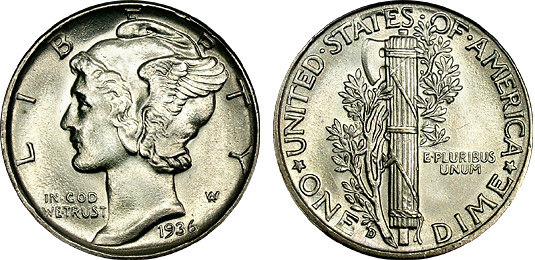
For those irked by things like this, the fascist symbol -- a bundle of rods and an axe, is featured on some American coins, like this 1936 dime. The bundle is formalized (all vertical, bound together, and behind the bundle is the axe blade at the top. The fasces go back to Roman Times when they were carried in front of certain official processions. I'm not sure if oak leaves are explicitly a fascist symbol, but a proud German Oak Tree was menaced by Jews in some propaganda images.
-
Is Your State A Menace or Is It Beneficent?"States do not have friends, they have interests" mostly describes state to state relationships. Even the UK and the US are not "friends" when it comes to state to state interaction. The United Kingdom has interests that are its business to pursue, and so does the United States. That's all. If those interests are the same, then all is well. If not, then not. The USSR and the USA could pursue a few common interests, even though our interests were decidedly not the same. For instance, both the USSR and the USA were interested in avoiding mutual assured destruction.
If France decides to bomb Syria, it is because it is pursuing its interests there. States don't get pissed off and decide to beat the shit out of somebody. That is people acting like people. When people act as states, they are cold.
People have relationships wherein friendship, hatred, annoyance, affection, amusement, and so on come into play. Ambassadors strive to cooly represent the interests of their nation, but as people they feel all sorts of things about the people they interact with. An ambassador may loathe the officials he has to deal with, but he is there only to represent his nations interests.
Sorry for beating the thing into the ground. -
What are you listening to right now?This probably won't appeal to black metal guys, but who knows? Classical Tracks on MN Public Radio this morning featured Louise Dubin, The Franchomme Project (Delos), a disk of rediscovered music by a 19th century cellist and composer. August Franchomme was an orchestral cellist and a chamber musician. He played in the orchestras of all three Parisian opera houses; he was a teacher; and he was appointed solo cellist to the King in 1832. See, I'd like to have a solo cellist on hand too.
Anyway, this disk of Franchomme's music can be heard at Minnesota Public Radio (for a limited time). Or, try this:
-
Liberté, égalité, fraternité, et la solidarité.So, after all this, do we agree on anything, here?
Is ISIS good, bad, or negligible?
If ISIS is bad, what may, might, can, should, be done?
Most philos don't like bombing. Fine. There is evidence that bombing is, quite paradoxically, not very effective at destroying organizations on the ground. Bombs not big enough? That's a problem we can solve. Philo enthusiasm for boots on the ground (our boots especially) is scant. How about an Arab boot? How would that force come about--and what are the chances?
No boots, no bombing. What's left? Economic sanctions? Perhaps -- but unless IS's transactions can be identified and blocked...
Propaganda? By all means try it. Don't hold your breath of course. Maybe Brussels could pass a resolution urging ISIS to be nice.
Maybe we should have a big conference of everyone in between Casablanca and Karachi and redraw the Great Post-modern Post-Colonial map of the Middle East. I'm sure that would work out just wonderfully.
Assad has to go. Everybody seems to like that idea. And what if he just doesn't? Then what? If he does go, what's going to happen with all of the combatants in the Syrian Civil War? Assad leaves followed by a love feast? I doubt it.
And if we talked the Jews into giving up Israel and having all of North Dakota (it even has oil) or Finland, or Austria, or Ireland, or Manhattan, or Holland and Florida (until they disappear under the Atlantic) would the absence of Israel solve all that many problems? -
Is Your State A Menace or Is It Beneficent?States have interests, they don't have friends. States are not virtuous. They can't be evaluated like persons.
States pursue interests. 75 years ago the US declared that controlling ME oil was a point of national policy NOT because arabs were inferior, or that we were entitled to it, or that it was our destiny, or anything like that. Controlling who had access to the oil and who didn't was in the national interest as understood by the Roosevelt (and subsequent) administrations. Nations that embark on empire (Britain, France, Italy, Germany, Spain, Portugal, Russia, Holland, Belgium, etc. did so because it was in their national interest.
The State's interest may even conflict with what citizens perceive as their interests. A state may go to war when it's population has no interest in the war. The state may wish to know what is passing through the telecommunication systems, but the citizens may wish to have their totally innocuous conversations and emails remain strictly confidential.
The policy of a given state may be appalling to its own people, and to people in other states, and whether the state pursues its policies openly without misrepresentation or does it with obfuscation, is a matter of state craft. (Though, obfuscation may cause its own or other people to doubt the state's intention all the more.)
It seems like a different scale has to be used for measuring states behavior and measuring individual behavior.
Life, Liberty, and the pursuit of Happiness (or egalité, liberté, and fraternité--pick your home town slogan) may not mean much to those who act as the state. So, whatever goal the US was pursuing in Iraq, it certainly was not Life, Liberty, and the pursuit of Happiness for the Iraqis. Their happiness just didn't figure in. Other States behave in exactly the same way.
In a way, citizens of a State are observers of State Theater. They may be paying for the production, but they are definitely not in control of it. -
Is Your State A Menace or Is It Beneficent?I do agree with unenlightened:
I don't see the state as being fundamentally other than the people that compose it.
— unenlightened — Mayor of Simpleton
I think the state can be, and may/might/sometimes/often is different than the people who compose it.
For instance, was Austria at it's antisemitic worst merely a composite of its population, OR was the State of Austria different than a composite of Austrians?
The United States (as it is perceived here, in the US, or as it is perceived elsewhere) isn't just a composite of 320 million people. The various branches of the US Government (the Dept. of Defense, for instance, vs. the Institutes of Health; the Energy Dept. vs. the Library of Congress; the CIA and all of the intelligence establishment, vs. the Dept. of Housing and Urban Development) all pursue various policies which are not all coordinated. There are among the 320 million people, numerous and quite different demographics that don't overlap and don't have the same values and interests. -
The Door is ClosingThe governors of the rejecting (or accepting, or no comment) states don't have a say about accepting refugees -- at least, not immediately. Refugees are strictly a federal issue. I don't know why anyone would send Syrians to Alabama anyway, but Alabama doesn't get to say "no".
What the states can do is perform poorly once the refugees get there. This will come easy for most of the rejecting states because they either have perfected, or are working at perfecting, poor performance in general. Bad schools, gun-controlled politeness, low achievement rates, hook worms, pestilential swamps, governors named Walker, and various other failures. -
The BarycenterI don't know.
Perhaps the heavy (βαρύ-ς) reference in the title is ironic. The light of dawn and dusk is weightless and is diffused and uncentered (after the sun departs, before the sun arrives). Celestial bodies can not revolve in two directions at once, but a poem can move in multiple directions at once.
I need more data. -
Liberté, égalité, fraternité, et la solidarité.They want to fight, to die, to go to heaven. — Cavacava
Gee whiz! If all they want is to die and go to heaven, don't they realize we would be more than happy to arrange their demise? -
Liberté, égalité, fraternité, et la solidarité.The Paris attacks are portrayed as an assault on the values of the west. In fact, the hopes and philosophies we cherish are global — jamalrob
Western imperialist rubbish, obviously. (Not to me) -
Liberté, égalité, fraternité, et la solidarité.Jamalrob asked: "Are Kurdish women equal to men because this was imposed on them by the West?"
I think they [Kurdish women] are. I wouldn't claim to know what that means in their culture though nor whether they aspire to "Western" equality in the first place. — Benkei
I bet Kurdish women who are equal to men, even if it was imposed on them by Western Imperialists, would be reluctant to give up their equal status. I bet Hindu women in India who have been gang raped and beaten to death because the appeared to be gaining personal sovereignty, would disagree with you. I would guess Chinese women who have gained rights under the Chinese Communist Party would be reluctant to go back to the days when their feet were still getting bound (a century or so ago).
The Afghan women who had lived relatively public and interesting lives before the Taliban took over parts of Afghanistan, didn't seem to be thrilled to be put back into their burkas and were sort of expected to stay 'barefoot and pregnant' again.
The women in sub-saharan Africa who are gaining control over their fertility and education for themselves and their children don't seem to resent western aid imperialist's efforts on their behalf.
Men and women everywhere generally like to have options in life if that is at all possible, whether they are Moslem, Hindu, Communist, Christian, Animist, fundamentalist Protestant in Central America, or what have you.
Universal Rights are universally a good thing, whether the reactionary local yokels like it or not. -
Liberté, égalité, fraternité, et la solidarité.There is a romance, slick and cool factor that is attracting these kids to find purpose within the ranks of ISIS. It is very similar to the gang codes of inner cities or out here in the West with the Hell's Angels and the Dirty Dozen where the initiation often involves taking out another from the rival gang. — ArguingWAristotleTiff
Even though it was cream cheese by comparison, quite a few young Americans were attracted to various leftist organizations and radical loony groups in the 1960s. The old-line communists called it "infantile adventurism". As you note, young people like the slick (or not so slick) cool factor. So did I, back in the stone ages. Adventure! "Let's see just how far out we can get!"
A few Somali youth have left Minneapolis for Syria, much to the horror of their parents. It hasn't worked out well for them. But, given their cold, upper midwestern cultural milieu, Syria is hot. -
Liberté, égalité, fraternité, et la solidarité.To this recent attack. I'm one of those "pansy liberals" who thinks the only good reaction to what happend in Paris is absolutely no reaction. — Benkei
Suggesting "absolutely no reaction" to a terrorist action in which 129 (+/-) were killed, about 100 were critically wounded, and 200+ more sustained serious to moderate injuries (mostly from gunfire) and x number of near-by eye-witnesses were traumatized, is just not creditable. It doesn't make any difference whether such actions are in Paris, Nairobi, Madrid, London, Beirut, Bagdad, Mumbai, or Timbuktu. "Absolutely no reaction" would never be an appropriate or sensible reaction.
The public policy we follow does need to be based on careful distinctions:
Terrorism isn't an accident (a train derailing); it isn't gang activity (fighting over turf); it isn't ordinary criminal behavior (knocking off a convenience store); it isn't subversive political activity (changing the government by covert political means); it isn't rioting (spontaneous outbursts); it isn't a game of political uproar.
Terrorism is a unique kind of intrusion (state sponsored or not) which is aimed at people who are not responsible for one's grievances. Terrorism is a specialty of guerrilla war; it is a powerful lever in the hands of the relatively powerless. A handful of operators can do a tremendous amount of damage.
Whether an open door policy for a flood of refugee/migrants is a good idea or not is a tangential issue. So also is the question of religion and terrorism: Tangential, but not irrelevant. The long history of Europe and the Middle East is tangential. Yes, we could go back to the Crusades, or to the conquest by Islam in the first place. But... let's not. More recent history will do.
Yes, it is true that that the colonial British, French, and Americans et al have all had a hand in creating the 20th century mess of the Middle East and Northern Africa. I was opposed to the war on Iraq and Afghanistan (and I said so at the time that if Iraq or Afghanistan were a mess, the USA definitely did not have sufficient expertise to straight it all out. And nobody else does either.) Plus, it has been stated US policy since WWII to control oil in the Middle East.
Do the actions of the UK, US, France, et al justify whatever happens next? I suppose one could say we had it coming. Everybody has some sort of unpleasant recompense coming. THERE ARE NO VIRTUOUS STATES. Not Saudi Arabia, not Iran, not Syria, not Israel, not Belgium, not Germany, not US, UK, Russia, or anybody else.
Appropriate responses for social disruptions. Who has an interest in the well-being of the Islamic State, outside of small circles of friends? It is likely that destroying their extremist enterprise will leave the world better off, particularly the world of those who live near by.


BC

Start FollowingSend a Message
- Other sites we like
- Social media
- Terms of Service
- Sign In
- Created with PlushForums
- © 2026 The Philosophy Forum