
Comments
-
Is our dominion over animals unethical?You want to have an ethical conversation, with you being the moral authority. Everything else is discarded. — Jake
Chatterbears nailed. -
The Future Of Fantasyan essentially unreal character in my experience. — Jake
You know, come to think of it, people do tell me to "get real" quite often. Maybe I am virtual, unreal. It seems like that some days.
You're right in that the more powerful the coming technology is the more it will become another tool in the process of funneling money and power from the middle and lower classes up the chain to those who are already rich. This is a sobering reality for sure. — Jake
As Marx noted, the nature of culture follows the curve of material production. We are talking about virtual reality because material production (in the form of television programs and film) are able to depict virtual reality (Matrix, the holodeck, Q and the Continuum (2nd generation Star Trek character, etc). But depicting virtual reality isn't virtual reality.
Facebook, Amazon, and Google didn't produce wealth by the multi-billion truckload because people just loved bloviating the details of their personal lives to the world, looking at stuff and seeing it appear on their front step (Sears and Wards starting doing that 125 years ago) or getting answers to everything from Google Search. Facebook, Amazon, and Google were engineered to make money by offering bait for what really produces earnings: advertising and buying stuff. Facebook, Amazon, Google, and thousands of other tech companies started out fairly small, had to struggle to find their market and exploit it (like, from a few college students to 1/7th of the global population for Facebook).
The use of VR and 3D printing together has great potential. 1st person immersion helps with design. — Nils Loc
Absolutely, first person immersion helps with design. I imagine that was true for the ancient ivory carver who created the "Venus" figurine 35,000 years ago, found near Willnedorf, Austria, or whoever carved the Venus de Milo, or Jackson Pollock dribbling paint on canvas. Adding a 3D printer and a virtual reality app to one's gear isn't "virtual" anything. The term "virtual reality" is leading people around by the nose. It's one more example (among trillions of examples) of us believing our own bullshit.
Has our grip on reality become so loose that we think the hardness of reality can just be waved away and EDIT:depictedperformed or inhabited however we see fit? I hope we have not lost our grip to that extent. -
The Future Of FantasyI read an interesting book about your part of the world (northern Florida?) -- Illumination in the Flatwoods: A Season with the Wild Turkey by Joe Hutto. Hutto hatched a batch of wild turkey eggs and raised the chicks which had been imprinted on him. He spent most of a year with the turkeys, all day, on many days. Great book.
-
The Future Of FantasyThere are of course needs of the body which presumably can't be met in the digital realm (the subject of bathrooms was never addressed in the Holodeck — Jake
The needs of the body weren't dealt with on any deck of the Enterprise, never mind the holodeck. Do you recollect seeing a urinal in any Star Trek episode? I was shocked when someone actually washed their hands in a sink. Did anyone ever vomit in an episode? People didn't even bleed, in most cases. Picard ordered many cups of Earl Gray tea from the replicator but rarely did he (appear to) take more than one sip.
The holodeck was more than a hologram. It had physically resistant topography, features, furniture, and forces. It was way pass virtual reality and was weird reality (except for the protections which somehow prevented things from getting out of hand -- until the protections failed, which they did regularly).
Virtual reality is going to have to figure out how to provide solidity to objects that do not exist. Nice trick, that. -
The Future Of FantasyWhile it's nice to fantasize about the future of fantasy and virtual reality, let us remember that you aren't going to get so much as a cheaply printed comic book for free, let alone an hour on the holodeck of the future.
Chickens and Eggs:
What came first? e-mail, cell phones, FaceBook, et al infected people with the coolness of avoiding face-to-face contact, or people were relieved when e-mail, cellphones, and FaceBook et al rescued people from the dreary necessity of face to face contact?
I'm prejudiced here. I think it was chickens.
Since writing, paper, and post offices made it possible to communicate reasonably well over distance and time, people have availed themselves of mail. The telegraph and telephone added something that was faster and more personal than mail. Recorded sound, film, radio, and television are all fantasy-stoking media, and have been since they were invented. The Internet and WWW, browsers, broadband, etc. merged all previous media into products that could be sold on small screens.
No media, no device, and no corporation selling media and devices was called into existence by customer demand. Entrepreneurs (like Steve Jobs, Bill Gates, Sergey Brin, Jeff Bezos, and Mark Zuckerberg, et al) created devices and media and sold them to the public at enormous profit. So much so that Jeff Bezos (Amazon) is the richest man on earth.
Media is a business; devices are a business; fantasy is a business. You aren't going to get it for free.
Just as people had to learn how to use and NEED telegraphy, telephones, recorded sound, cameras, film, radio, television, and computers, they have had to learn how to use and NEED the current batch of media and gadgets. Some of us are more suckers for the blandishments of corporation marketing messages than others. -
What Factors Do You Consider When Interpreting the Bible (or any other scripture)There are Biblical verses one hears a lot because they are part of liturgy, or because they are repeated frequently (like Psalm 23). There are some verses I don't hear in liturgy and they aren't repeated all that often like Micah 6:8: Do Justice, love mercy, and walk humbly with God.
Ecclesiastes 9:4 ... to him that is joined to all the living there is hope: for a living dog is better than a dead lion.
Ecclesiastes 9:9-9:11
Live joyfully with the wife whom thou lovest all the days of the life of thy futility, which he hath given thee under the sun, all the days of thy futility: for that is thy portion in this life, and in thy labour which thou takest under the sun.
Whatsoever thy hand findeth to do, do it with thy might; for there is no work, nor device, nor knowledge, nor wisdom, in the grave, whither thou goest.
I returned, and saw under the sun, that the race is not to the swift, nor the battle to the strong, neither yet bread to the wise, nor yet riches to men of understanding, nor yet favour to men of skill; but time and chance happeneth to them all.
Ecclesiastes seems to me to be quite unlike much of scripture in that it emphasizes the futility of existence. Enjoy life, because that's all there is, and in the end there is the grave where there is nothing. The best do not win. The wise are not rewarded. Life is futility.
Pairing the Micah and Ecclesiastes verses one gets "You only have this life in which to do justice, love tenderly, and keep God company. This one life is not a dress-rehearsal; it is the main, and only event. So, mortal, if you are going to do justice, love mercy, and keep god company, you had best get on with it.
Life may be futile for God too. Hosea was ordered to marry a prostitute who, after the marriage, continued to behave like a whore. What is the point of this exercise, a frustrated Hosea asks. God says that being the God of Israel is a lot like being married to a whore--extremely disappointing. -
How do doctors do it?They say the medical profession has the highest rates of suicide. — TheMadFool
Several professions claim to have the highest rate of suicide; it's a contest, I guess. But how do we identify and count all these suicides? From obituaries? From life insurance companies? From anecdotal reports? From police reports? What?
What is the cause for all these suicides? Is it the gap between ideals and reality? Financial pressures? Something inherent in highly ambitious people? Maybe they are insufficiently prepared to deal with life's ingravescent inimicalities? I don't know.
I doubt that doctors are especially prone to suicide. As how to doctors do it... they should know more than anybody else how to do it -- and they have the means at hand -- drugs, sharp objects, etc. -
What is intelligence and what does having a high IQ mean?As one of my old psych profs said (back in the antediluvian 1960s, "Want to is more important than IQ." This prof had been a professor for decades on the basis of a faked PhD. Unfortunately, his novel approach to scholarship was revealed later on and he died in some sort of disgrace. I thought he was a good teacher.
Intelligence is a good thing, of course, but so is stick-to-it-ivness, ambition, imagination, and planning. People tend to get smarter as they get older, in some cases, at least. Some people start getting dumber at about 30, give or take a few years, and by the time they are 50 or 60 they idiots. But if you work at it consistently (have curiosity, read widely, remember useful information and think about it), don't fry your brain with too many drugs or too much alcohol, don't hit your head on concrete too hard or too often, don't consume too much cultural crap, you tend to "get smarter".
Intelligence has never meant the certainty of being a huge success--making millions of dollars, becoming world famous, chased by crowds of screaming women (like screaming with excitement and lust, not #me2 screaming for blood), or getting elected president (we now know one can be a complete imbecile and be president). -
How do doctors do it?Are they practicing a noble profession or is it just another job? — Wallows
It's an elite profession requiring successive successful leaps over significant hurdles. Becoming a doctor is expensive, very time consuming, and difficult (in a variety of ways). The rewards vary from modest to excessive. Most people, irrespective of their noble intentions, can not afford to become doctors.
If you take a big-picture view of progress it isn't medicine and surgery that have brought about the greatest gains in quality of life. What has made the most difference in quality of life is the work of farmers and civil engineering. More and better food and effective sanitation systems have accomplished much of the benefit we enjoy. If you think wonder drugs are important, that credit goes to chemists and research scientists, not doctors.
Doctors can not claim most of the credit for gains in longevity. Most people still die of cancer, heart disease, and stroke. Engineering has significantly reduced the likelihood of dying in auto accidents, though a determined human can overcome those advances with either alcohol or a cell phone. Greater prosperity gives many more people access to adequate diet, shelter, clean water, and education. All of contributes to health and longevity.
So, no: medicine is not an inherently noble profession, but some doctors are noble. Medicine is a technical field. Most doctors are careerists who do at least reasonably good work and are quite well rewarded.
What doctors can do is often relieve suffering and improve healing. Their capacity to perform those beneficences owe much to people who are not doctors. -
Some Questions I Would like to Discuss About Western Civilization/CultureTo summarise, my objective in this post has been to argue that Classical Greco-Roman culture/civilization is not, as is widely presumed, equivalent to Western culture/civilization. What we call "The West" was not born in Athens in 500.BC. — johnGould
That Classical Greece and Rome are not Western Civilization per se makes sense. There were at least two breaks between Classical Athens and us: One is the Roman Empire which engulfed Greece and the second is the Medieval period where life without Rome had to be negotiated. Further, parts of Europe that had never been part of the Roman Empire came into their own (eventually). And Rome itself wasn't classical Greece just enlarged. Its ethos was quite different.
Question: Why did Spengler call it "Faustian"? When I think of Faust I think of Faustian bargain.
I haven't read Spengler; might have to add it to the collection of books to get read. -
Contradiction and TruthAs someone who grew up in a hell and damnation religious environment I am not happy to face years of threat and intimidation based on a highly suspect definitely incoherent and contradictory text. — Andrew4Handel
As well you should not! I grew up in a mainline Protestant (Methodist) home, where the Bible was taken seriously. I went to Sunday school, church, believed, etc. I was homosexual and this caused no end of internal conflict for a long time. I was stuck between God saying homosexuality is an abomination and being myself that abomination. There are three solutions; I used all three. The first is to just ignore the Bible and the church. Cruise the parks, go home with gay guys from the bar, all that, and ignore the religious message I was raised with. The second approach is hermeneutics: Ancient semitic cultures did not have a concept of "sexual orientation". People were supposed to marry the opposite sex, period. (I won't review the whole hermeneutics thing.) That helped; it enabled me to be active in religious groups where gays were accepted. Back in the 1970s that was in gay religious organizations. The third approach is rejection: I am gay and good, the Bible is wrong, so be it. If that's how the churches are thinking, then to hell with it. This approach works too. It can be difficult for dyed in the wool Christians to reject their religious system, but it can be done.
My siblings (all older than me, I'm 72, the oldest one still living is 80) are pretty much against gay people being accepted. They are mostly pretty conservative Republicans, to boot. They accept me, but that doesn't generalize to homosexuals in general, and how much they accept me is open to question.
Now I look at Christendom and the Bible from the outside in, much more than the inside out, and that's much better. -
Contradiction and TruthThis what the bible actually says in Exodus 20:5
" I, the LORD your God, am a jealous God, punishing the children for the sin of the parents to the third and fourth generation of those who hate me." — Andrew4HandelBut then in Ezekiel 18;20 it claims:
"The one who sins is the one who will die. The child will not share the guilt of the parent, nor will the parent share the guilt of the child. " — Andrew4Handel
Yes, there is no squaring this circle. The two verses are contradictory. But you know the Bible is a collection of texts from different authors and editors, and composed at different times and places. One could observe that the Ezekiel text displays a more generous system of judgement than the Exodus verse. One of the flaws of fundamentalist literalism is that it assigns a single voice (god) to the entire text. That assumption sets up the reader for trouble when he compares texts. There is no contradiction if the text was composed by various people over time. If God dictated the story, then there are big problems. People have to decide for themselves what it was.
What I would be attacking hear is biblical literalism. — Andrew4Handel
By all means, attack Biblical literalism which, you know, is the fault of the reader, not the text.
Reading the Bible cover to cover 10 times might be worthwhile, but it will not, in itself, instruct one in hermeneutics, the branch of knowledge that deals with interpretation, especially of the Bible or literary texts.
I think I've mentioned once or twice, here and there, that I don't believe the Bible is the Word of God. I understand it to be a sacred narrative, composed over time under varying circumstances. It was not composed over an expanse of time from Adam to Revelations. The book of Exodus wasn't composed during the exodus period. Exodus is a story - a narrative. So is Matthew. The people who composed, edited, and recorded the narratives were always dealing with current conditions, current issues, current thinking. -
Contradiction and Truth"No man hath seen God at any time". John 1:18, 1 John 4:12
The Lord talked with you [the people of Israel] face to face in the mount out of the midst of the fire. Deuteronomy" 5:4 — Andrew4Handel
Yes, literally contradictory. Oh dear, God screwed up. Woe is you!
Look, if you don't want to believe that the Bible is the word of God, that's fine by me. But if you want to build a case against the Bible (for whatever reason) you should come up with something more substantial and compelling than a few contradictions.
Personally, I don't believe the Bible is the word of god. The Bible is the word of serious people who believed in god, and were invested in the whole holiness project. For that matter, I don't believe all that much in god, either. I have nothing against people who take the Bible seriously and believe in god. Many hands were involved in writing the Bible -- both OT and NT, so we should not be at all surprised that there are contradictions. Maybe even factual errors! We weren't there; most of the Biblical writers weren't there either. They were, in most cases, writing about times gone by before they were born. -
Can you class a group of people with social statistics in this way?had an argument with a friend of mine... He claims that black people commit more crime and are therefore are more likely to commit crime. Following his premises, and he is white, we should fear black people and be suspicious.
I say he is arguing that being black causes you to be a criminal... which is a load of shit in my book.
He uses the statistics on US prisons to say blacks are proportionally more likely per capita to commit crime.
I argue that there could be other factors for their reason for being in jail. Racism, environment, mental illness, culture (as in respecting gang members and the pressures to conform) — Drek
Of course your friends is prejudiced. Yes, most blacks do not commit crimes. Blacks are disproportionately imprisoned. Etc.
Your friend's prejudices are not novel, and they used to be much more common than they are now, and were, in many cases, more extremely prejudicial. Times have changed. Polite white folks do not openly express these sorts of prejudices nowadays. Politically correct, liberal, woke, whatever... people pride themselves on not expressing, and not even having these prejudices.
Everybody has prejudices. It's quite impolitic these days to express prejudices about blacks, gays, trans, women, and various others. It is OK, maybe even mandatory, to have prejudices against white men--especially white men who have a small amount of power. It's also OK, maybe even obligatory, to have prejudices against religious people, especially conservative religious people.
It is quite possible that even politically correct, liberal, woke, sensitive, etc. people have prejudices against blacks, gays, fat people, women, poor people, uneducated people, and so on, as well as against well off white men, conservative religious people, Republicans, and so on. You won't catch them voicing these prejudices, though, most of the time. The prejudices are more likely to be detected by long-term observation: Where do they choose to live? What so their closest friends look like? Who do they hang around with, and who do they not keep company with?
Are people who claim to be without these prejudices merely hypocrites? Quite possibly; hypocrisy is as much a feature of human behavior as handedness or having more hair when one is younger than when one is older. -
Some Questions I Would like to Discuss About Western Civilization/Cultureif Spengler were alive today to "fill in some of the gaps" for us , relating to his work, he would probably identify the Vikings, who appeared on the map of world history in the 7th (?) century, as the first genuinely Western (Faustian) people; that is, the first "fully fledged", bone fide Westerners. — johnGould
Why Vikings? Why not the English, the French, or the Irish who, one book says, saved Western Civilization? True, the Vikings took the initiative and ranged all the way from Oslo to Constantinople, or Copenhagen to Canada. I have nothing against the Vikings, but I don't see why you would see in them the roots of western culture more than Ukrainians, Germans, French, Greeks, or the Spaniards.
"Western" is an amalgam of cultures stretching from the Levant, Greece, Rome, Northern Africa, Scandinavia, Finland (can't leave out the Finns, Balkans, Russians, etc.) and more.
When do you think the West began? During the Age of Pericles? Augustus? In the several centuries after the last emperor of Rome? What about Byzantium? Charlemagne? Before or after the conversion to Christianity of Europe?
I do not think it is possible to put one's finger on a date and place and say "That's where the West began!" The West, just like the East, China, the Maya, Inca, Aztec, Anasazi, Egyptian, or Islamic empire (and more besides these) -- is an emergent process. Babylon, Jerusalem, Athens, Rome, Alexandria, Moscow, Paris, Madrid, Stockholm, London and so on are all way stations on the road to the West.
The West that we belong to has been in existence for maybe 3000 years. Thanks to the colonial powers of Europe, much of the world is now tentatively western. -
Average illnessWe would love to believe that we are all destined for something. — Emmanuele
We are all destined for something: the grave. -
Have I experienced ego-death?I want to say this: it is not your job to heal the world. — Lif3r
Or it is our job to heal the world, and we have to do it with a sober, sound mind. -
Some Questions I Would like to Discuss About Western Civilization/CultureHere are a couple of books you might be interested in reading:
The Horse, the Wheel, and Language: How Bronze-Age Riders from the Eurasian Steppes Shaped the Modern World by David W. Anthony
Ancestral Journeys: The Peopling of Europe from the First Venturers to the Vikings by Jean Manco
Britain Begins by Barry Conliffe
The first, Horse, Wheel and Language is the best bet.
Guns, Germs, and Steel by Jared Diamond
The first two concern themselves with archeology and philology to trace physical and linguistic evidence of how a mix of various people eventually became "Europeans". Interesting books. The Horse/wheel book is the best of the those three.
Guns, Germs, and Steel by Diamond concerns the geographic advantages of the people living in the Fertile Crescent and southern Eurasia. The climate and geography was roughly the same from east to west (plains, grass, forest, mountains, sea coasts, and rivers). The Chinese also benefitted from a similar configuration. Africans, Western Hemisphere and Australian aboriginals didn't benefit from their locations in a similar way. From the Mediterranean to the southern tip of Africa, from Hudson Bay to Terra del Fuego, there are many bands of climate and geographies. In Africa, and the Western Hemisphere, People tended to move from north to south. What worked in the Pacific Northwest didn't work in the desert southwest or central America.
The domestication of various animals brought Eurasians into contact with several significant diseases -- smallpox, measles, and so on. They adapted, so that they didn't all die of the various afflictions that came with animal contact. When westerns and Amerindians came into contact, the Amerindian populations were devastated by the previously unmet diseases.
The difference in E--->W, vs. N--->S movement is that the former were able to benefit from developments in one place as they moved on, and the latter were not. Also, Africans and Western Hemisphere peoples did not have animals that would agree to being convenient sources of labor. The Eurasian people had the advantage of several wild herd animals that were calm and cooperative enough to be domesticated -- water buffalo, sheep and goats, cow, horse, and hog (camels were a late arrival). There were buffalo in North America but buffalo are flighty herd animals which will not submit to close human contact. (Horses were introduced to the W.H. by the Spanish.)
Diamond discusses some of the material determinants that helped produce Western Civilization. It isn't the case that Western Hemispheric aboriginals didn't develop complex civilizations and large structures: they did. The Cahokia monuments near the confluence of the Ohio and Mississippi Rivers is a very large cultural site. The earthwork structures are still quite large, even after a few centuries of erosion. Cahokia dominated much of the present central USA.


-
Some Questions I Would like to Discuss About Western Civilization/CultureI wanted to send a "@link" to show you all something (some photographs), in the context of this discussion of Western culture/civilization we are having, but my technical knowledge of computers/the internet is very poor unfortunately. (I am a stubborn, old, male Luddite in this respect !) — johnGould
Do not despair, for I bring you tidings of how to post pictures!
Most pictures on the Internet picture (like one resulting from the Google search for "Carving on a 9th century Viking boat) have an internet address. Here is an example of an Internet address: irisharchaeology ie wp content uploads 2012 09 Oseberg viking bucket (punctuation removed) You don't have to remember the address. If you are using an Apple computer, position the mouse over the picture you want to post. Hold down the "control" button and then click and hold the mouse down. A menu will appear. Near the bottom of the menu you will see "copy image address". Click on "copy image address".
Now, look at theat the top of the text box where you compose. There is a square icon with what sort of looks like an image inside it. click on that. It will tell you to paste the link to your image. Using your keyboard, hit Command - v. That will past the address of your image.
You won't see the image you pasted until you post the comment. Like this:
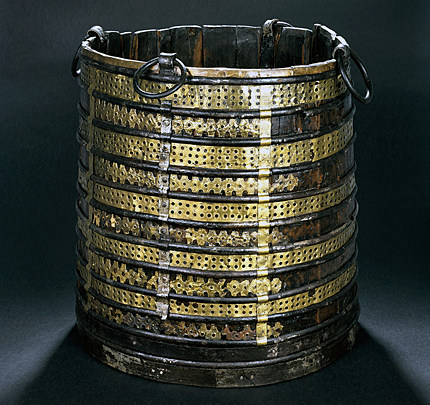
Now I'll copy and paste the caption under the picture:
This bucket was one of several found on on the ship. Made out of yew wood it is surrounded by decorative brass fittings and held together with iron hoops. A wooden ladle and 6-7 wild apples were found inside it.
It's been quite a few years, I don't remember how to copy/past internet addresses on PCs. Sorry. As I recollect it was sort of similar. -
Donald Trump (All General Trump Conversations Here)Is that good or bad, a problem or a solution? How much is enough, how much is too much etc?
I don't see how we get where ever it is we're trying to go population-wise if we have no idea what that is. — Jake
1 billion in 1870s, 2 billion 1920s, 3 billion 1960s, 4 billion 1970s, 5 billions 1980s, 6 billion 1999, 7 billions 2009, 7.7 billion 2018...
No one and everyone are individually responsible for global population and resource depletion. No individual American is responsible for our high rate of resource use, but we all are. Individually and collectively we are guilty of too much reproduction, too much resource consumption, and too much CO2. That's the problem: we make critical decisions individually and can't effectively deal with them collectively.
People individually decide to leave Mexico or Nigeria or Syria and walk or paddle, if need be, all the way to Los Angeles, Rome, or London. No one can blame people for wanting to leave shit holes and trying to find a better life somewhere else, but there are global consequences. 327 million Americans use up a hell of a lot of stuff, and 14% or 45 million of us are foreign born. Native-born Americans are fairly close to replacement rate reproduction, so most of our growth -- and increased resource demand -- is from immigration.
But some countries, like Italy, are at or below replacement levels. Good or Bad? For the planet, that's good. Over the long run (if there is a long run) we very much need to lower world population. A good deal fewer than 8 billion of us are more than enough. For individual countries, a shrinking population presents problems: too few young people to do the heavy lifting (production, agriculture, distribution, etc.) and to care for the elderly. Eventually a new equilibrium is established, though. In the meantime...
The northern half of the planet is growing more slowly (or the population is shrinking) than the southern half. As soon as you think of some way to get the southern half to stop breeding... let them know. -
The poor and Capitalism?I'm trying... — Drek
You are doing fine. Nobody dipped into Marx and instantly got it all. I read it several times as part of a socialist study group. It takes time for these contrary ideas to sink in.
Marx was describing how capitalism worked -- that's what Das Capital and Value, Price, and Profit is about. He wasn't interesting in specifying what the workers wages should be, because in his view, the workers should get it all--that is, the value of the goods they created. He hoped that at some point the capitalist would be done away with -- not by lining the capitalists up and shooting them, but by replacing capitalism and capitalists with socialism. Will it happen? I don't know.
I can't believe workers are getting paid half the efforts... I see the relation to Serfdom — Drek
They are getting paid less than that! As a rule of thumb, the cost of producing a product is usually about 1/10th of the retail price. So, where does the rest of the products retail price come from?
Take your shirt: Somebody has to design the cloth; somebody else makes the cloth. Somebody else designs the shirt; then somebody makes the shirt; then the shirt has to be washed, pressed, and put into a package; then the shirt has to be marketed; then the shirt has to be shipped to the various countries whose stores bought the shirt; then the shirt has to be transported to the warehouse of the buyer; eventually it gets to Walmart. Walmart advertises the shirt. You go buy it. You are paying for everything that happened along the way, and all the profit margins that each handling company tased on. That's why your $5 shirt ends up costing $50--or more. Maybe much more.
Capitalists don't have it easy. If they make too much of something, the price of it drops and they may lose a lot of money. If they don't make enough of it, they lost opportunity to sell the stuff. Sometimes customers decide they don't like something and won't buy it -- and the company is screwed (sort of). Maybe the company went into debt buying up other companies and can't afford to pay the interest -- then it goes belly up eventually. Like Sears and Penney's. Some companies like Neiman Marcus cater to very rich customers and can afford less volume on merchandise that is marked up a lot.
Manufacturers (or any other capitalist) pays no more to get workers to stay on the job that is necessary. Profitability doesn't determine wages. What determines wages is how much per hour it takes to get a worker to apply for the job. Here's an example:
Hormel (bacon, ham, etc.) used to be a union shop and paid pretty good wages to the local almost all white workers in Austin, Minnesota. After Hormel cut wages, the workers went on strike and Hormel hired temporaries. Eventually the striking workers were replaced permanently and the plant became an all Mexican immigrant plant paying much lower wages for worse working conditions. White workers would not work for greatly reduced wages. Mexicans would because the average lower rate here is still higher than the much lower rate of wages in Mexico.
Doing the hard thing for justice is good in and of itself and for the results.. no matter how profitable or pleasurable being unjust is? — Drek
There is nothing just about the Capitalist System. It is based on ruthless exploitation. -
The poor and Capitalism?Fanning the Flames of Discontent Department
According to a management consultant, “Employees can (and should) be underpaid, overworked, exhausted and then discarded.” The aim is to maximise the value of the company in the short term, with a view to cashing out when it is sold at an IPO.
Workers create surplus value, but don't expect gratitude from capitalists!
Quote from "Lab Rats by Dan Lyons and Seasonal Associate by Heike Geissler review – powerless at work" From Guardian Book Reviews. Read it and weep. -
The poor and Capitalism?I thought surplus value was the surplus of stuff that doesn't get sold (the article). Like, you make a bunch of bread, not all of it sells, but it goes bad. — Drek
"Surplus value" isn't the stuff that is left over after a sale. Here's a simple illustration.
In one pile is iron ore. In another pile is coal. Next to the coal and iron ore is a blast furnace. Iron ore, by itself, isn't worth a lot. It is basically red gravel. Coal by itself isn't worth a lot, nor is a cold blast furnace. But you own the ore, the coke, and the blast furnace, and you want to make some money. How do you do that?
You hire some iron workers to heat up the blast furnace with the coal and then add iron ore. It takes a lot of work and skill to run a blast furnace; to know how hot it should be; how long the ore will need to melt into slag and iron; to know how much oxygen to add, how and when to draw off the iron, and so on.
The workers have used their knowledge and energy to produce ingots of high quality iron. You own the
finished iron which is worth a lot more than the raw ore and coal. Where did the extra [surplus] value come from?
The surplus value came from the labor of the iron workers. By working the ore and coal into iron ingots, they greatly increased the value of the ore and coal. The greater value (of the iron ingots) less the cost of labor is surplus value.
Labor creates all wealth, because wealth depends on raw materials being worked up into finished goods by workers.
The workers are paid for the labor, not for the surplus value. The capitalist keeps the surplus value. Aren't the wages tied to the surplus value? No. Wages are tied to income from selling products (or services). Once the capitalist sells the iron ingots to Ford to make pickup trucks, he can pay the workers.
Farmers work the land and sell the crop. Garment workers take cloth (their raw material) and turn it into clothing. Butchers take cows (their raw material) and turn the cow into steaks, roasts, and hamburger. Tanners take cow hides and turn them into leather. Shoemakers take the raw material o leather and turn it into shoes. And so on.
The Capitalist will say, "but I owned all the raw materials, the blast furnace, and the factories. I told the workers what to do. I bought machines to make their work easier. I am the one that created the wealth." Except: the raw materials (like iron ore) could sit there forever without becoming a product. Even if machines are used, other workers made the machines.
Now, the capitalist could kill a cow and cut it up and sell it. In which case he would be a butcher, not a capitalist. A capitalist could buy some cloth and make a suit for me. In which case he would be a tailor, not a capitalist.
Does this help? If not, read Value Price and Profit here. It's free.
DISCLAIMER: It has been a long time since I read Value, Price, and Profit. It is possible that I have not accurately represented what Marx said. Feel free to correct my report. -
The poor and Capitalism?One of the reasons that the poor stay poor is that poverty is useful in the capitalist system. Having a batch of poor folk around serves as a labor reserve. should the need for greater production arise, the poor can be hired, solving the labor shortage. We are in that situation now, sort of: Unemployment is very low. (Of course, official unemployment figures should always be taken with a hefty dose of salt.)
A second reason for keeping the poor poor is that they are a living warning to the working class:
A) See that line of unemployed people out there? Demand too much and you will be joining them.
B) Step out of line and you'll be fired -- because you can conveniently be replaced.
why do the rich AND working class feel they deserve it? Isn't it for the poor? — Drek
Who the hell told you that surplus value was for the poor? Nothing could be further from the facts! Surplus value is what capitalists live for: Surplus value makes up the income stream of the rich. (Marx's short work Value, Price, and Profit elaborates how surplus value is accumulated.
Damn right Capitalism affords us great things. It lifts all boats. — Drek
Capitalism is good at cooking up new products, but that it lifts all boats is wishful thinking. Not everyone has a boat to lift. Most people will just have to swim or sink as the tide of capitalism rises. In fact, much of the income flowing to the richest segment of the world's population (the dozen or so very, very, very rich people that have more wealth than half of mankind) lifts only the boats of speculators. That is so because much of the super rich income comes from manipulating financial instruments, and these instruments have nothing directly to do with production.
The problem with all this cash flowing into the hands of a vanishingly small number of super rich is that the trillions of dollars in cash ceases to have a productive role in the world economy. Investing in credit default swaps, currency trading, and other esoterica doesn't generate new production, innovation, or better lives for anyone. (It doesn't do much for the super rich either, because they are already over the top. What more could they possibly want that they don't already have, other than more more and more of the same?)
Eat the rich! -
Sceptical TheismThough I must admit I find the comparisons between science and religion which dominate philosophy forums to be overblown. The constant comparison is basically an attempt to declare the acquisition of knowledge to be the "one true way" and then measure everything by that standard. — Jake
That may be, and I can't help that. Religion has never been practical knowledge (except accidentally or peripherally). For most of our history, religion and practical knowledge has been perfectly satisfactory. At the present time, science is clearly a much better form of practical knowledge, and religion does as well now as it ever did at providing a grounding: "This is the human situation"; "this is where you stand in the universe". The details of the universe vary--Buddhism's universe is different than the Abrahamic universe, and there are a several other universes (in terms of different religions).
But because of my insistence on comparing art to science I've been unable to offer any useful commentary on the value of art. — Jake
I get your example. Religion isn't science or practical knowledge or engineering and one should not compare the two -- like in, "Biology has a better account of birds than the New Testament does." I would hope biology has a better account.
Fundamentalists (and pre-enlightenment, maybe pre-renaissance religious) have mucked things up by insisting that Genesis is a practical account of the earth. Genesis is a theogony with the same purpose as Hesiod's theogony. Neither are or were meant to be taken literally. I doubt that ancient Greeks thought that Aphrodite was literally born from the white foam produced by the severed genitals of Uranus (Heaven), after his son Cronus threw them into the sea. The business between Cronus and Uranus was about the unpleasant succession of gods. God, the Garden, Adam, Eve, the Serpent, and the Tree are clearly, obviously, dead ringers for literary characters who explain how it came to be that life sucks.
There is nothing wrong with loving the story of creation. There is something wrong on the part of religionists to claim it as any sort of stand in or form of science. It isn't. It never was, until reactionary fundamentalists got carried away.
Yes, and the useful question here is, why do we feel alone? We might shift our focus to trying to better understand the problem which god theories are attempting to address. This seems particularly relevant to those who find they are unable to be involved in religion. — Jake
"Why do we feel alone?" he asks. The religious answer is that man is fallen and that fallen man lost the sense of oneness and unity which he enjoyed in the Garden before the fall. It's more theogony: How did we come to be chronically cold, wet, miserable, and lonely? Life did not suck in the Garden of Eden until we screwed up, and life has sucked ever since.
The religious solution to being cold, wet, miserable and lonely is to find reconciliation with God and our fellow cold, wet, miserable and lonely fellows traveling through this world of woe.
The scientific answer is not a lot more comforting: We are beings locked up in our skulls with only second-hand sensory information to rely on. Furthermore we're descended from proto-primates who bequeathed to us certain characteristics (like desires that are difficult to fulfill, competitiveness, vindictiveness, and various other fine traits) that prevent us from achieving satisfaction of our peak Hierarchy of Needs.
The scientific solution to sucky life is to improve social performance. Become more competitive, only with a better arsenal of offensive and defensive skills. Don't just sit there and take being called a diseased pariah. Get up! Assert your worth, your value. Demonstrate your puissance. Don't just sit there being cold, wet, miserable and lonely: Fight for the warm dry blanket and the girl (or boy) wrapped up in it. It's a blanket stealing world, so take it, and if you have gotten tough, strong, and can fight like a MAN you will be successful.
Do you have further questions? -
Sceptical TheismWhy did religion arise in the first place? — Jake
People are imaginative, curious, intelligent... We like to know what is going on. For the last several hundred years we've been using science (broadly defined) to figure out what is going on. Before we had science (broadly defined) we had myth and mystery -- in other words, religion. Religion was a reasonably capable system to describe at least some of what was going on, in the absence of anything better. Beside religion there was a body of practical knowledge.
We bright, curious, imaginative creatures are also lonely, quite often. We sometimes feel isolated, alone, alienated, cold, wet, and miserable. A warm dry god comes in handy at times like those.
In time, religion became less important as a way of explaining physical reality to prescribing human behavior: what one ought to do, what one should hope for. Religion was capable at directing human affairs, though the priests usually didn't have the stage to themselves. There were also emperors, philosophers, generals, benevolent pisspots, bureaucrats, et al who also wanted stage time to tell us what to do.
Science (broadly defined) doesn't do a very good job of being a warm dry god. More often than not, science is a cold wind that chills us a little deeper. People still turn to their warm dry gods in time of cold, windy, wet despair. Frankly, it makes sense. If one is deep in cold, wet despair, one ought to pull out a warm dry god and wrap one's self up in it. -
Music as a Form of Communication?we come to know "emotive content" before we come to learn it's an effect on other people and thus affect in ourselves, through learning. — Wallows
Yes, I agree; human emotions may not be fully developed in infants and children, but they are there from the beginning. Over time both cognitive, motor, sensory, and emotional capacity and complexity develop (not all at the same rate).
Platonic. Why do we still appreciate Mozart, Chopin, or Bach to this day? It evokes a sense of aesthetic appeal through emotion or nostalgia further through quite unknown means... — Wallows
I don't believe in platonic forms.
There are plenty of people who, in fact, don't appreciate Mozart, Chopin, or Bach. These unlucky children grew up without hearing Mozart, Haydn, or Beethoven, or Gabrieli, John Dowland, or Michael Praetorius, or Hildegard of Bingen (d. 1179) or 500 other great composers, both living and dead. There is absolutely no reason why someone who has grown up hearing not a lot more than the lowest grade of mass market country western music or rap would be ready to enjoy opera by Mozart or John Adams (Dr. Atomic or Nixon in China).
All music has 'conventions' which one has to learn something about. Not being familiar with the conventions of a given genre can scare one off.
A private education isn't required. Ordinary people can prepare their children to enjoy serious music (Bach, Chopin, Mozart et al) by enjoying it themselves and exposing their children to it frequently, in various venues -- some churches, live concerts, and of course radio and recorded music. (It has to be treated as something more than wallpaper, however; the parents need to engage with the music and be seen engaging with it.)
Formal concert attendance tends to be a gray-haired phenomena--partly owing to the cost of tickets. The audience for classical music is shrinking--<3% of music sold is classical. In 1937, the average age of orchestra concerts in Los Angeles was 28. Not any more-- it's closer to the social security average. average. There are a lot fewer classical music stations than there used to be, even 15-20 years ago. In 1995 Minneapolis-St. Paul had 3, now it has 1. Of course, there is the internet now, which wasn't a factor in 1995.
Way back in the 1950s CBS AM radio was still broadcasting live classical music. Imagine that! -
Music as a Form of Communication?We learn how to identify a melody, and whether it is a happy or sad melody; we learn how to recognize a rhythm; we learn how to recognize harmony; we observe the tempo, the timbre of the instruments and voices, and so forth. We learn that certain melodies, rhythms, tempos, and instrumentations have certain uses.
An Irish jig or a polka wouldn't be appropriate at a funeral. A dirge wouldn't suit a wedding. A military march might not fly at a peace conference.
The meaning of music isn't natural; it's a human invention, pretty much, and it's a physical thing. The fact that we have two feet and not 5 makes marches and polkas what they are. We can only sing so high and so low, and one can hold a note only so long. If we didn't have fingers, the piano (harpsichord, guitar, flute, bassoon, etc.) would not exist. Our ears can only hear a range of sounds, and our bodies can produce movement (on a keyboard, for instance) only so fast.
The meaning-making of music is very old. The first flutes are... something like 40,000 years old, and were made out of bone and found in a German cave.
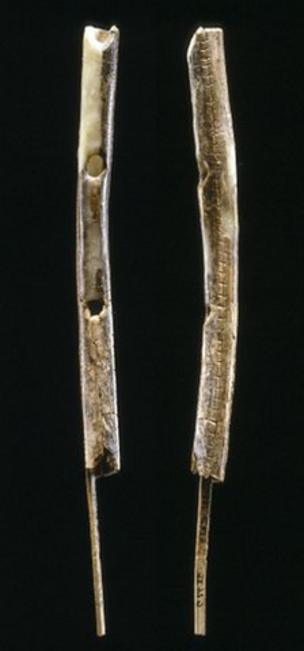
Music, body, emotion.
Here is a link to a page where you can hear a 9,000 year old flute being played. Why does it sound "normal"? Because it was designed for a human with 2 hands, 10 fingers, limited lung capacity, limited hearing, etc. -
Music as a Form of Communication?I've heard the Peking Opera doing traditional Chinese opera; I've also seen Japanese No plays, and must admit that neither of them meant anything to me. Zero. It was advertised as true to the form and first rate, but one has to have a set of knowledge and understanding to obtain meaning from music.
Were you to find a western audience of musically naive people (who had never heard music) and gave them a typical orchestral concert performance, opera, or rock song it is unlikely they would get much out of it. Music does communicate, but we have to learn its language.
The average 21st century peasant is far more musically sophisticated than the 18th century counterpart. With recorded sound, radio, television, and film (and live music, when available) even ordinary people have heard a vast amount of music. So, when people watch a movie, they respond appropriately to the music. They know the difference between romantic interlude music and approaching evil music, or victory, or defeat, or comedy, or excitement, etc.
So here is a piece of Balinese gamelan music; you or I may find it pleasant, interesting, repellent, or whatever -- I don't think we can find the meaning someone from Bali could without some preparation.
-
Ethical WorkMartin Luther called the work of lay people (whatever that was) as holy as the work of monks, nuns, and priests. Religious work (preaching, praying, serving) is holy, but so is bricklaying holy; so is milking cows holy; so is mining and smelting iron holy; so is teaching school, and all manner of work. That what the Protestant Work Ethic is about: The work of man is the work of God.
So, that's one way of looking at it.
Our problem with work, people living 500 years after the Reformation, is that most of us are engaged in work that is far removed from the more obvious work of the 15th and 16th centuries: extractive, agricultural, building, domestic, relatively simple manufacturing, and a very limited number of intellectual jobs (like teacher). Processing words, for instance, does not feel like holy work; in many cases it feels like a sickness unto death. Service work can seem like an extremely bureaucratic rigamarole that never touches people in a meaningful way. -
Sceptical TheismSkeptical theism has this great virtue: One doesn't have to engage with any believer about what God is or is not like. Whether Baptist, Bahá'í, or Baboonism, one can avoid godly discussion with them because you already know that they don't know, can't know, and will never know what they are talking about. The only secure position for the skeptical theist is to keep his mouth shut.
-
Gov't or impeachwackdoodle — tim wood
What is whack doodle is always having to weigh up the lesser of two evils, the less repugnant, the slightly better, and the obviously unsuitable.
It hasn't always been this way. Going back to to 1952, Stevenson/Eisenhower, Kennedy/Nixon, Goldwater/Johnson, Humphrey/Nixon, McGovern/Nixon, Ford/Carter, and Carter Reagan, Mondale/Reagan, Dukakis/Bush, Bush/Clinton, Dole/Clinton, which takes us up to this century, most of the candidates from both parties were at least adequate candidates and performed more or less satisfactorily. Goldwater was a little scary, but he was competent. Nixon had a large following of people who disliked him, but not for incompetence. Reagan may have been losing his competency over the 8 years of his 2 terms, owing to alzheimers. No president up to Trump has come close to being as unprepared for the job, as impulsive, as ill-informed, as willfully uninformed, as Trump. If his pre-election years were morally compromised, he'd fit in with Nixon, whose bad reputation came out of his California campaigns.
The opposing party has not liked its opposing candidate, of course. Eisenhower was obligated to campaign against Stevenson. The public enthusiastically voted for one candidate over another. Not all of the presidents listed were good. Stevenson would probably have made a better president than Eisenhower, Humphrey would probably have been better than Nixon, Carter was better than Reagan, and so on -- but whether McGovern would have been better, hard to say. I liked McGovern, but didn't have much company. Dukakis? Can't remember much of anything about him. Clinton managed the federal budget better than the Republicans before or after him (actually balancing federal spending and taxes), but on other points I'd fault him (and not for getting blow jobs from Monica). -
The misery of the world.How...do...we...live? So morals are dead? So fuck the founding father's then? What do we use as guidance then? Satan? — Drek
There are several good guidance systems kicking around. Most of them are from religious sources, but there are secular ones too. Nothing wrong with religious sources. The ethics taught don't really have to be paired with all of the religious beliefs. For instance, Jesus said "love one another." You don't have to believe in the resurrection to follow that ethical teaching. Love one another, take care of each other, be kind, be considerate, be responsible. It's not very complicated.
IF they are doing that, what is our obligations then? — Drek
Your obligation is to the nation or your community, not to the debased spectacle that politicians and big money can put on. I love my country; I don't love the the behavior of the elected representatives.
Just take it up tha ass? — Drek
No, Donald will do that for you.
So what are we really then a corpocracy? — Drek
Well... yes. To be precise, we are ruled by an oligarchy: a small group of people having control of a country, organization, or institution. Oligarchs are usually either very rich or they are well armed. -
Are there philosopher kings?A) Is it true that only a few people are capable of reason, as Plato says?
B) Are there really philosopher kings? — ernestm
A) Plato was grossly underestimating the abilities of the competition
B) I hope not -
Gov't or impeachMitch McConnell is an honorable man — frank
Mitch McConnell is a slime ball. (In the spirit of bi-partisanship, so is Nancy Pelosi.) As far as I can tell. -
The misery of the world.I think American culture is hypocritical — Drek
Of course it is. ALL societies, ALL cultural and religious institutions, ALL individuals everywhere are hypocritical. Hypocrisy is part of the human condition. That's why we advise each other to not believe everything they read and hear and not take others' statements at face value. People aren't hypocritical all the time, and you won't detect each instance that they are being authentic.
We are prisoner's of our own minds. We need to be free. — Drek
And once you escape your mind, where will you be? Yes, in a real sense we are all trapped in our skulls with nothing but a stream of second-hand information from the senses to inform us of what's "out there". Carry that far enough and you end up with encapsulated solipsism: "I am the only mind that exists".
How do you teach children ethics? How do you teach people to care? — Drek
You teach them the simple rules of ethical behavior when they are young, and then you model the desired behavior as they grow up into adulthood. Show your children what ethical behavior looks like, and correct them when they behave wrongly. Show them what caring behavior looks like.
Fundraising: There is no reason to donate money to rotten charities. Go here for ratings of charities.
https://www.charitywatch.org/join (may be a donation/fee)
https://www.charitynavigator.org
BBB Wise Giving Alliance (Better Business Bureau)``
You can call your state's Attorney General to find out if the charity you are interested in is currently being prosecuted. The IRS also reveals some information about charities.
Give to charities that use less than 25% of their income for all overhead activities -- including fundraising. (Charities that use more may not be crooks; they may be merely incompetent.)
Here is a list of police/veteran fundraising outfits that Consumers Union considers least reputable:
***American Federation of Police & Concerned Citizens
Titusville, Fla.
***Disabled Police and Sheriffs Foundation
Ste. Genevieve, Mo.
***Firefighters Charitable Foundation
Farmingdale, N.Y.
***National Association of Chiefs of Police
Titusville, Fla.
***United States Deputy Sheriff's Association
Wichita, Kan.
Veterans
***Disabled Veterans National Foundatio
Lanham, Md.
***Help Heal Veterans
Winchester, Calif.
***Military Order of the Purple Heart Service Foundation
Annandale, Va.
***Paralyzed Veterans of America
Washington, D.C.
***Veterans Support Foundation
Silver Spring, Md.
***California Police Youth Charities
Sacramento, Calif.
***Law Enforcement Education Program
Troy, Mich. — Consumers Union
My hypothesis is government and business are in bed together. — Drek
Yes, sir, they are not only in bed but they are fucking each other's brains out.
A more gracious quote on the matter from Karl Marx: Government is merely a committee for organizing the affairs of the Bourgeoisie. -
Is it more important to avoid being immoral or being legal?I don't care whether you drive barefoot or naked.
A person needs to identify a key virtue with which they will weigh their choices. Love is a possible key virtue. Of the 6 kinds of love
Eros, or sexual passion. ...
Philia, or deep friendship. ...
Ludus, or playful love. ...
Agape, or love for everyone. ...
Pragma, or longstanding love. ...
Philautia, or love of the self
Pragma, Agape, or Philia -- love of others in any case, might suffice.
Or, maybe Freedom, or Loyalty to some canon of virtue suits being a key virtue. There are others. When it comes to judgement (especially of squishy categories like "hate speech" or "Patriotism") you need a consistent standard of what is important.
So, for instance, which approach towards a thing most advantages agape, freedom, or family values -- whatever you measure importance by. When I measure importance with freedom, then so called hate speech is and ought to be protected. If "family values" are my guide, hate speech, porn, liberal values, and much else will be deemed not worth saving. -
Separation of Church and State?Am I delusional? — Drek
Maybe, but there is insufficient data. Please provide much more information. Do you happen to have a a copy of the Minnesota Multiphasic Personality Inventory (MMPI) around the house? If you do, fill it out and send it to the forum. That would help us answer the question about your possible delusional state.
My understanding of marriage is that in the US ONLY the state issues licenses to marry. One can not be considered "married" without the state issued license. A priest or a justice of the peace can marry people ONLY if they have the state issued license. The Roman Catholic Church can not make you more married than any old Justice of the Peace can.
We considered our gay relationship adequately protected by our mutual desire to be in the relationship. That worked for 30+ years till death did us part. There are fairly simple procedures to own property together so that in the event of death the survivor becomes the sole possessor.
two four six eight
ditch the church
& screw the state
BC

Start FollowingSend a Message
- Other sites we like
- Social media
- Terms of Service
- Sign In
- Created with PlushForums
- © 2026 The Philosophy Forum