
Comments
-
Difference between a feeling and an activity (or participation in an activity)?"feeling" is response of our body to a thought. — ahmad bilal
True. Thought does trigger feelings. Thinking of a lover who is dead can cause an array of feelings, some pleasant, some not at all pleasant. Feelings, emotions, are also responses to sensations. If you are walking along and you spot a poisonous snake in your path, you might have feelings (fear is quite common) before you can register anything else. If you see your best friend or lover, you may experience happiness before you think of anything.
As is the case with thinking and feeling, we are always engaged in an activity--existing is an activity. Sleep is an activity. To exist is to think and to do--something.
But then there is purposeful activity that is performed only occasionally. Most people are fairly purposeful about sex, cooking, eating, playing games, washing dishes, cleaning the kitchen floor, painting a wall, bathing, reading, etc. Quote often we choose an activity to get a particular emotion. We might go to a bar to experience whatever excitement happens there, or camaraderie, various stages of inebriation (drunkenness), or to find sex. Sex is exciting, pleasant (usually--if not do something else for a while), pleasurable, and later relaxing. We might go for a bike ride to feel exhilarated, or to feel confidence that we are healthy enough to ride for quite a while (whatever that is).
Sometimes we engage in activities to escape emotion--like going to the bar to escape boredom; going for a bike ride to escape ennui. We might go for a walk to reduce anxiety.
Anyway, activity, thought and emotion are a merry-go-round. -
Why is the verb 'realise' used as a state verb and much less commonly as an action verb in English?Bill Clinton said, "It depends upon what the meaning of the word 'is' is." referencing his affair with Monica Lewinsky, an intern who made it big.
So, a single noun a sentence doesn't make, but can, none the less, convey all sorts of meaning, as "Bitcoin." does here. -
Are some people better than others?What makes one a better person and who decides? — Harry Hindu
The person making the judgement decides on the basis of their set of standards. This is true whether we are talking about personhood or persons with superior features. "Jack is a better man than Joe because he is strong and honest." I prefer strong, honest men over weak, lying men. I think they are better persons. "Joe is a better carpenter than Jack because his houses are straight and true while Jack's are crooked and leaky." I happen to like houses with straight walls and roofs that do not leak.
Am I entitled to make these judgements about other people? Yes. Are you? Yes.
If you think being the best batter on the team makes you a superior person, that's your business. I don't happen to care that much. To me, being the best batter on the team is pretty much a matter of indifference. On the other hand, being the best batter on the team means he is a better ball player than the other people on the team, even if I am indifferent.
Making judgements about other people according to your opinion doesn't make you a relativist, if you are worried about that. It just makes you a person with opinions about other people, which puts you in the company if over 7 billion other people. -
Why is the verb 'realise' used as a state verb and much less commonly as an action verb in English?In this sentence "realize" is an action / transitive verb: "I realized I hate coconut." "I hate coconut" is the insight created by realized, and is the direct object of the transitive verb. "By selling these bonds I will realize a profit." Same here, will realize is a transitive verb, profit is the direct object.
Does that seem not-right to you? -
Why is the verb 'realise' used as a state verb and much less commonly as an action verb in English?If you didn't want to realize clichéd collocations before your very eyes you could have proffered a prediction or submitted a supposition. Who needs the hazards of guesses?
-
Body and soul...I'm not sure you were properly welcomed to The Philosophy Forum. Welcome. I am glad you are here.
quantum physics — ahmad bilal
True, quantum physics doesn't sit well with the naive picture of atoms as hard bits of matter in tiny little solar system atoms. Fortunately quantum physics works when it comes to us sitting down on a chair; the chair keeps us from landing on the floor; all those strong forces, weak forces, chair-supporting quarks and so forth.
Whatever we do, no matter how much we test our reality we can never know the absolute reality. All we know of reality is that it's bound to someone's perception and their way to thinking. — ahmad bilal
I agree that "absolute reality", whatever that is, is something we can not perceive, nor can we penetrate it with theory, like physicists did with quantum physics. (Unless quantum physics is ultimate reality, but I'm over my head here... best say no more.)
Getting back to souls...
I don't believe souls exist, but I would define "soul" as something that exists within us, is not physical, and continues to exist after we are physically dead. In common usage (everyday religion), it is "our soul" that goes to heaven. Christians claim to believe in "the resurrection of the body" -- that's what it says in the creed. What Christians actually seem to believe is that their "soul" will be transmitted directly to heaven (or hell, as the case may be). I don't believe in heaven or hell either, though heaven is a nice idea.
Whether we exist as bodies alone with all our mental apparatus, or whether we are physical beings plus a soul is a matter of belief; believing is seeing, in the case of the soul. Believers see it, non-believers don't. Well, believers don't "see it" because it isn't visible, but you probably get what I mean. -
Body and soul...
I would have used Billy Holiday's version of Body and Soul, but David Sederis ruined Billy Holiday with his Oscar Meyer wiener song, and Away in a Manger sung in his Billy Holiday voice. -
Body and soul...By the way,
The soul, then, belongs to that part of the world where believing is seeing, rather than seeing is believing. — Bitter Crank
the "believing is seeing" principle isn't limited to other-worldly things. When my partner drove downtown he could never find a parking place on the street. I kept telling him (and pointing at them) there were parking places -- it's Sunday night at 9:00 for christ's sake -- the only people down here are guys at the gay bars, and they aren't taking up all the parking places. "If you don't believe there are any parking places, you won't see them." -
Body and soul...Internal is as real as external. — T Clark
Not differentiating the reality of the physical world (which is external, perceived by the senses) with the reality inside our heads (which include imagination, wishes, delusion, emotions, ideas, etc.) can get us into trouble pretty quickly.
We have to test reality carefully sometimes to make sure our perceptions are not wrong. The strong wish coupled with a delusion and backed up by emotions isn't as easily testable as whether or not the water is really deep, or only looks deep... whether ice is really thin or is very thick... because the rational machinery is involved in the delusion itself. That's why we can go off half cocked about something, and stay that way for a long time.
Granted, sane intelligent people do manage to self-monitor the traffic between their ears and identify screwy thinking reasonably often. But we same people can also miss the boat on self-monitoring fairly often. -
Body and soul...It exists in your reality if you believe in it. — ahmad bilal
Yes. And so does god, the devil, hell, heaven, angels, and all other heavenly unworldly or otherworldly things.
On the other hand, the physical world exists whether you believe in it or not
The soul, then, belongs to that part of the world where believing is seeing, rather than seeing is believing. -
Body and soul...Unlike the reaction of moderators here when they encounter the word "race" (grand mal seizures and severe blistering--like shingles) I experience only slight itching when I see the word "soul". Clearly Sap gets fairly itchy around such words.
-
Body and soul...Soul, on the other hand, is ill-defined and seemingly mythical. — Sapientia
Soul is going to stay ill-defined because it is a vague mythical concept. As I said to Ahmed above,
We can refer to the soul, spirit, and essence and get away with vague meanings because there is a general agreement that "soul" has a private meaning for individuals. We all don't have to agree about what the soul is. It is "something that people think is an important part of themselves" even if it is invisible in both substance and action. — Bitter Crank
"Spirit" is another one of those vague words people get away with using; it has so many meanings. The "spirit" of the law, a horse with "spirit", "spirit" duplicator (used in schools for duplicating souls), wine, beer, and "spirits", "she's very spiritual", wtftm, and so on. -
Body and soul...As a member of the National Council of English Majors, I'll first critique your writing, because NCEM's enjoy torturing people that way.
Hi, im new here and i have a thing for thinking. I write sometimes but i am unable to discuss maturity and ability to convey my thoughts on paper with anyone. Here is something i wrote: — ahmad bilal
Many native speakers have started off their threads with writing about the same as yours. It's OK. A grammar point: " maturity" and "ability" are nouns here intended to describe the infinitive. verb "to discuss". They should be adverbs, words that modify verbs. So, "I am unable to discuss maturely and ably".
"Imagine that earth is our body and moon is our soul. Both are among each other at all times but we cannot see the moon in day light and it lights our way at night and guides our oceans. — ahmad
Calling the earth our body and the moon our soul is a metaphor, a very common device in poetry and prose both. The earth is a concrete thing, solid, the soul isn't a solid thing. You make them both solid, earth and moon. You could also say the earth is our body, the wind is our soul -- the wind being lighter and different than the earth.
Just like we are unaware of our soul when we are occupied by worldy matters but as soon as we are in darkness and despair it guides us through it. It draws its light from the devine as the moon draws its light from the sun. — ahmad
One hopes the soul can do that -- maybe the soul has it's own dark nights of despair, then where does guidance come from?
Our soul has << a >> significant role in each moment of our life but we are unaware of its presence because it is present in the void and it is communicating with << the >> body through the void. As << the >> void itself has presence and it encapsulates all that exists. — ahmad
It's my life, singular, or our lives, plural. Native speakers have problems with this too. I don't know what you mean in this paragraph -- a soul in the void communicates with the body through the void, and then the void itself is present... Just don't get that part. The meaning is obscure.
If we want to know how seperated our soul is from our body.. We should see how separated << the >>moon is from >> the >> earth, compared to the size of this whole universe. They look like they are one, yet << are >> separated.". — ahmad
Please identify weak points and please guide how i can i think to think better?[/quote]
So, I don't believe that there is such a thing as a soul, and I am pretty sure nobody knows what it is, exactly, whether they believe in it or not. It's the "spirit" or "essence" of someone or something. We can refer to the soul, spirit, and essence and get away with vague meanings because there is a general agreement that "soul" has a private meaning for individuals. We all don't have to agree about what the soul is. It is "something that people think is an important part of themselves" even if it is invisible in both substance and action.
Some police won't wave "soul" through the intersection; they'll stop and question it. "Just what do you mean be "soul" they'll ask. They'll protest "There is no such thing as the soul". They will demand you justify the use of the word "soul". Most people will, however, wave your soul on, and won't demand explanations.
Be aware that "soul" and "spirit" have a lot of religious connotations. The "soul" is loaded with issues in other words. Soul is by no means the only word that causes unexpected reactions. For instance, the word "race" has been known to give certain moderators of the site seizures and severe rashes. They twitch, foam at the mouth, proclaim various nonsensical ideas, and break out in painful blisters, something like severe herpes infections. So be careful about using the word "race". -
Are some people better than others?Of course, politicians already have come up with these ideas, and put them into effect. In fact, it's been done several times on a very large scale. Turkey did it to the Armenians, The British let the Irish starve, the Europeans did what they could to get the Native populations in the Western Hemisphere out of the way, the Hutus did it to the Tutsis in Rwanda, Pol Pot did it, Mao did it, Stalin did it, Hitler did it, and if you want to go back far enough, the Eurasia Steppe People did it to the people who were living in Europe at the time, around 4,000 BC, give or take a millennia or two. Maybe we all did it to the Denisovians and Neanderthals 30,000 years ago. It's an ancient tradition.
Once people get on a mass murder kick, there isn't any Humanism so elevated that it will make any difference. Germany had loads of elevated Humanism on hand before Hitler came along, and he put it into deep cold storage for the duration. -
Are some people better than others?I don't see anything inherently against disabled people in doing that. — Sapientia
And just because we think some traits are better than other traits like having two legs to walk on rather than none; or having properly functioning eyes and ears; doesn't mean that the obvious next step is sending out the poison gas vans to despatch everybody who fails to be "better".
Some people fear that if we admit that some people are "better" than that means everybody who isn't better is worthless. Not so. For one thing, if you list all the traits upon which we might rate people, the list will be very long, and no one will be better at all of them.
you are what you are. — Sir2u
Damn. -
Are some people better than others?A guy with a very high score spends his time spending his rich wife's money in fancy restaurants, gyms and fine clothes — Sir2u
What's the matter with that? :naughty:
where do you draw the line? — Plato'sView
Give me a pencil. :naughty: -
"A Perceived Conclusion"RP: What is the "crack whore conundrum"?
We need to build a society that can see that buying a gun to protect from people who are in turn are buying them doing the same is screwing Freedom, Liberty and being "ok" into an early grave. — Robert Peters
When you have a hammer, everything looks like a nail. Guns tend to make everything look like a target.
A move, in media, — Robert Peters
The world portrayed by mass media and advertising (whether print, broadcast, cable, or Internet) is grossly distorted in too many ways to describe quickly. This isn't a new situation; the reality portrayed by newspapers, radio, and television has always been quite distorted by the dominant interests of the owners. This is still true, but some outlets (the half-hour news programs constructed by local television stations) devote a substantial portion of the news-time to the city as a very dangerous place of robberies, fires, murders, and car crashes. It's very formulaic - if it bleeds it leads. There will be maybe one or two 45-secomd to 60-secomd stories about politics or the environment, then they talk at great length about the weather and sports.
Better to just stop looking at it.
Skip the news on commercial television and radio. Read a well edited newspaper that is nationally distributed (New York Times, Wall Street Journal) on line or occasionally in print. Find a few weekly or monthly magazines that are heavy on content (The Economist, for example, or Scientific American) to stay informed about major events. There is a lot of good, solid, and important information out there, but you have to seek it out. -
Are some people better than others?some people are more talented, fit, attractive, intelligent... [and] motivated. Other people have none of these traits. — Purple Pond
Would you prefer to be In the first group or the second, and why?
I would prefer to be more talented, fit, attractive, intelligent, and motivated, than less so, because higher levels of these features enable one to engage the human and physical world more successfully. Why would one not prefer that? People who have these traits are "better" than those who lack these features.
IF one would prefer to be more talented, fit, attractive, intelligent, and motivated, apparently one thinks it would be better. Can one logically prefer to be talented, fit, attractive, intelligent, and motivated, and then say "everyone is of equal worth"? If we, ourselves, would prefer to place ourselves in the "better" category, then we are not entitled to claim that everyone is equal, regardless of the undesirable traits they have. -
Are some people better than others?There are some nasty elements throughout history in comparing humans. Eugenicists and social Darwinists thought that some people are better than others and it's the duty of society to weed out the 'junk humans' to promote a healthy human society. — Purple Pond
Do genetics disease specialists add the "eu" to their field (eugenics) when they give reproduction advice to individuals who are carriers of heritable diseases, especially the really bad ones? Apparently the genetic disease doctors think that it is better that some people should not be born.
What about some future day (probably not that far off) when we can change the germ line (what we inherit through genes) to eliminate certain disadvantageous features, and enhance advantageous ones? -
Are some people better than others?You and Sapientia seem to be in need of couple's therapy.
-
New to reading philosophy. Struggling to read older texts due to grammar/language differences.I'm familiar with the fear of the unknown, but the "ironic fear of the unknown" is less familiar.
Open the door and walk right in, preferably during business hours. -
New to reading philosophy. Struggling to read older texts due to grammar/language differences.'m so curious though; mainly about what type of person will be behind the counter. — Noble Dust
What would be so scary that you would be reluctant to go into this bookstore? The Spanish Inquisition? -
Propedeutics QuestionsJust out of curiosity, where did you stumble across "Propaedeutics"? Nice obscure word.
-
Are some people better than others?Most people's gut reaction will be "Yes, obviously -- some people are a whole lot better than other people" and if they feel they are among friendly company, they may list just who all are better, and (more likely) who all are worse.
You need to decide whether you want to distinguish "personhood" from "specific traits of a person". All persons, supposedly, are sacred beings of equal value regardless of whether they are healthy, sick, smart, stupid, sane, crazy, honest, thieving liars, and so forth. On the other hand, most of us are not going to waste too much time on the sacred worth of the person who is in the process of stealing our car after beating us up. Shoot the son of a bitch, sacred worth or not!
Parents value their children as persons of sacred worth, even if the child is affected by disabilities. People continue to love their partners who develop severe mental illness. Friends stand by the murderer.
Christians are supposed to differentiate the sin from the sinner. (Hate the sin, love the sinner.) You might not be Christian, but the distinction is still there to be accepted or rejected. Without an interpersonal connection or relationship, most of us are probably more or less inclined to reject the distinction. People who behave like shit ARE shit. Bad acts are performed repeatedly by people who are bad. You can get away with one bad act, maybe, but 5 bad acts in a row and you are scum, filth, and dirt.
So what's your decision, Purple Pond? Good people do bad shit, or only bad people do bad shit. And what if bad people do something good? Then what. -
New to reading philosophy. Struggling to read older texts due to grammar/language differences.I noticed there was a Waldorf site that had a list of his books. I'm not knocking Steiner -- I really don't know anything about him.
-
New to reading philosophy. Struggling to read older texts due to grammar/language differences.In fact, I have rarely read anything that isn't a computer programming related book — MasterSplinger
So, it would probably be a good idea to NOT start with hard core texts by philosophers who, truth be told, are fairly often unable to write their way out of a wet paper bag.
If there is a philosopher who interests you (like this Rudolph Steiner) start by reading about him. Not so much biography, but books which summarize what he said. (this might be a chapter in a book about many philosophers.)
Amazon has several Steiner books, mostly available on Kindle (which as a computer person you know can be read on other devices with the Kindle app), and a few about him, like:
Rudolf Steiner: His Life, Work, Inner Path and Social Initiatives (Social ecology series)1987
by Rudi Lissau
Paperback
$2.99(23 used & new offers)
The Beauty of Anthroposophy, or:: What's Scientific About Spiritual Science? (Anthroposophical Studies Book Kindle Edition
by Frederick Amrine
Frederick Amrine is Arthur F. Thurnau Professor of German at the University of Michigan. He has been an anthroposophist his entire adult life. Besides Rudolf Steiner, his other interests are Goethe and the Goethezeit, German and English Romanticism, and modernism -- especially The Blue Rider, Freud, and Jung. He has a deep connection with Owen Barfield and Joseph Beuys.
Rudolf Steiner, Life and Work Volumes 1, 2, 3 by Peter Selg and so on...
Whether reading about a philosopher is easier than reading the philosopher himself depends on the writer. Like I said, I don't know anything about R. S. so, can't really tell you anything about who to read.
As you come across difficult words (philosophy has a few) write them down along with the definition. Tedious, but helpful. Wikipedia, Stanford Encyclopedia of Philosophy, and the Internet Encyclopedia of Philosophy are all places to look.
What works with Steiner will work with other philosophers too -- approach them indirectly first, read about them before you tackle their main books.
Youtube has some stuff on Steiner too.
Good luck. Hey, welcome, and let us know how this goes. Don't be afraid to give up on Steiner if it all seems just too, too obscure, and don't be embarrassed to tell us he's the greatest thing since sliced salami. -
The CharadeWhen I speak of life-changing experiences I don't mean to refer to events that merely change the course of one's life; I am speaking of events which alter the whole orientation of one's being. Love can do that — Janus
Most of us do not have life-changing experiences on the order of the Paul's experience on the road to Damascus. Usually we have small-scale experiences that lack the voltage to remake our whole orientation toward life.
I am not at all certain that had I a choice, I would choose a road-to-Damascus type experience. It was good for Saul/Paul, but there would be no guarantees about the kind of metanoia one would experience. It might be an unmitigated disaster.
Love is good bet. Love is an unplanned disruption.We can not choose to desire; one can't choose to fall in love. It just happens, (or it doesn't). We can change ourselves through learning, practice, persistent effort, working toward a worthy goal, but this won't have that ZAP! experience you spoke of. We can keep ourselves open to new experiences, and maybe something surprising and worthwhile will com of that. -
What is the solution to our present work situation?The federal government spends, and has spent, a great deal of money on causes which are not especially worthwhile. Iraq, Afghanistan, tax rebates for the wealthy, agricultural subsidies, industrial tax breaks, and so forth. The figure for all these things runs into the trillions, for which we have almost nothing to show.
Some inflation seems to be thought essential In a capitalist economy, provided the volume of economic activity is solid. While the UBI would increase government spending, at the same time other government spending would be eliminated: The various state welfare and unemployment programs, food security programs, and so forth might amount to 1 trillion dollars a year. Were a UBI to be instituted, most of these welfare and unemployment programs would disappear (because they would be redundant).
Does this pass your muster as amusing pseudo-economics?
it will be inevitable that the political pressure from the left side will lead to an unsustainable high UBI, as the mere socialist rhetoric of social rights (read entitlements) will dominate the elections. — Kitty
The left yammers about social rights a lot, true enough (it's dirty work but somebody has to do it) but not since the Johnson Administration has a major new program been instituted (Johnson instituted Medicare In the 1960s) and welfare payments are niggardly*** despite all the socialists complaints, even in northern liberal states. I'm not counting Obama care as a significant new program--it's still not clear it will exist very long or in what form.
*** Note to politically correct persons: 'Niggardly' is neither derived from nor is the source of the word 'nigger'. So just relax. You all have hereby been headed off at the pass. -
What is the solution to our present work situation?Man needs work as much as personal freedom, it's not mutually exclusive, rather what one seek is personal freedom in doing work rather than freedom from work. — Krupzzq
This sort of thinking is a kind of madness which arises when we decide to accept what is unacceptable, to my mind. — Moliere
Homo Faber (man the maker) needs "work", work being purposeful activity to obtain the satisfactions of needs (food, shelter, reproduction, clothing if needed for climate) and the fulfillment of wants -- aesthetic creation, love, companionship, exploration, and so on. In this technological age, crowded world, governed and policed societies, the most we can hope for are societies structured and operating loosely enough that individuals and groups can find the necessary 'space' to live the kind of life they desire to live.
Certainly many people do not find the restrictions and conformity of the work place troublesome, (clocking in on down to clocking out). A loose society has room for regimented factories and hippie colonies.
The problem for those who exploit the nooks and crannies of a loose society is when things are tightened up, screwed down, brightly lit all night and surveilled remotely, policed 24/7, and very thoroughly managed.
By my definition, the looser and healthier society is one which does not seek to track every social movement and every political action, does not compile databases of social deviants, does not strive to restrict personal freedom, across the board for political, social, sexual, literary... expression, and so on. It doesn't matter in some ways whether it's the CIA or Facebook & Google that are doing the tracking and compiling.
Societies in which the dominant classes (the richest, most powerful, the classes who feel they have quite a lot to lose) feel insecure are the societies where the screws will be tightened the most. -
Vegan EthicsSomething I need to do -- file an "advanced directive" to inform the hospital that has the document (assuming I don't end up in a hospital unconscious somewhere else) how I wish my demise to be managed.
----- Do Not Resuscitate
----- Do not Intubate
----- No heroic measures
----- withhold water
----- withhold food
Under the specified circumstances -- like,
----- probably is already seriously brain damaged
----- will be paralyzed from the neck down
----- will be unable to speak, swallow
----- has little time left before death from organ failure
----- so on and dreary so forth
As far as I know, advanced directives are not binding contracts; if the attending physician thinks I'll pull through just fine, even though it looks pretty bad, he isn't required to forego imtubatimg or resuscitating me. And, if there is no advocate on hand (one is supposed to delegate authority to someone trusted to advocate for pulling the plug under the right circumstances) there is a good chance one's final directive will be ignored.
I'm 71; I'm not figuring on dying in the next few years, but should I get run over by a lightweight vehicle and am not quite dead, or if I should develop a terminal disease which, by definition, isn't curable, then let's get it over with.
This all assumes I'm not awake. If I'm awake and alert, then I'll have to convince the doctor myself to let me out of my misery PDQ. -
What is the solution to our present work situation?A friend of mine has been reading up on Hunter / Gatherer societies. It would appear that at least those H/Gs situated in good environments did quite well, frequently living reasonably long lives (50-60 years), having enough to eat most of the time, as able to take care of their wounds and illnesses as anyone was for thousands of years after the H/G settled down. They had good technology (arrows, spears, extended bows, glues, stone tool technology which could be produced quickly and, interestingly, trade networks that covered quite a bit of distance. The ideal stones for tools (certain kinds of chert, flint, or obsidian) aren't found everywhere. The weren't trading tons of rocks. Rather they were trading relatively small pieces of rock that were ready to be turned into cutters, scrappers, and piercers.
People in an area with lots of Osage Orange trees might have traded pieces of their wood to make bows for obsidian, for instance. Osage orange wood is fairly hard and extremely springy. (These days the inedible fruit is sold as a spider repellant for basements. I've tried it; I can't tell whether it works.) -
What is the solution to our present work situation?
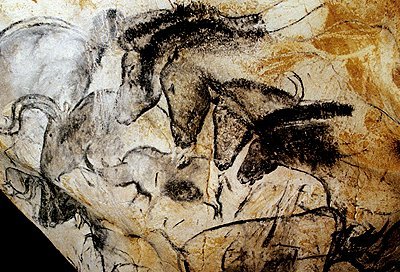
Animal art from Chauvet Cave in France, c. 25,000 BCE. It isn't just that the art work they did is appealing, it contains readily interpretable information from a person's 25,000 year old expression. We know what he means (we at least know what it was he was representing). -
What is the solution to our present work situation?Limited to physical existence? No, I wouldn't think so. After all, most people gave up hunter/gatherer lifestyles only recently--in comparison to the species' history. And evidence of aesthetic activities go back at least 40,000 years, thinking of the lion-headed man carved from ivory which was still legal to carve, 40,000 years ago. I would guess that aesthetic activity goes back further, but we haven't found much existing evidence dating before then.

The Löwenmensch figurine or Lion-man of the Hohlenstein-Stadel is a prehistoric ivory sculpture that was discovered in the Hohlenstein-Stadel, a German cave in 1939. The German name, Löwenmensch meaning "lion-human", is used most frequently because it was discovered and is exhibited in Germany.
The lion-headed figurine is the oldest-known zoomorphic (animal-shaped) sculpture in the world, and the oldest-known uncontested example of figurative art. It has been determined to be between 35,000 and 40,000 years old by carbon dating of material from the layer in which it was found, and thus, is associated with the archaeological Aurignacian culture.[1] It was carved out of woolly mammoth ivory using a flint stone knife. Seven parallel, transverse, carved gouges are on the left arm. Wikipedia -
What is the solution to our present work situation?I realize that's a whole book — Moliere
Whoa--a whole book? What do you think we are, Moliere, intellectuals or something that actually reads whole pages, let alone whole books? We have busy lives, what with hauling in beer, drugs, pizza, and bitches. Just summarize whatever that was in 25 short words or less. Geez. -
What is the solution to our present work situation?Oh, well, Schop, when you are in the black bread and turnip phase, health care is limited to very simple procedures. If you get very sick, you are put in bed to die -- quite simple, effective. That's the downside of very simple living--simple dying.
-
What is the solution to our present work situation?How about the relation to work itself? I guess here's my problem. — schopenhauer1
Work itself is where our tender, warm blooded personhood hits the gravel road of industrialism. Some people have found accommodating jobs where their personal aspirations and styles are well served. Some people thought they had found nice places to work, but over time it was degraded by administrators cutting costs, increasing profits, and maximizing control. A lot of people have worked at jobs which were never accommodating and never served their personal aspirations and styles but they put up with it because it was that or live in poverty.
Extracting a living from the environment has never been easy. Hunter gatherers, for instance, had to work at it all the time, and if things didn't go well, it could be really bad. As life became more complex, some parts of making a living became easier, and some parts became harder--but one has always had to put quite a bit of time and energy into surviving. Except those who are born into great wealth, and those who are able to happily live In a box under a bridge (a rather small number, actually).
It might be the case that if you can't stand working in jobs for other people ("hell is other people, per J. P. Sartre), you might have to take lessons from Agustino and start your own business of some sort. You know, there are people who do that who aren't gung ho capitalists -- they just can't stand working in close quarters for somebody else.
Maybe I should have done that myself, but I was too stupid to think of anything that would work as a bitter crank-sustaining operation. Plus, I don't seem to have an entrepreneurial bone in my body.
Just for example... someone started a business of installing and maintaining large bird cages in nursing homes. The cages are about 8 feet long, 8 feet high, and 2 feet deep. They have maybe a dozen canaries and finches in them, plus branches, and a kind of grass mat wall on the back which the birds seem to like. The residents of the nursing homes like to sit and watch the birds. Alternatively, a large aquarium can be had (smaller than the bird cage).
Maybe you live in an area where bird cages haven't been installed in nursing homes yet? Maybe a snake pit would be an alternative? Lizards and hissing snakes instead of chirping birds or silent fish. A rat colony? All sorts of possibilities. Termite mounds? Ant farms? -
What is the solution to our present work situation?Excellent points.
Our highly constructive age (buildings, cities, pyramids) isn't very old in relationship to our species age. If we've been around for tens of thousands of years, the first mud brick town is only about 9,000 years old, and that was a fairly modest affair. In between bursts of bigness (several ancient civilizations) life quieted down again. After the western Roman Empire fizzled out (about 500 A.D.) there were about 900 years of European peasants and very minor lords living quietly. Then things started heating up again, the Renaissance, the Enlightenment, and here we are.
Cultural code is an important driver, along with our genetic code. When the resources are aligned just right, we are driven to start building again, and after all that ends up in ruin, we give up angel food cake and go back to black bread and turnips for a few centuries.
We learn again and again about taking what we need and leaving the rest, but we keep forgetting it. Unfortunately our cultural codes over-ride humble truths and we decide to take everything if at all possible, or at least as much as we can cart away.
IF, and it's a huge 400 ft high IF, we could take just what we needed and leave the rest, we could all live a simpler life, but we could all live. 21st Century "post-industrial" civilization is doomed (planet wide) and the survivors of the doom will be forced to live a much simpler, harder life. But that's another thread.
The thing about the UBI, or an advanced economy anywhere, is that if one lives simply one wouldn't have to work so much. But living simply is hard -- the cultural code doesn't encourage it. Even simpler living is viewed as something of a pathology. There are barriers put I'm the way. -
The CharadeSorry BC I just cannot agree that the attempt to think the nature of the God, absolute, the infinite, the eternal or whatever you want to call it, is a complete waste of time. — Janus
Thinking about the nature of God is essentially a creative activity which brought God into existence. As a creative activity, making God real is an essential part of religious practice. The believer thinks God into being God. Man creates God.
God has a reality in the minds of his creators. There is no objectively existing being to discuss. It is like arguing over the objective abilities of Gandalf, Frodo, Elrond, or Lady Galadriel in LOTR. They, being fictional characters, have no objective abilities at all since they are only characters in a story. As such, they are wonderful characters, just not real.
Some people have a taste for the allusive, the evocative, the numinous or simply the arcane and esoteric, in thought and language. They may find it inspiring or even utterly life-changing. As long as it is not mistaken for definitive or empirical knowledge (which leads to fundamentalism) how can you justify saying it is a waste of time, per se? — Janus
There is nothing wrong with a taste for the allusive, the evocative, the numinous, or the arcane or esoteric; it just does not lead to anything life-changing. A few experiences are life-changing, but any one would be hard pressed to predict which experiences are going to do that.
Perhaps you were just shit-stirring, eh? :razz: — Janus
What, Moi? Remuer un pot de merde? How could you say such a thing about me! :cry: -
The CharadeIf, for example, theology is a waste of time for you, does it follow that it is a waste of time for all others? — Janus
The practice of religion which guides and comforts isn't a waste of time. Haranguing each other about what god God is like is a total waste of time, even for believers. (Especially when the god God in question has been very shy about revealing details.)
Trying to decide what god God can and can not do is, yes, a total waste of time. For everyone. Just stop it, at once! -
The CharadePeople want to get at the truth. "What is the TRUTH about Israel? Palestine? Who is really entitled to live there? We can just as well ask "What is the truth about Manhattan? Who is really entitled to live there--native Indians who Europeans? Puerto Ricans or Dominicans? Liberians or Mexicans? Rich folk? Poor folk?" What is the truth about Wales? Have the Welsh paid reparations to the earlier occupants of their measly plot of land?"
What is the truth about all the FAIT ACCOMPLI situations around the world? Accept what has happened? Hey, Hong Kong's British lease expired. Bad luck, but that's the way it is. You all had 99 years to get ready. Or demand that something be done about it? Give Hong Kong its freedom?
The Jews are coming! The Jews are coming! So, Palestinian Arabs, this didn't happen over night; you tried to get rid of them and you weren't able. What are we going to do now with you and the Jews?
'What is the truth?" Pontius Pilot asked, sarcastically.
I am sitting on land that belonged to one or several regional Indian tribes in Minnesota, Wisconsin, Iowa, and the eastern Dakotas, and not all that long ago. They are still here, though much disadvantaged and in much diminished numbers. We white folks took it away from them, pretty much all of it. That is how the west was won. We decided it was our manifest destiny to own the continent and we do.
That is the truth, but it doesn't help knowing the truth. I don't plan on vacating my house and giving it to the Mdewakanton Sioux Tribe or the Ojibwa Tribe. An injustice was done here, starting in the 1805, at the latest, probably quite a bit earlier. It became fait accompli by 1840. Things got worse for the Indians after Minnesota became a state.
The world is full of injustices, stacked up like cord wood going back to the ancient world, and we can not undo our history. It's fait accompli. The damage has been done. The egg has been fried and we can't put it back in the shell. Maybe Israel shouldn't have been founded, but it was, there it is, and in all likelihood, there it is going to stay. It's a battle the Palestinians pretty much lost. There are losers in history, wherever there are winners.
So, questions about truth may be highly philosophical, or legal, or contentious, but the truth is one thing, and what we are remotely willing to to do about it is something else, altogether. Good politics, bad philosophy.
I don't think we can reach a conclusion about which semitic tribe is most entitled to Palestine, and the just leave it at that.
BC

Start FollowingSend a Message
- Other sites we like
- Social media
- Terms of Service
- Sign In
- Created with PlushForums
- © 2026 The Philosophy Forum