
Comments
-
Christianity: not stupidStreet view is pretty amazing. Not taking the actual video of a given street, but storing this huge mass of data in such a way that Google can deliver a clear video image of a drive down one of millions (millions?) of streets, and can serve it up in just a few seconds.
-
Christianity: not stupidBut the ideas contained in them, where do they really come from? — Sir2u
Why, God -- of course!
Joking, of course.
In The Ruin of the Roman Empire, A New History by James J. O'Donnell, the author observes that after the Babylonian Captivity, when the Persians sent the Judeans back to Jerusalem, the holy scriptures were "rediscovered". O'Donnell asks, just how were the scriptures suddenly re-discovered, and what, exactly, did they (Ezra et al) rediscover??? O'Donnell doesn't know, and of course nobody else knows what they rediscovered either. The Babylonian captivity was a major disruption in Jewish religious continuity.
I suppose a remnant of the Judean population remained, and over the course of a couple of generations they kept a copy under a rock somewhere. Or maybe the Samaritans who weren't taken away, kept a copy for them, under a different rock.
My honest answer is that over time various creative people made the scripture up -- everything from "In the beginning..." down to the Apocryphal books. They sat there, composed in their heads, and then delivered well-honed texts at the appropriate time. People used to be able to do that; then writing came along and pffft: Ability gone. After that they had to use lambskin or papyrus to compose. Or clay tablets. All very clunky compared to a Mac desktop.
Just like people used to be able to find their way around the block before GPS devices were put in cars. -
Identity Politics & The Marxist Lie Of White Privilege?I was hoping that you'd chime in and provide some decent historical context, it was why I included the needle exchange thing as an example. — fdrake
Thanks for your confidence, but it has been quite a while since I have observed much about needle exchange.
What I saw, public health outreach, was welcome by IVDUs, because they recognized the risk (not always, but quite often) and it was offered without judgement. It's surprising to me that needle exchanges aren't common place, even ubiquitous. At least I see needle and other 'sharps' disposal units in a lot of washrooms where one wouldn't expect to find them. The last iteration of needle exchange I witnessed was a mobile operation where drug users could either visit the needle exchange van and get what the needed (plus testing, at certain times) or could arrange a visit somewhere with the van driver.
The better approach is "safer shooting galleries" which also are generally a public health approach and which run into more legal barrier than needle exchanges do. The safer shooting galleries do not offer drugs, they offer clean works and a safe place to enjoy the high, and someone on hand with Naloxone (or similar opiate receptor antagonists), should it be needed--which it quite often is.
The final approach to safer drug use is providing the kit and caboodle--works, drugs, setting--the whole thing. This relieves the addict of health risks, and avoids the criminal activity often required to get money for drugs. I don't think anybody in the US is doing this at this point. There are at least a few groups that would offer all this if they could get approval and funding.
Peer generated efforts are difficult because the peers are engaged in criminal activity to start with, and can't just show up at a city, county, or state health department and ask for money to start a program. They wouldn't be considered creditable by themselves. The health departments themselves are staffed by understanding, thoughtful professionals who none-the-less have their limits. The relevant staff may not want to get too deeply involved with IVDUs. Non-profit agencies have to be recruited, and there one finds the same reluctance to get too involved, and fears of PR disasters.
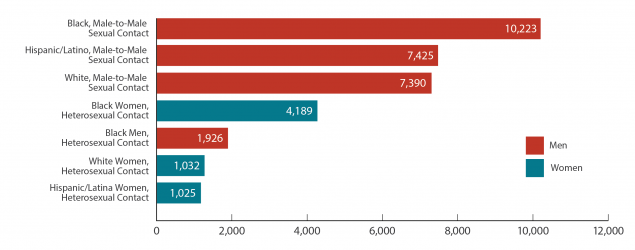
The take-away message on AIDS prevention is that it isn't going well. It isn't that nobody knows how to do HIV prevention education, doesn't know how to reach vulnerable groups (like young black gay men), isn't capable of creating effective messages (or finding someone who can), or can't find people willing to do the leg work on the street and in neighborhoods.
This limp wrist or limp dick approach starting appearing in the late 1990s with just really very mediocre education efforts replacing what had been more vigorous efforts; Then under George Bush doing education got more difficult because of more scrutiny and oversight demanded by the federal government. Material, for instance, had to be reviewed to make sure it wouldn't offend anybody. A fatal requirement. Sexual health messages that get to the point will definitely offend someone.
It's like there is a "failure of will" on the part of both public health people and communities. The statistics are clear that new infections are occurring regularly, despite there being reasonably effective to very effective methods of preventions -- condoms or a daily Truvada pill, an AIDS drug that when taken by the uninfected, prevents infection by the virus by suppressing reverse transcriptase). The cost of prevention is always less than the cost of treatment when someone gets infected.
I must admit that if I were 30 and sexually active, (sigh) I would hesitate to commit myself to taking Truvada every day for maybe 20 or 30 years. It isn't terribly dangerous, but it can have serious side effects, and it doesn't eliminate the need for condoms--for either HIV or other STDs.
Here's a CDC bar graph on 2016 infections:
-
Identity Politics & The Marxist Lie Of White Privilege?You didn't ask me, but... what the hell. Some of it is "identity" and some of it isn't.
Take the gay marriage issue. It wasn't part of the initial gay liberation agenda, even if a few gay people tried to marry as early as 1970. It didn't get major traction until much of the "acceptance" items on the agenda had been won. Gay advocacy could have stopped there. "Advocacy" is beneficial, but it is also a raison d'être and if the gay agenda had been met, what further need would there be for advocates? Little to nothing. Marriage was pushed to the fore, and grafted on to the liberation agenda, even if this sort of assimilationist move was contrary to the original "liberation" idea. As gay marriage became acceptable, transsexuals became the cause-celebre. It has never seemed to me that transsexuals seeking a medical solution (drugs, surgery) to their alleged problem were ever a natural part of gay liberation. None the less, here we are.
Needle exchanges? Night classes? Ending apartheid? No, I don't think these are identity-motivated. For one, a good deal of the drive to implement needle exchanges comes from the public health agencies. Many of the workers in these programs are not IVDU, though some are, or were. Rather than an identity movement, I see it more as "applying social marketing technology". Some people who start free evening classes no doubt below to the target audiences, but a lot of those programs are staffed by people who don't belong to the target group. Again, it's a well practiced social up-lift strategy with a history back into the 19th century. Apartheid? Most of the people I've seen agitating against apartheid were white Americans who didn't have much connection to South Africa. It is a good thing that white activists opposed apartheid, but I don't think opposition was based on identity.
Self Help programs generally are ethnicity based--because they arise out of a specific community. The gay response to AIDS was identity based self help. Organizing west coast agricultural workers and the grape boycott was self help with an ethnic base. The National Farmers Organization (now long gone) was a rural white-ethnic based agricultural self help drive. The civil rights movement was a black ethnic self help movement. -
Identity Politics & The Marxist Lie Of White Privilege?So: anything based on good, old-fashioned Marxism — gurugeorge
Well, blame who you will, but I don't think "old-fashioned Marxism" is a very good culprit. It's more likely new-fangled Marxism that is source of the nonsense. That and critical theory, POMO, and all that stuff.
Marx wasn't a 'splitter' he was more of a 'lumper'. He looked at 'lumps' like the bourgeoisie and the working class; he didn't split up the 'lumps' into all of the imaginable divisions like white working class, black working class, hispanic working class, female working class, male working class, undocumented working class, jewish working class, urban working class, suburban working class, rural working class, young working class, middle aged working class, old working class, lazy working class, ambitious working class, and so on and so forth.
The current fixation with identity is the province of obsessive-compulsive splitters. It isn't enough to separate out homosexuals and heterosexuals; there are gays, lesbians, bisexuals, transsexuals, queers, and don't-know-their-ass-from-their-elbow-sexuals. Transexuals magically split into... 10? 50? 100? different versions, some comprising less than 1 person (some twit who has mixed feelings). Every conceivable ethnic, racial, or geographical feature can be used as a wedge to further split things down as far as possible.
Have you heard of "games of uproar"? I think the SJW types, so called, like games of uproar. The splitters expose many new surfaces on which conflict can be imagined, if not observed, and by exaggerating everything, they can fuel their needs for excitement in these games of uproar. -
Christianity: not stupidBut did the Jews actually write it directly from the source they claim or copy it from somewhere else?
There are plenty of creation myths about and some contain elements similar to the one in the bible. — Sir2u
Yes, of course. We can assume that parts of the Jewish scripture were 'accumulated' from tribal sources, some of it was borrowed, and some of it was composed, and some of it developed from liturgical practice. The same thing is true of the New Testament.
But that isn't the question I was addressing. I said "the Jews never stopped reading their sacred work". Whenever, however, wherever it was composed, accumulated, borrowed, or developed, the Jews used the texts in Judea and took the texts with them into the diasporas. The synagogues preceded and survived the destruction of the Temple and, and it was in the synagogue that scripture usage was maintained.
There was no major break in the tradition and use of scripture -- it isn't like the scripture was lost in 100 BCE and then rediscovered in 500 CE or 1500 CE.
Christian Gnostic writings, or the 'Dead Sea Scrolls' met a fate of loss and rediscovery, but the Jewish and Christian Bible didn't meet such a fate. -
Sergei Skripal: Conspiracy or Not?If you think I speak like a true trumper, then you have perceived nothing about anything I have written. Plus, you aren't very good with non-literal statements. Kind of a sour-puss, actually.
-
Sergei Skripal: Conspiracy or Not?In the case of 9/11 there's a lot of unanswered questions in regards to how a modern steel framed building could have collapsed symmetrically and at free fall speed, with all the steel columns supporting the building turning into cheese. — Posty McPostface
WTC 7 was, I assume, a conventional steel frame building. WTC 1 and 2, the two big ones, were not. The big buildings weren't supported by interior steel or concrete columns. The floors were supported by the exterior steel walls of the building. The concrete floors were attached to the exterior, and within the floor structure were 'ties' that connected opposing exterior walls to add rigidity to the building.
The fires on and above the floors struck by the planes weakened the ties. The weight of the building floors in and above the fire, caused the exterior supporting structure to bulge, and begin to break away from the ties and the concrete floor--not instantly, but fairly quickly. When the weight exceed the support capacity of the bulging exterior walls, the x number of floors descended straight down (why would they not?) and overwhelmed the support capacity on the next floor, and the next floor... all the way to the bottom.
The 911 attackers did not need to plan this out--and as far as I know, they didn't expect the towers to collapse. They wanted to severely damage the WTC towers, and they would have totally succeeded if the building hadn't collapsed, and the fires had been put out. If they did plan pancaking, then they were that much more ingenious.
You are suspicious of steel giving way. Steel, as it happens, isn't heat resistant the way concrete is, or wood for that matter. The ties had been coated, but not heavily, and the shock of the crash caused much of the coating to fall off. Bear in mind, the ties were not heave H shaped supporting beams--they were rods, very strong, but not big enough to resist any force.
You are probably correct that a building constructed with the usual forest of steel columns would not have collapsed symmetrically, under the conditions of WTC 1 and 2.
WTC 7 was damaged in two ways: first by heavy debris from the collapsing towers, then by fire. The building did not weaken symmetrically, it was sagging and bulging before it collapsed. I haven't read or heard that much about WTC 7, so I can't say more about it.
911 was the second WTC attack. In 1993, if you remember, a truck bomb loaded with urea-nitrate explosives enhanced with hydrogen gas was detonated in the garage under the North Tower (can't remember if that was WTC 1 or 2--doesn't matter). The intention was to tip the North Tower over into the South Tower and cause both of them to hit the ground, killing a whole lot of people.
The truck bomb didn't happen to be just quite properly located to achieve the intended result. Had it been located in just the right place, the plan would probably have worked.
WTC 7 had a similar vulnerability. Certain support beams were critical in maintaining whole-building stability. Why would this be the case? Because of remodeling, design changes, and the required engineering changes needed to achieve stability. As it happens, the vulnerable support structures were damaged, contributing to the collapse.
From a conspiracy theorist POV, all this is probably unsatisfying because it leaves blame too diffused. Engineering decisions, lack of water pressure, electrical failures (no pumps), not enough insulation on rods, and so on and so forth.
Climate change conspiracy theorists think that global warming is a hoax for, I suspect, similar reasons. Blame is so diffused that there is no guilty party to pin it on. 300 years of coal and oil burning leaves a lot of guilty parties -- like, just about everyone. So, they reason, it must be a hoax.
You might be interested in a New Yorker Magazine story about the City Bank Building in NYC -- the one with the steeply canted roof and asymmetric supports at street level. The architect of the building had been thinking about the building, one fine day, and was thinking about what kind of fasteners were supposed to have been used to attach X-shaped structural members together. They were supposed to have been welded. When he checked it out, he found -- much to his horror, that they had not been welded, the bolts had been screwed into place. Fixing this wouldn't be easy, because the building was finished and occupied. He didn't think the building as it stood would be able to withstand an unlikely--but quite possible--hurricane force storm.
He alerted the building owners immediately, and crews began the process of opening up the walls over the X structures, one by one, floor by floor, and welding the many many bolts--this all being done at night so as not to disrupt bank operations. Then the walls had to be closed and refinished. God, think of the overtime! -
Christianity: not stupidAs much as someone steeped in mainline Protestant Christianity and who found it useful can, I call myself an atheist. But I didn't throw the baby Jesus out with the baptismal water--so to speak. I'm way too old now to reorganize my personality, so Christianity remains part of my 'operating system' but I find it necessary to do without the belief system. It's something of a relief.
I agree that Christianity is THE primary contributor to western civilization, not in a straight line from Jesus to Thomas Jefferson, of course. Not even in a very crooked line between the two. Too much happened over those 2000 years. -
Christianity: not stupidTen thousand years from now, after the destruction and rebuilding of civilization a couple of times, they might dig up a collection of Harry Potter books and decipher the unreadable scrawling on the page. — Sir2u
The thing about the Bible (and other writings from the ancient world) is that they are not 10,000 years old, and civilization hasn't been destroyed and rebuilt a couple of times. There is quite a bit of continuity in the culture of the last 2500 years which makes these texts (not just the Bible) accessible and meaningful.
The Jews never stopped reading and using their sacred writings. -
Christianity: not stupidBut then you have to account for all of the excellent colleges and universities that were started by and are run by Christians. Apparently it is possible to be intellectual and Christian, and secular all at the same time.
-
Sergei Skripal: Conspiracy or Not?I'm aware that the promoters of this forum grown upon it; but, the manner in which people respond to "beliefs that they do not share" or otherwise pejoratively called "conspiracy theories" leaves much to be desired. — Posty McPostface
Reasonable, and reasoning people--like yourself--react to conspiracy theories negatively because there is a "reality-challenging" pattern to the theories. Bad things happen that aren't readily explainable, and certain kinds of people find the ambiguity of the inexplicable very uncomfortable. To relieve the ambiguity they come up with theories that fit.
In November of 1964 Kennedy was fatally shot in Dallas. A man, Lee Howard Oswald, was apprehended the same day. A day or two later, another man, Jack Ruby, walked up to Oswald while he was being moved and shot Oswald to death on live television.
There were two official theories investigated -- the lone shooter and two shooters--Oswald and a second shooter. It had been quite a long time since a president had been assassinated, and people were shocked and appalled that such a thing could happen, and the investigation was long and exhaustive.
The assassination conspiracy theories were not a new phenomena, of course, but given the enormity of the event, they were given extraordinary play. The usual pattern applied.
#1 a priori assumption: the government is lying. #2 a priori assumption: the government actually did it.
This just could not be the act of a loner. This was a big operation. Actually, the CIA/FBI were behind the assassination, for their own devious purposes. Oh, no: This is clearly a mafia operation, in payment for disrupting the gambling operations in Havana. Baloney, others said, this was definitely a Cuban-Soviet plot. And so on.
And always, the government is not telling the truth -- even though several exhaustive investigations took place. Yes, but they were led by the government, so what do you expect? It's all a coverup.
I'm quite sure, somewhere, some old farts are still nattering away about how the government covered up the REAL STORY of the JFK assassination.
Just 10 years later, give or take, there was an actual conspiracy--the various activities of the Nixon Administration to spy on, and screw around with the Democratic Party's election effort. The Committee to Reelect the President (later abbreviated as "CREEP") did various dirty tricks and, of course, broke into the Democratic National Party offices in the Watergate hotel complex.
When the conspiracy finally came to light, and was gradually dissected in long, broadcast pubic hearings, Americans got a clear picture of how conspiracies actually work. It was all much more straight forward than the typical conspiracy theory. -
Sergei Skripal: Conspiracy or Not?I do care about the nature of conspiracy theories -- not so much the content of the theories. The main problem with the content of the theories is that the theorists generally can't get their hands on solid evidence--which of course, helps the theorists since no evidence also means no limitations on speculation.
Here's an example of conspiracy with evidence: Several years before it was revealed just how much spying on American citizens by their own government was going on, there was a story in the New Yorker (if I remember correctly) written by a telephone switching equipment specialist. He was in the San Francisco telephone switching building where, among other things, a large number of long-distance and internet cables for west coast traffic were located. One of the floors had been locked and declared off-limits. This struck the specialist is passing odd. He had never seen a block of switching equipment put off limits. He managed to find a fellow union member who did have access to the locked floor, and was able to observe what was going on there.
What he found was a massive intercept on all of the west-coast cables--put there at the behest of somebody other than the telephone company. Later he learned that similar things were happening in other main switching centers. What he assumed was that somebody was vacuuming up the content of traffic. Who and why, he didn't know. But he had a theory.
He did think it was a conspiracy of some sort, but he had seen evidence of something secretive and very fishy going on. As I said, a few years later his hunch was validated by Edward Snowden.
Most conspiracies aren't supported by unusual observation prior to the event in question. For instance, no one observed crews working in the WTC buildings, opening up walls and attaching stuff to critical structures, and running wires from those "somethings" to somewhere else. Installing enough explosives to collapse three WTC buildings in the way we all observed it happening, wouldn't be something people wouldn't notice. It would be fairly complicated. -
Sergei Skripal: Conspiracy or Not?Nothing, what makes you think it is Russia. — René Descartes
Did I say I thought the Russians did it? I thought I said I didn't care who did it.
One of the features of conspiracy theories is to always discount the official explanation (like, 2 planes flying to the WTC towers) and reach instead for an obscure explanation that blames the source of the official explanation (the US Government did it with explosives). -
Sergei Skripal: Conspiracy or Not?What is Langley HQ anyway. — René Descartes
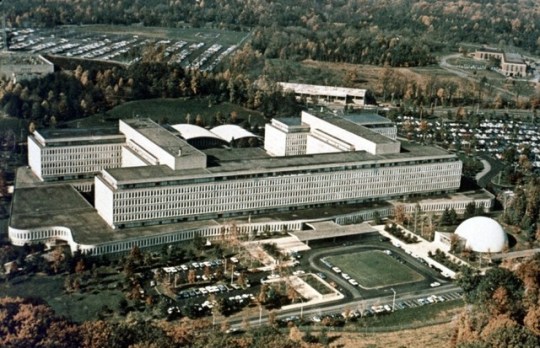
It's the headquarters of the Central Intelligence Agency in Langley, Virginia.
-
Sergei Skripal: Conspiracy or Not?Actually, I don't give a rat's ass about Sergei Scribal, his demise, and the motive or method employed to kill/execute/silence him and his daughter by whoever did it. That an exotic substance was used, instead of a gun, blunt object, blade, or bare hands doesn't make that much difference.
The thing is, what could you possibly bring forward that would actually clarify the identity of the agency which performed the killing and their motive? Conspiracy theories about 911 present the same problem: what could a bunch of even quite a bit above average Joes sitting in front of their computers possibly learn that would unravel the secret?
I will grant you that Ms. May could use something dramatic other than her own suicide to get her out of the Brexit negotiation mess. So... there is that. -
Sergei Skripal: Conspiracy or Not?René and Charlatan think they are freely engaging in a discussion of conspiracies. Obviously they don't know about the nano-sized implants in their brains, controlled by the CIA through satellite networks, like all those GPS devices which monitor EXACTLY where you are at all times...
They can't help but lip-sync to whatever music their masters in Langley HQ want them to dance to. -
The Book of JobArchibald Macleish wrote a play based on the book of Job, JB.
Plot summary
The play opens in "a corner inside an enormous circus tent". Two vendors, Mr. Zuss (evoking the chief Greek god Zeus; zuss is also German for "sweet") and Nickles (i.e. "Old Nick," a folk name for the Devil) [1] begin the play-within-a-play by assuming the roles of God and Satan, respectively. They overhear J.B., a wealthy New York banker, describe his prosperity as a just reward for his faithfulness to God. Scorning him, Nickles wagers that J.B. will curse God if his life is ruined. Nickles and Zuss then watch as J.B.'s children are killed and his property is ruined and the former millionaire is left to the streets. J.B. is then visited by three Comforters (representing History, Science, and Religion) who each offer a different explanation for his plight. J.B. declines to believe any of them, instead asking God himself to explain. Instead he encounters Zuss and Nickles. Nickles urges him to commit suicide in order to spite God; Zuss offers him his old life back if he will promise to obey God. J.B. rejects them both, and instead finds comfort in the person of his wife Sarah. The play ends with the two building a new life together. -
What exactly is communism?Communism is the withering away of the state; communism is the development of a knowledgeable working class (over time) which can take control from the bourgeoisie (the owners) of the economic resources of a country. The working class will have to take it, because the bourgeoisie are not going to just hand it over. That part could be a bit messy, depending on how tightly their fingers are gripping their property. (Hopefully it won't involve their cold dead hands.)
Without the state, without the bourgeoisie extracting surplus value from the workers (the profit, in other words), society will evolve to exploit the new economic circumstances. The demise of capitalism will not solve all problems, of course, and issues like global warming and environmental degradation are going to follow us to our graves, regardless of which political/economic system we have.
Still, I'd rather have a system friendly to the idea of "production for human need" rather than one based on "Production for maximum profit". -
What exactly is communism?Analogy: There are now 9 states that have nuclear weapons and a few more who could if they wanted to. The technology to make an atomic bomb was invented only once by the United States, 1942-1945, then a bit later for thermo-nuclear bombs. The technology was then stolen or shared.
There is similarly 1 state, the USSR, that established the first communist government and set the pattern. These two states shared their ideas and methodology with other states that also established communist governments in the PRC, North Korea, Cuba, and the eastern European bloc countries.
It has been pointed out many times that Russia was not a promising economy in which to apply Marxist thinking, but it none the less found enthusiasts well before the 1917 revolution. China was also not a promising economy.
The "flavor" of Soviet communism derived much from the personalities of its founders -- Lenin, Stalin, et al, and the project which they attempted to achieve: transform a very lightly industrialized agrarian economy with a long history of absolutist rulers, covering a vast territory populated by widely varying cultures, religions, geography, and so forth, into a heavily industrialized nation in a short period of time while engaged in two world wars, neither of which they started.
Both the USSR organized a very authoritarian governments (secret police and all) and operated a command economy (as opposed to a market economy) with the state serving as the Corporation. The State Corporation was not totally unsuccessful but it left much to be desired.
None of this is in Marx, Engels, or any major socialist/communist theorist. The Soviets (and others) tried for a giant leap-frog over the slow, historical development of a working class capable of seizing the means of production, and they failed miserably.
The results were both significantly good and really very bad. -
Identity Politics & The Marxist Lie Of White Privilege?There were indubitably acts of mass murder conducted by Sovet Russia and Communist China, among others. Doesn’t warrant hysteria but the fact remains. — Wayfarer
If war is diplomacy by other means, mass murder is social policy by other means. No one approves of it, but mass murder seems to have been a handy tool which has been reached for when more deliberative processes don't seem to be getting the job done.
That said, Stalin and Mao are both stand head and shoulders above the crowd of mass murderers, along with Hitler, and some others. But it wasn't communism, as far as I know, that led the US to pretty much wipe out native people. They were in our way, camping on valuable ground that, in our humble opinions, was not being put to its highest and best purpose--i.e., making America Great the first time around. The Japanese empire wasn't a communist operation either, as far as I know. Neither was the British Empire (killed a few, here and there) or the Spanish Empire (killed a few, here and there).
For that matter, it probably wasn't communism as envisaged by Marx and Engels and a batch of other early socialists/communists that drove Stalin and Mao. It was paranoia and bad policy -
Do You Believe In Miracles and/or The Supernatural?You also seem to agree with my basic position, that life itself is suffused with miracles and the supernatural - at least the active principle of life is. — Agustino
When you talk about miracles and the supernatural, aren't you references the actions of God? I am not. Chemicals, physics, and time produced life, and in time, intelligent beings, and at some point, just a few seconds ago in geologic time, God.
A theist could say that God brought all things into being through physical and chemical processes, and that the principle of life is the hand of God at work. If that's what you mean, fine; but that's not what I am saying. I am saying there was no directive hand, and that the processes of chemistry and physics could have ended up producing only rock.
The cosmos is a cold, frightful place, and we have found it a comfort to suppose that God is here (if not throughout an expanding universe). I believe God is our creation, brought into being to explain that which is intolerable to leave unexplained. That we are here is one of those things that requires a good explanation, and God does the trick for many. "In the beginning..."
I am quite sure that your use of the words "miracle" and "supernatural" does not signify the same thing that my use of the same words signifies.
This isn't criticism, just clarification. -
Do You Believe In Miracles and/or The Supernatural?I generally dislike that spiritual, mystical, and supernatural are often portrayed as some sort of medieval magic, and then dismissed right away. I also disagree with views that don't take into account the hidden, incoherent depths of unconsciousness. I'm not up for explaining anything just for the sake of seeming to have an answer. — Coldlight
I used to be a believer and engaged in talk of the spiritual, mystical, and supernatural. I never did, and I don't think of it as "medieval"--more like "normal". This thing, "spirit" and the quality of "spiritual" have an earth bound reality, at least the way I like to use the term. (And "spirit" has a long string of meanings, associations, and loose usages that can make the concept pretty much meaningless.) It is a feature of our minds that we can have experiences we call spiritual, mystical, and supernatural. Our mystical mind-bending experiences are cooked up somewhere in what you call "the hidden, incoherent depths of unconsciousness". It's where we live. Imagining God, creating God, striving to fulfill divine commands and follow the paths of Buddha or Christ or... are all profound creative acts. It is human. It is one of the things we do.
One has to decide how much reality one's God has. For billions of people, God is real, and since God isn't on hand to contradict our various, quite contradictory and highly inconsistent imaginations, the trick works. Imagining God doesn't make the deity a "fraud". (The charge of fraud, if warranted, will be laid against the creators, not the creation.) -
Do You Believe In Miracles and/or The Supernatural?Do You Believe In Miracles and/or The Supernatural? — Agustino
I do not.
But not believing in miracles and/or the supernatural doesn't mean living in a world which is not quite amazing.
If the cosmology of the big bang, 13.x billion years of time, a dust cloud that formed in this galaxy and produced this star, this solar system, this planet, this life is at least reasonably accurate, then our existence without miracles and the supernatural is still full of amazement.
Matter in its manifold complexity comprising all aspects of the physical world, including billions of minds, is not "mere". Looking for miracles in this world is "gilding the lily; it is adding cheap glitter to a sublimely complex, awful, wondrous, terrible, beautiful, beneficent, and even cruel and appalling reality. Existence is "super natural". There was once no existence; there was just matter.
That matter became life, without divine assistance, and evolved into the many beings of earth, is almost infinitely improbable, and one need look no further for miracles. -
Word of the day - Not to be mistaken for "Word de jour."Related word: tenebrae: (in the Roman Catholic Church) matins and lauds for the last three days of Holy Week, at which candles are successively extinguished. Several composers have set parts of the office to music.
craptacular — T Clark
Craptacular is excellent, but don't forget "crapulous", from Latin crapulosus
Caused by or showing the effects of alcohol.
‘I was a little too crapulous to register what had happened’
‘I'm surprised to see Graham spouting crapulous nonsense like this’
Then there is plain old crap which is, sadly, not derived from crapulous or crapulosus;
Crap, of course, means crap.
noun
noun: crap
1.
something of extremely poor quality.
nonsense.
rubbish; junk.
2.
excrement.
an act of defecation.
plural noun: craps
verb
verb: crap; 3rd person present: craps; past tense: crapped; past participle: crapped; gerund or present participle: crapping
Used in an obscure novelty song, "I Crept Into the Crypt and Crapped" by Homer & Jethro" -
Word of the day - Not to be mistaken for "Word de jour."Oh, did you know "aught" means anything at all? As in "know you aught of this fellow, young sir?" You were probably thinking of "ought" as in "you can't derive an 'is' from an 'ought', or 'aught' either.
Old English āwiht
Antique now, but it also means 'zero'.
Doggerel indeed! My doggerel is bigger than your doggerel. -
Word of the day - Not to be mistaken for "Word de jour."Brassicas are also referenced as 'coles'; cole slaw is a cabbage salad. Old King Cole was a cabbage head.
Old King Cabbage was a sharp witted savage
and a sharp witted savage was he.
He called for his pipe, he called for his stash
and he called for his brass players three.
He wanted to be chopped, and then be slopped
with mayonnaise, sugar, and cream.
Cole, apples and bananas, odd it may seem,
for a fine supper salad can't be topped.
'Cole' appears in Latin, German, Dutch, and Old Norse, and Old English. -
A Materialist Defence of Free Will (or Won't)It's phrased in different ways, but it seems to me that a physical world is compatible with a (necessarily limited) will which is able to make many decisions that are not deterministic. (Answering the phone, which many people do reflexively whether they want to or not, can be countermanded. Countermand often enough, and answering the phone is no longer automatic.)
Benjamin Libet's experiment bring to mind another point about determinism and free will: If someone thinks that their conscious mind is who they are, they will think they have complete free will. Feeling in charge is the effect of consciousness for us. But most of what we are, think, wish for, fear, will, etc. is not conscious, and we really don't have much personal knowledge about how anything happens back there in the stacks. My own opinion is that consciousness is a product of the non-conscious brain. In that sense, who we think we are (if we limit it to the conscious mind) is indeed determined, but it is determined by our non-conscious selves who operate out of sight, out of mind.
Of course there are physical causes of behavior. People become excited before thunderstorms begin. The air is charged with negative ions, and this stimulates people. Some dogs who hate thunder and lightening become agitated well before we notice that a storm is approaching. That's determinism. Chemicals in the food, water, and air have an effect on us as well, which is pretty much deterministic. Slip a small dose of caffeine into someone's food who never consumes caffeine, and they will feel elated whether they want to feel that way or not. Determinism. Low blood sugar can make a pleasant person turn into a snarling junk yard dog--which all disappears once one gets some food. Determinism.
We don't know how we think of things. It just happens. (I mean, "I can not observe my non-conscious brain working".) But something prompts the non-conscious mind to suddenly send text to the fingers (or mouth) which the conscious mind thinks it is composing. I don't "feel" this post being created. It just flows out, and I - conscious mind - read it as it happens. 999 times out of a thousand it isn't gibberish. But that 1 time per thousand comes round quite often... -
Epistocracy, no thanks.The second argument is that giving groups of people lesser voting rights is a provocative political act likely to lead to the kind of violence I hint at in the first para above. If we limit people's access to peaceful democratic decision-making then they will be liable to resort to unpeaceful and undemocratic means of redress. From the serfs of Russia to the suffragettes we can see this process. Shut me up, I will kick. And I will be justified in doing so because I have been given lesser rights to object by more peaceful means. — Cuthbert
I AGREE with what you said, but what was undemocratic and unpeaceful about the way the suffragettes sought the vote? The temperance movement involved more destruction (taking axes to saloons) and social disruption. -
Epistocracy, no thanks."But," you ask, "isn't public education (in the U.S.) already everything anyone would need to exercise their voting franchise in an informed and responsible manner?" Short answer: no! — tim wood
I was in Walgreens to get some first aid supplies for our first aid kit. A Walgreens clerk happened to be restocking that area. I asked him where the bandage was. "What is that?" he said. I said, "You're working in a drug store restocking the first aid shelves and you don't know what bandage is?" "No" he said. "How did you get this far in life without ever hearing the word "bandage". "What does it look like?" he asked. "It's gauze -- have you heard of gauze?" "Oh sure, it's right over there."
As it happened, next to the bandage. -
Epistocracy, no thanks.Can elected governments not lead to revolution also? Can they not become corrupt? — Mr Phil O'Sophy
They can, do, and did. Elected governments led to the second American revolution of southern succession, for instance. Elected governments also crushed that revolution.
"Corruption" is a problematic term. In the US, insider trading is considered corrupt. In some other leading industrial nations it is not. Corruption, meaning official-rule violating, may be the most effective way to achieve good results. If environmentalists had enough money, we could bribe congress to pass laws favorable to the environment and in accord with stringent carbon emissions reduction. That would save many people from dying. -
Epistocracy, no thanks.Determining what is good for everyone is not "knowledge" it is process.
The United States initially restricted voting to the 6% of the population who were white property-owning males. It took a long time for non-property-owning white males, black males, and women to gain voting rights. Did the 6% manage things all that well?
Who, better than the masses, knows what the masses need and want?
Intellectuals--or the most highly trained and or educated people--do not necessarily know what is good for themselves, let alone everyone else. Determining the best practice, best policy, best law, best tax system, best regulation, etc. is just plain difficult and freighted with all sorts of competing interests, even among a limited elite. Taking everyone's interests into account is that much more complex.
Working out what is good for the people is the peoples' business, and it tends to be a messy process (because of competing interests), and perhaps it is the messiness of politics to which the epistocracists object. -
WTF is gender?Were women not prodominantly care givers around the world for most of history? — Mr Phil O'Sophy
Women's Work: The First 20,000 Years: Women, Cloth, and Society in Early Times by Elizabeth Barber makes the case that women mastered the art and technology of fabric production because it was compatible with another task, child care. Fabric production, from raw material to finished cloth, could be done while caring for children without exposing them to unnecessary harm. Stone cutting, wood cutting, metal-making, plowing, herding, digging, hunting... -- all men's work -- was too risky for children to be close at hand.
The book is interesting for its treatment of both the social aspects and the fabric produced. Women in ancient Egypt could (did) produce linen cloth with 200+ threads per square inch which is about what ordinary sheets are today.
On the other hand, I am pretty sure there were lots of women doing agricultural work in the ancient world -- not because work roles were reversed, but because it was an 'all hands into the rice paddies and fields' necessity. That's still true today in places.
One also has to bear in mind that all work--domestic, raw materials production, and agriculture--was very hard work up until recently. Making bread? Women had to grind grain into coarse flour by hand, using heavy stones. Or they pounded raw material into usable mash.
The difference between women's and men's work was how much movement was involved, and risk. Taking an infant to the stone quarry, metal-making site, the forest (woodcutting), following herds, etc. is obviously not a good idea. Women's work tended to be more localized in the house or village. This localization allowed for safe work and child care in the same place. -
The Nietzschean project of cultural creationEarth to yupamiralda: Are you paying attention to this discussion?
-
The Nietzschean project of cultural creationyupamiralda's proposed social setup does seem to me to have intended sexual advantages for the elite. — T Clark
Elites usually have many advantages, not just sexual. After all, if one is a member of the elite and one has to hustle and scramble for only fairly good vintages of wine, merely satisfactory caviar, haute couture from two years ago, and haute cuisine from the frozen food department -- what the fuck is the point of being in the elite? Riff raff can do that well.
I would guess, with no specific evidence, that philosophers as a class get laid significantly less than average humans. — T Clark
OK, so how often is normal? (This should come as both a relief and a disappointment.)
The Kinsey Institute’s 2010 National Survey of Sexual Health and Behavior provides us with some statistics on the sexual frequency of men and women. Much depended on whether the respondents were single, partnered, or married.
Men
• Only 2% of single men between the ages of 18 and 24 had sex 4 or more times per week, but 21% of married men did.
• Just under half of married men between the ages of 25 and 49 had sex a few times per month to weekly. This was the highest rate in this age category.
• Age was not necessarily a deterrent to sexual frequency. Thirteen percent of single men age 70 and older had sex a few times per month to weekly. For partnered and married men in this age group, the rates were 63% and 15% respectively.
Women
• About 5% of single women between the ages of 18 and 24 had sex 4 or more times per week, but 24% of married women did.
• Like the men, just under half of the women between the ages of 25 and 59 had sex a few times per month to weekly, more than their single and partnered peers.
• Sexual frequency did decrease with age for women, although almost a quarter of partnered women over age 70 had sex more than 4 times a week, according to the survey. — Kinsey Institute
So, it would seem that the average is not Olympian. Of course, these are averages. Some people are having sex 10 times a week to make up for the philosophers who suffer from the Empty Bed Blues.
I think it would be "philosophically" harmful for philosophers to avoid sex (Take note, Agustino). If the proper study of man is Man (per Alexander Pope, born in 1688) then philosophers ought to experience all of what it means to be man. That can be accomplished by not roping off large areas of experience as irrelevant or too dirty to touch. Time and chance will take care of giving one a wide sampling of human experiences, in most cases. -
The Nietzschean project of cultural creationyou just get to get laid a lot — T Clark
Is getting laid a lot incompatible with philosophical goals?
I wouldn't think so, as long as getting laid a lot isn't one's primary, secondary, or even tertiary goal in life. As long as one gets laid as much as one really needs to get laid (which might be quite frequently at times), one can pursue all sorts of elevated and beneficial goals. Eating well isn't thought to be incompatible with philosophy is it? How about maintaining one's tan? Is going to the gym very regularly so that one maintains a slim, svelte body incompatible (setting aside the bit about being healthy)? What about lounging all morning in the public baths? Incompatible?
Some schools of religion and philosophy were rather spartan (20th century meaning), but there isn't anything essentially abstemious about philosophy as such.
OR, is there?
If getting laid a lot is one's primary, secondary, or tertiary goal, one is probably using too much time on that project to attend to study, scholarship, reflection, writing, and so on.
BC

Start FollowingSend a Message
- Other sites we like
- Social media
- Terms of Service
- Sign In
- Created with PlushForums
- © 2026 The Philosophy Forum