
Comments
-
What happens after you die. (I'm not asking, I'm telling you, so pay attention.)I guess I'll take this opportunity to smoke a cigarette... — Noble Dust
Good idea. Enjoy it, because you won't be able to smoke in the near total vacuum of space. How much do your cigarettes cost? Apparently you have been forced to smoke outside. Too bad. I always enjoyed writing and smoking in the house. But that was... 23 years ago. -
What happens after you die. (I'm not asking, I'm telling you, so pay attention.)There are people who believe the mind is a non-physical thing, not really coextensive with the brain. They think the mind is immaterial. If the mind is immaterial, then it could go on existing after death. And if it did go on existing after death, with the anchoring organism rotting in the ground, it would presumably be without any means for adding new information. Thus, it would be stuck with whatever it had on hand when the associated organism dropped dead.
-
What happens after you die. (I'm not asking, I'm telling you, so pay attention.)you don't know who I am — Noble Dust
René has a conversational relationship with god, so maybe he does know who you are. And grayscale is good. -
What happens after you die. (I'm not asking, I'm telling you, so pay attention.)You can talk to God and get away with it, but it is decidedly more worrisome when God starts talking to you.
How do you know it was God? You might have been hallucinating. -
What happens after you die. (I'm not asking, I'm telling you, so pay attention.)And on whose authority are you basing this absurd claim?
-
What happens after you die. (I'm not asking, I'm telling you, so pay attention.)So this thread is a joke? — Noble Dust
Bell rings in the lounge. Edit for clarity for Noble Dust: Ding! -
What happens after you die. (I'm not asking, I'm telling you, so pay attention.)I'm pretty sure that in the conventional heaven which people imagine, there are no gonads or orifices of excretion. White clouds, white robes, white feathers, harps, trumpets... God wouldn't want us getting feces, urine, and other excretions all over everything. And we would, because that's what happens without proper bathrooms, and I just don't see toilets and plumbing in heaven. Which doesn't exist, anyway.
-
What happens after you die. (I'm not asking, I'm telling you, so pay attention.)The disembodied mind operates for 1000 years starting with the moment of death -- no options on that. It's 1000 years whether you like it or not. Then poof! You finally disappear, forever. After 1000 years, you'll be grateful for nothingness.
-
What happens after you die. (I'm not asking, I'm telling you, so pay attention.)You're not paying attention. There is no heaven, as well as no media outlets or bookstores, fine restaurants, or sex organs. That's why you need to store up as many memories as you can now. Have you read Thackeray? Dostoyevsky? Are you having as much sex as possible so that you will have as many happy memories as possible? Are you eating up-market and better tasting hot dogs?
-
What happens after you die. (I'm not asking, I'm telling you, so pay attention.)Which 1000 years? — Noble Dust
What do you mean, "which 1000 years"? I've only mentioned 1 millennial stretch. -
What happens after you die. (I'm not asking, I'm telling you, so pay attention.)Of course I have your best interests at heart, so I improve the quality of my prose to strew as few stumbling blocks in your path as possible.
-
What happens after you die. (I'm not asking, I'm telling you, so pay attention.)You just have to grab the bull by the tail and face the situation.
-
What happens after you die. (I'm not asking, I'm telling you, so pay attention.)A sense of humor will help you pass the time during those 1000 years.
-
What happens after you die. (I'm not asking, I'm telling you, so pay attention.)Bullshit he says. It's no more unsensible than other schemes of what happens after one dies. You, for instance, will be among the last to be bored, since you have a well stuffed mind, or at least it looks like that at a distance.
-
What happens after you die. (I'm not asking, I'm telling you, so pay attention.)Nonsense. It's a prudent investment in content.
Maybe you misunderstood. Read "shove" as "shovel"; shovel in as much as you can. The separate etymologies of shove and shovel is one of those things you can think about after death. -
What happens after you die. (I'm not asking, I'm telling you, so pay attention.)Nothing happened to it. What's pessimistic about "eat, drink, be merry, and learn as much as you can while you have the opportunity, lest your life after death be the worst possible boring drag imaginable"?
You should be working on Tolstoy. Trollope, or an unabridged dictionary right now. Just shove it in while you still have time!!! -
Tibetan IndependenceOf course. If I wasn't agéd I would have skipped over old Lowell in a heartbeat.
Things have changed a lot since 1949. There are now good air, rail and highway connections to Tibet from the east coast of China, the better to dominate the territory. They probably aren't going over the mountains with donkeys, either. Helicopters these days.
So yes, John Oliver would be much more accessible, though less there to access.
Do millennials know where Tibet is? Or what Tibet is? Maybe they think it is a gambling app. -
Tibetan IndependenceYour video was livelier than mine. Funnier too. Perhaps, possibly, just slightly less factful.
-
Tibetan IndependenceLowell Thomas used to do a 15 minute weeknight radio program on CBS Radio, back in the 1940s and 50s. I remember listening to him talk about Tibet in the '50s, many times. In the US the same period was dominated by McCarthy's virulent anti-homosexual and anti-communist campaigns (hard to tell which was more important to him from this distance).
Here is a film report he did on a trip to Lhasa in 1949. https://www.youtube.com/watch?v=sjVN4M4l7sc. -
Tibetan IndependenceThe People's Republic of China engaged in a long suppression of the Tibetan people; in 1959 the Dalai Lama fled Tibet and has since lived in the Tibet community in India. Of course it should be self-governing; it isn't going to happen, I am afraid.
China is behaving the way the dominant regional or global powers always behave: they do what they believe they can get away with, all in their national best interests, of course. The Russians, the Soviets, the British, the Germans, the Austrians, the French, the Dutch, the Spanish and Portuguese, the Italians, the Turks, the Japanese, the Burmese, the Americans, etc. etc. etc. have all done the same thing, and most likely will all continue to do the same thing. I don't like it, but I am not sure how much effect people either in China, Tibet, or elsewhere in the world can do about it. -
A complete newbie on PhilosophyWe've been going here for about 2 years+. The old forum that many of had belonged to had run for at least 10 years. You might want to look over the list of thread titles.
On the left side of the screen is "All Discussions". Click on that button, and the list of topics will come up, the most recent first. At the bottom of the page are page numbers of more topics. Feel free to chime in on an old topic. Doing so will bring the thread up to the top of the list where other people may also see it and join in.
Or start your own thread.
Welcome. -
The American DreamI recollect that the Germans had a dream a few years back. Their dream didn't turn out well either. Maybe nations should just avoid dreaming.
-
The American Dreamhow many organisms do this — WISDOMfromPO-MO
I was responding only to the idea of "resources borrowed (or taken) from ecosystems". That's the basis of life. Of course, taking way too much, returning nothing, and wrecking the ecosystem is extremely stupid, and that's a specialty of our species. We do it because we can, and because we are unable to think. plan, and act for the long terms (beyond maybe 25 years or so). Sometimes we aren't able to think beyond the next 15 minutes. -
An Encounter With Existential AnxietyI don't know what is troubling you, but your experiences would indicate that you should see a psychiatrist to get checked out. You might have a panic disorder, you might have ptsd, you might be bi-polar, or... maybe none of those things. Don't know, can't tell, not a doctor anyway... But you should definitely see a doctor.
Worried about drugs? A reasonable worry, but the things that are happening to you aren't good for your creativity either. Like I said, I don't know what is troubling you, but I've had enough experience with my own and other people's mental illnesses to know that medicine can feel better than feeling crazy.
Besides, you aren't going to be forced to take medicine, and you don't need to be hospitalized.
You might be able to control panic attacks with talk therapy, but you might also want to have a medicine you can take to head off attacks, something like Ativan or Xanax (both benzodiazepines, both good occasional drugs for intense anxiety).
Good luck with this, welcome to The Philosophy Forum, and stick around. You might find us better than a sleeping pill or a poke in the eye with a sharp stick. -
The American DreamRegardless, it seems that the fact remains that it is possible to go from working class to super-wealthy provided that you have a good product, and you know how to sell it — Agustino
I will grant that it is possible for a working class person with a very bright idea and drive to become a billionaire, and out of 7.3 billion people, a minuscule--no, microscopic number, less than 500, are able to do that. But then, so what? 500 out of 7 billion is hardly a groundswell of opportunity.
Any native-born American can become president of the United States, too. And how likely is that? Over the next 40 years, no more than 10 people can become president, and only 5 if they all serve two terms.
The rare exception to the rule doesn't collapse the rule, it just means that there are rare exceptions. If a black man becomes POTUS, or a woman, this means nothing for the chances of any given black person or woman becoming president.
What matters is if 250 million working class people in the United States can gain a reasonable share of the enormous amount of wealth they produce (labor creates all wealth) and can direct that wealth into uses which bring about a sustainable future. The rich and super rich have not done that. In deed, the rich and the super rich are the ones who have arranged for an unsustainable future for everybody. -
The American DreamMany of the rich people I've met are quite uneducated. — Agustino
I'm not surprised. The "If you're so rich, how come you're so stupid?" phenomenon.
having the right political connections — Agustino
Political and class connections has been shown to be a part of gaining access to capital, expertise.
Making sales. — Agustino
Granted. When the business is making a product or delivering a service, there follows the necessity of selling it, if you are going to succeed, whatever it is that you have to sell. If no one wants to buy what you are offering, then you're not going to succeed (at least through honest means). Most businesses fail because either no one likes what the company offers, the business doesn't find its customers, it's out-competed, or the Russian mafia blows up the store, office, warehouse, lab, what have you.
If lots of people like what you have to sell and buy it every now and then, you will do reasonably well, barring other business mistakes, which lay in wait. Like expanding too fast, running out of inventory, not changing the style of the clothes you make fast enough to keep up with style changes, etc. Or bad luck -- like an outbreak of food poisoning from your kitchen.
"Freedom is just another word for nothing left to sell" they said sarcastically. -
What is a Philosopher?Are you sure those aren't space aliens? There appear to be antennas growing out of their heads, they have beards but also one breast -- all very suspicious. Green hair?
-
The American DreamPresumably the American Dream is about more than the amount of lucre one has accumulated. Isn't it also about the freedom to think, speak, and act politically; to go anywhere in the country without permission; to enjoy the great outdoors without running into too many fences with NO TRESPASSING signs; to pursue the kind of life one wants to pursue, or at least try; free libraries, health, education, and welfare for all; a wide assortment of religious, social, and political views not just tolerated but expected... ???
Maybe all that is utopian. -
The American DreamThese statements are false — Agustino
No, not false. Maybe it is true in the post-socialist wonderland where you live, that every schoolboy becomes rich by a frenzy of hard labor and inspiration IF he wants to. It isn't true in the United States.
You are right that billionaires are made, not born. You are wrong that the doors to fabulous wealth are wide open. There are certain entry level requirements that working people (most of the population) lack: the habits of middle class parents; a solid education starting in primary school and ending in one of the top ranked universities; contacts among successful, wealthy people; access to investment capital, and so on.
You are wrong about what 99% of the population sharing 1% of the wealth means: an exceedingly small share of a comparatively tiny pie. For many Americans it doesn't mean the abject poverty of the sort that the poorest decile experience; it doesn't mean the deprivation of the poorest third, even. But for even the middle 4 deciles of the 99%, it means poorer housing, less education, inadequate welfare, poorer outcomes all round. Only for the 2 richest deciles of the 99% is there better education, secure finances, good healthcare, adequately funded retirement, regular travel, and so forth.
You are wrong about the ferocity with which the labor movement has been suppressed. The suppression of organized labor has had a profound effect on American life, especially in the last 50 years. In an earlier period, labor was suppressed with goon squads and clubs. These days it is done through law and propaganda, backed up by the power of the state which has proven more effective.
You are probably not aware that wealthy conservatives have resented the existence of Social Security, Unemployment Compensation, Medicare (for the retired and disabled), Medicaid (for the indigent), welfare programs, etc. and have periodically sought to undo these programs ever since they were started, in some cases, 88 years ago. -
The American Dreamthere are 540 plunderers and extortionists worth more than s billion dollars--$2.399 trillion in all--in the United States. Whether they were self made, crawled out of a sewer, or were suckled on a 24 caret gold teat is of no concern to me. There is no reason for us proles to stare in wonder, jaws agape, at Mark Zuckerberg or Andrew Carnegie.
If you are awestruck by their net worth, and you think that Jesus approves, then drool on at the wonder of their wealth. -
What is a Philosopher?Good point. There are a lot of weeds that grow in the middle of the road. The best description of things is usually not dead center.
-
The American DreamT Capitalism hasn't failed, actually. It has succeeded admirably. Whether it will continue to succeed forever is a foolish question, of course. Who the hell knows. That some people have done so poorly under capitalism isn't a sign of failure, it's a sign of capitalist control.
Take black people, for instance. Why are so many black people poor? Poorly educated? Jobless? Sickly? It's not an accident. A central cause of black poverty today is the history of the Federal Housing Administration which, between 1930 and 1980, deliberately, competently, and thoroughly prevented black people from benefitting from the federal housing programs, the post WWII housing boom, and more recent advances in housing value. White people, on the other hand -- the ones who were well enough employed in the metropolitan areas of the country in 1946 to benefit, received a huge financial boost by being let into good, newly built mass housing which would hold its value and appreciate over the decades, up to the present. At least two generations of whites, numbering in the millions, benefitted from FHA programs. Not blacks. They were explicitly excluded from the programs. This is all described and documented in an excellent book, THE COLOR OF LAW by Richard Rothstein, 2017.
Education is largely organized around housing, and poor people tend to live together in cheaper, poorer or public housing. Poverty and less education isn't a good combination and when opportunities are closed off, people can't readily bootstrap their way up. They are stuck. At the bottom.
Now, not all white people benefitted from the FHA program. Poor whites, rural whites, and low paid whites, or whites with large families (which tended to keep them poorer) were not able to afford these programs, or they weren't available in their part of the country. That's maybe slightly less true now than in the past, but not by much. -
The American DreamI won't give you another chart, but note that some material has been added to the post where the chart was.
White Trash: The 400-Year Untold History of Class in America by Nancy Isenberg provides detail about how the earliest colonies were riven by deliberate deep class divides, and not just the divide between free and slave. There were wealthy white elites imported directly from England; what would later be called 'bourgeois whites' (businessmen, entrepreneurs, speculators); white farmers (small landowners), and then riff raff -- working people, in other words. So 4 classes. Working people were kept at the bottom of the class structure--not just relatively poor, but absolutely poor. Not until "disruptive" industrialism got underway, and created more routes to advancement, were working people able to make some advances -- not into the classes above them, but at least greater financial well-being within their own class of workers.
The westward movement of Europeans (led, spurred and facilitated by land speculators, railroads, etc.) created more opportunities for working people to get a slightly larger piece of their smaller share of the pie, but westward movement also involved a lot of financial and mortal risk for 'pioneers'. In the late 19th century the workers, still the bottom class relatively and absolutely, began to agitate against long work weeks, long days, unsafe conditions, low pay, and so forth by organizing unions. The resistance from the upper classes was fierce, and has remained fierce to the present. Which, by the way, is why the union movement is so weak in the United States. As the saying goes, the labor movement didn't get sick and die, it was murdered.
So here we are, 21st century; working people are as much at the bottom as ever, with no place to go. The small entrepreneurs, bourgeoisie, rich, and super rich are all still there too, richer and stronger than ever. -
The American Dream"The American Dream" isn't very old. Here is a Google Ngram chart that shows the history of the expression in print:
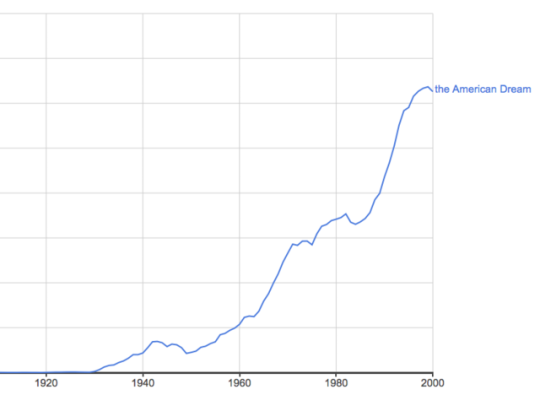
See? 1930, the beginning of the worst crisis in capitalism and writers started talking about this American Dream.
Unfortunately I do not have a chart that reveals whether the American Dream has succeeded, failed, or never existed in the first place. We do have history, however, and it is clear that capitalism was developed in England and was exported to the colonies. I can't say whether it was the British Empire or the United States that most fulfilled capitalism's potential. Let's call it a draw. And let's not forget Europe, South America, Asia, and Africa. Capitalism is alive and well all over, for good or for ill.
Capitalism = "The American Dream"? Maybe? Probably? Obviously? I don't know.
The American Dream was bought with credit. It was bought with resources borrowed (or taken) from ecosystems, non-renewable energy, indigenous peoples, etc., not just money borrowed from banks. This borrowing was wreckless. A lot of consumption more than investing. Externalities not included in the prices of that consumption. — WISDOMfromPO-MO
I think you will find that this is a pattern which is far older than the United States. There is no way for any organism to exist without using resources from ecosystems. As for the rest, sure: non-renewable energy, seizure of indigenous resources through genocide, reckless, costs externalized, etc. All true.
Capitalism is not sustainable--anywhere. To the extent that capitalism = the American Dream, then neither is sustainable.
This next comments will seem like they are totally off-topic, but it actually are not:
I've been reading the Doomsday Machine by Daniel Ellsberg. Ellsberg worked for the RAND Corporation in the 1950s and '60s as a national defense analyst and strategist. He became well acquainted with American nuclear war strategies at the time. He was appalled to discover that the US had a first-strike strategy; Command and Control was sloppy at best; authority to launch nuclear weapons was delegated by Eisenhower and subsequently followed by several presidents; the plan was all out attack on both the Soviet Union and China -- regardless of whether China was involved in whatever threat the USSR was thought to pose. The plan called for the destruction of every significant city in the USSR and China.
Kennedy wanted to know what the human cost would be -- assuming that all of our bombs reached their targets and no weapons were launched from the USSR. The military had a ready answer: around 700 million in Europe and Asia. The military planners, however, had not included deaths from fire storms, which they should have because they knew all about firestorms from Hamburg, Dresden, Tokyo, Hiroshima, and Nagasaki. A quite reasonable estimation of total deaths would be closer to 1 billion -- then 1/3 of the world's population.
The assumption was that the USA would survive the fallout from this massive attack with little or no cost. At the time, the concept of nuclear winter had not been developed. Ellsberg notes that the US still has enough missiles (about 400) and nuclear-armed submarines to bring about nuclear winter, even if we were the only ones to fire off our atomic weapons--because of the fire storms boosting massive tonnage of soot into the high atmosphere where it would remain for years--blocking a lot of sunlight and chilling the planet significantly -- causing a massive kill off of many species, including humans.
One might hope that America and the American military are not one and the same thing. At the very least, the ideas of Manifest Destiny and American Exceptionalism are ticking away in their heads, and in the heads of a lot of civilians too. -
Therapeutical philosophy?One should never underestimate the capacity of the determined to find futility where others find purpose. The radiant beams of a super nova might not penetrate the Stygian shadows wreathed about you in terminal gloom.
Use a shovel, schopenhauer1. -
Therapeutical philosophy?That was Henry David Thoreau — Andrew4Handel
Yes, my mistake. I store all the New England Transcendentalists in the same memory cell. I suppose I could afford to give Thoreau and Emerson each their own cell.
Maybe it's soothing; it is at least a relief to know that one's private desperate hell hole isn't all that unique.
This is an interesting observation. Do depressed people have a low self esteem due to prior experience?
Is there an internal desire for perfection or is it something assimilated from society with pressures on us to socialise well and achieve things or due to experiences of constant criticism? — Andrew4Handel
It's surprising that some people have any self-esteem at all.
If you think that depression has purely biological origins (it could), then the feeling of worthlessness is probably owing to a deficiency of certain brain hormones, neurotransmitters. If you think depression is socially engendered, then sure, social experiences and expectations would play a role. Most likely both play a role, in varying amounts in different people.
I don't know where this perfectionism comes from. When I was more severely depressed I was a chronic failed perfectionist. I can imagine completing a complex project perfectly, but in fact I don't have the kind of detail oriented mind to do such a thing. I'm a "big picture" type of thinker; I hate dealing with details.
As I look back over the last 71 years, I think a lot of our psychological problems stem from not really understanding ourselves. There is much about myself that I was very late in coming to understand well. Maybe "perfectionism" is the result of trying to conform to an ideal one thinks one should match. People who don't understand themselves don't understand that they can not be perfect--maybe not even be mediocre--at some tasks. -
Therapeutical philosophy?Are there any practical ways by which the study of philosophy can be used to overcome issues with depression, self esteem etc.? — LSDC
IF the study of philosophy leads you to a more realistic view of yourself, the world, and your relationship to the world, it can help. People (whether they are depressed, stark raving mad, or the very models of modern mental health) entertain various erroneous ideas about life, some of which make life more difficult. For instance, many depressed people have perfectionist tendencies--I don't know why, it just seems that way. Of course, they aren't perfect and quite often fall far short of perfection, and this reinforces their negative views of themselves.
Any drunk in a bar can tell you "nobody is perfect" but you might want a little exegesis with your cocktail. Perfection, after all, is the enemy of the merely good, and merely good is decidedly worth achieving. Why should you be perfect? Why do you have this hubristic tendency to excel in all matters? Do you think everyone else is achieving perfection? (Clue: They are not.) Are you comparing yourself with some fictional superman or superwoman?
So you think your drab, wretched life is uniquely miserable? Ralph W. Emerson said that "Most men lead lives of quiet desperation." If most people's lives are exercises in futility, why would yours be any different? But hello! I don't think life is futile, but some things definitely are. We just have to know when we are shoveling sand with a pitchfork. Philosophy (the kind you can do yourself) can help you decide what is worth shoveling and what is not. -
What is a Philosopher?I think a philosopher is someone who attempts primarily to cut through nonsense, — tim wood
And lots of people who aren't all that educated still have effective bullshit detectors, and some educated people can't tell shit from shinola. -
What is a Philosopher?It is possible to derive this from observation. Creativity and individual expression are pretty much suppressed from the time one first enters into the educational system right through their career. The great thing about retirement is that it becomes less so a challenge to experiment with self-expression and creativity - as long as one isn't seeking admiration or acceptance. — Rich
This is all true, but it is also true that certain velcro-coated ideas are floating around just waiting to glom onto a receptive surface. That "people are a herd and don't think" is one of them and is neither entirely true nor entirely false.
Yes, yes, yes, I know all too well how much creativity, or even slight innovation, is guarded against in most schools and work places. #Itoowasscrewedoutofadecenteducation.
The thing is though, that even the creativity-suppressed, thinking-discouraged masses have to account for their individual existences one way or another. Some people don't need any help; some people are too stupid to benefit from help; but the masses can benefit from all the help and encouragement thinking people can give them. That's why it is a bad idea to dismiss them as dull-witted cud-chewing bovines. (I don't mean to disparage cud-chewing bovines, of course. I have the utmost respect for cattle. Of course, we don't know what they are thinking about while they lie in the shade chewing away. Maybe they have exquisitely perceptive thoughts. Probably not, but who knows?) -
What is a Philosopher?Most people simply follow the herd, and allow others to think for them. — Jonathan AB
You are no doubt aware that your idea of people being a herd and allow others to do their thinking for them is an idea (maybe a 'meme') YOU picked up from a different herd.
BC

Start FollowingSend a Message
- Other sites we like
- Social media
- Terms of Service
- Sign In
- Created with PlushForums
- © 2026 The Philosophy Forum