
Comments
-
Is sex as idolized elsewhere as in the West?Who needs it? — Question
Children need age-appropriate information about human sexuality -- particularly their own sexuality. This does not mean, obviously, that 10 year olds should be instructed on the the fine points of sex on PornHub. As children grow, the age-appropriate and sexual-orientation appropriate information they need changes. Post-pubertal gay children need specific guidance, just as post-pubertal heterosexual children do. A lack of information isn't going to prevent adolescents from wanting to, and/or having sex. Without good information, they are sitting ducks for bad experiences.
Young adults can't make good decisions about education, careers, or health (lots of things) if they are totally unprepared to think about the topics. Same with sex. -
Is sex as idolized elsewhere as in the West?There's an unnecessary burden on parents to be always there, watching, directing, and supervising children. It's quite a failure of society to leave all the burden on the parents to raise a child, whereas society is just this thing out there not actively encouraging growth and identity formation. — Question
I'd say, rather, that it's quite a failure of society to not require parents "to be always there, watching, directing, and supervising children".
I don't expect or want people to be 'helicopter parents'. I expect them to be paying attention to what their children are up to. If people don't feel up to being parents, then they should get their various tubes tied or cut.
It's really fairly simple: Don't give the children a private room, a private computer, and a private internet connection; or a cellphone, or a tablet that accomplishes the same thing. Let them use this equipment in common areas of the house. Parents and children should be interacting and sharing, not all staring at private screens. -
Is sex as idolized elsewhere as in the West?It's getting to the point that we feel compelled to have sex just for the sake of it.
— Question
How awful. — jamalrob
As Jerry Seinfeld observed: "When sex is good, it's terrific; and when it is bad it's still OK." -
Is sex as idolized elsewhere as in the West?Sex and the collapse of the World Trade Center bldg.--why not?
The situation is much worse for growing and developing children growing up surrounded by media and advertisements promoting sex at such a young age. — Question
I grew up in a vacuum of information about sex, sexual imagery, sexual content, sexual innuendo, etc. Born in 1946, small town in rural Minnesota. No TV till the late 50s; the local movie theater ran standard fare--westerns, comedies, an occasional monster flick, that sort of thing. Small library, etc. PURE and WHOLESOME.
There was far too little in the way of information, too little content, too little sexual imagery. Like, none. Hey, great for first graders, but not so great for 16 year olds. On the other hand, children don't benefit from a glut of information, imagery, content, innuendo either. Unless the parents are AWOL, there is no reason why children would be over-loaded.
Children can get over-supplied with sexual content too early when they are given the means to peruse the internet and cable TV without supervision and oversight. Even without sexual content being available, it isn't healthy for children (or adults either) to be transfixed by the social media on digital devicee for hours on end--practically 24/7. -
Is sex as idolized elsewhere as in the West?I don't really have a sex drive in the sense you speak about it — Agustino
In my life in general, whatever sex drive you mention is absent. — Agustino
I never have this pressing desire to have sex that some others seem to have. — Agustino
that's why much of what you say doesn't make sense to me. — Agustino
At last! The admission that explains your views. When it comes to the healthy sex drives of 3.5 billion men, you don't know what you are talking about. ` -
Is sex as idolized elsewhere as in the West?Well it would be strange if other life forms would have been around for longer than bacteria, considering the fact that the first life to appear would be bacteria, since they are relatively the simplest in complexity. Evolution would be in quite some trouble if bacteria weren't around for the longest time :P — Agustino
They were here at the beginning and they are still here. Most species have long, long, long since disappeared. They will be here long after everything else. They are the preeminent success story in terms of survival. -
Is sex as idolized elsewhere as in the West?Sex depends on culture. — Agustino
Your strenuous arguments against people having sex in anything but the pristine confines of a lasting monogamous relationship is clearly a form of sublimating your own sex drive. You are substituting argument for sex in this discussion and getting the results all over everybody.
If sex depended on culture, evolution would have ceased and desisted a very long time ago. We, and everything more complicated than bacteria, wouldn't be here. Sex is a biological drive, like hunger, thirst, and sleep. The restrictions of society are the price of human advancement. Culture channels sex, but it doesn't provide its power. That's biology. Culture attempts to specify what sorts of emotional satisfactions we are to obtain from "proper sex" but our emotions always supersede culture.
Our human natures are always in conflict with our created societies. That's why life is essentially neurotic. The closer we come to actually blocking drives (and not just channeling them) the closer we are to neuroses bordering on actual pathology. Your path of restricting sex to either a consecrated marriage or an unconsecrated, long-term monogamous relationship, and disparaging all others, amounts to recommending that the sex drive either obey your rules or be blocked. That is the path to craziness.
You are more mesmerized by sexual imagery than most people are, apparently. You are taking what you see on the screen for the content of western culture. It isn't so. -
Is sex as idolized elsewhere as in the West?It seems to me that there is a neurosis with the subject of sex. For people to talk about it as something healthy and something that ought to be done instead of never is an indication of a pathology inside society. — Question
"Neurosis" and "society" are a combo package. In order to construct society we have to limit our individual drives, urges, aspirations, and appetites. Limiting natural drives, urges, aspirations, and appetites produces neuroses. "Limit" isn't the same as "blocking", however. It's a fair tradeoff. Society makes all kinds of things possible, and we have more or less learned to live with the resulting neuroses.
"Living with neuroses" is about as close to perfect psychological health as we are going to get. -
Is sex as idolized elsewhere as in the West?the difference between bacteria and sexually reproducing plants and animals begins with the difference between Eukaryotic Cells vs. Prokaryotic Cells. Prokaryotic cells are single-celled bacteria. Eukaryotic cells form multi-celled organisms like yourself. Prokaryotic cells reproduce through simple cell division. They don't come together to combine and produce daughter cells through either mitosis or meiosis. That's what Eukaryotic cells do.
They don't have sex. There are exchanges of genetic information, but it is helter-skelter. Bacteria in a puddle can pick up bits of genetic material from other bacteria that have fallen apart. By these and other hit and miss methods, bacteria can change -- like become resistant to antibiotics. They can also mutate and pass on the mutation when they divide themselves into two new bacteria.
It works for them. It works for bacteria so well, that they have been around longer than any other form of life. -
Is sex as idolized elsewhere as in the West?Really! I find it hard to believe myself, sometimes. Other times, not so much.
-
Is sex as idolized elsewhere as in the West?Right on! as we used to say. One of the causes of the neo-freudian Wilhelm Reich's downfall was that he advocated for the right of juveniles to have healthy sexual experiences. Surgeon General Jocelyn Elder hit the rocks for suggesting that sex education programs should encourage masturbation as an alternative to very problematic juvenile intercourse (children having babies, STDs, all of that).
We only "seem" to be saturated with sex. Sex saturation is mostly a commercial tease: "Here it is, quick look" then "NO you can't have it".
I used to be a libertine but that gradually went away as I crept into old age. Some 70 year olds are still quite active sexually. But... after being in a relationship for a long time, I don't really have that much interest any more. (Well, interest--yes, but not the performative élan I used to have.) -
Is sex as idolized elsewhere as in the West?I suppose something happened a long long time ago that doesn't want to be brought up; but, is a need of attention. Either that or I'm telling myself a crock of shit. — Question
It's always possible that you are telling yourself a crock of shit. All of us do that at one time or another.
If something happened a long time ago that doesn't want to be brought up and is in need of attention, then a public forum is probably not a good place to delve into it. You would benefit from the assistance of a good therapist to deal with the "doesn't want to be brought up" stuff.
Crocks of shit, though, are fair game.
There seems to be a cross-cultural consensus that sex is good for people and that they benefit from having healthy (not abusive) sexual encounters and sexual relationships. Unless one is sacrificing sex for a higher goal (like taking a vow of celibacy required of priests, monks, and nuns) there usually isn't any virtue in avoiding the kind of sex one desires.
There may not be all that much virtue in celibacy either. It's a very tough row to hoe for even the most committed, as are the vows of poverty and obedience.
You don't have to have sex, of course. Not everybody does, but most people do. It's mostly a question of "is this a comfortable and happy choice" or "is this an unpleasant accommodation of unpleasant personal experience"? If it is the former, talking about it here might useful. If it is the latter, talking about it someplace else (in private) would be better for you. -
Can we be mistaken about our own experiences?Yes, we can be mistaken about our experiences. Isn't this fact the basis of philosophy? — TheMadFool
Exactly.
You can dither over the question of whether the apple is actually red or green till the cows come home, but such dithering yields little of value--UNLESS you are getting feedback that other members of your species are perceiving the apples much differently than you are. If three apples are said to be yellow, red, and green respectively, and you can't tell the difference, then you have a problem that's worth thinking about.
What about cases in which people don't realize they are suffering until they get out of their habitual behavior, such as the case with addiction? What is going on here that allows a person to "suffer" but not realize that they are "suffering" until after the fact? — darthbarracuda
One of our problems is that we can not externalize our self-perceptions and see ourselves as other people see us. We can become quite unraveled, and if it happens gradually, we may not understand that we have become dis-arranged. We may be suffering and know it, but we can't see the cause within our complexly confused self-picture.
It is quite possible for our dis-arranged confused self to be eventually be taken (by us) as normal. If we do not receive some kind of acceptable objective feedback, or if life doesn't change for us we may never catch on to how messed up we are -- we will just keep suffering and suppose that it is because there is something wrong with the world.
As a counselor, I could give objective feedback to other people (about their conditions) without seeing how dysfunctional I was becoming. It was a huge discovery, once I quit working and could "re-ravel" myself back together, that I had been in quite a bit less than optimal shape for a long time. -
Is sex as idolized elsewhere as in the West?I've never had sex myself and frankly don't want to. I want to go through life not indulging in it; but, the struggle is real with sex being advertised and promoted almost everywhere you go. — Question
Do you want us to discuss your personal sexual feelings? I'd be more than happy to -- your lack of sex is a fascinating topic, and I would love to make you the object of prurient speculation, but you might not want that.
By the way, I suspect you'd find that your struggle to never have sex would be as difficult in the 10th century as in the 21st century. -
Is sex as idolized elsewhere as in the West?Why is sex so idolized in the West? — Question
Is it idolized? Is "the West" a uniform, billion+ person sex-worshiping fertility cult? I think not. Most people do not engage in anything remotely associated with "sex idolization".
Of the billion+ people who comprise the population of the west, there are three groups that might lead one to think that "the West" idolizes sex.
First, there may be 25 million people that may actually idolize themselves and sex. These people would be the younger, quite a bit more attractive, healthier-looking, more affluent heterosexual and homosexual hedonists who live in the larger urban centers. They are a small fraction of 1.5 - 2.0 billion people. They get a disproportionate amount of attention in the press because their hedonistic sexually active lives are much more distracting than coverage of the overweight working class people who are too tired and too poor to lead dazzling lives.
There is an second relatively small groups of people who are engaged in activities that might lead one to think that "the West" idolizes sex: certain businesses like advertising and cultural production and distribution. The cultural influence of this group is wildly disproportionate to it's size. This group primarily uses sex as a tool to sell an infinity of products.
The principle that "sex sells" comes with a critical catch: Sex sells products that almost never result in more sex. If it did, the product would have a much more limited sales life. If buying Lady Killer cologne promptly led to users finding more sex partners, their need for more Lady Killer would be diminished. They'd pour some of the stuff on themselves, go have an orgy, and not need to buy any other sex-promoting product for a long time. The product must always promise plenty but never deliver much.
Hence, we are inundated by advertising that promises sex and never effectively delivers it. What tends to get us sex is our own pheromones, reasonably healthy bodies, attractive faces, charm offensives, good hygiene... and money, of course. Even just a little money helps. Enough money to buy him or her a few drinks... Candy is dandy, but liquor is quicker.
A third group is the cultural production businesses--Hollywood, TV, Internet, music, video, magazines, and so on. This group sells entertainment that is laced with sexual imagery (and in the case of porn, sexual activity) because sex sells (and spices up) entertainment. Sex adds an air of verisimilitude to a dull and otherwise uninteresting story.
How much spice we each need varies. I can totally enjoy an orchestra concert which offers zero sexual innuendo or imagery. A steady diet of movies about love affairs that didn't involve any sex at all would not be acceptable. -
Congress is filled with morons.Good discussion. — Lower Case NUMBERS
It is a good discussion and the OP accidentally demonstrated how a possibly fake news story can be taken for real news by an intelligent and earnest reader. I swallowed the bait, didn't check the link, and came to altogether erroneous conclusions myself. -
Congress is filled with morons.What's with all the bogus news stories these days, they seem to be popping up everywhere, even getting picked up by mainstream media agencies some times? Is this the new trend for pranksters, or should I be worried about a deeper conspiracy? — Metaphysician Undercover
Worry about a deeper conspiracy.
Bogus news stories have been popping up for a long time. What is different is that the Internet is perfectly positioned for the bogus to spread far and wide, and to be taken more seriously than ever before. 100 or 50 years ago fake news stories were published in newspapers, but there were few ways and means for a story appearing in the Wacko, Texas Daily News to "go viral".
The Press has published bogus stories for a long time. The difference between the New York Times and some vague "news site" on the Internet is that the New York Times is a substantial financial asset with a real reputation to protect, with real journalists and editors on the job to do the protecting, and XYZ "news site" isn't. If the New York Times decides to publish something dicey (or a straight-forward lie), it's the result of a calculated decision. Like, they might trust the government to tell the truth on important issues, especially when they are not in a position to double check the facts of the matter themselves.
Did the Russians hack the American Election. Could be. I wouldn't be surprised. Those who can hack will hack. The press has reported it. Neither the American People nor The Press are going to see the raw data of the Intelligence Agencies (CIA, NSA, FBI, etc), so we have to take their word for it--for now at least.
Unprovoked attack in the Gulf of Tonkin? Highly doubtful, but it was a useful story at the time. Nuclear weapons in Iraq? No, but it was useful fake news at the time. -
Congress is filled with morons.I am glad there is not an IQ test for posting here. — m-theory
There is. You just flunked it. -
Congress is filled with morons.
I thought M-Theory had made up the story himself--curses, foiled again. However, I am sure that had he elected to write such a story, it would have been even better.
I have always assumed (but could not know for sure) that when people picked up the print versions (tabloids) of this sort of stuff at the supermarket they don't actually believe that a woman in Arkansas literally gave birth to a monster fathered by an alien from Proxima Z, or that someone had actually given IQ tests to the US Congress. I could be mistaken, of course.
If we are to take the OP seriously, then allow me to dissent: I very much doubt that the average IQ of the US Congress is 100, and no, I don't think the population elects people who are perceived to be relatively stupid because they think they will be safer. Congressmen may not sound like Oxford scholars when they talk, but it still takes a lot of intelligence to be an effective liar, thief, knave, and scoundrel at the professional level.
Selecting stupid people for leadership positions is something only the elite are in a position to do, usually. Her Honor the Mayor might appoint an approximate moron to head up an initiative she didn't want to have in the first place and now wants to wreck. Or you might promote the factory owner's son into a position he can not succeed in so that you can finally get rid of him. It isn't that the elite themselves are so clever, it's just that they generally have power disproportionate to their value in society.
I'll stick with the view that there are no idealists in Congress, even deluded or deceiving ones. -
This forum should use a like optionMaybe this forum needs a "building collapses on annoying person" button.
-
Congress is filled with morons.we are on a small boat in a world of shit — Ying
Have you heard that song by the Fugs (1960s) "Wide Wide River"?
(gospel sound)
River of shit,
River of shit,
Flow on, flow on, river of shit,
Right from my toes,
On up to my nose,
Flow on, flow on, river of shit.
(transition to Rock)
I've been swimming In this river of shit,
More than 20 years, and I'm getting tired of it,
Don't like swimming, hope it'll soon run dry,
Got to go on swimming, cause I don't want to die.
(spoken with gospel sound in background):
Who dealt this mess, anyway?
Yea, it's an old card player's term,
but sometimes you can use the old switcheroo and it can be applied to ...
Frontal politics
What I mean is ...
Who was it that set up a system,
supposedly democratic system,
Where you end up always voting for the lesser of two evils?
I mean, Was George Washington the lesser of two evils?
Sometimes I wonder ...
You got some guy that says
"For God sake, we've got to stop having violence in this country."
While he's spending 16,000 dollars a second snuffing gooks. -
Congress is filled with morons.Do we need to worry about sensitive terminology here? "Dull normal" might be less hurtful to women who whelped really stupid bastards.
-
Congress is filled with morons.I am concerned that there might be a factual contradiction in your otherwise valuable report: First you state that ...
The Kennedy School of Government did a longitudinal study over the last 30 years
Then you state that ...
Nancy Pelosi approved the funding of The Moron Study back in 2009.
There is an unexplained discrepancy between the past 30 years and the past 7 years. How do you account for this?
There is no functional difference between an IQ of 101 and 98.
It is a well known fact that "want to" is more important than IQ. You have neglected the role of blind ambition. A highly focused, energetic, and ambitious moron can out-achieve a laid-back genius any day. Other studies have found that the level of high-T-driven ambition (males and females both) in elected officials approaches the capacity limit of measurement tools. They are, in a word insanely ambitious.
delusional idealists — Ying
Ying, there are no idealists in the US Congress, delusional or otherwise. There are dissembling slime balls who pretend to have ideals, but they always prove to be craven crooks. -
I will delete the account relax :) there is no need to keep deleing my postsand at the same time plagiarising — unenlightened
Are you saying this monster didn't even make up his own trolling nonsensical baloney? He copied somebody else's? Incredibly OUTRAGEOUS. -
Is climate change overblown? What about the positives?Damn! All I've watched was Foxnews. — Hanover
No, no Hanover. Don't put yourself down. What you need is an in-house Climate Wonk. Get rid of the lawn and pool boys--also the housekeeper, you can't afford it all--and hire an in-house wonk who can supply you with every comfort that statistics and charts can offer. You'll probably want to request a curvaceous, sultry wonkess from Brandeis University who can fluff up your pillow and sit by your bed and read you lewd and lascivious nighttime tales from the Interagency Climate Change Adaptation Task Force as well as boil a kosher egg for your breakfast. (Personal services are charged separately.)
You can continue to watch Fox News and still be well informed. -
EntrenchedIf you aren't entrenched enough, here is a tool that will help.

It can also be used in hand-to-hand panel discussions about philosophical concepts. -
Is climate change overblown? What about the positives?As I understand it (not well at all) the relationship between the ozone hole and climate warming is rather complex. CFCs are a green house gas, yes? I don't think ozone depletion is a major factor in warming.
-
Is climate change overblown? What about the positives?Furthermore, solar and other renewables would have to be adopted unanimously by all G20 nations. If one country backs out of said commitment, then the house of cards falls. — Question
Why must renewables be unanimously adopted by all G20 nations? Why, if one backs out, does this prevent the other 19 from continuing to benefit? -
Is climate change overblown? What about the positives?the general public (myself included) has no idea what sort of experiments have been conducted or what sort of data has been collected, but we are all asked to accept the conclusions because most scientists say it's valid — Hanover
You might be surprised to hear that the scientific record supporting global warming is not and has not been kept a secret. You don't have to subscribe to obscure or well known but technically difficult science journals to become aware of what the information is. Unfortunately for you, if you have have not been paying attention for the last 25 years or so, you'll have to do a fair amount of catch-up reading.
If for the last 25 years had you regularly read general science articles in papers like the New York Times, Washington Post, Scientific American, and so on; had you been watching the Lehrer News Hour on PBS, had you been listening to news on National Public Radio, had you watched NOVA and Nature on PBS, you wouldn't be in this slough of deficient information. You would have heard many explanations about what data had been gathered, how they got it, how the analyzed it, and what the upshots were. -
Is climate change overblown? What about the positives?Here's some evidence from the little ice age: Hendrick Avercamp (1585–1634) painted this picture of an ice skating party at a time when Dutch waterways regularly froze in the cold of winter. The canals don't freeze now.

-
Is climate change overblown? What about the positives?And surely, the economy is almost at 20k, an all-time high. — Question
The Dow Jones Industrial Average may be almost at 20k, but the DJIA is not the same as the economy. Stock markets are speculative, and there is a somewhat tenuous relationship between the various stock averages and the actual financial/industrial activity in a country. The reason the DJIAI is still close to its high of 19,987.63 is that speculation keeps it there. Speculators are more confident in stock when the economy is at least reported to be doing OK.
The economy (actual production, consumption, profitability, rates of return on investment, employment, debt, etc.) and the DJIA or the S&P 500 are not chained together. Thousands of corporate reports showing actual financial results reveal how the economy is doing (that and Bureau of Labor Statistics, et al). There is a relationship between the actual economy and stock market, but there isn't a one-for-one relationship.
I'm not sure if you've gotten the point of this topic; but, climate change up to a certain point is actually beneficial to the economy and the world. If the smart scientists are right that a small increment in temperature will lead to a runaway effect, then we will walk over that bridge when the time comes (60-100 years from now). — Question
Of course I get the point -- I'm an urban sophisticate, just like you.
We can look at the Medieval Warm Period and the "Little Ice Age" that followed it. People were much better off physically and economically during the Medieval Warm Period than they were during the cooler "Little Ice Age." Here it is, all graphed out:
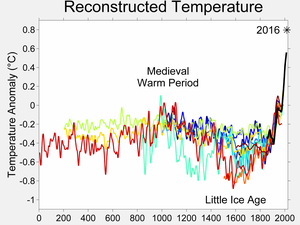
But bear in mind: Global warming didn't begin in the 1990s. It's been progressing for something like 2 centuries.
Svante Arrhenius (1859-1927) was a Swedish scientist that was the first to claim in 1896 that fossil fuel combustion may eventually result in enhanced global warming. He proposed a relation between atmospheric carbon dioxide concentrations and temperature. He found that the average surface temperature of the earth is about 15º C because of the infrared absorption capacity of water vapor and carbon dioxide. This is called the natural greenhouse effect. Arrhenius suggested a doubling of the CO2 concentration would lead to a 5ºC temperature rise. He and Thomas Chamberlin calculated that human activities could warm the earth by adding carbon dioxide to the atmosphere. This research was a by-product of research of whether carbon dioxide would explain the causes of the great Ice Ages. This was not actually verified until 1987.
The warming that has happened in the last two centuries is considerably greater than the warming during the Medieval period, and the level of CO2 in the atmosphere continues to rise. We passed the arbitrary 400 ppm in the last year. The warmer it gets, the more water vapor and CO2 there will be -- guaranteed by the laws of physics and chemistry. Add methane to the mix. The more water vapor, CO2 and methane, the faster the feedback loop.
We may, might, possibly, probably are, or could be past the point of beneficial warming. I've been around long enough (70 years) to see some warmth related changes. When I was in high school (before 1964) iris, peonies, lilacs, and bridal wreath peak blossomed for Decoration Day (aka Memorial Day). For the past 10 years, at least, these plants have been fished blossoming before Memorial Day. Migratory birds are returning 2-3 weeks earlier, and some birds have decided to skip migrating -- this in Minnesota. Insects that used to be killed off in the winter (ones that infest trees, particularly) are now surviving winter. It isn't that winter has disappeared across the northern tier of states. It is just that very cold periods are much shorter than they used to be with spring arriving earlier, and winter beginning a bit later. The last really long brutal cold spell in Minneapolis was the winter of 1983-1984 when the temperature in December '83 was near or below zero, with a low of -29ºF on Dec. 19. -
What direction is the world heading in?I don't buy this theory that we are so encapsulated that how we respond to other people's actions is purely a matter of our own choices.
— Bitter Crank
This makes no sense to me. — m-theory
We have more control about the behavior we display than the emotions we feel.
You invite your girlfriend to dinner. She says she is busy. You ask her to suggest a better date. She says, "Never. I don't want to see you again. Don't call me anymore."
It would be surprising if you could dial up whatever emotional reaction you thought was appropriate at that moment.
You ask your daughter to clean up her room. She turns to you and says, "Fuck you, creep." (Or whatever it is that daughters say these days.) This response is unexpected. You have 100% control over how you feel at that point?
The boss calls you in and tells you the company doesn't want you anymore. "Give me your keys and I'll escort you to the front door. Your belongings will be sent to you." No uncontrolled emotional reaction?
Maybe I am projecting. I have, in the past, been in situations where people got through whatever shields I maintained and "it got to me" and I reacted without selecting the best response. For the last few years I have been much more "in control" in that I have been much less reactive. But then, I have been going out of my way to avoid situations where I might run into static. But still, quite pleasant interactions happen and I can't seem to help respond positively. -
What direction is the world heading in?It would be my fault for being upset, I am responsible for my own emotions. — m-theory
I don't buy this theory that we are so encapsulated that how we respond to other people's actions is purely a matter of our own choices. Because we are social animals, the signals we receive from other people do affect us--beyond the way we wish to respond.
Granted, we can prepare ourselves for a difficult interaction, and if properly prepared we can defend ourselves. But often verbal/non-verbal social assaults come out of left field, or are so consistent that we eventually lose our ability to ignore them.
We are, at least to some extent, responsible for the consequences of our behavior on other people. -
What direction is the world heading in?...we have to come to terms with several impossibilities: — Agustino
(1) The impossibility of globalisation — Agustino
In one sense, globalization has already happened. Communication, trade, and travel have greatly diminished the sense of 'separateness' that people experienced say, a century ago, and further back. Whether economic integration would be a good thing or not, I just don't know. For the winners it would be fine, of course. Everybody else, not so much.
(2) The impossibility of a unified multicultural society — Agustino
Is it impossible? The US has been multicultural for what, 150 years, give or take a few. Each new intensification of multiculturalism tends to cause the established culture to recoil, but in time the newcomers become part of the established culture. Maybe 2 or 3 generations. The Western Hemisphere was repopulated over the last 500 years. There were decidedly winners and losers in this process, but multiculturalism was the result.
Still, multiculturalism isn't an entirely settled issue.
(3) The impossibility of an economic system based on and fueled by the idea of infinite growth — Agustino
Total agreement here. Clearly enough, economic growth has limits because the foundation of any economy -- conveniently accessible minerals and fertile soils -- is limited. The huge deposits of iron, copper, tin, coal, and so on turned out to be a lot less than infinite. (High quality sand for concrete is finite too, and even that is becoming scarcer.) Same goes for fertile soils.
(4) The impossibility of sustaining social order in a society driven by consumerism — Agustino
Clearly, "consumption" is insufficient to justify anyone's existence, and that is a major problem already recognized back in the 1950s and 1960s. (I think it was) Edgar Friedenberg who noted that one of the functions of the American education system was to regulate the labor pool of the young, and keep young people in the role of "consumption" and out of "production" for as long as possible -- maybe past the PhD.)
The counterculture of the 1950s (beatniks) and 1960s (hippies and all) was anti-consumerism. "Turn on, tune in, drop out" was Timothy Leary's idea. Lame brained as it was, it was also anti-consumerism (except for the production and consumption of Lysergic acid diethylamide). -
Is climate change overblown? What about the positives?I've been talking with a friend and essentially the argument goes that limiting growth today (sacrificing GDP) instead of saving it at a higher discount rate over, say 60-100 years when the discount rate will lead to a significantly higher return on saved money, then most of these prognostications will come to fruition is better than sacrificing current GDP growth and then tackling the problem of climate change in the future. — Question
Your friend has zero reasons to be confident in his economic predictions for 60-100 years hence. I know nothing about your friend; he might be a genius, but he still doesn't know what is going to happen economically in 100 years. Nobody else does either. I personally would not bank on such advice.
Go back to 1917 and ask yourself, what predictions in 1917 bearing directly on the economy have proved true in the intervening century? Nobody predicted the great depression, World War II (or any subsequent war); nobody predicted the immense importance of radio or automobiles or TV to the economy; nobody anticipated the manned landing on the moon or the absurdly expensive and wasteful Star Wars initiative of the Reagan Administration; nobody predicted antibiotics, the elimination of smallpox or polio, the 1918 worldwide influenza epidemic (only 1 year later) that killed between 20 and 40 million people in about a year. Nobody predicted AIDS, Ebola, or Zika either.
The human ecology and human economy is far more complicated than global weather. The range of predictions about global warming or climate change, whatever term you like better, is based on comparatively straightforward climate models which are based on physics, chemistry, and accumulated data. It's much easier to confidently predict what will happen to climate over 50 years with a doubling of CO2 methane in the atmosphere than it is to say what GDP will be 25 years from now.
You know, the Great Recession of 2008 was not predicted 15 minutes before it began.
Another point worth mentioning is if coal and natural gas, which are the cheapest available sources of power are abundant, then we ought to utilize them to achieve the maximum amount of growth possible. Then, when the resources run out or there are other cheaper options, then move onto utilizing those options. — Question
Have you learned nothing about the real world?
Look, at the time of the carboniferous epoch (359.2 to 299 million years ago) the world was very warm and humid and had high levels of CO2 in the atmosphere. The ancient forests, and animal life of the swampy world died, were buried, and locked up a lot of the excess CO2. It became coal, oil, and gas.
250 years ago we all started digging up all this sequestered carbon and burned it for various purposes. We've dug up a good share of the coal, sucked up even more of the oil, and have tapped a lot of the natural gas. All of the carbon we dug up and burned became the CO2 that is causing the planet to rapidly warm up. That's what CO2 does.
A lousy 2ºC is no crisis you say. It is, because the amount of CO2 that it takes to warm up the earth that much will be very hard to remove. As we continue to add CO2, even at an decreased rate, the climate will continue to warm. At 2ºC increase, serious climate and weather problems start to ensue.
Why? Physics and chemistry again. Put a lot more energy into the atmosphere and the result will be more extreme weather, more erratic weather, and worse.
So, Question, we can be much more sure of negative climate developments than we can of beneficial economic developments. -
EntrenchedWorse. Philosophers have more fire power in their armories to defend their entrenched positions. Not only that, they are entrenched about opinions that are 2500 years old. None the less, these dry, dusty issues are grabbed onto by the goats as if they were just cut and harvested yesterday.
-
Is climate change overblown? What about the positives?China is still building coal fired plants, however, and even in a command economy reasonably safe nuclear plants take quite a while to bring on line.
Carbon emissions are becoming less intense (x amount of carbon per y share of GDP), but it is still increasing and according to Chinese sources will continue to increase for a period of time because China is still in it's planned process of industrializing and urbanizing -- both of which involve increases in carbon output. (https://blogs.scientificamerican.com/guest-blog/making-sense-of-china-s-drop-in-coal-use/)
Granted, they are building more nuclear and solar plants, but in such a huge economy still being transformed, "Peak carbon" has probably not been reached yet. And the year after peak carbon doesn't mean no carbon, it just means a bit less carbon. That applies to the rest of the world's economies too. And don't forget India which will be an increasingly massive producer of carbon from various processes.
The US remains #2 after China in world carbon output. -
Is climate change overblown? What about the positives?Global warming won't result in evenly distributed consequences, beneficial or not. For instance, the earth's polar regions are -- and will continue to warm -- more rapidly than equatorial regions. So, what's the problem with that?
Melted polar ice will raise ocean levels enough to obliterate most of the world's coastal cities and lands, where the largest concentrations of people live. This won't happen overnight, but it also won't be avoided overnight, either. Fisheries and farm land will also be disrupted (most fish are hatched along shorelines).
Continental regions will not experience global warming evenly, either. The American southwest region is expected to experience deepening drought and excessive heat. The north mid-lands will experience not just more rain, but more rain in more frequent heavy rainfall. So, what's the problem with that?
A lot of people live in the SW, and as it becomes hotter and drier, their continued residence there will become increasingly unsustainable. They will have to resettle at great cost. As for the northern plains states, the source of a huge share of the nation's and world's food, they tend to be flat. A 10 inch rainfall on top of higher average rainfalls generally means flooding (which is bad of course) but it also means a drop in crop yields as flat fields stay under water for too long a period. A drowned corn, wheat, bean, sunflower, etc. crop in July means no crop at all. Even with a longer growing period, midsummer crop loss means no crop that year.
The glaciers in Asia are melting. The ice will be gone sometime in this century. Yes, there will be heavier -- and more unpredictable -- monsoons. A 20 inch rain would seem to solve the problem of glacier loss, but it doesn't. A sudden heavy rain (say, 10-20 inches) is too much to deal with. The soils can not begin to absorb that much rain, and it runs off causing severe flooding.
As one approaches the equator (even as close as the southern US) excess heat will make it increasingly difficult to spend the usual amount of time outdoors during the summer months required to run agriculture, fisheries, infrastructure repair, roofing, and so on. This will most likely be a late 21st century problem, but that's only 60 years away.
So yes: there will be benefits. One will be able to ship goods through the arctic ocean between Europe and Asia. The downside of a warm arctic is more methane in the atmosphere as the tundra melts and starts rotting, and releasing methane hydrates. Methane is a much more powerful greenhouse gas than CO2.
A warm Arctic might also mean a disruption of surface and deep ocean currents. So who cares? If the gulf stream is disrupted, Europe will get a lot colder. (It won't warm up enough to eliminate winter.) A much colder, and maybe drier Europe, will not be pleasant.
BC

Start FollowingSend a Message
- Other sites we like
- Social media
- Terms of Service
- Sign In
- Created with PlushForums
- © 2026 The Philosophy Forum