
Comments
-
Post truth
There. I just changed the objective fact that there was no reply to your post. How bout that?Objective facts can't be changed, only the interpretation of them can. — intrapersona -
Why is social conservatism generally associated with religion?So you're basically saying that it's a historically contingent fact that social conservatism is associated with religion instead of with atheism?
-
Is Truth Mind-Dependent?I expected something grander from post #2000 than a rehash of Hegel's position with regards to concepts and reality ... :D
-
Embracing depression.
Justification?Utter rubbish. — Heister Eggcart
Just because there's millions of hours put into it, doesn't mean that it's necessarily yielding good results.You make it sound as though there isn't millions of hours put into researching mental illness, and medicine in general. Also strange that you distrust doctors by appealing to academics. — Heister Eggcart
No, when my life is on the line, thinking what's best to do, regardless of who does that thinking, is what's needed. Independent thinking especially - not thinking that's clouded by biases, including medical biases. I may see the situation more clearly than the doctor does in fact. The doctor can only think through the prism of the medical establishment, and quite often not even through that. I still remember when I ended up in the hospital after a severe stomach infection that lasted for 1 week, with fever, diarrhea, not being able to sleep because of the pain etc.. I went there because I wanted them to do my blood tests, and I was sent to the very best gastroenterologist (because I knew someone who worked there) but the stupid doctor wanted to keep me there, and give me intravenous antibiotics and rehydration. And I refused, and I had to bear with their rant about the fact that I'm stubborn blah blah, and then when the blood tests came back, the doctor to go like "Oh yeah, blood tests are excellent, you were right, there is no sign of infection left in your blood". And then they advised me to "drink coke" and take medicine to stop the diarrhea - both advices which I ignored. They also advised me to drink rehydration salts, which was a good idea and I followed it. Firstly, coke, despite their supposed medical expertise, does not harden the stool - that's a medical myth. Why should I trust the "best" doctor in the hospital based on a medical myth? Secondly. taking drugs to stop diarrhea is stupid - your body reacts by having diarrhea because it is trying to get rid of a pathogen that way. You don't "stop" the diarrhea - unless you have to meet the President or something. You let your body do its thing.But when expertise is on the line, you best do what your doctor thinks is right, because you're not a doctor, he/she is. — Heister Eggcart
So yeah - doctors make mistakes, and they make mistakes more than almost anyone else, because they don't get held accountable for their mistakes. They have nothing to lose in making a mistake. That's very dangerous. And they never know when they make mistakes, precisely because they are never held accountable for them.
I have another example. Back when the doctor recommended me surgery, I went to three doctors to get a single one who would agree to do the surgery under local anesthesia, and not under spinal anesthesia (and I didn't get any who agreed). And guess what I found out! They all wanted to do the spinal anesthesia... why? Not because it was the least likely to cause further complications and would be best for the patient - but because it would be for the doctor's convenience. None of them wanted to have the patient be like "Ah it hurts there", then have to inject a bit more anesthesia, and so forth. So they were willing to take a higher risk for the patient (for example, one of the very rare but possible consequences of spinal anesthesia is cardiac arrest) because in, say 500 cases it would be fine, and in the 501st the patient would have cardiac arrest. But no worries! Who cares? He died. You know... he just died, not my fault. Complication from the surgery. No big deal! It happens!
And funnily enough, I had a relative who had cardiac arrest for the same surgery during spinal anesthesia. They saved him, but still - you get the point. Whereas, in medicine not the most comfortable option for the doctor should be undertaken, because the doctor doesn't want discomfort - but the best for the patient. Many doctors have forgotten that principle - out of sheer laziness.
I didn't claim that modern medicine hasn't helped people. It has. I'm only arguing that the help is more limited than doctor worship makes it sound like. And a large part of this help comes from better hygiene and prevention (by the way :P ) .If this were true, we wouldn't have hospitals and doctors and lots and lots and lots of people who have been able to thrive and prosper because of modern medicine. — Heister Eggcart
If breaking from the sensible thing enables you to save your life, why not? Again - you're judging something to be unintelligent merely because it is unintelligible - I had a thread about this in fact, check it out ;)Your appeal to the rarity of people like your friend's wife breaking from the sensible thing to do doesn't make it logical for you to ignore professionals. — Heister Eggcart
And I'm not appealing just to such rarity - my whole experience with the medical establishment, including countless of hours studying medicine by myself point to this. You can ignore all that, of course, and still go your own way. But it's always better to learn something from everyone, I think. I'm not telling you to never go to the doctor - only to be more skeptical of the doctor than your "oh in the end I will still do what the doctor says because he's the expert". No - you should have independent reason to do what the doctor says - not because "he's the expert". That's not an adequate answer. You have your own head that you can judge with. You can read medical papers yourself, you can study your condition, you can understand your condition by yourself. Nothing is stopping you from accessing the same resources doctors have access to. Then indeed discuss with a doctor, and then you'll be in a position to choose wisely. -
Embracing depression.
I was responding to Thorongil:If you walk into a doctor's office having already diagnosed yourself, then why are you even going to the doctor's and being surprised when, perhaps, your doctor may agree? When I've gone to the doctor, I don't do the job for her. I lay everything out for her to decide best what most probably is affecting me. You start with as many symptoms and clarifications as one can, and then your doctor decides with you what you should do. — Heister Eggcart
You could go to the doctor claiming to feel depressed and he or she might not diagnose you. — Thorongil
But they don't have to fix my home life or whatever. They have to fix my attitude/response to my home life so that the depressive response is changed with a different kind of response. And medicine isn't helpful in doing this.Doctors fully realize that they can't fix your home life, or your job, or whatever else. But medication can help those people arrive at a better baseline in which they can change their bad surroundings. You seem to really fumble over doctors' intentions, and why they do what they do. — Heister Eggcart
They've spent their time educating themselves how to treat disorders according to classifications made by others like them. They necessarily see through the prism of the classifications, and can never help the person they face. And I'm not the only one who believes so - there are academics who have written books supporting similar conclusions.Yes, it's why they spend over a decade educating themselves in order to best treat the people they live to serve. If it's not the doctor's role to decide that a cast on a broken bone is better for that person, then a doctor is of no use. — Heister Eggcart
I generally don't trust my doctors anyway. I have a decent grasp of medicine, and can always discuss and look at different possibilities with doctors. I had conditions in the past, for example, that doctors recommended surgery for, and that I treated without any kind of surgery after I pressured the doctor in the treatment I wanted (which by the way worked, even though the doctor was "skeptical" about it at first).
No I'm not blaming them, I'm simply stating a fact. If you have the bad luck of having such a condition, doctor or no doctor - you're still fucked. The doctor will help - but only very minimal kind of help.Sounds like you're trying to blame doctors and medicine for Alzheimer's ravages, and the medical field for not being able to cure your family member's illness. Sometimes you have to treat people with drastic means in order to ensure as drastically a different, but better, improvement in someone's health. This doesn't always work, however. — Heister Eggcart
If they were left alone, they wouldn't have been much worse than after treatment.But perhaps you'd rather your family member be left alone? — Heister Eggcart
If one has a heart-attack, I know the symptoms to expect, and I have the tools necessary to notice if there actually is a problem. For example - I will take their blood pressure, and monitor pulse for any kind of arrhythmia and see how fast/slow it is. I will measure their blood oxygen level. Provided that blood oxygen level is good, their symptoms are minimal, and blood pressure levels are normal, and there are no signs of arrhythmia I wouldn't worry too much, even if their heart rate may be high and they may claim tightness in the chest, etc. Then I will monitor the condition for any changes, and call the ambulance only if necessary. At the moment I don't have an ECG machine (but I will at one point acquire one, but can't be bothered at the moment), and then there will be no need for ambulance, except if they actually have a heart attack (in which case it might be faster if I transport them to ER).Mayhap if one has a heart-attack, you can be their cheerleader so that they can overcome what they can't, zzzz — Heister Eggcart
If they actually have a heart-attack though, and require surgery for it, they still run a very high risk of death, even if caught early. It's just a fact that doctors can't really help if you're really in trouble. They can do somethings for you, but generally not that much.
According to the doctors you love, I was :PThis doesn't therefore mean that you were truly clinically depressed. — Heister Eggcart
>:O that's hilarious!"fuck man, I real sad, halp me," — Heister Eggcart
Well I felt like I couldn't at the time. But that doesn't mean that I actually couldn't. You can learn to disbelieve your feelings with regards to some things.No, you can't. — Heister Eggcart
Well if you have advanced stage cancer - chances are again, that doctors, or no doctors, you're fucked. One of my cousin's grandparents was a doctor. When he got cancer, he refused treatment. Why? Because he understood that if you have cancer, treatment may actually speed up your death, and will make the rest of your life a living hell. It's easy for doctors to prescribe treatment to others - they're doing a job - but when it comes to themselves, it's a whole different story. Fact of the matter is, that when the body really goes haywire, the doctors themselves can do much less than people imagine. When doctors do wonders, most of the time, it's when the body hasn't actually really gone haywire. Like someone has indigestion and GERD - they go to the doctors, they follow a treatment, and they're as good as new!You might as well tell someone suffering from cancer that they can do it all by themselves. Perhaps some herbal tea is all you need... — Heister Eggcart
I had a friend who died from cancer in his late teens. He had access to the best doctors in the whole world actually, and his condition was caught quite early. He still died. Fact is if you get to the point when something really goes wrong with the body, it's very difficult to treat, even if you could afford the very best treatment in the whole world. It's just a fact - as sad as it is. It doesn't mean you shouldn't try to treat it, and you shouldn't hope that it will be successful, but just to consider that treatment will need to include much more than doctors can give you, and even then it might still fail. And the most important resource you have is still your body. Your body can do wonders that your doctors can't.
For example, I have a family friend whose wife had breast cancer in the terminal stage. Even with chemo, she was given a small chance to live. So she refused treatment. Instead she went on a special diet, the cancer went into remission, and she ultimately got cured. If she had listened to the doctors, she would have most likely died from the chemo (my friend that I mentioned above died from the chemo actually - and I know other people as well who died from the chemo). I wouldn't claim now that following her diet, not eating almost anything, drinking your urine, and drinking special water will cure you. But the medical world is much less capable to explain or account for the multivariate elements that are involved in such serious cases. Ultimately as I said, it is the body that does wonders and cures - medicine can at best help it, at worst hinder it. And we actually know much less about how to cure things than we are (mis)led to believe by the medical establishment.
Also, don't forget that for doctors ultimately, you're just another patient. If you die, oh well, the patient died. You're not the first, nor the last that will die. They're used to this. In fact, doctors learn to become emotionally detached from their patients, precisely because they get to see so many dying people, and they can't be emotionally attached to them all the time, or they would lose their mind. They see patients dying in hospitals since their very early days, in medical school, training to be doctors. They're used to others dying. They learn they have to give so and so treatment, and if the patient dies - no big deal for them. Because they practice this detachment, they also don't really have skin in the game - be very afraid when someone doesn't have skin in the game. Your doctor won't lose his head if you die. He has no skin in the game. Therefore you should be highly skeptical of doctors, lest you die earlier than your allotted time because of them. Make use of them - but be skeptical of them too. Use your own brain - don't believe it merely because experts claim it is so. The doctor is rapidly becoming the equivalent of the priest in the old days - people believe him, regardless of what he says.
And by the way - doctors themselves are one of the leading causes of death - through a process widely known as iatrogenesis in medicine. Solving your problems isn't as simple as going to the doctor - going to the doctor may get you killed as well. You have to take everything into account. -
Embracing depression.
But is it the doctor's job to decide what "better" is for the patient?has a specific toolkit with which he/she seeks to understand whether one's life can be changed for the better. — Heister Eggcart
In my experience, it is your own inner strength, and maybe a few people close to you, who are most helpful, not the doctor. The doctor is "helpful" in a few cases. Someone from my family suffered and died from Alzheimer's. Yeah, the doctor was "helpful", she gave them pills and injections so that they would be like a vegetable, and would lose interest in everything else - of course they wouldn't be violent anymore. If you count that as "helpful" fair enough. I don't. If you're unlucky to get a physical condition like that, then you're fucked - doctor or no doctor. That's it, if you get that, I honestly think that nothing, save a miracle, can save you.Perhaps you do still think that seeing a priest or saying a prayer can fix the frailties of our bodies, but this suggests to me a distinct lack of understanding for the nuance distinguishing the role of medicating the body and medicating the mind. — Heister Eggcart
But I'm not discussing that type of mental illness. If you get depression - and I was diagnosed with depression before - you have hope. You're not finished. You have a lot of inner resources left, which lie untapped inside of yourself. So long as your mind is not physically affected, you can still climb out of the pit you have dug yourself in. In that case, there's ways for you to save yourself. But they ultimately depend on you, not on the doctor. The doctor can do little, if anything, to save you. -
Embracing depression.
I highly doubt that if I go to a doctor telling them that I am depressed, they would just send me out the door, and not diagnose me with anything. They would diagnose me with something for sure, and quite possibly prescribe me some pills for the short term and then ask to see me again. I don't need to have major depression (which is what you're talking about) to be treated by a doctor. It will suffice that I have, for example, frequent episodes of lethargy, loss of energy/motivation, trouble sleeping and sadness. That is not sufficient to qualify me for major depression. But it is more than sufficient to warrant treatment according to a doctor.You could go to the doctor claiming to feel depressed and he or she might not diagnose you. — Thorongil
http://www.mayoclinic.org/diseases-conditions/depression/expert-answers/clinical-depression/faq-20057770
There's also other "symptoms" or personality types that would be (mis)diagnosed with depression. For example, lack of motivation, sloth and laziness will often pass for depression. Because whoever is feeling in such a mood doesn't feel like doing anything and yet they're not particularly sad, but those around them will find it unnatural. (in fact, I've had long periods in my life like that. On holidays I prefer to sit around literarily doing nothing much at all instead of travel, etc. - most folks around me find this strange, because they all want to travel on holidays) But medical doctors have a tendency to think such people require "treatment", rather than that they simply require something interesting to do. -
Why is social conservatism generally associated with religion?I will look into it, but I wasn't referring to your recommendation, but to modern literature in general. Of course there are exceptions, for example Paulo Coelho's Alchemist was good. But the state of modern literature is by and large, from what I see, truly despicable. It's like authors have gone into the business of mass producing low quality novels (many which honestly read like leftist propaganda >:O ) The job of an author isn't to parrot the popular memes of his culture - unless all he intends to do is sell books.
-
Why is social conservatism generally associated with religion?
Yes but my problem isn't just that they are "new". My problem is that their ideas, and even their characters, seem quite superficial and uninteresting, it's like such people don't have anything of value to teach me. Someone "forced" me recently to read "Revolutionary Road" by Richard Yates - such a great disaster! Honestly the story is so disgusting and serves nothing more than illustrating pure stupidity. It's the story of an alcoholic couple who nevertheless are well perceived by their suburban conservative world, both with serious problems who ultimately self-destruct because of their restlessness, unrestrained ambition and simple lack of intelligence.Everything old was once new and "progressive." — Heister Eggcart
It is a tale told by an idiot, full of sound and fury signifying nothing. — Shakespeare
You know, when I read a novel, I must learn profound things from it. Otherwise, why am I spending my time reading it? -
Why is social conservatism generally associated with religion?
I think not. Again, there never is a time when not acting virtuously is better pragmatically than acting virtuously. And thus, even if the character in question is a sociopath, they could never "show their face" so to speak. And if they can never show their face, and therefore they never do anything sociopathic, in what sense are they even a sociopath? The problem with sociopaths is that they hide and hide - but at one point they have to show their true colors, otherwise in what way are they sociopaths? For them, this showing their true colors ultimately is their undoing. Virtue is its own reward, and evil self-destructs. Even your so called sociopaths don't think sufficiently in the long-term. They are irrational.I would also quickly add, Agustino, that I think your 'conservative' ethics is ripe for the type of highly functional sociopaths who can successfully pass themselves off as virtuous while actually being the opposite. — Erik
Epicurus wasn't interested in politics, and advocated that his followers live a tranquil life, focused on study, exploration of nature, friendship, and enjoyment, and away from potential sources of pain, such as politics, sex, and the like.My guess is that Epicurus would have made many concessions to the dominant social and political forces that Socrates (and Jesus) was unwilling to make, and that the reason for this could be traced to their respective understandings of human existence and, more specifically, to the existence or non-existence of a 'soul' whose needs can be at odds (at least on occasion) with the desires of the body. — Erik
I don't find this in myself.Well, I believe that I'm a conflicted being with conflicting impulses. — Erik
Then you are a very strange human being, who would willingly advance towards his own destruction, and who, if he wouldn't have a notion of the spirit, would willingly pour poisons down his throat...I would feel no deep pangs of conscience for fucking a woman other than my wife, I would not willingly sacrifice my life for my children without hesitation, or even more unpractically, for an abstraction like freedom of thought and belief. — Erik
Even if we did not know that our mind is eternal, we would still regard as of the first importance morality, religion, and absolutely all the things we have shown to be related to tenacity and nobility. The usual conviction of the multitude seems to be different. For most people apparently believe that they are free to the extent that they are permitted to yield to their lust, and that they give up their right to the extent that they are bound to live according to the rule of the divine law. Morality, then, and religion, and absolutely everything related to strength of character, they believe to be burdens, which they hope to put down after death, when they also hope to receive a reward for their bondage, that is, for their morality and religion. They are induced to live according to the rule of the divine law (as far as their weakness and lack of character allows) not only by this hope, but also, and especially, by the fear that they may be punished horribly after death. If men did not have this hope and fear, but believed instead that minds die with the body, and that the wretched, exhausted with the burden of morality, cannot look forward to a life to come, they would return to their natural disposition, and would prefer to govern all their actions according to lust, and to obey fortune rather than themselves. These opinions seem no less absurd to me than if someone, because he does not believe he can nourish his body with good food to eternity, should prefer to fill himself with poisons and other deadly things, or because he sees that the mind is not eternal, or immortal, should prefer to be mindless, and to live without reason. These are so absurd they are hardly worth mentioning — Benedict de Spinoza
I for one, for example, do feel pangs of conscience - even if I were to believe there is no spirit at all. For example, I feel pangs of conscience for fucking a woman other than my future wife. I don't understand why, absent spirit, you would go head long doing that. It's like, absent spirit, I wouldn't want my wife to be special to me and me to her. It's like, absent spirit, I wouldn't care about what my future wife is currently doing (and what I am currently doing). It's like absent spirit I wouldn't care if my wife is a loose slut or not. That is so foolish, as Spinoza said, that it's hardly worth refuting.
If you were Socrates, would you have chosen to die or to live? I would have chosen to die. We all have to die in the end, better to die as a great hero that all of history will remember, than die as a coward, begging for a few more days of life, humiliated and despised for my weakness by all, and suffused in such great shame. Such a life would indeed have been worse than death! Socrates, and Jesus, simply didn't have any better alternatives. They picked the best path they had available.or that Socrates willingly chose to die for — Erik -
Embracing depression.
But a doctor could certainly diagnose the latter too, wouldn't he? If he wouldn't, in what sense is it depression?The former is diagnosed by a doctor, the latter is not. — Thorongil -
Why is social conservatism generally associated with religion?
Yes.What leads to happiness and well-being? A life of moderation and the implementation of other virtues? — Erik
If that were so, then you should go ahead and join them. Then there would be no way for social conservatism to win - it would be impossible. If satisfaction of sexual desires with as many partners as possible really would make most happy, then that is the end. No amount of spiritual pleading could ever convince them otherwise, if they rationally perceived it to be so. The only alternative would be deception and force, but even they would probably fail in the long-run.To my naive view, it seems like the satisfaction of sexual desires with as many partners as possible would make most people very happy. — Erik
An Epicurean wouldn't accept the distinction physical/spiritual. They would claim that the mind is what is meant by spirit, and the mind is also material. And so since sexual pleasure is felt in the mind, it is of the same kind as what you call spiritual pleasure, and in no way different in substance. However, the pleasures of the mind are to be preferred over the pleasures of the flesh simply because the pleasures of the mind can be achieved more easily, at lesser costs. Thus Epicurus would argue that the sage isn't interested in sex, because there is nothing to gain from it - the costs always outweigh the benefits.Physically at least. Now my counter-point would be to smuggle in a resulting spiritual unhappiness from such behavior. — Erik
Going away from traditional Epicureanism now, which discourages physical love and attachments. The question isn't only that you betrayed the trust and loyalty that your wife placed in you. The question is that if you do this, then your wife will also (likely) do this, and you do not want that because you would experience jealousy then. So you merely feel guilty because you know what awaits you. If even you cannot be trusted, how could your wife be trusted? And this becomes the problem. If you fail, then not only have you failed her, she has also failed you.I betrayed the trust and loyalty that my wife placed in me and which should have prevented me from succumbing to the temptation of physical pleasure for the sake of (at the very least) a mental contentment that comes from knowing that I can constrain myself, that I'm more than a mere beast seeking to satisfy its natural desires. — Erik
There are some people for example who don't care if their wife cheats on them. These are the very same people who don't care about cheating on their wife either - they wouldn't feel guilty. It's the fact that you care about your wife cheating on you that makes you feel guilty if you cheat on her - it's an outgrowth of the golden rule. You do want the physical pleasure of sex, it's just that you realise that most scenarios of getting it lead to you ruining yourself. So you choose to abstain. You recognise that gaining it simply isn't in the cards for you. And you accept it.
Sure, do that, but they might not be your friends for long :)Same thing with friendship. Without a belief in anything more valuable than my own happiness and well-being, why not just use other human beings in a utilitarian way to the extent that they can assist my attempt to achieve things like bodily health, longevity, etc. — Erik
You would see them, when you have no alternative. Say your wife is in danger. If you don't risk your life to save her, will you ever have another wife? Probably not - probably people won't respect you anymore. You'll be considered a coward and a wimp. Nobody will want to be around you anymore. And so it is better to risk losing your life, because if you don't, then you've already lost what is of value in it. And consider the alternative - you risk your life and manage to save her and survive - everyone, including your wife, will consider you a hero! You've won big league as Trump would tell you ;)I see no grounds here to do unnatural things like lay down my life, or sacrifice my own well-being, for the sake of another person, and I would not expect them to do so for me if they were guided by similar considerations. — Erik -
Why is social conservatism generally associated with religion?
Because that's what leads to well-being and happiness for yourself and others? If you read Epicurean works - take De Rerum Natura by Lucretius - you'll see that one, for example, should be free from lust because being a slave to lust makes one suffer - it diminishes their strength. One should be bonded in friendship with others because friendship makes everyone stronger, and none weaker. Giving in to your greed or lust isn't, paradoxically a way to satisfy the grandest ambitions of the ego - but a way to destroy them - it's the ego self-destructing because of lack of restraint.You may very well be correct, but in what sense does the notion of piety have any legitimate meaning in a materialistic universe devoid of intrinsic purpose or value? — Erik -
Why is social conservatism generally associated with religion?
I don't think this follows at all. What about someone like Epicurus - you really can't get more atheistic and materialistic than that. And yet, Epicurus was very pious, and probably quite close to social conservative values. It's not materialism that is the problem. Politics comes before materialism - and materialism is merely the post-fact rationalisation for a certain kind of politics. There is no necessary, or even likely link, between materialism and liberal progressivism.The ground seems a bit flimsy though without some 'higher' conception of reality which includes, but is not exhausted by, its material component. Man does not live by bread alone. — Erik -
Why is social conservatism generally associated with religion?
How? The conservative atheist has his own independent reasons for adhering to tradition - reasons which are independent from God. His "belief" in God is not dishonest - it's merely a mask he uses to communicate with others in a language they can understand.So there is no doubt the socially conservative atheist may find God a useful concept for policing society and grounding their values, but it comes at the cost of honesty. — TheWillowOfDarkness
But - what if believing in God is equivalent with adhering to tradition? What if believing in God is simply doing the Will of the Father? What if faith is simply upholding the virtues? What if this is simply all we mean when we say someone believes in God?God only works as a foundation when it is believed — TheWillowOfDarkness
Yes, but that's other people from the conservative atheist's position.Only if people think God is intellectual, is inseparable of the intellectual and political ethics of a just world, can it help reinforce socially conservative practice. — TheWillowOfDarkness
They could, as I have outlined above.The social conservative atheist's argument might rest on reason (or specifically an intellectual and binding ethical/political position), but they can't publicly state that and make rhetorical use of God. — TheWillowOfDarkness
Sure, but this is different from having social conservative values being the outgrowth (or consequence) of belief in God. Rather, in this case, social conservatism is simply equated with belief in God, in such a way that anyone who is a social conservative is an (anonymous) Christian, for example.To keep the theists on side, the public face must claim God is true and equate social conservative values with religious belief. — TheWillowOfDarkness -
Post truthObjective facts can be changed, and therefore changing them is deciding what the truth is. I see nothing wrong with post-truth, it's merely the logical conclusion of the identity of truth and empirical reality that happened after the advent of post-modernism. Truth no longer corresponds to a metaphysical reality, which no physics could ever change or alter, but to the reality of physics itself.
-
Embracing depression.
How would one go about distinguishing between clinical depression and non-clinical depression?You need to distinguish clinical depression from non-clinical depression. If you're talking about the latter, then I actually agree with you. If you're talking about the former, then there is something wrong with it, medically speaking. — Thorongil -
Why is social conservatism generally associated with religion?
Okay but if this is so, then the case against God is political rather than intellectual, and it's good for both participants to realise it is so. Then it merely becomes a matter of pushing tradition, rather than God for the theist. The atheist will then have a hard time defending and claiming moral superiority once God ceases to be a central focus of the debate. Once the theist stops claiming that social conservatism depends on belief in God, it will be very difficult for the atheist to oppose. So long as the theist can't be cornered, and the atheist can no longer claim that the theist believes X because of his belief in God, then it will be very difficult for those opposing tradition.I mean what is God without the "traditionalist" elements? If God is not a moral arbiter or enforcer of the world, God becomes sort of irrelevant. What does it matter if there is some being if it has no impact on the world? The question of believing in God becomes equivalent to whether one thinks there is some astroid in some galaxy we haven't observed. God without the "traditionalist" stuff is so benign that no-one has a beef with them-- well, apart from the traditionalist theists, who cannot stand the notion because it would mean the absence of their moral arbiter and enforcer.
I'd say everyone has a beef with God because that God is inseparable from the tradition they are opposed to. Even the "descriptive" atheist (i.e. the worried about the presence or logical coherence of God) reacts because belief would mean partaking in a tradition they found abhorrent (e.g. believing in falsified states and/or incoherent concepts). — TheWillowOfDarkness
Yes, but the social conservative atheist, while not believing in God himself, could find belief in God useful for policing society, and so could at any time ally with the theist. Their mutual commitment to tradition is stronger than their commitment to God. Even more, since the atheist is a social conservative, he could find the preservation of religion useful for the set of morals it teaches, and not for its facticity. Then God becomes mere rhetorical device to help the propagation of a system of morality which ultimately doesn't rest on God - but on reason.Without the reactionary defence religious tradition or alt-right identity, it's difficult for the social conservative atheist to generate political appeal — TheWillowOfDarkness -
Why is social conservatism generally associated with religion?
If atheism is true, then God happens to be part of it, and not the foundation.God doesn't 'happen to a part of it' — Wayfarer -
Why is social conservatism generally associated with religion?
Unfortunately no.Have you read Cormac McCarthy's No Country for Old Men? — Heister Eggcart
I do read fiction, but I don't really like present-day fiction, I have an aversion to it. It's too progressive for my liking. I like reading the likes of Dostoyevsky, Tolstoy, Kafka, Garcia Marquez, Jane Austen, etc.I don't see you as a fiction reader — Heister Eggcart
Well I don't know the book, but if you state the themes I could respond that way I guess.but I'd be interested to know what you think of the book's themes. — Heister Eggcart -
Do you talk about Philosophy w/ people who don't know much about it?
But why do you take my retelling so? I never suggested he was inferior or irrational. Quite the contrary, I admire his reason, and looked with scorn upon the bookworms - that's why I offered him as an example. Even apparently uncultured and uneducated folks can reason/philosophise.Ah, well, lack of culture... You do know that he doesn't have a lack of culture, he just doesn't have YOUR culture. (Don't get me wrong; I value literacy highly, but in anthropological terms, he is probably as "cultured" as you or me.)
Actually I thought his answer was perfectly adequate. Lots of people don't know what to believe anymore. You weren't giving him a cultural literacy test, you asked him a reasonable question, he gave you a reasonable answer. — Bitter Crank -
Why is social conservatism generally associated with religion?Fine. But you don't address the point of the thread. Why is social conservatism associated with religion mostly, and not with atheism? Why are those values, in other words, associated with religion, and not (also) with atheism?
-
Why is social conservatism generally associated with religion?But then, their essence is certainly being anti-traditionalists rather than merely atheists. For they don't have a beef with God, but rather with the whole of tradition. They only have a beef with God, in other words, because they want to get rid of tradition, and God happens to be part of tradition.
-
Why is social conservatism generally associated with religion?Okay I agree, but again, why would an atheist be less likely than a theist to see the value of religion/tradition for society at large?
-
Why is social conservatism generally associated with religion?
Maybe - I meant that achieving it in thought, obviously not practically achieving it.Should you not for example have written "recommending" rather than "achieving"? Because otherwise I am having difficulty parsing you statement. — John -
Why is social conservatism generally associated with religion?Yes, and that goes a long way towards achieving the separation between religion and social conservatism. I think the two should be separated while at the moment all too often they are not.
-
Why is social conservatism generally associated with religion?
But how is Hitchens socially conservative? I mean his position regarding gay marriage, sex outside of marriage, value of family etc. are completely the opposite of what a social conservative would hold. Abortion is possibly the only commonality.and a commie (Hitchens) convinced me of social conservatism — Emptyheady -
Why is social conservatism generally associated with religion?
Sure but then it means that - granting atheism - God becomes merely a tool of enforcing morality - a morality which has an entirely different foundation than God.I didn't say they did. — John -
Why is social conservatism generally associated with religion?
Not necessarily - they don't believe in authority for authority's sake.Social conservatives believe in authority. God is associated with the idea of genuine authority. Only the author has genuine authority, and God is usually understood to be the author of the world. Absent God authority is a merely contingent matter, upheld by worldly power. — John -
Why is social conservatism generally associated with religion?Well to be honest - I very rarely, if ever come across social conservatives. Most folks are either:
1. Progressive liberals
or
2. Reactionaries
What I mean by progressive liberals is clear, but what I mean by reactionary is different. Alt Right, Men's Rights, etc. such groups I qualify as reactionary. They are reactionary because they revolve around primitive notions of - for example - gender relations. For example, they think women should be servile towards men, they think the most powerful man should have the most choice of women, they use double standards - promiscuity for men, chastity for women - and so forth. To me, they are almost just as bad as progressive liberals, but they are easier to deal with than progressive liberals are, because they never claim to have the moral high ground. Such reactionaries often speak in the language of alpha males - a language that I find demeaning to women (the idea that a woman would choose a man because he is the most powerful is demeaning). But I never worry too much about them. It's only a matter of time before they will be defeated. I only worry that if they are defeated the progressive liberals will take over. So I would rather ally with them, than with progressive liberals. The enemy of my enemy is my friend.
So if I am to speak of social conservatism - let's take one view - that abortion should be limited to specific cases such as rape, incest, or when the woman's health is in danger - then I get one of two reactions - (1) women should be allowed no abortions or (2) ewww that's disgusting, women should be allowed to do whatever they want with their bodies (and I hate the second reply).
Or take sex outside of committed relationships. I get two responses - (1) what, are you stupid? Don't you want to fuck women without having to worry about them ever again? Do you want to be a woman's slave? or (2) When and how two consenting adults have sex is their business. Women should be allowed to have sex with whoever they want, and however they want. I find both responses much more unintelligent, uninformative and immoral than my own social conservatism. So there's few which treat sex with the same dignity and respect that I treat it with. -
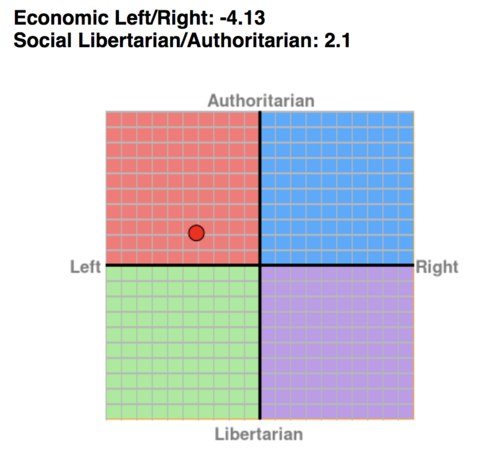
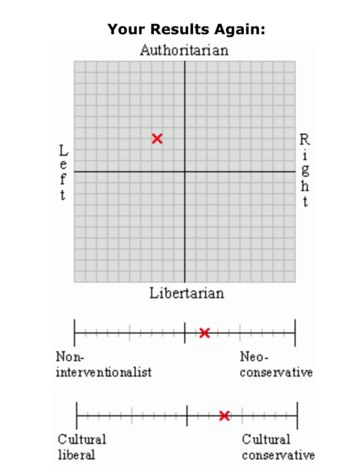
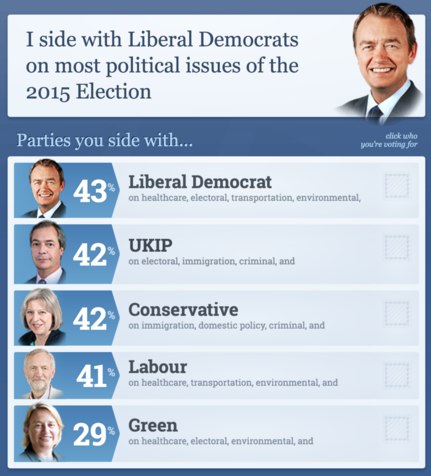
Political Spectrum TestI never vote(d) for anything except when I ran myself for something :P Most of the time, I feel 1 vote is too little to make a difference, so I can't be bothered much. Either that, or the candidates running aren't all that different. If I was in the US, I would have voted Trump this time - but that's an exception. I wouldn't have voted Romney for example in Obama vs Romney. I wouldn't even have gone to vote. Same for Obama/McCain.
-
Do you talk about Philosophy w/ people who don't know much about it?Yes, no doubt about that.
-
Do you talk about Philosophy w/ people who don't know much about it?
Not understand what?But did he really not understand? — anonymous66 -
Why is social conservatism generally associated with religion?
Conservative in the sense that it was spreading itself and keeping with the spirit of other religions of the time, looking to gain adherents and have them share their beliefs.Are you classifying Islam conservative (at its birth) because religion was allied with conquest and control of territory and people? — Bitter Crank -
Do you talk about Philosophy w/ people who don't know much about it?I don't explain philosophy to them, I just get them to talk about their beliefs, pose non-aggressive but inquiring questions, and so forth. People like to talk about the big questions!
For example, I recently visited an old friend at the countryside. His uncle was at the table with us, and he is a peasant who doesn't know how to either write or read. So I said like: "I notice a lot of people here going to Church, is there a lot of belief here?" And the uncle said "Well some believe in Mohammed, others in God, others in Zeus, others in Allah - one doesn't know what to believe anymore"
Obviously his lack of culture shows - but he makes exactly the same point that many atheists make for not believing - many big headed atheists with a lot more refinement than him. He clearly for example doesn't understand that Mohammed is a prophet, and Allah is the God, and so forth. He doesn't understand the differences because of his lack of knowledge and culture. And yet he makes a fair point - if there are so many options to believe one can't be expected to know what is true anymore,
So even those who aren't learned at all enjoy talking about the big issues, but you have to be able to talk in their language, and talk at their level. Don't try to teach everyone something, not everyone can be taught. But discuss the issues, explore their beliefs. -
Why is social conservatism generally associated with religion?
Well I did take tendency in an absolute sense, but apart from that I guess I would question that conservatism (or at least my conservatism) prefers traditionalism for its own sake. I see good reasons to preserve it.You're not ignoring the word "tendency" and reading it as an "absolute" instead, are you? — Terrapin Station
(In fact, I am quite against the type of conservative who thinks we should do something that way, because it's always been done that way. I hate that actually - in my country for example, there's a lot of that type of conservatism - for example you have men who think women should never hold a job, etc. but that seems stupid to me - there's no reason to believe or hold to that - it's irrational ) -
Why is social conservatism generally associated with religion?
The only way to keep a white post white is to, every now and then, repaint it white no? If you avoid change, you're not conservative at all, ultimately.Conservatism refers to particular views, but it also refers to a general tendency to avoid change and to prefer traditionalism for its own sake. — Terrapin Station
Agustino

Start FollowingSend a Message
- Other sites we like
- Social media
- Terms of Service
- Sign In
- Created with PlushForums
- © 2026 The Philosophy Forum