
Comments
-
Emphasizing the Connection Perspective
You said: "As I said, I don't think the hard problem of consciousness is hard. I don't even think it's a problem".
Speaking of logic, how do you explain that consciousness defies the law of excluded middle (our ability to do two things at once-conscious and subconscious cognition) ?? Is there an exceptional formula that explains that phenom? Or is it existential and just is. -
Kant-the five senses and noumena
Here's a fun exercise. I'll first try some definitions and add assumptions. (“All A is C; all B is A; therefore, all B is C.” )
Noumena= partly mathematical secrets that define our existence & contains the laws of nature/theory of every-thing.
Mathematics= an objective truth (a priori) that presumably always existed, which does not necessarily confer any evolutionary advantage.
1. Mathematics is an a priori objective truth
2. Noumena transcends human phenomena but is considered an a priori objective truth (mathematics).
3. Therefore Noumena is...
I'm not sure I have that correct...but you can see that metaphysical statements usually won't produce any meaningful results just by their definition. So I suppose it begs maybe one question, how do we discover any-thing? What did Kant say about that? -
Emphasizing the Connection PerspectiveThat's right Khaled, self-awareness is what separates us from lower forms of existence such as those in the animal kingdom.
Seems obvious to me too.... -
Kant-the five senses and noumenaLOL, thanks Wayfarer, I officially stand corrected !!!! To this end, do you know to what extent there were any similar breakthroughs... ?
-
Kant-the five senses and noumenaAurther, I failed to mention an important driving force behind one other metaphysical theory that may help. Theoretical Physicist Paul Davies has postulated that knowing the laws of physics (knowing mathematics) has no evolutionary advantage, only the manifestations of them do. It's a compelling case...
So maybe if Kant would have postulated a similar theory vis a vis his noumena, he too might have theorized same. Again, all of this kind of stuff is theretical but as you said worth exploring... . -
Kant-the five senses and noumena....sure Auther, it's worth exploring the notion that all events must have a cause as it were.
I think metaphysics is enjoying a little resurgence. Quantum physics was not fully explored during Kant's time. Science has made the connection to the 'observed and observer' on a quantum level, where it has been declared an interactive phenomenon of hide and seek (and indeterminate change).
So one takeaway from say from an ethics point of view (how to live a happy life) , is that a new analogy relating to quantum states of consciousness has emerged in the form of the so-called ' law of attraction ' theory.
So yes, some things are worth exploring even on a less scientific level. -
How Do You Do Science Without Free Will?
"Are there any scientific synthetic a priori propositions?"
Of course you are joking right (or maybe I misunderstood)? Here's an easy one for you: every event must have a cause. -
How Do You Do Science Without Free Will?
"No, because I don't think a sense of wonder is a necessary condition for doing science. The ability to weigh/evaluate evidence is."
RA, I think you may be overlooking the obvious. Would you not agree that raising the ' scientific question' in itself is a necessary part of the evaluation process?
And if so, is that not called human wonderment? But if not, then why choose to evaluate at all? -
Objective Morality vs Subjective MoralityMarzipanmaddox said:
"While it is true that if we had an infinite amount of computational and analytical power, we could likely map and analyze the brain and human body to the point where we could predict each and every person's subjective experience when doing cocaine with 100% accuracy. We are not at that point, but even still, that would just be an objective representation of the subjective experience. Even if the data can predict how you will feel, the data truly cannot feel high, it cannot feel the pleasure of cocaine, and that experience of feeling is what I would call subjective. "
M, Thank you for your reply and elucidation. Just wanted to make a 'succinct' point about some dangers of dichotomizing... . And to your point, it would be nice to be the so-called designer of the big cosmological computer [our mind] to gain such volitional knowledge and awareness of ourselves and behavior... . (Actually a friend of mine is developing some newer software that would predict market buying patterns in relation to a given set of criteria.) -
Kant-the five senses and noumenaAR,
Some Christian Existentialists' [including myself] would interpret noumena as a metaphysical construct. Meaning the idea of noumena is a force of energy that possibly exists outside the human mind. For example the nature of Christian Revelation [revelatory thoughts] and everyday knowledge/wisdom associated with our states of consciousness (Ontology/Epistemology).
How if effects our cognition could also be from a cosmological context. For instance, the nature of mathematical truth's appear to us a priori (without sensory experience). The how's and more importantly the why's of this phenomenon are the existential questions. Like why does mathematics/geometry exist? Is it independent and outside of our knowing it?
All we know is that it works, yet it's powerful and useful truth that exists without experience. In other words, no amount of sensory experience will change its truth value (2+2=4 never changes).
So my interpretation is that Kant's noumena would represent a metaphysical question to me: if noumena could somehow be the source of mathematical truth's why does it exist? Why does it describe the universe so well? And what would its nature be...? -
Objective Morality vs Subjective MoralityMarzipanmaddox,
What a great question (s) and debate! I hate to ask this somewhat rhetorical question but after reading some of your analysis; what is the human phenomena called Love? Is it subjective, objective, or a little of both (?). And if you believe it's both, in the spirit of ethics and/or morality, how should we exclusively parse that in your mind?
I apologize again in advance for that question however I'm just trying to understand your argument in favor of objective exclusivity... . -
How Do You Do Science Without Free Will?RA, just a thought, would it make better sense to ask …"Can you do science without a strong sense of wonder"?
In other words, if we were to use logic, one could argue that a 'synthetic a priori' proposition is essential in science for moving the thought forward, as well as realizing the resulting discovery and uncovery of such things... ?
So I suppose the 'choice' to be curious or having a strong sense of wonder, along with being glass half-full to the spectrum of possibilities is some of what you are getting at... ? -
Are science and religion compatible?https://www.amazon.com/Mind-God-Scientific-Basis-Rational/dp/0671797182
If you haven't had the opportunity to read physicist Paul Davies' Book...it's a great, great read!!
Accordingly, I believe the short answer is yes. I was always inspired by Einstein's search for answers and sense of wonder...
"Knowledge of the existence of something we cannot penetrate, of the manifestations of the profoundest reason and the most radiant beauty - it is this knowledge and this emotion that constitute the truly religious attitude; in this sense, and in this alone, I am a deeply religious man." (Albert Einstein) -
Do you run out of feelings?PP, you can also think of it this way: embrace the feelings you have about living a constant life of striving. We are never satisfied. Content or comfortable yes, but never satisfied. If we were satisfied, our quality of life would diminish. There would be no will to improve upon the human condition and/or need to experience newness. We would presumably be like animals. As other's mentioned we were hard-wired this way, like it or not... . Maybe it begs the next question: what should we do with this insatiable energy?
-
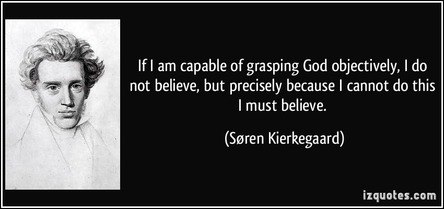
Subjectivity, Objectivity, and KierkegaardA few years back I made a case for subjective truth vis-à-vis the existence of God. I tried to parse objective truth v. subjective truth (I will try to find some of the arguments). Remembering Maslow, he preached we all have an unfortunate disposition of 'defaulting to' the dichotomization of everything (politics of course is one example). However, I think it's safe to say the so called reality of living this life incorporates both A and B not either/or... . For example engineering is mostly A or B. If the formula is applied incorrectly, it won't work. But the phenomena of living life/the human condition and pretty much most of our perception is more often A and B. Vocationally speaking, and in a funny way, that also explains why managing people is generally considered 'more difficult' than doing engineering work lol. Needless to say, human sentience plays a big role there... .
So I would submit truth is relative to a gradient scale. That said, I believe 'truth' is both subjective and objective, however, more specifically I believe 'truth' to be .333 Objective; .667 Subjective. And that's the truth! -
Is "Jesus is God" necessarily true, necessarily false, or a contingent proposition?Here's another thought. The idea of God being three persons seems to defy our rules of logic and/or is a logical fallacy. If that is true, then question whether there are any existing analogies in the world of physics or otherwise that defy logic. Our consciousness is one of them.
I would argue the reason consciousness defies logic is because it precludes the law of excluded middle. The reason is, we humans can do two things at one time. One example is driving a car while totally thinking about something else. Or reciting something and thinking about something else that is completely different.
I believe Atheist Daniel Dennett wrote a book on Consciousness but unfortunately could not logically explain this phenomena about the mind (as well as other things).
3017amen
Start FollowingSend a Message
- Other sites we like
- Social media
- Terms of Service
- Sign In
- Created with PlushForums
- © 2026 The Philosophy Forum