
Comments
-
Holy shit!
Not many people do get me, but in saying that admittingly it was not explained all to well. I had a long day rock-climbing with whinging girls.I have no idea what you're talking about — TheMadFool
The point was that when you analyse something like hysteria, exaggerated emotions like uncontrollable laughter in the face of a shocking experience and other really strange exhibitions or behavioural displays indicates these conversion disorders are usually due to the person being unable to manage the ensuing shock or distress and so resort to highly imaginative actions to convert the anxiety into something that is not anxious - hence laughter, or sexual displays etc. This is the same with dissociative disorders or even people who experience PTSD.
The brain instinctually desires the immediate alleviation of distress or anxiety and as such people can during traumatic or shocking experiences repress the shock - this is a non-verbal expression, what you mentioned. -
Holy shit!The environment has a role to play in all reactions with a linguistic character, of course. I don't see how that fact isn't accommodated by what I wrote, or how what you've written fits into the issue raised by the OP. — Baden
The failure to consider non-verbal responses to shock that exhibits curious behaviour, which heavily involves psychological frameworks; the OP mentioned hysteria, for instance. The exhibitions of irrationality are often induced by the shock reflecting on their perceptual understanding and changes to their self-awareness which, itself, can be shocking. -
Black Hole/White Hole
I'm not sure I understand, are you saying that black holes are merely theoretical? Perhaps elements of the subject do not completely ameliorate its external properties, but the emission of electromagnetic wavelengths from quasar radiation have been observed where redshift surveys that use parametrical time delays have been compared. That is, the interaction between matter and electromagnetic radiation - visible through the wavelengths of spectral lines - have been observed.we could safely assert black holes as abstract — mcdoodle
https://academic.oup.com/mnras/article/337/1/109/1034129/Measuring-the-black-hole-masses-of-high-redshift
White holes are hypothetical though. -
Holy shit!I can suppress my startle reflex. — Wosret
So, if you met an attractive girl who is funny and highly intelligent, you would not be startled? -
Holy shit!
It is surely environmental. For instance, notions like masculinity play a pivotal role in opinions that are not really authentic, particularly in relation to moral points of view. I said recently that to be loved is something earned and that one must appreciate how to give love in order to recognise what they should do to earn it, but the men I spoke to immediately denied the concept of love in its entirety because it was like their masculinity depended upon it. People have been taught that earning respect is a given if you conform to the right image and so people are not only not learning how to give correctly, but they are also expecting it to be given if they do conform. Those who have conformed to these notions are the ones that react with confusion since they are shown their perceptions of the world are false.Semantic content is not so important here as emotional connotation or weight, so the presence of contradictory meanings in our reaction bank shouldn't be cause for puzzlement. — Baden
Reactions themselves could even get violent or aggressive because their entire identity is at risk. -
Book and papers on love
That is actually a great point, I will certainly read it and with the recent banning of a children's movie in Russia, a focus on the subject vis-a-vis sexuality is pretty interesting.I hate to mention this in the present company of high art, but there is a children's story that I think makes a quite good point about love: The Velveteen Rabbit. I first heard it as a middle age'd adult. The Velveteen Rabbit wants to know how to become real. The rocking horse explains that one becomes real by being loved. Adults who prefer sucking lemons won't like the book. — Bitter Crank -
Why is society important?We communicate to each other, so, we learn. Its purpose is to enable us with the tools to transcend to a consciousness where we can think independently; when we reach that state of mind, happiness becomes the protection of society' moral wellbeing and peace so that others can achieve the same freedom.
-
Book and papers on loveThe Heart of a Dog by Bulgakov; It doesn't have anything to do with love, but it's very good. — Bitter Crank
I actually haven't read it, but the Master and Margarita is one of my favourite books because it is somewhat a literary triptych and contains a framed narrative that uses imaginative descriptions to discuss concepts like unconditional love, divine love, and brotherly or social love politically and socially. It is ridiculously intelligent.
Existential literature tackles the subject of love in the philosophical sense; Anna Karenina is a perfect example of a narrative that exemplifies the 'moral' vs. the 'immoral' through the two relationships in the book. Its actually one of the best books ever written, in my opinion. You are also spot-on with Shakespeare, but Rumi is an exquisite example on the subject.
Art can do this also. In my house, I have a massive "The Kiss" by Gustav Klimt sitting above my couch and I actually - quite literally - became physically enamoured when I was at the Villa Borghese in Rome and saw the statue of L'abisso - Particolare that I believe that I stared at it for over an hour.
Baroque - my favourite period - is filled with artists especially Caravaggio because of the biblical or moral vs. sexual tensions, and even going back to statues, Bernini' Apollo and Daphne as well as the Rape of Proserpina are stunning examples that question the morality that is required to convey 'love'.

L'abisso - Particolare
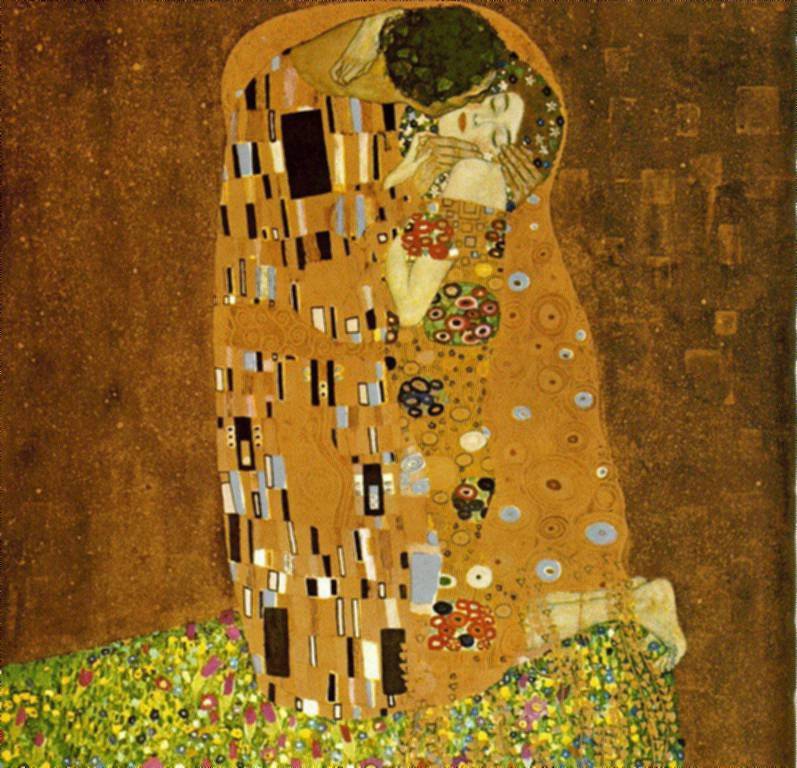
"The Kiss" by Gustav Klimt
_edited.jpg/1200px-Narcissus-Caravaggio_(1594-96)_edited.jpg)
Caravaggio Narcissus -
Book and papers on loveI'm composing a reading list to start tackling the topic of love in philosophy. Here's what I got so far:
phaedrus
symposium
the nature of things (selections)
conditions of love: the philosophy of intimacy john armstrong
the art of loving erich fromm — Moliere
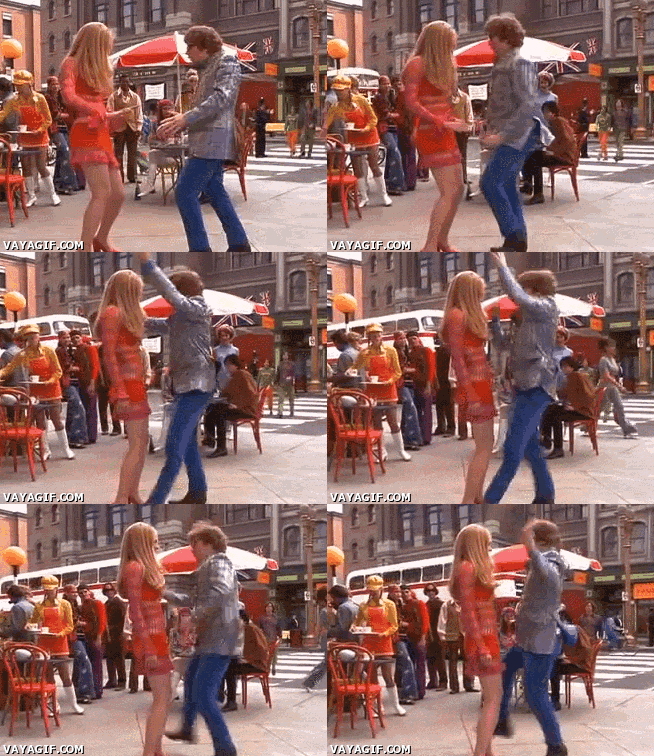
Omnia vincit Amor! Yay!!! Someone else is interested in the actual study. I feel like Austin Powers right now:
Kierkegaard - Works of love
Blaise Pascal - Discourse on the Passions of Love
Raja Halwani - Virtuous Liaisons: Care, Love, Sex, and Virtue Ethics
Confucius - [concept of Ren]
Hume - Treatise of Human Nature (Sentimentalism)
Guillaume de Lorris - Roman de la Rose
Max Scheler - The Nature of Sympathy
ST Aquinas - Summa Theologiae [God's love]
Ovid - Ars Amatoria (friggin LOVE this, not specifically for the somewhat baffling content, but just the whole way he approaches the subject matter)
Eva Kittay - Love's Labor: Essays on Women, Equality, and Dependency
Kant - Doctrine of Virtue
Andreas Capellanus - The Art of Courtly Love
Husserl - Phenomenology and the Crises of Philosophy
Bulgakov - The Master and Margarita
There is more, but I would love to share ideas as I have been involved in this study for the last six months? PM me if you are interested in further one-on-one discussions on the subject. -
Post truthPhilosophically speaking, the 'post truth' phenomenon is nothing new. It is just a label for something that has become more apparent to more people recently. The phenomenon is recorded in history ever since Alexander the Great ignored Aristotle's reasons not to invade persia. — ernestm
You need to get an eye patch.
-
What are you listening to right now?
It's funny how some musicians you wouldn't really listen to tend to be amazing in concert. When I saw Gotye before he became famous many years back, he was totally awesome in this dodgy little hotel in Melbourne where I saw him with only twenty or so people there. I saw Jose Gonzales when I was in Sweden and he was INCREDIBLE. This became one of my favourite songs of all time.These guys killed it live at concert: — darthbarracuda
-
The desire to make a beneficial difference in the worldIs anyones desire to make a positive change in the way we live our lives just a narcissistic ignorance of nihilism? — MonfortS26
You seem to imply that making a positive change somehow equates to political change alone, but there are a plethora of other ways then simply running for office where you could make significant changes. I assisted - through research - the eventual progress and ultimate change to bullying legislation in my state and I am not a politician. I am also involved in research that is currently working to change the rights of children who experience domestic violence. I studied law, but I work at grassroots level with young girls and get really low pay, but I am happy since I am supporting the disadvantaged. Is it not a possibility that one of those that I assist would one day become a policy-maker or a politician?I don't think I'll ever have the power to make even the slightest of change in any of that unless I run for office and I don't want to be a lawyer. Why not just live a self indulgent life? — MonfortS26
Change is not some "smack bang here you are" thing served on a silver platter. It takes time, effort and a commitment that is only possible when you are right within - when you are morally conscious and accountable for your own actions - and nihilism is quite the reverse. Your only objective in life should be to better yourself and help your community to improve, however small or vast. Nihilism and virtue ethics is mutually exclusive but in saying that, being virtuous and morally conscious does not suddenly imply a sacrifice of all material considerations or to walk around monk-like ringing bells and eating porridge for dinner. You can still live your own life as you improve your own mental well-being while at the same time doing good for others in the community.
That is not narcissism. That is quite simply happiness. -
How do certain songs make us nostalgic?Some songs are so strong in this respect that they bring painfully vivid images of the past to my mind's eye of the times in which these songs were of relevance to my daily life. — camuswetdream
I am interested in why you say painfully vivid images. Why should you find pain as something you need to avoid? My absolute favourite album when I was young was 'The Distance to Here' by Live and I remember just how unique I was and how the album reflected my state of mind so many years back. As you get older, priorities and desires change so I see nostalgia - however the memories are induced whether it is musical or not - as an opportunity to reflect and remember where you went wrong and where you can improve.
When I went back to listen to the album recently, I realised I stuffed up later in life because I sacrificed my freedom consciously because I was lonely, so while trying to be like others I paid the price. When I listened to the lyrics of the album, I remembered who I was again and I have never been happier.
Give no mercy to your fear.
-
What are you listening to right now?I listen to this when releasing my anger at the gym and thinking about people I don't like. :-} I am a fluffy person, I assure you, except... when at the gym. Actually, awesome lyrics.
-
How useful is it to identify with a certain political ideology?
Hmm, I'm not too sure about this. The criteria extends mere ideas because ideology is represented symbolically and its approach emblematic that attempts to strengthen public mobilisation because of its almost mythological position. So, while you have the functional political operation - like democracy or totalitarianism - through these ideas, the behavioural dimension is perhaps more semiotic as the elusive communication legitimises these ideas and becomes the deliberate impetus for power and control. So, I would probably call ideology an organised set of symbols.In some ways, 'ideology' gets a bad rap. But generally, ideology is just an organized set of ideas. — Bitter Crank -
'Panpsychism is crazy, but it’s also most probably true'
It is why embodied cognition is an interesting model, where the mind is no longer this abstract processor with no connection to the external world and that cognition emerges from the mind-body relationship and our interaction with our environment.That is what is at issue, though. So to assert that it is the case, is to beg the question. — Wayfarer -
'Panpsychism is crazy, but it’s also most probably true'Why is our experience so different that it requires special treatment? — TheMadFool
Perhaps because we are able to articulate it, but surely it is not that easy. All things have consciousness or a mental element present and – like the study of quantum mechanics or say multiverse theory – consciousness is immeasurable neither within ourselves or other objects and the notion that there is something in all matter that enables or emerges this consciousness (thus consciousness itself is this unified element that permeates through everything) is quite attractive because of its almost anti-Kantian conclusiveness that closes further enquiry.
Nevertheless, panpsychism lacks appeal on some fronts only because it is dangerously close to justifying bizarre possibilities – again, like quantum mechanics – but when you think of what the condition is for being ‘cognitive’ it is questionable that the mind is merely a network of neural processes and that mental constructs is more than the ‘brain’ where input of information viz., biological constraints fails to embody the features of first person experience. Attempting to solve this problem through physical explanations alone simply does not work and a non-reductive approach becomes inevitable.
I am interested in phenomenal externalism and the subjective qualities of experience that makes us distinct [individually] from others, which renders thought on Buddhism and qualia; is anyone alive or does anyone die? I think that – just like the coupling of space and time – it is important to appreciate both models of embodied cognition, material and panpsychic. -
OIL: The End Will Be Sooner Than You Think
As I said, oil is far more than mere economics, it is international politics and the source of political power. Add capitalism to the algorithm; McDonalds needs beef, skip the supply-chain process and you have deforestation to agriculture cows that produce more greenhouse emissions than cars. You have multinational corporations, skip the absence of environmental management and international restrictions, you have massive environmental degradation in the Niger Delta or Texaco killing people, animals, the environment in Ecuador. Nuclear power and radioactive waste that gets buried for...ever? Nuclear bombs in the pacific?So what will we all be doing in the future?
What we will all be doing is trying to grow food. Farming is our future because without oil (tractors, combines, all the heavy duty equipment) we'll all be out hoeing what crops we can grow on whatever land we can find. What happened to all the land? It will still be there -- just that most people don't live on the land anymore. Most people live in cities, and it will take time to redistribute remaining populations.
Remaining populations? There will, of necessity be a "population decline" shall we say? A big die off. Oil gave us the carrying capacity for 7 billion. No oil, no 7 billion. — Bitter Crank
Can a human body survive with fats, without water? Drain them, you kill the person. Earth, the ecosystem works like a living organism and there is only so much it will take.
Are you sure we even have a future? -
Philosophical concept of SatanGod is a religious concept. — jkop
Hence, philosophy of religion.
Can a symbol of evil be evil? I don't think so. — jkop
Vat? <- (with a thick Russian accent for added effect)
This is truly the most random comment I have ever read. :-} Uhm, ok, no, you can't send the word 'evil' to prison, probably because, well, it's a word.For example, we can't ask the word to apologize, confess its sins, send it to prison, nor expect it to improve its behaviour etc. It's a word, not a moral agent. — jkop
But, let us assume that moral agency is a 'person' - self-aware - who is capable of making moral judgements; dialectical reasoning enables contrasts that articulates the process of the internalisation. It is the reason why I quoted Kant who offers us an explanation of 'evil'. -
Eternal Musical PropertiesIt seems that hearers tend to respond to music with emotion one way or other, because musical expressions of pitch and rhythm are recognizable expressions of emotion, just like shouts and groans, laughter and weeping, slaps and caresses, are recognizable expressions of emotion. Perhaps we should add that a recognizable expression of emotion tends to elicit emotional responses in observers; but the emotional response depends in part on the observer's psychosocial position relative to the observed act. — Cabbage Farmer
(Y)
I said earlier that musical experience becomes a 'gateway' so to speak to our subjective feelings, enabling us a passage through our imagination to realise and perhaps even acknowledge the emotions that soon provides us with the ideas that articulate those emotions. Hegel distinguishes the music as sounds - external, sensory etc - in itself [the objective] with music as representation; the former contributes through harmony and melody in the pythagorean sense to compel our imagination, which is triggered by the sensuous and symbolic 'movement' caused by the emotions it conveys. Hence:
It is like a paradigmatic form, whereby music as an objective or conscious experience is mathematical or pythagorean while the subjective or subconscious is symbolic and communicative and the apparent contradiction here is how closely tied they are to one another. I use the Freudian dualism of the psyche - between the Ego and Superego - as an example of Hegelian interpretation of the musical aesthetic.Now it seems you've added something about the way a great deal of information about physical context is "filtered out" of conscious perceptual experience. But again I'm confused by the way you seem to associate "objective" with "conscious" and "subjective" with "subconscious". — Cabbage Farmer
Lyrics are important to me only because it helps explain the meaning of the emotions that may be advantageous when trying to gain a better understanding of your feelings. For instance, I was a teen when the film The Crow came out and it is still one of my favourite soundtracks. The darkness, revenge, passion all resonated with me, but the lyrics to Dead Souls by Nine Inch Nails really resonated at the time with me because I was really angry back then because of being treated rather badly but I was a genuinely loving person, so torn between such powerful emotions.Lyrics are more important to some people than to others. They can add (or subtract) value from a piece of music, but should be distinguished from the underlying musical content of the piece, which could be repeated with different lyrics or with solfege syllables or phonetic nonsense. — Cabbage Farmer
Does this sound right: You like his work as a songwriter, but not his work as a performer and recording artist, though you admire his moral and political principles and the way he brings them to bear in his work? — Cabbage Farmer
Yes. It is the same reason why I stopped listening to Kings of Leon when I found out that they didn't write and create most of their songs. -
Eternal Musical PropertiesThe error here is not in my feeling of sadness, nor in my personal, subjective association of blue skies and sadness, but only in my confused projection of my subjective association into an incorrect objective generalization. — Cabbage Farmer
Precisely, hence why I said that it is a network of perceptual experiences that we are unable to identify and we attempt to make sense of these feelings by utilising both matters of objective facts and experiences in order to articulate the reasons for having these feelings. Think of it like this; some people might feel unwell and so scour the internet searching for answers that could explain the symptoms they feel, yet somehow they assume they have cancer or diabetes because the explanations of these symptoms represent what they are physically feeling, but that is not the case. We do the same with subjective emotions and oftentimes the actual reasons for these emotions are blurred mostly because of our ignorance, which is why learning is everything and why philosophy is a language.
Nevertheless, I say it's an objective matter of fact, that I experience feelings of aversion to pigeons on the relevant occasions. Accordingly, there would be an objective basis for my statement, "I'm afraid of pigeons" or "I feel uneasy around pigeons". Though I would be mistaken to suppose that everyone feels the same way that I do about pigeons. — Cabbage Farmer
But this objective matter of fact can be overcome when you are able to articulate the reasons for the fear in the first place.
I once met a young man who I could see was struggling in intense confusion and through conversations with him I was able to locate the source of his difficulties. He was very immature that immediately exposed that he was 'caught' somewhere, stuck at a young age though he was far from being considered young. His mother left his ailing father and returned only near his father' death and he experienced this tragedy at a very young age. It forced the notion that he needed to 'man up' or to grow up, but he was still too young for that and thus the emotional war began within him; he attempted to show his strength physically by using steroids as though such appearances would exemplify this image of 'man', taking drugs and drinking and making himself unwell (insomniacs tend to become so because it brings about a 'daze' that stops thought) just so he could never face the heartache of losing his father and the anger he feels for the abandonment by his mother. His refusal to become a man, basically, compelled him to follow others and allow others to think on his behalf but he was torn between who he was within - the real him and someone who wants to do things differently - to what he had become. What he thinks is his reality now is all a product of his escape from himself and to break that reality would mean to face what he dreads. He is torn between the need for approval by others because he refuses to think for himself with his amazing, beautiful mind that I could see was crushed by the weight of his fears. So, the subjective war only developed a hatred within him and he tried to balance the emotions through new ageism that does nothing really but temporarily enables a management of his intense feelings.
I know of plenty more, another person whose partner cheated on him while she was interstate and he was in complete denial because he thought he was in control of her when it was the other way around. This was projected by his misattribution and by him committing sexually devious acts just so he could feel a sense of guilt that would maintain the relationship. Whenever he would cry out his frustrations about her to me and I would try to provide him with a way towards the real reasons for his frustrations (not just his crap about 'she does this' or 'she does that') he would almost always dissasociate from the conversation. I would be talking to a wall. The reasons were because he had a dominating mother and her controlling behaviour led to a subjective passivity and though he tries to be controlling of his girlfriend such as having access to her facebook and emails etc as well as lash out to irrelevant actions to vent his frustrations at her (but not for the real reasons he is frustrated), the real reason is because he has been trained to defend an abuser as he defends his mother' behaviour.
So, while your objective reality is a 'fear of pigeons' there is a root cause for why, you just need to articulate those reasons and when your (primitive) mind enables defences mechanisms to stop you from facing the subjective memories that is often the source of anxiety - which is the causal reason for the repression - along with our natural inclination to avoid anxiety, acknowledgement of why would dissipate those fears that has been projected to pigeons.
Should such considerations, about subjective associations, make us doubtful about our own judgments of taste, our own aesthetic preferences? I don't need a "good reason" to like a piece of music or a piece of food. — Cabbage Farmer
I think we should always be doubtful of our judgements. What you may 'like' may not be a product of what you authentically like and this is the key difference. Setting aside aesthetics for a moment, we may be compelled by choices to do our best to avoid feelings of anxiety, becoming comfortable in our ignorance that we soon become dependent on them. This 'fixed' state or habit makes us believe that it is somehow real. When it comes to our aesthetic preferences, perhaps our subjective feelings of intense anxiety compels us to death metal music and our attempt to balance those feelings to buddhist mantras. If we are ever able to find true wholeness and authenticity, our objective experiences would completely transform. -
Philosophical concept of Satan
Would you say the same of God? Satan is an antithetical representation of good and though religious, functions as a symbol of evil and therefore is worthy of moral consideration.I'd say Satan is a religious concept, not philosophical. Baudelaire's "philosophical" claims have little to do with philosophy. Instead they were deliberately obfuscatory and controversial, a way for the romantic poet to market himself as a public figure. — jkop -
OIL: The End Will Be Sooner Than You ThinkThis is true: without oil (and all the technology that depends on cheap oil) there will be less reason -- and ability -- to go to war on a big scale, like WWII. But there will be plenty of fighting over the last few billion barrels of oil, rest assured. — Bitter Crank
The unfortunate problem here is that oil extraction and consumption is primarily required for military use and domination of sources and production is essentially an economic and strategic commodity, hence why I have zero optimism. It is clear that the situation in the Middle East and the dynamics of regional politics - United States vs. Russia and China - really amount to the rivalry for oil as a military asset since provisions would enable both the economic advantage but also machine power. China realised the importance of this while observing the Gulf War and as their military strength and space technology increases, so does the need for oil; renewable energy is a technology the military has no time for.
In addition, methods of oil extraction is having too great an impact on the environment that I hardly think we have the time to really wait for renewable energy to be implemented. Deforestation and construction of technology to extract oil along with the toxic chemicals and emissions polluting the air and water that it is clearly damaging the environment and wildlife - as well as people - that the ecosphere will not survive if we continue. This, capped with a whole lot of other issues reinforced by capitalism, the existential crises we face seems to be duly ignored by the rubbish of the entertainment industry. -
Non-identity problem and related issuesAnd of course we don't want to go to the extreme and start a eugenics program...but look ahead a few decades from now and we might be having designer test-tube babies. Is this not eugenics? — darthbarracuda
Well, clearly not. Aktion T4 exemplifies why, nothwithstanding the general abuse that continues with ableism such as forced sterlisations of women. It is an interesting bioethical question to compare designer children with eugenics vis-a-vis the medical and technological advances.
Singer purports that a mother' preference for abortion ethically takes precedence and that to abort a fetus with a severe disability is justifiable because what defines 'life' is severely restricted. Being alive is not necessarily living and that personhood contains a criterion, namely self-awareness. -
Philosophical concept of SatanAdam Kotsko just published a very well received book on the subject, The Prince of This World, which will be an excellent starting point for your research. If you can get your hands on it, you should find plenty of contemporary citations for you. — StreetlightX
Thanks for that, I will look that up to read.
I would also like to add Mikhail Bulgakov' The Master and Margarita, a framed narrative concerning biblical morality through the eyes of Stalinist Russia and the wayward decline viz., spiritual love both individually and within a social and political atmosphere. The plotline links the love story between the Master, a writer in despair, his lover Margarita and her sacrificial and almost divine love for the Master along with the machinations of Woland or Satan tempting her away, and the symbolic conversation between Yeshua or Jesus with Pontius Pilate.
For Bulgakov, there exists a psychological line segment where on one end you have good and on the other evil, with the mean being love. The formula, as such, of reaching the midpoint between good and evil is usually followed by a proof, a test that verifies the intent and is usually authenticated by taking a "leap of faith" which is the reason for Woland' presence in the novel. Margarita' love is unconditional, transcending any utilitarian or deontological modes of moral action; she loves him and neither good nor evil can change that. It is also sacrificial, demonstrated biblically with Jesus, which is the reason for the addition of another narrative based during the time of Jesus in Jerusalem, where a conversation between Yeshua and Pontius Pilate takes place, the latter a representation of Russia and the former of the spiritual.
The presence of Satan in the book is really about clarity of the ultimate maxim - love - that cannot be corrupted when done so through free will. Kant offered a secular theory toward the concept of evil, whereby humans by nature are naturally inclined toward goodness but also evil under the umbrella of a radically free will. As a consequence, only by free will are we able to choose what is right and thus when we do not make the choice to do good, we are thus evil. But the latter ‘evil’ is graded into several levels, being:
“The possibility of hubris is accounted for by the concept of freedom. There are thus three levels or gradations of evil: (1) mere counterlegality, (2) the lower level of countermorality, occasional single-cases of evil, and (3) the worse level of evil “as a rule”… full-fledged evil designates the constitution of an agent or of an agents maxim.”
The similarity with Johann Goethe’ Faustus is clear but his greed for knowledge leads Satan or Mephistopheles to seduce him away from love in pursuit of vanity or desire toward Gretchen, only saved in the end because he felt grievously ashamed, a realisation of the importance of our moral responsibility toward others as part of our endeavours toward reaching happiness. Mephistopheles is banished to the ‘Eternal Empty’ or symbolically the unhappy place of living without the fulfilment one receives when choosing the will to be good since Faust finally tames his desires that he experiences happiness and able to reach God. -
On Fascism and Free Speech
May I kindly suggest that you discontinue using the internet following the oral consumption of rolled hashish? :-|So what you're proposing is to revoke the right to exist in society of whichever swaths of the political spectrum and their associated speech habits which you think winds up making employers behave favorably towards people with familiar sounding names? Riiiiight? — VagabondSpectre
Are you talking about the riots? Because, again, perhaps since I was talking to another member you may have missed it, I do not condone it and I hardly think that discussing hate speech laws somehow means that I do. I assume from the above-mentioned that you disagree with the mob mentality? If this is what you are talking about, as in, what the rioters have done, I agree. I still think the riots were nevertheless a product of many cultural and legal failures within the United States.I don't sympathize with white supremacists, but I sympathize with any non physically violent group being crushed by another group through violent force in a depiction of might makes right because if we allow it to happen to them we're in principle allowing it to happen ourselves. One day, the mass offended might begin to find you or your ideas offensive and they could use your own precedents to silence you... — VagabondSpectre
Nope.So are you saying that free speech is now obsolete because we know what should and should not be said? (for instance, the need to outlaw national socialism/racism?). — VagabondSpectre
Hence the Nuremberg trials; while I can see the logic in your argument, hate crimes based on race, ethnicity, skin colour, religion, gender and national origin have a higher probability than crimes against someone with cellulite on their elbows.I simply don't condone a law that makes it illegal to say something in public that causes offense just because it's on the basis of race. Why not make it illegal to offend people on the basis of hair color? Body-weight? Height? Etc? Keep in mind if someone is actually engaged in harassment (which goes beyond merely uttering a single statement on a sidewalk) then harassment law can legally sanction them without the need for special cases of race based offense. — VagabondSpectre
People don't like a lot of things about the law and there are certainly risks. What I fail to understand here is that you are saying 'force us all to adhere to the linguistic rigidity' but is that not what the first amendment is doing?Being politically correct is emotionally considerate and sensitivity to the feelings of others is laudable, but to force us all to adhere to the linguistic rigidity that is required to spare all possible feelings sacrifices too much to preserve too little (the gaps in existing harassment law) — VagabondSpectre
I agree, though, and let us hope our conversation will continue under this assumption, that the mob mentality is a failure and works in contravention to 'individuality', something highly prized in the USA even though people tend to blindly move in masses, whether leftist or right-wing. -
On Fascism and Free Speech
?How do we fight against people innately not calling to interview people with names they've never heard before? — VagabondSpectre
Again, ?hows' abouts' we silence the far right and force "different name" mandates upon employers such that they need to hire more of the most oppressed class currently in America: The differently named. — VagabondSpectre
So it sounds ridiculous? Yet, it is not ridiculous to say that everyone else should adapt to the rhetoric of the far right? Why and what exactly is your reasoning here? Do you sympathize with white supremacy?The far-right should adapt" in this context bears the same sentiment as "send them to the re-education camps". (Better finish that cirriculum ;) !) — VagabondSpectre
Goodness. I hardly think my previous responses expressed any alleged hurt of feelings.I realize only now that it's entirely possible that me alleging "you should contact an adult" if and when your feelings get hurt could actually cause your feelings to get hurt (what cruel irony!). Which, theoretically, could trigger the draconian law you want to be put in place that will see me physically sanctioned for victimizing you with my emotionally harmful and therefore hateful-speech. — VagabondSpectre
As I have said several times, positive laws such as the first amendment requires ambiguity to apply common law fluidity on a case-by-case basis. It is not that freedom of speech itself that is wrong, certainly not, but the question we should be discussing rather than me having to swim through a sea of awkward remarks is whether freedom and equality is mutually exclusive? This is what needs to be discussed, rationally and with evidence.The first amendment is the thing that tells the US government to NOT make any laws which abridge people's right to religion, or abridge their right to political opinions and to peacefully speak those opinions, for the sake of freedom, truth, and democracy. — VagabondSpectre
There it is....who equates free speech with national socialism — VagabondSpectre
I'm asking you specifically for example statements or ideas (not contextually enhanced bullying/harassment) which you feel, on their own, ought to be forbidden from public speech or topics of public discourse.
But how can we be sure that banning certain ideas is really by the people and for the people if we're then not permitted to discuss the ideas in question?
Please though, which ideas should we ban? — VagabondSpectre
I guess I will need to reiterate but in this instance it may be that you failed to read what I wrote to another member in this thread, which I find understandable. I also do find it understandable that perhaps I was not using the best examples, so I will go directly to the source of law to exemplify my point.
In Australia, we have legislation - namely the Racial Discrimination Act that legally enables perpetrators of racial hate speech to legal account without flagrantly opposing freedom of speech. There needs to be a clear disproportionate harm caused by the hate speech to ever risk the human right to speak freely. The freedom to communicate - particularly on political subjects - on topics of public interest is fundamental and plays a very important part in Australian culture and democracy. One important element is that it needs to be a case-by-case - procedurally thus within the common law jurisdiction - that assesses this proportion.
Jones v Toben that convicted hate speech did so following the publication that vilified Jews by claiming the holocaust never occurred, that Jews who claim that it did have a lower intelligence and their intention is merely for financial gain. Other malicious remarks included all deaths caused by Stalin was secretly caused by Jews and since the publication is reproduced and considered public source for news, they were forced to remove the content. Similarly, topics that threaten national security are also subject to similar regulations.
Tests to ascertain whether one has breached racial vilification laws is not subjective [as in, how one person felt] but entirely objective and explicit even if there is one complainant. Considerations of community standards and the likely impact - that must be serious - would have on the community in question.It is to level or have a fair balance.
The relevant definitions can be viewed here
This is a topic of concern still and has only recently been once again raised to the public fore. I mentioned sexual harassment and bullying for a reason, particularly relating to liability and torts that involve racial vilification. -
On Fascism and Free Speech
This, in turn, stipulates that the amendments themselves are unnecessary and could have once perhaps been used as a guide but now redundant amid changes to our understanding of human rights and freedoms, particularly following the Nuremberg trials. If it is indeed about protecting individuals, not only is the separation between the judicial, executive and parliamentary powers necessary to ensure that either are not corrupted or influenced - something clearly problematic in the US - but that due to the tensions of positive laws such as rights vs. freedoms, ambiguity in legal frameworks is necessary to enable common law jurisdictions to assess on a case by case basis and apply decisions according to the fundamental rule that the intent of the law itself was developed by the principle of protecting the people. This is how landmark cases here is Australia - like Mabo v Queensland - were applied by the high court and why our government continues to try and challenge it.By your own description the 1st amendment flexes to additional stipulations wherever we choose to add them. Anti-harassment laws are a good example which exist quite happily in US criminal law. If you can show that an action is a reasonable source of fear for physical safety or damage to property, that can be prosecuted. The existing laws in the end are meant to protect individuals, not broad demographic categories. — VagabondSpectre
You're still not getting it, are you? You are consistently attempting to justify pernicious acts by purporting the victims are the ones requiring flexibility and adaptation, on the contrary, it should be those that discriminate that should be adapting. It is almost a master-slave dialectic, as though the master - the far-right who you purport should be allowed to speak freely - while the slave - everyone else who you purport should adapt, the latter almost at fault for not. This is a incorrect way of analysiing the situation. How about we reverse your line of though here, that the far-right adapt by our acknowledgement of the madness of such extremism and extremist rhetoric, whereby a pluralistic and inclusive society dedicated to righteousness would ensure that it is the far-right that should adapt.All they need to do is abbreviate their name to something common in the header, problem solved. No hate speech (subconscious thought?) laws required. — VagabondSpectre
You seem to be tossing in confusion as to your position and I think that it really quite simply lies in your misunderstanding of how the legislature functions. You are holding victims partially responsible for actions committed against them and this is an attitude and a barrier that requires elimination, as you say below:I really don't get how you've taken the examples I've given of justifiable ridicule and instantly equated them with the worst sort of harassment and me with "victim blaming". We need better anti-harassment and bullying laws, or have them better enforced, not laws which rigidly outlaw words and ideas for our own protection. — VagabondSpectre
If ideas in and of themselves make someone feel unsafe, then they've got psychological issues of their own that need sorting — VagabondSpectre
Experiencing ridicule is a part of life. — VagabondSpectre
If someone told a joke at your expense, or stated an idea you are afraid of, contact your nearest adult. — VagabondSpectre
What exactly is the first amendment then? Hence the necessary ambiguity.We can and do legislate behavior, but we ought not legislate against certain thoughts and ideas themselves, even if they can be emotionally or psychologically offensive. — VagabondSpectre
You are still gobbledygooking, buddy.Interestingly Trump would probably be with you in this. The amount of ridicule he has received over the last year or so might actually be more than any single person in such a short period of time ever in history. Surely if we outlaw all ridicule because of the deep emotional trauma that it might lead to then ridicule of Trump would at this point be the the majority of all crime committed day to day. — VagabondSpectre
Ideological? As I said earlier, in Australia we have legislation that ensures all parliamentary bills adequately adhere to human rights principles to avoid corruption prior to being passed and changed into a law. If the separation of powers remains, corruption is minimized and laws are made by the people for the people.So you hereby claim glorious and honorable right of list maker who lays great foundation for ideological future of mankind? — VagabondSpectre -
Hidden Figures (Movie)It was the trinity of the unlikely three - the female, a scientist, and African American - that certainly made the film worthwhile, but it just wasn't captivating and perhaps that is the inevitable outcome of the narrative. A great film for me is one that can make you think about the moral points long after the film is finished and even compare it to ideas and principles completely unrelated.
For instance, when I watched Unbreakable - which is one of my favourite films - I pondered about moral responsibility, about mathematics, about relationships etc. A movie that can make you think, laugh, cry and shock is a movie that is unforgettable. Hidden Figures is, forgettable. -
On Fascism and Free SpeechThe founding fathers are old, dead guys Vagabond. They each owned slaves and it was the onset of executive corruption. Things have changed.
Whilst I appreciate your detailed answer, you have unfortunately misconstrued my point in use as the remarks were not an example of hate speech, but rather the absurdity to disregard hate crimes because no one was physically hurt. Violence needn't be aggravated assault and can also be emotional and psychological. But, I certainly agree with you nonetheless that it is wholly dependant on the particular circumstances; bullying legislation here in Australia requires a particular set of circumstances before it could be considered serious harassment - such as repeated behaviour that is clear and/or evidenced - that would enable the judge to ascertain the potential damage it could/has caused to the victim. Someone just yelling out absurdities once to a person is not considered bullying. Ambiguity in legislative terms is necessary to enable this judicial process to work effectively, something the positive, inflexible regulations in the amendments stifle.Using an example of possibly sexually harassing words as something we ought to censor is actually a very bad example to use to make the argument for anti-hate speech laws because we already have a very detailed set of existing laws which handle issues of verbal harassment, sexual harassment, stalking, intimidation, and sexual assaults. The difficulties of trying to set proper speech standards for such dynamic, informal, and context dependent situations in and of itself is a legislative nightmare... — VagabondSpectre
Research has shown that people who have "foreign" names have a unlikely chance of getting a job interview; it is that invisible discrimination that I made reference to vis-a-vis the ramifications of hate speech in the broader context. But, certainly, yes there are a number of protective instruments that empower workplace rights.I'm not sure how discrimination from and within employment is facilitated by hate-speech, but there is also a rather large set of anti-discrimination law and human rights laws already on the books which are designed to handle cases of human rights abuses in the workplace (many overlap with the anti-harassment laws). There are many instances of speech that we can all agree are criminal, but we don't need to appeal to hate-speech for 99% of those instances. — VagabondSpectre
Whilst your opinion is duly noted, unfortunately psychological harm is a great deal more vicious than mere pangs of cognitive and emotional development. Laws here have changed only recently (inclusive of my own petitioning) which we call Brodie's Law because of a young girl who committed suicide from the repeated bullying done to her by male staff. Psychological - and sometimes psychiatric - injury is serious and we cannot brush the circumstances aside and blame Brodie needed to sort out her own issues and the inevitable result was her fault. That is victim-blaming, again, your failure to see that the actions themselves are wrong despite the injury it has caused.Regarding the psychological harm that might be incurred as the result of experiencing ridicule or hearing an idea that makes you feel unsafe, these are the natural pangs of cognitive and emotional development in my opinion. If ideas in and of themselves make someone feel unsafe, then they've got psychological issues of their own that need sorting, and when it comes to ridicule, there's a difference between justifiable political speech which includes ridicule and verbal harassment or bullying. If I publish a client-patron anarcho-communist gift-economy manifesto I'm opening the door completely for the use of ridicule. Ridicule is often the first and last line of defense against bad ideas. Likewise if someone publicly publishes a picture of themselves on the internet and says "Am I hot?", they are opening the door very widely to ridicule and speech that we might otherwise classify has harassment. Context matters. — VagabondSpectre
Prevention is absolute and we asses [depending on the legal jurisdiction] the level of impairment caused by the experience/s but tort cases often demonstrate the failure in duty of care and whether or not adequate responses were made to remedy the situation just as much as it is about whether the acts were repeated over a period of time. Laws are established for the people, to protect them and to keep bad behaviour in check and without adequate checks and balances, people and organisations would continue to cause havoc in society.
This is just mere gobbledegook. It is not just about white supremacy and whether these extremists are more or less appealing is completely besides the point. Is it wrong? Yes. No.If you censor the very idea of white supremacy all you will do is give it the appeal of a forbidden fruit and increase the already inflated fear of it in others. Sunlight is the best disinfectant, and if liberal and progressive morals and ideals really do have merit, then we should not be afraid to put them in the ring against any opposition. But deciding that the masses at large are not capable of making sufficiently rational decisions when it comes to the finer points of governance and ideology is to throw the baby of democracy out with the bigoted bathwater. And by absolutely protecting people from the emotional difficulties and occasional harshness of the real world you will be hampering their ability to develop any real resistance to it.
If I agreed though and we sat down to write out the list of every political idea which could possibly compel someone to an ideological extreme, how large would that list be and what would it look like? What if I felt that the tenants of socialism inherently provoke some people to the ideological extreme of infringing upon my natural land ownership rights? What if I felt that irrational religious beliefs inherently lead to terrorism? That very long and immutable set of every idea we forbid would be nothing more than an expression of our own imperfect moral and material assumptions about the very uncertain future of a very complicated world, to the exclusion of all others. — VagabondSpectre -
Father Richard Rohr at Science and Nonduality ConferenceI saw a video by him a few months ago and was slightly intrigued but then watched a few more and slowly began to see his MO. He's just another new age, self-help guru who peddles pseudo-science and shallow universalism, but with the unique angle that he pretends to be a Catholic, even though almost all of his views conflict with Church teaching. How much do you want to bet he's a millionaire, or at the very least, a very wealthy man? "Franciscan" my ass. — Thorongil
(Y) -
On Fascism and Free SpeechThese rights can be readily upheld by straightforward law-enforcement. — Bitter Crank
If only it were that easy. :-! You mention equal rights quite a bit but herein lies the dilemma. Is freedom and equality mutually exclusive?
I am quite confident that any crimes that may be constituted as 'bias-motivated' would fall into that category because of the clarity of the transgression. You were robbed at gunpoint by a wealthy teen from a ultra-religious cult who repeatedly harassed or followed you prior to the act and has information visible on social networking sites that he hates gay people. It is easy to try and excuse with poor examples but I assume that your intention perhaps lies in a covert fear that corruption could lead to the solidification of laws that may ultimately impact on many other freedoms that the amendments were created to afford. To a degree, this is certainly true and a risk with all laws unless there are adequate mechanisms that prevent corruption. Here in Australia, we recently enacted legislative changes that would distinctly prevent corruption from the executive branch, namely that all bills that pass through parliament must be independently assessed to comply with Human Rights principles. In a country like US where politics is heavily invested in the judicial system, corruption is a constant problem so I can see your worry."Bias motivation" is not necessarily clear from the start. Was I robbed and beaten at gun-point because I was gay, or was it because I looked like I might be worth robbing? Was the man shot because he was black, or because he seemed to behave in a dangerous manner? Was the woman raped because she was female, white, and alone, or was it because she was a communist, atheist, lesbian? — Bitter Crank
See, in Australia you can have both. If someone said to you, "I hate fags" in private, they can. If someone publically said "I hate fags" they would be liable. There needs to be a balance.I would rather live in a society where it is permissible to say "I hate fags" than live in one where it is illegal to say "I hate fags". I want to be free to express my opinions, and if I am free to say what I think, others should be similarly free. We have limits on free speech at the extreme edge: We are not free to encourage everyone who hates fags to get together and actually target and kill any gay men they might know of, or suspect. The limit here is on conspiring to kill people, not on hating fags. We are not free to engage in conspiracies to commit crimes--even ones involving no bias at all -- like robbing a bank — Bitter Crank -
On Fascism and Free SpeechApologies for getting back to you so late :-#
"Hatred" here is a bit tricky, but more or less the hate speech laws are about protecting people from harmful hate speech, which specifically does not include something like mere ridicule or affronts to dignity. People like Milo who are excellent provocateurs certainly ridicule and affront the dignity of many individuals and groups, but what Milo has not done is actually advocate for any violence of any kind. For me a part of the whole issue is that people are asking questions like"is it moral to punch nazis in the face?" and "Ought we to permit white supremacists and other groups who do not share our moral values the right to public assembly and free speech?" as if the people they're actually talking about (Trump, Milo, et al.) are genuinely fascist or nazi or white supremacist, let alone the fact that they're preparing to throw democracy out the window by doing so. — VagabondSpectre
Hate speech is a form of violence; you do not need to experience physical violence and the impact of hate speech can injure a person psychologically and emotionally. In Australia, we have a plethora of legal protections such as racial vilification laws under the Racial Discrimination Act that does not limit any form of "insulting, humiliation, offence or intimidation of another person or group in public on the basis of their race" to just expression through words, but also prohibits the use of "singing and making gestures in public, as well as drawings, images, and written publications such as newspapers, leaflets and websites" and must do so only in public. Most human rights legislation provides legal exemptions from the prohibitions to enable 'room' to ensure that assessments do not result in an absurd conclusion - that is, if the offender acted reasonably and in good faith, judges have the capacity to assess the intentions, circumstances and impact to confirm whether they are culpable. So, it is not about 'advocating violence' as you put it, but that his ridicule and affrontry of individuals and groups from particular backgrounds that is wrong.
If someone says to woman "every time you bend over I get an erection" and she makes a complaint about it, saying "he didn't threaten to rape her" doesn't justify the original remarks that brought about fear and intimidation. Such hate speech can cause just as much damage in a variety of different ways including bullying, discrimination from and within employment, psychological harm to say a few.
It is dangerous, yes, because not everyone can be like you and me where we could utilise the opportunity to dissect - perhaps psychologically or politically - the motivations that would compel a person to such ideological extremes. For most, hearing a bigot or fascist has greater ramifications as it can easily influence the ignorant who are politically compelled but have little learning just as much as it can fill people with fear and anger.Is hearing a bigot or fascist speak and seeing their ideology for what it is really so dangerous?
If we should censor opinions of white supremacists, why? And what else should we be censoring on those grounds as well? — VagabondSpectre -
I fell in love with my neighbors wife.The content in this thread really makes me understand Kelso...
-
∃ and quiddityWhy versus, you puritan you? That is useful as a concept without predefined levels since the descriptions can be richer and ultimately exploited to satisfy multi-dimensional predicates; perhaps an unidentified infectious disease? But, does there really need to be a ‘versus’ between ontology and taxonomy? I don't know, I'm too sleepy to go any further than that.
-
On Fascism and Free Speech
Quantity has no bearing over the amount of noise a small group of anarchists and marxists can make, I can assure you. I have never been fond of the academic leftists and I have never appreciated the smug conservatives either as both appeal to methods of a peculiar kind that contributes unfavourably to rational progress. I was battered and beaten when studying graduate political science by marxists, conservatives and the academic leftists that tore my thesis design apart as I stood sandwiched between the tussle of the three attempting to convince me which method I should conform to. I ultimately dropped out mostly from the isolation I felt. The worst of the three, though, was the Marxist who constantly insulted and degraded 'me' when I opposed taking his suggested routes, even went so far as to ostracise me from conference funding and publically insulted me at graduate meetings. The academic leftists and conservatives are at least bearable.Anarchists and marxist rioters on the one hand, and academic liberals on the other are quite distinct. For one, the number of the former are very small. The latter are far more numerous and whatever they might say, they are upwardly mobile professionals who aren't going to put their lifestyle at risk by throwing rocks through bank windows. — Bitter Crank
This is the precise problem, though, the question of whether the Bias-Motivated Crime Ordinance was - though unconstitutional - wrong? These questions have been pondered on the subject of international human rights laws and whether one can legislate core human rights instruments on subjects - such as cultural rights - without it paradoxically creating the very problems it seeks to avoid. In Australia, we have - rather appropriately in my opinion - avoided a Bill of Rights and instead adopted legislative changes that protect core human rights principles whilst at the same time enabled the judiciary the flexibility to remain fair through the separation of powers, something not done fairly in the USA.The contradiction between not prosecuting cross-burners and arresting nude sun bathers arises from unrelated sources. The problem with the ordinance in the cross-burning case was that it was overly comprehensive, forbidding protected political speech — Bitter Crank
The discourse on how the gesture was admirable undermines the importance of fairness on both common and legislative grounds and this hard, positive and equitable approach needs to be tempered by notions of fairness.
Comparatively, one can think that restricting hate speech is a type of affirmative action. What do you think?
From memory, there was more than one but nevertheless this is really diverting the argument from the point; whilst it may be considered an isolated incident, there are many other causal factors that need to be considered by such an act, including what led to it as much as the ramifications of it that would inevitably broaden the demographics. The US has a consistently high record of hate crimes, Bitter, as you are likely well aware.t isn't relevant to the law, but the "cross burning" was an extremely inept performance by 1 teenager, not a dozen adult Ku Klux Klaners doing a "proper" cross burning. — Bitter Crank
It is interesting that you say that the laws banning nudity - a considerably logical law to have - has different roots namely that of the repulsion one experiences witness body parts; but, isn't it just as repulsive, repugnant and disgusting witness a cross being burned on the lawn of an African American home?
Sometimes people demonstrate on behalf of others, or engage in vicarious struggle, when they have no skin in the game. Such is the case when white, middle class and above... Allies are one thing, parasites are something else. — Bitter Crank
Being fake has its benefits both socially and within the employability market, something clearly seen in the competitive field of law. To see me 'downgrade' my intelligence by working with young, disadvantaged refugees after receiving academic accolades in a law degree that could have enabled me a financially rewarding career confused the many people who pretended to care about worldly affairs, human rights and even animal rights only because the 'good' image they create enabled them this employability and social power. Sometimes, even corporates mock them, like the veggie burger from McDonalds appealing to vegetarians, a capitalist food chain that is environmentally destructive both in terms of clear-cutting forests to agriculture cows that happen to produce massive amounts of Co2 emmissions and play a wonderful part in destroying not just animals but people too?
There is nothing inherently wrong with destruction of private property during a riot. BUT, it has to be for a good reason, and it has to contribute to a larger cause. — Bitter Crank
This is where I disagree in multiple ways. I do think it is wrong destroying private property, but I do not think the cause for the riots was not for a good reason. It was, it was necessary, but not to that extreme. I think the tactical advantages of behaving in that way failed to see how it fed directly into the fascist agenda by people - even intelligent ones like you - thinking twice about the leftist cause. There is a great deal of hate crimes, discrimination, violence and bigotry that can clearly espouse why these protests should take place and/or working toward the prevention of hate speech.
TimeLine
Start FollowingSend a Message
- Other sites we like
- Social media
- Terms of Service
- Sign In
- Created with PlushForums
- © 2026 The Philosophy Forum