
Comments
-
Consciousness is a Precondition of Being
Yeah, it’s from my book. But I’m not at home right now. I can get you the print edition and whatnot. -
Consciousness is a Precondition of Beingtraditionally in philosophy, anything that can be said to be is a being.
— Jamal
That is one I will need a citation for. — Wayfarer
This is comical.
Do you really doubt this claim? Are you implying that Aristotle wouldn’t say that a rock is a being?
Rocks are beings. Are rocks sentient beings, like human beings? No.
Flowers are beings. Bach’s fugues are beings. Numbers are beings. Parachutes are beings.
At least according to what I — and traditional ontology — mean. You seem to understand this. But if you do, then what’s the problem here? -
Consciousness is a Precondition of BeingAristotle, Aquinas, Heidegger, and many others use the term to mean anything that is, i.e., anything that can be said to be. Nobody has to follow them in this usage, of course, but Wayfarer actually attempts to correct people who use the word in this traditional way, by saying that, actually, only sentient individuals are beings. — Jamal
Yes indeed. In this thread I believe Wayfarer is saying that Jung’s use of being is more in line with sentience, but I still don’t see how. In that case Jung would be arguing that consciousness is a precondition of sentience — a rather odd thing to say.
All things that are, conceptually speaking, are be-ings just as long as they continue to be. — Janus
Yes.
I suppose I've derailed the thread. We'll see what Mikie does about it :razz: — Jamal
I can’t do shit — yet. But I’m working on a mutiny. -
Consciousness is a Precondition of Being
Yeah— maybe you can take it from here. It’s not off topic, in my view, but wasn’t what I wanted to get into the weeds about myself. I was more interested in those defending Jung.
He may claim he’s departing from rationalism, although I don’t get that from the text you cited — but in any case, I think many people probably think they’re rebelling against Descartes in some way, but end up talking exactly like him when it comes down to it. Jung seems to be no exception. Appreciate the attempt— maybe I’m missing something. -
Consciousness is a Precondition of BeingLike I said, this is thinking of it psychologically. My 11 month old son experiences sensation, he does not have any concept of being as such. — Count Timothy von Icarus
But he “is,” and has a preontological understanding of being (a Heidegger phrase) or pre-theoretical concept of being. He may not have a great concept of life either. Doesn’t mean he’s not alive— even from a psychological point of view.
Likewise we don’t cease to be simply because we haven’t abstracted its meaning.
It’s not a distraction, but I agree we don’t have to continue on. I’ll leave it by saying that I find Taoism fascinating, but am no expert on it. Appreciate the quotes. -
Consciousness is a Precondition of BeingIf you think of it psychologically, consciousness, as sensation, is prior to the abstraction of being and of the recognition of the external world as external.
"Being" presupposes non-being, it's an incoherent concept otherwise, but consciousness as simply sensation precedes any such distinctions. — Count Timothy von Icarus
All of this seems confused. Consciousness is not simply sensation, and being is not simply an abstraction — any more than life is an abstraction. But if it is, then so’s consciousness and sensation.
Merely proclaiming that consciousness = sensation, and sensation is prior to all abstractions, is only shifting definitions. Besides, one (or something) has to “be” before it senses anything whatever.
That being is “incoherent” has quite a history. Heidegger has useful things to say about it. It’s a tricky term, but not at all incoherent. We use it and interpret it constantly, even if there’s no agreed technical definition. Likewise “energy” isn’t incoherent, although it has several definitions — including a technical one in physics. I know what people mean when they say it in context, although if pressed it would be perhaps more difficult to pin down. -
Consciousness is a Precondition of BeingI don't know if he's expressing a 'standard metaphysical view — Wayfarer
I think he’s repeating Descartes. Descartes’ dualistic ontology is fairly standard, I’d say. Even on the forum.
You will just say, for example, that inanimate things are not beings, to people who are using “being” to mean anything, animate and inanimate, which is. And they are in line with standard philosophical usage, not you. — Jamal
Thanks for putting the time in to write all this out in detail. I’ve been down this road with Wayfarer too many times already. But you’re quite right: by “being” I mean anything whatsoever; by “a being” I mean any particular entity whatsoever. I don’t know how to be any clearer. -
Consciousness is a Precondition of BeingThe Tao, the primal oneness, comes before distinctions are made. — T Clark
Naming, consciousness, brings things into existence. — T Clark
In that case the Tao is being as a whole — existence. The individuated beings (things) that we differentiate in perception have as much existence an anything else, as beings.
If there was no one around to call an apple an apple, it wouldn't exist as a separate object, only as part of the inseparable whole. — T Clark
It wouldn’t exist as a linguistic entity— but animals interact with apples all the time. They seem to differentiate between them and what we call rocks just fine. -
Consciousness is a Precondition of BeingA non-conscious being is not actually 'a being' but an object or a thing. — Wayfarer
As I’ve stated many times before, I’m not using “being” in the sense of sentient beings. Beings, in my usage, means “things,” or “entities.” It’s anything whatsoever. -
Consciousness is a Precondition of BeingSo the self ceases to exist when asleep. — Banno
Well wakefulness ceases anyway. The “self” is too loaded a term to say anything useful about, in my view.
If being is interpreted as existence I agree. — jgill
Yeah…although now I realize Jung may have meant being in the sense of being a human. But it doesn’t look that way. -
Dilbert sez: Stay Away from BlacksI’ve scrolled through several pages of this horrible thread, and regret it. Figured I’d say so.
-
Dilbert sez: Stay Away from BlacksThe Rasmusson Poll isn't a scam, but it isn't a highly rated polling organization either. — BC
:up:
A stupid poll by a crappy right-wing institution, whipping into a frenzy other right-wing goofs like Scott Adams.
I’m glad he’s been canceled. Not because of what he said— but because “Dilbert” has always sucked. Wish they did it years ago. -
Psychology of Philosophersthen 16 I lost 'my religion' (I'd realized I did not 'believe in' Catholicism or the God of the Bible) and then @17 had my first philosophy class (textbook – From Socrates to Sartre). — 180 Proof
By TZ Lavine? That’s great. They have her reading her own material on YouTube from a series years ago which I like a lot.
Your post was interesting— thanks for contributing.
Thanks for clarifying. I understand now!
I feel there's a connection between philosophy and a willingness to look analytically at things which hurt the eyes. Do you? — fdrake
Sure. The questions we call philosophical are often hard to ask and look at.
At some stage in this confessional thread one might start to see a pattern; so far the obvious pattern is that philosophers like to display their examined lives, and think it serious and worthwhile to do so. — unenlightened
Yes — and that religion plays a big role in our paths to philosophy, which is interesting to me. -
Chess…and Philosophers
Yeah I just completely missed that one. Too focused on preventing castling, and moving too quickly. Even Rd8 would have been better now that I look at it. -
Chess…and Philosophers
I resign. I should have done so a while ago probably.
To add insult to injury, I get the comment from the computer basically saying that I blew it:
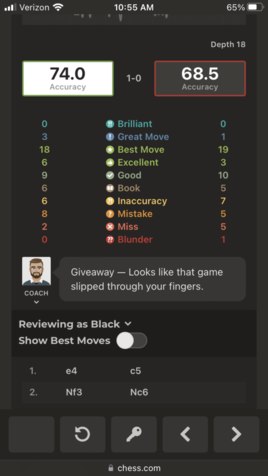
Thanks, computer bot guy. :roll:
Good game. -
Chess…and Philosophers
That’s not the reason I blundered. You’ve played a very good game and deserve the win. I was just giving you shit because I’m used to playing 3-10 minute games. For the record. -
Chess…and Philosophers
No trap, just a mindless move. C4 was a blunder and most likely cost me the game. This is what happens when you spend less than a minute on a move. :roll: Credit to Hanover for not overthinking that one. -
Ukraine Crisischallenges to that view — Paine
That’s the point. There’s very few “challenges” to alternative views, beyond what you yourself have demonstrated nicely. -
Ukraine CrisisSounds pretty certain. — Paine
Seems to be accurate when looking at the evidence. But by no means certain. -
Ukraine CrisisThe issue is 99.9% obvious and certain for you. — Paine
It’s not close to being 99.9% certain and obvious to me.
Whatever point you’re trying to make — if there is one — utterly fails. Both as sarcasm or satire.
But thanks for proving my point.
Statement: “Even if 99.9% certain, one should question.”
Response: “You’re 99.9% certain!”
Maybe Twitter’s influence. -
Ukraine CrisisOne year into a war instigated and prolonged by the United States.
Looks like China is pushing for a ceasefire. So that’s how grown-ups behave…
Anyway— how disappointing it is that the majority in this thread refuse to question the Western narrative, even if it appears to them 99.9% obvious and certain. Given this is a philosophy forum and all.
I think it shows how reading a lot of philosophy books is probably a complete waste of time for most people. C’est la vie. -
Psychology of PhilosophersMy reading life grew through adolescence, especially when I became depressed in sixth form, and by the time I left school reading philosophy and related areas was an integral part of my life. It was partly sparked by the tension between religion and science too. — Jack Cummins
Appreciate you sharing this. It’s interesting to hear what leads some people to philosophy and others to have nearly no interest.
However, that doesn't mean that all people who are interested in are 'troubled souls', but they usually have some reason to go beyond conventional common sense understanding. — Jack Cummins
Yes, definitely, and that’s my point. This stuff doesn’t happen in “objective space.” Neither does science. Neither does mathematics.
Our 'intellectual facilities' like to think they are above it all, not affected by all the good and bad stuff that compose our histories. — BC
Yes indeed. And I appreciate the kind comments.
We are all products of forces beyond our control - not just those of geopolitics and economics, but the ideas and very language we use to communicate. — Tom Storm
language is an excellent example, of course. We simply can’t cut off our heads and start thinking.
Does my social status and my environment contribute to how I think? To a large extent sure. But since I cannot live two lives in separate environments, I cannot say... — Manuel
Right — although you can try, it’s nearly impossible to imagine the ways your life could have gone had you been born into a different family or time, up to and including all your values and beliefs.
We all have an interest in philosophy— otherwise we wouldn’t be on this site. There are reasons we have an interest, just as there’s reasons we take the positions we do and why some thinkers are more appealing to us than others. An obvious (cliched) point, yes, but I thought worth reminding myself of in a public way.
Left politics - being mocked by a school friend's family because my family couldn't afford a dish washing machine. — fdrake
Interesting, but I can’t say I fully see the connection. Was it that being mocked made you more aware of your class position?
Something close to eliminative materialism - have suffered from people behaving incongruously with how they describe and motivate their actions. Minds are made for confabulating. — fdrake
I’m completely confused by this one! The fault could very likely be mine alone.
Philosophy in general - who knows. Threat modelling? Making sense of a world which doesn't make sense? Growing up in places where what intuitions are taught/expected to work don't work at all. Needing to think like this to survive. — fdrake
You needed to think philosophically to survive in a relatively unstable environment— does that sum it up? If so, if you’re willing to flush that out a little more I’d be interested to see how it connects. As I mentioned, I think my own interest was because I didn’t like the uncertainty of death, and this came from a story told to me as a child regarding an afterlife of heaven and hell. Also my trying to wrap my little head around God and nothingness. I also had way too much time on my hands and was way too sensitive to changes (and time). I was nostalgic for 6 when I was 8, etc.
It’s all speculations, and I’m probably either wrong or only shedding light on a small fraction of causes— but the main point is to at least think about it. Which itself is philosophical, in the sense of questioning things.
In the years since, I’ve come to realise that maybe a lot of my quest was motivated by the ‘God-shaped hole’ that was left when I declined Anglican confirmation. — Wayfarer
I suspect philosophy and early religious upbringing are often closely associated due to their questions. Thanks for your thoughtful post — never knew you were a boomer and former (or current?) hippie!
For me, I think it was primarily curiosity. I just want to know how it all fits together. What happens next. It's fun, play. — T Clark
That’s the motivation I’d love to instill in children. Questioning and discovery for its own sake. Alas, I can only partly make the same claim. Too much religious indoctrination, and too neurotic.
That's one of the main points of philosophy - to get beyond those cultural, social, and historical factors to the extent possible. — T Clark
And that may be a fool’s errand. I think that’s Neitzsche’s point anyway. I tend to agree. But you did say “to the extent possible,” so I take your point. -
External world: skepticism, non-skeptical realism, or idealism? Poll
How about “the fact that we’re even talking about an ‘external world’ is kind of ridiculous” as an option? -
BanningsI can add that I even messaged him privately with some advice only a week or so ago, which he seemed to appreciate. It’s too bad, he was a very affable person. But this decision was cut and dry and I’m glad it’s over with.
-
What are you listening to right now?Not sure if I said this before, but Phoebe Bridgers is amazing. And I’m in love.
Anyway — Her Tom Petty cover is great — though my wife, who’s a huge Petty fan, wasn't as enamored.
-
Top Ten Favorite FilmsBest cast overall?
Life Aquatic with Steve Zissou.
Or maybe Royal Tenanbaums.
The Firm also had a great cast. -
Substance is Just a WordThe difference between the real apple and the imaginary apple is that the properties of the real apple really exist: we can see its redness, feel its mass. The properties of the imaginary apple exist only in our mind. — Art48
This is equating “reality” with the empirical. It also seems to assume Descartes’ dualism: the apple as part of the res extensa in the first instance and res cogitans in the second.
Substance is indeed a word— but so what? Determining what it means is interesting. It’s true it goes back to the Greeks and has been an important concept in the history of thought. Substantia was the Latin translation of the Greek word, which was ousia.
Ousia is an interesting topic indeed. You should pursue that, in my view. -
New Atheism
If you’re talking about Sam Harris, Dawkins, Hitchens and Dennett, then I largely agree. Dennett at least has philosophical things to say, but I’ve been gradually less impressed with him over the years. Too scientistic, in my view. Harris has interesting things to say about meditation, which I like— but his political ideas are immature, as demonstrated clearly in 2015 when he discussed the Al Shifa bombing with Noam Chomsky. He was also traumatized by 9/11 and clearly motivated by it in his dealings with Islam. Hitchens too, who became a sad apologist for Bush because of it.
I like all these guys, really. I have far more in common with them than most people I’ve met. But I think the appeal back in ‘06–‘09, when they were seemingly everywhere (recall even South Park spoofed Dawkins), was part of the backlash against Christianity (in the wake of the Catholic sex abuse scandal) and Islam (in the wake of 9/11) and the need to ground oneself in something— in this case, rationality and science.
Goofy guys like Michael Shermer pop up and Carl Sagan (who I still admire) gets made into a high priest to the church of “naturalism.” I began to snap out of all that jazz after discovering much more interesting and relevant thinkers — Chomsky being an easy living example, but also Bert Dreyfus and Richard Wolff and Arendt and Fromm and Orwell and Marx etc etc. In many ways so much deeper, more complex, and more relevant than a thesis that essentially boils down to “religion is faith-based and thus irrational, and therefore bad; science is evidence-based and rational, and (while fluid and imperfect) is good.”
Glad I grew out of that, and glad you have too. -
TaxesThe real effect of tax rate reductions is to make the future prospects of profit look more favorable, leading to more current investments that generate more current economic activity and more jobs. — javi2541997
Except this doesn’t happen. We’ve seen the “real effects” of tax cuts over and over again. The latest round in 2017 resulted mostly in stock buybacks. Real wages and investments and job growth — not so much. Predictably.
Sowell. Another market fundamentalist in the Friedman tradition who gives cover for the wealthy to continue their fleecing of the American people. No thanks. -
Top Ten Favorite Films
I’ve watched that multiple times. Not only is it great advice for filmmakers, it’s great advice for life. Fantastic. -
Chess…and Philosopherswe're actually moving fairly fast with this time control. — Hanover
I meant to pick 3 hours… -
Chess…and Philosophers
-
Chess…and Philosophers
Yeah but the game reviews are mostly bullshit.
Pawn to g4 wasn’t brilliant but it was definitely excellent, and exactly the kind of move the computer won’t understand.
Mikie

Start FollowingSend a Message
- Other sites we like
- Social media
- Terms of Service
- Sign In
- Created with PlushForums
- © 2026 The Philosophy Forum