
Comments
-
Debating the Libertarian Idea of "Self-Ownership"I agree that the idea of self ownership is flawed. The self cannot own itself anymore than it can possess itself. — NOS4A2
In addition to what Streetlight said regarding the awkward application of legalese to selfhood, any sense of self is natally given, so he's starting from a false ontology of an atomistic self. — Maw
Is the problem with the term "ownership" and "own"? Would it help if I just said that we are causally responsible for our actions?
It doesn't make sense to say that we don't own our selves in a world where we have plagiarism and copyright laws. What are those laws based on if not some atomistic view of the self? If we didn't have those laws, sure I could pass someone else's work as my own, but that would be wrong in the ontological sense, not in some moral/ethical sense. What about the right to have an abortion? Isn't that based on the idea that the woman owns her body?
It seems to me that an atomistic view of the self is the basis for having laws in the first place. If atomistic self is a false ontology, then why do we need laws at all?
Also, what is identity politics if the atomistic self is a false ontology? -
Probability is an illusionThats like saying you can predict what someone will conclude without knowing their premises. Its nonsense. You would not be predicting. You'd be guessing
— Harry Hindu
What then is the correct explanation?
Probability, in my understanding, is the presence of multiple outcomes, each with its own weightage in terms of likelihood.
The opposite of probability, determinism, is that there is only one outcome given the initial state of a system.
In my example the system (person A and the dice) can have initial states that are probabilistic in nature. Even person B who can accurately calculate the outcome of the system doesn't have access to what initial states will obtain. It's here that probability creeps into what is actually a deterministic system. — TheMadFool
But the presence of multiple outcomes are in your head, not out in the world. It wouldn't be correct to call them multiple outcomes. Only one outcome occurs, not multiple ones. Possibilities are not outcomes. They are ideas in the head in the present that can change your behavior to be more in tune with the reality of the situation, or the imagined situation that you call a possible outcome.
The weightage of some outcome is dependent upon the information you have about present conditions and the effects they leave in some future moment, and the amount of outcomes we are talking about - like rolling a six-sided dice vs a 20-sided dice. Because the 20-sided dice has more "possible outcomes" than the six-sided one, the probability of any particular side being on top decreases. This is all the result of our ignorance. If we weren't ignorant of the facts of the present conditions and the effects they lead to in the future, then there would be no such thing as possible outcomes. The one and only outcome would be known.
The initial states aren't probabilistic in nature. If someone doesn't know the initial state, then how can they know some future state? -
Let's Talk About MeaningIf behavior is the effect of some cause, the cause is the meaning of the behavior...
— Harry Hindu
That doesn't follow. Rather it fails to draw the distinction between causality and meaning. "Neglects" may be a better word choice here. "Conflates" works as well. — creativesoul
If causality and meaning aren't the same, then what is the distinction?
When you ask me what I mean when I use words, what are you asking? -
Davidson - On the Very Idea of a Conceptual SchemePhilosophy isnt bunk. Philosophy is a science. The conclusions reached in one domain of investigation shouldn't contradict those in another.
-
Davidson - On the Very Idea of a Conceptual SchemeConceptual schemes, we are told, are ways of organizing experience; they are systems of categories that give form to the data of sensation; they are points of view from which
individuals, cultures, or periods survey the passing scene.
What distinctive properties are relevant to the paper?
There may be no translating from one scheme to another, in which case the beliefs, desires, hopes and bits of knowledge that characterize one person have no true counterparts for the subscriber to another scheme. Reality itself is relative to a scheme: what counts as real in one system may not in another.
So he cares about, given two conceptual schemes C and D, whether and how it is possible to "translate" elements of C to elements of D in a manner that produces counterparts of C in D and counterparts of D in C. Davidson wishes to question the claim that it is impossible in principle to translate from C to D. Say that C and D are commensurable if some counterpart mapping/translation can occur between them. He wants to doubt whether it is impossible in principle that C and D are commensurable. How? What's his motivating suspicion? — fdrake
If a conceptual scheme includes cultures and periods, which are an amalgam of individuals' conceptual schemes, then by definition individual conceptual schemes contain counterparts that are not just translatable, but similar, or how else could you say that a culture or a period has a point of view? What would that mean? How do schemes evolve and change if there aren't translatable counterparts - like one counterpart being a more evolved version of some previous one because we all undergo a similar process called learning?
Evolutionary psychology implies that we have similar schemes because natural selection filters behaviors and functions and our behaviors and functions are dictated by our conceptual schemes. We share fundamental conceptual schemes thanks to how those schemes were useful in the past and passed down via inheritance. The variability between cultures and periods typically have to do with a the variability between a select few determining the conceptual scheme for everyone else in one culture vs another, and what new knowledge we've gathered from new observations of nature when it comes to the variation between periods (what we've learned - we are specially created by god, or evolved from other animals). -
Probability is an illusionYes, person B can predict the outcome of each dice throw but he's oblivious about what these initial states will be. In other words B can predict the outcome of the initial state of the system but can't predict what these initial states will be. — TheMadFool
Thats like saying you can predict what someone will conclude without knowing their premises. Its nonsense. You would not be predicting. You'd be guessing. -
Probability is an illusion
It seems that if your goal is to put a man on the moon and you put a man on the moon, your knowledge was 100% accurate. Now, if you wanted to put a man on a certain area of the moon that is only 50 meters in diameter, then that would be a more difficult stunt to pull off. That would require more specific/relevant knowledge to accomplish.It doesn’t take 100% accuracy to put men on the moon. — leo
It's interesting to note that the difficulty of some task seems to coincide with it's probability of being accomplished. The more difficult the task, the lower the probability. How difficult a task is is dependent upon how experienced we are with that task - how many times we've done it and worked out all of the kinks in our understanding of the process that it takes to accomplish the goal. It seems to me that these indicate some kind of subjective skewed view of the world where we are imposing our probabilities and level of difficulty out onto the world that isn't probabilistic or difficult/easy. It just is a certain way, which includes the amount of knowledge we have about it.
Our knowledge isn't accurate because we aren't omniscient. We don't have direct access to the entire universe at every moment of our life. What gives us the power to get close enough, if not all the way, is mathematics. Mathematics allows us to summarize our knowledge into simple formulas. It is why scientists are searching for a theory of everything - a formula that explains reality with 100% accuracy and can make virtually any prediction. What human beings would do with this knowledge is a topic for another thread.
The fact that we can load dice so that they increase the chances of rolling a 6 to almost 100% means that we must know something about dice-rolling. Maybe certainty and knowledge come in degrees rather than in bits. If we had enough information about the dice, the dice-roller, and the environment, we'd be able to predict what the outcome would be.
Notice that if we increase the likely outcomes by giving the dice-roller a 20 sided die (for all you pen & paper RPGers out there) then we increase the amount of information we'd need, increase the difficulty, and lower the probability of a particular outcome. The probability of some outcome is constrained by the possible outcomes in a given process, like dice-rolling with different sided-dice. Rolling a 4-sided dice increases the probability of all the outcomes, and makes it easier to predict the outcome.
Information is the relationship between cause and effect. The more causal relationships we are talking about in any given causal process, the more information in that system. Dice rolling has numerous causal processes involved meaning that it would require for some mind to have access to all of that information to predict the outcome. The more information in that system, the more information we need to make predictions about that system.
We also need to take into account that each particular moment of dice-rolling is different. The conditions of each dice-roll aren't the same. The prediction made about one particular dice roll won't apply to the next because there may be different conditions, like how the dice-roller is holding the dice, or the weather changes, etc. So in each instance, the information changes and we need to update our information in order to make a proper prediction. Because some prediction worked and then doesn't work in the next instance isn't to say that our knowledge is inaccurate, or can't be certain. It is to say that the process is different and so the information we have is not relevant to the current situation. So we would be making a category error in applying information to a situation that it doesn't apply, not that our knowledge can't be accurate.
It's not just the world, but my own mind. I have reasons for behaving the way I do, or for the conclusions I come to. That is how reasoning works. You use reasons to support your conclusion. Your reasons are usually observations. Reasoning is causal, and can be predictable when you have access to the information in another person's mind - like when you know how they think because you have the experience of having lived with them for 25 years.The world 'appears' deterministic at times at the human scale (e.g billiard balls on a pool table) but this in fact is only an artefact of approximate perception. Is that the origin of the confusion? — Pantagruel -
Why are We Back-Peddling on Racial Color-Blindness?
I'm hoping Baden is working on the OP of his new thread. I will wait until that starts and add this to my responses.Even if it's a bit off topic, how about "robust national defence"?
That if anything is a collective endeavor and has nothing to do with individual liberty. Citizens having a pistol and a shotgun at home doesn't make at all a "robust national defence". — ssu -
Why are We Back-Peddling on Racial Color-Blindness?
It seems to me that you are agreeing with, and want to adopt my position. What does it matter what we call ourselves, left, right, moderate, libertarian, authoritarian, etc. if our ideas are the same, or if we agree?You can categorise that whatever way you want. There are serious issues concerning freedom in both schools of thought, with the libertarian attempt to co-opt the concept particularly problematic.The left needs to assert itself in this area because it has a much more legitimate claim to be the ideology of freedom than either of the above. — Baden
This is why I have proposed that we abolish political parties because it gets in the way of talking about ideas and can make us oppose each other for no other reason than we label ourselves differently, yet we still think the same way about things. I think that most of us want the same things and maybe its just the means by which we get there that are different.
We are being divided and pitted against each other when it is all the elitist politicians that we need to be united against and blaming them for the way things are. I propose that everyone vote for a non-democrat and non-republican this next election cycle. There are plenty to choose from, but you have to do your research because they are not allowed an equal voice in the debates thanks to this polarizing mass delusion we have that things need to be black or white, democrat or republican, etc. -
Why are We Back-Peddling on Racial Color-Blindness?And I'm saying that you are making it more complicated, and therefore less coherent, than it needs to be. I have a feeling that this is how your thread will go - you making things more complicated than necessary and then Google-blocking those that don't understand your mental gymnastics.
-
Why are We Back-Peddling on Racial Color-Blindness?
I'm not categorizing it "how I want". That is how Libertarianism is defined. In saying that the left needs to assert itself in this area, you are essentially saying that the left should become libertarians.You can categorise that whatever way you want. There are serious issues concerning freedom in both schools of thought, with the libertarian attempt to co-opt the concept particularly problematic. The left needs to assert itself in this area because it has a much more legitimate claim to be the ideology of freedom than either of the above. But I'm not going to follow that up here. I'm considering starting a separate discussion. If I do, you may feel free to come along and lose the argument there. :wink: — Baden
Look at this:
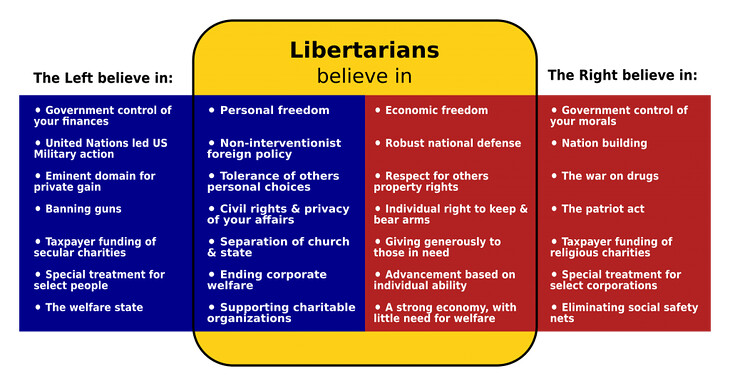
See how both the left and the right have libertarian and authoritarian positions? Notice how the Libertarians are the only ones with no authoritarian positions and all libertarian ones. So, to assert yourself in this area in the middle, would essentially make you a Libertarian an no longer a leftist. -
Why are We Back-Peddling on Racial Color-Blindness?The color of your skin doesn't matter in matters of health. (Perhaps white people get sun burn more often, I don't know.) Yet the division in medical records by sex is totally understandable as the physiology and some diseases are different between men and women. Similarly we treat children and adults differently in medicine too as they obviously are different. — ssu
Some diseases are more prevalent in some populations identified as races due to their common ancestry. Thus, people of African and Mediterranean descent are found to be more susceptible to sickle-cell disease while cystic fibrosis and hemochromatosis are more common among European populations. — Wikipedia
The two main dimensions of the race controversy can be discussed separately. First, the “ideological” concept of race informs popular discourse and shapes policy, with a parallel impact in public health. This version of race is defined by social and historical forces and is used to create and justify many of the divisions that exist among people of varying religious, ethnic, or geographic backgrounds. This concept assumes the existence of categories that have no scientific foundation—at least none based on molecular data. This concept has been challenged since Darwin (1981), yet it persists for ideological purposes (Cooper, 1984; Montagu, 1964; Root, 2001). Although everyone in public health needs to be reminded of the importance and illegitimacy of this notion, and those who have not yet heard the news need to be informed, there is little of substantive importance that is really new to add to this debate: We should begin by simply acknowledging that race in the world of politics, and all the nutritional, educational, and social influences it entrains, continues to be the determining influence on ethnic variation in health.
A second use of race has assumed new relevance. As a label for regional populations, race has a long history in population genetics, and in this arena, important opportunities exist to revisit old questions on interethnic variation in health. At stake is whether or not we can move beyond the indirect methods applied in epidemiology or the generalizations built on estimation of genetic distance that have preoccupied population geneticists and anthropologists (Cavalli-Sforza, Menozzi, and Piazza, 1996; Relethford, 1998). Specifically, it is now possible to ask a set of testable questions: Can the global variation in the human genome be aggregated into subunits, and do those units correspond to the categories we call race? Can we assess the relative magnitude of shared and nonshared genetic material among population groups? Is there variation in causal genetic polymorphisms that is associated with important differences in chronic disease risk? Is it possible to conceptualize the collective human genome as a whole, and express that concept in quantitative terms? — Richard S. Cooper
https://www.ncbi.nlm.nih.gov/books/NBK25517/ -
The significance of meaningYes, they are not being intellectually honest with themselves, so how would one expect them to intellectually honest with me? They aren't asking the questions I asked myself and others when I did believe and sought clarity. It's not just religion, but in politics as well. Politics is just another form of religion and I consider myself apolitical. Most, if not all, political discussions are based on subjective emotions and devolve into an emotional shouting match based on this idea that we are different when we aren't. We are made to think that we are thanks to those elitists in the nation's capital who manipulate citizens into pointing the finger at each other rather than at them where the blame for how things are belongs. Many athiests have simply swapped one Big Brother for another.
-
Why are We Back-Peddling on Racial Color-Blindness?
I agree with this because asking for race when applying for college is a category error.What there is, is this fanatic obsession with race, which does contribute of especially Americans and British to structural racism. It starts with when you participate in a course in the university or open a bank account and in the questionnaire you fill in beside your name and adress has a question of race and ethnicity. Why? I really ask why. Because that is then used to categorize you. If you think that is totally normal, how about religion? Do you have to fill in a questionnaire that what is your religion or state that you are an atheist when opening a bank account? How about participating in a history course in the university? That would be the case if the society would be divided by religion. Then we would all be talking about multiconfessionality. — ssu
Would it be racist to have your race listed in your medical records? Medical records are mostly private - only accessible by your physician. -
An Argument Against Realism
Who made that absurd statement? That would be like saying "the apple makes no difference to what the apple is".It is indeed an absurd question; however, the question is simply a response the absurd statement “knowing makes no difference to what is known.” In order for the realist’s claim to have any meaning, he must know that which he defines as unknown. In other words, he claims to have knowledge about that which he cannot—by his own definition—have knowledge about. He can’t support his claim by relying on his experience of “knowing x” because said experience would fall under the condition of “x being known;” it is impossible for him to prove that “knowing makes no difference to what is known” unless he takes it as gratuitous. With the development of quantum mechanics, we know that observation or measurement does in fact alter the being of an object—take Schrödinger’s Cat as an example. Therefore, if the realist takes “the being of X is independent of its being known” or “knowing makes no difference to what is known” as simply a “given” on faith. With that being said, the realist’s position is undermined by groundbreaking discoveries in the field of quantum mechanics which subsequently serve as evidence that go against the realist’s assertion that “knowing makes no difference to what is known.” — PessimisticIdealism
I don't think anyone is claiming that you can have knowledge of something for which you don't have knowledge for. That makes no sense, so your question is based on a misunderstanding of what knowledge is. When you can make statements like that, or like "I know that I don't know anything", then we have a problem with our understanding of what knowledge is.
Using my explanation, do you get those types of absurdities? It seems to me that there is no information lost in observing or in communicating. It just depends on where you look and when.
How does QM undermine realism if different scientists are coming to the same conclusion based on their observations of reality external to them? Who is it that agrees with them to form a consensus on QM if there is no external world? How can they share ideas via words on paper or sounds in the air if they only get at their own subjectivity, and not at the real actual paper with real ink scribbles and see, and interpret it, the same way?With that being said, the realist’s position is undermined by groundbreaking discoveries in the field of quantum mechanics which subsequently serve as evidence that go against the realist’s assertion that “knowing makes no difference to what is known.” — PessimisticIdealism -
Why are We Back-Peddling on Racial Color-Blindness?
This is another straw-man. I didn't make the argument that others "want to give central government all the power it is possible for a government to have... the power to tell you when to get up, what breakfast to have, what car to drive, who to marry, what clothes to wear..."Everyone wants to limit centralised power. Who in the world wants to give central government all the power it is possible for a government to have... the power to tell you when to get up, what breakfast to have, what car to drive, who to marry, what clothes to wear...?
Libertarianism is bullshit because the only unifying aim is something everyone wants - the least imposition on freedom that still produces an acceptable society.
So the only thing that distinguishes so-called libertarians from any other more interventionist political persuasion is that they just care less about the stuff the government imposes on our freedom in order to get done. — Isaac
My argument was that if racism is equated to power, then why give the government more power than it has, or maintain the status quo, by voting for big government political parties, like the Democratic Party who has mostly whites running for president? This isn't to say that Republican party isn't for big government either. They are both for big government. The left wants more control over the economy, while the right wants more control over what religion can be taught in publicly funded areas. They both have authoritarian tendencies. I have made the case elsewhere on these forums that we should consider other parties, or really we should consider other ideas and we should abolish political parties.
Libertarians are the only true liberals.
This would be like saying "ban all treatment for sickle cell anemia because it takes into account race". That isn't what I'm saying. I'm saying that race exists and is biological, not social. What is social is the category errors that we make when we put people into boxes labeled "black" and "white" that have nothing to do with their color of skin - like when hiring someone, as opposed to determining what diseases they might be more susceptible to.Medicare must be ageist because it takes account of age. Ban medicare! — Baden
Now, take your position that we should take account of race because to do otherwise would be racist. Why aren't you forcing the members of this forum to display their race? Aren't you and the rest of the Admins being racist by not doing that? How is it that you aren't?
Then your previous argument makes no sense. If age doesn't exist, then why do we have medicare? If race doesn't exist as a biological characteristic, then what does "race as a social construction" entail?Biological race doesn't exist, but race as a social construct does. The distinction makes a difference. — Baden
Another category error. Libertarianism/anarchism has to do with the ideas that you hold, not your wealth or how violent you are.The libertarian is more rich and the anarchist more violent. — ssu -
The significance of meaning
Theories are based on observations.The difficulty with tbe origin of DNA lies not in the (inevitable!) lack of observation, but in the lack of a plausible theory. — Chris Hughes
The problem isn't that others aren't getting what you are saying. If that was the problem, then why didn't you say so earlier rather than respond to me as if I understood what you were saying? You never led me to believe that I didn't understand what you were saying. There comes a point where you should re-think your position - not grip tighter to a position that is fallacious.I was hoping someone here would get what I'm saying, kind of agree (or accept it for the sake of argument), and develop it. — Chris Hughes
By who?I'm grateful for the four pages of responses, but there's a lot of unimaginative knee-jerk mechanism. — Chris Hughes
Yes, that too. :up: It offends me because it insults my intelligence to use explanations that aren't intelligible.Or, also popular, properties attributed to the Designer that we can't really make sense of. An explanation that's no longer intelligible is no longer an explanation. And that offends because it dresses up we-don't-know in the trappings of clarification. — Eee -
An Argument Against RealismI think our understanding of knowledge, which leads to paradoxes like, "knowing that you don't know anything" needs to be reworked before we start asking how we can know what the external world is like.
We know what the external world is like by observing it. Asking what it looks like independent of observing it is silly. If you want to know what it looks like, look at it. If you want to know what it is, look at it.
Observing is a causal process. The perceived is one of the causes. Light is another. Your visual system is another cause that leads to the effect of it appearing in your working memory. If you want to know specifically about the thing and not about light or your visual system, then you parse that information in working memory to exclude those causes so that you can get the object being perceived. Your doctor gets at the state of your visual system by asking you to look at an eye chart.
The apple isn't red, that is a product of your visual system and light. What the object is is something that reflects certain wavelengths of light and absorbs others. It does so based on it's ripeness. Ripeness is a property of the apple, not the light or my visual system. I use the information in my working memory to get at the ripeness of the apple so that I may use that information when I am hungry. -
The significance of meaning
Difficulty is another anthropomorphic projection. Difficulty lies in our ability to understand the processes that actually did happen due to the lack of observational evidence, not in the actual process.It's high improbability arises from the difficulty of getting from the component chemicals to the highly complex molecule without the benefit of evolution (which is, of course, only possible with DNA). — Chris Hughes -
An Argument Against Realism
But those are all external worlds. Is the argument "how do we know there is an external world", or "how do we know what the external world is like"? The latter assumes the prior is true.But that external world might be a brain in a vat, a simulation, a dream in God's mind, etc. if we take into account skeptical possibilities. — Marchesk
Then the question is how can we be certain, not how do we know things?The problem is that our acquisition of knowledge doesn't lead to certainty. Which is usually fine for everyday living, but has issues when doing philosophical inquiry. If we want to know what's real, then we have to deal with skepticism. — Marchesk
How can you be certain that you will never be certain? If you can be certain that you aren't certain, then you're certain about something, right? So it seems that knowledge can lead to certainty? -
The significance of meaningAny meaning in DNA is there because of what we do with that DNA. — Banno
Don't look to meaning, look to use. — Banno
That your OP stands on a misconstrual of meaning. Meanign is constructed by people; DNA has no meaning.
You might be able to build a similar argument using information instead, but you will still have to avoid the further objection of teleology. Causation does not work backwards; The desirability of a certain outcome does not bring that outcome about. — Banno
What do you mean by "use"?
"Use" for me entails causation. You conceive of a goal, then you use your brain, words, screwdriver, etc. to achieve the goal, observe the effects of your action and if the goal hasn't been realized then adjust your plan and repeat until it is.
Desire, or intent, does play a role in the outcomes of the world - or else how can you accuse people of say, racism?
Meaning/information is an inherent part of reality as the relationship between cause and effect, and as being part of this reality we are effects of prior causes and are causes of new effects. The rings in the tree stump mean the age of the tree because of how the tree grows throughout the year, whether some observer is there using that information to achieve some goal or not. -
An Argument Against RealismAs for the skeptical alternative, that would require a clear definition of what it means to know anything — Harry Hindu
Well yeah, they're realists about other minds. Which is open to the same sort of criticism of the OP — Marchesk
Yes. Doesn't that tie into the OP's argument? — Marchesk
I'm not quite clear on what the problem is. Don't we acquire knowledge from observations? We don't know anything until we observe it. So the answer is observe it and then you will know.The burden of proof lies on the realist to demonstrate that he “knows” whether the being of X is independent (not in terms of relations (i.e. the being of X ceases to partake in the relation of being known to a knower")) of its being known — PessimisticIdealism
Are you asking how do we know things independent of knowing? That would be a silly question.
When you observe your experiences it seems pretty clear that there is an external world because it would be a different experience if there wasn't. You might say that there'd be no experience at all.
If there wasn't an external world, "knowing" wouldn't make any sense. "Mind" wouldn't make any sense. The existence of "words" wouldn't make any sense, nor would how they came to exist in the first place. -
The significance of meaningNot enough. There's no possible way in which we can exist. — R3DNAX3LA9
I'm speculating that, given the improbability of the ocurrence of DNA, there may be a design-like process analagous to evolution at work in the universe. — Chris Hughes
Probabilities are only probable when you don't incorporate all the facts. — Harry Hindu
How do you know how probable, or possible, the occurrence of DNA is? It doesn't seem to occur out in the vacuum of space, but on certain planets with certain conditions, it seems certain that it does.
You're asking a very tough question. No one knows the answer right now, but we also didn't know that we evolved until someone did the hard work of observing nature for many years and documenting everything and offering up the idea that has now been tested for a 160 years. Doing a quick Google came up with this that seems to suggest that viruses may have had a role to play:Well, you've done better than anyone else - come up with the explanation for the origin of DNA. — Chris Hughes
https://www.ncbi.nlm.nih.gov/books/NBK6360/
If the complexity of some system requires a designer, then why wouldn't the designer require a designer? The design argument leads to an infinite regress of designers.
It seems like a better explanation would be that the (multi-)universe is a certain way and is all there is, and we are discovering (through consistent observation and trying to limit our biases of how we want it to be) how things are. When I say that it's a certain way, I don't mean to imply that it could be any other way. That would just be our anthropomorphic tendency to project our imagination onto the universe and use our ignorance as a basis for the existence of possibilities, which are really just imaginings that don't take into consideration, or have access to, how things actually are. -
The significance of meaning
Energy put into the a stable system.It's similar to how you get from primeval soup to DNA. Until the ocurrence of DNA there was no evolution, so how did that amazingly complex molecule come to exist? — Chris Hughes
Think of natural selection as an environmental feedback mechanism where the current state-of-affairs of the environment influences the development of the individual things within that environment. Predators are individuals in an environment, but are part of the environment and influence the evolution of prey, and are themselves evolving based on how the prey evolves. You cannot have change in one without the influence of the other.
They weren't random. They were based on existing conditions.Random chemical interactions took place over a very long time (like the imagined random character generator). Some may have resulted in proto-DNA structures, but without evolution (and without the benefit of the thought experiment's infinity), how would the huge number of exact steps needed go arrive at self-replicating life-forms have ocurred? — Chris Hughes
The pre-existing conditions of slightly less complex molecules coming together to form more complex ones thanks to the stable energy and environment that existed at that time.Exactly - and my metaphysical question is: if the effect is DNA, and it was not randomly generated, what's its cause? — Chris Hughes -
An Argument Against Realism
Do either of the first two that you mentioned hold a view other than there are things outside of our experiences, or that there aren't? For a transcendental or Berkeley idealist, are there things that exist independent of their mind, whether it be other minds, or other bodies? The point is that it doesn't matter whether the external stuff is other ideas, or material, or whatever - only that there is stuff that exists independent of your experience, or not at all - what that stuff is made of is irrelevant at this point.Add transcendental and Berkeley's idealism to the list. Skepticism is that we simply can't know, so that would be fifth one. — Marchesk
As for the skeptical alternative, that would require a clear definition of what it means to know anything. -
Why are We Back-Peddling on Racial Color-Blindness?
Because of citizens who revolted against an unfair and authoritarian government.Then why are your civil rights in the freaking constitution? — frank
I answer your questions. When are you going to answer my questions? Is this an interrogation or a discussion? -
The significance of meaning
Which has nothing to do with how the universe works from existing states to new states. The universe does not consist of new states coming about completely on their own without any prior cause, or present state-of-affairs, shaping what comes next.The thought experiment is: imagine a device producing random characters indefinitely. Probablity maths says it'll reproduce the works of Shakespeare. — Chris Hughes -
An Argument Against RealismWhat are the viable alternatives? Are there only two - solipsism and realism?
If so, then we've narrowed it down to just possibilities.
If solipsism were the case, then why does it seem like realism is the case, and not solipsism? How can a solipsist mind arrive at the idea of there being a world outside of my experience of it? It seems to me that only if there really is a world that my experiences are about, would my solipsist, infant mind come to the realization that realism is the case.
We see just that occurring naturally. We are born solipsists and only through our trying to make some sense of our experiences do we come to realize object permanence - the idea that your mother still exists when she leaves the room.
So it seems that for solipsism to be the case, one would have to explain why it seems like there is an external world. -
An Argument Against Realism
Is there a correlation between us and the world? If so, then isn't science getting at what is?Science is only concerned with how the world correlates to us, and not how it is. — Marchesk -
The significance of meaning
How do you distinguish a thought experiment from imagination?Actual monkeys and typewriters aren't needed for the thought experiment. Mechanistic probabilitarians are imagining random character generation which can continue indefinitely.
Meaning, in this context, is a metaphysical property. The improbability of DNA ocurring by chance raises the question: does its ocurrence have cosmic meaning? — Chris Hughes
There is a difference between random character generation, and processes that can only build on what it has in the present. "Random" characters generated are random precisely because they aren't taking into account the present conditions, or state-of-affairs, that exists and that natural selection has to work with. Natural selection doesn't just add another two legs to an organism. It can only filter or promote conditions that exist in the present, into the next generation. Mutations can only happen to existing DNA structures, not make up completely new ones out of thin air.
Meaning, in this context, is that effects are about their causes, and not randomly generated. If they were, there would be no such thing as meaning, even for us human beings. -
Why are We Back-Peddling on Racial Color-Blindness?The only libertarians Ive met were mentally... unstable, so I've never been inspired to look closer.
How does it work? How is it different from a desire for anarchy? — frank
I meant people I've actually met.
How is it different from anarchism? — frank
This straw-man is no surprise from someone who conflates "fondness" with "a type of harm, or unjust action".
What in this statement implies that a Libertarian would be for NO, as opposed to LIMITED, centralized power?Libertarianism would be the way to go - to limit centralized power. — Harry Hindu
It seems to me then, that if racism is about power, the solution to systemic racism would be anarchy, and that Libertarianism doesn't go far enough.
No, the idea of civil rights is that citizens are in conflict with the government.You mean if the system is racist, why give more power to the system?
The idea of civil rights is that the government is in conflict with itself. — frank
What is an extra-governmental system? You keep throwing around these vague terms that don't have any substance, and are then unwilling to put more meat on the bones for the rest of us to chew on.The systemic racism that's been spoken of in this thread is extra-governmental, though. — frank -
An Argument Against RealismIf another person told you about Mt. Everest, then you'd have to first believe that that person and their observations exist independently of you for you to then understand that that there is something else that you don't know that they are referring to. If I use their descriptions and go to where their observations lead me, then I will find Mt. Everest. How can that be in a world other than a realist world?
How would a solipsist mind come to imagine a realist world in which I need information from others to experience what they experienced? -
The significance of meaningFirst, nothing happens randomly, or by chance. There are reasons things happen, if not then logic would be useless, and our understanding of the universe would impoverished to the degree that we would probably die before we reached the age of 1 week old.
The monkeys typing Shakespeare is impossible, not probable, because monkeys don't live for an infinite period of time. Probabilities are only probable when you don't incorporate all the facts.
Meaning is the relationship between some effect and some cause(s). When you read a post (the effect), you're able to get at the causes via meaning. The cause is the idea in someone's head and their intent to communicate it on a forum. So in reading words, you are getting at the idea in someone's head. -
Why are We Back-Peddling on Racial Color-Blindness?180, you're painting a bleak picture. People in the in-group can't see it, so I suppose they can't help. There can be no plan until all the members of the out-group die, blessing their lighter-skinned descendants on their way out. *Snark*
But then, there'll be no need for a plan. — frank
Or you could keep the plan you have and be hypocrites. You are hypocrites because:
1) you are encouraging the mistreatment of people who had no choice in the circumstances that they were born into.
2) AND THIS IS A BIG ONE, you keep voting for bigger government - you know - the Democrat party - which is mostly whites running for president. You keep voting to give more power to the system that you claim is racist! WTF?!
If racism was about power, then why are you voting to give more power to the system? Libertarianism would be the way to go - to limit centralized power. You people are so confused and you have your politics(religion) to thank for it. -
Exploring analytical philosophy with Banno
If this were the case, then there would never be a case where someone doesn't know what they are talking about - meaning their model is inaccurate and they are pointing to the model, not the thing. We can inform them they are wrong because someone else has the correct model thanks to the proper observations. Observation is how the model gets updated with more accurate information, or else the model is full of imaginary information. Effects, which are the observations, are about their causes, like Jack's existence interacting with light in the environment, which then enters your eyes. Notice how the model of the cat, Jack includes information about light in the environment too. Turn out the lights and your model of Jack the cat changes.For me it's a carry over from critique of indirect realism. When I talk about my cat, Jack, I'm not talking about a model-of-Jack that sits in my head; I'm talking about that cat. When you talk about Jack, you are talking about the cat, not your model-of-Jack. So we both manage to be talking about the very same thing - Jack; and not two seperate things, our distinct models-of-Jack. — Banno -
Exploring analytical philosophy with BannoThat communication is more effective in person. I suppose that is the obvious conclusion here? — Wallows
:confused:
Uhh... Go back and read that question again. Your answer is for a different question that I did not ask.
What information is in your tone or behavior, that is relevant to your posts on this topic, that I am missing? If you're not making yourself clear and you know what information is missing to make yourself clear, then why aren't you including that information via words? If I held these beliefs that you do - that 90%+ information is lost when communicating on philosophy forums - I wouldn't waste my time trying to communicate with others on a philosophy forum. You avoided that question to: What percentage would you consider it a waste of time to communicate via written words on a forum? How is it that stories in books get interpreted similarly by different individuals if written text is missing 93% of it's relevant information? Answer the questions and be specific.What is it about your tone and body language that is relevant to the point you're trying to make in any post, that doesn't get picked up by the reader? — Harry Hindu -
Exploring analytical philosophy with BannoWhat is it about your tone and body language that is relevant to the point you're trying to make in any post, that doesn't get picked up by the reader?
The only reason you'd need to use tone or body language is when you are more vague with your word-use. -
Why are We Back-Peddling on Racial Color-Blindness?NB: UN Reports on Human Rights, UNDP, WHO, ICJ the Hague and other international human & civil rights NGOs thoroughly document and annually publish accounts and analyses which track both manifestations and the effects of racism (as well as other modalities of systemic discrimination). Anyone who doesn't know about these pervasive and persistent injustices simply doesn't want to know because s/he has the in-group privilege of not having to survive discrimination, even open persecution, as members of out-groups everywhere must. And what you don't know about you don't care - give a fuck! - about, which shows. — 180 Proof
Sounds like something the Roman Catholic Church would pronounce some centuries ago. Anyone who doesn't believe in the vague descriptions we've given of our Big Brother in the sky is a heretic!
Give a better description of your Racist Big Brother so that we can believe in him and pool our resources to fight it. But we need a plan. What's the plan? -
Exploring analytical philosophy with Banno
If you didn't intend to type that and submit it, then how did it get on the screen for me to read?What exactly is missing? I'm trying to get specifics here, so I'd appreciate a more specific answer.
— Harry Hindu
Uhh, intentionality for starters??? — Wallows
Are we talking about your intentions, or the topic of this thread? Again, I'm making the distinction of relevancy. What your intentions are, other than typing and submitting posts of your ideas on this topic, are irrelevant to the topic.
What else is missing? You're the one that gave dropped the measurement of percentages into this, so what is the percentage? How high would it have to be for you to consider language-use a waste of time?
I don't understand what you mean by bullshitting. You simply said what I said after that. Part of knowing the truth, and is relevant information when you're going to lie to someone, is whether an interlocutor knows the truth or not. Your map has to include their map as well as the territory.That's what lying is. In order to lie, we'd already have to have some inclination into what the other person is thinking, or how they will interpret our words, in order to manipulate them into thinking something other than what is relevant to the facts. You can't lie to someone who already knows the facts.
— Harry Hindu
No, that's just plain bullshitting. Lying requires one to know what the truth is and hide it from plain sight when engaging an interlocutor. — Wallows
Sure, if your goal is to get to the top of the mountain. The territory has rest-stops, and hopefully your map has the location of these when your need to use the restroom.If it gets you to the top of the mountain I'd say it's a good map. — Wallows -
Exploring analytical philosophy with BannoA large degree. — Wallows
Yeah, but what percent? A majority of it? You're the one on that end that knows what they're typing on the screen and how much of it is missing. What exactly is missing? I'm trying to get specifics here, so I'd appreciate a more specific answer.
Then, as a psychopath, you're goal of trying to confuse me isn't relevant information to this specific topic that you and I are both discussing.Yet, please use this as an example. Say, that I am some psychopath that is trying to get you confused because I get a kick out of making people feel bad. How do you know that I am or am not one? I suppose it would be harder for a psychopath to convince someone to die over the internet, despite the hot topic of bullying on places like Reddit or elsewhere. — Wallows
That's what lying is. In order to lie, we'd already have to have some inclination into what the other person is thinking, or how they will interpret our words, in order to manipulate them into thinking something other than what is relevant to the facts. You can't lie to someone who already knows the facts.
Both, if the map is accurate. If it isn't, then the map is irrelevant information, no?Yes; but, the context of what exactly, the map or the territory(?) — Wallows
Harry Hindu

Start FollowingSend a Message
- Other sites we like
- Social media
- Terms of Service
- Sign In
- Created with PlushForums
- © 2026 The Philosophy Forum