
Comments
-
Philosophy has failed to create a better worldGood moral thinking depends on knowledge of science. — Athena
No, no, no, no, no, no, no, no, no, no, no, no, no, no, no, no.....................................................
Do you believe that good moral behavior depends on good moral thinking? -
Philosophy has failed to create a better worldI am a believer in the New Age and I get really excited about what is possible. ... I think we have created a better world....abundance is bringing the best in us now. — Athena
This forum is generally full of sour pusses and depressed introverts. I usually find myself one of the few rosy cheeked, bright eyed romantics. You make me look like Eeyore.
If we get education back on the enlightenment path we might come out of the present transition okay — Athena
I'm not sure the capital E enlightenment path is the right one. It's certainly not the only one. -
Metaphysical Epistemology - the power of beliefConfusing - conflating - belief and presupposition in RGC's thinking simply a mistake. — tim wood
What I got out of the essay, whether or not Collingwood actually meant it that way, is that people are likely not to be aware of the suppositions underpinning their beliefs. That lack of awareness leads to misunderstanding and disagreement that are almost insurmountable. -
Metaphysical Epistemology - the power of beliefAh, no. R.G. Collingwood's (RGC) ideas on metaphysics are simple and powerful. It is a shame to misunderstand them and get them wrong. At the same time they also have that quality of newness that makes any idea first encountered seem a little strange until got used to. And it is a challenge to capture them in short summary. — tim wood
You were the person who steered me toward Collingwood's essay a few years ago. I know it had a big impact on both of us. My first reaction when reading the original post in this thread was "No, that's not what Collingwood said at all." I was going to write something, but you got there first and what you wrote is better than mine would have been.
Which means I don't have to do anything. Yay!! -
Taxesthe country which does not invest in taxation has the best quality life — javi2541997
Switzerland has federal and provincial income taxes, although the rates are significantly lower than in the US. There are no capital gains taxes for many transactions but there is a wealth tax. -
Beautiful ThingsYou don't need to go to Machu Picchu — Anand-Haqq
I've never been and have no desire to go. It pleases me that we live in a world where such a beautiful thing exists. -
Philosophy has failed to create a better worldI don't think Christianity has such a good history, and today, to me it appears one of the worst problems we have. — Athena
Science and religion are just expressions of human nature projected onto a world where the don't, can't fit. Humanity doesn't have such a good history in the sense you mean. -
Have we really proved the existence of irrational numbers?The volume of a pizza of radius z and height a is pi z z a. — fishfry
Are you proposing this as proof of the existence of God? -
Beautiful ThingsThis thread hasn't been open for a while. I have something I tripped across a couple of months ago I wanted to post here.
This is the most beautiful thing in the history of the universe.

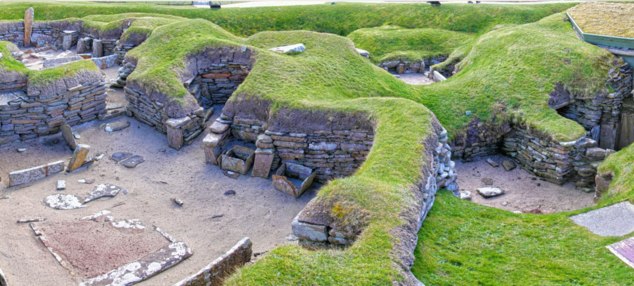
Orkney Island, Scotland, UK. Skara Brae. More than 5,000 years old. Can you believe that? Do you think these people didn't care about beauty? -
The Origin of the First Living Cell with or without Evolution?Science is many ideologies — Joshs
I was using "ideology" in a fairly negative way in my post. Ideology as an inflexible, dogmatic viewpoint. -
The Origin of the First Living Cell with or without Evolution?You cherry picked that quote: I said ‘for this kind of thinking, science is a religion’. I don’t think that most people see it like that, but it’s a significant strain of thought in come circles. — Wayfarer
Not an important point for me in this discussion, but it bothers me in general. I think it is disrespectful to both science and religion. -
The Origin of the First Living Cell with or without Evolution?science *is* a religion. — Wayfarer
No. I don't agree. Science is an ideology, not a religion. Religion is... well, no, I don't want to open that door here.
'metaphysics' and 'supernatural' are essentially synonymous terms, — Wayfarer
I don't know how it was used in the olden days, but that's not what "metaphysics" means now. At least that's not all it means. -
Have we really proved the existence of irrational numbers?My argument is that just as a sandwich is not a number, perhaps neither is pi. Maybe it's an algorithm. — Ryan O'Connor
A = sandwich * r^2. Doesn't work for me. Arccos (-1) = sandwich. Nope. -
The Origin of the First Living Cell with or without Evolution?But happy to be told it isn't relevant by W or you. — Tom Storm
Someday, in another discussion, we can discuss how God is involved in all this, because it is. But, no, I am not, and I don't think Wayfarer is, talking about anything supernatural. -
The Origin of the First Living Cell with or without Evolution?
-
What is the relationship, if any, between emergent properties and quantum mechanics?Please enlighten me? — Pop
I've taken my best shot. If what I've written so far hasn't convinced you, let's leave it at that. -
Have we really proved the existence of irrational numbers?But perhaps it is simplest if I take existence out of my original question: Have we really proved that √2 is an irrational number? — Ryan O'Connor
Just checked. Here is a link to a discussion in Wikipedia about the proof that pi is irrational:
https://en.wikipedia.org/wiki/Proof_that_%CF%80_is_irrational#:~:text=In%20the%201760s%2C%20Johann%20Heinrich,is%20a%20non%2Dzero%20integer.&text=In%201882%2C%20Ferdinand%20von%20Lindemann,irrational%2C%20but%20transcendental%20as%20well.
Not claiming I understand it. -
What is the relationship, if any, between emergent properties and quantum mechanics?Semantics. The emergent property of concrete is structural rigidity, which is not present in any of its component materials. But in their relationship emerges a structurally rigid material. — Pop
I agree. It is semantics. You have misunderstood the meaning of the word "emergence" in this context. -
The Origin of the First Living Cell with or without Evolution?Given you are pretty much an atheist (from our pervious conversation), as far as more literalist theists may be concerned, what benefits do you believe your worldview brings, which are not available to the person who thinks the scientific method is the only reliable pathway to truth available to us at the moment? — Tom Storm
I'll take a swing at this. @Wayfarer and I don't agree on a lot, but I think we share some views and values in this area. I'm a civil engineer. That means, when there is some work to be done, I find out what our client wants, get a survey, do some calculations, make a drawing or two, then get a bunch of bulldozers and knock everything down. That works, to the extent it does, because we follow the typical materialist route of separating our area of interest from the rest of the universe and pretending what we do inside the area doesn't have anything to do with what goes on outside. Yes, I'm oversimplifying the process.
This leads to all sorts of problems. Is there another way, sure - look at the world, forgive me, holistically. As one unified system. There are sciences that do things that way - ecology, geology, evolutionary biology, hydrogeology. Observational rather than experimental sciences. -
What is the relationship, if any, between emergent properties and quantum mechanics?The relationship here is sand and cement. The result is concrete - is concrete not an emergent property that neither sand or cement posses on their own ? — Pop
Concrete is not a property, it is a material made up of sand, cement, and water. Strength is a property which is relevant to concrete and all three of its component materials. -
What is the relationship, if any, between emergent properties and quantum mechanics?David Chalmers, a philosopher and social scientist, wrote a nice article on weak and strong emergence a few years ago. — jgill
I downloaded the Chalmers article. Thanks for the suggestion.
I didn't really buy his distinction between strong and weak emergence. Most of the interesting phenomena I think of when I talk about emergence - e.g. transitions between hierarchies of knowledge such as between chemistry and biology - he calls weak emergence. The only phenomenon he considers strongly emergent is consciousness. That's as far as I got. It's a bad case of special pleading and I don't buy it. -
What is the relationship, if any, between emergent properties and quantum mechanics?As I indicated with Pop, this is not the correct use of the word "emergence" in this context.
-
What is the relationship, if any, between emergent properties and quantum mechanics?"In philosophy, systems theory, science, and art, emergence occurs when an entity is observed to have properties its parts do not have on their own, properties or behaviors which emerge only when the parts interact in a wider whole." - Wikipedia
The normal understanding relates to complex systems, but as per previous posts a relationship is an emergent property, unless you can prove otherwise? — Pop
Sand and cement have known physical and chemical properties, including strength. Resistance to force, i.e. strength, is not a new property or behavior and your example is not emergence. Unless you can prove otherwise. -
What is the relationship, if any, between emergent properties and quantum mechanics?Are you saying that concrete does not have emergent (structural) qualities that are not characteristic of the sand & cement separately? — Gnomon
The term "emergence" has a specific technical meaning in this context. If it means what you indicate it does, all physical and chemical interaction between matter and energy represents emergence. The word loses all meaning. -
What is the relationship, if any, between emergent properties and quantum mechanics?a pile of sand might contain thousands of grains, but each grain reacts to inputs of energy independently. Yet, if you add some lime cement to the pile, it will soon harden into the integrated system of grains we call "concrete", with emergent structural qualities not found in the grains. — Gnomon
Not every change in characteristics is emergence. In your example, the behavior of the concrete is directly causally related to the physical and chemical characteristics of the sand and cement. That's not emergence. -
The Origin of the First Living Cell with or without Evolution?All I am saying is that the scientific method remains the single most reliable pathway to truth. — Tom Storm
"Truth" is generally defined as congruence with objective reality. I will agree that science is very good at identifying the truth in that sense. There's a good argument to be made that objective reality is a human construct which boils down to that which can be perceived, conceived, and understood by humans. That has been discussed many times in the forum. Getting into that would require shanghaiing the original post.
There are ways of knowing the world that do not require an objective reality. -
The Origin of the First Living Cell with or without Evolution?There are many critical things that can be said about the hard problem (see Thompson&Varela, forthcoming), but what I wish to point out here is that it depends for its very formulation on the premise that the embodied mind as a natural entity exists ‘out there' independently of how we configure or constitute it as an object of knowledge through our reciprocal empathic understanding of one other as experiencing subjects. — Joshs
I like this Thompson guy, even though he's got it all wrong. At least he lays out the problems clearly. As a great philosopher once said - Clarity is so rare and unexpected, it is often mistaken for truth. I'm going to jiggle around with what he says above to make it match the way I see things:
There are many critical things that can be said about [objective reality], but it depends for its very formulation on the premise that [reality] exists ‘out there' independently of how we configure or constitute it as an object of knowledge.
That was fun.
One problem with this whole way of setting up the issue, however, is that it presupposes we can make sense of the very notion of a single, canonical, physicalist description of the world, which is highly doubtful, and that in arriving (or at any rate approaching) such a description, we are attaining a viewpoint that does not in any way presuppose our own cognition and lived experience. — Joshs
Hey, this Thompson guy is ok. Maybe I don't disagree with him after all. -
The Origin of the First Living Cell with or without Evolution?'The mystery of the origin of life is very real' - no argument with that from me. — Amity
Do you mean "mystery" as in stuff we don't know yet or as in stuff that requires some special way of knowing? Or maybe stuff that is unknowable?
I second your view on how there's a enormous gulf between the inanimate and the animate and that our attempt to explain the latter in terms of our knowledge of the former is at best confusion and at worst a delusion. — TheMadFool
That seems like a much stronger statement than what I understand @Wayfarer to be saying, but I'll let him speak for himself.
It seems I'm not alone in this though as the question "what is life?" posed to biologists elicits responses that are marked by an equal degree of ignorance and that's ironic since they've constructed a whole corpus of knowledge which they claim is about life. — TheMadFool
This is misleading. The classification of what is living and what is not may have some ambiguity in it, e.g. viruses, but that's true of most distinctions. We biologists, and we, generally know what is meant when we say "living." -
The Origin of the First Living Cell with or without Evolution?I think 'scientific realism' is a useful stance in asking scientific questions. But 'the nature of our experience' is another matter altogether. — Wayfarer
A point I would make is that the kind of self-knowledge that philosophy wants to impart doesn't necessarily require any special scientific apparatus. — Wayfarer
I agree that there are important, completely non-scientific ways of understanding consciousness and experience and science that doesn't recognize that is scientism. But when people talk about "the hard problem of consciousness," they are generally talking about consciousness as a scientific issue. It is perfectly possible to study consciousness on a purely scientific basis. Something is lost, left out when you do that. -
The Origin of the First Living Cell with or without Evolution?Unfortunately, that was what was is being done when Evolutionary Theory is taught as fact in schools. Just filling in a huge hole, the size of the Grand Canyon. — MondoR
Abiogenesis and evolution are entirely different processes. Evolutionary theory says nothing about the origins of life, only how life has changed over time. Abiogenesis describes the mechanisms by which life came from non-living matter. -
Philosophy has failed to create a better worldTechnology is not science. Humans have had technology since they lived in caves. ...That is technology, plus philosophy, equals science. — Athena
I specifically made the distinction between science and technology.
We understand not only what works but why it works. — Athena
I'll nitpick - Science doesn't tell us anything about why, only how.
Religion is a stumbling stone for science.... We are not as controlled by the church as we once were but for thousands of years it has been a stumbling block. — Athena
I'm not a theist, but I don't see it that way.
You seem like a hardheaded, no nonsense type. That's a good thing. Fun to argue with. I am a softheaded, nonsense type. -
Introducing myselfI'm sorry no one has responded, so I will. Welcome to the forum. I am an engineer and visiting the Netherlands has always felt like coming home. A nation of engineers. But North Sea oysters are terrible.
-
The Origin of the First Living Cell with or without Evolution?Consciousness is nothing special any more than neutrinos, cockroaches, or I are. It's just one of what Lao Tzu would call the 10,000 things. Just stuff.
— T Clark
So, the suggestion that living organisms can't be wholly understood through the objective sciences implies 'the supernatural'! — Wayfarer
I do want to make one thing clear, in case I've been misleading - I believe there are legitimate, non-scientific ways to know the world. Most of the ways we know the world are not science based or even rational.
I am arguing the view that an ontological distinction must be made between living things and inorganic nature. — Wayfarer
I disagree with this. -
Philosophy has failed to create a better worldLife is like a boulder perched over the edge. Philosophy is kind of like gravity and science is like the person who pushes the rock over the edge and claims all the credit. — Outlander
An....odd simile. By which I mean I don't know what you're trying to say. -
What is the relationship, if any, between emergent properties and quantum mechanics?
Here's a link to a famous article written in 1972 - "More is Different."
https://science.sciencemag.org/content/177/4047/393
You'll find it referenced in just about every article you read on the hierarchies of science and emergence. Take a look. It really helped me.
Emergence and quantum mechanics describe different kinds of phenomena. -
Philosophy has failed to create a better worldscience & technology have saved us...I'd love to hear how philosophy could contribute to that. — TaySan
Whether or not technology has saved us is open to debate, but we'll leave that for now. Science by itself doesn't help anyone. It has to be turned into technology by engineering. Engineering is applied science.
And science is applied philosophy. -
Is there a race war underway?Peering at life through the racial lens is the problem to begin with. — NOS4A2
If you're proposing that our society should be so called "color-blind," that won't sell. Maybe it might in the future sometime once we've worked ourselves out of this hole we've dug ourselves into over centuries.
T_Clark

Start FollowingSend a Message
- Other sites we like
- Social media
- Terms of Service
- Sign In
- Created with PlushForums
- © 2026 The Philosophy Forum