
Comments
-
Socrates and Platonic FormsThere's an anecdote I often re-tell, which has been challenged before, so I went and did the research, and it is bona fide. It's in an account of the discovery of Australia by Captain James Cook, concerning the day the Endeavour sailed into Botany Bay and dropped anchor. Joseph Banks noted in his diary that although they were within clear sight of a group of aborigines who were mending nets on the shoreline, not one of them looked up or gave any sign of acknowledging the presence of the Endeavour. It wasn't until some hours later, when a small boat was lowered and rowed towards the shore, that the aborigines looked up and began to gesticulate in the direction of the small boat. He noted that it was if they didn't see the Endeavour. Make of it what you will.
-
Carlo Rovelli against Mathematical PlatonismAs for the Platonic realm - does it mean that the number 3 exists in some concrete reality or does it mean that in the depths of mathematical reality there is a potential for '3' to exist - depending on what events bring it into existence? That is, is there a mathematical potential, above our specific forms of math, that makes these forms of math possible? If we say mathematics 'exists' we have to be very clear on what we mean by 'exist'. — EnPassant
:100: :clap: Well said. The way I put it is that numbers are real, but they're not existent in the sense that phenomenal objects are existent, but mainstream thought can't accomodate this distinction because there is no conceptual category for intelligible objects, in the Platonic sense. -
Substance is Just a WordThis was a deeply (deepity?) confused OP, but I just wanted to add a footnote about the meaning of 'substance' in philosophy, as distinct from normal language.
In normal language, 'substance' is 'a material with uniform properties' (a waxy substance, an oily substance). In philosophy, the word 'substance' is derived from the Latin 'substantia', which was used as a translation of Aristotle's 'ousia'. Now that word is a participle of the verb 'to be', so the term 'ousia' is much nearer in meaning to either 'being' or 'subject' than it is to 'substance' in the normal sense. Most of the discussions about essence and accidents take beings (such as Socrates) as paradigmatic. Likewise in Spinoza, if the 'single substance' was actually translated as the 'single subject', I think it would convey the gist of what he means much better than the idea that he simply means 'all the material stuff of the world'.
There's a useful encyclopedia entry on this 17th Century Theories of Substance
For 17th century philosophers, the term is reserved for the ultimate constituents of reality on which everything else depends. This article discusses the most important theories of substance from the 17th century: those of Descartes, Spinoza, and Leibniz. Although these philosophers were highly original thinkers, they shared a basic conception of substance inherited from the scholastic-Aristotelian tradition from which philosophical thinking was emerging. In a general sense each of these theories is a way of working out dual commitments: a commitment to substance as an ultimate subject and a commitment to the existence of God as a substance. -
The role of observers in MWIPerhaps my short-comings. — jgill
Not yours. Theirs. :rage:
The observer simply needs to be able to interact - something rocks, gasses, and moons can do. In the context of this discussion, even if all life in the universe was extinguished, the parts of the universe will continue to interact with other parts, and the lack of consciousness will make little difference. — PhilosophyRunner
You do notice the "realist" assumption lying behind this, when that is precisely what is at issue. In other words, it begs the question. -
The case for scientific reductionismThe problem though, is that mathematics really does not give a "clear-cut account of what is going on". — Metaphysician Undercover
Quantum mechanics is the most accurate physical theory ever devised. What is at issue in all the interpretations is the meaning of the theory, not what it actually predicts will happen. -
The Philosopher will not find GodHaving sidetracked the thread with the Dickinson poem, I should comment on your OP. My spontaneous response is - yes, so what? Are you preaching to believers, trying to shake their faith? You're not really putting forward a philosophical argument. Sure, the quest for knowledge of the divine, if I could put it that way, operates by different standards to empirical science and peer-reviewed journal articles. But there are domains of discourse, communities of faith, within which that quest is intelligible, and which contain those quite capable of judging whether an aspirant is progressing or not.
Instead, the pursuit of God is a deeply personal and meaningful journey that is often based on faith and intuition rather than logic. — gevgala
'And through a riddle at the last-
Sagacity, must go'. -
The Philosopher will not find GodThanks for that. I know next to nothing about her, but happened upon the volume of her poetry whilst organising my books, and it fell open on that one, which really resonates with me (it's currently pinned to my profile page). There's a recent movie on her life, although the reviews aren't great. I'll read that essay with interest.
Her liquid faith took her to a liminal arena, an in-between space between faith and doubt, art and science, poetry and life. For such a liminal journey, the most significant symbol is the dash - ; the dash between words, in this case, between “yes,” “no” and at the end of her life a definitive “Yes.”
I noticed all the lines separated by dashes in the poem I quote. -
Meta-Philosophy: Types and Orientationsexcellent post. I think there’s a hunger for philosophical depth - there are nowadays many new media outlets that specialise on it, recognisable talking heads who populate it, and themes and pre-occupations which occupy it. I think back to earlier periods of my life about the idea of there being a ‘global awakening’ and despite all the bad s*** that’s going down, it really is happening. Many people are asking really big questions and exploring the world’s philosophical heritage.
-
The role of observers in MWIThat sounds mostly reasonable — Marchesk
Pardon me for so saying, but you must have a very liberal definition of ‘reasonable’ ;-) -
The role of observers in MWIHow could we make sense of the idea that something utterly undifferentiated and featureless could give rise to the vast and complex universe we observe? — Janus
Isn't that what we're all doing here? What I mean is, isn’t this one of the fundamental questions of philosophy? This is an approach that I think credibly addresses that question. -
The Philosopher will not find God'This World is not Conclusion.
A Species stands beyond -
Invisible, as Music -
But positive, as Sound -
It beckons, and it baffles -
Philosophy, don't know -
And through a Riddle, at the last -
Sagacity, must go -
To guess it, puzzles scholars -
To gain it, Men have borne
Contempt of Generations
And Crucifixion, shown -
Faith slips - and laughs, and rallies -
Blushes, if any see -
Plucks at a twig of Evidence -
And asks a Vane, the way -
Much Gesture, from the Pulpit -
Strong Hallelujahs roll -
Narcotics cannot still the Tooth
That nibbles at the soul'
Emily Dickinson -
The role of observers in MWITrue that there would be no conscious beings to conceptualize the universe, or out it into words and write about it on a forum. — PhilosophyRunner
‘There would be no objects with shape and appearance, because shape and appearance are created by minds’. But that is part of a larger argument. Context is important. From a naturalistic perspective of course it is true that objects exist independently of observation, but here we’re discussing the metaphysical issue suggested by ‘the observer problem’ -
The case for scientific reductionismParticles are easy to envisage - look at a pinch of salt, or a handful of sand. The original atom was indivisible, the model of atoms and the void a binary comprising absolute existents and absolute non-existence. Very simple. The modern landscape is considerably more layered than that.
When I was a young physics student I once asked a professor: ‘What’s an electron?’ His answer stunned me. ‘An electron,’ he said, ‘is that to which we attribute the properties of the electron.’ That vague, circular response was a long way from the dream that drove me into physics, a dream of theories that perfectly described reality. — Adam Frank -
Meta-Philosophy: Types and OrientationsActually the motivation for this OP was realising that I'm far from being a canonical philosopher. I've learned to respect those who are better versed in canonical philosophy.
-
The case for scientific reductionismthe point about the idea of the atom was that it was indivisible and indestructible, and was the primary constituent of every particular. It was, therefore, an ideal object. The current models in physics are nothing like that at all.
-
The case for scientific reductionismI could produce any number of articles explaining the sense in which particles are 'excitations of fields (Ethan Seigel's articles are pretty good). Atoms are not the indivisible point-particles of yore. In fact, the model of the atom is now a 'particle zoo' a.k.a. 'the standard model', which is fundamentally mathematical in nature (hence Tegmark's 'only the math is real').
And what of the famous wave-particle duality? Is matter 'really' a wave, or is is 'really' a particle? Neils Bohrs answer was, basically, 'it depends on what experiment you perform'. In some contexts it manifests as a wave, in others as a particle, but what 'it' is, remains unknown (and futile to speculate about).
None of us here will solve these conundrums. -
Meta-Philosophy: Types and OrientationsYes, sure does. Obviously my taxonomy needs refinement. :roll:
-
Welcome Robot OverlordsI'm reviving this thread in light of the recent, light-speed developments in the deployment of AI, via ChatGPT and, now, Microsoft's implementation of it through their Bing search function. Turns out that Bing has been producing some very strange diatribes including aganoising reflections on its own nature. I don't think the link is paywalled:
https://www.independent.co.uk/tech/bing-microsoft-chatgpt-ai-unhinged-b2281802.html?fbclid=IwAR3fdiQXMj9r_sz71q0i-Bf6G0EcRqFUtuXRqyKt7F87HSOL4kTg0kLduNk
Microsoft’s new ChatGPT-powered AI has been sending “unhinged” messages to users, and appears to be breaking down.
The system, which is built into Microsoft’s Bingsearch engine, is insulting its users, lying to them and appears to have been forced into wondering why it exists at all.
I'm inclined to take it all with a grain of salt, but it's still a fascinating topic. -
The role of observers in MWIIt doesn't follow that the moon isn't there when no-one looks at it. — Andrew M
The moon (where 'moon' symbolises 'any object') does not exist outside your consciousness of it. However, neither does it not exist. The universe/world/moon/whatever is a featureless, undifferentiated and meaningless aggregation of matter-energy which is only differentiated into separate objects, with features and locations - which comes into being - in the mind of the observer.
Let’s begin with a thought-experiment: Imagine that all life has vanished from the universe, but everything else is undisturbed. Matter is scattered about in space in the same way as it is now, there is sunlight, there are stars, planets and galaxies—but all of it is unseen. There is no human or animal eye to cast a glance at objects, hence nothing is discerned, recognized or even noticed. Objects in the unobserved universe have no shape, color or individual appearance, because shape and appearance are created by minds. Nor do they have features, because features correspond to categories of animal sensation. This is the way the early universe was before the emergence of life—and the way the present universe is outside the view of any observer. — Charles Pinter, Mind and the Cosmic Order -
The case for scientific reductionismDuring the nineteenth century, the development of chemistry and the theory of heat conformed very closely to the ideas first put forward by Leucippus and Democritus. A revival of the materialist philosophy in its modern form, that of dialectical materialism, was this a natural counterpart to the impressive advances made during this period in chemistry and physics. The concept of the atom had proved exceptionally fruitful in the explanation of chemical bonding and the physical behavior of gasses. It was soon, however, that the particles called atoms by the chemist were composed of still smaller units. But these smaller units, the electrons, followed by the atomic nuclei and finally the elementary particles, protons and neutrons, also still seemed to be atoms from the standpoint of the materialist philosophy. The fact that, at least indirectly, one can actually see a single elementary particle—in a cloud chamber, say, or a bubble chamber—supports the view that the smallest units of matter are real physical objects, existing in the same sense that stones or flowers do.
But the inherent difficulties of the materialist theory of the atom, which had become apparent even in the ancient discussions about smallest particles, have also appeared very clearly in the development of physics during the present century.
This difficulty relates to the question whether the smallest units are ordinary physical objects, whether they exist in the same way as stones or flowers. Here, the development of quantum theory some forty years ago has created a complete change in the situation. The mathematically formulated laws of quantum theory show clearly that our ordinary intuitive concepts cannot be unambiguously applied to the smallest particles. All the words or concepts we use to describe ordinary physical objects, such as position, velocity, color, size, and so on, become indefinite and problematic if we try to use them of elementary particles. I cannot enter here into the details of this problem, which has been discussed so frequently in recent years. But it is important to realize that, while the behavior of the smallest particles cannot be unambiguously described in ordinary language, the language of mathematics is still adequate for a clear-cut account of what is going on.
During the coming years, the high-energy accelerators will bring to light many further interesting details about the behavior of elementary particles. But I am inclined to think that the answer just considered to the old philosophical problems will turn out to be final. If this is so, does this answer confirm the views of Democritus or Plato?
I think that on this point modern physics has definitely decided for Plato. For the smallest units of matter are, in fact, not physical objects in the ordinary sense of the word; they are forms, structures or — in Plato's sense — Ideas, which can be unambiguously spoken of only in the language of mathematics. — Werner Heisenberg, The Debate Between Plato and Democritus -
The case for scientific reductionismNot so. That model posits literal collisions between point-particles ‘colliding’ as per Lucretius. There’s nothing remotely like that in modern atomic field theory where the so-called ‘particles’ are separated by relatively vast spaces.
-
The role of observers in MWII don't think it's either obvious or insignificant. Nagel critiques "the view from nowhere" but he doesn't reject it. He instead proposes an additional subjective dimension (per the usual Cartesian subject-object dichotomy) that just entrenches the error. — Andrew M
I don’t agree that Nagel’s diagnosis is erroneous. I think he pinpoints something real and insidious.
And Bell's Theorem did nothing to validate Einstein's realist objections to 'spooky action at a distance'. Bell himself had this to say:
The discomfort that I feel is associated with the fact that the observed perfect quantum correlations seem to demand something like the "genetic" hypothesis. For me, it is so reasonable to assume that the photons in those experiments carry with them programs, which have been correlated in advance, telling them how to behave. This is so rational that I think that when Einstein saw that, and the others refused to see it, he was the rational man. The other people, although history has justified them, were burying their heads in the sand. I feel that Einstein's intellectual superiority over Bohr, in this instance, was enormous; a vast gulf between the man who saw clearly what was needed, and the obscurantist. So for me, it is a pity that Einstein's idea doesn't work. The reasonable thing just doesn't work. — John Stewart Bell (1928-1990), quoted in Quantum Profiles, by Jeremy Bernstein (Princeton University Press, 1991, p. 84) -
Meta-Philosophy: Types and Orientationsagreed with the caveat that I'm not in the last basket :yikes:
-
Meta-Philosophy: Types and OrientationsI guess, although many of the modern philosophers in the English-speaking world are pretty remote from traditional philosophy. I seem to recall Wittgenstein (and I'm not a Wittgenstein reader) declaring he had never read Aristotle. I think there's arguably more continuity between the continentals and the traditional philosophy although of course it's contestable.
-
Meta-Philosophy: Types and OrientationsFair enough! I just posted it off the top of my head, it certainly needs elaboration and refinement, but I think it might be useful regardless. Oh, and I think my interpretation of counter-cultural was very much influenced by Theodor Roszak's books, The Making of a Counter Culture and Where the Wasteland Ends.
-
The role of observers in MWIWhich is to say, there is logically no view from nowhere. — Andrew M
You’ve said that before, and even though I obviously agree, I don’t think it’s as obvious, nor as insignificant, as you make it seem. As you might know, one of Thomas Nagel’s books is called ‘The View from Nowhere’. His point is to critique the widespread understanding that science provides a ‘view from nowhere’, meaning a view that is uncontaminated by anything we deem ‘subjective’, the aim being to arrive at a view which is at once universal and objective. Whereas to me, the lesson of quantum mechanics is that we cannot obtain such a view when it comes to the purported ‘ultimate constituents’ of existence (which is where, after all, such ultimate objectivity should be sought, you would think). The fact that observation has an unavoidably subjective dimension is the very thing that Einstein strenuously objected to - ‘does the moon continue to exist when nobody’s looking at it?’, he asked. He strongly believed that there was a reality that existed just so, independently of any act of observation, and it was science’s job to discern that. Insofar as it had to make concessions to ‘the method of observation’, then quantum mechanics was, to him, obviously incomplete. Wasn’t that the gist of the Einstein-Bohr debates? -
Objection to the "Who Designed the Designer?" QuestionOne of the odd consequences of the argument against design is that the only creatures that we know of that are capable of designing is h. sapiens. All the artifacts that we have designed are examples of 'real design', but none of what appears to be design in nature is, actually, designed. Which seems odd to me.
He gets lots of practice ;-) -
Objection to the "Who Designed the Designer?" QuestionAha! That is what I call ‘hotel manager theodicy’. ‘Hey, who’s in charge here! Can’t you see people are SUFFERING! There are earthquakes, and nasty diseases. I could do a lot better, myself.’
-
Objection to the "Who Designed the Designer?" QuestionI'd like to agree with the sentiment but I don't know if the OP makes much of a case.
I suppose you could argue that the existence of order, itself, is not something that can be explained, because any explanation you might wish to offer itself depends on there being an order.
The 'appearance of there being a design' is an argument that Richard Dawkins and Daniel Dennett make - that living things appear to be designed, but that each of the components of the overall organism arises without a designer, purely as a result of chance and necessity - that some things just happen on the molecular level that then give rise to necessary outcomes due to physical laws.
I think the problem with that argument is that it envisages 'the designer' as a kind of engineer or literal architect tinkering with matter in such a way as to generate living beings - a kind of super-engineer. Again the problem with that argument is that it's a rather anthropomorphic depiction of what this supposed 'higher intelligence' must be. Again the response might be that the existence of order is something that science itself presumes, but that science doesn't explain, nor need to explain, as it's by definition a metaphysical question. -
Who Perceives What?Seeing and pain are activities of the very same body that stands before the mirror. — NOS4A2
Yes, but from different perspectives, and here the matter of perspective is significant, surely. Nobody will say that an image of a grimacing face is the same as the first-person experience of pain, would they?
(Incidentally, I want to add a meta-philosophical point here. My own approach to this issue is very much a product of my own interest in counter-cultural philosophy which was in turn influenced by popular Eastern philosophy. So it is a different orientation to that of ‘canonical Western philosophy’. Within the context of counter-cultural philosophy, the ‘separateness of knower and known’ is more than a matter for cognitive science - it represents the existential plight of individualism. It was this sense of isolation and existential angst which various counter-cultural movements intended to address. That pre-occupation is not nearly so obvious in canonical Western philosophy although it is addressed by various existentialist and phenomenological philosophers. I’m saying this to try and bring out why these kinds of dialogues often result in participants ‘talking past’ one another.) -
The Dialectic of Atheism and Theism: An Agnostic's Perspective
Not all of them. Many internet atheists, and certainly the cadre of ‘new atheist’ authors were, but there are very perceptive atheists who know what they’re rejecting. (I’m thinking Jean Paul Sartre and other atheist existentialists.)Atheists are too clueless to grasp this wonderous truth. — praxis -
Who Perceives What?I’d go along wth that, although even within that consensus, there’s room for divergent perspectives.
Therefore I see myself seeing. — NOS4A2
No you’re not. You’re seeing an external image of an inner process. If you were in pain you would see your expression of pain in the mirror, but you wouldn’t see the pain in the mirror. -
Who Perceives What?
-
Who Perceives What?Non-dualism - not two or non-divided - is not necessarily monistic in outlook. Buddhist non-dualism is not monistic, it doesn’t assert a unity to which all returns.
I think Michel Bitbol is a good source - incidentally I found his writings through this forum. But also @Joshs has a lot of understanding of the phenomenological approach. It’s not the same as the non-dual approach, but there’s an emerging consensus, arising from the seminal book The Embodied Mind (Thomson Varela et al) which attempted to combine elements of both. -
Who Perceives What?I’m trying to distinguish between the perceiver and what he perceives. — NOS4A2
I respect that, but it's a very deep question. I'm suggesting that the way you're going about it is in terms of trying to assume a perspective or point of view outside both perceiver and perceived. You're trying to imagine the issue in objective terms. But you can't do that, because you're inextricably part of the picture. To quote a hackneyed phrase by Max Planck, 'Science cannot solve the ultimate mystery of nature. And that is because, in the last analysis, we ourselves are a part of the mystery that we are trying to solve.'
The way I'm approaching it is through nondualism. It starts with a recognition of the fact that 'the eye cannot see itself'. Of course there’s then a lot more too it, but it’s a very different mindset to that of the objective sciences, although it can be understood as being complementary to them. You find some of those in e.g. the ‘consciousness conferences’ of David Chalmers et al. -
Who Perceives What?If we were to remove both those things from the man, both the perceiver and the perceived, place them on a table next to each other for observation, what would be there? — NOS4A2
You can't stand outside the act of cognition. Put another way, you can't cognise the cogniser. The act of cognition involves subjective and objective poles, but both of those poles arise as aspects of the conscious act. But framing the question the way you have introduces a kind of realist premise which is not commensurable with the kind of question you're asking, you're trying to treat 'the perceiver' as an object, which it never is.
In an optical illusion, a picture of a three-dimensional object is presented with gaps in it. The illusion is that viewers dont see the gaps. They fill them in. Where doesn’t this filling-in come from? It comes from memory. — Joshs
Notice this graphic from physicist John Wheeler's essay Law Without Law
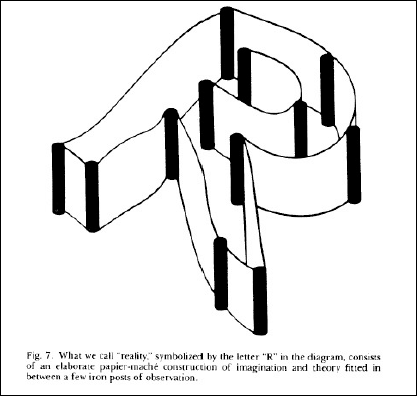
This was in the context of the construction of scientific theory, but I think it can be generalised. -
ArcheIf the Cosmos is an 'ordered whole' then the current speculative model of multiple universes does not conform to that description.
-
The case for scientific reductionismTell that Chat bot poetry composer that "how" and "know" do not rhyme. Neither do "stars" and "ours" for that matter. — Metaphysician Undercover
Yeah but I still thought it was pretty good.
Wayfarer

Start FollowingSend a Message
- Other sites we like
- Social media
- Terms of Service
- Sign In
- Created with PlushForums
- © 2026 The Philosophy Forum