
Comments
-
Donald Trump (All General Trump Conversations Here)France has a long tradition of demonsrating in the streets, since their much beloved revolution. The US hasn't had that tradition for a long time, yet I think, unfortunately, it will be the new normal for you now. — ssu
My point was that Europe also influences the US. It's a two-way street. Least we forget, fascism was born in Europe for instance, and all these white supremacists are in effect euro-centric by definition.
As for the tradition of demonstrating in the streets, remember the US has had a lot of that, historically, upto the civil rights movement at least. They too had a revolution (that influenced the French one much) so the US and France have something in common in their basic political mindset.
There was actually a guy among the rioters in the Capitol waving the tricolor. He wasn't downing a yellow jacket but I bet he was close.
Check this video taken by two female journalists, also French, who were reporting on the demonstration (2:07) and then decided to follow the rioters inside the Capitol (3:15 onward). The guy and his French flag appears at 5:40.
https://www.tf1.fr/tmc/quotidien-avec-yann-barthes/videos/capitole-le-recit-minute-par-minute-de-nos-journalistes-au-coeur-de-linvasion-16460883.html -
Donald Trump (All General Trump Conversations Here)Europeans really ape all things that happen in the US. — ssu
And vice versa. Those guys in Washington were aping the gillets jaunes. -
Generic and Unfounded Opinions on FascismFascism is not a hard-to-understand idea. It's just totalitarian hegelian rhetoric. It has not depth, it's all shiny mirrors.
Which does not mean that you can talk a fascist out of it, mind you. Any good ideologue lives in his own comfy mental prison, and he doesn't want to get out. You can't reach out to them by way of words. I've tried many times, not anymore. -
Donald Trump (All General Trump Conversations Here)a myth of American exceptionalism — Tobias
I never believed in any exceptionalism and am not saying Americans are magically removed from the human race's problems or America built on some shiny hill, just that they have dug themselves pretty deep right now as compared to the past few decades. The trajectory is downward, and they have reached a new low. Including in terms of mental health.
What are they going to do now? Arrest and trial thousands including the cops and armed forces who took part in the sack of the Capitol? Biden won't do that, I think. Too cleaving. I guess the important thing right now for him and his team is to manage security during the inauguration. -
Donald Trump (All General Trump Conversations Here)
Yes of course.Ironically the USSR was part of it too. Are they part of the guys that saved the world — Brett
There were a few great American leaders before, Lincoln, Teddy Roosevelt, etc. JFK in my opinion was of the same great American alloy. Too bad they killed him. Then there was the civil rights folks. MLK, Malcom X, Angela Davis, etc.But let’s say you’re right. It’s a very short period over the span of American history.
Now they have Sanders, who lost brilliantly to Biden, who won over The Douche, which must count for something... Let's see what Biden can do. History is not over. -
Donald Trump (All General Trump Conversations Here)Well, there was the great generation, the folks who fought and won in WW2. Those guys basically saved the world. Now their descendents doom the world, they are becoming a nuisance, an enemy of mankind.
-
Donald Trump (All General Trump Conversations Here)However that does not mean I cannot also find the deaths that this leads to tragic. Such an attack is not black and white, it is black and black. — Tobias
What I find truly tragic is that a nation which was one the smartest and most benevolent on Earth has been dumbed down to such a level of stupidity and hatred, where something like 40% of the people hate truth and wish their democracy away... That is truly tragic because it means thousands more deaths are in store, be it through inept COVID response, sheer idiocy and lies, or more violence. The death of that rioter symbolizes the cultural decline of a once great nation, its disunity, its lack of wit, the sheer stupidity and meaness of its political discourse. In that broader sense I agree it is tragic. -
Donald Trump (All General Trump Conversations Here)Try to imagine the same attack being perpetuated by people of non-white skin ... — javra
You got that right. They're crying because the dead terrorist is blond. -
Donald Trump (All General Trump Conversations Here)But she was shot before she could get through, as evidenced by her falling back into the room. — NOS4A2
Shit may happen when you attack a federal building, I suppose. -
Donald Trump (All General Trump Conversations Here)Indeed a drunk fool also does not deserve to die. You have a rather cavalier attitude to human life, but I think it is for the sake of argument. — Tobias
You have a rather cavalier attitude to attacks on democracy. -
Donald Trump (All General Trump Conversations Here)He might well be shot if he would storm the royal palace together with a whole violent gang. That would be tragic, because someone caught up in a feverous frenzy at the wrong time and place does not deserve to die, even if the shooting might be justified. — Tobias
There are far worse tragedies in this world. I see this one more as a ‘what did they except’ kind of tragedy, like when a drunken fool tries to walk on top of a train or to give a blow job to a bear... Darwin award material. -
Donald Trump (All General Trump Conversations Here)There Is No 'Peaceful Transition'
Molly Osberg for Jezebel.com
An hour ago
This morning I woke up and immediately turned on the radio, something I do regularly but which felt particularly urgent today. I wanted to know if there were any more pipe bombs discovered in federal buildings and how many people died as a direct result of the pro-Trump coalition of conspiracy theorists and white nationalists who stormed the Capitol building to ostensibly protest legitimate election results yesterday. (The answer, at least initially, was four.)
Imagine my surprise, then, to hear a steady stream of pundits and politicians looking forward to a “peaceful transition of power” with the same breath they used to describe yesterday’s events. I might argue that peaceful transition ended at one point or another in the past few months, and that the fantasy of an orderly progression from one administration to another has been delusional for about, say, four years. But perhaps you’ve seen the photographs of the guy in the Punisher vest carrying zip ties through the Senate chamber, or the one of men waving Trump flags as they scaled the Capitol wall: What should be obvious at this point is that the “peaceful transition” is irrefutably over now.
Since the election, the impulse to filter the grotesque or previously unimaginable through the language of optimism and stability has landed us in a bizarre place, watching the coup on the horizon as people on TV act as though saying words like democracy or integrity or bipartisanship will manifest a parallel reality in which the president’s supporters haven’t already been primed extensively to commit violence in his name.
This is why, I imagine, Ted Cruz and George Bush and Joe Biden and the CEOs of Blackstone and Morgan Chase as well as Facebook’s Mark Zuckerberg have all urged nearly verbatim that the transition be peaceful sometime in the last 12 hours, an outcome not only impossible on January 7th but one that many of those figures actively worked against to their significant personal gain. It’s a minor gripe given the rather extraordinary circumstances, but if there was ever a time to call something by its name it might as well be the time a crew of a losing candidate’s supporters broke into the Capitol with zip ties and guns to contest an election they’d been repeatedly encouraged to believe was a hoax.
The transition between presidents in 2021 is not peaceful. And there’s no way it’s going to be any more smooth or respectful of a process from here. There’s supposed to be an inauguration in two weeks. -
Donald Trump (All General Trump Conversations Here)The shooter might have acted in legitimate self defense or defense of others, but her death is tragic. — Tobias
It’s called law and order: if your Dutch guy tried to storm the royal palace instead of tagging it, he might get shot at too. -
Donald Trump (All General Trump Conversations Here)
No, this was certainly not a terrorist. And quite frankly if people honestly believe the election was stolen, this reaction would be totally understandable. — Benkei
It was certainly a person using violence for political gain, aka a terrorist or if you prefer, an old style fascist. And of course it’s logical from their screwed-up POV. Mussolini was logical too, and his reactions perfectly understandable from a fascist perspective. -
Donald Trump (All General Trump Conversations Here)She was veteran storming the capitol building only to be gunned down by police. It’s tragic. — NOS4A2
A terrorist was shot. Cry me a river. -
Donald Trump (All General Trump Conversations Here)What We Get Wrong About America’s Crisis of Democracy
The interesting question is not what causes authoritarianism but what has ever suspended it.
By Adam Gopnik - New Yorker - January 4 & 11, 2021 Issue
Readers of “Through the Looking-Glass” may recall the plight of the Bread-and-Butterfly, which, as the Gnat explains to Alice, can live only on weak tea with cream in it. “Supposing it couldn’t find any?” Alice asks. “Then it would die, of course,” the Gnat answers. “That must happen very often,” Alice reflects. “It always happens,” the Gnat admits, dolefully.
How the Bread-and-Butterfly survives, given the impossible demands of its diet, is a nice question. Lewis Carroll was in part teasing Darwinian ideas, which depend on a struggle for existence in which, eventually, we all lose—nonexistence being the norm of living things, over time. But the plight of the Bread-and-Butterfly comes to mind, too, when we contemplate what is called, not without reason, America’s crisis of democracy. It always happens. We are told again and again that American democracy is in peril and may even be on its deathbed. Today, after all, a defeated yet deranged President bunkers in the White House contemplating crazy conspiracy theories and perhaps even martial law, with the uneasy consent of his party and the rabid support of his base. We are then told, with equal urgency, that what is wrong, ultimately, is deep, systemic, and Everybody’s Fault. Perhaps there is a crisis of meaning, or of spirit; perhaps it is a crisis caused by the condescension of self-important élites. (In truth, those élites tend to be at least as self-lacerating as they are condescending, as the latest rounds of self-laceration show.)
Lurking behind all of this is a faulty premise—that the descent into authoritarianism is what needs to be explained, when the reality is that . . . it always happens. The default condition of humankind is not to thrive in broadly egalitarian and stable democratic arrangements that get unsettled only when something happens to unsettle them. The default condition of humankind, traced across thousands of years of history, is some sort of autocracy.
America itself has never had a particularly settled commitment to democratic, rational government. At a high point of national prosperity, long before manufacturing fell away or economic anxiety gripped the Middle West—in an era when “silos” referred only to grain or missiles and information came from three sober networks, and when fewer flew over flyover country—a similar set of paranoid beliefs filled American minds and came perilously close to taking power. As this magazine’s political writer Richard Rovere documented in a beautifully sardonic 1965 collection, “The Goldwater Caper,” a sizable group of people believed things as fully fantastical as the Trumpite belief in voting machines rerouted by dead Venezuelan socialists. The intellectual forces behind Goldwater’s sudden rise thought that Eisenhower and J.F.K. were agents, wittingly or otherwise, of the Communist conspiracy, and that American democracy was in a death match with enemies within as much as without. (Goldwater was, political genealogists will note, a ferocious admirer and defender of Joe McCarthy, whose counsel in all things conspiratorial was Roy Cohn, Donald Trump’s mentor.)
Goldwater was a less personally malevolent figure than Trump, and, yes, he lost his 1964 Presidential bid. But, in sweeping the Deep South, he set a victorious neo-Confederate pattern for the next four decades of American politics, including the so-called Reagan revolution. Nor were his forces naïvely libertarian. At the time, Goldwater’s ghostwriter Brent Bozell spoke approvingly of Franco’s post-Fascist Spain as spiritually far superior to decadent America, much as the highbrow Trumpites talk of the Christian regimes of Putin and Orbán.
The interesting question is not what causes autocracy (not to mention the conspiratorial thinking that feeds it) but what has ever suspended it. We constantly create post-hoc explanations for the ascent of the irrational. The Weimar inflation caused the rise of Hitler, we say; the impoverishment of Tsarism caused the Bolshevik Revolution. In fact, the inflation was over in Germany long before Hitler rose, and Lenin came to power not in anything that resembled a revolution—which had happened already under the leadership of far more pluralistic politicians—but in a coup d’état by a militant minority. Force of personality, opportunity, sheer accident: these were much more decisive than some neat formula of suffering in, autocracy out.
Donald Trump came to power not because of an overwhelming wave of popular sentiment—he lost his two elections by a cumulative ten million votes—but because of an orphaned electoral system left on our doorstep by an exhausted Constitutional Convention. It’s true that our diagnoses, however dubious as explanations, still point to real maladies. Certainly there are all sorts of reasons for reducing economic inequality. But Trump’s power was not rooted in economic interests, and his approval rating among his followers was the same when things were going well as it is now, when they’re going badly. Then, too, some of the blandest occupants of the Oval Office were lofted there during previous peaks of inequality.
The way to shore up American democracy is to shore up American democracy—that is, to strengthen liberal institutions, in ways that are unglamorously specific and discouragingly minute. The task here is not so much to peer into our souls as to reduce the enormous democratic deficits under which the country labors, most notably an electoral landscape in which farmland tilts to power while city blocks are flattened. This means remedying manipulative redistricting while reforming the Electoral College and the Senate. Some of these things won’t be achievable, but all are worth pursuing—with the knowledge that, even if every box on our wonkish wish list were checked, no set-it-and-forget-it solution to democratic fragility would stand revealed. The only way to stave off another Trump is to recognize that it always happens. The temptation of anti-democratic cult politics is forever with us, and so is the work of fending it off.
The rule of law, the protection of rights, and the procedures of civil governance are not fixed foundations, shaken by events, but practices and habits, constantly threatened, frequently renewable. “A republic if you can keep it,” Benjamin Franklin said. Keeping a republic is a matter not of preserving it like pickles but of working it like dough—which sounds like something you’d serve alongside very weak tea. But it is the essential diet to feed our democracy if we are to make what always happens, for a little while longer, happily unhappen. ♦ -
Can we see the world as it is?"see the world as it is" is inherently contradictory. "See" is a stand in for perceive. "Perceive" as we know it means to transform signals into a symbolic domain — hypericin
I agree. The phrase is self-contradictory. To « see » is to extract, to translate, to interpret, and therefore it implies a certain disturbance and interpretation. -
Generic and Unfounded Opinions on FascismHave any of you guys read any real fascist work? — Bertoldo
I’ve read What is Fascism by Mussolini, and Technique du Coup d’Etat by Malaparte, written when he was still a fascist. One thing you gotta give to Mussolini is a certain intelligence, a certain brilliance with words. Logical coherence and consistency were not his thing (Malaparte ended up calling him Monsieur Cameleon) but he had studied Hegel and others, and Fascism was in essence an attempted hegelian synthesis between socialism, nationalism and religion.
Mussolini could write, his rhetoric was powerful, a bit overdone for today’s taste, but it worked. Of course it is easy today to see that behind the glittering rhetoric hides a egotic, opportunistic mind, ready to use whatever argument that works for him. But back then many smart folks fall for him and his skillful way with words.
If Trump had been half as smart and energetic as Mussolini, the US would look very different today... in a bad way I mean. Luckily, Trump was more of a douche than a Duce. -
I THINK, THEREFORE I AMPLITUDE MODULATE (AM)Descartes' claim that he's thinking is no more justified than a radio's claim that it's creating the contents it's playing on its speakers. — TheMadFool
If this were the case, a conversation between two folks would be equivalent to a radio tuned to (say) the weather report making noise next to a radio tuned to (say) Beethoven's fifth. nobody could have a conversation with nobody else, because radios can’t exchange ideas that are not theirs. But instead, we can have conversation because we decide what to say, and we direct our thoughts. Or at least it feels like it.
So Descartes was right. It’s annoying, right? -
Confirmable and influential MetaphysicsGood paper, thanks. Definitely Popperian. So there is a metaphysical core (or several) to any scientific theory.
-
Confirmable and influential MetaphysicsThis has flared up in physics in respect of string theory and the multiverse; one side is arguing that these theories are not falsifiable in principle, so, not empirical, so, not really science; the other side is accusing those critics of being popperazi. — Wayfarer
I don’t know much about string theory but IF it cannot possibly be falsified, then I agree it is not a scientific theory. The problem with unfalsifiable theories is that they have no predictive value. You cannot use them to predict what will happen next. Therefore they do not add to our control and abilities. All they do is help us make sense (describe) an event or condition after it occurred.
I personally disagree with Popper on psychoanalysis. True that Freud himself kept tinkering his theories all the time and did not base them on much evidence, but his theories are nevertheless inherently falsifiable, and his tinkering of them shows an effort to fit the data better. E.g. he added ‘Thanatos’ (desire of death) to ‘Eros’ (the libido) after WW1, because he could not explain otherwise the extent of hatred, death and destruction seen in this war. So he postulated an instinct of death and destruction, operating side by side with an instinct of love and life. That shows a bona fide effort to explain experience. Other tenets of Freud have been invalidated by experience, such as ‘penis envy’.
Finally, psychoanalysis have led to the development of many related theories and approaches, some of which are practical and effective, e.g. transactional analysis, or Bateson’s analysis of family dynamics and ‘double-binds’. -
Confirmable and influential MetaphysicsIn principle, burning a book is reversible — Marchesk
Like a rotten corpse can be brought back to life, in principle. All you have to do is convince the bacteria eating it to work backward in time, deproliferate (I suppose mitosis is reversible, in principle) and reconstruct the dead body the way they found it when it died.
In principle. But in reality, it never ever happens, because the odds are beyond minuscule. Just like you rarely see bullets ejected by a wounded body right back into the hole of a handgun canon, though it is possible, in principle. -
Confirmable and influential MetaphysicsThe Black Hole Information Paradox is a big issue in physics because information loss would mean processes cannot in principle be time reversible, which is not the case with most of physics. — Marchesk
Thermodynamics teach that information can be lost, is in practice lost all the time, and thus that some events are irreversible. When you burn a book and spread the ashes, it becomes hard to read. When somebody dies, she becomes hard to resuscitate. When a species becomes instinct, it’s hard to recreate it... If tomorrow our planet was swallowed by a black hole, I imagine the planet would melt into some particle soup, and us too. I seriously doubt that we would be able to keep talking about Schopenhauer and Descartes on the forum, unaffected. -
Deep SongsThis is the first day of my life
I swear I was born right in the doorway
I went out in the rain
Suddenly everything changed
They're spreadin' blankets on the beach
Yours is the first face that I saw
I think I was blind before I met you
I don't know where I am
I don't know where I've been
But I know where I want to go
So I thought I'd let you know
That these things take forever
I especially am slow
But I realized that I need you
And I wondered if I could come home
Remember the time you drove all night
Just to meet me in the morning
And I thought it was strange
You said everything changed
You felt as if you just woke up
And you said,
This is the first day of my life,
I'm glad I didn't die before I met you
But now I don't care I could go anywhere with you
And I'd probably be happy.
So if you wanna be with me
With these things there's no telling
We'll just have to wait and see
But I'd rather be working for a paycheck
Than waiting to win the lottery
Besides maybe this time it's different
I mean I really think you like me...
-
Towards a Scientific Definition of "Free Will"This essay tries to define agency in physical terms:
Agency in Physics, by Carlo Rovelli
https://arxiv.org/pdf/2007.05300.pdf
Also worth checking the work of Jennan Ismael. -
Incel movement and hedonismI argue that "incel" is just used as a synonym for "young single white male loser". — Garth
Why white? Why male, even? Not saying that these adjectives don’t work here, they do, but why do people not call ‘incels’ those young females who never get laid? And whats do we call the young black males who don’t get any? Nobody cares... they are not called anything.
This points to a sense of white male entitlement being at the core of the incel psychology. People who lack this sense of entitlement are apparently not developing this particular form of mental illness. So an incel is a young white male who thinks he deserves some but ain’t getting any.
And who or what does the incel thinks he deserves? The cutest girls of course, the ones he wanks on on his cellphone. Here is the real tragedy, because there are thousands of girls out there not getting any either... and quite a few of them because they want the cutest boys too... If only these sexually ambitious boys and girls would lower their aim a little bit (considering that the cutest girls tend to go with the cutest boys and vice versa), they would easily find a mate.
So why don’t they? Why do folks stay alone all their life rather than ‘settle’ for what they can have? The answer to this is in Houellebecq, e.g. in Extension du domaine de la lutte. -
Confirmable and influential MetaphysicsConservation of momentum, energy, — Banno
... are easy to test and clearly not metaphysical. Never heard of conservation of information though. -
Can we see the world as it is?Then does "the world as it is in itself" make any sense? — Banno
Yes it does, as an horizon, and as the necessary hypothesis for empirism. -
Can we see the world as it is?But we do see the world as it is to some degree. You seem to see this professor and his biases, for example. — deletedusercb
People are easier to see than atoms and neutrinos, evidently. It depends. But as a general rule, the map is always at a variance with the territory, and to maintain this distinction is important to understand biases. -
Can we see the world as it is?Hence, Olivier, I agree with your comment, there is an awful lot of truth we can say about the world. — Banno
In its relation to ourselves and in our relation to it, yes. But we can’t say much about the world as it is in itself. If you assume that you know the world as it is, then you are totally oblivious to the possibility that you may have biases. Any disagreement is simply because the other person is wrong. I suspect that is precisely why David Stove was such an misogynist and racist: he believed he saw the world as it was, and if in that world the tenured professors in Sydney U were all white and males, it was because white males display more intellectual merit than other people, not because there was a bias in the system...
We can do better than that. -
Can we see the world as it is?". The idea is that there is a world that stands outside our perceptions of it, and hence is outside of our capacity to discern. Further, this world, beyond our keen, is the actual thing. Since we cannot discern the goings on in this world as it is in itself, we cannot make statements about it, let alone true statements. On this view, there is precious little that we can say that is true. — Banno
I agree with the begining of this quote, of course. The hypothesis of a world independent of what we think or perceive of it is fundamental to explain disagreements between people. However, your last sentence in unwarranted: there is an awful lot of truth we can say about the world, in its relation to ourselves and in our relation to it. What escapes us is its ontology: what is matter, for instance, apart from something we hurt our toes on? -
Scottish independenceI wish the Scots would do so, but won’t bet on it. Economically, it could work out for them fine IF they are given a quick EU accession path and I believe that the 27 would be willing and even eager to offer a quick accession to an independent Scotland. But the power of habit...
-
Can we see the world as it is?in the novel Van Gogh saw through the eyes of Eustis once, and tried to paint the world as seen by the gods — Olivier5
A possible interpretation is that the artist lends us his eyes to see the world in a new way, more meaningful, more beautiful than the way we usually see it, and in doing so, the artist helps us rediscover the primordial enchantement of being at the world. -
Can we see the world as it is?I'm not familiar with Eustis; but it's a good story (apropo). Thanks. — Bitter Crank
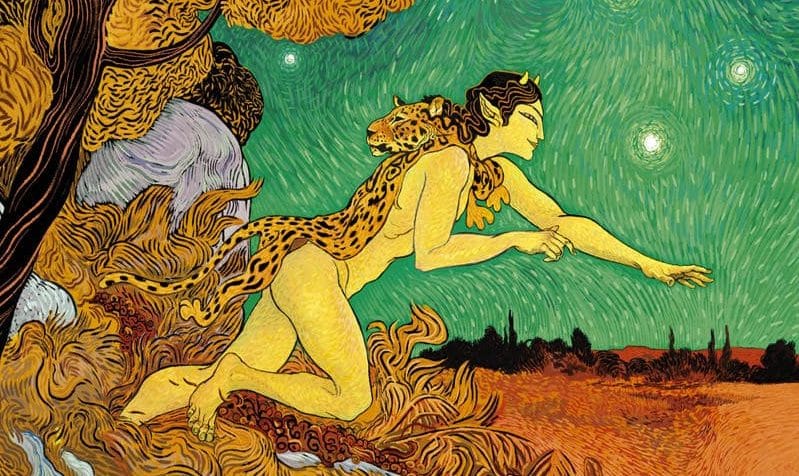
It’s one of many good stories in a stupendous graphic novel by Italian Fabrizio Dori, called Il Dio Vagabondo (the Vagrant God). I don’t think it has been translated in English yet. It should be, it’s a masterpiece.
Imagine a minor olympian divinity left alone in our modern, disenchanted world. Other gods of old, his companions, have disappeared when Christianity swept over the world. He lives by himself in a sunflower field, and he drinks a lot — aptly so, for ‘Eustis’ means ‘good grapes’ in Greek and Eustis’ ex-boss, Dionysos, is the god of wine.
But in fact Eustis has only been banished by the gods in the world of mortals. An old professor will help him find his way to where his divine buddies are hiding from the cold and rational beings that humans have become.
Graphically, Il Dio Vagabondo functions as an homage to Van Gogh. As explained, in the novel Van Gogh saw through the eyes of Eustis once, and tried to paint the world as seen by the gods. Unfortunately, humans cannot stand the full extent of the world’s beauty, and Van Gogh was maddened by it and committed suicide.
Dori’s previous novel was about Gauguin, so he is quite ambitious both graphically and narratively.
-
Can we see the world as it is?Yeats' poem, The Second Coming, suggests what it would be like if the 'much different and true reality' should become perceptible: — Bitter Crank
I prefer the version of Fabrizio Dori in Le Dieu Vagabond (The Wandering God), which tells the story of Eustis, a Greek god, a satire to be precise, from the retinue of Dionysos, wandering in the modern world as a bum. If you give him a bottle of wine, he will tell you your future. Like all gods, he sees the world as it really is, not the pale version that human eyes can see. Once, only once, Eustis lent his eyes to a mortal, a painter, who wanted very badly to see the world as it is. After he saw the world through the eyes of Eustis, the painter started to work furiously on canvas after canvas, to try and capture the vision he just had. But the beauty of this vision was so great that the artist started to despair of his ability to paint it, and committed suicide. His name was Vincent Van Gogh... Since then Eustis does not allow men to see the world through his eyes, even in exchange for a lot of wine. -
Can we see the world as it is?The point is that you cannot account for something as simple as a disagreement if we all see and know the world ‘as it is’. For there is only one world, and many different views about it...
Likewise, the assumption renders one unable to account for individual bias. -
Can we see the world as it is?Were sensory experience highly variable (such that some people perceived water as dry, fire as cool, thunder as a sucking sensation, and so on), we couldn't say the world is as we see it. — Bitter Crank
When two people seeing the world as it is disagree about what it is, are they seeing two different worlds?
Olivier5
Start FollowingSend a Message
- Other sites we like
- Social media
- Terms of Service
- Sign In
- Created with PlushForums
- © 2026 The Philosophy Forum