
Comments
-
Is Weakness Necessary?
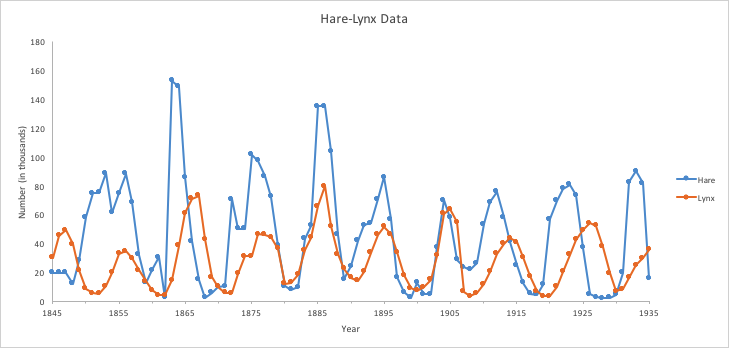
This effect leads to cyclical population growth and decline in prey and predator, as illustrated here:In natural predator-prey relationships if a predator is so strong a hunter it proliferates and the prey population declines, their group gets equally wiped out. — kudos
-
Mary's RoomTo describe in writing Beethoven's 9th to a completely deaf person so that he would 'hear' it seems indeed impossible. Likewise with explaining the color red to a blind man, or the scent of vanilla to someone who never experienced it.
-
Midgley vs Dawkins, Nietzsche, Hobbes, Mackie, Rand, Singer...I did find her article enjoyable, witty but a bit too much all over the place. The arguments could have been presented with greater clarity, in sequence, in my not so humble opinion. Hence the "doing so always makes for confused argument".
-
Midgley vs Dawkins, Nietzsche, Hobbes, Mackie, Rand, Singer...
Indeed, and he is also saying that these ways of speaking are about the behaviors of genes and animals. Hence my objection remains valid:He's saying that altruism and selfishness are not emotional states at any scale — Kenosha Kid
We are left to wonder how a gene could possibly "behave" in the first place, how it could possibly "behave" to increase another gene's "welfare", and even how it could possibly pay for the "expense". As for "the exact opposite" of altruism, what would that be? An entity that behaves to increase its own welfare at the expense of other entities' welfare? How would that happen in the case of a gene? The gene for cholinesterase tells the gene for hemoglobin to get lost because he's taking over it's locus? Or are we talking about alleles, mysteriously undermining the chances of other alleles present in other organisms? -
Midgley vs Dawkins, Nietzsche, Hobbes, Mackie, Rand, Singer...
He is obviously speaking about the behaviors of genes and animals. What else? The behaviors of lampposts?It doesn't require explaining — Kenosha Kid -
Midgley vs Dawkins, Nietzsche, Hobbes, Mackie, Rand, Singer...should not have apologized for it. — StreetlightX
Apology is due, not only for the delay but for the impatient tone of my article. One should not lose one’s temper, and doing so always makes for confused argument. My basic objections remain. But I certainly ought to have expressed them more clearly and temperately. — Mary Midgley -
Midgley vs Dawkins, Nietzsche, Hobbes, Mackie, Rand, Singer...
:up:It is incredibly muddled, and it obfuscates far more than it illuminates. — StreetlightX -
Midgley vs Dawkins, Nietzsche, Hobbes, Mackie, Rand, Singer...Denial it is... So by your rather peculiar understanding of the English language, he is not talking of animals, human being or genes in that quote.. What IS he talking about then, according to you?
-
Midgley vs Dawkins, Nietzsche, Hobbes, Mackie, Rand, Singer...I thought you'd like it.
-
Midgley vs Dawkins, Nietzsche, Hobbes, Mackie, Rand, Singer...He's not talking about genes in that quote, — Kenosha Kid
He is. You are in denial.
When biologists talk about 'selfishness' or
'altruism' we are emphatically not talking about emotional nature, whether of human beings, other animals, or genes. -
Midgley vs Dawkins, Nietzsche, Hobbes, Mackie, Rand, Singer...He says himself it's not metaphoric use. It's some "special meanings" of selfish and altruist that he made up entirely, and that don't work. Genes couldn't possibly behave altruistically even if they wanted to, if one defines altruism as Dawkins does. Similarly, genes cannot be described as selfish even by his non-definition of it, since they constantly share pieces of information with one another in a process called recombination. So alleles constantly put their fitness at risk by giving a piece of themselves to the other alleles in the same genome, and receiving a piece in exchange.
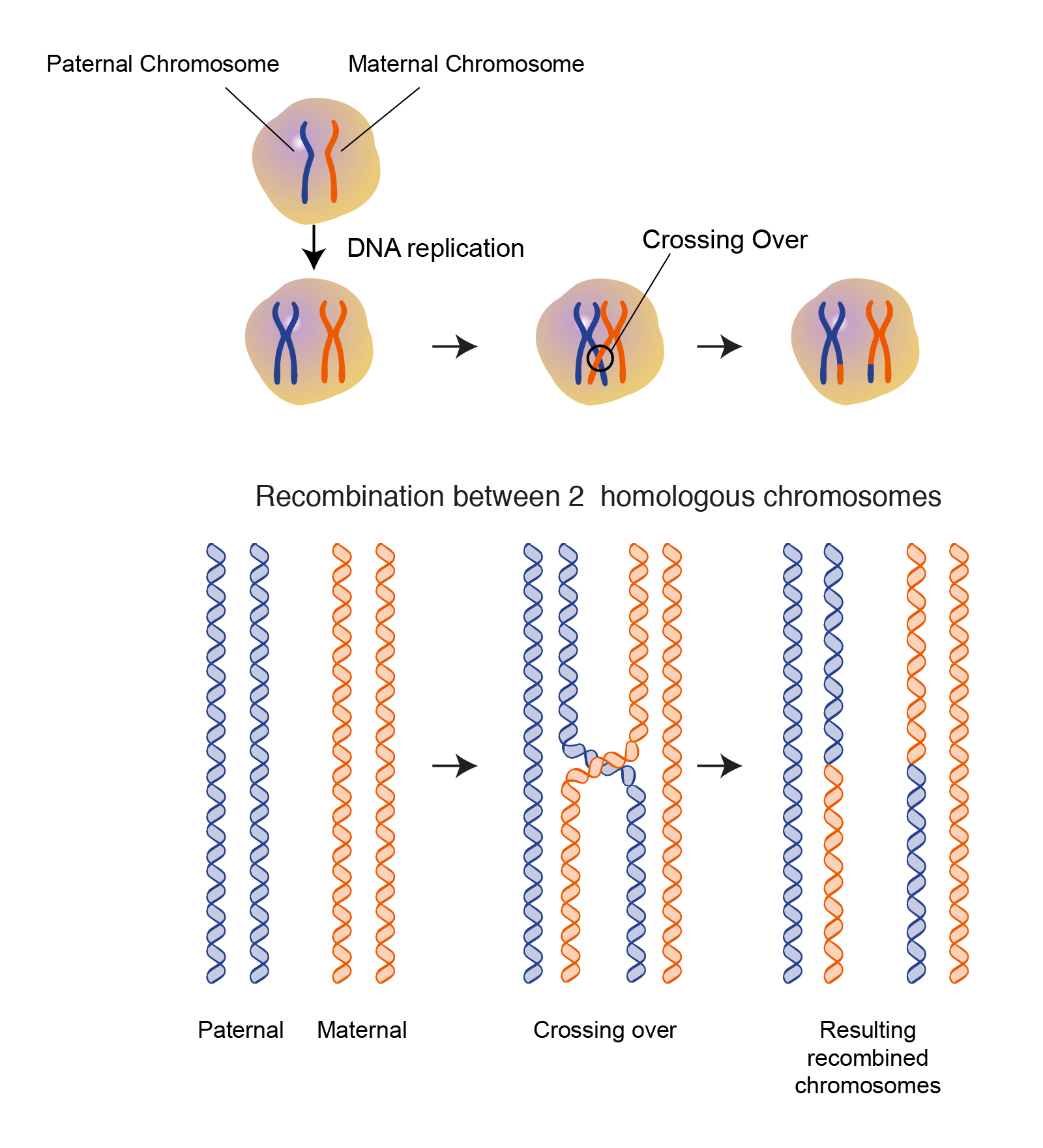
Homologous recombination is a type of genetic recombination that occurs during meiosis (the formation of egg and sperm cells). Paired chromosomes from the male and female parent align so that similar DNA sequences from the paired chromosomes cross over each other. Crossing over results in a shuffling of genetic material and is an important cause of the genetic variation seen among offspring.
https://www.genome.gov/genetics-glossary/homologous-recombination -
Midgley vs Dawkins, Nietzsche, Hobbes, Mackie, Rand, Singer...
You cannot have an altruistic gene if you define it the way he does, evidently. A gene can only replicate itself. It's not like it has the capacity to replicate a Mercedes-Benz instead.The point that you couldn't possibly have an "altruistic" gene is one I made quite a while ago. It doesn't make any sense. A selfish gene -- one that adapts to prolong itself -- is both viable and accurate. — Kenosha Kid -
Midgley vs Dawkins, Nietzsche, Hobbes, Mackie, Rand, Singer...I ve edited my post for clarity.
-
Midgley vs Dawkins, Nietzsche, Hobbes, Mackie, Rand, Singer...Unless of course one is looking for an excuse. In this case, bringing genes into the conversation is useful, to be able to say "my genes made me do it".
IOW, one of the reasons some guys here are in awe with Dawkins is that he explained to them that they were not free agents but mere machines. In the book, "Gene the Selfish" controls the human beings he is encased in. Them kids' obsession with determininism was confirmed by some (fake, distorted) biology, so they got all excited.
I've read through Dawkins' response to Midgley (here). It's confused blah. He says "biologists use these words ("altruist", "selfish") in a special way, and then he fails to define the oh-so-special meaning he gives to them... To wit:
We are left to wonder how a gene could possibly "behave" in the first place, how it could possibly "behave" to increase another gene's "welfare", and even how it could possibly pay for the "expense". As for "the exact opposite" of altruism, what would that be? An entity that behaves to increase its own welfare at the expense of other entities' welfare? How would that happen in the case of a gene? The gene for cholinesterase tells the gene for hemoglobin to get lost because he's taking over it's locus? Or are we talking about alleles, mysteriously undermining the chances of other alleles present in other organisms? The whole conceptual framework is muddy and unhelpful.When biologists talk about 'selfishness' or
'altruism' we are emphatically not talking about emotional nature, whether of human beings, other animals, or genes. We do not even mean the words in
a metaphorical sense. We define altruism and selfishness in purely behaviouristic ways: 'An entity . . . is said to be altruistic if it behaves in such a way
as to increase another such entity's welfare at the expense of its own. Selfish behaviour has exactly the opposite effect. -
Midgley vs Dawkins, Nietzsche, Hobbes, Mackie, Rand, Singer...Why are you wasting your time arguing with people online about it? — Saphsin
Partly because I find bizarre, convoluted metaphors funny, but also because I believe it is wrong to miseducate lay people with the wrong ideas about evolution. If you want to discuss a specific point of sociobiology, I'd be happy to. -
Midgley vs Dawkins, Nietzsche, Hobbes, Mackie, Rand, Singer...If you dislike the metaphor so much, fine. As I mentioned earlier, Dawkins did too and preferred the term Immortal Gene. You can google it. My problems with the book is that it's outdated science, don't waste your time going around in circles because the terminological usage offends you so much. — Saphsin
I agree. The 'metaphor' means something quite true and oft forgotten: that genes can only replicate themselves.
Soooo selfish of them! I can't believe the scoundrels... You'd think they would have the good grace of replicating a few alternative versions of themselves, rather than replicating just themselves all the sodding time, right?
I really wish my genes could replicate silver spoons and bank notes. I think that's the least they could do, but apparently they are just too selfish, huh? -
Midgley vs Dawkins, Nietzsche, Hobbes, Mackie, Rand, Singer...The title of the book is The Selfish Gene, not The Selfishness Gene; — Srap Tasmaner
Actually it was a typo. The title should read: "Gene the Shellfish". -
Midgley vs Dawkins, Nietzsche, Hobbes, Mackie, Rand, Singer...
"Gene the Suicidal" doesn't have the same ring to it, I'm afraid. Your metaphor has limited blockbuster potential.genes are antinatalists. — unenlightened -
Midgley vs Dawkins, Nietzsche, Hobbes, Mackie, Rand, Singer...Brilliant!

GENE THE SURVIVOR
(episode MMMMMMMMMMMMMMMMMMMMMM MMMMMMMMMMMMMMMMMMMMMMMMMMMMMMMMMMMMMMMMCCCCLXXXIV) -
Midgley vs Dawkins, Nietzsche, Hobbes, Mackie, Rand, Singer...And because genes are not literally selfish, we are not born selfish. — unenlightened
Indeed. But we are born survivors, so the better metaphor is: "Gene the Survivor".
Now I wonder, who could play the part if it was made in a movie? Vin Diesel? Jean-Claude Van Damme? -
Midgley vs Dawkins, Nietzsche, Hobbes, Mackie, Rand, Singer...Yes, it's about finding a less negative, less jaundiced, less Thatcherist metaphor, one that more genuinely reflects the scientific data, without all the emotional bias.
"Gene the Survivor" is my favorite. It rolls off the tongue nicely, is dramatic enough for the kids, with just a tinge of Nitschean theater, and it almost rhymes with Conan the Barbarian. But it also expresses well the resilience of life, and the important idea that our hero Gene has survived SO FAR. We may be adapted to our past but are we adapted to our present?
Gene the Survivor's movie is TO BE CONTINUED... -
Midgley vs Dawkins, Nietzsche, Hobbes, Mackie, Rand, Singer...Okay so it means "natural selection works on genes, eliminates the weak ones, and keeps the strong". Fair enough.
The Strong Gene, then. Or "Gene the Survivor". -
Midgley vs Dawkins, Nietzsche, Hobbes, Mackie, Rand, Singer...When we describe this behaviour as "selfish" metaphorically, it does not make sense to ask where this selfishness came from as if it were a literal thing. Do you understand? — Kenosha Kid
What I understand is that the metaphor of "selfish gene" maps to itself, it has no content, nothing that it is alluding to other than itself.
It doesn't actually mean anything more than "Let's see how the world would look like if the traditional perspective was reversed, that is, if we'd consider that genes were replicating themselves through us, instead of us through them."
So it's a different perspective to evolution, one driven by genes rather than by the fitness of individuals to their social and ecological environment. -
Midgley vs Dawkins, Nietzsche, Hobbes, Mackie, Rand, Singer...
And where is the selfishness coming from? It's in the eye of the beholder. A better metaphor would be: alleles that survived were historically better at 'propagating themselves' [metaphorically] than those that didn't survive. That says nothing about their inherent selfishness or altruism. It's a good scientific metaphor. Much better though less dramatic than some Chicago mafioso metaphor, so less appealing to the kids.Thus metaphorically genes are adapting to propagate themselves. ... This is a useful metaphor. — Kenosha Kid
Midgley quotes a few.I recall no such instruction from Dawkins' book to cease taking genetic selfishness metaphorically, do you? — Kenosha Kid
that it misrepresents the scientific knowledge about ethology and evolution — Olivier5
What part of "it misrepresents the scientific knowledge about ethology and evolution" did you fail to understand?No. That's treating the metaphor as being literal. You do understand what a metaphor is, right? — Kenosha Kid
It does not, for instance, eradicate the view that humans themselves are intrinsically altruistic. — Kenosha Kid
Why, I think it does, by saying that any altruism in transactional, a desguised selfishness. -
Midgley vs Dawkins, Nietzsche, Hobbes, Mackie, Rand, Singer...As an illustration of her verve (about memes):
So, apparently, if we want to study (say) dances, we should stop asking what dances do for people and should ask only what they do for themselves. We shall no longer ask to what particular human tastes and needs they appeal, how people use them, how they are related to the other satisfactions of life, what feelings they express or what needs cause people to change
them. Instead, presumably, we shall ask why dances, if they wanted a host, decided to parasitize people rather then elephants or octopuses.
Now, to be fair, the memes of dances did come down from their platonic realm onto the puffins too. I don't know about octopuses.
-
Midgley vs Dawkins, Nietzsche, Hobbes, Mackie, Rand, Singer...
Interesting... What pedagogic power, may I ask?Well it is a useful metaphor, insofar as it has pedagogical power — Kenosha Kid
She makes a series of points, to be fair. One is that indeed Dawkins is ambiguous on the metaphor thing. Another points is that even if it was just a metaphor (which it's not), the 'selfish genes' idea would be a luridly simplistic and misleading metaphor, that it misrepresents the scientific knowledge about ethology and evolution. Yet another point is that doing so is immoral, as it leads Dawkins' readers to either rationalise and amplify their most selfish behaviors (if they are 'winners' in the economic game, their genes deserve it), or to fatalism (if they are 'losers' in this game, that's because they have losers genes).Also, that was not her point. Her point rests on pretending that the metaphor is not a metaphor, such that she can construct the straw man that the selfish gene idea is some kind of social Darwinism and attack that straw man. -
Midgley vs Dawkins, Nietzsche, Hobbes, Mackie, Rand, Singer...The dislike for the idea of a gene behaving as if it were selfish, even though that is a useful metaphor for the actual behaviour, — Kenosha Kid
Her point -- and I think it is correct -- is precisely that it is NOT a useful metaphor. That a better metaphor would be that the genes are strong (i.e. efficacious).
Not just. It could be a gene that 'collaborates' with other genes for an optimal outcome... A gene that works as part of a whole, like each player in an orchestra. Or it could be a metaphor for a gene (or set of alleles to be precise) that induces some capacity to empathy and altruism. Or it could mean that some of our collaborative and positive traits have been selected as efficacious, somehow, for the survival of the group.an altruistic gene would be a gene that sacrificed itself for the sake of another gene. — Kenosha Kid -
Midgley vs Dawkins, Nietzsche, Hobbes, Mackie, Rand, Singer...genes are not moral patients, people are. — Pfhorrest
My point entirely. Bringing genes in the equation does not help much. -
Currently ReadingI have read the Open Society in two volumes. As it was published I think?
You can always cut the 800 pages volume in two halves, if that helps. -
Midgley vs Dawkins, Nietzsche, Hobbes, Mackie, Rand, Singer...
I think you are correct that it was part of the zeitgeist. It was certainly central to Midgley's beef. She called Dawkins' theory "biological Thatcherism".
I note that The Selfish Gene is mainly based on the work of William Hamilton in the hippy, community-oriented 1960's, which was about the theoretical genetic basis of altruism. A decade later in Dawkins' book, the same ideas are presented in defense of individualism. Hypothesis: the change in zeitgeist explains the change of perspective here.
Said more crudely, a book making more or less the same Hamiltonian case about how our social behavior might have some evolutionary background rather than be pure 'nurture', but titled "The Altruistic Gene" would not have sold so well in the late seventies. It would not have resonated quite as much as "The Selfish Gene" did. -
Midgley vs Dawkins, Nietzsche, Hobbes, Mackie, Rand, Singer...As for Midgley's tone — Banno
I'm reading her wikipedia entry and the Philosophy Now article about her. I like her a lot so far, so thanks for the introduction.
She always was a polemist, a fighter, a sarcastic and down-to-earth writer. The paper you posted, Gene-juggling, is complex, a bit convoluted, but acerbic and assertive, and as you said, it works. There's something shrudely effective in her very British wit. I don't think age had much to do with it.
The last sentence I read in the PN bio was:
So it seems to go way back.To understand how Midgley became a fierce philosophical rebel, we have to go back to Oxford in the Second World War.
I totally subscribe to this (from wiki):
Midgley argued that philosophy is like plumbing, something that nobody notices until it goes wrong.
Also she wrote about the problem of evil in an agnostic/atheist frame, which is a topic that gives me much puzzlement. So I'll try and read that. -
Midgley vs Dawkins, Nietzsche, Hobbes, Mackie, Rand, Singer...Ach, it fitted the tone of the times, along with Milton Friedman and all that garbage about self interest. — Banno
Okay. Well spotted. There's some truth to the point that capitalism has something competitive that fits our nature of competitive animals, as long as one remembers that capitalism amplifies human greed, and puts us on a runaway train to climatic hell. -
Midgley vs Dawkins, Nietzsche, Hobbes, Mackie, Rand, Singer...From a Darwinian standpoint rape advantages the rapist, but evidently not his victim, just like parasitism only benefits the parasite, not the host.
-
Midgley vs Dawkins, Nietzsche, Hobbes, Mackie, Rand, Singer...Take it as a florish of evolution, a flare of artistic creativity.
-
Midgley vs Dawkins, Nietzsche, Hobbes, Mackie, Rand, Singer...
The best theory I know is that nice feathers in male birds code for health and fitness, which would be why they are seen as attractive by the ladies in most bird species.It must be, so the myth would have us believe, because partnering with a male with a big tail somehow helps the female's genes to survive. — Banno
This does not explain the extravaganza that a peacock trail is. Most probably Darwin was right and it's just that the sexual pairing system of peacocks (complete with mating dances and rituals of course) went in overdrive somehow, with the ladies really really liking them shiny colors. -
Midgley vs Dawkins, Nietzsche, Hobbes, Mackie, Rand, Singer...It's just an example of how involving the genes brings nothing to the fore. Replace 'rape' with 'selfishness' if you prefer. Did we need Dawkins to tell us that human nature includes it's fair share of selfishness, greed, egocentrism, and narcissism? Was that still a scoop in 1976?
-
Midgley vs Dawkins, Nietzsche, Hobbes, Mackie, Rand, Singer...
That's a good question alright. Some argue that rape fantasies have been genetically selected by our evolutionary history, for instance. E.g. our history is one of rape --> we developed some liking to it --> more rapes happened. What would be the moral consequences if it was proven true?The question is how to knit together the blind, mechanical reproduction of genetic material with the layered, complex behavior of the creatures carrying that material. — Srap Tasmaner
a. To pardon at least some rapists, those who can prove their genes made them do it?
b. To edit out of our genome the guilty genes by various eugenic techniques?
c. To punish rape harshly, while playing out our age-old fantasies with consenting adults?
I vote for c., if anyone needs to know. It is not radically new but more needs to be done (on both fronts of solution c).
My point here is to show that the gene argument brings very little that is actually new to this debate. Moralists have been warning us of the bestial nature of man since what? The Jurassic? No wait... -
Midgley vs Dawkins, Nietzsche, Hobbes, Mackie, Rand, Singer...Back to Midgley. I really liked this part where she quotes Jane Goodall:
" In the species most like our own, lasting resentment after injuries is by no means a prominent or important motive. In some cases, of course, immediate fighting is possible, but prolonged grudge-bearing is rare and trivial. Jane Goodall notes with interest how in her chimps the usual effect of an injury is something very different—a distressed approach to the aggressor with a demand for reconciliation. What seems to be most noticed is not the injury itself, but the failure of the social bond:
A chimpanzee, after being threatened or attacked by a superior, may follow the aggressor, screaming and crouching to the ground or holding out his hand. He is, in fact, begging a reassuring touch from the other.
Sometimes he will not relax until he has been touched or patted, kissed or embraced (In the Shadow of Man, p. 221).
While a male chimpanzee is quick to threaten or attack a subordinate, he is usually equally quick to calm his victim with a touch, a pat on the back, an embrace of reassurance. And Flo, after Mike's vicious attack, and even while her hand dripped blood where she had scraped it against a rock, had hurried after Mike, screaming in her hoarse voice, until he turned. Then as she approached him, crouched low in apprehension, he had patted her again and again on her head, and as she quietened, had given her a final reassurance by leaning forward to press his lips on her brow (p. 114).
As she points out, this reaction makes it possible to resume the relationship as though the injury had never taken place. (A community of retentive 'grudgers' would by contrast be a terribly insecure one; no lapses would be tolerated.) She rightly remarks, too, that small human children do the same thing. It is only for adult human beings, with their much stronger powers of memory, imagination and foresight, that this simple reaction becomes impossible. " -
Midgley vs Dawkins, Nietzsche, Hobbes, Mackie, Rand, Singer...
Okay so he changed his mind at some point. A good point for him I suppose.

Olivier5

Start FollowingSend a Message
- Other sites we like
- Social media
- Terms of Service
- Sign In
- Created with PlushForums
- © 2026 The Philosophy Forum