
Comments
-
Infinite Staircase Paradox@Metaphysician Undercover @TonesInDeepFreeze @fishfry
I've moved your discussion on set ordering and the meaning of equality to this discussion. -
Infinite Staircase ParadoxI'm not firmly opining as to whether A implies B — TonesInDeepFreeze
Then let's rephrase P1 as a question.
If the first task is performed at 11:00, the second at 11:30, the third at 11:45, and so on, then how many tasks are performed by 12:00?
nor as to whether B is possible. — TonesInDeepFreeze
This is where Thomson's lamp comes in. His argument is that if B is performed then a contradiction follows; the lamp can neither be on nor off at 12:00 but must be either on or off at 12:00. Therefore B is proven impossible.
I'm not sure whether the argument is modally valid — TonesInDeepFreeze
I'm pretty sure it is. But if you prefer:
P1. If (A) it is possible for the first task to be performed at 11:00, the second at 11:30, the third at 11:45, and so on, then (B) it is possible for infinitely many tasks to be performed by 12:00
P2. It is not the case that B
C1. Therefore, it is not the case that A
First, though, what sense of 'possible' is meant? Thomson discusses physical possibility and logical possibility. If I'm not mistaken, he doesn't mention metaphysical possibility. Of course, discussion doen't have to be limited to Thomson's context, but 'metaphysical possibility' requires even more explication. — TonesInDeepFreeze
See subjunctive possibility:
Logical possibility is usually considered the broadest sort of possibility; a proposition is said to be logically possible if there is no logical contradiction involved in its being true. "Dick Cheney is a bachelor" is logically possible, though in fact false; most philosophers have thought that statements like "If I flap my arms very hard, I will fly" are logically possible, although they are nomologically impossible. "Dick Cheney is a married bachelor," on the other hand, is logically impossible; anyone who is a bachelor is therefore not married, so this proposition is logically self-contradictory (though the sentence isn't, because it is logically possible for "bachelor" to mean "married man").
Metaphysical possibility is either equivalent to logical possibility or narrower than it (what a philosopher thinks the relationship between the two is depends, in part, on the philosopher's view of logic). Some philosophers have held that discovered identities such as Kripke's "Water is H2O" are metaphysically necessary but not logically necessary (they would claim that there is no formal contradiction involved in "Water is not H2O" even though it turns out to be metaphysically impossible).
Nomological possibility is possibility under the actual laws of nature. Most philosophers since David Hume have held that the laws of nature are metaphysically contingent—that there could have been different natural laws than the ones that actually obtain. If so, then it would not be logically or metaphysically impossible, for example, for you to travel to Alpha Centauri in one day; it would just have to be the case that you could travel faster than the speed of light. But of course there is an important sense in which this is not possible; given that the laws of nature are what they are, there is no way that you could do it. (Some philosophers, such as Sydney Shoemaker, have argued that the laws of nature are in fact necessary, not contingent; if so, then nomological possibility is equivalent to metaphysical possibility.)
I am claiming that supertasks are more than just nomologically impossible. They are either logically impossible or metaphysically impossible. I say the latter simply because it's the weaker claim. -
Infinite Staircase Paradox
Where is the conflation in my argument? I'll set it out more clearly:
P1. If (A) the first task is performed at 11:00, the second at 11:30, the third at 11:45, and so on, then (B) infinitely many tasks have been completed by 12:00
P2. B is impossible
C1. Therefore, A is impossible
The argument is certainly valid; it's modus tollens. So are you saying that A doesn't entail B or are you saying that B is possible? -
Infinite Staircase Paradox(1) We may question P2. — TonesInDeepFreeze
P2 is what Thomson tries to prove by introducing his lamp. Having performed infinitely many tasks entails a contradiction (the lamp must be either on or off but cannot be either).
(2) C1 doesn't follow from P1 and P2. — TonesInDeepFreeze
It seems to be a straightforward modus tollens.
If A then B
B is impossible
Therefore, A is impossible -
Infinite Staircase ParadoxIt is incorrect to infer that infinitely many tasks may be completed in finite time from the premise that there is no finite upper bound to how many task may be completed in finite time. I would put it this way: For for any finite number of tasks, there may be a completion of all the tasks. But that does not imply that there may be a completion of all of infinitely many tasks. — TonesInDeepFreeze
So from this we make the following argument:
P1. If the first task is performed at 11:00, the second at 11:30, the third at 11:45, and so on, then infinitely many tasks have been completed by 12:00
P2. It is impossible to have completed infinitely many tasks
C1. Therefore, it is impossible for the first task to be performed at 11:00, the second at 11:30, the third at 11:45, and so on.
So what prevents the performance of the first task at 11:00, the second at 11:30, the third at 11:45, and so on? One answer is that it is metaphysically necessary that time is discrete with some smallest unit of time. At some point the time between task n and task n+1 is equal to the time between task n+1 and task n+2.
Is there another answer that allows for continuous time? -
Infinite Staircase ParadoxWhere in the paper does Thompson say that? — TonesInDeepFreeze
And one may take it as a premise or as an established fact that there is a shortest distance and a shortest duration. But perhaps one may also logically take a hypothetical premise that that is not the case. — TonesInDeepFreeze
It is taking this hypothetical premise – that there is no smallest unit of space and time – that gives rise to such things as Zeno's Paradox, Bernadete's Paradox of the Gods, and Thomson's lamp.
So if these arguments prove that contradictions follow if we assume that there is no smallest unit of space and time then as a refutation by contradiction it is proven that there is some smallest unit of space or time. -
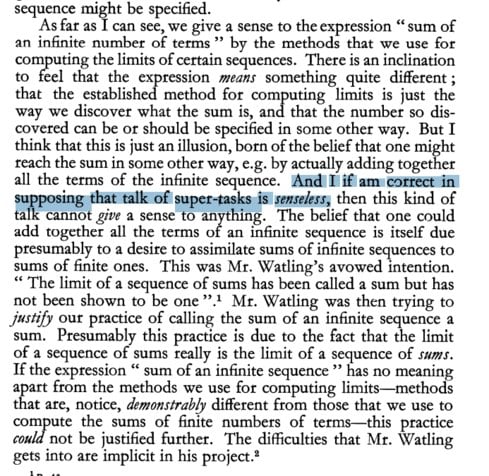
Infinite Staircase ParadoxDid Thomson make that argument? Was that part of his answer to the paradox? — TonesInDeepFreeze
No, he only argued that "talk of super-tasks is senseless."
I simply use this as a refutation by contradiction. If spacetime being infinitely divisible entails the metaphysical possibility of supertasks and if supertasks are metaphysically impossible then spacetime is not infinitely divisible.
Although on this point there is perhaps some ambiguity in the phrase "infinitely divisible," a point that Thomson addresses:
If something is infinitely divisible, and you are to say into how many parts it shall be divided, you have alternatives from which to choose. This is not to say that is one of them. And if something is infinitely divisible, then the operation of halving it or halving some part of it can be performed infinitely often. This is not to say that the operation can have been performed infinitely often.
So I suppose what I mean to say is that within some finite section of space and time there cannot be an infinite succession of halfway points.
In my mind this requires that there be some smallest unit of space and time, but I'm open to the possibility that it doesn't, and that I'm simply failing to fully grasp the notion of infinity. Perhaps this is related to the fact that is infinite but that every is finite.
Although as I suspect that some quantum theory of gravity will be correct, and as such quantum theories require discrete spacetime (as far as I understand), I think that it's at least true that there is some smallest unit of space and time, even if it's not necessarily true.
Mathematics doesn't say there is no limit to the ways objects may be divided. — TonesInDeepFreeze
That really depends on what you mean by "object". If you mean "physical object" then mathematics doesn't say anything about them at all, and whether or not some physical object is infinitely divisible is a matter for empirical investigation.
As it stands one cannot have half a photon (or any point particle) and if spacetime is quantized then there is a limit to how far one can divide some section of it into two. -
Infinite Staircase ParadoxThat's the first I've heard of any use of transfinite numbers in this thread. I don't think they are relevant - more, I very much hope they are not relevant. — Ludwig V
If we're talking about an infinite number of tasks being performed then we are talking about a transfinite number of tasks being performed.
But space or time being infinitely divisible does not entail that supertasks are possible. — Ludwig V
I'm not talking about physical possibility. But even then, if space and time are infinitely divisible then motion is a physically possible supertask.
Yes, that's what I thought. I think the concept of a valid paradox is a bit confusing. — Ludwig V
Then forget the word "paradox". If Thomson's argument is valid then it proves that supertasks are impossible. -
Infinite Staircase ParadoxThompson says that there's a false premise, which is that infinitely many tasks cannot be completed in finite time. He says that there's no finite upper limit to the number of tasks that can be completed in finite time, but that not infinitely many can be completed in finite time. — TonesInDeepFreeze
So his paradox shows that the time between each task in a sequence cannot in principle be modelled by a geometric series, e.g. where the first task takes 1 minute, the second 30 seconds, the third 15 seconds, and so on, because if it were possible then it would be possible for an infinite number of tasks to be performed within 2 minutes. -
Infinite Staircase ParadoxI'm puzzled. I thought you thought that Thompson's paradox was flawed and therefore invalid - as Thompson did, didn't he? — Ludwig V
No, I think (as did he) that it successfully shows that supertasks are not possible.
What does "paradox is valid" mean? Does it mean that the premises indeed entail a contradiction. — TonesInDeepFreeze
Yes. If space and/or time being infinitely divisible entails that supertasks are possible, and if supertasks being possible entails a contradiction, then it is proven that space and/or time are not infinitely divisible.
The analogy with imaginary numbers and apples is amiss in this regard: Yes, apples are counted by integers, not imaginary numbers, so indeed imaginary numbers are not the correct kind of number to count with. But distances and durations are measured by real numbers, so smaller and smaller real numbers are not a difference in the kind of number. — TonesInDeepFreeze
In this case the mistake is in the application of transfinite numbers. -
Infinite Staircase Paradox
It's not that complicated. Imaginary numbers have a use – even in electrical engineering – but I cannot have an imaginary number of apples in my fridge.
There's nothing wrong with maths, just sometimes an improper use of it. There is no smallest number, but if paradoxes like Zeno's and Thomson's are valid then it would suggest that there is a smallest unit of space and/or time – and that this isn't just a contingent fact about the physics of our world but something far more necessary. -
Infinite Staircase ParadoxMy question was about mathematics not physics. — TonesInDeepFreeze
Then no, there is no smallest number.
But then I'm not sure what relevance this question has to the matter at hand? -
Infinite Staircase ParadoxIf there is a maximum number of divisions, then what is that maximum number? — TonesInDeepFreeze
That is an empirical matter:
Einstein’s General Theory of Relativity describes the properties of gravity and assumes that space is a smooth, continuous fabric. Yet quantum theory suggests that space should be grainy at the smallest scales, like sand on a beach.
One of the great concerns of modern physics is to marry these two concepts into a single theory of quantum gravity.
Now, Integral has placed stringent new limits on the size of these quantum ‘grains’ in space, showing them to be much smaller than some quantum gravity ideas would suggest.
...
Some theories suggest that the quantum nature of space should manifest itself at the ‘Planck scale’: the minuscule 10-35 of a metre, where a millimetre is 10-3 m.
However, Integral’s observations are about 10,000 times more accurate than any previous and show that any quantum graininess must be at a level of 10-48 m or smaller. -
Infinite Staircase ParadoxCome on Michael. Fire Ologist explained the problem with "placing", and you said, we could assume that they are already placed. Now I show you the problem with "already placed", and you say we can assume placing. What's the point in switching back and forth, when both are shown to be problematic? — Metaphysician Undercover
We can assume that they simply exist in their places or we can assume that they are placed just before the runner reaches the next designated distance.
What these "supertasks" show us is that there is a disconnect between the conceptual structures of mathematics and the concepts of the empirical, natural philosophy, (science). — Metaphysician Undercover
I agree. I am trying to prove this by accepting the assumptions of those who believe in supertasks and then showing that their assumptions entail a contradiction. This is how refutation by contradiction works, and is going to be more convincing than an argument that denies their assumptions outright. -
Infinite Staircase ParadoxTo avoid the problem , you just assume the impossible. There is a limit to the number of sensors which can exist in that space, depending on the size of the sensors, Because a sensor takes up space. Or, are you assuming that an infinite number of sensors can fit in a finite space? — Metaphysician Undercover
The sensors are two dimensional with a width and height but no length. If spacetime is continuous and infinitely divisible, as is assumed, then an infinite number of two dimensional sensors can fit within finite space.
But if you prefer then we can stipulate that only one sensor exists at a time, the next placed only when the previous has been passed.
A thought experiment like this is perfectly appropriate in philosophy. See for example Bernadete's Paradox of the Gods which is similar in kind to mine. -
Infinite Staircase ParadoxThe answer to the question is available, if only you would apply ordinary arithmetic to the problem. — Ludwig V
Then what is the answer? -
Infinite Staircase ParadoxDo you not understand what thought experiments are or how they're used?
-
Infinite Staircase ParadoxSo you never finish placing the sensors. — Fire Ologist
For the sake of the argument the sensors just exist at their locations. We don't have to place them. The thought experiment is only to examine the internal consistency of continuous space and time, not the practicality of carrying out the experiment. -
Infinite Staircase ParadoxI’ve addressed all of these premises before. There is no half until after there is a whole. You don’t travel half a distance first then travel the second half and thereby complete the whole. To call a distance “half” you first call another distance “whole” and then cut it in half. The whole always comes first. So when Zeno says Achilles must first travel half, he forgot that Zeno already accounted for the whole so he could claim whatever shorter distance to be some fraction in relation to that whole. — Fire Ologist
2-dimensional sensors are placed after 100m, 150m, 175m, and so on. These sensors approach the 200m finish line but importantly no sensor is placed on the 200m finish line.
When each sensor is passed the distance is displayed on a screen, as well as the time that the sensor was passed. This display remains until the next sensor is passed. Nothing else controls the behaviour of the screen.
Say we run at a constant speed. We pass the 100m sensor at 12:00:10, the 150m sensor at 12:00:15, the 175m sensor at 12:00:17.5, and so on.
When we reach the 200m finish line at 12:00:20, what distance and what time is displayed on the screen?
There is no sensor on the 200m finish line and so neither 200m nor 12:00:20 will display, and the screen won't turn into a plate of spaghetti. -
Infinite Staircase ParadoxIn the supertasks article, they mention a “hotel with a countably infinite number of rooms”. Right there, at the premise, what does “countably infinite” point to? That’s nonsense. — Fire Ologist
See countable sets. -
Infinite Staircase ParadoxSo why do you disagree with the other things I’m saying? — Fire Ologist
You claimed that the supertask described in Thomson’s lamp does not entail a contradiction. It does, as shown by that previous post.
This contradiction proves that supertasks are impossible. -
Infinite Staircase ParadoxDo you think supertasks can be completed? — Fire Ologist
No. I’m trying to prove that they are impossible, as clearly shown in this post. -
Infinite Staircase ParadoxAnd supertasks didn’t come up until later in the post and really another way of incorrectly claiming there is anything relevant to the lamp problem at two minutes. — Fire Ologist
Thomson’s lamp is a thought experiment designed by Thomson to prove that supertasks are impossible, with Thomson being the person who coined the term “supertask.” -
Infinite Staircase ParadoxThe concept of the “super task” is not essential to anything I’m saying. — Fire Ologist
Supertasks are the topic of this discussion. They are what the rest of us have been arguing about for 26 pages.
You could perhaps start with the SEP article. -
Infinite Staircase ParadoxI am not going to add confusion and complexity to this by starting to discuss “super tasks”. — Fire Ologist
Is this a joke? -
Infinite Staircase ParadoxTHERE IS NO AFTER WE FINISH PUSHING THE BUTTON!! — Fire Ologist
There is according to those who claim that supertasks are possible. They claim that within two minutes I can finish pushing a button an infinite number of times, allowing me to then carry on my day.
Do you not understand the discussion we're having? -
Infinite Staircase Paradox
I'm not redefining the premises.
Before we even consider when the button is pushed, it is implicit in the thought experiment that the lamp both existed (as a lamp) before we start pushing the button and continues to exist (as a lamp) after we finish pushing the button, and that for its entire existence nothing other than pushing the button controls the lamp.
The button pushing is just one aspect of the wider environment. You and fishfry seem to ignore this wider environment, treating the supertask as nothing other than some infinite sequence of values. -
Infinite Staircase ParadoxI think you mean between 22:00 and 23:00, assuming the two minute mark is 0:00. — Fire Ologist
No I don't. I mean exactly what I said. -
Infinite Staircase ParadoxThat doesn’t contradict the premises, because the premises never touch the lamp at two minutes. — Fire Ologist
Yes they do. These are our background premises:
P1. Between 00:00 and 23:59, nothing happens to the lamp except what is caused to happen to it by pushing the button
P2. If the lamp is off and the button is pushed then the lamp is turned on
P3. If the lamp is on and the button is pushed then the lamp is turned off
P4. The lamp is off at 00:00
P5. The lamp is either on or off at 12:00
Only then do we consider the manner in which the button is pushed.
If the button is only ever pushed at 11:00 then the lamp is on at 12:00.
If the button is only ever pushed at 11:00, 11:30, 11:45, and so on, then the lamp can neither be on nor off at 12:00. This is a contradiction.
Note especially P1 which is where fishfry and Benacerraf go wrong. -
Infinite Staircase ParadoxAnd because lamps are either on or off at all times, but you can’t deduce the state from the premises, we don’t have a contradiction. — Fire Ologist
Not only is no state deducible from the premises, no state is consistent with the premises.
The lamp is turned on if and only if the button is pushed when the lamp is off.
The lamp is turned off if and only if the button is pushed when the lamp is on.
Neither of these are possible at t1 if a supertask has been performed between t0 and t1. But the lamp must be either on or off at t1. This is the contradiction. -
Infinite Staircase ParadoxAs a side note, you’ve proven that reasoning with you about how infinity works is a supertask. — Fire Ologist
I understand how infinity works. The problem is that fishfry doesn't appear to understand how a lamp works. -
Infinite Staircase ParadoxBut I've already discovered that Benacerraf and others have viewed this problem exactly as I do. So my position is valid, or you should take your objections up with them. The problem does not defined the lamp state at midnight and it can be anything you like. — fishfry
I addressed his paper a month ago. See also here for a more formal argument.
As for the screen, it can only ever display the time that the button was most recently pushed. If the button is only ever pushed at 23:00 then at midnight the screen displays 23:00. Notice that the rule about how the screen works still applies at midnight, long after the button has been pushed. This rule also still applies at midnight if the button is only ever pushed at 23:00, 23:30, 23:45, and so on.
And because the button is not pushed at midnight the screen cannot display 00:00 at midnight, even though 00:00 is the limit of the sequence.
There is no tiny little interval before midnight where the sequence has ended, leaving the lamp in a particular state. — fishfry
This is why the supertask is impossible. A lamp can only be on if something causes it to change from off to on. This is as true at midnight as it is at any time before and after midnight. It’s a fundamental fact about lamps. Therefore a lamp cannot be modelled by the sequence off, on, off, …, on. -
Infinite Staircase Paradoxthe limit of a sequence has no immediate predecessor in the sequence, and that's just a mathematical fact — fishfry
I have always accepted this; it's the reason that the supertask is proven impossible.
A lamp being off must always precede it being on, and so the sequence off, on, off, ..., on cannot model a lamp.
Midnight. ... Of course the clock says midnight at midnight. — fishfry
It's not a clock. It's a screen that displays the time that the button was most recently pushed.
If the button is pushed at 23:00 then the screen will display 23:00 until the button is pushed again at 23:30, and then the screen will display 23:30 until the button is pushed again at 23:45.
The button is not pushed at midnight and so the screen will not display 00:00 at midnight, even though 00:00 is the limit of the sequence.
Thompson's lamp is a rather poor example of a supertask, because its underlying sequence can not be made to converge to a limit. — fishfry
A supertask is any infinite succession of tasks performed in finite time. Having that task be to push a button is as good a task as any, regardless of what pushing the button actually does.
I'll concede your point that the lamp is impossible. That does not necessarily entail that supertasks in general are impossible. — fishfry
The lamp has two buttons. One button turns the lamp on and off, the other does nothing. The same mechanism is responsible for pushing both buttons. If it is possible to have pushed one of these buttons an infinite number of times then it is possible to have pushed the other button an infinite number of times.
If Thomson's lamp proves that it is impossible to have pushed the button that turns the lamp on and off an infinite number of times then it proves that it is impossible to have pushed the button that does nothing an infinite number of times.
And we can replace pushing a button with literally any other task and the same conclusion follows. Therefore, Thomson's lamp proves that all supertasks are impossible. -
Infinite Staircase ParadoxAt midnight the Supreme Button Pusher flips a coin and turns the lamp on or off, accordingly. I don't see any problem. — fishfry
If the Supreme Button Pusher turns the lamp on at midnight then it must have been off before He turned it on, because that's what "turning on" means. If He turned it off at midnight then it must have been on before He turned it off, because that's what "turning off" means.
For the entire continuous time that the lamp exists – not just the time during which the button is pushed – it being off must precede it being on, regardless of magic or divine intervention. As such the sequence off, on, off, ..., on makes no sense, much like having an imaginary number of apples in the fridge makes no sense.
We must accept that the button can only be pushed times between t0 and t1.
But also note P1 in the argument above, implicit in Thomson's argument. You don’t get to just introduce God to deflect from the incoherent causal consequence of having pushed a button an infinite number of times.
Thompson's lamp is not a good example of a supertask, because the sequence doesn't have a limit or any natural termination point. — fishfry
A supertask is just performing an infinite succession of tasks in finite time. Pushing a button, which just so happens to turn a lamp on and off, is as good a supertask as any.
But let’s assume that pushing the button displays the time that the button is pushed – persisting until the button is pushed again – and is pushed (only) at successively halved intervals of time starting two minutes to midnight. What time is displayed at midnight?
The sequence approaches midnight but because the button is never pushed at midnight the display can never show midnight, but must show something because it’s never turned off. It always only displays the time that the button was last pushed, but in this scenario there is no last button push, entailing a contradiction.
As Thomson says, "the impossibility of a super-task does not depend at all on whether some ... sequence is convergent or divergent." -
Infinite Staircase ParadoxIt's not like either number is somehow more physical than the other one — fdrake
I’m not claiming otherwise. I’m only claiming that I cannot have an imaginary number of apples in my fridge.
That some number is sensible isn’t that it’s sensible to use that number in any and every context.
Similarly, the sequence 0, 1, 0, …, 1 might make sense in some contexts, but the sequence off, on, off, …, on doesn’t make sense in the context of a lamp being turned on and off by pushing a button. -
Infinite Staircase ParadoxTell that to an electrical engineer or quantum physicist, both of whom use imaginary and complex numbers as essential tools of their trades. — fishfry
I didn't say that imaginary numbers don't have a use. I said that I cannot have an imaginary number of apples in my fridge.
You really reject the complex numbers, negative numbers, fractions, and irrationals? — fishfry
No.
It's a premise of the thought experiment that there is a sequence of steps at successively halved intervals of time. — fishfry
Yes, and this premise is proven false. See refutation by contradiction and modus tollens.
I already showed you how to model the process using the inverse powers of 2. You ignored that, since it refutes your argument. — fishfry
It doesn't refute my argument because it doesn't address my argument.
My argument is that the lamp cannot be on unless it is turned on (whether by pushing a button or by magic), as argued above.
Therefore, off, on, off, ..., on makes no sense in context. The lamp being off must precede the lamp being on. Given that this is inconsistent with the premise that the button is pushed at successively halved intervals of time it is proven impossible in principle to push the button at successively halved intervals of time. -
Infinite Staircase ParadoxYour argument doesn't prove that. — Ludwig V
Others do, like Zeno's and Bernadete's. -
Infinite Staircase ParadoxThis leads us to think that there is some sort of miracle involved in arriving at the fridge to get a beer. — Ludwig V
There's no miracle. Motion isn't continuous; it's discrete.
Michael

Start FollowingSend a Message
- Other sites we like
- Social media
- Terms of Service
- Sign In
- Created with PlushForums
- © 2026 The Philosophy Forum