
Comments
-
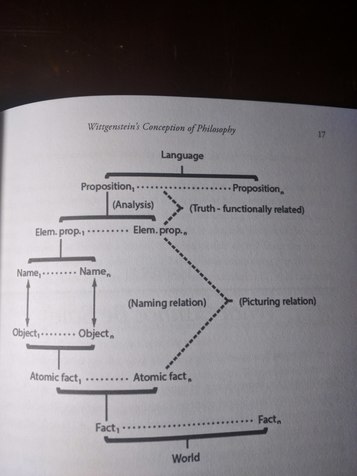
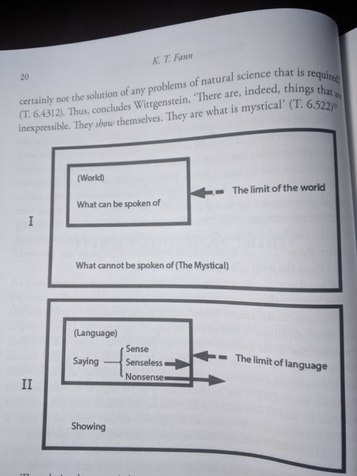
Ongoing Tractatus Logico-Philosophicus reading group.If we are to take a resolute reading of Wittgenstein, then we must begin talking senselessly and nonsensically. Who wants to start?
-
Ongoing Tractatus Logico-Philosophicus reading group.Nice conversation you guys got going here. Enjoying it. Cheers.
-
How to relate Mental Illness to The Nature of Consciouses
Yes. The internal monologue that people have takes place from "within the head", where hallucinations are percieved by a schizophrenic as originating outside of ones head. -
Naming and Necessity, reading group?
How so? Isn't the designator for "Jesus", the definite description that he is/was the "Son of God"? And this designates rigidly... -
How to relate Mental Illness to The Nature of ConsciousesEverything can be nightmarish if you're in the wrong state of mind. — Nils Loc
Yeah, if we can ever redefine "schizophrenia" being a "condition" instead of a "disorder or illness", then I suspect the abnormally high suicide rates for schizophrenics might abate. The struggle is real. -
Naming and Necessity, reading group?I think part of the confusion that emanates from N&N is that, so far as I have been able to see, Kripke fails to specify an accessibility relation for the set of possible worlds that are under consideration. Without such a relation, there is no limit to the possible worlds that can be considered, so we end up having to allow silly things like 'if Nixon were a golf ball...' — andrewk
This goes to my topic raised a while about quantification of entities in possible worlds along with how we talk about them as either de re or de dicto. A curious case is "God", who is quantified in all possible worlds, by the very definition of she, he, it's properties or definite description. Further, the Son of God, being Jesus is another case where the accessibility relation is satisfied over all possible worlds by virtue of being modally absolute (or the accessibility relation is transcendent above/over counterfactual's) or necessary de dicto. De re one can always just say that that is nonsense because I don't "believe" in "God".
And so the confusion arises when we talk about names de re in possible worlds, but not de dicto.
I'd like to consider alternative accessibility relations. Perhaps Kripke does choose one somewhere, and I missed it. If so, I'd be grateful if somebody that has spotted it could point it out. Wallows did you spot an accessibility relation in the text? — andrewk
Nope. -
Naming and Necessity, reading group?Can a definite description be a rigid designator?
Now a rigid designator refers to the very same individual in all the possible worlds in which it exist.
So your question is the same as "can a definite description refer to the very same thing in every possible world in which that thing exists?"
But remember that if something is true in all possible worlds, it is true necessarily.
So "Can a definite description be a rigid designator?" is the same as asking "Can a definite description be necessarily true of its referent?".
Agreed? — Banno
You might find it a curious case of Jesus exists in all possible worlds, having the definite description of being the Son of God, further being of greater import than the name "Jesus" as a rigid designator in our world. What do you make of an entity that only attains its meaning or import by the definite description that is rigid in all possible worlds? -
How to relate Mental Illness to The Nature of Consciouses
Sounds like you had a scary experience reading a book by Borges. Have you seen, Through a Glass Darkly by Ingmar Bergman? I was captivated seeing it for the first time, might give it a whirl again. -
Naming and necessity Lecture Three.Rather, in so far as the referent of a proper name is fixed at all, it is by what Kripke calls causal chains, but what I might call shared use. — Banno
It's important to highlight that causal chains are derived from verified or the standard convention of definite descriptions. Baptism can only occur in tandem with definite descriptions being utilized to designate a certain state of affairs that endows meaning onto a name. This process of how that happens is the gist of much of what has been going on in the reading group thread. If you care to elaborate on this process, that might help to get a better picture of the mutual relationship between rigid designators and definite descriptions.
Thanks. -
Naming and Necessity, reading group?
I designated him leader when starting the thread. He obliged, and here we are approaching page 52 of a quality thread. I don't mean to sound rude but are you being ungrateful?
Perhaps we can resort to some secondary literature or comparisons or criticisms of the descriptive theory of reference through the lens of Kripke's causal theory of reference. -
Naming and Necessity, reading group?
Well, Banno is still the leader of this reading group and perhaps the most competent person to be it. So, I'm content with how he is doing. Perhaps a new thread is in order in regards to the issue of definite descriptions standing in as designators for names.
Notice how this issue doesn't apply to empty names... -
Naming and Necessity, reading group?Oh, Lawd. All this confusion about definite descriptions... I've always thought that definite descriptions like Jesus being the Son of God are what enable baptism of names, which for some odd reason we haven't even touched on.
Anyone care to take a stab at baptism in contrapositive with definite descriptions? -
Naming and Necessity, reading group?It is used most heavily in the middle part of lecture 1, p34ff in my version, where he discusses the relationship between 'necessary' and a priori. Is that the bit you meant? — andrewk
Yes, I suppose so. What are your thoughts about it? -
Naming and Necessity, reading group?
But, you do agree that in some cases where ambiguity arises about the object of interest, that a definite description can attain the status of a rigid designator? -
Naming and Necessity, reading group?So, we haven't really covered the necessity part of Kripke's book. Or did I sleep through it?
-
Naming and Necessity, reading group?I'm quite amazed that we haven't had to resort to interpretations or companions for this reading group.
-
.The idea would never appeal to materialists or physicalists. I'm naturally inclined to believe that the mind is something more than matter at play. Perhaps there might indeed be some "ether" which the mind occupies and exists in. If that's so then I believe that the mind might exist after death. Although, I don't believe that there's no jump discontinuity during/after death.
-
How to relate Mental Illness to The Nature of ConsciousesThis is a podcast about the issue that I found very interesting. Thoughts?
https://philosophybites.com/2013/01/john-campbell-on-schizophrenia.html -
How to relate Mental Illness to The Nature of ConsciousesI actually take the same meds as you, olanzapine and sertaline. — Josh Alfred
Yeah, I've tried Abilify, Vraylar, and Latuda. I like how Zyprexa calms me down and makes me docile. Do you get akathisia from your Zyprexa? I had real bad akathisia from Abilify. Felt uncomfortable. I have been somewhat worried about Zyprexa becoming ineffective for me, and if that does happen I might switch to Clozapine.
The medication has been working wonders for me. I haven't visited a hospital in two years now! — Josh Alfred
Great news. Hope things continuously get better for you.
Do you have bad negative symptoms, like anhedonia, apathy, and such? How have you dealt with those issues? -
Donald Trump (All General Trump Conversations Here)In regards to Trump saying that he would have been a great general with his decision to pull out American troops from Afghanistan (so that ISIS and the Taliban kill each other off) despite the advice from his generals not to do so...
Huu? What? How? -
Is it possible to stop nuclear war?Not wanting to die is based on a comparison, whether one realizes that or not. — Jake
Not really. Again, you don't have anything to compare life to apart from your neighbor who always smiles every day when going to work and coming back from it. I'm not aware of people being able to compare their life to something like death, unless the suffering of living is so great that death seems like the only alternative. However, that is taking the issue to the extreme in my opinion, and fortunately, not many people contemplate suicide or at least shouldn't if there's some alternative to entertain that is more productive to oneself and others.
Appreciating life is not the same thing as not wanting to die. — Jake
Yeah, that much I agree on. No dispute about that on my end. -
How to relate Mental Illness to The Nature of ConsciousesBut aren't depression and anxiety treated as beliefs produced by cognitive distortions in CBT? — sime
Yes, they are. But, even in the book that got me into CBT, called Feeling Good: The New Mood Therapy by David D. Burns, the author highlights that cognitive distortions in the most extreme forms manifesting in delusions of control, grandeur, reference, and paranoid or persecutory types, they need to be addressed through medication.
Couldn't the falling success rate of talk therapy for treating neurosis possibly be an indication that the placebo effect and behavioural conditioning are the main causal agents responsible for talk therapy's success in treating neurosis, as opposed to talk therapy working due to reasoned argument? — sime
I don't know the directionality of the placebo effect and rational/dialectical/logotherapeutic talk therapy. I'm also unaware if neurosis is not something that can be addressed through talk therapy. I would think that neurosis is best treated through CBT and some SSRI.
In many cases, the depressive's beliefs about himself and the world are probably more rational than his therapist's in the sense of being evidence based. Perhaps CBT works mostly as a rhetorical device whose success has more in common with religious propaganda than with rational and honest epistemology of the self. — sime
Not really. CBT has some hard evidence showing it to be a successful type of self-therapy. The whole point with CBT is to be "prepared" when you fall into a slump.
In my own case I frequently have bouts of depression in which I will give lengthy evidence based justifications for my negative life expectations, yet my expectations often change instantly positive the moment the sun comes out... This seems to suggest that negative rationalisation is an epiphenomenal symptom of depression rather than a cause of it. — sime
That's an interesting way to phrase the question. A sort of chicken-egg thing. I'm not aware of structural abnormalities in the brain of a depressive, and the data pointing that depression is hereditary is somewhat iffy or I'm not really well acquainted with it. But, I suppose to some degree your "mental filter" can be hardwired a certain way and in a dialectical manner you build rationalization (cognitive distortions) about how you perceive the world, which then manifests into some mood. Keep in mind that "rationality" is a pretty novel thing in the evolution of humanity, so I often wonder how cavemen dealt with depression, and why does it still persist to this day.
And knowing all of this doesn't help me avoid negative beliefs during a future depressive episode... — sime
Well, there's no permanent solution to depression, apart from suicide. One just learns to cope with it. Sometimes the CBT comes handy when you're in a rut, and can serve as a band-aid before engaging in more nuanced solutions, like changing one's behavior. Keep in mind that when I talk about CBT, it's not in the normal fashion. I tend to place a focus on the cognitive component of CBT, and less of an emphasis on the behavioral component.
So while there are clearly phenomenological and neurological differences between psychosis and neurosis, I am tempted to think that they should be pushed closer together. — sime
So, you're saying that neurosis is endogenous, much like psychosis is due to genetic abnormalities? I don't quite think that's right. -
Is it possible to stop nuclear war?Rewarding in comparison to what? — Jake
There is no comparison. So, we must appreciate life for what it offers us regardless. -
Is it possible to stop nuclear war?Which opens another huge box of worms. Where is the evidence that life is better than death? — Jake
That's like trying to prove a negative. Don't you find life rewarding enough to not want to die? -
Is it possible to stop nuclear war?Well, obviously we need a doomsday weapon. Just hope that everyone is rational enough to not want to die.

-
How to relate Mental Illness to The Nature of ConsciousesAre schizophrenic delusions categorically different from neurotic beliefs? — sime
Well, delusions are rather not beliefs; but, convictions that are justified and maintained through erroneous reasoning like cognitive distortions.
For example, is psychotic paranoia qualitatively different from social-anxiety paranoia? — sime
Yes, it is something else entirely, to a large degree. This is because the way psychotic paranoia manifests itself is spontaneous and quite random or too mundane events which appear to have personal significance due to delusions of reference, whereas social-anxiety is context dependent and triggered through certain situations or circumstances (like being in a crowd of people or due to having to deliver a speech).
Is the introspective rationalization of those states similar or different? — sime
The rationalization is fundamentally different due to the above. Furthermore, paranoid delusions can't be reasoned with and saught through or banished away with talk therapy to a large extent due to being convictions about the world that are precipitated through stress or endogenous factors like being in a prodromal state of schizophrenia. And, this is why delusions are interesting. Since, they have no propositional content, that what do you call them? Bedrock beliefs (although irrational to the n'th degree)? If so, then why do they have such an impact on one's thinking, and why can't they be reasoned with? -
How to relate Mental Illness to The Nature of Consciouses@unenlightened, your input would be very much appreciated and welcome here. What are your general thoughts about delusions, paranoia, and delusions of reference. Quite a "magical" thread. Only at TPF I suppose.
-
Music as a Form of Communication?Just some more about a blind elephant enjoying a piece of Bach. Quite fascinating:
-
Music as a Form of Communication?Clearly, music has some appeal to animals, specifically elephants. Perhaps, a radio might be playing some opera or the blues and the elephant overhears it. It responds in some way.
Just as an example:
Clearly, the elephant in this video is enjoying the music. Its ears are flapping, it moves its head to the melody, wants to actively participate in the generation of the music by banging the piano keys. -
How to relate Mental Illness to The Nature of Consciouses
Whoa Noah, that sounds pretty serious? Are you on meds? I'm on Zyprexa and am calm as a Hindu cow on it. It kind of takes away the high and elation of existence; but, it's a fair trade-off for staying sane.
I understand the stigma of admitting that you have a problem, and often the delusions prevail in the feelings of grandeur or specialness. I know, it was hard to admit for me that I had some issues, like thinking I was under the surveillance by the government after I got discharged from the military or helicopters flying outside my house to monitor and force me into submission through fear (helicopters flying overhead in circles is intimidating!) or neighbors observing me.
In all this there is a grain of truth in all this, helicopters are observing something by flying in circles... The TV is trying to grab your attention. Neighbors might be passively observing you, after all the grass is greener on the other side and we try and keep up with the Joneses, no? I guess, to isolate a fundamental feature of schizophrenia is the delusion of reference. What are your thoughts about this core delusion that is the source of supreme frustration in the life of a schizophrenic? -
Music as a Form of Communication?
I wonder how much of music is derived from its social context. For example, everyone knows that Chopin is renowned for inducing a feeling of nostalgia or melancholia. But, is this something a child would apprehend had he or she heard Chopin for the first time? Would they say, "Oh wow, this song really makes me miss home!"
What do you or others think? -
Ongoing Tractatus Logico-Philosophicus reading group.The Tractatus is an austerely beautiful and simple work. One would do well to read it instead of reading about it. To that end I will be following and perhaps contributing. — Fooloso4
Great to have you with us, @Fooloso4. We are around propositions 2.5. If you want to start over, I'm fine with that also. -
Ongoing Tractatus Logico-Philosophicus reading group.Wallows! You there man? — Pussycat
Yes, I am here.
Shawn

Start FollowingSend a Message
- Other sites we like
- Social media
- Terms of Service
- Sign In
- Created with PlushForums
- © 2026 The Philosophy Forum