
-
Navalny and RussiaHas anyone watched this video by Navalny — The Opposite
Yep: as I write this it's had over 79 million views :grin: -
Submit an article for publicationThanks, they look interesting. I don't know when I'll get around to reading them. Maybe others on the staff might want to have a look: @StreetlightX, @fdrake, @Baden.
Thanks Josh. On the face of it, something like a critique of mindfulness might have some potential, and personally I'm interested in phenomenology, but ideally, articles should be accessible to intelligent and curious lay-people, those who aren't familiar with the literature. -
Why do some argue the world is not real/does not exist?Or the more likely reason is you are defending a nutter, which seems popular in philosophy. — Darkneos
If only you had offered a criticism for me to defend him against.
[Moving this garbage thread to the lounge] -
Why do some argue the world is not real/does not exist?That still sounds foolish to me. Judging by his books it sounds more like the guy doesn't have a grasp on the subjects he talks about. Even his book is rife with logical fallacies. — Darkneos
If this is your own assessment rather than that of the philosophically illiterate one star Amazon review that you quoted, then tell us in what way it's foolish, why you think Gabriel doesn't have a grasp of the subjects he talks about (whatever that means), and point out his logical fallacies.
When Gabriel decided on his provocative title, he likely wanted to stimulate curiosity. It obviously hasn't worked in your case. You didn't like it and came here to attack what you assume it is he is saying. As I pointed out, you made a mistake. Own up to it. -
Why do some argue the world is not real/does not exist?Other than a few similar interviews, I've read the book, Why the World Does Not Exist, which uses the concept first laid out in Fields of Sense: A New Realist Ontology, which I haven't read.
In any case I'd need a refresher to discuss it; maybe I'll look at it again. (It could make a nice reading group too, especially in the way it might attract both analytics and continentals). -
Why do some argue the world is not real/does not exist?Up his sleeve he has indefinitely many fields of sense, I believe.
-
Why do some argue the world is not real/does not exist?I'm not sure. Some kind of coherentism, I suppose.
-
Why do some argue the world is not real/does not exist?I suggest reading that interview to get an idea of what he's saying.
Here's a quote from it:
Skepticism, the position or worry that we cannot really ever know anything, is completely unjustified... — MG
http://www.fourbythreemagazine.com/issue/world/markus-gabriel-interview -
Why do some argue the world is not real/does not exist?Just work on your reading comprehension please.
-
Why do some argue the world is not real/does not exist?I have no idea how you got that from what I said.
-
Why do some argue the world is not real/does not exist?It just seems.....weird to me that some folks would do that? I mean doesn't that amount to shooting yourself in the foot more or less? Who are you talking to then? Why charge for your courses? Why tell this to anyone? — Darkneos
If you really want to know why Markus Gabriel says that the world does not exist, you should read his book, Why the World Does Not Exist, or one of the interviews in which he summarizes the argument, like this one.
Very roughly, he argues that existence applies locally and within domains, i.e., to each object against its background, not to some posited all-encompassing container object that itself has no background or domain.
Anyone thinking that...
It's just skepticism doing what it does best — TheMadFool
...is incorrect. -
Feature requestsNo problem Todd. Assuming you're on a desktop computer or laptop rather than a mobile device, to "hover over" is to position your on-screen mouse pointer over something, without clicking. I've indicated this in the image below:
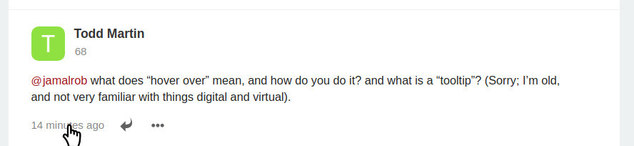
The date and time isn't shown in this image, but if you position your pointer as shown, over the grey text that says "14 minutes ago" (or whatever), you'll see it. -
Feature requestsAnd if you hover over the "an hour ago", "a day ago" or whatever, it displays the date and time in a tooltip.
-
Why does a David Lynch movie feel more real than a documentary?Is it because documentaries show reality as it is, which is fundamentally illusory, but never points that out? whereas Lynch shows us illusions and then shows us how these illusions are manifestations of something real? — samja
I think of it in terms of the common technique in writing: show don't tell. Like many other artists in their films and novels and poems and so on, Lynch is showing, and he doesn't tell us much at all. Whereas a documentary tells us what happened, and we feel appropriate emotions and gain insights only insofar as the narrative approaches the dramatic techniques of fiction, in fiction itself the artist is free to concentrate on what matters, which aims to be universal, to apply to everyone.
But what matters? I think often what matters to us, which therefore strikes us most forcefully as being more truthful, is some kind of direct representation of what people are like and how they feel; of their love, pain, joy, anger, creation and destruction.
Tolstoy was preoccupied with truth, and he said (something like) that the more he strove for historical accuracy in War and Peace, the further away he got from the truth. The parts of that book that strike one as most truthful are certainly not the parts in which he gives you his high-level, bird's eye account of the war of 1812. Rather, the truth is in his fictional world, in his observations of individual characters and relationships.
Unlike Tolstoy, Lynch is an expressionist, really only interested in character and relationships and mood--and more fundamentally just in feelings--so this kind of truth, the truth of how people like you and me feel, and why they do what they do, is what comes across strongest.
But I think Lynch goes further than most. His films feel truthful, to those who are responsive, because they show you pure emotion, and he dispenses with narrative simplicity or clarity. Often the way that truth is told in film and literature is by telling stories, but Lynch is somewhat different: either he places less importance on storytelling--using it as a convenient background against which to show us emotions and sensations--or he makes you work at making sense of the story (probably both).
But I don't think show don't tell is necessary for maximal artistic truthiness. Proust uses a hell of a lot of words to describe experience in meticulous detail. When I read it in my twenties it blew my mind because I never imagined that any writer could have captured those elements of life that I was familiar with but hadn't thought to explore or to share, and which I had probably come to think of as unique to me. The truth here is in the description more than in the dialogue and the drama (what there is of it).
Which is to say, there are several roads to truth. If you want to see what jealousy or impotence are, i.e., if you want to know the subjective truth of those conditions, then you can watch Lost Highway, Mulholland Drive, or Eraserhead. If you want to know how China got from feudalism to Communism, a documentary or a history book is fine. But if you want to know how the Chinese people felt about what was happening, and what its meaning was, go for a story: an autobiography or a historical novel. But that scheme doesn't scratch the surface. -
People not being notified of mentions?I was notified just then, so it's working sometimes at least. I have a vague sense that there are some edge cases in which mentions don't work as expected, but I don't know what those cases are.
-
Population Density & Political compassWhat could prompt the development of new cities? Surely every city has a breaking point where it is too costly to live there, and there isn't enough space? I have seen footage of some Chinese cities and I can't imagine a more crowded way to live. — TiredThinker
Building new cities from scratch is exactly what the Chinese have been doing. Beijing and Shanghai were too expensive for people to live in and too difficult to work with for developers so they built new ones, and they've been very successful. -
Welcome to The Philosophy Forum - an introduction threadHello. Where have you been all our lives?
-
Liberation of ThailandBefore addressing this, I just want to emphasize the following exchange to show what the OP represents, if it's not obvious to everyone already:
At the very least, a large majority is likely to be adamantly against foreign occupation. So what about their rights and freedoms? — Echarmion
Those Thais are my enemy — Paul Edwards
Anyway, setting aside for a moment the sheer madness of this fantasy, there are a few things worth knowing about the situation that I've found out just from googling around. I don't know much about Thailand, but it seems to me that the situation is more complicated than you realize:
1. What the OP is referring to is the law against criticizing the king, which has been on the books since 1908 (and I'd guess that a similar law existed in some form prior to that). The law was relaxed a few years ago, only now being brought back to full force in the face of intensifying protests.
2. Protests against the government--which have included calls for the reform of the monarchy, and even criticism of the king--have been going on since earlier this year. Back in August: "Such open criticism of Thailand’s monarch by non-elites at a public place within Thailand with the police simply standing by is the first of its kind in Thai history." (source)
3. Protesters have not, as far as I know, asked for outside help in the form of armed intervention.
This doesn't scratch the surface of recent Thai history, but from what I can tell, it's a country in transition, and the appearance of open criticism of the monarchy must be significant. In this situation, I don't see how armed intervention could be helpful. If you were running the "free world", Paul, I think you'd merely fuck things up for the Thai people, as well as killing lots of them and destabilizing the region.
I noticed that your first topic on this forum invoked the responsibility to protect. Is that your justification in this case? Because it doesn't apply to the curtailment of free speech:
The responsibility to protect embodies a political commitment to end the worst forms of violence and persecution. It seeks to narrow the gap between Member States’ pre-existing obligations under international humanitarian and human rights law and the reality faced by populations at risk of genocide, war crimes, ethnic cleansing and crimes against humanity. — UN
There's nothing like that going on in Thailand, so how else would you justify such drastic action? There is no principle that I know of that could provide such a justification.
Nobody has a right to intervene militarily in Thailand.
Also, I don't want to indulge in whataboutism but I'm curious as to why you're ignoring China, Saudi Arabia, Russia, and other regimes that curtail freedom of speech. Is it because you want to pick off what you see as the easy targets, thereby enlarging the "free world"? -
Donald Trump (All General Trump Conversations Here)My arguments are better than yours. I'm telling you. Believe me. If you don't, you're just stupid. — Benkei
S, is that you? -
What are you listening to right now?I like Don Cherry, so I wanted to like that, but I just can't stand whispering.
-
Joe Biden: Accelerated Liberal ImperialismHey, Hippyhead, do you have any comments on the substance of my post, revolving around the two quotations, one from the ECFR and one from a professor at West Point? One was about the conceptual basis of the conflict between Russia and the West, and one was claiming that Putin's increasing authoritarianism is a response to perceived threats to his position.
You have to begin contributing here properly. I'll accept what you say about Putin's wealth if it makes you happy, but for the purposes of this discussion I don't really care about it. That Putin is a ruthless opportunistic silovarch (half siloviki, half oligarch) surrounded by others of the same kind is a point I have made myself, but right now I don't see the significance.
So please, just calm down and discuss things like a grown-up. There are other contributors to the thread who I disagree with but whose posts I wouldn't dream of deleting. You're not in that category so far. -
Joe Biden: Accelerated Liberal ImperialismI do think Russian bombing in Syria has been de-emphasized here though, which is Putin’s worst crime in the past decade. You can squeeze in a realist interpretation in this too to an extent, but not as much as for Ukraine. So I think the bounds are a bit more than Eastern Europe. — Saphsin
Yes, that occurred to me, good point. Maybe I'll get around to dealing with that. -
How does a naive realist theory of colour explain darkness?Nice summary. It's not the way I see it, but right now I don't know how to respond adequately.
-
How does a naive realist theory of colour explain darkness?Well if that's what is meant by it, fine.
-
How does a naive realist theory of colour explain darkness?That distinction is not clear to me. I mean sure, houses have back doors that you can't see when you're in the front garden, and the small woman I saw waiting outside my apartment building the other day was actually a pile of boxes, but apart from that kind of thing, appearance vs reality is a very troublesome opposition to me.
-
How does a naive realist theory of colour explain darkness?That's a nice breakdown, but I don't think it works as it stands, because it goes wrong at the start. If perception is indirect, it must mean not just that there are intervening factors (light? electrical impulses?), but that there are intervening objects of perception, that is, the things that are perceived. Nobody thinks that perception is magic.
2. it focuses the attention on such mechanisms and their study can help improve people's vision or audition, e.g. I wear glasses and they help me to see. — Olivier5
Yes, but this doesn't depend on the philosophical position of indirect realism. -
Joe Biden: Accelerated Liberal ImperialismLike, fuck off back to the Dora the Explorer forums or something. — StreetlightX
In this case, I heartily approve of your abusive language. :grin: -
Joe Biden: Accelerated Liberal ImperialismExactly, Russia and China are not in the same ball park at all.
(Much to Putin's frustration, no doubt) -
Joe Biden: Accelerated Liberal ImperialismThe subject of foreign intervention and territorial expansion by Russia has come up a few times in this thread, with a few of the usual suspects frothing at the mouth about Putin's evil designs, or some such caricature. But it is an interesting topic in relation to the OP, because what we are seeing is a clash between competing visions of how to do foreign policy, with Western liberals and neocons in favour humanitarian intervention and spreading democracy, against Russian realpolitik.
Kadri Liik of the ECFR explains this from, I think it's fair to say, a basically EU and NATO perspective:
https://ecfr.eu/article/commentary_what_does_russia_want_7297/What Russia truly wants in terms of territory is a sphere of control in its neighbourhood – mainly, the six countries that lie between the EU and Russia and comprise what the EU calls its Eastern neighbourhood: Armenia, Azerbaijan, Belarus, Georgia, Moldova, and Ukraine. Moscow expects these countries to be sensitive to Moscow’s wishes; it wants to have the ability to manage, arbitrate, and veto their relations with the West, and to prevent the expansion of Western organisations into that part of the world, based on the assumption that any Western actions there should have Russia’s approval. What Moscow wants to avoid is the emergence of direct links and true closeness between the region’s countries and the West: that is why it bent over backwards in 2013 to prevent the association agreements with the EU from being signed.
And this is where the clash between Russia and Europe becomes fundamental and paradigmatic: it is impossible for the West to grant Russia such a sphere of control. The countries either have the right to choose their own arrangements and alliances, or they do not – there is no space in between, and this is not a question that can be managed with a wise compromise.
However, it is rarely understood that this paradigmatic disagreement extends far beyond this territory. What Russia really wants is a new international order, and new global – or at least European – rules of the game. It wants to do away with many of the basic concepts of what has been called the post-cold war liberal order: the emphasis on human rights, the possibility of regime changes and humanitarian interventions.
[...]
Russia’s view of the new world order that it desires is admittedly neither very developed nor sophisticated. But in essence, Moscow wants the West to give up on its vision of liberal international order and to return to conducting international affairs based on realpolitik. And because of this, the West and Russia are again locked in a conceptual standoff, not unlike that of the Cold War – this time, not over domestic models, but over the international order. — Kadri Liik
I no more approve of Russian realpolitik than I do of what I've been calling "liberal imperialism"--between Russia and the West I haven't taken sides and I don't feel compelled to do so--but I think this basic incompatibility of foreign policy aims is useful as a frame.
I think one also has to keep in mind Russia's habitual and well-known defensiveness, otherwise one will never understand that its actions in Ukraine and Crimea are largely a response to the encroachments of NATO and the provocations of the US. This is not to justify those actions, but to understand them.
Incidentally, there's an interesting paper that posits a domestic defensiveness--wielding the concept of defensive realism in international relations--to explain Putin's increasing authoritarianism at home:
https://www.sciencedirect.com/science/article/pii/S1879366516300239During the 17 years that Vladimir Putin has ruled Russia, the country has become increasingly authoritarian. However, I argue that this rollback of democracy has not been motivated by Putin's blind desire to maximize his political power, as many have assumed. Rather, his anti-democratic policies have responded to perceived specific threats to his control. In applying theories originally developed in the field of international relations to individual leaders, we can understand Putin as a “defensive realist” who balances against threats in order to maintain security rather than maximize power. This is an essential distinction that produces important conclusions about what motives lie behind the increasingly authoritarian character of the Russian state and gives insights into the possible future trajectory of the regime. — Robert Person (Associate Professor of International Relations at the United States Military Academy in West Point, New York)
Jamal
Start FollowingSend a Message
- Other sites we like
- Social media
- Terms of Service
- Sign In
- Created with PlushForums
- © 2026 The Philosophy Forum