
-
How to gain knowledge and pleasure from philosophy forumsI'd now be on my private island — Wayfarer
Most of us are on our private islands these days. -
What if Hitler had been killed as an infant?I moved it to Interesting Stuff > Humanities and Social Sciences, and I think it just about qualifies there. If things go well with the discussion, it's a way of exploring the idea of counterfactual history, which, though not popular among historians, does have distinguished adherents, such as Niall Ferguson. "What would have happened if Hitler had been killed before his rise to power?" is a typical way of looking at it.
Even if the discussion never gets as far as the philosophy of historiography, it could still be interesting. If you don't have anything to say about it, feel free to ignore it. Or if you have a critique of counterfactual history, I for one would be interested to read it. -
Marx and the Serious Question of Private PropertyHave to say a lot of references to Stalin from many people here.
Yet the Soviet Union lasted after Stalin for nearly 40 years. Surely when Nikita Khrushchev came into power the Russian Civil War was ancient history and the Communist Party was firmly in control. Krushchev denounced Stalin, relaxed the repression and cencorship in an era which is called the "Krushchev Thaw".
Wouldn't that have been the perfect moment to have this democratic Marxism as surely Khrushchev was a confident marxist-leninist? — ssu
I'm not sure. I've been arguing against the idea that the Soviet Union was a Right wing or fascist tyranny, and I think you're on my side in that debate. Otherwise, maybe you want to suggest that the Soviet Union was both Left-wing/Marxist, and had no potential to become democratic. Well, I agree with that. Or perhaps you want to say that democratic Marxism is an oxymoron. You might be right about that too, in some sense.
But, taking your last question seriously, here's the way I see it. The thinking of the party at that time was that there could be no democracy or true communism in the Soviet Union until western Europe and the rest of the world had their own proletarian revolutions, or rather Soviet-style, Soviet-dominated Communist rule for mutual security. Before that happened, democratization wasn't on the cards. Krushchev denounced Stalin and eased up on the repression because he wanted to be the one to do what everyone knew had to be done to ensure the country's survival. He was very far from being a democrat or humanitarian. -
PrivilegeI have taken the Harvard implicit bias test, at least the one on race -- I assume everyone here has — Srap Tasmaner
Same! — fdrake
I had never heard of it. I got "a moderate automatic preference for African Americans over European Americans". Does this mean I'm in the clear? Or do I need to work on eliminating this bias? I thought I hated all Americans equally.
It could have been because I didn't like the look of one of the white guys. I don't even know the guy but already I don't like him :roll:
I don't think it's possible to eradicate it — fdrake
I don't think it's possible to eliminate biases across the board, but the dimensions of bias vary, and I see no reason why "racial" bias can't be pretty much eliminated, while other biases remain common (fat/thin, tall/short, etc), largely because I think racism and its underlying biases are not transhistorical.
From a quick google search, the test seems to be very controversial. As far as I can tell, this Vox article seems to do a good job of describing the debate.
Without delving very deeply into this, I suppose my instinctive position might be closer to Judaka's than to yours. It looks to me like the focus on personal bias, while maybe not without value, is part of a tendency to essentialize racism, which in turn seems to encourage a kind of essentialism of race itself. This is vague, I know. I don't know if I'm going to get into it. Really I'm here just to show that I'm more woke than you guys. :wink: -
Marx and the Serious Question of Private PropertyI am not sure, maybe you can cite some concrete actions that Stalin and the party took that legitimately moved the Soviet Union in the direction of a democratic, liberal society? I do not see this. — JerseyFlight
What I actually referred to was the Soviet government's conscious aims, and its actions to destroy the monarchy and the old social hierarchy. The whole point was to say that even without moving in a more "democratic, liberal" direction, it was Left wing. I mentioned...
... the government's actions to destroy the old social structure and institute a completely new one — jamalrob
Anyway, to answer your question it might be fun to look at the things the Soviet government did that together make it hard to characterize it as anything close to fascism, or anything like the hierarchy that had existed before the revolution:
- Women's rights: women's equality in employment, abortion on demand, and divorce on demand.
- Ethnic minorities: two-thirds of the Bolshevik leaders were from ethnic minorities, they opposed all forms of racism, and the suppression of Islam was brought to an end. And despite a low point for minorities in the 1940s, racism continued to be socially extremely unacceptable in the Soviet Union.
- Withdrawal from the First World War
- National self-determination for countries of the Russian Empire: the Bolsheviks supported the principle of national self-determination.
- Free education and health care.
- Workers' rights: mistreatment of workers by bosses banned and heavily punished, paid vacations, etc.
- Support for anti-colonial movements around the world
- In the very early years of the Soviet state, avant-garde art was encouraged, in contrast to fascism.
- And of course, the desctruction of capitalism, monarchy, the suppression of the powerful Orthodox Church, and massive socioeconomic changes in the countryside designed to eliminate class distinctions.
In this list I've mixed up policies that were introduced at different times, I'm very aware that several of them were later reversed, especially under Stalin, and I'm not even saying that they were all unreservedly good or true to their stated ideals in practice. I think you're right that Stalinism in particular was very far from being progressive, and you're right that democracy and liberty were lacking. But to simply label the Soviet Union as a fascist tyranny just won't do.
@ssu Before you rush to tell me that, for example, the Soviet Union's support of anti-colonial movements was cynical and strategic, or that their socioeconomic changes in the countryside led to the starvation of millions, or that Stalin wasn't very nice to the Finns: yes, I know all that. It's not the point. -
Marx and the Serious Question of Private PropertyI guess what worries me here is the desire to describe Left vs Right as Good vs Bad guys*. I've recently seen some commentators defining the Left as being nice to people or something similar. This vapid definition does an injustice to the complexities and conflicts that characterize the history of socialism and will continue to be a part of these struggles in the future.
As it happens, I think it does an injustice to the richness of conservative thought as well, but I'm not here to defend conservatism: the conservatives can do that themselves.
*I'm not accusing you of this @Pfhorrest -
Marx and the Serious Question of Private PropertyFair enough. Being some kind of libertarian leftist myself I also tend to emphasize the inherent libertarianism of leftist politics (sadly this might often be just a silly one-upmanship in which I try to convince leftists that I'm more left-wing than they are).
However (and this can function in reply to @JerseyFlight as well), if we're going to carry on using "Left" and "Right", we need some way to make sense of what has happened since the Assemblée nationale in those terms. I believe we can see a Leftist authoritarianism even just a couple of years later, in the form of the Committee of Public Safety and the Reign of Terror--but I'm on firmer ground with Russia: the Russian Civil War was fought by the Bolshevik Red Army against (1) those who wanted to restore the monarchy or the traditional hierarchy; (2) those who wanted a liberal democratic capitalist society; and (3) other socialists. How are we going to talk about this? Leaving aside (3) (Lenin characterized these socialists as ultra-leftists suffering from an "infantile disorder"), the war can surely be said to have been between the Bolshevik Left and the monarchist or liberal Right, even though the Bolsheviks were authoritarian. I mean, I'm open to other ways of seeing these conflicts, but I'm not convinced that Left-Right can be just done away with (not that you're arguing for that position).
So I think we have to take account of what self-consciously Leftist movements have actually done since the early days of the French Revolution, when the Left had not yet gained the power to make fundamental changes to society, and why they did it. So we need to look at means and ends. To me, if the conscious desired end of a political movement or party is liberty and equality, then this makes it Left-wing.
As as libertarian socialist, I stand by the original notion of left and right, with the left being for both liberty and equality and the right being opposite both — Pfhorrest
And yet we seemingly can't stop talking about Left and Right even when referring to political movements that are for liberty more than equality or vice versa. I think it's easily resolved in the way I suggested above, by saying that politics aiming at equality and liberty that nevertheless uses authority as a means to these ends is Left-wing. Accordingly, the early Soviet Union was Left-wing (and how much it became Right-wing later is debatable and complicated). I think this matters more than it might seem to. -
Marx and the Serious Question of Private PropertyThe politically right is conservative or reactionary: it seeks to preserve existing social hierarchies, or reintroduce past hierarchies. It argues that such a preservation or return is necessary, because those hierarchies are based on what is in some sense natural, and that attempts to improve on them or get rid of them are doomed to failure and chaos. "Right wing" is thus importantly ideological, i.e., it's not just about methods of governance. — jamalrob
I do not agree with this. Hard to see how political ideology does not contain premises regarding governance? This seems like drawing an artificial line. The methods of Right wing governance are literally in the direction of monarchy. — JerseyFlight
You seem to have ignored the word "just". Was this a mistake?
Generally, your entire response is based on either (1) ignoring the definition of right-wing that I gave, quoted above, or (2) implicitly holding that the Soviet Union satisfied that definition. You seem to want to argue that authoritarianism is always right-wing, so I can see why you want to go for (1). But I don't see how you can just ignore the definition: if you disagree with it or think it's useless, then I think you should say so explicitly. Same for (2).
I conceded that the Soviet Union sometimes had a conservative and even reactionary character, but argued that the self-consciousness of the regime as a socialist one on the way to communism and the government's actions to destroy the old social structure and institute a completely new one, show that the the Soviet Union cannot be called right-wing.
Would you claim that Lenin and the original Bolsheviks were also right-wing? They were certainly authoritarian. They dissolved the Constituent Assembly and banned competing parties--without the support of the soviets--when the Socialist Revolutionaries, not they, won the election. They set up the Cheka to spread terror and destroy opposition from the left and right. They hoped this would be a temporary state of affairs, but they were willing to sanction the most horrendous atrocities as means to the end of communism. The Soviet authorities continued to think like that until the Union fell apart.
They were Marxists. You seem to be under the impression that to be a Marxist is to be merely a faithful follower of Marx, but this is not what it meant to be a Marxist in the early twentieth century. Marxism was a tradition that grew largely out of Engels' interpretation of Marx, and the latter's humanism was not well-known at the time (much of Marx's work remained unpublished).
But still, they were Left-wing. Here is Engels, arguing against the anti-authoritarians in the socialist movement:
https://www.marxists.org/archive/marx/works/1872/10/authority.htmWhy do the anti-authoritarians not confine themselves to crying out against political authority, the state? All Socialists are agreed that the political state, and with it political authority, will disappear as a result of the coming social revolution, that is, that public functions will lose their political character and will be transformed into the simple administrative functions of watching over the true interests of society. But the anti-authoritarians demand that the political state be abolished at one stroke, even before the social conditions that gave birth to it have been destroyed. They demand that the first act of the social revolution shall be the abolition of authority. Have these gentlemen ever seen a revolution? A revolution is certainly the most authoritarian thing there is; it is the act whereby one part of the population imposes its will upon the other part by means of rifles, bayonets and cannon — authoritarian means, if such there be at all; and if the victorious party does not want to have fought in vain, it must maintain this rule by means of the terror which its arms inspire in the reactionists. Would the Paris Commune have lasted a single day if it had not made use of this authority of the armed people against the bourgeois? Should we not, on the contrary, reproach it for not having used it freely enough? — Engels, On Authority
If you wish to say that radical undemocratic politics is bad per se, and that politics is like a circle on which extreme left and extreme right meet, then I can respect that, but to label this meeting-point as right-wing is merely tendentious: if the circle of politics is true, then the meeting-point can be either left or right.
If totalitarianism has taught us anything, it is that we must always pay attention to the sabotage of democracy. It would not have been possible for Hitler or Stalin to do what they did if there were democratic checks on their power. — JerseyFlight
Absolutely, I agree.
And I agree with the last quotation from Fromm, that the Soviet Union was "state managerialism". This didn't make it right-wing or fascist, though I agree that it was totalitarian, in the 1930s perhaps the most thorough totalitarianism that has ever existed. -
Marx and the Serious Question of Private Property@JerseyFlight You've made good contributions here, but I want to take issue with your portrayal of the Soviet Union as a fascist or right-wing dictatorship. Much as it pains me to say it, I agree with @ssu on this.
the tyranny you are referencing is Right Wing tyranny, fascism. It's what you get when individuals are put into power without a check on that power, it's what you get when individuals in power are allowed to execute any order they want and the people obey out of fear (see Arendt); it's what you get when you subvert democracy. — JerseyFlight
The Soviet Union was a Right-Wing-Dictatorship presided over by Joseph Stalin. Just like all good Right-Wing ideology the Leader was allowed to unilaterally make the rules and issue executive orders without a democratic check on his power. — JerseyFlight
This is the closest you come to explaining how the Soviet Union was right-wing. Something like this: a government or state is right-wing if it is undemocratic or totalitarian, or is run by a dictator. The Soviet Union was such a state, therefore it was right-wing.
The problem here is that this is not what right-wing politics is, assuming the conventional understanding of the term, which seems still to apply usefully despite shifts in usage. The politically right is conservative or reactionary: it seeks to preserve existing social hierarchies, or reintroduce past hierarchies. It argues that such a preservation or return is necessary, because those hierarchies are based on what is in some sense natural, and that attempts to improve on them or get rid of them are doomed to failure and chaos. "Right wing" is thus importantly ideological, i.e., it's not just about methods of governance.
It could be argued that the Soviet state was conservative in many ways, because it feared change and strenuously protected the privileges of the political elite. But the purpose of this conservatism, certainly for Stalin, really was to preserve the gains of the revolution by any means possible, and consolidate socialism. They really did think they were on the way to communism, although there was growing scepticism about this in the last few decades of the Soviet Union, when no such progress was evident. But even then, in the eighties, a man could rise to the position of General Secretary of the Communist Party who was a committed Leninist and believer in the communist future of the Soviet Union (of course, in the course of events he came to realize how naive he had been).
There's another way that the Soviet Union and Stalin might be characterized as right-wing: the targeting of ethnic minorities, e.g., the deportation of the Chechens, Kalmyks, Balkars, Tatars, and many others, and what became something like official anti-Semitism by the time Stalin died (a policy that was quickly reversed). I think this characterization is fair, but again it has to be balanced against the wider aims and in this case Stalin's paranoid handling of the war.
What I think we can say is that to the extent to which the Soviet Union was conservative or even reactionary (as with Great Russian chauvinism and anti-Semitism), it was so in the conscious service of a Left-wing cause, which by any standard makes it quite different from a right-wing state.
Many Marxists don't like to admit it, but Stalin was a committed Bolshevik, communist, and Marxist, popular in the party for his ability to get things done and absolutely dedicated to the cause. Even if many fellow-Bolsheviks, including Lenin himself, thought he was a bit rough and dangerous, he was one of them. And he felt this too: he was not a charlatan, using the Party and the apparatus of Terror to set himself up as dictator--this is a cartoon-like but sadly still popular Trotskyist fantasy--but had grown up in the Party and worshipped Lenin and his aims.
It was the apparatus of government, secret police, and the ruthless elimination of opposition that had developed in the revolutionary and Civil War period that Stalin inherited and extended.
After 1945, he did come to enjoy his role, and became a more self-conscious dictator, but until then he had seen himself to a large degree as a party worker sacrificing himself for the cause. Incidentally, this seems to demonstrate, better than the image of him as a dictator, the dangers of radical politics (note that I'm not condemning radical politics as such but appealing for self-awareness).
It's worth looking at what the Soviet state, and Stalin in particular, actually did when gaining and maintaining power (which they did genuinely believe was a dictatorship of the proletariat). Aside from merely maintaining power, all of their positive efforts were aimed at smashing capitalism and the remnants of feudalism and destroying the class structure, which in effect meant not only the confiscation of private property but also the literal destruction of the people of certain classes: the urban bourgeoisie and petite bourgeoisie, and the small landowners among the peasantry. As it happened, of course, the ordinary proletariat and peasantry suffered too, through starvation, terror, and compulsion. The fascists did not attempt any such fundamental reordering of Italian or German social and economic relations, because they had vastly different aims, a vastly different ideology.
There's probably much more to discuss but I'll leave it there.
Please note that I'm not here arguing that Marx can be blamed for all of that. I haven't made up my mind how to think about that question.
EDIT: you mentioned Arendt, but the importance of the term totalitarian is surely that left and right can both take on this character in practice, that totalitarianism is a tendency beyond left and right. -
How to gain knowledge and pleasure from philosophy forumsBut even more I would love to explore the world of philosophy together with people and not against people, and without prestige. I am at the end of a rather succesful career (in a much more boring discipline than philosophy) and I have no need to prove Wit or IQ. I simply want to learn togeter with others. Is that possible here? — Ansiktsburk
The best way to do it here is probably a reading group. We have a section for that:
https://thephilosophyforum.com/categories/16/reading-groups
You'll notice that most of them didn't take off, because they take some effort. When they work, they tend to be lacking in the kind of unpleasantness you've talked about.
Welcome to the forum :smile: -
PrivilegeAsked twice, you have failed to present your notion of racism and explain why what I have written is racist. Nor have you rescinded the accusation. — Banno
Judaka did respond with the following, which goes some way to ticking those boxes:
you have informed yourself about the individual using your prejudices against a racial group. You specifically noted the race, sexual orientation and sexual identity of individuals and used your feelings about how you think people of that race, sexual orientation and sexual identity usually behave to discriminate against the individual. There is no other justification for your comments, only that. — Judaka
I happen to disagree that it follows that you're racist, Banno, but Judaka did try to justify it. -
UproarAh well, shenanigans of excrement paintings of obesity presently engaged in shenanigans — MortalsWrath
:chin: -
Functionalism versus BehaviorismThis from the IEP entry on functionalism looks about right:
https://iep.utm.edu/functism/That is, what makes something a mental state is more a matter of what it does, not what it is made of. This distinguishes functionalism from traditional mind-body dualism, such as that of René Descartes, according to which minds are made of a special kind of substance, the res cogitans (the thinking substance.) It also distinguishes functionalism from contemporary monisms such as J. J. C. Smart’s mind-brain identity theory. The identity theory says that mental states are particular kinds of biological states—namely, states of brains—and so presumably have to be made of certain kinds of stuff, namely, brain stuff. Mental states, according to the identity theory, are more like diamonds than like mouse traps.
Functionalism is also distinguished from B. F. Skinner’s behaviorism because it accepts the reality of internal mental states, rather than simply attributing psychological states to the whole organism. According to behaviorism, which mental states a creature has depends just on how it behaves (or is disposed to behave) in response to stimuli. In contrast functionalists typically believe that internal and psychological states can be distinguished with a “finer grain” than behavior—that is, distinct internal or psychological states could result in the same behaviors. So functionalists think that it is what the internal states do that makes them mental states, not just what is done by the creature of which they are parts. — IEP
But aside from these differences in ontology, I see the two as different primarily in their motivations and emphases. Functionalism was the basis for a lot of work in cognitive science and artificial intelligence, because computationalism is a kind of functionalism, or is based on it. -
Marx and the Serious Question of Private PropertyDo you then reject Marx's notion of species-being?
Even accepting what you say, does there not remain "an inner ‘dumb’ generality which unites many individuals only in a natural way." (Theses On Feuerbach) ?
If your claim is that we cannot identify an essence that fully determines human actions, this is surely far from saying that there is no human nature at all. -
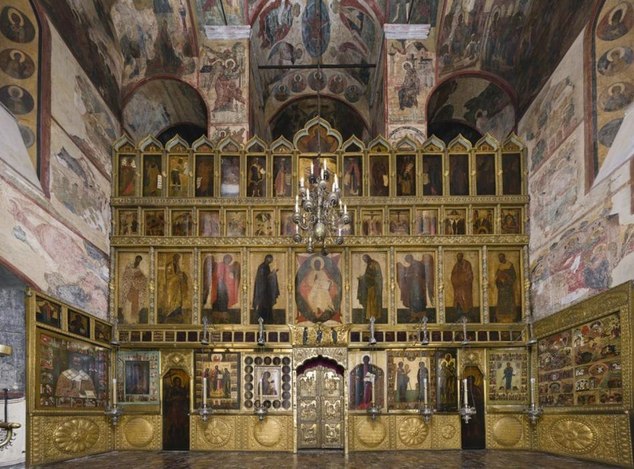
Word of the day - Not to be mistaken for "Word de jour."Iconostasis.
The Canadian voice in my audioguide at the Moscow kremlin yesterday said "turn to face the iconostasis" when I was in one of the cathedrals. It was obvious what he meant, but I'd never heard it before.
Wiki: "In Eastern Christianity, an iconostasis (plural: iconostases) is a wall of icons and religious paintings, separating the nave from the sanctuary in a church."
Fans of Tarkovsky may be interested to learn that some of the icons and frescoes in these kremlin churches were done by Andrei Rublev and Theophanes the Greek.
-
Marx and the Serious Question of Private PropertyPeople, please stop posting here about moderator actions. We have a feedback category.
By the way, it's our normal practice to delete any response to a deleted post.
Carry on with the Marx :cool: -
Why were my threads on Computer Psychology deleted?I don't even know who the moderators are half the time. Is there a listing somewhere that members should be referencing? — Hippyhead
https://thephilosophyforum.com/profile/members/staff -
BanningsDenying the antecedent, or at the very least a non sequitur. — Michael
In fact, I was warning against that fallacy. If I admit to sometimes judging posts or posters that I agree with as good, simply because I agree with them (which was implied), then it's reasonable for me to make it explicit that if I don't agree with them, I might still think they're good. Humour demanded a level of subtlety that it appears you, Michael, cannot reach. :wink: -
A reason should be given when a thread is movedThanks for the info on a question I didn't ask. — Professor Death
It wasn't for you. -
A reason should be given when a thread is movedIn case it has to stated explicitly: this is not a Russian website, it's in a foreign language, and it's a philosophy forum with no mass appeal, and certainly not in Russia. The Russian authorities don't care about us and I'm happy for people here to criticize the Russian government if they want to.
Tzeentch made some good points and you were too lazy, rude, or ignorant to discuss them. -
A reason should be given when a thread is movedI don't see why. You're clearly on a war footing already, and it's clouding your judgment.
I serve the TPF members, not the Russian state. -
A reason should be given when a thread is movedYeh, they only allow me to keep this forum going on the condition that I stamp out any criticism of Putin or the glorious FSB, defenders of the Motherland.
-
A reason should be given when a thread is movedI moved it to the Lounge because it's a low quality or informal discussion. The one interesting post, from Tzeentch, gained only a stupid response.
To answer your point: that's fair, but because it's not automated it doesn't always happen. -
Currently ReadingAgain no philosophy, and again quite Russia-centric.
Recent highlights:
Oliver Twist, Charles Dickens
The characters are grotesques or ciphers: rather than developing, they're only revealed, more or less gradually, and we know that how they respond to circumstances is the only way they ever could. The plot relies on several incredible coincidences. The satirical irony is laid on far too thick, even though we can share his anger and righteousness. Despite his progressive treatment of social issues, and despite his ironic targeting of snobbery, he's still a class-bound snob himself. And the repeated contemptuous descriptions of "the Jew" make for uncomfortable reading (I read somewhere that some of Dickens' Jewish friends complained about this during its serialization, and that he removed the phrase "the Jew" after a certain point in the finished book, but at least in my edition it's there up to the end).
But aside from all that, it's great. The intensity and distinctness of the characters (unchanging as they may be), of the most dramatic scenes, and of his scene-setting descriptions is brilliant. And it's great fun.
War and Peace, Lev Tolstoy
I read it straight after the Dickens and had grouped the two books together in my mind as classic mid-nineteenth century novels, but of course, Tolstoy could hardly be more different. War and Peace feels much closer to my world and my life, and it's more real. The characters develop, change their minds, behave unpredictably. The war bits are much more realistic than I expected, intentionally emphasizing the cowardice and the chaos, the comical errors, the blood and guts, the self-serving lies of the officers, and the basic uselessness of orders and tactics. Tolstoy has some persuasive historico-philosophical arguments and manages to weave them into the plot (except for the final epilogue, which is a repetitive and anti-climactic essay).
Also it's great fun to read. It's full of energy and a passionate love of life and the world--not what you get from Tolstoy's contemporary Dostoevsky.
All Hell Let Loose, Max Hastings
To correct my ignorance of the Second World War--I didn't have a good idea of what happened and when--and especially to see how the Soviet Union fitted in to everything else that was happening, I wanted a one-volume overview, and this turned out to be a pretty good choice. Knowing that Hastings is politically a moderate conservative, hovering around the centre-right, I was surprised at how devastatingly critical he is of the British war effort, not only from a strategic-military point of view but also morally. He shows great sensitivity to the experiences of ordinary soldiers and civilians in all the countries involved, and doesn't hold back when smashing apart the myths of heroism and sacrifice that have been part of the Allied story ever since 1945 (not that he claims heroism and sacrifice were non-existent). One of the unique features of the book is that almost every paragraph contains quotes from archived letters written by people at all levels of society and the military.
Next:
Anna Karenina, Lev Tolstoy. I know some people say this is the best novel ever, but I can't help but expect it to be a let-down after W&P.
A Hero of Our Time, Mikhail Lermontov. I confess I got this partly because I discovered that his ancestors were the Learmonths from Scotland. Maybe I'm homesick or something.
The Unconsoled, Kazuo Ishiguro. I read this when it was first published, when I was in my early twenties. It creeped me out, I didn't get it, but I was fascinated. Now that I'm older and it feels like time is running out, it'll make more sense.
Iron Curtain: The Crushing of Eastern Europe 1944-56, Anne Applebaum. For me this is going to be a kind of sequel to the WW2 book.
Red Famine: Stalin's War on Ukraine, Anne Applebaum. I mentioned to a Russian friend that I was going to read this book and she impatiently said "It wasn't just the Ukrainians who suffered under Stalin! It was us too!" :roll:
War and Peace again, because it was so good. -
I want to read many books but life is shortInstead of many, why not read a few? It's not all or nothing.
-
A few forum statsAlso it might just be me but all I see is this: — Michael
A direct link to the image gives a 403 "Your client does not have permission to get URL..." — Michael
Me too. Maybe only you can see them @SophistiCat. -
Why is mental health not taken seriouslyThen is blame is always a mistake, and is there no such thing as agency, which would seem to follow?
Jamal
Start FollowingSend a Message
- Other sites we like
- Social media
- Terms of Service
- Sign In
- Created with PlushForums
- © 2026 The Philosophy Forum